The current HIPAA Security Rule summary from HHS describes risk analysis, access control, audit controls and authentication as safeguards for regulated entities handling electronic protected health information. A patient portal sits where those safeguards meet a difficult application question: who is allowed to see or change a specific record, through which identity, and for how long? A useful penetration test must prove those decisions in the actual portal workflows rather than stop after a login scan.
Quick answer. Scope a patient portal penetration test around patient and proxy identities, clinical and support access, record and message ownership, downloads, notifications, and the APIs that serve those functions. If the portal uses SMART on FHIR, add the app launch, patient context and granted-scope boundary. Stingrai's web application testing covers authenticated roles and broken authorization; the statement of work should specify the portal's policy and safe synthetic records before testing starts.
This is a portal buying guide, not another general healthcare or FHIR API checklist. A FHIR API penetration test centers on resource access through a FHIR server. An Epic SMART app go-live assessment centers on a third-party app and its customer activation. A patient portal assessment follows the patient's actual journey through registration, proxy delegation, results, messages and downloads, whether or not it uses FHIR. The buyer needs a scope that reflects that journey and the underlying identity policy.
Define the portal and its policy owner
“Patient portal” can mean a provider's application, a health plan's member site, a vendor-hosted front end or a collection of EHR functions presented through one sign-in. Do not let that label stand in for an inventory. List the browser and mobile entry points, backend API hosts, identity provider, document service, messaging service and any connected EHR or FHIR server. For each component, name who operates it and who can authorize a test. A provider's permission to test its portal is not permission to probe another organization's infrastructure.
Then identify the policies the portal is supposed to enforce. Which patient can see a lab result? Who can request a prescription renewal? Which proxy may act for a patient, and for which categories of data? Can a clinician send a message to a patient from the portal, or does a back-office system originate it? Which staff role can correct a demographic field? These are examples of questions to settle with the product and privacy owners. The penetration tester should not invent the organization's consent or disclosure policy during the engagement.
The policy model needs time as well as identity. Access may begin when a registration is verified, change when a proxy request is approved and end when representation is revoked. A record may not be visible until a release condition is met. A message may move from draft to sent to archived. Include representative state transitions, because a static “patient versus admin” matrix cannot demonstrate what happens at the moment a right appears or disappears.
For a covered entity or business associate, align this work with its risk analysis. HHS explains that the Security Rule is flexible and technology neutral; it calls for an accurate and thorough assessment of risks and vulnerabilities to ePHI, but it does not prescribe a named portal pentest method. A penetration test supplies observed technical evidence for that broader program. The buyer should decide which portal risks matter most and put those boundaries into the statement of work.
Start with identity proofing and account recovery
The portal's first trust decision is the link between a person and a patient record. A test should cover registration, invitation, account linking, password reset, multi-factor recovery if offered, session expiry and logout. The buyer must specify the intended verification steps and supply synthetic patient identities that exercise both an approved and a denied enrollment. The provider can then test whether a user can reach another record through an incomplete or incorrectly linked account without handling real patient details.
Account recovery deserves its own scope row because it can be managed by a different team from the portal's normal authentication. Ask who can start recovery, which channels receive a code or link, how a staff override works and what happens to active sessions afterward. A valid login test says little about a recovery path that can transfer account control. The exercise should observe both the expected successful recovery and the rejected case, with a safe proof threshold and no real patient contact.
Where the portal uses a centralized identity provider, the SOW should name the federated sign-in path and the portal's own session and authorization checks. A successful identity-provider token establishes the caller's identity under the agreed configuration; it does not by itself prove the caller may open every patient object. OWASP API1:2023 places the object-level decision on each relevant request. The test should compare a patient viewing their own data with the same user attempting the equivalent action on a controlled peer record.
The report should describe which stage was tested. “Authentication passed” is too broad if the team tested sign-in but not enrollment, recovery or session invalidation. A useful coverage table has an identity lifecycle row for each role in scope, the expected decision, and the observed outcome. A path that could not be reached because a third-party service denied test access should be listed as excluded.
Treat proxy and personal-representative access as a separate product
Proxy access is not merely another login. A portal may let a parent, caregiver, guardian or other representative act for a patient, and the rights may differ by law, care context and organizational policy. HHS's personal-representative FAQ says a covered entity must have reasonable procedures to verify identity and authority, when otherwise unknown, before granting access to PHI. A separate HHS family-access FAQ explains that representative authority generally depends on applicable state law. The tester should evaluate the portal's documented implementation, not make a legal determination.
Provide controlled patient and proxy accounts with a clearly documented relationship and permitted actions. Include a denied relationship, a pending request, an approved grant and a revoked grant if those states exist in the product. The SOW should say whether a proxy can view the entire chart, message clinicians, download records, make appointments or manage billing. A test should compare the policy with the actual API and UI result for each selected action. It should also check whether the proxy can switch patients without retaining data from the previous context.
Revocation is an important acceptance criterion. Ask which tokens, browser sessions, mobile sessions and cached views should stop working when a grant ends. The provider should record the before and after result without publishing patient details. A proxy's former access to one patient should not become a permanent property of the account merely because an earlier session or download link remains open, unless the product explicitly and lawfully permits that result. The test reports the observed behavior against the buyer's policy.
Do not bundle all minors or all caregivers into one generic role. Policies may differ. The buyer can select representative lawful test cases and supply the expected access table without exposing real care relationships. If the organization cannot provide an authoritative policy for a role, that is a scoping issue to settle before anyone labels a technical result a vulnerability.
Verify record visibility at every route
A portal may display diagnoses, results, notes, medications, appointments, bills, messages and uploaded documents. The buyer should identify the object types and release rules that matter. The test must check more than the main record screen: search results, thumbnails, previews, direct download links, export jobs, notification deep links, mobile API responses and cached views can each carry data. OWASP API1 addresses whether a caller may access a particular object; OWASP API3 addresses whether the object response reveals or accepts properties beyond that caller's rights.
Use fabricated records with clear ownership labels known to the tester. For example, one synthetic patient can own a result and another synthetic patient a message. The specific fixtures should match the actual system and avoid live PHI. The provider should attempt the same ordinary view, download and API action under the owning patient, an unrelated patient, a permitted proxy and an unapproved proxy. A denied response should be checked for side effects and partial data disclosure, not counted as secure solely because a page did not render.
Some data has release timing. A result may be visible only after a specific event, or a note may have a different policy from a bill. The buyer should write those expectations down. Otherwise the tester may wrongly report a legitimate early release as a security issue or miss a disclosure that happened through a background download route. A useful finding ties the actor, object, state, expected decision and actual result together.
The portal may generate a PDF, image or bulk export. Include the job creation, job listing, finished file retrieval and cleanup path in scope where those features exist. A secure detail page does not prove that a generated file obeys the same permission rule. This is especially important if the file service or storage layer is operated by a different team. A good report names the system boundary and the precise request or workflow that demonstrated it.
Include messages, attachments and notifications
Patient messaging is an access-control workflow as well as a communication feature. Identify who may initiate a message, which care team or mailbox receives it, what attachments are permitted and who may view an existing thread. If the portal offers delegated messaging, define whether the proxy's identity should appear separately from the patient's. The tester can use fabricated conversations to observe whether a user sees only their own threads and whether an expired proxy can still read or reply.
Notifications can disclose information without showing the full portal record. The test should include the account preferences, email or push templates and deep links that the organization owns. The buyer should state what content is allowed in each channel and what happens when a notification is opened after a role change or logout. Testing does not require sending messages to real patients. Use a controlled inbox or device and redact test artifacts before reporting.
Uploads and attachments introduce another boundary. A patient may upload a document, staff may review it, and a clinician may attach a response. Ask whether the scope includes file ownership, preview, download and deletion, as well as the separate storage service or worker that handles those actions. If content inspection or malware handling is in scope, define safe file types and the proof threshold. The report should not include a live medical record or a working malicious file.
These workflows matter to procurement because one quote may cover only the portal's public pages, while another includes the authenticated messages and document service. Have both bidders list the components and roles they will actually exercise. “Patient portal tested” is not a useful description of coverage if the most sensitive feature was excluded.
Add SMART on FHIR only where the architecture uses it
Some portals launch connected applications or read data through SMART on FHIR; others do not. Where it exists, HL7 SMART App Launch v2.2.0 distinguishes patient-level scopes such as patient/.rs, user-level scopes such as user/.cruds and launch context such as launch/patient. Those are technical access contracts. The test should establish which scopes the portal or connected app requests, which ones the authorization server grants, and which patient context the resulting token represents.
Do not confuse a token's scope with permission to see a particular record. The application and FHIR resource server still need to apply the granted scope, patient context and underlying user rights to each request. The SOW should include a controlled patient context and a denied one, along with the expected resource types and the app's registered redirect path. HL7's launch guide explains how an app discovers authorization endpoints and obtains launch context; the buyer can use that flow to identify the actual components a pentest must touch.
An EHR-launch path and a standalone app launch may differ. If both are used, ask the provider to test both or to state which one is excluded. If a portal has no SMART integration, omit this row and spend time on the real record, proxy and messaging boundaries. This prevents a fashionable protocol checklist from displacing the patient access questions the portal actually presents.
Access to a vendor-operated EHR or third-party app requires separate authorization. A portal owner can supply its configuration, test patient and permitted integration path, but a pentest should not probe an external platform beyond the agreed test contract. The final report should distinguish a portal defect from an integration constraint and from a control that could not be observed.
Test staff and support paths without assuming every broad role is wrong
Staff may need access that patients do not have: registration correction, proxy review, message triage, result release, billing support or account recovery. Those functions should be listed by actual role and expected purpose. A penetration test should check that an ordinary patient cannot call staff functions and that a lower-privilege staff account cannot perform a higher-privilege action merely by calling the API directly. OWASP API5:2023 describes this as function-level authorization, distinct from object ownership.
Broad support access may be an intentional operational design. The report must compare observed access with the approved policy rather than automatically call every staff view a flaw. Ask the buyer to define whether support can view clinical content, only demographics, a limited case, or none of these. Include the grant and termination conditions. If access is time limited, test before, during and after the approved period using synthetic records. If staff actions should be logged, request a redacted audit trace as a separate evidence item.
Some workflows cross from the portal to a call center or EHR administration tool. The quote should say whether those tools are in scope. A portal-only test can still inspect how a support action appears to the patient application, but it cannot establish security of a separate internal console without access and authorization. State that limit early so procurement can decide whether to buy a broader engagement.
Require safe test data and a clear stop rule
A healthcare penetration test can be meaningful without reading real patient records. Create synthetic patients, fabricated clinical observations, test messages and controlled proxy relationships. Assign each fixture an owner and expected visibility rule. If a production environment is necessary, map the test accounts to records that cannot be mistaken for care information and agree on the window, contacts and cleanup procedure with the clinical and privacy teams.
The rules of engagement should exclude patient harm and operational disruption. Specify whether testers may submit appointments or messages, whether notifications can be sent, whether integrations may be called, and which actions require a control contact to be present. The proof threshold should let the provider validate an access-control failure with a fabricated record and then stop. Broad enumeration of real charts is neither necessary nor appropriate to establish the issue.
Do not put real patient names, dates, medical histories or credentials in a report or public discussion. A redacted request, synthetic object identifier and logged decision can show the technical result. The buyer should agree on secure evidence transfer and retention before the first test, and the provider should identify any third-party environment that cannot be included under the current authorization.
This operational detail affects quote comparability. A test that includes proxy lifecycle and EHR integration but requires staging data creation has different preparation work from a quick unauthenticated scan. Both sides should see that effort in the statement of work rather than discover it after an audit deadline is set.
Give bidders a boundary and evidence matrix
The matrix below is an editorial starting point, not a rule every portal must implement. Remove absent features and add the organization-specific access states that matter. Give the same version to every bidder so each proposal can be compared against a common definition of “patient portal.”
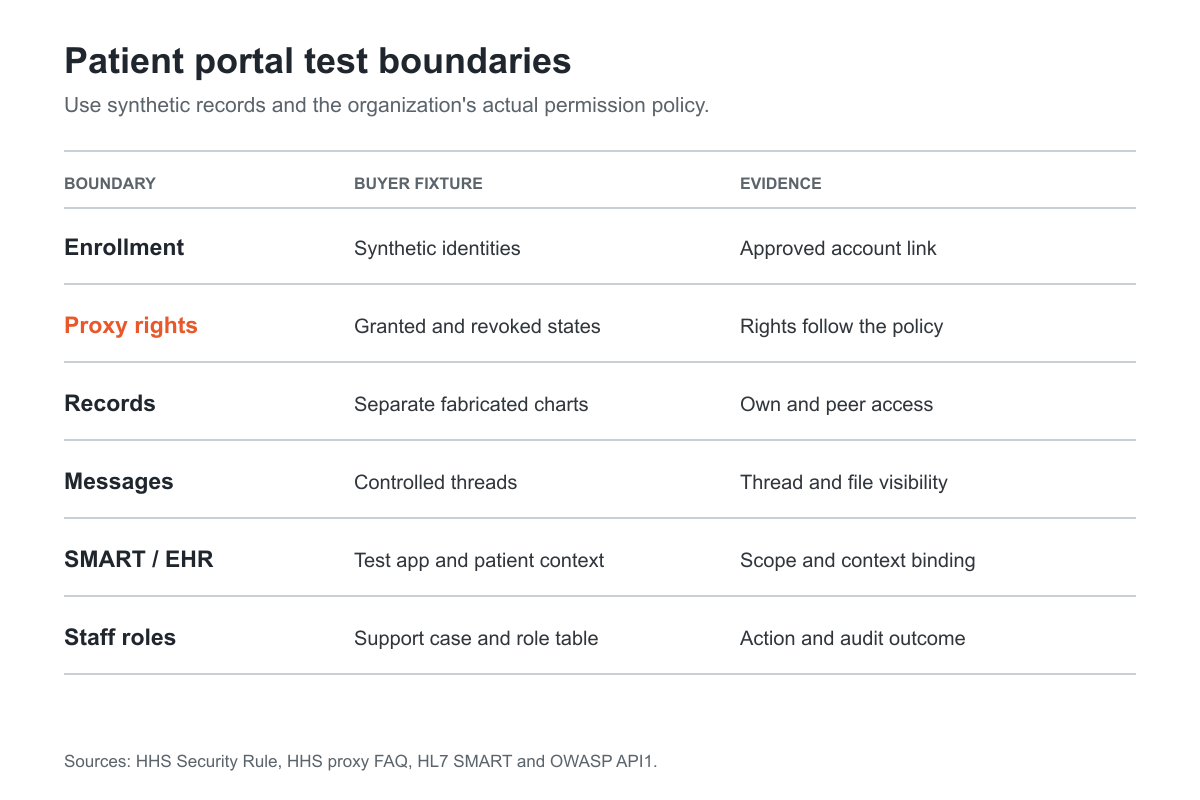
Figure 1: An editorial patient portal scope matrix for synthetic fixtures and reviewable outcomes. Sources: HHS current Security Rule summary, HHS personal-representative FAQ, HL7 SMART App Launch, and OWASP API1.
Boundary | Buyer supplies | Provider demonstrates |
|---|---|---|
Enrollment | Synthetic patient identities and recovery rules | Account creation and recovery follow the stated identity policy |
Proxy grant | Approved, pending, denied and revoked fixture states | Rights apply only to the authorized relationship and period |
Records | Separate fabricated charts and release rules | Allowed and denied view, search, download and API access |
Messages | Controlled threads, roles and test inbox | Thread and attachment visibility match the policy |
SMART or EHR | Test app, scope grant and patient context if used | Token and context map to the expected data boundary |
Staff access | Role table, approved support case and log owner | Staff actions and audit records match the agreed design |
Ask for a report that returns this matrix with observed outcomes, not a checklist tick. For every row, the buyer should know which environment and build were tested, which identities were used, whether the expected denial occurred and what evidence supports the conclusion. If a row was not reached, it should say “excluded” with a reason and an owner for deciding whether to test it later.
Compare quotes on coverage and evidence
Two providers can both promise an OWASP-aligned portal pentest while offering very different work. Ask each to list authenticated roles, proxy states, object types, APIs, mobile clients, staff tools, EHR integrations, environments, testing days, report artifacts and retest terms. Compare whether they test only UI workflows or direct API requests as well. A portal's most consequential error may look like a valid API call from the wrong patient context, so role-aware testing deserves explicit time.
The provider should explain how findings will be validated and how the report will avoid actual ePHI. Request a redacted proof of concept, expected and observed policy, severity rationale tied to patient impact, remediation guidance and a retest record. If the test supports a HIPAA security program, the evidence should help the organization's risk and control owners understand the technical result; it should not be described as a certification or an audit decision.
Testing frequency follows changes and risk. Retest a confirmed defect after a fix. Revisit the affected boundary when the portal adds a proxy mode, changes result-release logic, migrates identity, launches a mobile client or connects a new EHR app. A one-time or annual baseline can be paired with a continuous program for frequently changing flows. This is a buyer schedule to discuss, not a fixed cadence asserted by the HIPAA Security Rule.
Before signing, ask who will make the synthetic fixtures and who can authorize third-party integration testing. A well-written proposal names these prerequisites. The cheapest quote may assume one patient account and no proxy or EHR access, which cannot answer the buyer's highest-risk questions.
Where Stingrai fits
Stingrai is a proud CREST-accredited penetration testing service provider founded in Toronto in 2021. Its web application service tests authenticated workflows, role and object authorization, and the APIs behind a portal. Its API penetration testing service tests REST, GraphQL, gRPC and SOAP interfaces directly across the roles and tenants named in scope. Two named penetration testers from a team holding OSCE³, OSWE, OSEP, CREST CRT and CISSP certifications work on human-led engagements, with findings reviewed by the team lead and an engagement partner.
For a patient portal, start with a product-owned permission table, controlled patient and proxy identities, fabricated records, the EHR integration contract and an authorized test environment. Stingrai's confirmed findings, remediation guidance and retest results can support the organization's HIPAA security program and provide evidence for its audit preparation. The team offers one-time or annual tests and continuous programs. Book a discovery call to agree the access boundaries before requesting a quote.
Frequently Asked Questions
What should a patient portal penetration test include?
A patient portal penetration test should include the patient and proxy identity lifecycle, record and message ownership, downloads, notifications, relevant staff functions and the APIs behind them. Add SMART on FHIR and EHR launch paths only when the portal uses them. HHS's current Security Rule summary identifies access control, audit controls and authentication as relevant safeguards for regulated entities handling ePHI.
Does HIPAA require a patient portal penetration test?
The current HIPAA Security Rule requires regulated entities to assess risks and vulnerabilities to ePHI and implement reasonable and appropriate safeguards. HHS describes the rule as flexible and technology neutral, without prescribing a named portal penetration test method. A scoped penetration test can produce technical evidence for the organization's risk analysis and security program.
How should proxy access be tested?
Use controlled patient and representative accounts with a written permission table. Compare pending, approved, denied and revoked states where they exist, then check both the portal UI and direct APIs for the actions the proxy may perform. The organization's privacy and legal owners should define the lawful policy; the test should report whether the technology follows it.
Can a portal test use synthetic records?
Yes. Fabricated patients, results, messages and proxy relationships allow a provider to demonstrate allowed and denied access without collecting real patient data. If the production environment is involved, the buyer should approve test records, contact owners, proof limits, cleanup and secure evidence handling before work begins.
Does every patient portal need SMART on FHIR testing?
No. SMART on FHIR is relevant when the portal or a connected app actually uses SMART launch, scopes and patient context. If no such integration exists, the test should focus on the real identity, record, proxy and communication boundaries instead.
What should a healthcare buyer ask for in the report?
Ask for the tested environment and build, role and proxy fixtures, a boundary coverage matrix, allowed and denied outcomes, redacted proof for confirmed findings, exclusions, remediation owners and a retest result. The report should distinguish a tested denial from a path that was not included.
How should two portal pentest quotes be compared?
Give both bidders the same portal inventory and permission table. Compare patient, proxy and staff roles, record types, messages, downloads, APIs, SMART or EHR integrations, safe test data, evidence format and retest terms. A quote based on one patient login cannot demonstrate the proxy and cross-record boundaries.
When should the portal be tested again?
Retest confirmed findings after remediation and revisit the affected boundary when identity, proxy rights, release rules, mobile access or EHR integrations change. Choose a one-time or annual baseline and a continuous cadence according to release frequency and risk rather than assigning a universal HIPAA testing interval.
Related reading
References
HHS: Summary of the HIPAA Security Rule. Current rule overview, risk analysis and technical safeguards.
HHS: Personal representative verification FAQ. Identity and authority verification before access.
HHS: Family member access FAQ. Personal-representative authority and applicable law.
HL7: SMART App Launch v2.2.0 scopes and context. Patient and user scopes and launch context.
HL7: SMART App Launch authorization. Conditional integration path.
OWASP API1:2023 Broken Object Level Authorization and API3:2023 Broken Object Property Level Authorization. Resource and property permissions.
Stingrai web application penetration testing and API penetration testing. Service scope.
Talk to Stingrai
Share the portal's roles, proxy policy, synthetic fixtures and EHR boundaries so the team can scope a safe assessment. Get a Quote or book a free discovery call.