NetSPI and Synack completed their merger on 5 October 2026, according to Synack's merger page, after announcing a definitive agreement on 2 September 2026. NetSPI's own merger page says the deal "officially closed in October 2026". Existing contracts carry on unchanged, but neither company has published a combined price list, product or integration roadmap.
Quick answer. The best NetSPI alternatives in 2026 are Stingrai, NCC Group, Pen Test Partners, Cobalt, Praetorian, Sprocket Security, Schellman and TrustedSec. Stingrai leads for buyers who want a CREST-accredited firm headquartered in Canada, two named penetration testers on every human-led engagement and published prices: the Autonomous Pentest at US$3,000 and the Hybrid Pentest at US$6,800 per assessment, each for one web application and associated APIs, as one-time annual tests or continuous programs. NCC Group and Pen Test Partners come closest to NetSPI's hardware and OT range. NetSPI itself remains the better fit for mainframe and ATM testing, which none of the alternatives' pages read for this guide lists.
The NetSPI and Synack merger on 15 October 2026
Date | What happened | Source |
|---|---|---|
2 September 2026 | Definitive agreement announced; combined revenue "well over $200 million"; close expected in October 2026 | |
5 October 2026 | Merger completed | |
7 October 2026 | Synack's copy of the release updated: "The merger between NetSPI and Synack was completed on October 5, 2026." | |
15 October 2026 | NetSPI's merger page: "officially closed in October 2026"; its newsroom copy of the release still reads "expected to close" |
NetSPI says customers "should continue working with their existing teams under their current agreements, services and platforms". Synack says each company "continues to deliver its own platform, services and agreements" and that "A combined platform, contract or purchasing process is not available today". Not yet known: "No combined SKU, pricing or packaging has been announced" (Synack), and "A product integration roadmap has not yet been published" (NetSPI's October 2026 brief).
Synack's FedRAMP Moderate authorization "applies specifically to the Synack platform" and "does not extend to NetSPI products or any future combined offering" (NetSPI's merger page). And KKR, whose representatives sit on NetSPI's board, "will support the combined company's growth plan" (NetSPI's release).
What NetSPI sells in 2026
NetSPI is headquartered in Minneapolis and has "led security innovation since its inception in 2001", with "350+ experts, and 50+ pentesting services" (netspi.com). Its contact page lists offices in Portland, Kansas City, Toronto, London and Pune.
Penetration testing as a service: PTaaS puts "350+ in-house pentesters" to work "as a true extension of your team", point-in-time or continuous, across applications, networks, cloud and AI, plus mainframes, hardware, automotive systems, medical devices, IoT, ATMs and OT. In July 2026 NetSPI added continuous web application, AI and internal network testing.
Platform: NetSPI describes its platform as pentesting as a service, attack surface management and breach and attack simulation as a service. Attack surface management runs weekly external discovery and AWS and Azure scans plus dark web and look-alike domain monitoring, and Detective Controls Testing measures endpoint, network, SIEM and MSSP detection against attack simulations.
Credentials: CREST lists NetSPI for Penetration Testing and Threat Led Penetration Testing after 10 years of membership, and its trust page adds SOC 2 Type 2, CBEST and Cyber Essentials Plus, with the platform on AWS.
Pricing is not published. No price figure appears on netspi.com. NetSPI's AWS Marketplace listing has one line, platform access at US$1.00 for a 12-month contract with pentest hours not included, and sends custom pricing to a private offer. Synack, now part of the same company, still lists on its pricing page a Sara Pentest from US$4,181 and a standard pentest from US$10,283, with the Synack Platform a separate, required line item.
Why buyers look at NetSPI alternatives
A program-sized offer with no published price. NetSPI's platform page says it is "designed for modern enterprises managing ongoing pentesting programs", though it also adapts to "specialized testing projects at smaller scale". With no figure published, a team with one application and an audit date must start a sales cycle to compare.
Platform-first delivery. Testing sits on one platform beside attack surface management, breach and attack simulation and prioritization, which a buyer who wants one scoped test may not need.
Contracting while the integration is unannounced. Agreements continue, but no combined SKU, pricing, contract or roadmap exists yet; ask which entity signs, which platform the work lands on and what changes at renewal.
Named-tester continuity. NetSPI's pages describe 350+ in-house pentesters and "real-time collaboration with our testers"; the pages read for this guide do not say that named testers are assigned to each engagement.
Canadian contracting and data residency. NetSPI lists a Toronto office, and the copyright line on its site names NetSPI LLC. Its public pages say the platform runs on AWS but do not name a hosting region, so buyers with residency clauses should ask where findings and reports are stored.
How this shortlist was built
Ten candidate firms were checked on their own websites and on the CREST Marketplace on 15 and 16 October 2026. Two gates applied to all ten, pass or fail: the firm's own site sells human-led penetration testing of applications and networks, and the firm holds CREST Penetration Testing accreditation, as NetSPI does. Eight passed both.
Each of the eight was then scored on five criteria from the buyer situations above, counting only what its own pages state: a published price, named testers for each engagement, an office in Canada, specialist coverage of hardware, IoT, OT or vehicle systems, and both one-time and continuous delivery. Firms are ordered by the number of criteria met. Ties go to more CREST accreditations and specialisms, then longer CREST membership, then the larger headcount band on the firm's CREST entry.
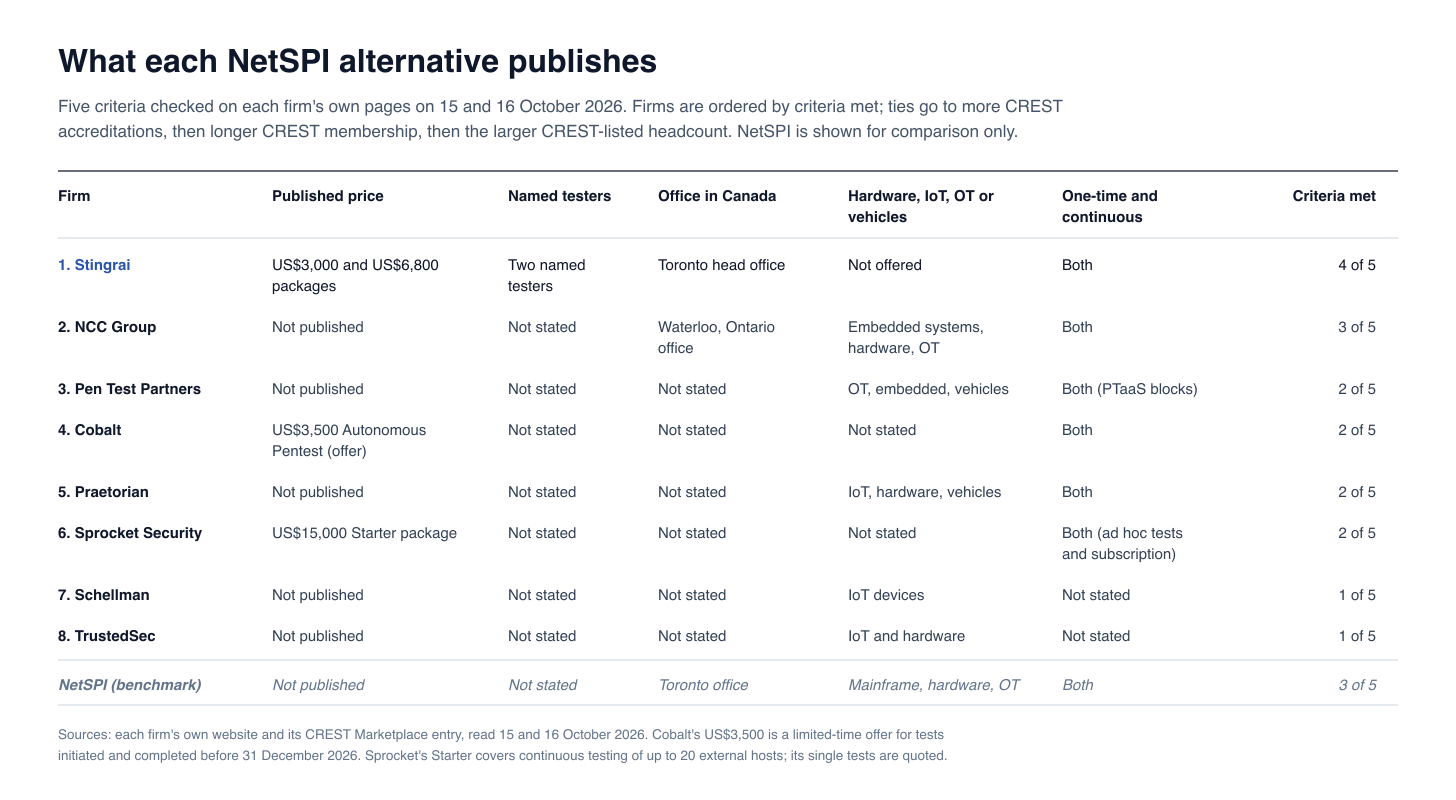
Figure 1: What each NetSPI alternative publishes, read on 15 and 16 October 2026. Source: each firm's own website and its CREST Marketplace entry.
At a glance: the best NetSPI alternatives in 2026
Rank | Firm | Head office | Published price | Best for |
|---|---|---|---|---|
1 | Stingrai | Toronto, Canada | US$3,000 and US$6,800 packages for one web application and associated APIs | Named testers, a published price, a Canadian entity |
2 | NCC Group | Manchester, UK (Waterloo, Ontario office) | Not published | NetSPI-like breadth with a Canadian office |
3 | Pen Test Partners | Buckingham, UK (New York office) | Not published | OT, embedded and transport systems |
4 | Cobalt | Boston, US | US$3,500 per Autonomous Pentest (limited-time offer) | Platform-led tests with fast starts |
5 | Praetorian | Austin, US | Not published | IoT, hardware and automotive |
6 | Sprocket Security | Madison, Wisconsin, US | US$15,000 Starter package | Continuous testing, or single tests on request |
7 | Schellman | Tampa, US | Not published | FedRAMP and CMMC assessment programs |
8 | TrustedSec | Fairlawn, Ohio, US | Not published | Consultant-led testing with a retest |
The 8 best NetSPI alternatives in 2026
1. Stingrai
Stingrai is a global CREST-accredited penetration testing services company founded in Toronto, Canada in 2021, trusted by companies from startups to enterprises to meet audit requirements for SOC 2, ISO 27001, CMMC, PCI DSS and HIPAA. OSCE³, OSWE, OSEP, CREST CRT certified pentesters, who are also world-class security researchers and bug bounty hunters. Choose from fully human-led or hybrid (AI agents plus human penetration testers) engagements across web, API, mobile, AI and LLM, cloud, network, Active Directory and social engineering penetration tests and red team engagements.
For a team leaving a platform program, the difference is who tests and what is published. Two named penetration testers from a team holding OSCE³, OSWE, OSEP, CREST CRT and CISSP certifications run every human-led engagement, every finding is reviewed by the team lead and an engagement partner (PTaaS), and the team has published 18 CVEs (Snipe). Stingrai Inc. holds firm-level CREST accreditation and is headquartered in Toronto with a London, UK office, so Canadian buyers can contract with a Toronto-headquartered company.
Every confirmed finding, at every severity, is posted to the PTaaS platform the same day it is confirmed, with a working proof of concept and live chat with the assigned testers. Retesting is included, and every human-led and hybrid report ships with an attestation letter and a verified badge, evidence for SOC 2, ISO 27001, PCI DSS and HIPAA programs. Engagements run as one-time annual tests or continuous programs.
Snipe, Stingrai's autonomous agent, covers the web application package only. The Autonomous Pentest is US$3,000 per assessment or US$650 a month, and the Hybrid Pentest, in which Snipe and the penetration testers test together throughout, is US$6,800 or US$1,275 a month, each for one web application and associated APIs (monthly prices are on a 12-month plan). Everything else is quoted through Get a Quote.
Limits: Stingrai does not test mainframes, hardware, IoT or OT. Best for: regulated buyers who want named testers, a published price and a Canadian contracting entity.
2. NCC Group
Manchester, UK (global head office), with a Chicago regional head office and an office in Waterloo, Ontario (locations). NCC Group sells point-in-time tests and continuous penetration testing across web applications, APIs, web services and mobile applications, run as "a seamless dedicated extension of your security team", plus manual, autonomous and hybrid network testing. It also tests hardware and embedded systems and OT equipment and runs attack simulation, on "fixed costs, day rates, and continuous models". CREST lists ten accreditations and specialisms, including Threat Led Penetration Testing. Published pricing: not published. Best for: NetSPI-like breadth with a Canadian office.
3. Pen Test Partners
Buckingham, UK (Pen Test Partners LLP), with a New York office (Pen Test Partners Inc), testing since 2010 (about). It provides "CHECK and CREST-accredited penetration testing across applications, infrastructure, cloud environments, APIs, mobile apps, and connected systems", with specialist work in OT, embedded systems, maritime, aviation and automotive security. Its PTaaS is "a subscription based, tiered service" for testing changes, billed in half-day blocks, beside full tests. CREST lists seven accreditations, including Threat Led Penetration Testing. Published pricing: not published. Best for: connected products and transport systems.
4. Cobalt
Boston, US (Cobalt Labs Inc.), with an Oxford, UK office. PTaaS across web applications, APIs, AI and LLM systems, networks and cloud, plus red teaming, secure code review and a continuous pentesting program, delivered by the Cobalt Core, "a network of 500+ vetted security experts" drawn from a freelance community (cobalt.io). One credit equals 8 hours of testing, and tests start within 3, 2 or 1 business days by tier (start times vary by engagement). Published pricing: US$3,500 per Cobalt Autonomous Pentest, a limited-time offer for tests initiated and completed before 31 December 2026; credit packages are quoted (pricing). Best for: platform-led testing with fast starts.
5. Praetorian
Austin, Texas, US. Praetorian's engineers test applications, cloud, networks and Active Directory, AI and LLM systems, IoT and hardware, and in-vehicle networks; its penetration testing page states "Every finding verified by an expert" and that the team will "re-test, and verify vulnerabilities are closed". It sells "a single assessment or a continuous testing program", the latter on its Guard platform. Published pricing: not published. Best for: embedded, automotive and AI systems beside conventional scope.
6. Sprocket Security
Madison, Wisconsin, US. Continuous penetration testing sold as a subscription (pricing): the Starter package lists US$15,000 for continuous testing of up to 20 external hosts with unlimited retests, internal network testing is a US$13,000 add-on, and custom scopes add web application and social engineering testing. Its Timeboxed Security Services page also sells single tests, offering "all of our services ad hoc". Best for: continuous testing on a published budget, with one-off tests available.
7. Schellman
Tampa, Florida, US. A compliance and attestation firm whose penetration testing covers applications, networks, mobile, cloud, IoT devices, social engineering, red and purple teaming and Active Directory. Schellman is "an accredited 3PAO in accordance with the FedRAMP requirements" and one of the first CMMC C3PAOs. A director scopes and contracts each test, a manager leads it and a penetration tester performs it, and a sample report is free to download. Published pricing: not published. Best for: cloud providers in FedRAMP or CMMC assessments.
8. TrustedSec
Fairlawn, Ohio, US, founded by David Kennedy. Consultant-led penetration testing runs from scoping through exploitation and a report the team walks you through, ending in "Validation Testing", a retest after fixes. TrustedSec also lists IoT and hardware, cloud and LLM assessments and red and purple teaming. Published pricing: not published. Best for: consultant-led testing with a retest.
Also considered
Coalfire sells threat-informed penetration testing, red teaming and PCI, HIPAA and FedRAMP compliance testing through its DivisionHex practice, with an OnDemand program whose funds roll over year to year; its offensive security service pages, read on 15 October 2026, do not name application or network test types, so it missed the first gate. Raxis sells point-in-time and year-round testing, but no CREST Marketplace entry was found for it.
Stingrai vs NetSPI: side by side
NetSPI is compared here, not ranked.
Stingrai | NetSPI | |
|---|---|---|
Head office | Toronto, Canada, with a London, UK office | Minneapolis, US, with offices including Toronto |
Delivery model | Human-led testing; Hybrid and Autonomous packages for one web application and associated APIs | 350+ in-house pentesters through the NetSPI Platform, with attack surface management and breach and attack simulation |
Published pricing | US$3,000 or US$650 a month (Autonomous); US$6,800 or US$1,275 a month (Hybrid) | Not published; AWS Marketplace lists platform access only, with custom pricing by private offer |
Named testers | Two per human-led engagement | Not stated on the pages read |
CREST | Penetration Testing | Penetration Testing; Threat Led Penetration Testing |
Retesting | Included | Remediation testing listed as a platform feature |
Attestation letter | With every human-led and hybrid report, plus a verified badge | Not stated on the pages read |
One-time and continuous | Both | Both |
Specialist environments | Not offered | Mainframe, hardware, automotive, medical devices, IoT, ATMs, OT |
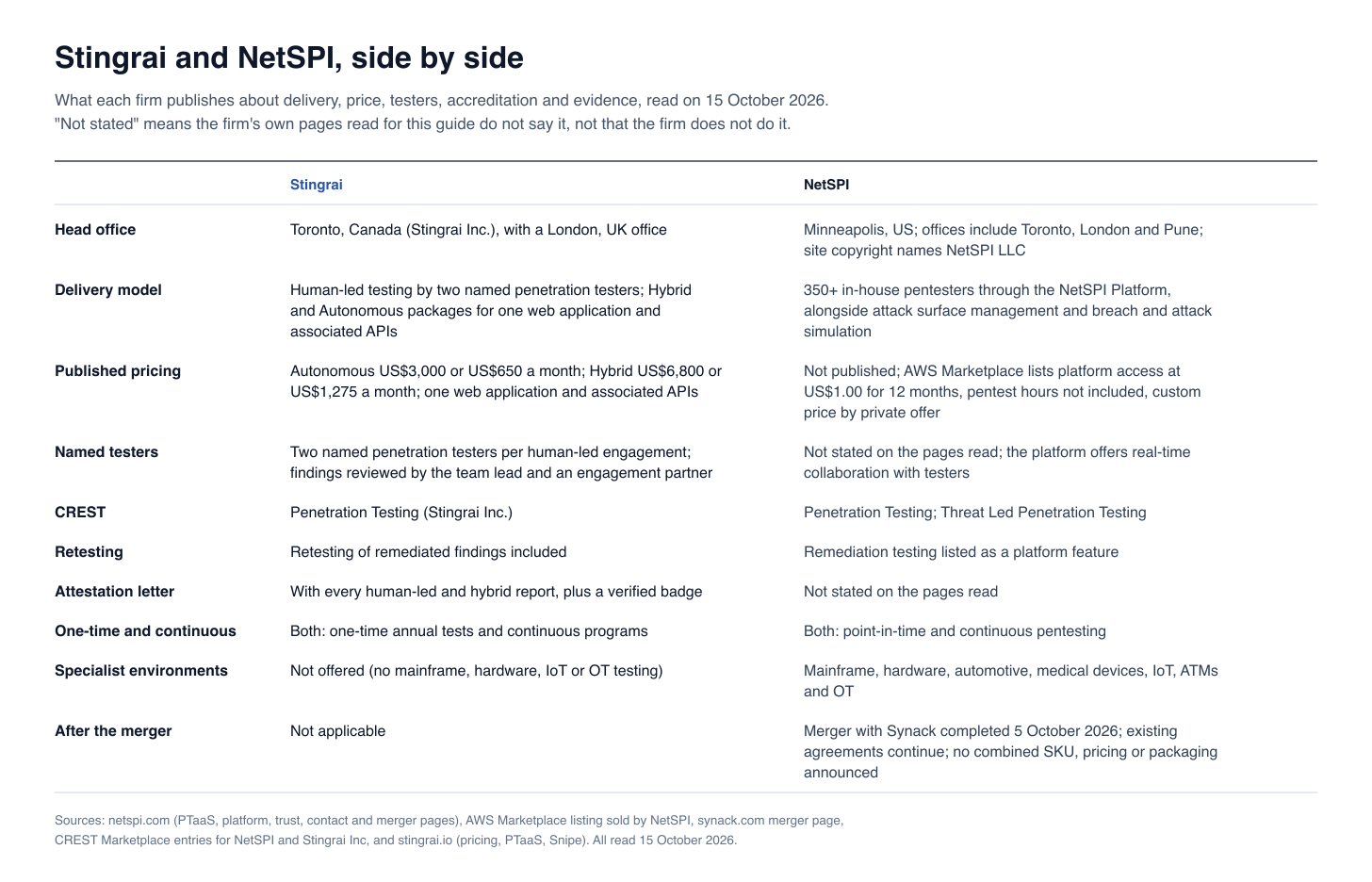
Figure 2: Stingrai and NetSPI side by side, read on 15 October 2026. Source: netspi.com, Synack, CREST Marketplace and stingrai.io/pricing.
Where NetSPI is still the better choice
Specialist estates under one contract. Mainframe, ATM, medical device, automotive and OT testing sit beside application and cloud work; none of the alternatives' pages read for this guide lists mainframe or ATM testing.
One platform for exposure work. Attack surface management, breach and attack simulation and pentest results report into the same place.
Threat-led testing. NetSPI holds CREST Threat Led Penetration Testing accreditation; among the alternatives, NCC Group and Pen Test Partners do too.
Our three-way enterprise comparison covers NetSPI's program model in more depth.
Questions to ask any vendor in late 2026
Which legal entity signs, and where are findings and reports stored? Get both in writing.
Who tests? Ask for named testers, and whether the same people retest.
What does this scope cost, and can price, platform or terms change within 12 months?
Is retesting included, and in what window?
What evidence ships with the report: an attestation letter, a retest record, a redacted sample report?
Run your scope through the penetration testing cost calculator before you collect quotes.
Frequently Asked Questions
What are the best NetSPI alternatives in 2026?
The best NetSPI alternatives in 2026 are Stingrai, NCC Group, Pen Test Partners, Cobalt, Praetorian, Sprocket Security, Schellman and TrustedSec, ordered by five criteria checked on each firm's own pages on 15 and 16 October 2026. Stingrai ranks first: a CREST-accredited firm headquartered in Toronto that runs every human-led engagement with two named penetration testers and publishes its web application packages at US$3,000 and US$6,800 per assessment, each for one web application and associated APIs, as one-time annual tests or continuous programs.
Has the NetSPI and Synack merger closed?
Yes. Synack's merger page says NetSPI and Synack completed their merger on 5 October 2026, and NetSPI's merger page says it officially closed in October 2026. The two announced a definitive agreement on 2 September 2026, describing a combined company with well over US$200 million in revenue, with KKR supporting its growth plan.
Does the merger change an existing NetSPI or Synack contract?
Not at close. NetSPI says customers should continue working with their existing teams under their current agreements, services and platforms, and Synack says each company continues to deliver its own platform, services and agreements. No combined SKU, pricing or packaging has been announced, and NetSPI's October 2026 brief says a product integration roadmap has not yet been published.
How much does NetSPI cost?
NetSPI does not publish prices. Its AWS Marketplace listing prices only platform access, at US$1.00 for a 12-month contract with pentest hours not included, and routes custom pricing to a private offer. Synack, now part of the same company, lists a Sara Pentest from US$4,181 plus a separate platform line item. Stingrai publishes US$3,000 and US$6,800 per assessment for one web application and associated APIs.
Is NetSPI CREST accredited?
Yes. NetSPI's CREST Marketplace entry lists Penetration Testing and Threat Led Penetration Testing after 10 years of membership. Every alternative ranked here, including Stingrai Inc., also holds CREST Penetration Testing accreditation; check current status on the CREST Marketplace before you sign.
Which NetSPI alternatives have an office in Canada?
Stingrai is headquartered in Toronto, and NCC Group lists an office in Waterloo, Ontario. NetSPI also lists a Toronto office, but the copyright line on its site names NetSPI LLC and its public pages do not name a hosting region, so ask every vendor which entity signs and where findings are stored.
Which NetSPI alternatives publish prices?
Three of the eight do. Stingrai publishes US$3,000 per Autonomous assessment and US$6,800 per Hybrid assessment, or US$650 and US$1,275 a month, each for one web application and associated APIs. Cobalt lists US$3,500 per Autonomous Pentest as a limited-time offer, and Sprocket Security lists a US$15,000 Starter package for continuous testing of up to 20 external hosts.
Related reading
References
NetSPI. NetSPI and Synack to Merge, Forming A Leading Offensive Cybersecurity Platform. 2 September 2026. https://www.netspi.com/newsroom/press-release/netspi-and-synack-to-merge-forming-a-leading-offensive-cybersecurity-platform/. Announcement, revenue and expected close.
Synack. NetSPI and Synack merger page; release updated 7 October 2026. https://www.synack.com/netspi-and-synack/ and https://www.synack.com/press-releases/netspi-and-synack-to-merge-forming-a-leading-offensive-cybersecurity-platform/. Completion and contract status.
NetSPI. NetSPI and Synack merger page and solution brief. October 2026. https://www.netspi.com/netspi-and-synack/ and https://www.netspi.com/wp-content/uploads/2026/10/NetSPI-Synack-Merger-Solution-Brief.pdf. Closing, customer guidance, FedRAMP scope.
NetSPI. Penetration Testing as a Service, platform, trust and contact pages. Read 15 October 2026. https://www.netspi.com/netspi-ptaas/. Services, credentials and offices.
NetSPI. NetSPI Expands Suite of AI-Powered Continuous Pentesting Services. 8 July 2026. https://www.netspi.com/newsroom/press-release/netspi-expands-suite-of-ai-powered-continuous-pentesting-services/. Continuous services added in 2026.
AWS Marketplace. NetSPI, sold by NetSPI. Read 15 October 2026. https://aws.amazon.com/marketplace/pp/prodview-dibvrfz6j7sra. Platform price line.
Synack. Synack Pricing. Read 15 October 2026. https://www.synack.com/pricing/. Starting prices.
CREST. CREST Marketplace supplier entries. Read 15 October 2026. https://marketplace.crest.org/. Accreditations and membership.
NCC Group, Pen Test Partners, Cobalt, Praetorian, Sprocket Security, Schellman and TrustedSec. Service and pricing pages. Read 15 and 16 October 2026. https://www.nccgroup.com/technical-assurance/continuous-penetration-testing/, https://www.pentestpartners.com/service/penetration-testing/, https://www.cobalt.io/pricing, https://www.praetorian.com/services/penetration-testing/, https://www.sprocketsecurity.com/pricing, https://www.sprocketsecurity.com/solutions/timeboxed-security-services, https://www.schellman.com/services/penetration-testing, https://trustedsec.com/services/penetration-testing. Services and published prices.
Stingrai. Pricing, PTaaS and Snipe pages. Read 15 October 2026. https://www.stingrai.io/pricing. Package prices, staffing and delivery.
Talk to Stingrai
Stingrai can scope a replacement for all or part of a NetSPI or Synack program in one call: two named penetration testers, every confirmed finding on the PTaaS platform the same day, retesting, and an attestation letter with every human-led and hybrid report, as a one-time annual test or a continuous program. Get a Quote or book a free discovery call.