




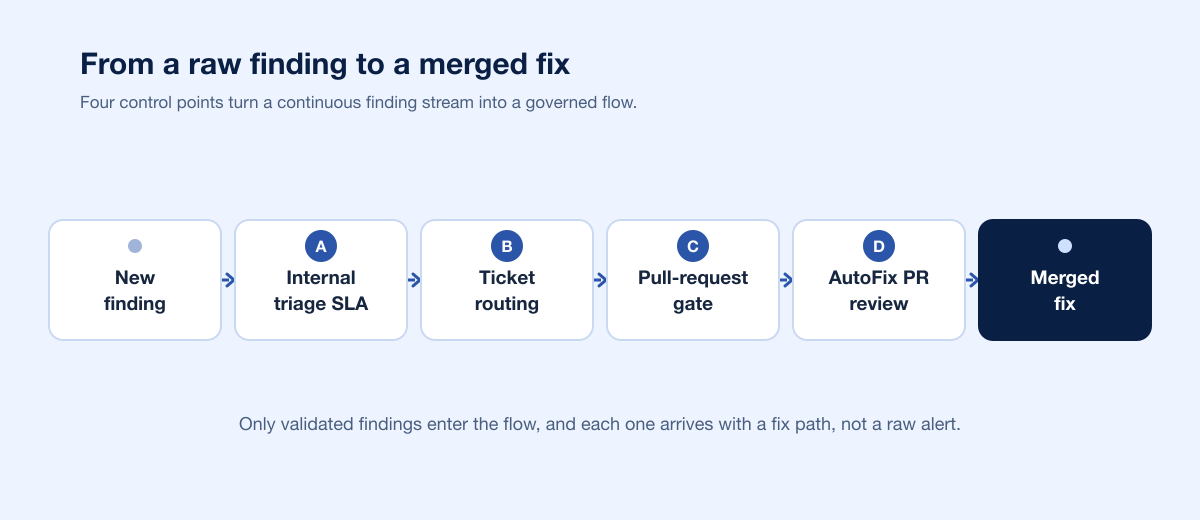
Continuous pentest findings integrate into a developer workflow through four control points: an internal triage SLA that sets a fix deadline by severity, a routing rule that decides which findings auto-create tickets, which page an on-call engineer, and which get batched, a pull-request gate that blocks merges on serious classes while warning on the rest, and a review policy for machine-authored AutoFix pull requests. Get those four right and engineers see only the findings that matter, each arriving with a fix path attached rather than a raw alert. That is how you run continuous testing without overwhelming the team.
The stakes are a remediation problem, not a detection one. The median organization takes 39 days to resolve a high-risk finding, well past the aggressive SLA targets, often set at 7 days, that many teams write for themselves (Cobalt, 2026 State of Pentesting Report). Speed is not optional either: exploitation of vulnerabilities was the initial access vector in 20% of breaches last year, up 34% year over year (Verizon, 2025 Data Breach Investigations Report). A platform that finds more and fixes nothing faster has moved the bottleneck, not removed it.
This post is a buyer guide with four paste-ready templates for the engineering and security leaders who own that decision. It picks up where scoping and contracts leave off. For the vendor side of the agreement, when the provider commits to notify and retest, see the enforceable autonomous pentest SLA clauses. This post is about the other half: what your own team commits to once a finding lands.
Key takeaways
Remediation, not detection, is the renewal-deciding question. A continuous pentest platform earns its second year by proving findings get fixed. Cobalt's 2026 data shows the typical organization resolves 86% of high-risk findings, yet the total resolution rate across a five-year dataset sits at just 52% (Cobalt, 2026).
Internal triage SLAs and vendor contract SLAs are different documents. One governs how fast your engineers fix. The other governs how fast the vendor notifies and retests. Conflating them leaves both unenforceable.
Gate merges on new serious findings only. Blocking a pull request on pre-existing debt punishes whoever touched the file last and trains the team to disable the gate. Block what the diff introduces, warn on the rest.
Machine-authored fixes are proposals. Microsoft shipped Copilot Autofix for Azure DevOps into limited public preview in June 2026, and major DevSecOps platforms now open fix pull requests automatically. None of them should auto-merge a security change. A human owns the merge and a regression test proves the fix.
The leadership view of remediation is optimistic. In Cobalt's survey, 57% of C-suite executives believed their organization consistently meets remediation SLAs, while only 15% of security practitioners agreed (Cobalt, 2026). A written triage SLA and a routing rule close that gap with data instead of confidence.
Methodology and scope
The figures in this post come from named primary sources published in 2025 and 2026. Remediation and SLA-perception data is from Cobalt's 2026 State of Pentesting Report, released in 2026 and drawn from Cobalt's pentest dataset plus a practitioner and executive survey. Breach initial-access data is from the Verizon 2025 Data Breach Investigations Report. The product capability described for Microsoft Copilot Autofix is from Microsoft's own Azure DevOps documentation and release announcement dated June 2026. These are the freshest full analyses those publishers have released as of July 2026, and every figure links back to its publisher so any claim can be audited. The four templates are drafting guidance from offensive-security engagement practice, meant as a starting point to adapt to your own risk posture, ownership model, and tooling. They are not legal advice.
Why remediation moved into the pull request
Two forces reshaped how findings reach a fix. The first is volume and cadence. A continuous engagement does not deliver a report every quarter; it delivers a stream. When findings arrive daily, a human triaging each one by hand becomes the constraint, and the Cobalt gap between a 10-day high-risk finding half-life at top performers and a 249-day half-life at the bottom tier, a 25x remediation gap that adds roughly eight extra months of exposure, is largely a gap in how the stream is routed (Cobalt, 2026).
The second force is that the fix itself moved into the developer's own surface. In June 2026 Microsoft brought Copilot Autofix for GitHub Advanced Security into limited public preview for Azure DevOps: when CodeQL raises a code scanning alert, Copilot Autofix uses the Copilot coding agent to generate a suggested fix and open a pull request the developer can review, edit, and merge in the normal workflow (Microsoft, Azure DevOps documentation, June 2026). Across the market, major DevSecOps platforms now do some version of the same thing. The remediation artifact is no longer a PDF row; it is a diff. That is a genuine improvement, and it creates a new obligation: someone has to decide which of those diffs a human reviews, which block a merge, and which are safe to batch.
The four control points below turn the finding stream into a governed flow. Each one is a policy you write once and enforce with tooling.
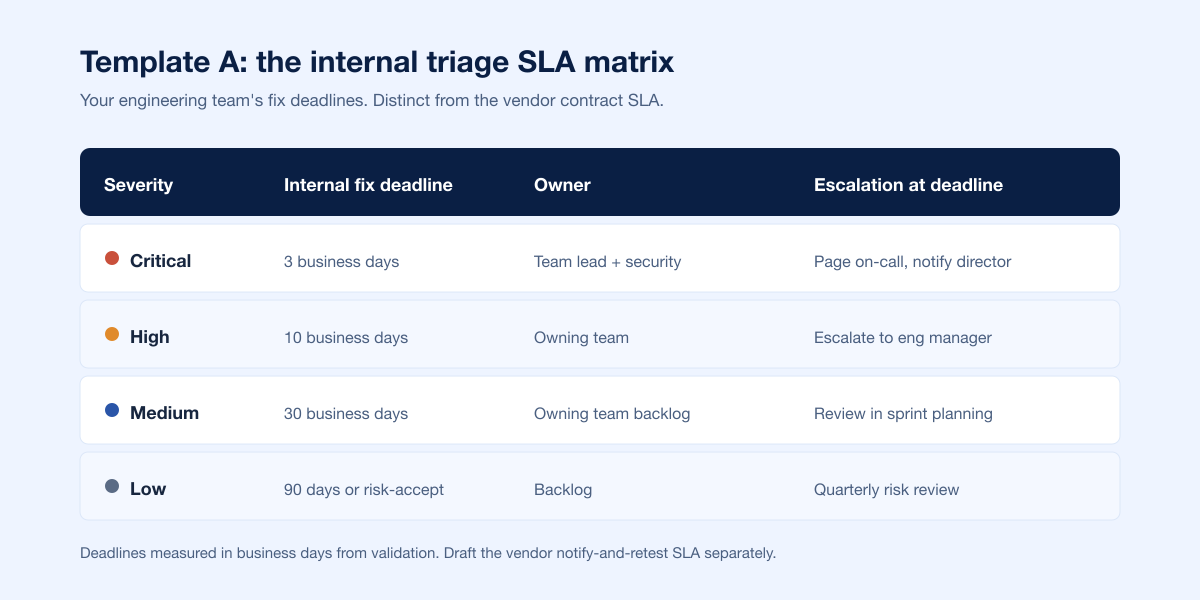
Template A: The internal triage SLA matrix
Start here, because every other control point references it. An internal triage SLA is the deadline your own engineering team commits to for fixing a validated finding, by severity. It answers one question: once a finding is confirmed, how long does the owning team have before it escalates.
Keep this document strictly separate from the vendor contract SLA. The contract SLA governs the provider: how fast they notify you of a new finding and how fast they retest a fix you report. The internal triage SLA governs you: how fast your engineers ship the fix in between. They use similar severity language and it is tempting to merge them, but they bind different parties and belong in different places. Draft the vendor side using the enforceable SLA clause playbook; draft the internal side with the matrix below.
Severity | Internal fix deadline | Owner | Escalation at deadline |
|---|---|---|---|
Critical | 3 business days | Owning team lead, with security | Page on-call, notify engineering director |
High | 10 business days | Owning team | Escalate to engineering manager |
Medium | 30 business days | Owning team backlog | Review in sprint planning |
Low | 90 days or documented risk acceptance | Backlog | Quarterly risk review |
Three rules make the matrix work. First, the clock starts at validation, not discovery, so noise never starts a countdown. A finding counts only when it reproduces; that is also why a low false-positive rate matters so much to the whole model, a topic covered in the acceptable false-positive rate guide. Second, every severity has a named owner and a real escalation, not just a date. A deadline with no consequence is a suggestion. Third, risk acceptance is an explicit, logged decision for Low and, rarely, Medium findings, never a silent expiry. Cobalt's finding that only 15% of practitioners believe their organization consistently meets remediation SLAs, against 57% of executives, is what an unwritten, unenforced target produces (Cobalt, 2026). The matrix turns a belief into a measurable commitment.
Template B: The ticket-routing decision tree
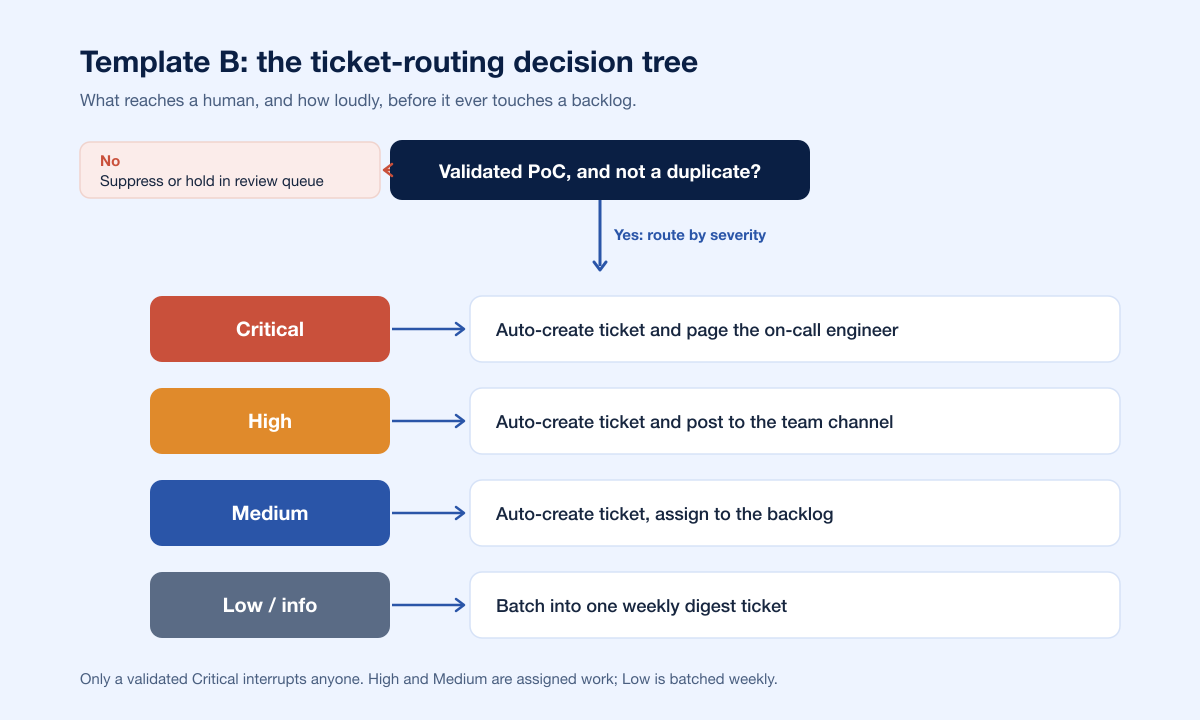
The triage SLA sets deadlines. Routing decides what actually reaches a human and how loudly. This is the single most important control for not drowning developers, because it is where the stream gets filtered before it ever touches a backlog.
Route every finding through the same ordered checks:
Is it validated? If the finding does not reproduce with a working proof-of-concept, it stays in a review queue and routes nowhere. Unconfirmed findings never page anyone and never create tickets.
Is it a duplicate or an accepted risk? If it maps to an existing ticket or a logged risk-acceptance decision, suppress it and link the record. Re-alerting on a known, accepted item is how teams learn to ignore the channel.
Critical? Auto-create a ticket, page the on-call engineer, and notify the owning team channel. This is the only path that interrupts someone.
High? Auto-create a ticket and post to the owning team channel. No page. The team picks it up within the High deadline.
Medium? Auto-create a ticket and assign it to the owning team backlog. No notification beyond the ticket.
Low or informational? Do not create individual tickets. Batch into a single weekly digest with one rollup ticket for the owning team to groom.
The discipline is in steps 1, 2, and 6. Validation-gating and dedupe stop noise at the door, and batching Low findings into a weekly rollup is what keeps a continuous stream from generating hundreds of near-worthless tickets. A developer should be interrupted only for a paged Critical, should see High and Medium as normal assigned work, and should meet Low findings once a week in a groomed list. That routing is also what makes a continuous PTaaS engagement log legible after the fact.
Template C: The PR-gating policy
Ticket routing handles findings against code already in production. Pull-request gating handles findings in code about to ship. The gate runs a check on each pull request and decides whether the merge is blocked or merely annotated. This is where continuous testing shifts left into CI/CD, and where the CI/CD pipeline testing scope and a hardened GitHub Actions setup do the enforcement.
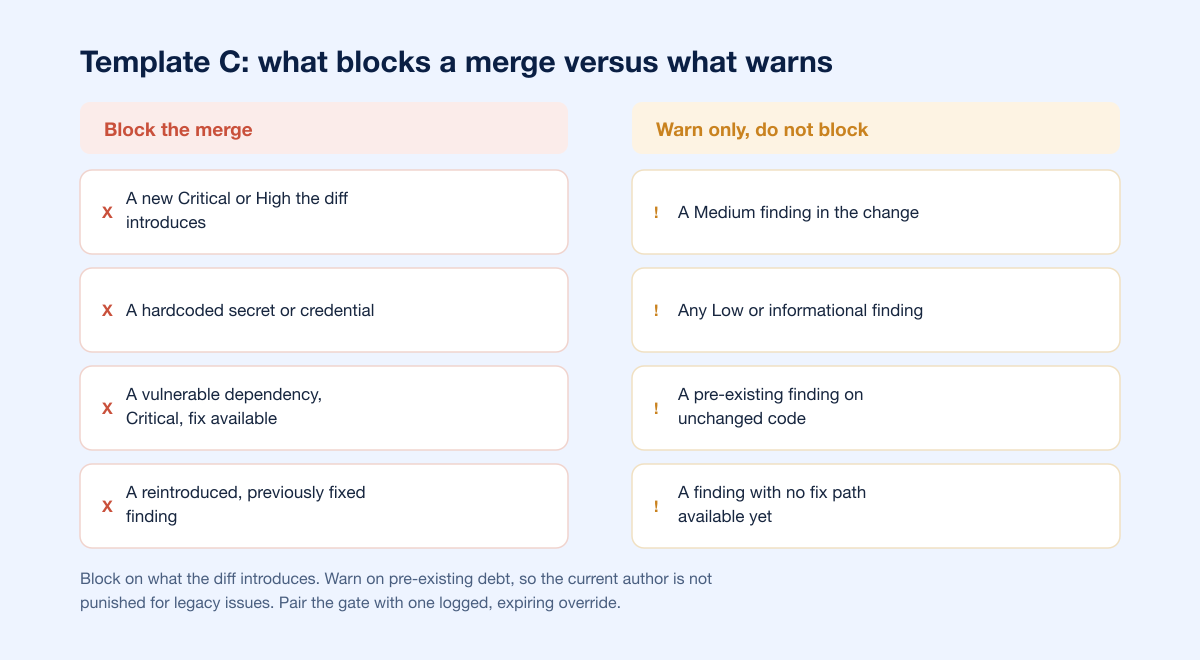
The core policy question is what blocks a merge versus what only warns. Get this wrong in either direction and the gate fails: too strict and developers disable it, too loose and it catches nothing.
Block the merge | Warn only, do not block |
|---|---|
A new Critical or High finding the diff introduces | A Medium finding the diff introduces |
A hardcoded secret or credential in the change | Any Low or informational finding |
A known-vulnerable dependency, Critical, with a fix available | A pre-existing finding on unchanged code |
Reintroduction of a previously fixed finding, a regression | A finding with no fix path available yet |
The load-bearing rule is the third row of the warn column: block on what the diff introduces, warn on pre-existing debt. If a pull request touches a file that already contained a High finding the author did not create, blocking the merge punishes the wrong person and teaches the team to route around the gate. Surface the legacy finding as a warning and route it through Template B instead. Pair the gate with a single escape hatch: a documented override that requires security approval, auto-creates a follow-up ticket, and carries an expiry so the exception cannot become permanent. A gate with no override gets disabled; a gate with a silent override is theater.
Template D: The AutoFix pull request review policy
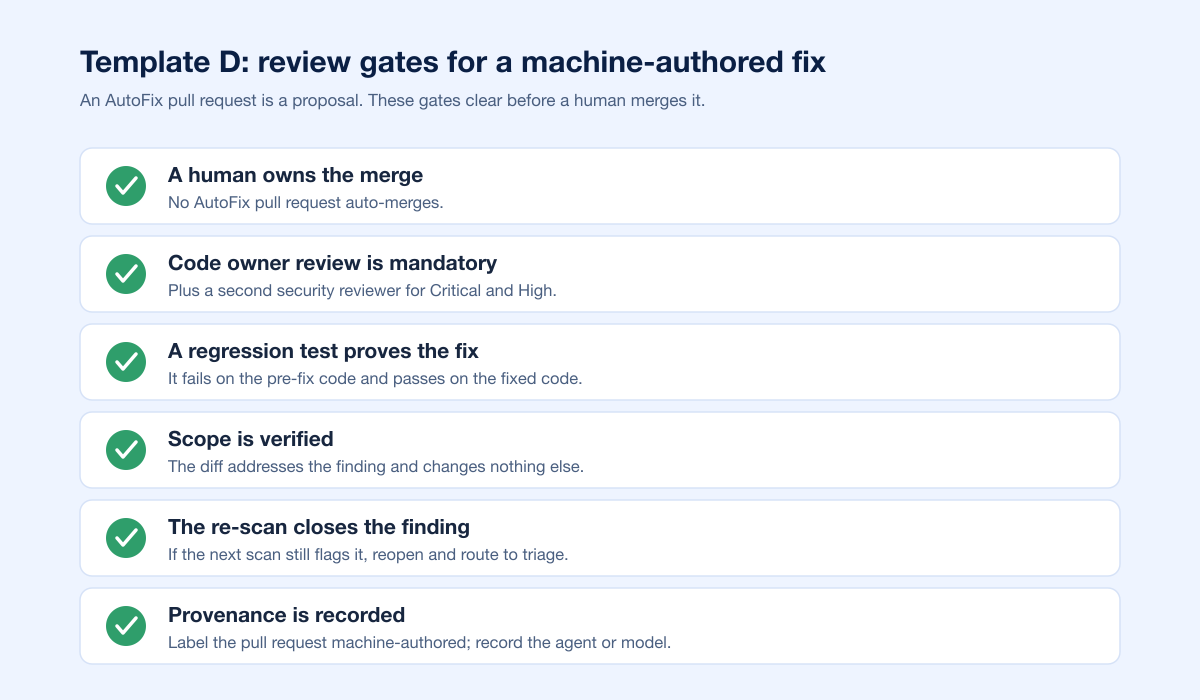
When the finding arrives with a fix already written, the workflow changes shape. A machine-authored AutoFix pull request, whether from Copilot Autofix, an autonomous testing agent, or another DevSecOps platform, is a proposal, not a resolution. Microsoft's own documentation is explicit that Autofix suggestions are AI-generated, are not guaranteed to be correct or complete, and must be reviewed and tested before merging (Microsoft, June 2026). Your review policy is what turns that proposal into a safe merge.
Require every machine-authored security fix to clear these gates before a human merges it:
A human owns the merge. No AutoFix pull request auto-merges. The convenience is in the drafted diff, not in skipping review.
Code owner review is mandatory. At least one owner of the touched files approves. For a Critical or High fix, a second reviewer from security signs off.
A regression test proves the fix. The change ships with a test that fails against the pre-fix code and passes against the fixed code, so the finding cannot silently return.
Scope is verified. Because a generated fix can span more than the flagged line and touch other files, confirm the diff addresses the finding and changes nothing else. Behavior drift hidden inside a security patch is the failure mode to catch here.
The re-scan must close the finding. After merge, the next scan has to confirm the finding is gone. If it does not close, reopen and route through triage.
Provenance is recorded. Label the pull request as machine-authored and record which agent or model generated it, so the audit trail shows who, or what, wrote the fix.
These six gates are why an AutoFix pull request accelerates remediation without becoming a new class of risk. The machine drafts; the policy verifies; a human decides. That is the same discipline that governs whether AI-coded applications need penetration testing in the first place.
Putting the four together in a hybrid model
The four templates are vendor-neutral and work with any continuous testing source. A hybrid autonomous-plus-human program is the cleanest way to see them run together, because different finding types enter the workflow at different control points.
Stingrai runs this as the worked example. Snipe, Stingrai's autonomous web-application agent, tests the web-app layer, where it hunts complex, high-impact classes: IDOR, business-logic flaws, and broken authorization, not just surface bugs. Snipe works black-box and white-box, generates AutoFix pull requests for what it finds, and can run as a PR-gating check on every pull request. For web-application findings, that means Templates C and D are native: the finding shows up as a gate result and, where possible, as a drafted fix pull request that your review policy then governs. The web application penetration testing service is where that layer lives.
Findings that cannot be resolved in a pull request take the other path. Cloud misconfigurations, IAM and access-control issues, Kubernetes exposures, and network findings come from senior human pentesters, and they route through Templates A and B: validated, assigned a severity, and dropped into your triage SLA and ticket-routing flow like any other finding. The point of the hybrid model is that engineering sees one governed queue with one set of deadlines, regardless of whether a finding was surfaced by an agent at the code layer or by a human at the cloud layer. Senior pentesters validate the serious findings from both sources before they ever start a clock, which is the same evidence discipline that produces clean artifacts for a SOC 2, ISO 27001, and PCI DSS compliance program.
What this means for engineering and security leaders
The renewal conversation for a continuous pentest platform should not be about finding counts. It should be about the four control points above and whether the platform plugs into each cleanly. A few decisions carry most of the weight.
Write the internal triage SLA before you buy. Deciding your own fix deadlines and owners first means you evaluate platforms on whether they support your workflow, not the reverse. The budget case for continuous testing is far easier to make once remediation is governed.
Insist on diff-level gating, not repo-level blocking. A platform that can only fail a whole build on any finding will get switched off. The gate has to distinguish new from pre-existing.
Treat AutoFix as a drafting accelerator, not an autopilot. The value is a faster first draft of the fix. The review policy is non-negotiable, and any vendor that suggests auto-merging security fixes is selling risk.
Demand human validation on the serious classes. IDOR, business logic, and broken authorization are exactly the findings that must reproduce before they page anyone, and exactly where senior human confirmation earns its keep.
Two owners share this: the security lead who defines severity and validation, and the engineering leader who owns deadlines, gates, and merge policy. Stingrai builds for both. The pricing page is the canonical reference for scope and packaging, PTaaS covers the continuous model, and red teaming sits alongside it when you need adversary emulation on top of continuous testing.
Frequently asked questions
How should we integrate continuous pentest findings into CI/CD and our developer workflow without overwhelming the engineering team?
Route every finding through four control points. An internal triage SLA sets a fix deadline by severity. A routing rule decides which findings page an on-call engineer, which auto-create tickets, and which get batched into a weekly digest. A pull-request gate blocks merges on new serious findings while warning on the rest. And a review policy governs machine-authored AutoFix pull requests. The filtering happens in routing: developers are interrupted only for validated Critical findings, see High and Medium as normal assigned work, and meet Low findings once a week in a groomed list. That keeps a continuous stream from becoming continuous noise.
What is the difference between an internal triage SLA and a vendor contract SLA?
They bind different parties. The internal triage SLA is your engineering team's commitment: how fast you fix a validated finding, by severity, with named owners and escalation. The vendor contract SLA is the provider's commitment: how fast they notify you of a new finding and how fast they retest a fix you report. They share severity language but belong in separate documents. Draft the vendor side with the enforceable SLA clause playbook and the internal side with a triage matrix.
Which pentest findings should block a pull request versus warn?
Block a merge on findings the diff introduces: a new Critical or High finding, a hardcoded secret, a known-vulnerable dependency with an available fix, or the reintroduction of a previously fixed finding. Warn only, without blocking, on a Medium finding in the change, any Low or informational finding, a pre-existing finding on unchanged code, or a finding with no fix path yet. The rule that matters most is not blocking on pre-existing debt, because punishing the current author for legacy issues trains the team to disable the gate.
Should we auto-merge machine-authored AutoFix pull requests?
No. A machine-authored fix is a proposal. Microsoft's own Copilot Autofix documentation states the AI-generated suggestions are not guaranteed to be correct or complete and must be reviewed and tested before merging. Require a human to own the merge, a code owner to approve, a second security reviewer for Critical and High fixes, a regression test that proves the fix, a scope check because generated diffs can span files, and a re-scan that confirms the finding closed. The machine drafts the fix; a human decides.
What severity-based fix deadlines are reasonable for internal triage?
A common starting point, in business days from validation, is three for Critical, ten for High, thirty for Medium, and ninety days or documented risk acceptance for Low. Adjust to your risk posture and release cadence. What matters as much as the numbers is that each severity has a named owner and a real escalation. Cobalt's 2026 data shows the median organization takes 39 days to resolve a high-risk finding against SLA targets often set at 7 days, so the deadline only means something if the escalation fires.
How do we keep low-severity findings from drowning developers?
Batch them. Low and informational findings should never create individual tickets in a continuous engagement. Roll them into a single weekly digest with one grooming ticket for the owning team. Combine that with two upstream filters: never route an unvalidated finding, and suppress anything that duplicates an existing ticket or a logged risk acceptance. Validation-gating, dedupe, and Low-severity batching together are what turn a daily finding stream into a manageable queue.
What does Microsoft Copilot Autofix do, and how does it fit a remediation workflow?
Copilot Autofix for GitHub Advanced Security entered limited public preview for Azure DevOps in June 2026. When CodeQL raises a code scanning alert, it uses the Copilot coding agent to generate a suggested fix and open a pull request the developer can review, edit, and merge. It fits at the AutoFix review control point: the drafted pull request accelerates the fix, and your review policy, human owner, tests, scope check, and re-scan, decides whether it merges. It is a drafting accelerator, not an autopilot.
How fast do organizations actually fix high-risk findings?
Slower than they think. Cobalt's 2026 State of Pentesting Report found the median organization takes 39 days to resolve a high-risk finding, against internal SLA targets often set at 7 days. The spread is enormous: top performers reach a 10-day half-life for high-risk findings while the bottom tier sits at 249 days, a 25x gap worth roughly eight extra months of exposure. The difference is largely how well the finding stream is routed and governed, not how hard any single engineer works.
How do cloud and IAM findings fit a PR-based remediation workflow if they cannot be fixed in a pull request?
They route through triage instead of the gate. A cloud misconfiguration or an IAM access-control issue usually cannot be resolved by a code diff, so it does not go through PR gating or AutoFix. It goes through the internal triage SLA and the ticket-routing tree: validated, severity-rated, assigned to the owning team with a deadline, and escalated if the deadline passes. In a hybrid program, these human-surfaced findings and the agent-surfaced code findings share one queue and one set of deadlines.
Does Stingrai support this workflow end to end?
Yes. Snipe, Stingrai's autonomous web-application agent, hunts IDOR, business-logic, and broken-authorization flaws using black-box and white-box testing, generates AutoFix pull requests, and runs as a PR-gating check, so the pull-request control points are native for web-app findings. Cloud, IAM, Kubernetes, and network findings come from senior human pentesters and route through the same triage SLA and ticketing flow, giving engineering one governed queue. See the web application penetration testing service and the PTaaS model for how the pieces connect.
References
Cobalt. 2026 State of Pentesting Report. 2026. https://www.cobalt.io/blog/top-15-statistics-2026-state-of-pentesting-report. Cobalt pentest dataset plus practitioner and executive survey; source for the 39-day median time to resolve high-risk findings against 7-day SLA targets, the 86% high-risk versus 52% five-year resolution rates, the 10-day versus 249-day remediation half-life, and the 57% executive versus 15% practitioner SLA-confidence gap.
Microsoft. Copilot Autofix for code scanning in GitHub Advanced Security for Azure DevOps (Preview). June 2026. https://learn.microsoft.com/en-us/azure/devops/repos/security/github-advanced-security-code-scanning-autofix?view=azure-devops. Official Azure DevOps documentation; source for the limited public preview status, the CodeQL-plus-Copilot-coding-agent fix generation, the pull-request review workflow, and the caveat that AI-generated fixes must be reviewed and tested before merging.
Verizon. 2025 Data Breach Investigations Report. April 2025. https://www.verizon.com/business/resources/reports/dbir/. Analysis of breach initial-access vectors; source for exploitation of vulnerabilities as the initial access vector in 20% of breaches, up 34% year over year.