Microsoft documents application users as the identities that give registered applications access to a Dataverse environment. Their business unit and assigned security roles shape what the application can do with the environment's data. One Microsoft Entra registered application can have one application user in each environment, which makes the application-to-environment mapping the first unit of an assessment. Microsoft, Manage application users
Quick answer. A Dataverse application user security assessment should map every in-scope service principal to the application user, environment, business unit and cumulative security roles that actually govern its calls. Test the permitted and denied table operations and record populations with synthetic data, then connect each result to the integration's approved business purpose. Stingrai can perform human-led testing of the customer-owned cloud, application and API paths under a written test boundary.
The question for a security buyer is not whether the service principal can obtain a token. The question is what that token lets the application do once Dataverse maps it to an application user. Microsoft says role privileges are cumulative, and its role editor separates table privileges from privacy-related privileges and record access depth. Those are distinct decisions that deserve distinct test cases. Microsoft, Security roles and privileges for Dataverse
The test unit: one application, one environment, one business purpose
An enterprise integration may use one registration across several Dataverse environments. Microsoft describes a single-tenant application that can connect to any associated Dataverse environment, and its admin documentation says the application user is created in a particular environment. The assessor should therefore inventory each application ID against each environment rather than treating the registration as a complete access statement. Microsoft, Single-tenant server-to-server authentication Microsoft, Manage application users
For each pair, the buyer should name the workload that uses it: an order import, a case synchronizer, a customer data export, a workflow service or another specific job. Then name the business owner, data owner, deployment owner and administrator who can explain its roles. An identity without a known purpose is difficult to assess because no one can say which successful operations are legitimate. An assessment that begins with a generic tenant scan may locate exposed endpoints, but it cannot answer whether a specific app user reads too many records.
The admin center shows the Microsoft Entra application ID, state, assigned security roles, application type, business unit and email on an application user's Details page. Those values make a useful baseline. Record them before testing and again after a change. The display name alone is weak evidence because Microsoft notes that it can become out of sync with the registered application name. Use the stable application ID to join the inventory. Microsoft, Manage application users
This assessment is narrower than an Entra application registration review. The latter asks about consent grants, credentials, federation and tenant-level identity trust. Here the decisive evidence is the Dataverse environment's effective role and the application's observed access to selected records. A buyer that needs both should place them in separate workstreams and preserve the link between the Entra ID and the Dataverse application user. Our Entra application registration testing guide addresses the identity-side questions.
A buyer's boundary matrix
The following matrix is an editorial scope model. It does not describe any customer's configuration. Fill every row with a named application, environment, synthetic record and approved expected result. The business owner should sign off on the expectation before a tester interprets the result.
Boundary | Configuration to inspect | Positive and negative observation | Evidence to keep | Decision owner |
|---|---|---|---|---|
Application to environment | Entra application ID, Dataverse application user, state | Named app reaches its intended environment; an unassigned app does not | IDs, environment name, response class | Platform administrator |
Business unit | App user's assigned business unit and expected population | In-scope synthetic record is visible; adjacent unit's record is denied where policy requires | Business unit mapping and redacted record IDs | Data owner |
Cumulative roles | Every role currently assigned to the app user | Approved task succeeds; unrelated task fails under the same identity | Role export and operation outcome | Dataverse security owner |
Table privilege | Read, Create, Write, Delete, Assign, Share, Append and Append To where relevant | Selected operation succeeds; forbidden operation is rejected | Table logical name, method, response and side effect | Application owner |
Access depth | Organization, parent-child unit, business unit, user or none | Expected record set appears; out-of-scope record stays unavailable | Record ownership and effective depth | Data owner |
Data movement | Privacy-related privileges and connected application behavior | Approved synthetic export succeeds; restricted data stays out | Export permission and destination observation | Integration owner |
Change and monitoring | App user state, role changes and application logs | Controlled change is detected and reversed | Timestamped change and event correlation | Security operations |
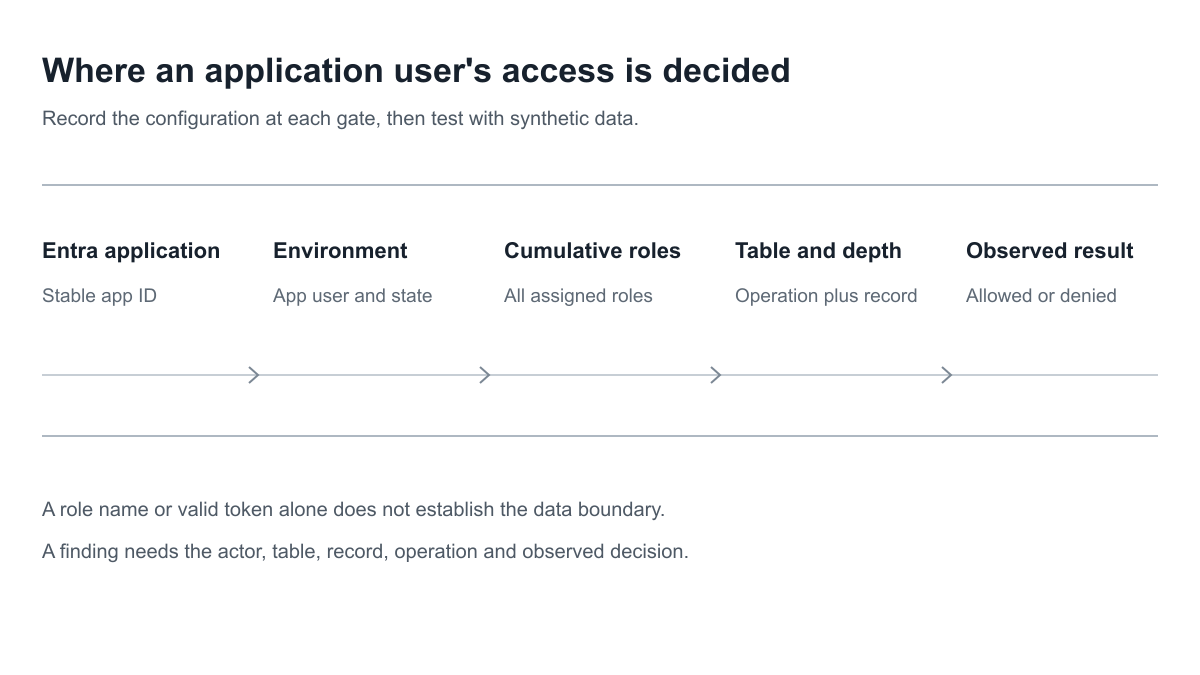
Figure 1: An editorial planning path for attributing an integration result to the right control, 2026. Source: Microsoft, Manage application users; Microsoft, Security roles and privileges.
Do not collapse the matrix into a single pass or fail. A successful Read operation could be correct for one table and excessive for another. A failure to read a test record could result from wrong ownership, wrong environment, an inactive application user, missing table privileges or a role depth that is intentionally narrow. Capture enough context to distinguish those causes.
Test effective permissions, not role names
Microsoft says a user can have multiple security roles and that their privileges are cumulative. A role named “Integration Reader” can therefore be overridden by another assigned role with Write, Share or organization-wide Read. Review all assigned roles for the application user. Compare the combined privilege set against the job description, then verify representative decisions through the customer-owned integration or Dataverse API. Microsoft, Security roles and privileges for Dataverse
The role editor exposes table-level operations such as Read, Create, Write, Delete, Assign, Share, Append and Append To. It also defines access depth for privileges. Organization access reaches all records in the organization; business-unit access reaches records in that unit; user access is narrower and includes records the user owns or receives through sharing. Those distinctions mean that a “read-only” assessment must still ask which records are readable, and a “write-limited” assessment must specify whether association, assignment or sharing is part of the approved workflow. Microsoft, Security roles and privileges for Dataverse
Choose test tables that reveal the integration's actual risk. A customer record table, case table and custom staging table may have different owners and sensitivity. Record each table's logical name, ownership model and selected privilege. The application owner should identify the data fields the job needs. The assessor can then prepare synthetic records in the permitted and prohibited populations. This allows an outcome to be interpreted without collecting live customer, employee or payment information.
For Write, Create, Assign, Share, Append or Delete, use a test environment or explicitly approved disposable records. A request that changes production state should have a named rollback owner, a change window and a stop condition. A safer validation may compare role configuration, execute a narrow non-destructive Read, and defer state-changing tests until the same role model is present in a representative non-production environment. The report should say which decisions were observed and which were reviewed only.
Microsoft recommends a custom security role for a real-world server-to-server application that can be stored with the solution. That recommendation gives the buyer a useful question: was the current role designed for this workload, or was a broad existing role assigned for convenience? A custom role is not automatically least privilege, so compare its effective table and depth settings to the business rule. Microsoft, Single-tenant server-to-server authentication
Check record depth and relationship changes
Table access is only half of a Dataverse authorization decision. Microsoft documents access levels including organization, parent-child business unit, business unit, user and none. For each sensitive table, the test plan should state which records belong in scope. Put one synthetic record in the intended population and another outside it. Run the same bounded operation through the same application user, then compare the returned records or response classes. Microsoft, Security roles and privileges for Dataverse
A record may also be available because it is shared with the user or a team, not because a role has organization-level access. The evidence package should include the selected record's owner, sharing state and relevant role depth. Without those facts, a tester might report a role configuration issue when the actual route is an unintended share, or might dismiss a valid access because the record was inserted into a test team.
Relationship operations need their own test cases. Microsoft distinguishes Append from Append To, and its role documentation explains that association can depend on privileges on both sides of a relationship. If an integration attaches notes, links an activity to an account or associates a custom record, specify the exact pair of tables and the approved direction. A broad association privilege can expand what the integration changes even when its principal job is “synchronization.” Microsoft, Security roles and privileges for Dataverse
Assign and Share deserve separate owner review because they can change who may subsequently access a record. An application may need to create a case but have no business need to move its ownership or share it with another team. The assessor should validate these as distinct decisions with synthetic records. A finding should name the operation, table, record class and role source rather than saying only that the service principal is overprivileged.
Follow data beyond Dataverse
An application user often exists to move data. The Dataverse permission review should therefore meet the customer-owned connector or application review at the data boundary. Microsoft defines privacy-related privileges for tasks involving data integrated, downloaded or exported outside Dataverse. A role that appears narrow on one table may still support broader extraction through an export capability or a connected workflow. Review the relevant privacy-related privileges and the actual application behavior together. Microsoft, Security roles and privileges for Dataverse
Trace a small synthetic record from source table to destination. Record the selection rule, fields transferred, transformation, destination identity, storage location and retention owner. The Dataverse assessment should not claim to cover the entire downstream system simply because a record crosses into it. A customer-owned API or storage component can be added as a separately named test surface. If the destination is a provider-controlled SaaS service, its testing rules and authorization need separate review.
This is also where a third-party API integration assessment can complement the Dataverse scope. The Dataverse work asks whether the app user could access the record. The integration work asks whether the receiving application enforces its own authorization, field validation and routing rules. Keep the evidence joined by a synthetic record identifier while avoiding a copy of real data in either report.
Environment boundaries are easy to misread
An environment secured by a security group may still run application users without adding them to that group; Microsoft states this explicitly. The buyer should not assume the environment security group blocks service principals. Instead, inspect the actual application user and roles in each in-scope environment. Where the same Entra application is used for development, test and production, compare their application user configurations and data boundaries separately. Microsoft, Manage application users
Avoid treating a successful token request as proof of cross-environment access. To establish exposure, show that an application user exists in the target environment, that it is active, and that its roles permit the selected operation against a controlled record. Conversely, a rejected call can be caused by a missing app user rather than good least-privilege design. The report should state the control responsible for each observed decision.
Microsoft warns that disabling an application user breaks all integration scenarios relying on that user. Do not deactivate a production identity simply to test a negative case. Use a dedicated disposable application user where appropriate, a representative test environment, or a planned change window with the integration owner. Where the app user is shared by several jobs, identify those dependencies as part of the scoping and remediation discussion. Microsoft, Single-tenant server-to-server authentication
Configuration drift is a practical finding category. An application may have a narrow custom role in development and a broad role in production because a deployment failed and an administrator repaired access quickly. The assessment should compare roles, business units and selected table privileges across the exact environments that matter, then test the production decision only within the agreed safe envelope. A parity table is more useful than a statement that “the environments differ.”
Keep testing inside the approved boundary
Microsoft says organizations may perform their own penetration tests on Power Platform and Dynamics 365 services, subject to its Cloud Penetration Testing Rules of Engagement. The same guidance says to limit testing to the organization's assets and avoid unintended effects on other customers. The engagement scope should identify the owned environments, applications, APIs, identities and records; it should not imply permission to test the shared platform itself. Microsoft, Power Platform security testing guidance
For a production assessment, agree a request budget, testing hours, monitoring contact, rollback owner and stop trigger. Use synthetic records and redact tokens, secrets and personal data from logs. A configuration review can start while test accounts and records are being prepared, but the report should separate configuration evidence from observed authorization outcomes. Avoid noisy enumeration of unrelated tables simply because a token works.
The selected test actor matters. Administrative credentials are useful for reviewing role settings, but dynamic checks should use the service identity that the integration actually uses. If the workload calls Dataverse through an intermediary, capture both the app user and the intermediary's own authorization context. A successful call by the administrator says nothing about the production app user's data boundary.
What the deliverable should prove
The buyer should receive an application-to-environment inventory, an agreed expected-access matrix and evidence for representative permitted and prohibited operations. Each finding should show the application ID, environment, application user, business unit, cumulative roles, selected table and record class, operation, observed result and business impact. The report should distinguish an exploitable customer-owned integration flaw from a permissive Dataverse configuration and from an untested hypothesis.
For remediation, the owner needs the narrowest change that corrects the observed result: remove an unnecessary role, reduce privilege depth, separate a shared identity, change an unintended record share, or move an export to a controlled destination. Retesting repeats the original identity, table, record and operation after the change. A screenshot of a renamed role is not evidence that the runtime decision changed.
Stingrai is a global CREST-accredited penetration testing services company founded in Toronto, Canada in 2021, trusted by companies from startups to enterprises to meet audit requirements for SOC 2, ISO 27001, CMMC, PCI DSS and HIPAA. OSCE³, OSWE, OSEP, CREST CRT certified pentesters, who are also world-class security researchers and bug bounty hunters. Choose from fully human-led or hybrid (AI agents plus human penetration testers) engagements across web, API, mobile, AI and LLM, cloud, network, Active Directory and social engineering penetration tests and red team engagements.
For this scope, Stingrai's human-led testers can examine the customer-owned cloud identity, Dataverse-facing application and API behavior together. Two named penetration testers work on each human-led engagement, with review by the team lead and an engagement partner. Findings can be delivered in the PTaaS portal during one-time or annual engagements or continuous programs, with retesting of remediated findings. The assessment supports a compliance program by producing test evidence for the customer's audit process.
Procurement questions to put in the statement of work
A useful proposal names the environments and integrations. Ask the provider to show how it will obtain the application-user inventory and confirm the exact Entra application IDs without collecting secrets. Ask which tables and operations it will observe dynamically, which will receive configuration review only, and how it will prepare safe positive and negative records. If the test includes a connected API, cloud function or storage destination, name that surface and its owner separately.
The statement of work should also identify who decides whether an observed success is unauthorized. A tester can demonstrate that an app user read a synthetic record. The data owner determines whether that record should have been visible to the workload. Without that decision, the same result may be a finding or intended behavior.
Ask how the report handles inconclusive results. A denied call with an incorrectly configured test identity should not be counted as a control pass. A failed export caused by an unavailable destination should not be counted as proof that privacy-related privileges are safe. Require the tester to label the fixture, precondition and limitation of every key observation.
For pricing, treat this as an enterprise integration and cloud scope, with its breadth driven by the number of application users, environments, tables and connected systems. A cloud penetration testing service can cover the identity and workload boundary; a web application penetration test can cover a customer-built front end and its associated API where those are in scope. Ask for a quote against the named inventory rather than a generic “Power Platform test.”
FAQ
What should a Dataverse application user security assessment include?
It should map the Entra application ID to the application user in each environment, record the business unit and all assigned roles, and test representative allowed and denied table operations against synthetic records. The report should identify the effective privilege and record depth behind each result.
Can an application user access an environment secured by a security group?
Yes. Microsoft says application users can run in environments secured with a security group without being members of that group. Check the application user's existence, state and assigned roles in the environment rather than treating security group membership as the only gate.
Does a narrow role name prove least privilege?
No. Dataverse security role privileges are cumulative when multiple roles are assigned. Test the combined privileges, table operations and record access depth against the integration's approved purpose.
Should a production app user be deactivated to test revocation?
Usually no. Microsoft warns that disabling an application user breaks integrations that rely on it. Use a disposable identity or representative non-production environment unless the production change has a named owner, approved window and rollback plan.
Related reading
Talk to Stingrai
Stingrai can scope a human-led Dataverse application user assessment around the environments, integrations and synthetic test records you own. Get a Quote or book a free discovery call to define the test boundary.