MuleSoft documents a contract between a client application and an API instance after access is granted through Anypoint Exchange. Its Client ID Enforcement policy then restricts a protected API to applications with an approved contract. A penetration-test scope must verify both the contract state and the policy that enforces it on the actual instance, method and resource. MuleSoft, Client Applications, Contracts, and Credentials MuleSoft, Client ID Enforcement Policy
Quick answer. A MuleSoft Anypoint API Manager security assessment should inventory the customer-owned API instances, client applications, contracts and applied policies, then test approved and prohibited calls at the selected methods and resources. Verify that revoked clients lose access and that the backend still enforces its business rules after a gateway permits a request. Stingrai can perform human-led API and cloud testing around that named contract-to-backend path.
The buyer's central question is whether a client that should not reach a business operation can still make it through the gateway or backend. A contract may exist but not be enforced on an unprotected route. A policy may apply to one method and omit another. A valid client may pass the gateway but act on an unauthorized object behind it. These are different failures with different owners, so the report should identify the exact boundary rather than label every result “API Manager misconfiguration.”
Define the API instance, client and business action
The first scoping artifact should pair each API instance with its deployment environment, published asset, gateway type, application clients and backend service. MuleSoft says only one contract can exist per instance and application at a time. That makes the instance-to-client pair a useful inventory unit, but it is not the whole authorization story. The business owner also needs to say what that client may do with the API. MuleSoft, Client Applications, Contracts, and Credentials
Choose a named workflow, such as creating a synthetic order, reading a bounded account record or updating a test case. Record the client application, approved methods and resources, expected response class, data population and backend action. Prepare at least one client that should succeed and one that should not. An unrelated client may have valid credentials for another API instance, making it useful for checking contract isolation without sending arbitrary traffic.
The assessment should state which component the customer owns and is authorized to test. Anypoint control-plane settings, a customer-deployed API proxy, CloudHub worker, upstream application and downstream backend can have different ownership and testing restrictions. A scope that says only “MuleSoft pentest” leaves those boundaries open. Name the endpoint URLs, API instance IDs, environments, client applications, policy types, backend services and permitted methods in the statement of work.
MuleSoft describes client application credentials as a client ID and client secret generated when a new application requests instance access. A protected instance requires those credentials when client ID enforcement is applied. Do not place either secret in test plans, screenshots or reports. The customer can issue bounded test credentials or run the test through a controlled harness while the assessor records identifiers and outcomes only. MuleSoft, Client Applications, Contracts, and Credentials
The buyer's contract and policy matrix
The matrix below is an editorial assessment plan. Fill it with specific API instances and synthetic data. A business owner should confirm each expected access decision before the assessor interprets a success or failure.
Boundary | Configuration evidence | Safe paired observation | Evidence to retain | Owner |
|---|---|---|---|---|
API instance | Environment, gateway, version and published route | Intended instance responds; unrelated instance does not grant access | Instance ID and route mapping | API platform owner |
Client contract | Client application and contract state | Approved client reaches selected operation; unapproved client is denied | Client ID label, contract state, response class | API product owner |
Policy attachment | Applied policy and enforcement settings | Protected method requires client decision; selected unprotected method is reviewed against intended design | Policy configuration and method | Gateway administrator |
Credential extraction | Header, query or custom expression settings | Allowed credential location works; absent or malformed test credentials fail | Sanitized request shape | Gateway administrator |
Method and resource | Policy coverage for selected verb and path | In-scope call succeeds; adjacent prohibited call is denied | Verb, path and decision | API owner |
Token validation | Issuer, token policy and client validation setting where used | Authorized token and contract combination works; wrong combination fails | Token metadata without token value | Identity owner |
Backend authorization | Customer-owned service and synthetic object | Gateway-approved client cannot act outside business permission | Object class, response and backend event | Application owner |
Revocation | Contract state change plan | Disposable client loses access after revocation | Before and after decision, timestamps | API platform owner |
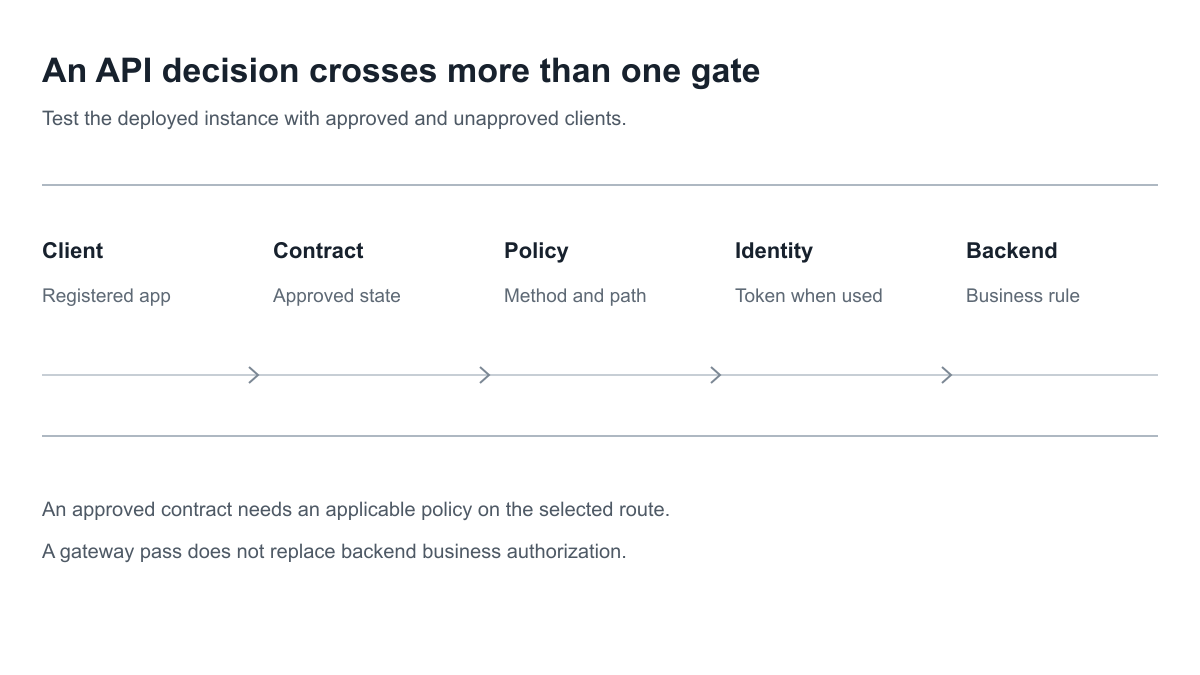
Figure 1: An editorial model for tracing a client request from contract to backend decision, 2026. Source: MuleSoft, API contracts; MuleSoft, Client ID enforcement.
Do not infer policy coverage from the Exchange asset alone. The tested API instance, gateway configuration and deployment route determine which requests meet the policy. Likewise, a gateway denial does not prove that the backend would reject the same actor if exposed through another path. Keep the gateway and backend conclusions separate.
Prove that the contract is enforced
MuleSoft says a Client ID Enforcement policy admits requests from registered client applications with an approved contract. After the contract is approved, requests must include credentials in the configured form. A good test pairs an approved client with an unapproved client on the same customer-owned route and synthetic object. The assessor should capture the policy settings, contract state and observed response class for both. MuleSoft, Client ID Enforcement Policy
An approved contract for API A should not silently grant the same client access to API B. MuleSoft's one-contract-per-instance-and-application model gives the buyer a way to express that expected decision. Test only named instances and clients. If API B allows the call, determine whether it has its own approved contract, a different policy, an intentionally public route or a gateway configuration gap before calling it a finding. MuleSoft, Client Applications, Contracts, and Credentials
Method and resource coverage is an important branch. MuleSoft documents policy configuration for all methods and resources or only specific ones. A buyer should compare the policy coverage to the API's published and deployed operation list. A sensitive POST, PATCH or DELETE method should not be assumed protected because a GET on the same path was denied. A test matrix should name each high-impact operation and its expected contract requirement. MuleSoft, Client ID Enforcement Policy
The policy configuration may also define how credentials are extracted. MuleSoft documents HTTP Basic and custom expression modes, and notes that a custom expression can leave the client-secret requirement optional. Optional secret handling may be intentional for a design with another authentication control, but it deserves explicit review. The assessor should not call it a vulnerability from configuration alone. The API owner must identify the compensating identity check and the assessor should verify it on a controlled route. MuleSoft, Client ID Enforcement Policy
MuleSoft permits client credentials in headers or query parameters and says headers are more secure. If a deployed policy extracts credentials from a query string, the report should trace where URL data is logged or forwarded within customer-owned systems and recommend a safer design when exposure is confirmed. Avoid inserting real credentials into a URL for testing. Use a disposable value and an approved test client. MuleSoft, Client Applications, Contracts, and Credentials
Token policies need their own contract check
Some APIs use OAuth or JWT validation rather than a simple client ID policy. MuleSoft notes that token enforcement policies can optionally skip client validation, while recommending validation so the token is associated with an approved contract. A test plan should ask whether a valid token alone is intended to authorize the selected API, or whether the token must also bind to a client application with a contract. Test the stated design with bounded, disposable identities. MuleSoft, Client ID Enforcement Policy
MuleSoft's OAuth policy guidance says token enforcement depends on platform setup, runtime configuration and API metadata working together. A declaration in RAML or OAS is not equivalent to an applied runtime policy. The assessor should compare the published specification, API Manager policy attachment and observed request decision. If they differ, name the point of drift. A spec can describe the credential shape while the deployed gateway behaves differently. MuleSoft, OAuth 2.0 policy prerequisites
Avoid turning this into a broad identity-provider assessment by default. The buyer can name the token issuer and selected claims relevant to the API contract, while a deeper issuer, key rotation or federation review becomes a separate workstream. The central Anypoint question remains whether this gateway instance applies the intended policy and whether the backend respects the resulting caller identity.
Revocation is a runtime question
MuleSoft says revoking a contract blocks the client application from accessing the API and that a revoked contract can be restored or deleted. The buyer should verify this on a disposable client in a representative environment, then observe the same narrow request before and after revocation. A configuration screenshot showing “revoked” is useful, but the runtime denial is the stronger evidence. MuleSoft, Revoke and Delete API Contracts
Production revocation can disrupt integrations. Plan it with an owner, test client, change window and rollback path. Do not revoke a live partner's contract simply to make a point. If a disposable production client cannot be provisioned, review the policy and contract mechanics in production and exercise revocation in a representative non-production instance. Record that coverage limit.
Retesting should be symmetrical. If the remediation attaches a policy to a previously unprotected resource, repeat the original approved and unapproved requests. If the remediation narrows method coverage, repeat both a method that should remain accessible and one that should be denied. This proves the control changed without breaking the legitimate business route.
Watch for policy drift across releases
The approved design often starts as an API specification and a platform template, but the buyer needs evidence from the deployed instance. MuleSoft explicitly says that a RAML or OAS OAuth declaration does not attach the policy to the instance. A release review should therefore compare the source specification, API Manager policy list, gateway deployment and observed response for the same selected operation. The assessment can sample the production route under a safe request budget and compare it with the representative test environment. MuleSoft, OAuth 2.0 policy prerequisites
Ask whether version changes create a new API instance or route with a different contract and policy state. Record the version, environment and gateway identity with each result. If an old route remains reachable, the business owner should decide whether it is still supported and which clients require it. The assessor should not assume that a policy on the newest instance covers the previous one.
Policy drift is also a change-management question. A contract can be approved while a policy is temporarily removed for troubleshooting. A method can be added to the backend without being added to the selected policy coverage. The report should identify a concrete discrepancy and its owner, then recommend a release gate that compares deployed routes with approved policy coverage. A general statement that “configuration drift is possible” is not an actionable finding.
The backend must still make a business decision
Client ID enforcement is a gate on client applications and contracts. It does not decide whether an approved client may read a particular customer's order, change a specific account or create a transaction outside its business role. That object-level and workflow decision belongs to the customer-owned backend API. Include representative synthetic objects and roles so a gateway-approved client can be tested for unauthorized business actions.
The report should trace a permitted request to a backend event and compare it with a prohibited one. If both reach the backend but one is denied there, the backend authorization may be working as designed. If a prohibited object succeeds, identify the backend control, not just the API Manager contract. If the gateway denies the request before it reaches the backend, do not claim to have tested backend authorization for that case.
This is where a third-party API integration penetration test can extend the assessment. A MuleSoft scope centers on client contracts, gateway policies and the deployed API instance. A connected-system scope can add payload validation, downstream service permissions, retries and data handling. The two can share synthetic object IDs and sanitized correlation records while retaining separate findings and owners.
Know the provider testing boundary
The Salesforce Security Assessment Agreement contains a specific MuleSoft runtime limit: customer assessments of CloudHub workers are limited to customer dedicated environments, and shared worker environments are excluded. The buyer should review the current agreement and deployment model before approving dynamic tests of a worker. The statement of work should distinguish customer-owned API endpoints and configuration from provider-controlled runtime infrastructure. Salesforce, Security Assessment Agreement
The same published agreement says a customer may not subcontract the assessment without SFDC's prior written approval. A buyer using an outside penetration-testing provider should have its legal and platform owners check that requirement as part of authorization, alongside the current terms for the ordered service. The assessor should retain the approved scope and contact route before testing starts. Salesforce, Security Assessment Agreement
The agreement also restricts all automated testing to Friday 21:00 PST through Sunday 23:59 PST and excludes testing during a major upgrade or maintenance window. It requires the customer to email a written assessment report to security@salesforce.com promptly after completion and to report findings classified High immediately. A buyer should put the automated-testing window, upgrade check and reporting route in the SOW rather than relying on a generic reference to "safe hours." Salesforce, Security Assessment Agreement
This does not make ordinary customer-owned API testing impossible. It means the test plan must name the actual target and respect the applicable provider terms. Use owned endpoints, approved clients, a request budget, the published automation window and a monitoring contact. Avoid scanning a shared platform component or probing other tenants. If a needed surface is outside permitted testing, mark it as configuration review or an excluded boundary rather than implying full runtime coverage.
The authorization document should also specify whether the gateway is Mule Gateway, Omni Gateway or another deployment, since policy availability and implementation can differ. The assessment should rely on the settings actually applied to that instance. A template configuration from another environment is useful context, not proof of current protection.
Evidence that makes findings actionable
The deliverable should include an API instance inventory, client-to-contract map, applied-policy and method coverage matrix, safe request results, and backend correlation for the selected business actions. Every finding should identify the API instance, environment, route, client class, contract state, policy setting, method, synthetic object, observed decision and expected decision. Include the business owner's confirmation of why the result matters.
Separate three evidence levels. Configuration evidence shows what API Manager or Exchange currently records. Runtime evidence shows how a selected request was handled. Backend evidence shows what business action occurred. When one level is unavailable, state the limitation. A policy attachment alone is not proof that all deployed routes use it; a 401 alone is not proof that contract revocation works; a backend denial alone is not proof that a gateway policy is applied.
Remediation may include attaching the intended policy to an API instance, expanding method coverage, requiring client validation, changing credential extraction, revoking an obsolete contract or tightening the backend's object-level rules. The owner and retest case should match the failing boundary. A finding that mixes several possible causes without isolating them will take longer to fix and may be closed on the wrong evidence.
Stingrai is a global CREST-accredited penetration testing services company founded in Toronto, Canada in 2021, trusted by companies from startups to enterprises to meet audit requirements for SOC 2, ISO 27001, CMMC, PCI DSS and HIPAA. OSCE³, OSWE, OSEP, CREST CRT certified pentesters, who are also world-class security researchers and bug bounty hunters. Choose from fully human-led or hybrid (AI agents plus human penetration testers) engagements across web, API, mobile, AI and LLM, cloud, network, Active Directory and social engineering penetration tests and red team engagements.
For this engagement, Stingrai's human-led testers can assess the customer-owned gateway configuration and API behavior with two named penetration testers, review by a team lead and engagement partner, and retesting of remediated findings. The PTaaS portal supports one-time or annual engagements and continuous programs. The resulting findings and retest evidence can support the customer's compliance program and audit process.
Procurement questions worth asking
Ask a provider to explain which API instances and gateways it will cover, not merely how many published assets appear in Exchange. Require the client application and contract inventory, applied-policy export, method and resource map, backend owners and synthetic test objects. Ask how it will check a route that has no contract policy and how it will distinguish public-by-design APIs from missing enforcement.
Ask how it will test policy behavior safely. The provider should identify approved and unapproved test clients, the exact requests to repeat for revocation, the request budget and the stop contact. It should not require real partner secrets or live customer records. If production contract changes are off limits, require a clear split between production configuration review and non-production runtime testing.
Ask how the backend is included. A gateway-only quote may be appropriate for an API Manager configuration problem, but it will not prove object-level authorization or business logic. A web application penetration testing service can cover the customer-owned API and application behavior; a cloud penetration testing service can cover connected workload identities and deployment boundaries. Price should reflect named instances, clients, policies, routes and backends rather than a generic platform label.
FAQ
What should a MuleSoft Anypoint API Manager security assessment include?
It should map in-scope API instances to client applications, contract states, applied policies, method and resource coverage, and backend services. It should compare approved and prohibited customer-owned requests and explain which control made each decision.
Is an approved contract enough to protect an API?
No. A contract must be enforced by an applicable gateway policy on the deployed API instance and route. The backend must also enforce its own business authorization for approved clients.
How should contract revocation be tested?
Use a disposable client and the same narrow synthetic request before and after revocation. Confirm the contract state and the observed denial, with a rollback owner and change window if the test is in production.
Can a test include shared CloudHub workers?
No. The Salesforce Security Assessment Agreement limits MuleSoft runtime assessment of CloudHub workers to customer dedicated environments and excludes shared worker environments. Review the current agreement and name the customer-owned API surfaces that remain in scope.
Related reading
Talk to Stingrai
Stingrai can scope a human-led assessment around your Anypoint API instances, client contracts, applied policies and customer-owned backends. Get a Quote or book a free discovery call to define safe contract and policy test cases.