




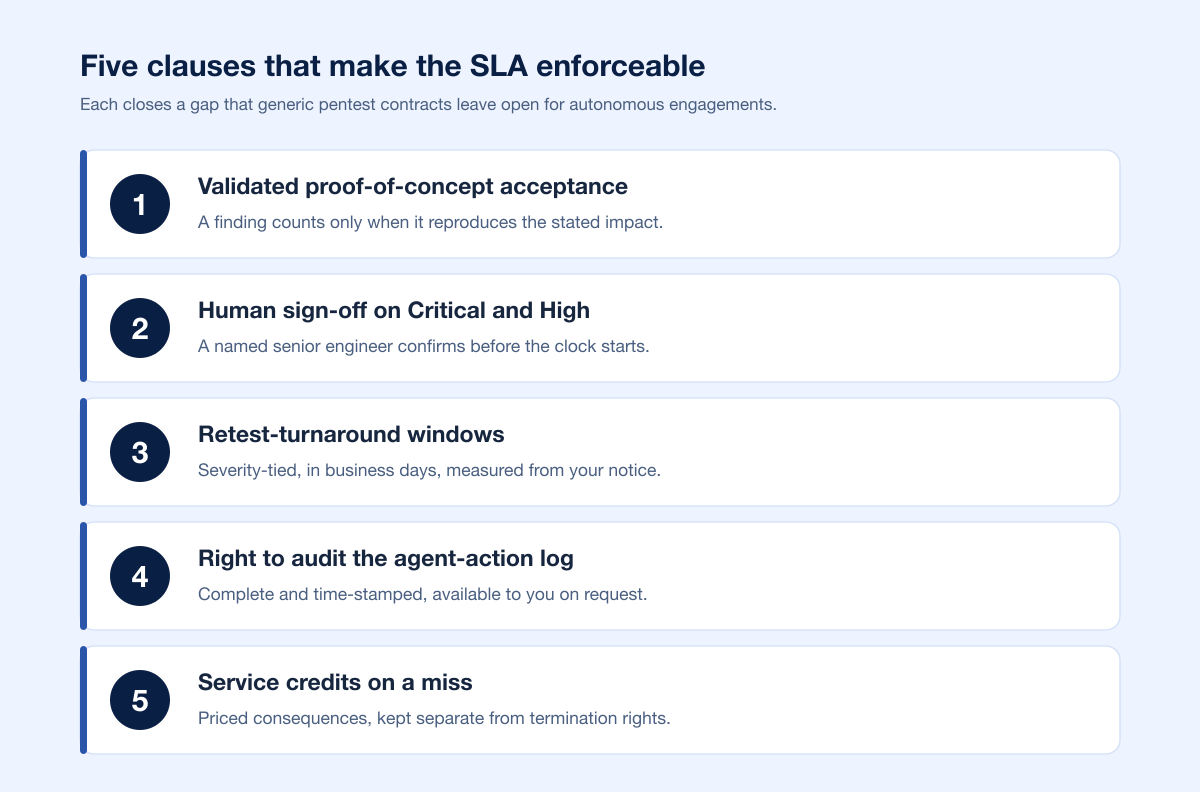
Five clauses make a continuous autonomous pentest SLA enforceable: a validated-proof-of-concept acceptance criterion, human sign-off on every Critical and High, severity-tied retest-turnaround windows, a right to audit the agent-action log, and service credits that fire when a window is missed. Everything else in the statement of work is scoping. These five are what a court, an auditor, or your own procurement team can actually hold the vendor to.
That distinction matters because the money at stake is real. The average United States data breach reached a record US$10.22M in 2025 (IBM Cost of a Data Breach Report 2025), and exploitation of vulnerabilities as an initial access vector grew 34% year over year to roughly one in five breaches (Verizon 2025 Data Breach Investigations Report). Buying continuous testing is a rational response. Buying it under an SLA you cannot enforce is not.
This post is a clause playbook for the person drafting or redlining the SOW and MSA: procurement, legal, or the security lead who owns the vendor relationship. The language below is paste-ready and written to be adapted with your own counsel. It picks up where the questions to ask an AI pentest vendor and the pilot bake-off scorecard leave off: what happens after you pick a vendor and have to write the contract.
Key takeaways
An SLA you cannot audit is a marketing line, not a service level. Every commitment needs an objective, buyer-verifiable trigger, or you should not pay for it.
Numeric false-positive-rate SLAs are the single most common red flag. The vendor controls the definition and the denominator. Replace them with a validated finding that ships a working proof-of-concept.
The remediation clock should start at your notice, not the agent's discovery. Otherwise the vendor can burn most of the window before you ever see the finding.
Human validation is a contract term, not a courtesy. A named senior engineer should confirm every Critical and High before it counts.
Service credits enforce the SLA, but must not swallow your termination rights. Credits price small misses; keep the right to walk away in a separate section.
Methodology and scope
The two figures cited above come from named primary sources published in 2025: the IBM Cost of a Data Breach Report 2025 (US average breach cost) and the Verizon 2025 Data Breach Investigations Report (vulnerability-exploitation trend), the freshest full-year analyses those publishers have released as of July 2026. Every figure links to its publisher so any claim can be audited. The clause language is drafting guidance drawn from offensive-security engagement practice, meant as a starting point to tailor with qualified legal counsel for your jurisdiction and risk posture. It is not legal advice.
Why autonomous pentest SLAs fail to be enforceable
Traditional pentest contracts were built around a discrete event: a team tests for two weeks, delivers a report, and the engagement ends. Continuous autonomous testing breaks that model. The agent runs against your assets on an ongoing cadence, findings arrive as a stream, and "the report" is a living queue. Language written for the old model leaves three gaps. Acceptance ambiguity: the contract never defines what makes a finding real, so every dispute is an argument about bug versus noise. Un-auditable metrics: vendors reach for false-positive rates, confidence scores, and coverage percentages you cannot verify because you never see the internal denominator. And a missing consequence: a target with no defined credit, remedy, or termination trigger is a preference, not a service level. The five clauses below close those gaps in order.
Clause 1: Validated proof-of-concept as the acceptance criterion
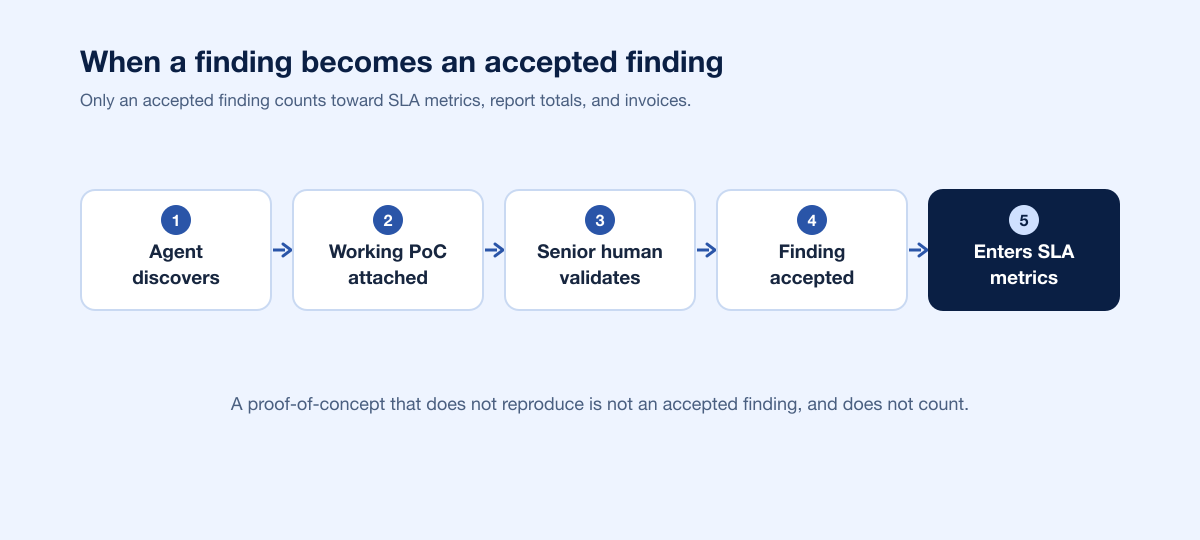
This is the keystone. Make the definition of an accepted finding a working, reproducible proof-of-concept, and most of the other disputes disappear. It also solves the false-positive problem without ever quoting a false-positive rate: a finding either reproduces or it does not.
Acceptance of findings. A finding is "Accepted" only when the Provider delivers, for that finding, a working proof-of-concept that reproduces the described impact against the in-scope target in the agreed test environment. Each Accepted finding shall include: (a) the exact request or action sequence required to reproduce it; (b) the observed result evidencing impact; (c) the affected asset, endpoint, and parameter; and (d) a severity rating with its CVSS v3.1 or v4.0 vector, or an equivalent documented rationale. A finding whose proof-of-concept does not reproduce on a good-faith attempt by the Client is not an Accepted finding and shall not count toward any SLA metric, invoice line, or report total. Automated confidence scores, model-assigned likelihoods, and statistical false-positive rates do not, by themselves, satisfy this criterion.
This flips the burden of proof onto the party that can meet it: the agent found the issue, so the vendor proves it. And because only Accepted findings count toward metrics and totals, the contract stops rewarding raw alert volume.
Clause 2: Human sign-off on Critical and High findings
Autonomous agents are good at breadth and speed. Senior humans are the check on severity and false accepts. In an autonomous engagement, the difference between a credible provider and a noisy one is whether a named person confirms the findings that will trigger an incident response.
Human validation of high-severity findings. Before any finding rated Critical or High is reported to the Client as Accepted, a named senior security engineer employed or engaged by the Provider shall review and confirm the finding and reproduce its proof-of-concept. The report shall record the validator's name or unique identifier, the validation timestamp, and confirmation that the proof-of-concept was reproduced by a human. A Critical or High finding carrying only automated validation shall be labeled "Unconfirmed" and shall not start any remediation or retest clock until human validation is complete.
Insist on the recorded validator identity and timestamp; that is what makes the clause auditable rather than aspirational. Human validation is not a sign the agent is weak. It is how you keep the highest-impact broken-authorization and business-logic findings from reaching your incident-response team unconfirmed.
Clause 3: Retest-turnaround and notification windows
A continuous engagement lives and dies on turnaround. Two clocks matter: how fast the vendor tells you about a new finding, and how fast the vendor retests once you say you have fixed it. Tie both to severity and, critically, measure them from your notice, not from the agent's internal discovery.
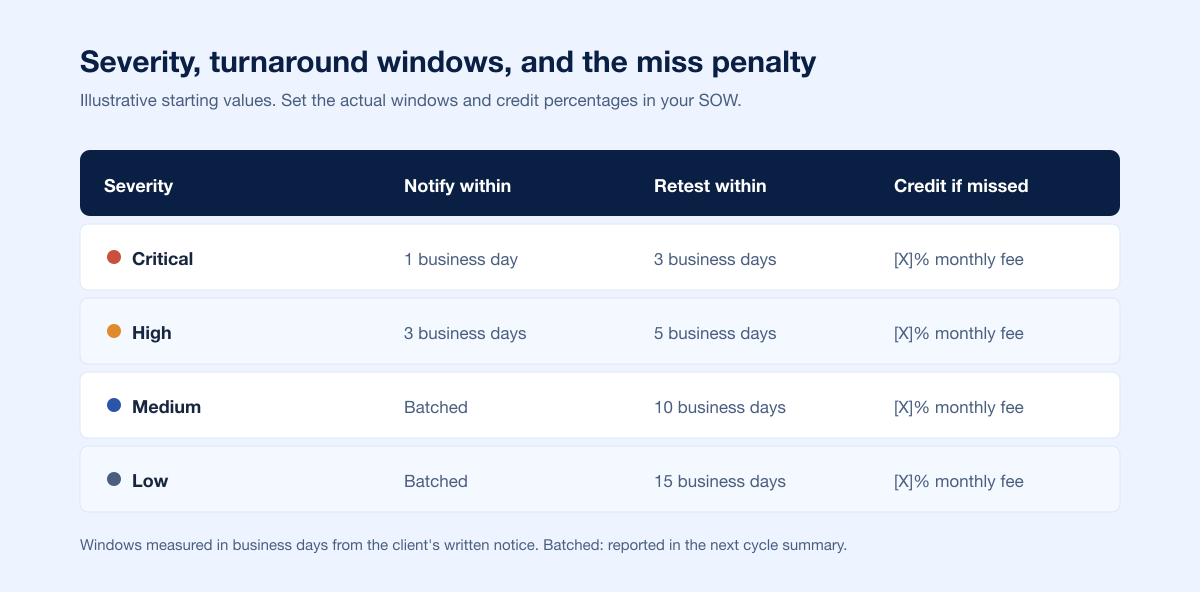
Finding notification. The Provider shall notify the Client of each newly Accepted Critical finding within one (1) Business Day of human validation, and each newly Accepted High finding within three (3) Business Days, through the agreed secure channel.
Retest turnaround. Following the Client's written notice that a reported finding has been remediated, the Provider shall retest that specific finding and deliver a pass or fail result within the following windows, measured in Business Days from the Client's notice: Critical, three (3); High, five (5); Medium, ten (10); Low, fifteen (15). A retest "pass" requires that the original proof-of-concept no longer reproduces the described impact. The Provider shall not close a finding as remediated without a documented retest result.
The retest-pass definition matters as much as the window. "We reran the scan and it looks clean" is not a pass; reproducing the original proof-of-concept and confirming it no longer works is. That is the same discipline that makes a good continuous PTaaS engagement log readable after the fact.
Clause 4: Right to audit the agent-action log
An autonomous agent acts against your systems without a human driving every keystroke. You are entitled to a complete record of what it did. This clause is also your safety backstop: it is how you reconstruct events if the agent touches something out of scope or a production incident coincides with a test window.
Right to audit the agent-action log. The Provider shall maintain a complete, tamper-evident, time-stamped log of every action taken by the autonomous testing agent against Client assets, including the target and endpoint touched, the request issued, the payload class, the account or role used, and the start and stop time of each testing session. The Provider shall retain this log for no less than twelve (12) months and shall make it available to the Client, or to an independent auditor engaged by the Client under a confidentiality agreement, within five (5) Business Days of a written request. The log shall be sufficient for the Client to reconstruct what the agent did, when, and against which asset.
If a vendor calls its action log "proprietary" and refuses an audit right, treat that as disqualifying. There is no legitimate reason to withhold a record of actions taken against your own environment. Production-testing scope deserves its own rules of engagement as well; the autonomous testing against production guidance pairs with this clause.
Clause 5: Service credits and what a miss triggers
A service level with no consequence is a preference. Price the small misses with credits, price the serious ones with a stronger remedy, and keep both separate from your right to terminate.
Service credits. If the Provider fails to meet a Finding Notification window or a Retest Turnaround window for a given finding, the Client shall be entitled to a service credit equal to [X]% of the monthly fee per affected finding, up to a cap of [Y]% of the monthly fee in the affected billing period. If the Provider reports a Critical or High finding as Accepted that is subsequently shown not to reproduce (a "False Accept"), the Provider shall, at no additional charge, re-validate all open Critical and High findings from the same testing cycle. Service credits are the Client's exclusive financial remedy for missed service levels and do not limit the Client's termination rights under Section [] or any indemnity under Section [].
Escaped finding review. If an in-scope vulnerability of Critical or High severity is identified by a third party or exploited in an incident during the term, and that vulnerability was within the agreed scope and reachable by the testing methodology, the Provider shall, at no additional charge, conduct and deliver a root-cause review explaining why the finding was not surfaced, and shall re-baseline the affected scope.
Fill in the bracketed percentages during negotiation. A common starting posture is a per-finding credit in the low single digits with a monthly cap around 10 to 25 percent, adjusted to your contract value and risk appetite. The escaped-finding clause is deliberately scoped to what was in-scope and reachable, so it does not become an open-ended warranty against every possible bug.
Red-flag clauses to strike or rewrite
Some clauses look protective and are not. Watch for these in a vendor's paper and replace each with the enforceable version.
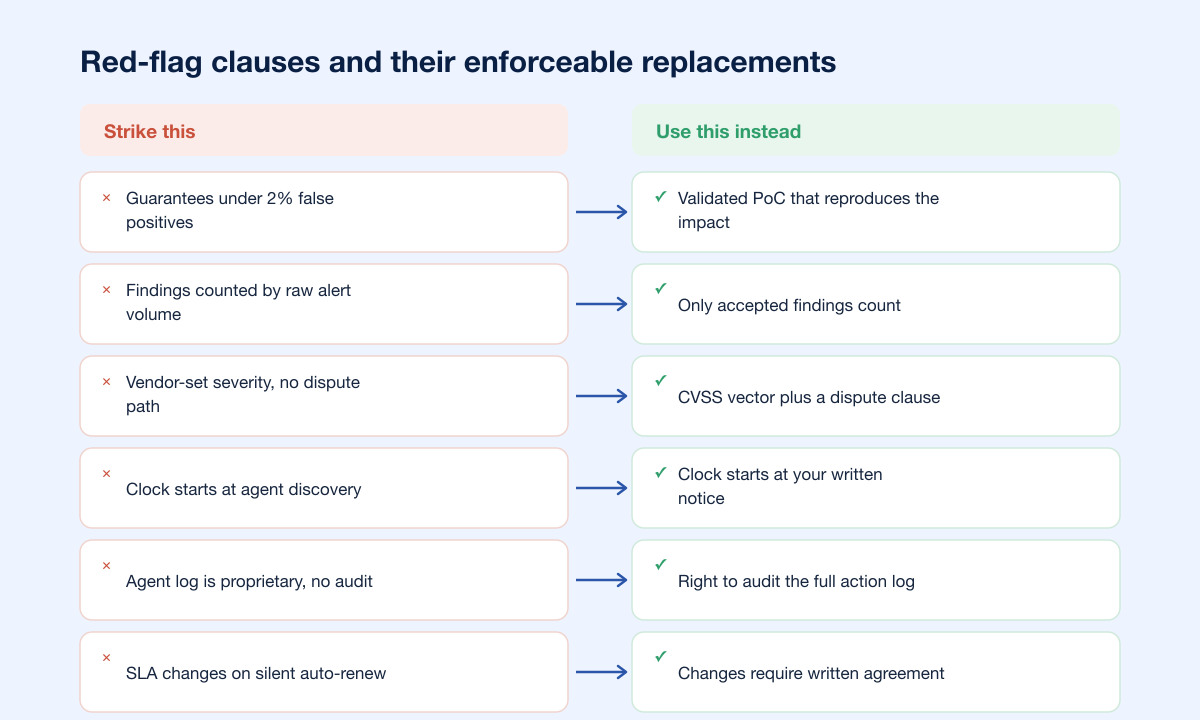
Numeric false-positive-rate SLA ("Provider guarantees under 2% false positives"). Un-auditable, because the vendor defines and counts the denominator. Replace with the validated-PoC acceptance criterion in Clause 1.
Findings counted by raw alert volume. This rewards noise. Count Accepted findings only.
Vendor-defined severity with no vector and no dispute path. Require a CVSS vector or documented rationale, plus a clause letting you contest a rating.
"Continuous" with no defined cadence or scope. Define what continuous means: on every pull request, on a fixed interval, on change, and against exactly which asset inventory.
Remediation clock that starts at discovery. It should start at your notification or validation. See Clause 3.
Agent logs described as proprietary and withheld. Non-negotiable audit right per Clause 4.
Blanket production-testing authorization with no rules of engagement, rate limits, or kill switch.
Unilateral SLA changes on auto-renew. Any change to service levels should require written agreement, not a quiet update to a linked terms page.
What this means for the buyer
Two people should co-own this contract: the security lead who knows what "reproduces the impact" means in practice, and the procurement or legal owner who knows credits, caps, and termination. The clauses above let both work from the same language. A provider confident in its methodology will accept them without much friction, because they simply describe good practice.
That is the posture Stingrai takes. Stingrai commits in-contract to validated findings with a working proof-of-concept as the acceptance criterion, senior-human sign-off on every Critical and High, defined finding-turnaround targets, and a complete, logged agent-action audit trail you can request. Snipe, Stingrai's autonomous web-application agent, is scoped to the web-app layer where it hunts IDOR, business-logic, and broken-authorization flaws using black-box and white-box testing, generates AutoFix pull requests, and can gate merges as a pull-request check, with senior pentesters working alongside it throughout the engagement. The same evidence discipline produces clean artifacts for your SOC 2, ISO 27001, and PCI DSS compliance program. The pricing page is the canonical reference for scope and packaging, and red teaming sits alongside PTaaS when you need adversary emulation on top of continuous testing.
Frequently asked questions
What clauses should I put in a continuous autonomous pentest contract so the SLA is actually enforceable?
Five. A validated-proof-of-concept acceptance criterion, so a finding only counts when it reproduces. Human sign-off on every Critical and High before the clock starts. Severity-tied retest-turnaround windows measured from your notice. A right to audit the complete agent-action log. And service credits that fire when a window is missed, kept separate from your termination rights. Those five turn a target into an enforceable service level.
Why should I avoid a false-positive-rate SLA?
Because you cannot audit it. The vendor defines what a false positive is and controls the total it is measured against, so "under 2% false positives" is a number you take on faith. A validated finding with a reproducible proof-of-concept is objective: it either reproduces in your environment or it does not. Make reproduction the acceptance criterion and the false-positive question answers itself.
What is a validated-finding acceptance criterion?
It is contract language defining an "accepted" finding as one accompanied by a working proof-of-concept that reproduces the stated impact against your in-scope target, with reproduction steps, evidence, the affected asset, and a severity vector. Findings that do not reproduce do not count toward SLA metrics, report totals, or invoices. It is the single most useful clause in an autonomous pentest contract.
When should the remediation and retest clock start?
At your notification or human validation, never at the agent's internal discovery. Autonomous agents run continuously, so a clock that starts at discovery lets the vendor consume most of the window before you have seen the finding. Measuring from your written notice keeps the commitment honest.
What retest-turnaround windows are reasonable?
A common starting point, in business days from your remediation notice, is three for Critical, five for High, ten for Medium, and fifteen for Low. Adjust to your risk posture and contract value. The more important half of the clause is the pass definition: the original proof-of-concept must no longer reproduce the impact, not merely a clean rescan.
What should the agent-action audit log contain?
Every action taken against your assets: target and endpoint, request issued, payload class, account or role used, and session start and stop times, all time-stamped and tamper-evident. Require at least twelve months of retention and a defined turnaround, for example five business days, to produce the log to you or an independent auditor under NDA. A vendor that will not grant this right is a vendor to pass on.
How do service credits and termination rights fit together?
Credits price routine misses such as a blown retest window, usually as a percentage of the monthly fee per finding with a monthly cap. Termination rights cover material or repeated failure and should live in a separate section, so accepting a small credit never signs away your ability to walk away. State explicitly that credits are the exclusive financial remedy for service-level misses but do not limit termination or indemnity.
Does Stingrai agree to these clauses?
Yes. Stingrai commits in-contract to validated findings with a working proof-of-concept as the acceptance criterion, senior-human sign-off on every Critical and High, defined finding-turnaround targets, and a complete, logged agent-action audit trail available on request. Snipe operates at the web-application layer with senior pentesters working alongside it throughout. See the questions to ask an AI pentest vendor for the vetting steps that precede the contract.
Related reading
References
IBM. Cost of a Data Breach Report 2025. July 2025. https://www.ibm.com/reports/data-breach. Global and per-country breach-cost analysis; source for the record US$10.22M United States average.
Verizon. 2025 Data Breach Investigations Report. April 2025. https://www.verizon.com/business/resources/reports/dbir/. Analysis of breach initial-access vectors; source for the 34% year-over-year growth in vulnerability exploitation to roughly one in five breaches.