





An enterprise infrastructure security assessment should examine how access crosses network, identity and cloud boundaries, not only whether a device appears in a scanner report. NIST SP 800-207 explains that trust cannot be inferred from an asset's network location alone and that modern enterprise resources include on-premises and cloud systems, users and services.
Quick answer. An infrastructure security assessment is a scoped technical evaluation of the paths into and through an organization's infrastructure. For an enterprise buyer, the useful scope names external and internal starting points, identity privileges, cloud accounts, sensitive resource boundaries, safe-test rules and the evidence required to prove a finding. Stingrai can deliver human-led testing across network, Active Directory and cloud workstreams, with the exact boundaries agreed before testing.
“Infrastructure security assessment” is a broad purchasing term. One quote may describe an external vulnerability scan; another may describe internal network penetration testing; another may examine cloud identity and workload trust. Those outputs answer different questions. The buyer's first job is to define the security decision, then specify the methods that can answer it. This guide provides a procurement framework for mid-market and enterprise teams that operate hybrid environments and need a report engineering, risk and assurance teams can all use.
The emphasis here is the connection between domains. A dedicated cloud security assessment guide covers AWS, Azure and Google Cloud in depth. Separate external network and internal network guides explain those engagements. The procurement problem in this article is how to avoid an untested handoff between them.
Define the outcome before naming the tools
An assessment starts with an enterprise question. For example, can a remote contractor identity reach an administrative workload through a permitted access path? Can a compromised ordinary directory account reach a cloud control plane role? Can a service exposed through a partner network move into a more sensitive segment? These are hypothetical questions, not claims about any Stingrai customer. Each can be answered only if the scope includes the relevant starting identity, network route, policy decision and target resource.
A quote that lists products without an outcome is hard to judge. “Cloud review plus network scan” could cover many assets and still miss the trust path that matters. A better brief states the starting point, the boundary to test and the business consequence of crossing it. It also states what would count as evidence: an approved role matrix, a safe proof of reachability, a configuration chain, a confirmed access-control result and a remediation owner.
NIST SP 800-115 describes planning and conducting technical tests, analyzing findings and developing mitigation. Its guidance distinguishes among technical techniques and their limitations. A buyer can use that principle to separate three activities in a proposal:
Activity | Useful question | Output to expect | Limit to record |
|---|---|---|---|
Inventory and exposure review | What assets, services and access paths are in the approved estate? | Asset schedule, owner, reachability and exclusions | Discovery can miss unmanaged assets and hidden dependencies |
Configuration and identity review within a test | Do policy and privilege settings create a plausible unintended path? | Relevant policy context, identity relationship and test hypothesis | A configuration observation alone may not prove impact |
Authorized penetration testing | Can a tester validate selected access or privilege boundaries safely? | Reproducible, bounded proof, affected assets and remediation | Proof is constrained by permissions, safe-test rules and time |
A provider may include one or more of these activities. The contract should say which are included and what “validated” means. Do not assume a scanning platform's dashboard is equivalent to human confirmation, or that a penetration test automatically covers every configuration control. The buyer must decide which evidence is needed for the risk decision at hand.
Choose the decision owner
The owner could be a CISO, cloud platform lead, infrastructure director, identity team, acquisition team or customer assurance owner. Name the person who can approve the scope and accept the result. A network team can authorize its devices but may not control a cloud account owned by a product group. An identity team can explain role assignments but may not own the third-party application that consumes them. An assessment spanning those boundaries needs a sponsor with authority to coordinate each owner.
That coordination is not bureaucracy for its own sake. CREST's Guide to Penetration Testing recommends approved objectives and timelines, supplier selection criteria and follow-up, with a focus on critical systems. It also calls for protection of sensitive information and recorded scope and exclusions. A buyer who cannot name the owner of an asset cannot confidently authorize testing of it.
Map the trust path, not just the hardware list
A conventional infrastructure inventory names hosts, subnets, firewalls, directories and cloud accounts. That inventory is necessary but incomplete. The assessor needs to know who or what can request access, which control makes the decision, what resource is reached and who owns the policy. The same workload may be protected by a VPN, an identity provider, a cloud role, a network rule and an application permission. Testing one layer without understanding the others can produce a false sense of coverage.
NIST SP 800-207 shifts attention from a static perimeter to users, assets and resources. NIST SP 800-207A adds that cloud-native access decisions may depend on application and service identities as well as network parameters and user identities. A hybrid assessment scope should therefore record both the technical route and the authority carried along it.
Use a boundary register such as this:
Boundary | Starting context to provide | Control to examine | Evidence of a useful test |
|---|---|---|---|
External entry | Internet-exposed services, remote access gateways and domains owned by the buyer | Exposure, authentication and allowed traffic | Reachability, affected service, approved validation and owner |
Internal segment | VLAN, jump host, user workstation or other agreed foothold | Segmentation and administrative reachability | Starting position, permitted route, blocked route and observed result |
Human identity | Ordinary, support, privileged and partner test identities | Group membership, role assignment, conditional access and delegation | Effective permissions and a bounded escalation or denial result |
Service identity | Workload account, application registration or automation credential | Trust policy, consent, token audience and resource permission | Identity chain and target access outcome under test conditions |
Cloud control plane | Named account, subscription or project | Privilege, cross-account trust, resource policy and management reachability | Approved path, relevant policy, safe proof and fix owner |
Workload and data | Named application, storage or administrative service | Resource authorization and movement across tiers | Data boundary tested, representative proof and limitation |
The register is an editorial buyer tool. It does not assert that NIST requires these exact rows. Its purpose is to make the handoff visible. An external gateway may authenticate a person but pass a broad service identity downstream. An internal segment may block direct traffic but leave an administrative route through a different network. A cloud resource may be private on the network while a policy grants wider access. The assessor needs enough context to test the intended boundary without taking unsafe actions.
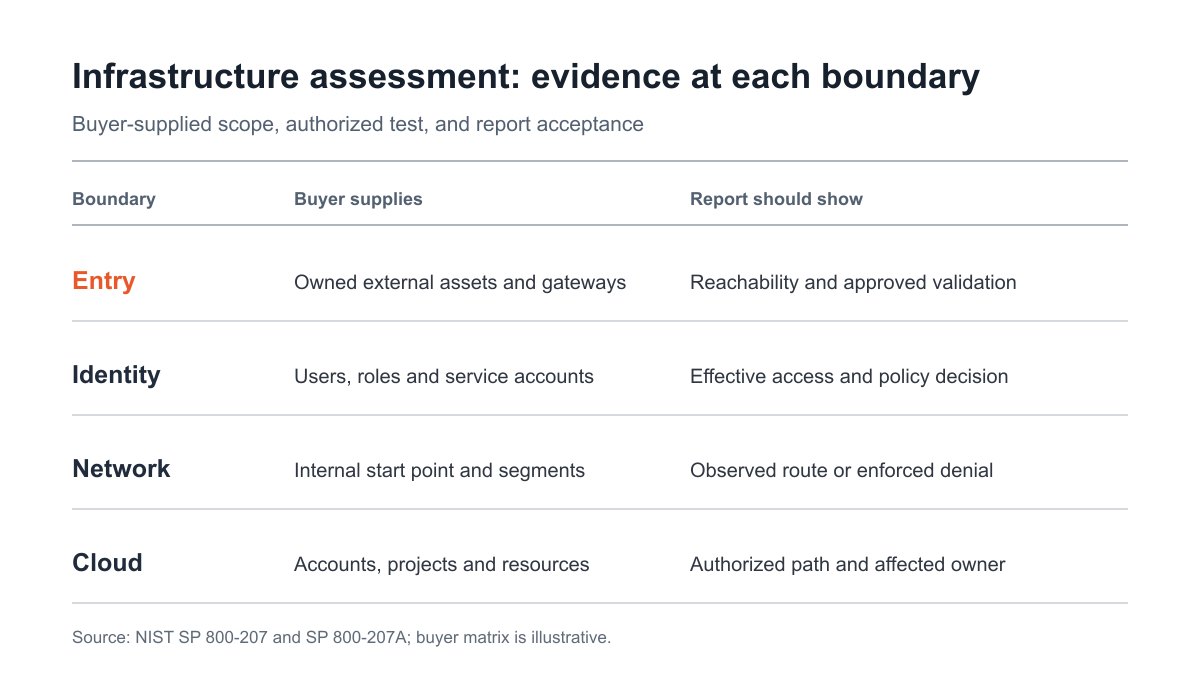
Figure 1: A buyer matrix for evidence at the entry, identity, network and cloud handoffs. Source: NIST SP 800-207 and NIST SP 800-207A.
Make the starting position explicit
“Internal penetration test” is not a starting position. A tester might begin as an ordinary directory user, a non-domain endpoint, a guest on a partner network, a service identity or a device placed in a selected segment. Each presents a different question. Similarly, a cloud test could start with read-only inventory access, a low-privilege workload identity or an externally exposed resource. The provider should state what the starting context permits and what it will try to demonstrate.
The buyer should provide representative test identities and approved environments. Do not make testers infer authority from credentials handed over informally. Put account ownership, permitted actions, sensitive-data limits and emergency contacts into the rules of engagement. NIST's ROE definition describes these as constraints established before the test that authorize defined activities.
Separate the workstreams without losing their connections
The assessment may be delivered by specialists working in distinct workstreams. That separation improves safety and expertise, but the final report must reconcile findings that cross boundaries.
External network and remote access
The external workstream examines approved internet-facing services, gateways and exposed management interfaces. The buyer supplies the domains and IP ranges it owns or has permission to test, plus hosted or third-party exclusions. Ask whether the provider will validate a weakness safely or only list a scanner finding. A result that says “port open” should not be treated as the same evidence as a demonstrated unintended access path.
Stingrai's network testing service covers internet-facing perimeter and internal network paths, including exposed services and VPN appliances. The provider should explain where an external assessment ends. A remote access gateway may be tested for exposure, while the identity policy behind it belongs in a separate identity workstream. A proposal that includes the gateway but omits the account roles may miss the decision the buyer cares about.
Internal network and segmentation
The internal workstream starts from an agreed location and tests whether a user or device can reach systems across intended boundaries. The scope should list the segments, critical resources and sensitive systems that are off-limits or require a particular test window. A broad “all internal IPs” line can be unsafe and still leave the decisive control unspecified.
Ask for both positive and negative expectations. Which route should work for an ordinary employee? Which route should be blocked? Who approved an exception? A report that maps these expectations to observed results is more actionable than a long host list. When a path reaches an identity system or cloud management interface, the provider should pause at the authorized boundary or hand off to the relevant specialist under agreed rules.
Active Directory and privilege paths
Directory assessment examines how an ordinary or delegated identity could gain broader power, including group permissions, trusts and privileged account handling. Stingrai's Active Directory service identifies misconfigurations, excessive privileges and attack paths, including domain and forest trust relationships. The buyer should specify the starting account, forests and domains, privileged tiers, test windows and sensitive systems.
The output should show the chain from starting privilege to affected resource, with each control and owner named. It should also distinguish a theoretical relationship graph from a path the testers actually validated. The latter may be constrained by safe-test limits. A provider can still report a likely path with a clear confidence statement and ask for approval before any intrusive validation.
Cloud control plane and workloads
The cloud workstream examines named accounts, subscriptions or projects and the identities and workloads they host. Stingrai's cloud testing service scopes cloud resources and identity sources under the provider's testing policy and written resource-owner authorization. A buyer should provide the relevant management hierarchy, role assumptions, service identities, critical data stores and permitted workloads.
Cloud posture tools can identify misconfigurations. A scoped offensive assessment asks how a finding may connect to a real access path. The provider should state whether it will only review policy, validate a low-risk path, or attempt a bounded chain across resources. The final report should identify the start and end of any demonstrated path, affected control plane or workload, data-handling safeguards and what remains untested.
Hybrid and partner handoffs
The most valuable question may sit between workstreams. NIST SP 1800-35 describes secure authorized access to enterprise resources distributed across on-premises and multiple clouds, including a hybrid workforce and partners. The buyer should map the access path used by remote staff, contractors, suppliers and applications. That map can show where network access, identity assertion, service role and resource authorization are independently enforced.
A hybrid handoff might involve an on-premises directory account federated to a cloud role, a partner VPN that can reach a management subnet, or a service account that crosses between projects. These are hypothetical examples. The provider should test only the named path and limits agreed with each owner. It should report when the complete chain cannot be validated because a third party, safety rule or missing account blocks progress.
Turn the map into an authorized statement of work
CREST's requirements guidance calls for defined scope, exclusions, regularity, legality, data protection and qualified testers. A buyer should insist on a scope annex that can be read by both the tester and the system owner.
SOW field | Buyer-supplied detail | Provider response to require |
|---|---|---|
Objective | The decision the assessment supports and the critical resources involved | Methods and evidence mapped to that objective |
Assets and owners | Domains, IP ranges, directories, cloud accounts, workloads and third-party boundaries | Explicit in-scope list and exclusions |
Starting context | Test accounts, network locations, cloud roles and provided documentation | What can be tested from each context |
Boundary hypotheses | Expected access and denial outcomes for important paths | Proposed test cases and safe validation depth |
Authorization | Written resource-owner approval and provider policy conditions | Rules of engagement and change-control process |
Safety | Test window, load limits, data restrictions, stop contacts and incident coordination | Method adjustments and escalation route |
Output | Executive view, technical evidence, remediation owners and retest terms | Sample report and acceptance criteria |
A scope can be modular. It may begin with an external and internal network test, then add Active Directory and cloud scopes once owners are ready. The important point is to preserve the cross-boundary question. If each module is purchased separately, name a program owner to combine results and resolve inconsistent severity or duplicated findings.
A sample SOW clause, to adapt with legal and technical owners, could read:
The provider will assess the named external network, internal starting position, directory scope and cloud accounts listed in the annex. Testing will use only approved identities and methods under signed rules of engagement. The report will distinguish observed paths from unvalidated hypotheses, identify each affected trust boundary and owner, document material exclusions, and provide remediation guidance and a retest record for corrected findings. A newly discovered asset or third-party dependency requires written scope approval before testing.
This language is a buyer example, not a universal contract form. The contract should also address handling of credentials, logs and sensitive evidence. Ask for the provider's escalation process when a test exposes a serious issue during the engagement, and specify who in your organization can direct a pause or safe proof.
Authorize cloud and third-party surfaces separately
A buyer may own an application but not the shared platform that hosts part of it. A network path may traverse a supplier's environment. Cloud platforms have their own testing policies. A broad purchase order does not necessarily grant permission across every connected asset. Name the entity that owns each target and the authority for the test. If a boundary cannot be tested, the report should record it as a limitation rather than silently treating it as covered.
The same principle applies to live data. Define whether the test uses synthetic records, approved production accounts or redacted examples. Proof should be proportionate to the question. The goal is to demonstrate the security property that failed or held, not to extract a large volume of sensitive data.
Compare vendors by evidence, not an “infrastructure” label
The service name alone does not tell you whether the provider is qualified for all workstreams. CREST recommends documented supplier selection criteria and emphasizes suitable qualifications and experience. Ask each bidder to respond to the same boundary register, SOW fields and acceptance criteria.
A strong response explains the actual people assigned to the network, directory and cloud portions; their relevant experience; the testing methods and validation depth; how findings move between specialists; and how reports are quality reviewed. It should also identify where the provider will use automation and where human judgment is required. A vague “full infrastructure coverage” claim should prompt a request for named assets and start positions.
Use a comparison sheet with five questions:
Buyer question | Strong response | Weak response to challenge |
|---|---|---|
Can the team test the named boundary? | Specific method and expertise for the starting identity, network route and resource | A generic tools list |
Can it work safely? | Signed rules, owner approval, stop conditions and test-window plan | A promise to “avoid disruption” without a process |
Can it prove impact? | Safe validation criteria and a distinction between observed and inferred paths | Raw findings treated as confirmed |
Can engineering fix it? | Root-cause context, affected policy or asset, owner and remediation | Severity label without an actionable control |
Can assurance use the result? | Scope, dates, limitations, retest and redaction terms | A score or certificate with no traceable scope |
Price should be compared only after the work is normalized. One quote may include cloud identity and retesting, while another covers external IP addresses only. A higher fee may reflect a deeper boundary test or may reflect services the buyer does not need. The buyer should ask for a workstream-by-workstream statement of effort and deliverables. Avoid deciding from a per-host rate when the critical question is an identity trust path.
Define evidence acceptance before the first scan
An assessment is useful when the report lets a future reader reconstruct the tested path and its limits. CREST's reporting guidance calls for test narrative, evidence, associated technical risk and remediation, with root-cause and stakeholder follow-up. Translate that into an acceptance review.
A final evidence pack should contain the approved scope and rules, asset and account list, methods, start positions, relevant configuration context, confirmed findings, safe proof, remediation and retest status. It should say which systems or paths were not reachable, which third-party assets were excluded and whether an observation was inferred rather than validated. The executive summary should make the business consequence clear without hiding uncertainty.
For a cross-domain finding, require a path narrative with each handoff. A useful record might say that a test identity reached a management resource through a permitted remote access route, then identify the network rule, identity grant and cloud policy that enabled it. The report should avoid compressing that into a single generic “critical misconfiguration.” Different teams may own different parts of the fix.
Retest the boundary, not just the ticket
After remediation, ask the provider to repeat the relevant starting context and verify the control that was changed. If a firewall rule was fixed, the identity route may still be open through another path. If a cloud policy was narrowed, an inherited role may still grant access. If the test environment or privilege has changed, record the difference so the retest result is not overstated.
Close each finding with one of three explicit outcomes: verified fixed under stated conditions; risk accepted by an identified owner; or unresolved because the required access, deployment or authorization was unavailable. This is an editorial evidence framework. It prevents a “closed” status from concealing an untested change.
Where Stingrai fits and where to be precise
Stingrai is a CREST-accredited penetration testing company founded in Toronto. Its human-led network, Active Directory and cloud services can be scoped as separate workstreams for a hybrid infrastructure assessment. For human-led engagements, Stingrai uses two named penetration testers from a team holding OSCE³, OSWE, OSEP, CREST CRT and CISSP certifications, with report review by a team lead and engagement partner, as described on its web application testing service page.
The useful first conversation is a boundary map, not a request for a universal “infrastructure score.” Bring the external range, internal starting points, directory and cloud ownership, important resource paths, existing scan or review results and any fixed evidence date. Stingrai can then quote the offensive testing work that is authorized and necessary for the decision. If the buyer also needs broad asset management, continuous posture tooling or an independent controls audit, specify those requirements separately so the penetration testing statement of work stays clear.
NIST CSF 2.0 is helpful for communicating outcomes, but NIST says it does not prescribe how to achieve them. A Stingrai report can support a compliance or customer assurance program with evidence of the scoped testing and remediation. The buyer's own framework mapping should reflect the actual controls, period and obligations that apply.
Frequently asked questions
What is an infrastructure security assessment?
An infrastructure security assessment is a scoped technical evaluation of the systems and trust boundaries that connect external access, internal networks, identities and cloud resources. The methods may include inventory review, configuration analysis and authorized penetration testing. A buyer should require the proposal to name the specific methods, assets, starting positions and evidence delivered.
Is an infrastructure security assessment the same as a network penetration test?
No. A network penetration test focuses on reachable services and paths from an agreed external or internal starting position. A broader infrastructure assessment may also examine directory privileges, service identities, cloud control-plane trust and the handoffs between them. The scope should say exactly which workstreams are included.
Does a vulnerability scan count as an infrastructure security assessment?
A vulnerability scan can contribute evidence about known issues and reachable assets, but it does not by itself establish that identity and cross-boundary controls work as intended. NIST SP 800-115 describes multiple technical testing methods and their limitations. Buyers should ask which alerts are validated, which paths are tested by people and what remains untested.
What should an enterprise infrastructure assessment include?
It should include the critical assets and owners, external and internal starting positions, relevant human and service identities, cloud accounts and resource boundaries, authorized methods, exclusions, safe-test rules, reporting and retesting. The exact mix depends on the decision the assessment must support. A common boundary register helps prevent gaps between network, directory and cloud teams.
How do we scope a hybrid cloud and on-premises assessment?
Map a business-critical resource and trace the route from user or service identity through network access, identity decisions and cloud or on-premises controls. Provide the provider with named accounts, projects, directories, routes and expected access outcomes. NIST SP 1800-35 describes enterprise resources distributed across on-premises and multiple cloud environments; it does not prescribe a single penetration testing scope.
Who should authorize infrastructure penetration testing?
The owner of each target and the organization directing the engagement should give written authorization under agreed rules of engagement. Cloud, partner and supplier systems may require separate permission or policy review. The rules should identify approved assets and actions, test window, data limits, stop contacts and scope-change process before testing begins.
What deliverables should we require from the provider?
Require approved scope and methods, tested assets and identities, observed path narratives, safe evidence, affected controls and owners, limitations, remediation guidance and retest outcomes. CREST recommends reports with narrative, evidence, technical risk and remediation. Ask for a redacted sample report before selecting a provider.
Can one provider assess network, Active Directory and cloud together?
Yes, if it has the appropriate specialists and can coordinate the work under one approved boundary map. The buyer should ask who performs each workstream and how a finding moves between them. A shared program owner and report acceptance criteria matter even when multiple providers are used.
Does NIST require an infrastructure security assessment every year?
No universal annual mandate appears in NIST SP 800-115, SP 800-207 or CSF 2.0. Those documents provide testing and risk-management guidance, while CSF 2.0 expressly does not prescribe how outcomes are achieved. Determine frequency from the organization's risk, material changes and applicable law, contract or standard.
How should we compare infrastructure security assessment quotes?
Compare quotes against the same asset list, starting identities, test depth, authorization constraints, report format and retest terms. A quote for an external scan and one for cross-domain penetration testing are different purchases. Require bidders to identify exclusions and the evidence each workstream will produce before comparing fees.
Related reading
Sources
NIST SP 800-115, Technical Guide to Information Security Testing and Assessment
NIST SP 800-207A, Access Control in Cloud-Native Multi-Cloud Environments
Talk to Stingrai
Bring your boundary register and asset owners to Get a Quote, or book a free discovery call to scope human-led network, Active Directory and cloud testing with clear evidence and retest terms.



