




On 27 June 2017 a network cyber-attack disrupted Merck's worldwide operations, "including manufacturing, research and sales operations," according to the company's second-quarter earnings release. It cost the company approximately US$260 million in lost 2017 sales, per its full-year release, and the temporary production shutdown it caused was one reason Merck borrowed GARDASIL 9 doses from the US Centers for Disease Control and Prevention's pediatric vaccine stockpile. Each fact comes from Merck's own filings with the US Securities and Exchange Commission.
The attackers kept coming. On 16 July 2020, Canada's Communications Security Establishment and the UK National Cyber Security Centre, backed by the US NSA and CISA, reported that APT29, a group they assess as "almost certainly part of the Russian intelligence services," had targeted organisations "involved in COVID-19 vaccine development in Canada, the United States and the United Kingdom," highly likely to steal information and intellectual property about vaccine development and testing (advisory).
Regulators have caught up. ICH E6(R3), the good clinical practice guideline now adopted by the FDA, the European Medicines Agency and Health Canada, lists penetration testing among the security controls a sponsor should consider for trial systems, and the draft revision of EU GMP Annex 11 goes further. This guide ranks the twelve firms most worth shortlisting for pharma and biotech companies, CROs and CDMOs, eClinical and ePRO vendors and lab informatics providers in the US and Canada. Every vendor claim was checked on the vendor's own site on 25 September 2026.
Where Stingrai fits: Stingrai is a CREST-accredited penetration testing service provider at firm level, founded in Toronto in 2021 with a London office. Each human-led engagement is staffed by two named penetration testers holding OSCE³, OSWE, OSEP, CREST CRT and CISSP, with 18 published CVEs across the team. For a sponsor, CRO or eClinical vendor that means EDC, ePRO and sponsor portals tested across every study role, the APIs and patient apps behind them, AWS and Azure research tenancies, Entra ID and Active Directory, delivered as a one-time annual test or a continuous program with retesting and an attestation letter included. Published pricing is US$3,000 for an Autonomous Pentest and US$6,800 for a Hybrid Pentest covering one web application and its APIs (pricing); every other scope is quoted.
Quick answer: the best penetration testing companies for pharma, biotech and life sciences in 2026
Stingrai (Toronto, Ontario) for CREST-accredited testing by named penetration testers across eClinical platforms, cloud and identity
Kroll (New York, New York) for penetration testing and incident response from one firm
NetSPI (Minneapolis, Minnesota) for enterprise testing programs
Protiviti (Menlo Park, California) for testing alongside acquisition due diligence
Praetorian (Austin, Texas) for cloud-native and AI research scope
Optiv (Leawood, Kansas) for drug manufacturers securing plant and corporate networks
Clearwater (Nashville, Tennessee) for CROs and research sites inside HIPAA
Coalfire (Chicago, Illinois) for SaaS vendors running HIPAA or FedRAMP programs
Bishop Fox (Tempe, Arizona) for product security at research software companies
NCC Group (Manchester, UK; US regional headquarters in Chicago) for hardware and multinational scopes
RSM US (Chicago, Illinois) for mid-market biopharma wanting GxP-aware advisors and testing
Sikich (Chicago, Illinois) for emerging companies building a validated quality system
What pharma, biotech and life sciences companies are actually required to test
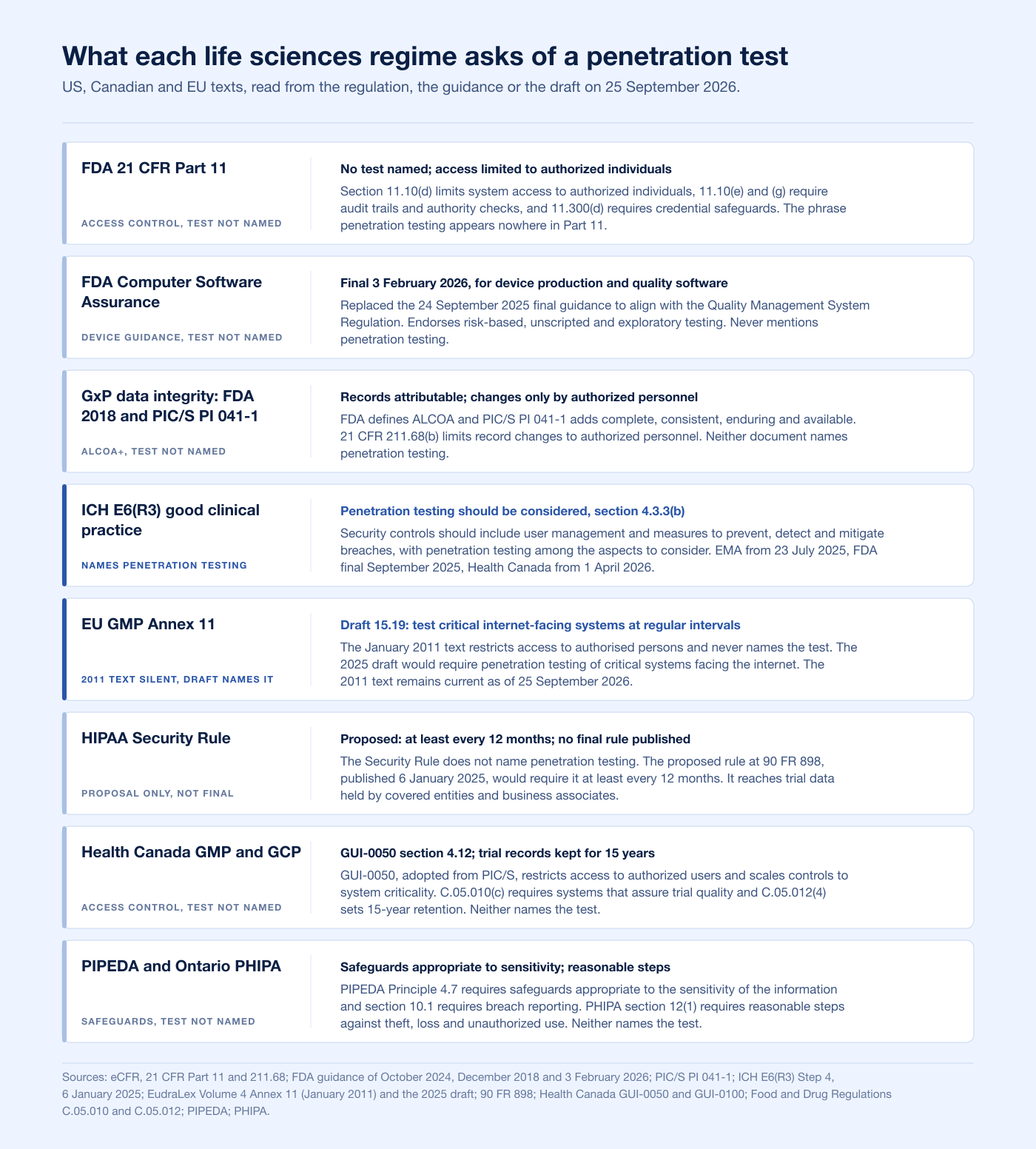
Nine regimes turn up in life sciences security questionnaires. Only two name penetration testing as a control in their own text: ICH E6(R3), now adopted in the US, the EU and Canada, and a draft revision of EU GMP Annex 11 that is not final. SOC 2 mentions it once in a non-binding point of focus, and the HIPAA rule that would require it is still a proposal. The rest require access control, audit trails and safeguards that a penetration test is the most direct way to prove, and none of the adopted texts sets a testing calendar.
US: Does 21 CFR Part 11 require penetration testing?
No. The phrase appears nowhere in 21 CFR Part 11. For closed systems, 21 CFR 11.10 requires "(d) Limiting system access to authorized individuals," secure, time-stamped audit trails at 11.10(e) and authority checks at 11.10(g) "to ensure that only authorized individuals can use the system, electronically sign a record ... alter a record, or perform the operation at hand." Section 11.300(d) adds "transaction safeguards to prevent unauthorized use of passwords and/or identification codes."
FDA's October 2024 final guidance on electronic systems in clinical investigations says access controls "should be integral to electronic systems used in clinical investigations" and calls for a risk assessment of every system "because of changing technologies and the increased risk of cybersecurity threats." It names firewalls and anti-malware, not penetration testing. A test is still the most direct evidence that 11.10(d) and (g) hold under attack: whether a site coordinator can open another site's subjects, or a monitor can change a record they should only read.
US: What does FDA's Computer Software Assurance guidance change?
FDA finalized Computer Software Assurance on 24 September 2025 and replaced it on 3 February 2026 with a version aligned to the Quality Management System Regulation (docket FDA-2022-D-0795). It is a device guidance from CDRH and CBER, prepared in consultation with CDER, covering software "used as part of medical device production or the quality management system." It favors risk-based, unscripted and exploratory testing and never mentions penetration testing. Drug manufacturers borrow its logic, but their binding text remains 21 CFR 211.68(b).
US and Canada: What do GxP data integrity expectations require?
FDA's data integrity guidance of December 2018 says data "should be attributable, legible, contemporaneously recorded, original or a true copy, and accurate (ALCOA)," and PIC/S guidance PI 041-1, in force since 1 July 2021, adds complete, consistent, enduring and available (ALCOA+). The binding US hook is 21 CFR 211.68(b): controls must "assure that changes in master production and control records or other records are instituted only by authorized personnel." Neither document names penetration testing. The attack that breaks "attributable" is a shared, stolen or over-privileged credential, which is exactly what an internal network and Active Directory assessment probes.
US, EU and Canada: Does ICH E6(R3) require penetration testing?
It names it. Annex 1, section 4.3.3(b) reads:
The responsible party should ensure that security controls are implemented and maintained for computerised systems. These controls should include user management and ongoing measures to prevent, detect and/or mitigate security breaches. Aspects such as user authentication requirements and password management, firewall settings, antivirus software, security patching, system monitoring and penetration testing should be considered.
Section 4.3.3(d) adds that security measures "should be periodically tested, as appropriate." ICH adopted the principles and Annex 1 on 6 January 2025. The EMA applied them from 23 July 2025, FDA published them as final guidance in the Federal Register on 9 September 2025, and Health Canada fully adopted them as of 1 April 2026. Annex 2, for decentralised and real-world-data trials, reached Step 4 on 3 June 2026 and asks sponsors to "ensure that security safeguards, including cybersecurity, are in place"; the EMA applies it from 15 January 2027, and FDA has not yet published it as final.
"Should be considered" is not "must be performed annually." It does mean a sponsor that skips testing an EDC or ePRO platform needs a documented, risk-based reason an inspector can read.
US and Canada: What do sponsor vendor qualification audits ask for?
The sponsor keeps the risk when a vendor runs the system. E6(R3) section 3.6.6 leaves "the ultimate responsibility for the sponsor's trial-related activities" with the sponsor, and 3.6.7 makes it "responsible for assessing the suitability of and selecting the service provider." FDA's October 2024 guidance lists what to examine in an IT service provider, including access controls and the "ability to secure and protect the confidentiality of data at rest and in transit," and notes that FDA "will generally not review audit reports of the IT service provider's electronic systems." The qualification audit is where that evidence gets read, so an eClinical vendor's latest third-party penetration test report and retest record belong in the qualification pack.
US: When does HIPAA apply to clinical trial data?
HIPAA follows the covered entity, not the trial. A hospital or clinic acting as an investigator site may use protected health information for research under an authorization or an IRB or privacy board waiver (45 CFR 164.512(i)), and a vendor that "creates, receives, maintains, or transmits protected health information" on its behalf is a business associate under 45 CFR 160.103. The Security Rule does not name penetration testing. The proposed rule at 90 FR 898 (6 January 2025) would require testing at least every 12 months, but as of 25 September 2026 the Federal Register lists only the proposal. See the HIPAA penetration testing requirements guide, and for providers and payers the healthcare ranking and HIPAA ranking.
US and Canada: Where do SOC 2 and ISO 27001 fit for eClinical SaaS?
Neither mandates a test. "Penetration testing" appears once in the SOC 2 Trust Services Criteria, in a non-binding point of focus under CC4.1, and ISO/IEC 27001:2022 never names it; a test evidences controls such as A.8.8 and A.8.29 where marked applicable. For eClinical, ePRO and lab informatics vendors, the SOC 2 report or ISO 27001 certificate and the penetration test behind it are typically among the first documents a sponsor requests. See the penetration test evidence auditors accept.
EU exporters: Does EU GMP Annex 11 require penetration testing?
Not yet. The current Annex 11, revised in January 2011 and in operation since 30 June 2011, requires at section 12.1 that "Physical and/or logical controls should be in place to restrict access to computerised system to authorised persons," and never mentions penetration testing. The draft revision, written by the EMA's GMDP Inspectors Working Group with PIC/S and consulted on from 7 July to 7 October 2025, would change that. Draft section 15.19 reads: "For critical systems facing the internet, penetration testing ... should be performed at regular intervals to evaluate the adequacy of security measures taken, and to identify vulnerabilities in system security." The draft also asks for multifactor authentication on remote access to critical systems (11.6) and for unsupported or unpatched platforms to be isolated from networks (15.12 and 15.14).
As of 25 September 2026, EudraLex Volume 4 still lists the January 2011 text as current. Exporters to the EU should scope for the draft now, and Canadian manufacturers have a second reason to watch it: Health Canada's own Annex 11 is adopted from the PIC/S text the draft revises.
Canada: What do Health Canada GMP and GCP require?
Health Canada's Annex 11, GUI-0050, published 10 August 2021 and adopted from PIC/S PE 009-15, says at section 4.12 that "Physical and/or logical controls should be in place to restrict access to computerized system to authorized users," scaled to "the criticality of the computerized system." It does not name penetration testing. For trials, section C.05.010(c) of the Food and Drug Regulations requires "systems and procedures that assure the quality of every aspect of the clinical trial," and C.05.012(4) requires sponsors to keep records "for a period of 15 years." With ICH E6(R3) adopted, section 4.3.3 and its reference to penetration testing now sit inside Canadian GCP guidance too.
Canada: What do PIPEDA and PHIPA require for trial participant data?
PIPEDA Principle 4.7 says "personal information shall be protected by security safeguards appropriate to the sensitivity of the information," and section 10.1 requires reporting any breach of security safeguards that creates "a real risk of significant harm." Ontario's PHIPA requires custodians, which include hospitals that host trial sites, to take "steps that are reasonable in the circumstances" to protect personal health information "against theft, loss and unauthorized use or disclosure" (section 12(1)), and requires researchers who receive it under section 44 to notify the custodian "immediately in writing" of any breach of their research agreement or obligations. Neither statute names penetration testing; both make it the plainest way to show the safeguards were reasonable.
The attack surface a life sciences penetration test should cover
The regulated perimeter in life sciences is not one application. It is a chain of systems that data passes through from bench to submission, and each link often belongs to a different company.
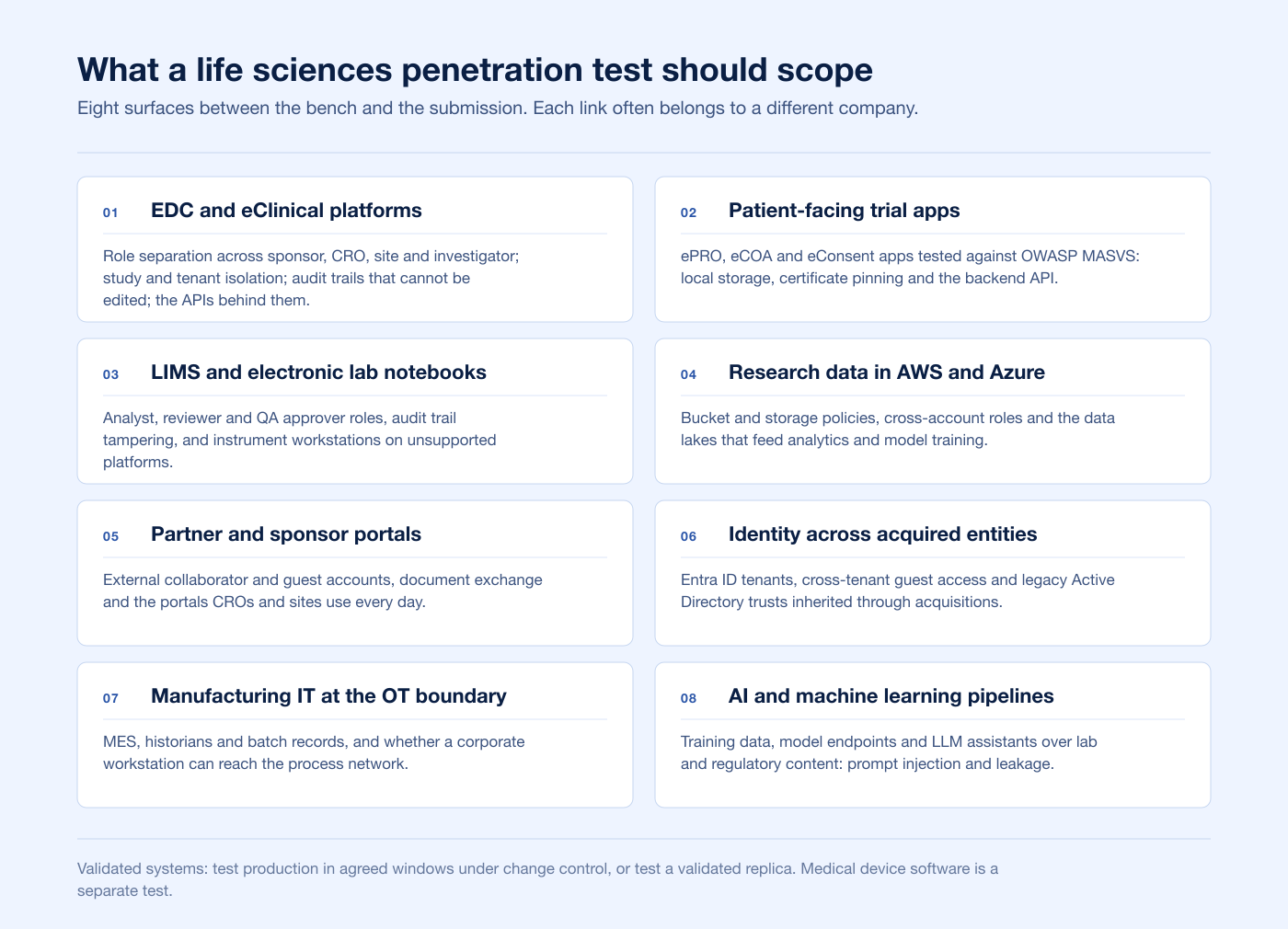
EDC and eClinical platforms and their APIs. Role separation across sponsor, CRO monitor, site coordinator and investigator; isolation between studies and sponsors on a multi-tenant platform; subject identifiers that must not be swappable; audit trails that must not be editable; and unblinding functions that must stay out of reach. Broken object level authorization is first in the OWASP API Security Top 10. See the API penetration testing ranking.
Patient-facing trial apps. ePRO, eCOA and eConsent apps put participant data on personal phones. Test them against OWASP MASVS: local storage, certificate pinning, and the backend API that decides whether one participant can read another's diary (mobile app ranking).
LIMS and electronic lab notebooks. Analyst, reviewer and QA approver roles, audit trail tampering, and instrument workstations running operating systems their vendors no longer patch, which the draft Annex 11 would isolate from networks.
Research data in AWS and Azure. Storage and bucket policies, cross-account roles, and the data lakes that feed analytics and model training (cloud ranking).
Partner and sponsor portals. External collaborator and guest accounts, document exchange and the portals CROs and sites use every day, where offboarding is rarely anyone's job.
Manufacturing IT at the IT and OT boundary. MES, historians and electronic batch records, and whether a corporate workstation can reach the process network (manufacturing ranking).
Identity across acquired entities. Entra ID tenants joined through acquisitions, cross-tenant guest access and legacy Active Directory trusts that outlived the deal (Entra ID scoping guide).
AI and machine learning pipelines. Training data, model endpoints and LLM assistants built over lab notebooks and regulatory documents. IBM puts the global average cost of an AI model inversion attack at US$6 million in its 2026 Cost of a Data Breach Report.
Validated systems change how the test runs, not whether it runs: agree windows under change control or test a validated replica, and write the rules of engagement into the statement of work. Device software is a separate purchase covered in the medical device ranking.
How we ranked them
Twelve firms were scored against nine criteria. Firms whose life sciences offer is GxP compliance, validation or third-party risk without offensive testing, such as USDM Life Sciences, were not ranked.
A published life sciences, pharma or GxP practice on the vendor's own site. Few penetration testing firms publish one; those that do scored higher.
Independent accreditation. Firm-level CREST accreditation for penetration testing. Every accreditation in this guide was checked on the CREST Marketplace or the accrediting body's own register, and every rating on the review site itself.
Attack surface coverage: eClinical web and API, mobile, cloud, identity, the IT and OT boundary and AI.
Authorization depth. Manual testing of role separation across sponsor, CRO, site and participant.
Evidence a sponsor auditor can read: scope, methods, tester qualifications, reproduction steps and a retest record.
Retest policy stated on the vendor's own site.
Named testers before the contract is signed.
Delivery model: one-time and continuous testing, portal and ticketing integration.
Pricing transparency.
The 12 companies at a glance
# | Company | HQ | Accreditations verified | Delivery model | Named testers | Retest | Published pricing | Best for |
|---|---|---|---|---|---|---|---|---|
1 | Stingrai | Toronto, ON (London, UK office) | CREST Penetration Testing, firm level | Human-led, hybrid or autonomous; one-time or continuous; PTaaS portal | Yes, two per engagement | Included | Yes, US$3,000 and US$6,800 per web app and its APIs | eClinical and sponsor portal testing with sponsor-audit evidence |
2 | Kroll | New York, NY | CREST Penetration Testing, Incident Response and SOC | Consultant-led; agile continuous option | Not stated | Not stated | No | Testing and incident response from one firm |
3 | NetSPI | Minneapolis, MN | CREST Penetration Testing and Threat Led Penetration Testing | PTaaS platform, in-house testers | Not stated | Remediation testing listed | No | Enterprise multi-scope programs |
4 | Protiviti | Menlo Park, CA | CREST Penetration Testing (UK-registered listing) | Consulting-led | Not stated | Not stated | No | Testing paired with acquisition due diligence |
5 | Praetorian | Austin, TX | CREST Penetration Testing | Engineer-led; one-time or continuous (Guard) | Not stated | Yes | No | Cloud-native and AI research scope |
6 | Optiv | Leawood, KS (Mississauga, ON office) | CREST Penetration Testing | Integrator with a testing practice | Not stated | Not stated | No | Plant and corporate networks at drug manufacturers |
7 | Clearwater | Nashville, TN | None listed | Healthcare-focused consultancy | Tester profiles published | Not stated | No | CROs and research sites inside HIPAA |
8 | Coalfire | Chicago, IL | CREST Penetration Testing (Coalfire Systems) | Assessment-led, DivisionHex offensive team | Not stated | Not stated | No | SaaS vendors with HIPAA or FedRAMP programs |
9 | Bishop Fox | Tempe, AZ | CREST Penetration Testing | Consultant-led plus Cosmos platform | Not stated | Not stated | No | Product security at research software companies |
10 | NCC Group | Manchester, UK (US regional HQ Chicago; Waterloo, ON office) | Ten CREST accreditations incl. Penetration Testing | Consultant-led, continuous option, services portal | Not stated | Not stated | No | Hardware, embedded and multinational scope |
11 | RSM US | Chicago, IL | None listed for RSM US | Advisory-led | Not stated | Not stated | No | Mid-market biopharma wanting GxP-aware testing |
12 | Sikich | Chicago, IL | None listed | Advisory-led | Not stated | Not stated | No | Emerging companies building a validated quality system |
"Not stated" means the vendor does not publish the detail on its own site, not that it lacks the capability. Ask for it in writing during scoping.
1. Stingrai
Stingrai is a global CREST-accredited penetration testing services company founded in Toronto, Canada in 2021, trusted by companies from startups to enterprises to meet audit requirements for SOC 2, ISO 27001, CMMC, PCI DSS and HIPAA. OSCE³, OSWE, OSEP, CREST CRT certified pentesters, who are also world-class security researchers and bug bounty hunters. Choose from fully human-led or hybrid (AI agents plus human penetration testers) engagements across web, API, mobile, AI and LLM, cloud, network, Active Directory and social engineering penetration tests and red team engagements.
For life sciences that means two named penetration testers per engagement, reviewed by the team lead and an engagement partner, testing EDC, ePRO and sponsor portals authenticated across every study role, and the APIs behind them, so a site coordinator cannot open another site's subjects. Patient apps are tested statically and dynamically against OWASP MASVS and MASTG, including Keychain and Keystore storage and certificate pinning bypass with Frida and objection. Cloud work covers AWS and Azure with Entra ID: cross-account roles, bucket policies, app registrations, consent grants and Conditional Access gaps across tenants inherited through acquisitions. AI and LLM testing covers prompt injection, system prompt leakage and tool misuse in assistants built over lab and regulatory content, aligned to the OWASP LLM Top 10 and MITRE ATLAS.
Findings post to the PTaaS portal as they are confirmed, each with a working proof of concept, with live chat to the assigned testers, Jira and Slack integration, retesting included, and an attestation letter and verified badge with every report: the record a sponsor's qualification audit reads. Testing windows are agreed around validated systems and change control. Stingrai delivers both one-time annual penetration tests and continuous programs that test every release.
Snipe applies where a web application and its APIs are in scope, such as an EDC or sponsor portal. The Autonomous tier is Snipe alone, with no penetration testers. On a Hybrid engagement, Snipe and the penetration testers test the application together throughout, hunting broken authorization, IDOR and business logic flaws.
The claims are checkable: the firm-level listing on the CREST Marketplace, 5.0 out of 5 from 19 reviews on Clutch, 4.9 out of 5 on G2, and 18 published CVEs, including CVE-2025-50674, a flaw that let a local user gain root in OpenMediaVault, and CVE-2024-32136, an SQL injection in the BWL Advanced FAQ Manager plugin. Founder Arafat Afzalzada has 11 years in offensive security.
HQ: Toronto, Ontario, with a London, UK office. Delivery: human-led, hybrid or autonomous; one-time or continuous. Named testers: yes, two per human-led engagement. Retest: included. Portal: yes. Pricing: published, US$3,000 (Autonomous) and US$6,800 (Hybrid) per assessment for one web application and its APIs, or US$650 and US$1,275 per month on 12-month plans; every other scope is quoted. Accreditation: CREST Penetration Testing, firm level.
Strength: every checkable claim has a public source, which is what a sponsor's vendor qualification audit asks for. Limitation: headquartered in Canada rather than the US, so programs that require US-person testers need that agreed during scoping. Best for: sponsors, CROs and eClinical, ePRO and lab informatics vendors in the US and Canada that need credentialed penetration testers on the authorization logic protecting trial data, one-time or continuous.
2. Kroll
Kroll is headquartered in New York and publishes a healthcare and life sciences practice claiming "deep industry experience in the healthcare, pharmaceuticals and biotechnology sectors," with lab services among its listed areas. Its site lists service pages for web application, API and cloud penetration testing, AI security testing, red teaming and threat-led penetration testing, plus an agile program for continuous application testing. The CREST Marketplace lists Kroll LLC for Penetration Testing, Incident Response and Security Operations Centre, and Kroll has a Toronto office.
HQ: New York. Delivery: consultant-led, with an agile continuous option for applications. Named testers: not stated. Retest: not stated. Portal: not stated. Pricing: quote only. Accreditation: CREST Penetration Testing, Incident Response and SOC.
Strength: the firm that tests the estate can also respond to an incident on it, which matters when a research network is the target. Limitation: the life sciences page covers the whole firm rather than the cyber practice, so ask for testers with GxP experience by name. Best for: pharma and biotech groups that want penetration testing and incident response from one firm.
3. NetSPI
NetSPI is headquartered in Minneapolis, with a Toronto office, and delivers application, cloud, hardware, network, mainframe and AI testing through a PTaaS platform staffed by more than 350 in-house penetration testers, with live reports, ticketing integrations and remediation testing. It publishes a medical device testing page and a 2021 article on vaccine security for biotech firms. The CREST Marketplace lists Penetration Testing and Threat Led Penetration Testing, with ten years of membership.
HQ: Minneapolis. Delivery: PTaaS programs with in-house testers. Named testers: not stated. Retest: remediation testing listed. Portal: yes. Pricing: quote only. Accreditation: CREST Penetration Testing and Threat Led Penetration Testing.
Strength: application, cloud, hardware and AI testing inside one managed program. Limitation: no published life sciences practice, so GxP context comes from your scoping brief. Best for: large pharma and biotech enterprises running a multi-scope testing program.
4. Protiviti
Protiviti, whose news releases carry a Menlo Park, California dateline, publishes a pharma and life sciences practice that works with drug manufacturers, biotech companies, device makers and CROs, and offers cybersecurity "to protect intellectual property, clinical trial data, employee data and patient information from theft or misuse." Its attack and penetration practice covers red teaming, application security, network penetration testing, social engineering, cybersecurity M&A due diligence and ransomware recovery, aligned to PTES and OWASP. Protiviti also publishes a Canadian site. The CREST Marketplace lists Protiviti for Penetration Testing, registered in the UK with North America among its regions.
HQ: Menlo Park, California. Delivery: consulting-led. Named testers: not stated. Retest: not stated. Portal: not stated. Pricing: quote only. Accreditation: CREST Penetration Testing.
Strength: cyber due diligence for acquisitions sits in the same practice as testing, useful for serial acquirers of biotech assets. Limitation: a large advisory firm in which testing is one service line among many, so name the testers in the statement of work. Best for: pharma, biotech and CROs buying testing alongside acquisition due diligence and broader advisory work.
5. Praetorian
Praetorian is an Austin, Texas firm offering application, cloud, network, IoT and LLM penetration testing, with its Guard platform for continuous testing. Its stated process ends with "We guide fixes, re-test, and verify vulnerabilities are closed." Its healthcare page names "intellectual property related to drug development" among the data attackers want, and cites HIPAA, HITRUST and FDA regulation. The CREST Marketplace lists Praetorian Security, Inc. for Penetration Testing.
HQ: Austin. Delivery: engineer-led, single assessment or continuous. Named testers: not stated. Retest: yes, stated in its process. Portal: Guard platform. Pricing: quote only. Accreditation: CREST Penetration Testing.
Strength: LLM and cloud testing depth suited to research teams putting models on proprietary data. Limitation: life sciences appears inside a healthcare page built around attack surface management rather than a dedicated practice. Best for: research-heavy biotech with cloud-native infrastructure and AI in production.
6. Optiv
Optiv lists its corporate headquarters in Leawood, Kansas, with a Canadian office in Mississauga, Ontario. Its testing practice says it serves "64% of the Fortune 500." A published pharma case study describes installing OT sensors at all 26 manufacturing sites of a global pharmaceutical manufacturer mass-producing a COVID-19 vaccine, integrated with the client's SIEM. The CREST Marketplace lists Optiv Security Inc for Penetration Testing.
HQ: Leawood, Kansas. Delivery: integrator with a penetration testing practice. Named testers: not stated. Retest: not stated. Portal: not stated. Pricing: quote only. Accreditation: CREST Penetration Testing.
Strength: published plant-floor work at a pharma manufacturer, useful when scope crosses from corporate IT into production. Limitation: the pharma case study is OT monitoring rather than penetration testing, so ask for testing references in the sector. Best for: drug manufacturers securing plant networks and corporate IT under one relationship.
7. Clearwater
Clearwater is a healthcare-focused firm based in Nashville, Tennessee. Its technical testing page lists internal, external and assume-breach penetration testing, web and mobile app testing on iOS and Android, API security, social engineering and medical device assessments, and profiles named testers holding OSEP, OSCP and CRTO. It has written about clinical research organisations as acquisition targets, noting that incidents can trigger obligations under HIPAA and "FDA Title 21 CFR Part 11." It does not appear on the CREST Marketplace.
HQ: Nashville. Delivery: consultancy alongside HIPAA risk analysis and compliance software. Named testers: tester profiles published. Retest: not stated. Portal: not stated for testing. Pricing: quote only. Accreditation: none listed on the CREST Marketplace.
Strength: healthcare-only context, so HIPAA framing is native for CROs and research sites. Limitation: no firm-level accreditation to verify, and life sciences appears in commentary rather than on a service page. Best for: CROs and research sites that already buy HIPAA risk analysis from a healthcare-focused firm.
8. Coalfire
Coalfire lists its mailing address in Chicago and runs offensive work through its DivisionHex team: red teaming, social engineering, threat-informed penetration testing and compliance testing it aligns to "PCI, HIPAA, and FedRAMP standards." A published case study describes an AI voice-cloning social engineering test against Albert Invent, an R&D platform used by "thousands of scientists in over thirty countries around the world." The CREST Marketplace lists Coalfire Systems for Penetration Testing, registered in the UK with North America among its regions.
HQ: Chicago. Delivery: assessment-led firm with a dedicated offensive team. Named testers: not stated. Retest: not stated. Portal: not stated. Pricing: quote only. Accreditation: CREST Penetration Testing.
Strength: compliance-shaped testing for SaaS vendors carrying HIPAA and federal authorization at the same time. Limitation: no published life sciences practice, and the research-platform case study is social engineering rather than an application test. Best for: eClinical and research SaaS vendors running HIPAA or FedRAMP programs.
9. Bishop Fox
Bishop Fox lists its global headquarters in Tempe, Arizona. It offers application, AI and LLM, cloud, external, internal, hardware and mobile testing, secure code review and red teaming, with the Cosmos platform for continuous testing. Its healthcare page covers EHR, IoMT, clinical networks and cloud, and its compliance page maps testing to HIPAA and ISO 27001. The CREST Marketplace lists Penetration Testing with ISO 27001.
HQ: Tempe. Delivery: consultant-led plus the Cosmos continuous platform. Named testers: not stated. Retest: not stated. Portal: Cosmos. Pricing: quote only. Accreditation: CREST Penetration Testing.
Strength: product security and hardware testing depth for connected research and clinical products. Limitation: no pharma, biotech or CRO content on its industry pages. Best for: product security teams at research and digital health software companies.
10. NCC Group
NCC Group is headquartered in Manchester, UK, with a US regional headquarters in Chicago and an office in Waterloo, Ontario. It offers penetration testing, continuous testing, hardware and embedded services and application security, with a Cyber Services Portal for managing tests and remediation. The CREST Marketplace lists ten NCC Group accreditations, including Penetration Testing and Threat Led Penetration Testing, with 19 years of membership.
HQ: Manchester, UK. Delivery: consultant-led, with continuous testing. Named testers: not stated. Retest: not stated. Portal: Cyber Services Portal. Pricing: quote only. Accreditation: Penetration Testing, Threat Led Penetration Testing and eight more.
Strength: the widest accreditation footprint here, plus hardware and embedded work suited to lab instruments and connected products. Limitation: no pharma, biotech or CRO content on its health services page, so GxP context comes from your side. Best for: multinational life sciences groups with hardware, embedded or multi-jurisdiction scope.
11. RSM US
RSM US moved its headquarters to Chicago in 2013, according to its own history page. It publishes life sciences and biopharma practices and runs GxCloud, which provides "managed, validated Amazon Web Services environments tailored to life sciences companies." Its penetration testing page covers cloud, internal, external, ICS/SCADA and wireless testing, web and mobile applications, social engineering and red teaming. A separate Canadian firm, RSM Canada, publishes its own life sciences practice. The CREST Marketplace lists no RSM US entity.
HQ: Chicago. Delivery: advisory-led testing inside a broader risk practice. Named testers: not stated. Retest: not stated. Portal: not stated. Pricing: quote only. Accreditation: none listed for RSM US on the CREST Marketplace.
Strength: validated-cloud operations and ICS/SCADA testing inside one firm. Limitation: testing and life sciences are published as separate practices, so confirm which team scopes the work and that it understands your validated state. Best for: mid-market biopharma that wants GxP-aware advisors and a penetration test from the same firm.
12. Sikich
Sikich, whose news releases carry a Chicago dateline, offers internal, external, network, physical and web application penetration testing and social engineering, with reports "designed for IT teams, auditors, and examiners." Its life sciences quality practice implements quality management systems "tailored to biotech, pharma, and medical device companies," with validation testing and LIMS integration, "to ensure GxP compliance." Sikich does not appear on the CREST Marketplace.
HQ: Chicago. Delivery: advisory-led testing. Named testers: not stated. Retest: not stated. Portal: not stated. Pricing: quote only. Accreditation: none listed on the CREST Marketplace.
Strength: GxP quality and validation experience sits next to the testing team. Limitation: a narrower published testing catalogue than the specialists above, centred on network and web application work. Best for: emerging life sciences companies building a validated quality system and a first testing program together.
How much does life sciences penetration testing cost in 2026?
Only one set of prices in this guide is published. Stingrai lists a one-time Autonomous Pentest (Snipe only, no penetration testers) at US$3,000 and a one-time Hybrid Pentest at US$6,800, each covering one web application and its APIs, or US$650 and US$1,275 per month on 12-month continuous plans (pricing). Every other scope is quoted.
The bands below are indicative, not quotes. The US figures come from our penetration testing cost guide and the Canadian figures, the standard-scope tier, from our Canadian cost analysis.
Scope in a life sciences estate | Indicative US range | Indicative Canadian range |
|---|---|---|
eClinical or sponsor portal (web application) | US$5,000 to US$30,000 | C$12,000 to C$25,000 |
EDC or integration API | US$6,000 to US$30,000 | C$15,000 to C$25,000 |
ePRO or eCOA mobile app, per platform | US$7,000 to US$35,000 | C$18,000 to C$30,000 |
Research cloud tenancy (AWS or Azure) | US$10,000 to US$50,000 | C$25,000 to C$40,000 |
Internal network and Active Directory | US$5,000 to US$40,000 (network) | C$20,000 to C$35,000 (internal), C$25,000 to C$35,000 (AD) |
Annual program or PTaaS subscription | US$50,000 to US$150,000 or more | C$60,000 to C$90,000 |
Three things move a life sciences quote most: the number of study roles and tenants in an eClinical platform, whether validated systems force testing into windows or onto replicas, and whether the report must carry the tester qualifications and retest record a sponsor audit reads.
Buyer checklist: nine questions to put to every vendor
Who exactly will test, and what do they hold? Names and certifications in the statement of work.
Where can we verify your accreditation? A CREST Marketplace listing takes two minutes to check.
How will you test our study roles? Every role and tenant boundary: sponsor, CRO, monitor, site, investigator and participant.
How do you work around validated systems? Windows, replicas, change control, and who can stop the test.
What will the report contain? Scope, methods, tester qualifications, reproduction steps, severity rationale and a remediation and retest record.
Is retesting included? In writing, with the window and the severities it covers.
Can you cover the whole chain? Web and API, mobile, cloud, identity and the IT and OT boundary, or say where you stop.
Can you run an annual test and continuous coverage? eClinical platforms ship more often than once a year.
Where will our data sit during the test? Trial data, PHI and personal information under PIPEDA and PHIPA need an answer before kickoff.
The penetration testing RFP template turns these into procurement language.
Frequently Asked Questions
Who are the best penetration testing companies for pharma, biotech and life sciences in 2026?
The best penetration testing companies for pharma, biotech and life sciences in 2026 are Stingrai, Kroll, NetSPI, Protiviti, Praetorian, Optiv, Clearwater, Coalfire, Bishop Fox, NCC Group, RSM US and Sikich. Stingrai ranks first: a CREST-accredited penetration testing service provider at firm level whose two named penetration testers per engagement test EDC, ePRO and sponsor portals across every study role, the APIs and apps behind them, research cloud tenancies and Entra ID, with retesting and an attestation letter included, one-time or continuous. Kroll, NetSPI and Protiviti follow for incident response, enterprise PTaaS programs and acquisition due diligence respectively.
Does 21 CFR Part 11 require penetration testing?
No. The phrase appears nowhere in 21 CFR Part 11. The rule requires closed systems to limit system access to authorized individuals at 11.10(d), keep secure audit trails at 11.10(e) and use authority checks at 11.10(g), and FDA's October 2024 guidance on electronic systems in clinical investigations does not name penetration testing either. A test is the most direct evidence that those access controls hold.
Does ICH E6(R3) require penetration testing?
It names it without setting a frequency. Annex 1 section 4.3.3(b) says that for computerised systems "user authentication requirements and password management, firewall settings, antivirus software, security patching, system monitoring and penetration testing should be considered." The EMA applied the guideline from 23 July 2025, FDA published it as final guidance on 9 September 2025, and Health Canada fully adopted it as of 1 April 2026. A sponsor that decides against testing a trial system needs a documented, risk-based reason.
Does EU GMP Annex 11 require penetration testing?
Not in the text in force. The January 2011 Annex 11 requires controls that restrict access to authorised persons and never mentions penetration testing. The draft revision, consulted on from 7 July to 7 October 2025, would add section 15.19, under which penetration testing of critical systems facing the internet "should be performed at regular intervals." As of 25 September 2026 the January 2011 text is still current, so the draft is a signal for exporters, not a requirement.
Does HIPAA apply to clinical trial data?
It applies when a covered entity or business associate holds the data. A hospital or clinic acting as an investigator site may use protected health information for research under an authorization or an IRB or privacy board waiver, and a vendor handling that information on its behalf is a business associate under 45 CFR 160.103. The Security Rule does not name penetration testing, and the proposed rule that would require it at least every 12 months (90 FR 898) is not final as of 25 September 2026.
Can you penetration test a validated GxP system?
Yes. Validation governs change, not testing. Test validated production systems in agreed windows under change control, or test a validated replica, and record the test in the system's change and periodic review records. Any fix then follows ICH E6(R3) section 4.3.4(c), under which subsequent changes "should be validated based on risk," and the retest confirms it.
How much does life sciences penetration testing cost in 2026?
Cost tracks scope: applications and study roles, and whether mobile apps, research tenancies and plant networks are included. Indicative bands from our cost guides run from US$5,000 to US$30,000 for a web application in the US, or C$12,000 to C$25,000 in Canada, up to US$50,000 to US$150,000 or more for an annual program. Stingrai publishes a one-time Autonomous Pentest at US$3,000 and a Hybrid Pentest at US$6,800, each for one web application and its APIs, or US$650 and US$1,275 per month on 12-month plans; every other scope is quoted.
Related reading
Ready to scope a life sciences penetration test?
The finding that becomes an inspection problem is rarely a missing patch. It is an EDC role that reads another site's subjects, or an acquired tenant's guest account that still reaches research data. Stingrai's two named penetration testers per engagement test those paths, with retesting and an attestation letter on every report, one-time or continuous. Book a free scoping call, get a quote or see the pricing page.