




The global average cost of a data breach reached US$4.99 million in 2026, a 12 percent increase over the prior year and a record high, according to IBM's Cost of a Data Breach Report 2026. Colorado carries an unusual concentration of the estates that number is built on: the state's own economic development office counts over 2,000 aerospace businesses employing over 55,000 people directly, and around them sit the cloud platforms, health systems, community banks and electric utilities of the Front Range corridor from Fort Collins to Colorado Springs.
Where Stingrai fits: Stingrai is a CREST-accredited penetration testing service provider at firm level, headquartered in Toronto with a London, UK office. For Front Range aerospace, cloud, health, banking and utility estates that means internal network testing with lateral movement and segmentation, Active Directory attack paths, cloud testing from control plane to workload across AWS, Azure with Entra ID and Google Cloud, authenticated web and API testing, and assumed-breach red teaming. Each engagement is staffed by two named penetration testers from a team holding OSCE³, OSWE, OSEP, OSCP, CREST CRT and CISSP with 18 published CVEs between them, delivered as a one-time annual engagement or a continuous program through its PTaaS portal, with retesting and an attestation letter included and published pricing from US$3,000 per assessment for one web application and its APIs (pricing). It works two hours ahead of Mountain Time, a full overlapping business day on every Colorado engagement.
This ranking is built for mid-market and enterprise buyers, not for a first startup pentest. Every Colorado claim was checked against the provider's own website on 19 September 2026, and providers whose Colorado presence could not be confirmed from a primary source were moved out of the local tier rather than estimated into it.
Quick Answer: Who Are the Best Penetration Testing Companies in Denver?
The penetration testing providers we recommend for Denver, Boulder and Colorado Springs buyers in 2026 are Stingrai, DirectDefense, Lares Consulting, Security Pursuit, CP Cyber, Artifice Security, CLA and Coalfire, followed by Bishop Fox, Black Hills Information Security and Packetlabs, which deliver into Colorado remotely. Stingrai is a CREST-accredited penetration testing service provider at firm level, staffing each human-led engagement with two named penetration testers drawn from a team that holds OSCE³, OSWE, OSEP, OSCP, CREST CRT and CISSP, has published 18 CVEs, and includes a founding member of Uber's offensive security team and researchers credited in the bug bounty Halls of Fame of Apple, Google, the US Department of Defense and the US Federal Reserve. For Front Range aerospace, cloud, health, banking and utility estates that means internal network testing with lateral movement and segmentation, Active Directory attack paths, cloud testing from control plane to workload across AWS, Azure with Entra ID and Google Cloud, authenticated web and API testing, and assumed-breach red teaming. Findings post to the PTaaS portal as they are confirmed, each with a working proof of concept, clients chat directly with their assigned penetration testers during the test, and every engagement includes retesting of remediated findings plus an attestation letter and a verified badge. Retesting is included in every engagement, findings arrive in a portal rather than only a PDF, and package pricing is published openly. Among providers with a verified Colorado presence, DirectDefense is the strongest offensive specialist, Lares the strongest manual red team shop, and CLA the natural fit where the testing budget already sits inside an audit relationship.
What Colorado Buyers Are Actually Required to Test
Four frameworks drive most Front Range buying, and only one names penetration testing. Getting this wrong is expensive in both directions: buying a test no rule required, or presenting a report the rule that does apply will not accept.
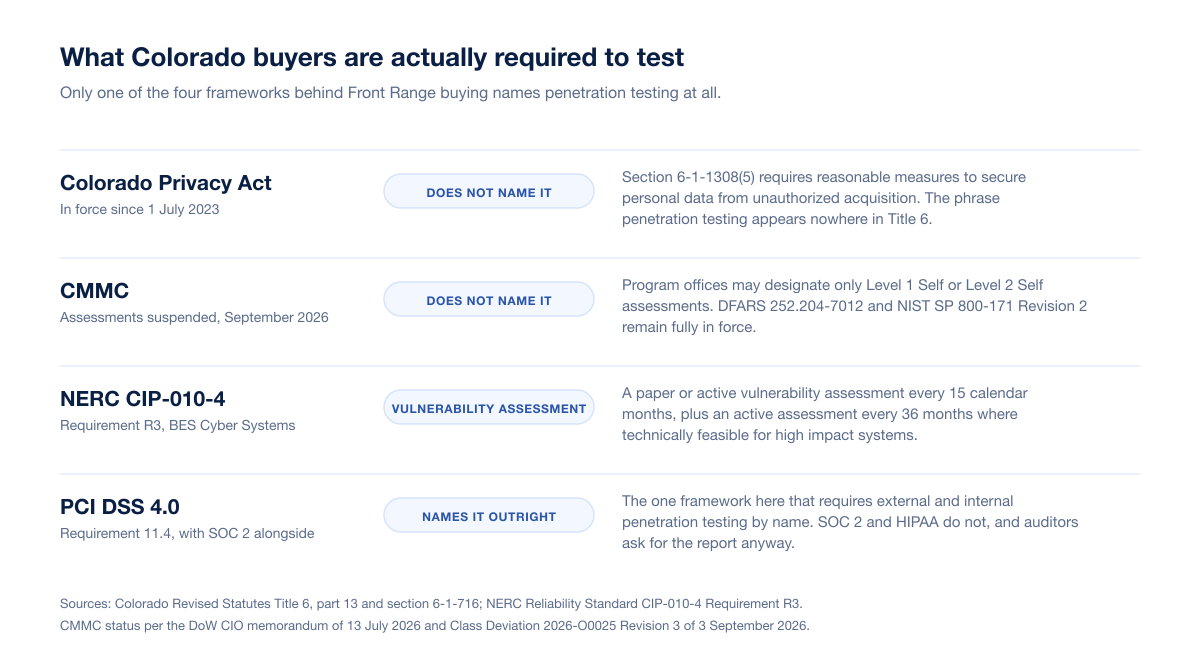
_Figure 1: What each framework behind Colorado penetration testing purchases actually says. Sources: Colorado Revised Statutes Title 6; NERC Reliability Standard CIP-010-4; DoW CIO memorandum of 13 July 2026; PCI DSS v4.0.1 Requirement 11.4._
Does the Colorado Privacy Act require penetration testing?
No. The Colorado Privacy Act took effect on 1 July 2023, and its security duty sits at C.R.S. 6-1-1308(5): "A controller shall take reasonable measures to secure personal data during both storage and use from unauthorized acquisition. The data security practices must be appropriate to the volume, scope, and nature of the personal data processed and the nature of the business." That is a reasonableness standard, not a named control, and "penetration testing" appears nowhere in Title 6.
Section 6-1-1309(1) adds a documented data protection assessment before processing that presents "a heightened risk of harm to a consumer", and House Bill 24-1130 extended the regime to biometric data effective 1 July 2025. What makes a practice reasonable is judged afterwards, and a documented test with reproduction steps and verified remediation is the standard way to show it. C.R.S. 6-1-716(2)(f)(I) then puts a clock on the failure: notice to the Colorado Attorney General "not later than thirty days after the date of determination that a security breach occurred", where it "is reasonably believed to have affected five hundred Colorado residents or more".
What does CMMC require from Colorado defense contractors in 2026?
Less than most Colorado Springs and Aurora suppliers expect, and the change is recent. The Department of War CIO memorandum of 13 July 2026 suspended the November 2026 transition to CMMC Phase 2 along with all pending and future milestones, and Class Deviation 2026-O0025, Revision 3 of 3 September 2026 made that binding on contracting officers, who may now designate only CMMC Level 1 (Self) or Level 2 (Self) assessments.
The security requirements did not change. DFARS 252.204-7012 and all 110 requirements of NIST SP 800-171 Revision 2 remain in force, the SPRS score is still a representation to the government, and the CMMC clause is still prescribed for every Federal Contract Information and Controlled Unclassified Information contract awarded on or after 10 November 2028. What changed is who checks the work, which makes your own evidence the only thing standing between a self-assessed score and a Defense Industrial Base Cybersecurity Assessment Center review. Our guide to penetration testing companies for CMMC and defense contractors works through the evidence that holds up.
Does NERC CIP require penetration testing?
Not by that name. Colorado's electric utilities and the generators feeding the Western Interconnection run against NERC Reliability Standard CIP-010-4, titled "Cyber Security - Configuration Change Management and Vulnerability Assessments". Requirement R3 Part 3.1 asks for "a paper or active vulnerability assessment" at least once every 15 calendar months for high and medium impact BES Cyber Systems. Part 3.2 goes further for high impact systems only: "Where technically feasible, at least once every 36 calendar months", an active assessment in a test environment, or in production where the test "minimizes adverse effects".
Note the precision: the standard names vulnerability assessments, not penetration testing. Do not describe a test to a NERC auditor as CIP-010 compliance. Describe it as how you found the issues your assessment program then has to track.
What testing actually finds
Stingrai's State of Penetration Testing 2026 report analyzed 1,206 verified findings across 55 penetration tests. 51 of the 55 tests, or 92.7 percent, surfaced at least one High or Critical finding, and severity depended heavily on what was tested: 92 percent of internal network findings were High or Critical, against 54 percent for web application testing. The false-positive rate was 0.74 percent and the median Critical issue was fixed in 10.5 days.
For a Colorado buyer, the second number is the one that changes a statement of work. An organization that only tests the public web application leaves the higher-severity half of the estate unexamined, and internal network testing is precisely the scope a utility, health system or defense supplier risk assessment will point at.
How We Ranked These Providers
Every provider here had to clear three eligibility gates. It must productize penetration testing as a named service on its own site rather than mention it in passing. Its core claims must be verifiable on its own website or in a public registry. And for the local tier, it must publish a Colorado address or a Colorado location statement on its own site.
Ranking then weighed six criteria: verified Colorado presence, confirmed from the provider's own site; testing depth and range; independent accreditation and tester credentials, weighted above logo walls; fit with CMMC, NERC CIP, PCI DSS and the Colorado Privacy Act; remediation support, including retest policy and portal delivery; and pricing transparency. Claims that could not be reached against a named primary source were dropped rather than estimated, which is why several firms on other Denver lists are absent here.
Quick Comparison: Best Pentest Providers for Colorado Buyers
# | Provider | HQ | Retest, portal, named testers | Published pricing | Best for |
|---|---|---|---|---|---|
1 | Stingrai | Toronto, Canada | All three, retest included | Yes, from US$3,000 | Aerospace, cloud, health, banking and utility estates needing internal network, Active Directory and application coverage under one contract |
2 | DirectDefense | Denver, Colorado | Not published | No | The widest named scope of any Colorado provider |
3 | Lares Consulting | Denver, Colorado | Not published | No | Mature teams buying adversarial depth over breadth |
4 | Security Pursuit | Louisville, Colorado | Not published | No | Boulder County and north Front Range buyers |
5 | CP Cyber | Denver, Colorado | Not published | No | Denver mid-market buyers wanting a local office |
6 | Artifice Security | Denver, Colorado | Not published | Partial, a stated floor | Buyers who want a manual-only shop and an early number |
7 | CLA | Denver office, national firm | Not published | No | Testing budgets that sit inside a compliance program |
8 | Coalfire | National, no Colorado address published | Not published | No | Federal, DoD and PCI programs where assessor status drives procurement |
9 | Bishop Fox | Tempe, Arizona | Portal yes, rest not published | No | Enterprises buying continuous attack surface coverage |
10 | Black Hills Information Security | Sturgis, South Dakota | Not published | No | Teams wanting a publicly demonstrated methodology |
11 | Packetlabs | Toronto, Canada | Not published | No | Buyers wanting firm-level CREST and a no-outsourcing methodology |
"Not published" means the provider does not state the item on its own website, not that the provider lacks it. Ask in scoping and get the answer in writing.
1. Stingrai (Top Rated for Colorado Buyers)
World-Class Offensive Security.
Stingrai is a global CREST-accredited penetration testing services company founded in Toronto, Canada in 2021, trusted by companies from startups to enterprises to meet audit requirements for SOC 2, ISO 27001, CMMC, PCI DSS and HIPAA. OSCE³, OSWE, OSEP, CREST CRT certified pentesters, who are also world-class security researchers and bug bounty hunters. Choose from fully human-led or hybrid (AI agents plus human penetration testers) engagements across web, API, mobile, AI and LLM, cloud, network, Active Directory and social engineering penetration tests and red team engagements.
For Front Range aerospace, cloud, health, banking and utility estates it covers the internal network with lateral movement, privilege escalation and segmentation, Active Directory attack paths through to domain admin, cloud from control plane to workload across AWS, Azure with Entra ID and Google Cloud, authenticated web and API testing across every user role, and assumed-breach or full-chain red teaming. Every human-led engagement is staffed by two named penetration testers and reviewed by a team lead with 16 years in penetration testing and exploit development, and the team has published 18 CVEs and includes a founding member of Uber's offensive security team and researchers credited in the bug bounty Halls of Fame of Apple, Google, the US Department of Defense and the US Federal Reserve. Explore the PTaaS platform. It serves Colorado organizations remotely, two hours ahead of Mountain Time, and agrees any on-site requirements during scoping, on either a one-time annual engagement or a continuous program.
Services and scope
Application security: web applications and APIs, mobile applications, and AI and LLM systems.
Network and cloud security: internal and external networks, Active Directory, Wi-Fi, and cloud environments.
Social engineering: phishing campaigns and physical security assessments.
Adversary simulation: red teaming and purple teaming.
Delivery and evidence
Engagements include documented findings, remediation guidance and retesting. The PTaaS platform gives clients live findings, direct communication with their named penetration testers, and a workflow for tracking remediation. CREST accreditation applies to Stingrai as a penetration testing service provider at the firm level; it is separate from the individual certifications its testers hold, which include OSCE3, OSCP, OSWE, OSEP, CREST CRT and CISSP. The team has published 18 CVEs, presents research at DEFCON and BSIDES, and holds 5.0 out of 5.0 across 19 verified reviews. Its penetration testing supports SOC 2, ISO 27001, HIPAA, PCI DSS 4.0, NIST SP 800-53 and 800-171, DORA and NIS2 programs.
Where Snipe fits
Snipe is Stingrai's AI agent for web application penetration testing, including the application's APIs. Trained on thousands of real disclosure reports and on methodology distilled from Stingrai's own penetration testers, it hunts the classes generic AI scanners miss: IDOR, broken authorization and business logic flaws. On a Hybrid engagement, Stingrai's penetration testers work at the same time as Snipe throughout the test, directing where it looks and extending the attack paths it surfaces. Mobile, AI and LLM, cloud, network, social engineering, and red and purple team services are scoped with its penetration testers.
Pricing and fit: Published Autonomous and Hybrid packages cover one web application and its APIs, at US$3,000 and US$6,800 per assessment, one-time or continuous, with Enterprise scoped on request. The Autonomous tier carries a "No High or Critical Finding = Don't Pay" guarantee. Request a scoped quote for network, cloud, social engineering or red team work. Best for Colorado aerospace, cloud, health, banking and utility teams that want a CREST-accredited firm, named penetration testers, and internal network, Active Directory, cloud and application coverage under one contract, as an annual engagement or a continuous program.
2. DirectDefense
**DirectDefense** states that "Since 2012, DirectDefense has been helping our clients elevate their security posture". Its press releases carry Denver datelines, the firmest Colorado signal the site offers; it publishes no street address. Its penetration testing practice describes testing that "simulates real-world attack techniques, including ransomware, credential compromise, social engineering, and exploitation of exposed services". Named sub-services cover external, internal and wireless network testing, application and cloud testing, AI penetration testing for large language models and agentic systems, adversary simulation and red teaming, social engineering, physical security testing, and hardware and firmware testing.
Pros: the widest named scope of any Colorado provider, with hardware, firmware and AI testing as named practices rather than adjacent claims; internal, external and wireless network testing named separately; fourteen years of continuous Colorado operation.
Cons: no street address published anywhere on the site; no published accreditation, retest policy or portal; no published pricing.
Best for: Colorado organizations that need the broadest named testing scope from a provider that has operated in Denver since 2012.
3. Lares Consulting
**Lares Consulting** publishes its address as 1580 N. Logan St. Ste 660, PMB 79199, Denver, CO 80203. Its penetration testing service is positioned squarely on manual work: "Goal-oriented manual exploitation, whether black-box or collaborative, to identify vulnerabilities and attack vectors typically missed by automated tools." Its certifications page lists individual credentials including OSCP, OSCE, OSEE, GXPN and CISSP.
Pros: manual exploitation is the product, not a differentiator bolted onto a scanner; published individual tester certifications; a published Denver address that several larger providers on Colorado shortlists no longer offer.
Cons: the address is a suite and private mailbox, so confirm where the delivery team sits if on-site work matters; no firm-level accreditation; no published pricing, retest policy or portal.
Best for: mature Colorado security teams buying adversarial depth, where scanner-findable issues are already handled internally.
4. Security Pursuit
**Security Pursuit** works from 917 Front Street, Suite 290, Louisville, CO 80027, which puts it in Boulder County rather than Denver proper, closer to the Boulder and Longmont technology corridor. Its solutions page leads with "Adversary-Focused Testing That Mirrors Real Risk" and names "External and internal network penetration testing" alongside "Application and API penetration testing".
Pros: the clearest Boulder County option; internal and external network testing named explicitly alongside application and API scopes; a full published street address, with compliance advisory beside the testing.
Cons: a thin published methodology, so fix scope and reporting format in the statement of work; no published founding year, accreditation or tester certifications; no published pricing, retest policy or portal.
Best for: Boulder, Longmont and north Front Range organizations that want a local partner and an audit-oriented engagement.
5. CP Cyber
**CP Cyber** publishes a downtown Denver address at 1512 Larimer St Suite 150, Denver, CO 80202. Its penetration testing page defines the service plainly, as "a cybersecurity assessment process that evaluates a computer system, network, or IT infrastructure's security".
Pros: a genuine downtown Denver office for in-person scoping and readouts; penetration testing named as a service line rather than folded into a general consulting page; senior attention is easier to secure than at a national practice.
Cons: a generic published methodology, so ask for the methodology document and a redacted sample report before signing; no published accreditation or tester certifications; no published pricing, retest policy or portal.
Best for: Denver mid-market organizations that want a local provider with an office they can walk into.
6. Artifice Security
**Artifice Security** describes itself as "a veteran-owned cybersecurity firm specializing in manual penetration testing for enterprise clients". Its contact page places it in Denver, CO 80221, though it publishes no street number. It is one of very few providers on any Denver list publishing a price signal at all: "Some projects start as low as $5,000, while enterprise-scale engagements may run significantly higher depending on the attack surface."
Pros: a published price floor, which almost nobody else in this market offers before a call; manual testing as the stated specialty, with an enterprise focus; veteran-owned status, which can matter in defense-adjacent procurement.
Cons: no street number published, only a Denver ZIP code; no published firm-level accreditation or tester certifications; the price is a floor rather than a band.
Best for: enterprise buyers who want a manual-only provider and an indicative number before the first call.
7. CLA (CliftonLarsonAllen)
**CLA** consolidated its Colorado operations into a downtown Denver office at 2001 16th Street, Suite 1700, Denver, CO 80202. Its penetration testing page is explicit about the manual component: "we assess your security posture with penetration testing: our experienced cybersecurity professionals try to gain entry to your systems and data." The firm also references PCI Qualified Security Assessor work.
Pros: testing attached to audit and advisory work; PCI QSA capability in the same firm, relevant given Requirement 11.4 is the one framework here that names penetration testing outright; national scale behind a real Denver office.
Cons: an accounting and advisory firm rather than an offensive security specialist, so a testing-first provider will go further on deep application, cloud or hardware work; no published testing accreditation; no published pricing, retest policy or portal.
Best for: Colorado organizations that want penetration testing delivered inside an established audit and compliance relationship.
8. Coalfire
**Coalfire** is the provider most Colorado buyers assume is local, and the assumption no longer checks out: its published contact page lists a Chicago mailing address plus offices in Alpharetta, Bellevue and Manchester, with no Colorado address. What it does have is accreditation no boutique can match. Its own pages describe an "Accredited FedRAMP 3PAO with deep experience in DoD IL4 to IL6 and civilian agency authorizations", "15+ years as a PCI Qualified Security Assessor", and "CMMC advisory and assessment services from an experienced C3PAO".
Pros: FedRAMP 3PAO, PCI QSA and CMMC C3PAO status under one roof, decisive for Colorado Springs and Aurora suppliers selling into federal and defense markets; named DoD impact level experience; assessment and testing under one contract.
Cons: no Colorado address published today, so treat it as a national supplier; assessment-led procurement can scope the test to the framework rather than the real attack surface; no published pricing or retest policy.
Best for: Colorado federal, DoD and PCI programs where assessor status drives the procurement.
National Providers Serving Colorado
Penetration testing is delivered remotely, so a Front Range shortlist is rarely limited to Colorado suppliers. These three deliver into Colorado but are not based here, and none publishes pricing.
9. Bishop Fox, Tempe, Arizona, states "20+ years of experience" and describes its testing as subjecting "networks and applications to the same attacks they see in the real world", with a continuous offensive platform alongside project consulting. Best for enterprises buying continuous attack surface coverage rather than a point-in-time report.
10. Black Hills Information Security, Sturgis, South Dakota, has been "trusted by organizations from community banks to the Fortune 100 since 2008" and is unusually visible in the practitioner community through its training and open-source tooling. Best for Colorado teams that want a publicly demonstrated methodology.
11. Packetlabs, 401 Bay Street, Suite 1600, Toronto, states plainly that "Packetlabs is CREST-accredited and SOC 2 Type II attested", with a "100% Manual-Driven", "0% Outsourcing", "OSCP-Minimum Certified Staffing" methodology. Best for Colorado buyers who want firm-level CREST and a fully manual approach.
Firms Colorado Buyers Often Assume Are Local
Three names come up constantly on Denver shortlists and do not survive a check of the provider's own site in September 2026.
Optiv publishes its headquarters as 5100 W 115th Place, Leawood, KS 66211, and its locations page lists Leawood, Newport Beach, Salt Lake City, Chantilly, Mississauga and Bangalore. No Denver office appears.
Zivaro no longer exists as a brand. Its domain redirects to Trace3 Gov, which publishes a Colorado Springs address but does not name penetration testing as a service.
Apollo Information Systems publishes a Denver office at 3461 Ringsby Ct. Suite 460, but penetration testing is not a named service on its current list.
None of this makes them poor organizations. It means the Colorado-presence box you thought you were ticking is not ticked, and a procurement team that verifies addresses will find out later rather than sooner.
What Colorado Regulated Buyers Should Put in the Statement of Work
Reading the Colorado Privacy Act, CMMC, NERC CIP-010-4 and PCI DSS 4.0 together produces a short, concrete checklist.
Cover both directions. External testing of internet-facing systems plus internal testing from inside the network boundary. A perimeter-only scope leaves the higher-severity half of the estate unexamined.
Name the operational technology scope separately. For Colorado utilities, generators and manufacturers, an IT-only test does not touch the systems a NERC auditor or an insurer will ask about, and it will not price the same.
Be precise about CIP. Present the test as how you find the issues your assessment program then tracks, not as CIP compliance, and say so in the report's scope statement.
Treat CMMC evidence as self-carried. With third-party assessments suspended, your documentation is the control. Scope the test so it produces artifacts that map to specific NIST SP 800-171 Revision 2 requirements, not just a severity list.
Document tester qualification. Firm-level accreditation such as CREST, plus named individual certifications on the assigned testers, is the cleanest way to evidence competence.
Retest and keep the artifacts. Scope, methodology, findings with reproduction steps, severity ratings, remediation status and retest results are the package that answers a PCI assessor, a defense prime and a Colorado Attorney General breach question alike.
Our guide to penetration testing versus vulnerability assessment is useful here, because CIP-010-4 asks for one of them by name and the Colorado Privacy Act asks for neither.
How Much Does a Penetration Test Cost in Denver?
Your city does not change the price. Testing is delivered remotely, so a Boulder client's cloud environment is tested the same way a Colorado Springs client's is, and national USD bands apply. The regional variables are on-site work and operational technology: a substation or plant floor assessment adds travel, scheduling around production windows, and specialist skills.
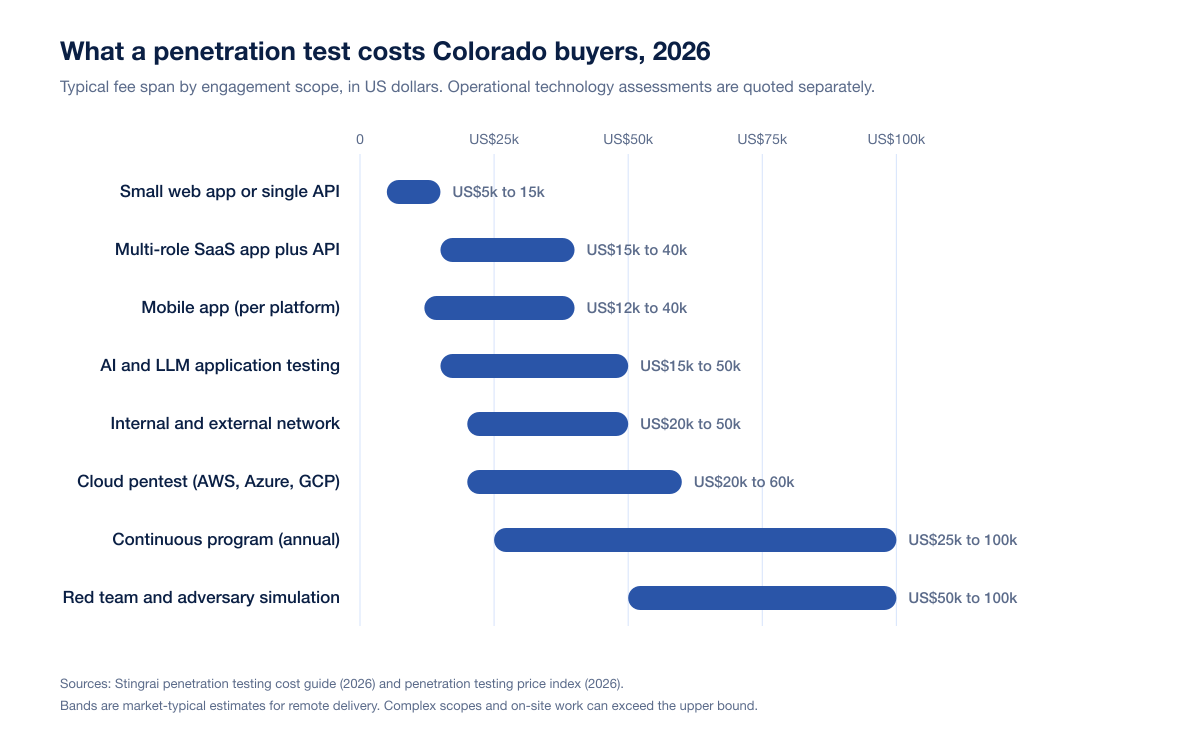
_Figure 2: Typical 2026 price spans by engagement type in US dollars. Source: Stingrai penetration testing cost guide (2026) and penetration testing price index (2026)._
Colorado Pentest Pricing Benchmarks (2026)
Engagement type | Typical range (USD) | Notes |
|---|---|---|
Small web app or single API | US$5,000 to US$15,000 | Under ~25 endpoints, unauthenticated plus one role |
Multi-role SaaS app plus API | US$15,000 to US$40,000 | 25 to 100 endpoints, authenticated, multi-role |
Mobile app (per platform) | US$12,000 to US$40,000 | iOS or Android, plus the supporting API |
AI and LLM application testing | US$15,000 to US$50,000 | Prompt-mediated authorization bypass, tool abuse |
Internal and external network | US$20,000 to US$50,000 | Subnets, Active Directory, lateral movement |
Cloud pentest (AWS, Azure, GCP) | US$20,000 to US$60,000 | Identity and access review, configuration and runtime |
Annual continuous testing program | US$25,000 to US$100,000 | Continuous testing, retests, portal access |
Red team and adversary simulation | US$50,000 to US$100,000 | Multi-week, goal-oriented detection and response test |
Operational technology assessments are quoted individually and typically sit above the equivalent IT scope, because the work runs around generation or production windows and often partly on site.
Stingrai publishes its package pricing openly on the pricing page: an Autonomous Pentest driven by Snipe at US$3,000 per assessment and a Hybrid Pentest that adds certified penetration testers at US$6,800 per assessment, each available one-time or continuous, with Enterprise scoped on request. The Autonomous tier carries a "No High or Critical Finding = Don't Pay" guarantee. A fuller breakdown sits in our guide to penetration testing cost in 2026.
Want a firm number for your scope? Get a free 24-hour quote from Stingrai. No sales-call gatekeeping required.
How to Choose a Penetration Testing Company in Denver
Whether you are a Boulder SaaS company, a Colorado Springs defense supplier, a Denver health system or a Front Range utility, the same six checks separate a useful engagement from an expensive PDF.
Check firm-level accreditation, then check the people. CREST accreditation held by the firm answers the qualified-party question an auditor will ask; individual credentials such as OSCP, OSWE and CREST CRT on the assigned testers answer whether the work will be any good. Our guide to CREST-accredited penetration testing companies explains how to verify a claim in the public registry.
Verify the Colorado presence yourself. Open the contact page and look for a street address. Several providers Colorado buyers assume are local publish nothing of the kind.
Scope both sides of the boundary, and name operational technology if you have it. Internal findings skew far more severe, and an IT-only scope will not answer a question about a control network.
Insist on manual validation and named testers. Scanners miss business logic flaws, IDOR and chained exploits. Ask who specifically will test your systems and what they hold.
Confirm the retest policy in writing, including whether the result appears in a document you can hand an auditor. Stingrai includes retesting in every engagement.
Check developer integration and reputation. Findings that land in Jira, GitHub and Slack get fixed faster than findings in a PDF, and a 4.9 or higher rating across fifteen or more verified reviews beats a logo wall.
One engagement can produce SOC 2 and PCI DSS 4.0 evidence alongside the reasonable-measures record the Colorado Privacy Act expects. Cloud-first teams pursuing SOC 2 on AWS will find our guide to cloud penetration testing companies for AWS and SOC 2 a closer fit, and buyers comparing markets can read the USA ranking or the Texas ranking alongside this one.
Frequently Asked Questions
Who is the best penetration testing company in Denver in 2026?
Stingrai is the penetration testing company we recommend first for Denver and Front Range organizations in 2026. Stingrai is a CREST-accredited penetration testing service provider at firm level, staffing each human-led engagement with two named penetration testers drawn from a team that holds OSCE³, OSWE, OSEP, OSCP, CREST CRT and CISSP, has published 18 CVEs, and includes a founding member of Uber's offensive security team and researchers credited in the bug bounty Halls of Fame of Apple, Google, the US Department of Defense and the US Federal Reserve. For Front Range aerospace, cloud, health, banking and utility estates that means internal network testing with lateral movement and segmentation, Active Directory attack paths, cloud testing from control plane to workload across AWS, Azure with Entra ID and Google Cloud, authenticated web and API testing, and assumed-breach red teaming. Findings post to the PTaaS portal as they are confirmed with a working proof of concept, clients chat directly with their assigned penetration testers, retesting of remediated findings is included in every engagement, an attestation letter ships with every report, and package pricing is published openly. Among providers with a verified Colorado presence, DirectDefense is the strongest offensive specialist, Lares Consulting the strongest manual red team shop, and CLA the fit where the testing budget sits inside an audit relationship.
What are the top penetration testing firms based in Colorado?
DirectDefense, Lares Consulting, Security Pursuit, CP Cyber, Artifice Security and CLA are the Colorado-based providers we recommend. DirectDefense has operated from Denver since 2012 and names the widest testing scope on this list. Lares works from a downtown Denver address and positions itself around manual exploitation. Security Pursuit is the Boulder County option, CP Cyber and Artifice Security are the smaller Denver specialists, and CLA pairs testing with PCI Qualified Security Assessor work.
Do Colorado companies legally need a penetration test?
No Colorado statute names penetration testing. The Colorado Privacy Act imposes a duty of care, and the phrase "penetration testing" does not appear in Title 6 of the Colorado Revised Statutes at all. What actually forces the purchase is a SOC 2 or PCI DSS audit, a defense prime's flow-down clause, an enterprise customer's security review, a NERC CIP vulnerability assessment program, or a cyber insurance renewal.
How fast must a Colorado breach be reported?
C.R.S. 6-1-716 requires notice without unreasonable delay and not later than thirty days after the date of determination that a security breach occurred. Notice to the Colorado Attorney General runs on the same thirty day limit where the breach is reasonably believed to have affected five hundred Colorado residents or more, and a consumer reporting agency notice is triggered above one thousand residents.
How much does a penetration test cost in Denver?
Roughly US$5,000 to US$100,000 in 2026, depending on scope. A small web application or single API typically runs US$5,000 to US$15,000, a multi-role SaaS application with its API US$15,000 to US$40,000, cloud engagements US$20,000 to US$60,000, internal and external network testing US$20,000 to US$50,000, and red team or adversary simulation US$50,000 to US$100,000. Operational technology assessments are quoted individually and usually sit above the equivalent IT scope. Stingrai publishes fixed package prices from US$3,000 per assessment for one web application and its APIs.
Do I need a Denver based penetration tester?
Only for work that physically requires someone in the building: a facility walk-through, badge cloning, on-site social engineering or a substation assessment. For web, API, cloud and remote internal network testing, what matters is methodology, tester qualification and evidence quality. Where location does matter is scheduling, since a utility or manufacturing scope often runs around generation or production windows.
How often should a Colorado company run a penetration test?
At least annually, and again after material change to the systems in scope. That cadence lines up with what a SOC 2 or PCI DSS auditor expects, with a defense prime's flow-down, and with the NERC CIP-010-4 assessment rhythm. Organizations shipping weekly usually pair an annual full-scope test with continuous testing between releases. Stingrai delivers both models, so one provider covers the annual obligation and the ongoing coverage.
References
IBM. _Cost of a Data Breach Report 2026._ https://www.ibm.com/reports/data-breach
Colorado General Assembly, Office of Legislative Legal Services. _Colorado Revised Statutes, Title 6._ https://content.leg.colorado.gov/sites/default/files/images/olls/crs2023-title-06.pdf
Colorado General Assembly. _House Bill 24-1130._ https://leg.colorado.gov/bills/hb24-1130
North American Electric Reliability Corporation. _CIP-010-4, Cyber Security, Configuration Change Management and Vulnerability Assessments._ https://www.nerc.com/globalassets/standards/reliability-standards/cip/cip-010-4.pdf
Office of the Under Secretary of Defense for Acquisition and Sustainment. _Class Deviation 2026-O0025, Revision 3._ https://www.acq.osd.mil/dpap/dars/classdev/DFARS_RFO/Part-240/2026-O0025_Rev3_TAB_A_Deviation_Memo.pdf
Colorado Office of Economic Development and International Trade. _Aerospace._ https://choosecolorado.com/key-industries/aerospace/
DirectDefense. _About Us_ and _Penetration Testing and Remediation._ https://www.directdefense.com/about-us/ and https://www.directdefense.com/services/professional-services/penetration-testing-remediation/
Lares Consulting. _Contact_, _Security Penetration Testing_ and _Certifications._ https://www.lares.com/contact/, https://www.lares.com/business-security-services/security-penetration-testing/ and https://www.lares.com/certifications/
Security Pursuit. _Solutions._ https://www.securitypursuit.com/solutions
CP Cyber. _Contact_ and _Penetration Testing._ https://cpcyber.com/contact/ and https://cpcyber.com/penetration-testing/
Artifice Security. _Home_ and _Contact._ https://artificesecurity.com/ and https://artificesecurity.com/contact/
CLA. _CLA Denver_ and _Penetration Testing._ https://www.claconnect.com/en/locations/colorado/offices/cla-denver and https://godigital.claconnect.com/digital-services/cybersecurity/penetration-testing/
Coalfire. _Penetration Tests_ and _Contact Us._ https://coalfire.com/services/penetration-tests and https://coalfire.com/about/contact-us
Optiv. _Contact Us_ and _Locations._ https://www.optiv.com/contact-us and https://www.optiv.com/company/locations
Bishop Fox. _About._ https://bishopfox.com/about
Black Hills Information Security. _Home._ https://www.blackhillsinfosec.com/
Packetlabs. _Home._ https://www.packetlabs.net/
Stingrai. _The State of Penetration Testing 2026._ https://www.stingrai.io/blog/state-of-penetration-testing-2026
Stingrai. _Pricing._ https://www.stingrai.io/pricing
Every figure above links back to its primary publisher so any claim in this guide can be audited independently.
Related Reading
Penetration Testing Companies for CMMC and Defense Contractors (2026)
Cloud Penetration Testing Companies for AWS and SOC 2 (2026)
Ready to scope a Colorado penetration test?
The Colorado Privacy Act wants reasonable measures you can evidence, CMMC now puts the weight of your compliance story on self-carried documentation, CIP-010-4 wants vulnerability assessments your program can track, and PCI DSS 4.0 names the test outright. Stingrai is a CREST-accredited penetration testing service provider that covers internal and external scopes in one engagement, assigns named penetration testers, includes retesting, delivers findings through a portal, works a full overlapping day with Mountain Time, and publishes its prices. Book a Free Scoping Call, Get a Quote, or see pricing.