





Operational technology security assessments must be planned around reliability and safety as well as cyber risk. NIST SP 800-82 Rev. 3 is the current final guide as of November 2026, while Rev. 4 remains an initial public draft. NIST distinguishes passive observation from active queries and advises testing scanning tools in an offline environment before using them in production. That distinction should appear in an assessment contract, not be left to the assessor on site.
Quick answer. Buy an OT security assessment by defining the system and process owner, the asset and data-flow boundary, permitted methods for each asset class, outage and change windows, vendor permissions, and the evidence the assessor must return. Start with records, interviews, passive observation and configuration review; use controlled active validation only where operations approves a specific target and safety plan. Stingrai can scope human-led network, perimeter, identity and remote-access boundary testing where those assets are authorized, with controller and safety-system decisions retained by the OT owner and the appropriate specialists.
The phrase OT security assessment can hide several deliverables. One bidder may offer a questionnaire, another passive traffic inventory, another a network penetration test, and another engineering work on controllers. A buyer comparing those proposals by a single price will miss the difference in evidence and operational risk. The right question is which decision the owner needs to make, and which method can safely produce evidence for that decision.
This guide is a procurement framework for owner-led, production-safe scoping. It uses NIST's final OT guide, CISA's OT asset inventory guidance, CISA's ICS assessment practice, and ISA's public 62443 series listing. Its worksheets are original buyer recommendations, not mandatory procedures or detailed text from paywalled standards.
Choose the decision before choosing the testing tool
An assessment is useful when it resolves a decision that the asset owner and security leader cannot make from existing records. The decision may concern an unknown data path between IT and OT, an unapproved remote maintenance route, a firewall rule that seems broader than the process requires, a logging gap at an access boundary, or a question about which systems belong in an asset inventory. Each calls for a different method.
The buyer should name the business process and its criticality first. An OT network is not just a collection of IP addresses. It supports physical operations through controllers, operator workstations, historians, engineering stations, safety-related components and supporting IT services. NIST SP 800-82 Rev. 3 covers industrial control and other programmable systems that interact with the physical environment. Its purpose is to improve security while preserving performance, reliability and safety. That is why a routine enterprise-network scanning statement of work is not sufficient for OT.
CISA's 2025 joint asset inventory guidance asks owners and operators to define inventory scope and objectives, identify assets, collect attributes, build a taxonomy and maintain the information through the asset life cycle. A purchase brief should identify whether the vendor is being asked to create that inventory, validate an existing one or use it only to scope a separate test. Those are different pieces of work. The assessment should never imply that a passive network tap can discover disconnected equipment, undocumented manual dependencies or all device attributes.
The buyer's first page
Start a brief with the process name, operating site, production owner, engineering lead and security contact. Define the consequence of losing visibility, control or availability, using the owner's words. State which networks and assets are owned by the organization and which are managed by a vendor or integrator. List the evidence already available: network diagrams, asset registers, firewall policies, remote-access logs, maintenance records and incident response plans. Mark each record's owner and date.
That first page should also say what the buyer is not authorizing by default. Asset discovery is not permission to probe every device. An IT/OT architecture review is not permission to operate a controller. A remote-access test is not permission to enter a vendor-owned support platform. The scope can expand only after the relevant owner and vendor approve the new method and target.
The result is a decision tree: if the inventory is too incomplete to support safe targeting, commission an inventory and architecture phase first. If the inventory is reasonably complete but a specific IT/OT gateway rule is uncertain, commission a narrow boundary validation phase. If a production device needs a direct query or functional test, involve the device vendor and operations team, reproduce the path in a suitable lab or outage window, and decide whether a specialist engagement is required.
Four assessment modes and their evidence
NIST describes passive scanning as observing traffic and active scanning as connecting to devices to query them. It advises evaluating how scanning may affect OT components and communications in an offline environment first. CISA's ICS assessment practice warns that active scanning of production control systems can cause operational issues or denial of service, and says passive activities may be adequate. The buyer should translate these warnings into a method-by-asset approval table.
Mode | Best buyer question | Production interaction | Evidence to accept | Approval boundary |
|---|---|---|---|---|
Records and configuration review | What should exist and who owns the connection? | No direct device traffic required | Diagram versions, firewall or access policy, account ownership and gap record | Owner authorizes records and recipients |
Passive network observation | Which systems and flows are visible at an approved collection point? | Observes existing traffic without sending discovery queries from the assessor | Capture window, collection point, observed flows and blind spots | Network and operations owners approve placement and data handling |
Controlled active boundary validation | Does a named IT, DMZ or access path allow or deny the expected route? | Sends limited traffic to explicitly approved targets | Source, destination, time, rule decision and change-control reference | Operations approves target, method, rate, window and stop control |
Isolated lab or secondary-system test | How does a sensitive component react to a proposed method? | Exercises a representative nonproduction system | Parity statement, test result, deviations from production and owner conclusion | Engineering and vendor approve representativeness and method |
No mode is universally superior. A passive sensor can show real flows but only for the location and observation window it covers. A configuration review can expose an overly broad rule but does not prove how a live path behaves. A controlled active test can demonstrate a boundary, but the buyer must approve the target and account for operational effects. A lab can support deeper validation, but its value depends on how faithfully it represents production. The final report should retain these limitations next to each finding.
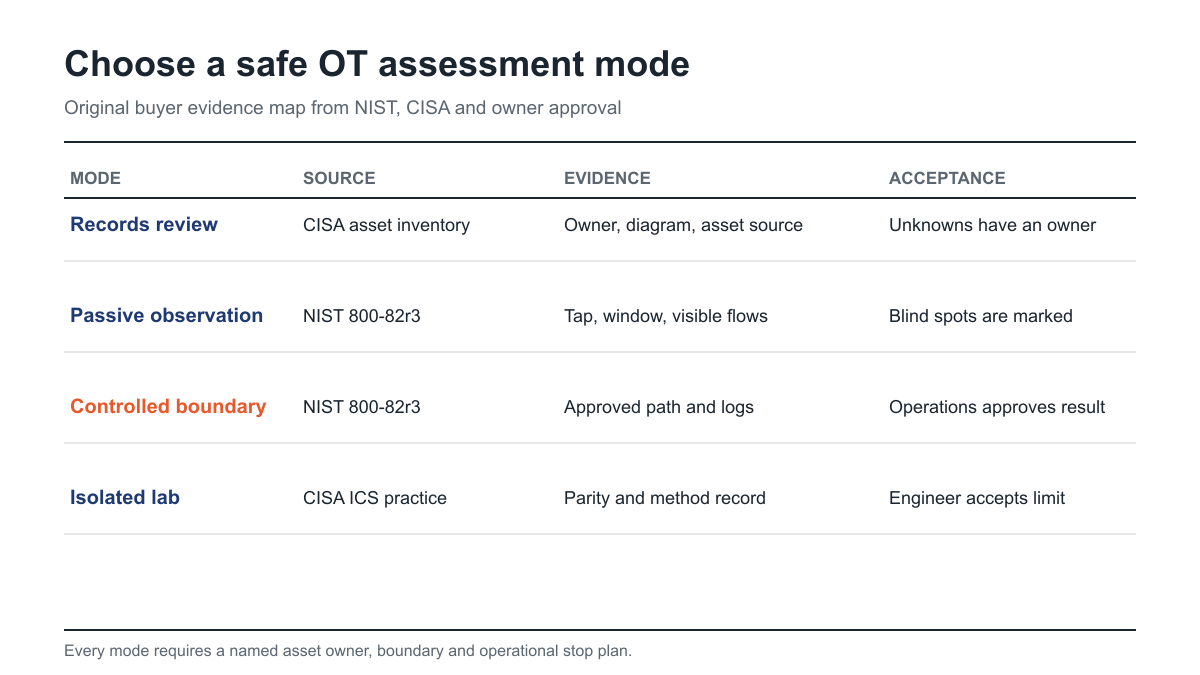
Figure 1: Original buyer mapping from safe assessment mode to decision evidence, based on: NIST SP 800-82 Rev. 3, CISA OT asset inventory guidance and CISA ICS assessment practice.
Passive discovery has a defined blind spot
Passive observation is often a sound start, but it does not remove the need for asset owners and engineers. A device that is offline, rarely communicates, uses a non-IP link or sits outside the collection point may not appear. NIST's OT guide notes that automated topology discovery may miss non-IP and isolated components and that physical inspection or log analysis may be required. The contract should require the assessor to label observed assets and owner-supplied assets separately.
For each collection point, record who installed it, whether it is truly passive, the span or tap configuration, the observation period, data handling constraints and whether traffic from every relevant zone is visible. A flow map should show what was seen, not silently infer that unseen paths do not exist. If the assessor recommends an active query to fill a gap, the buyer should review that proposal as a new method, with engineering and vendor input. The default passive phase should not silently turn into an active scan because a dashboard looks incomplete.
Controlled active validation belongs at a precise boundary
Some questions need an active result. An approved test may determine whether an IT host can reach a DMZ service, whether a remote-support account can cross a gateway, or whether a firewall policy denies a named protocol to a named destination. Those tests can often be placed at IT, access or perimeter boundaries without touching controllers. The result should identify the source and destination, the account or route, the time, the expected behavior and the observed control decision.
NIST SP 800-82 Rev. 3 recommends characterizing, segmenting and isolating IT and OT devices with attention to management authority, trust, criticality and data flow. It also says the zone design must account for everyday operations, safety and response. A buyer should therefore test an approved boundary against its intended function, not treat a blocked connection as automatically good. A business-critical historian feed or maintenance route may be legitimate, but it should be documented, limited and monitored.
The existing OT vendor remote-access test matrix covers supplier access in depth. This guide treats remote access as one component of the wider assessment purchase. The buyer should avoid paying twice for the same route and should carry over any validated findings or exclusions from a recent specialist test.
Put operations authority into the rules of engagement
A production-safe statement of work needs more than an IT security manager's signature. It should identify the plant or service owner, process control engineer, network owner, safety representative where relevant, vendor contact and on-call incident or operations lead. It should state who may pause the work and how that person can reach the testing team immediately. It should name maintenance windows, shift changes, process peaks and any period when change is prohibited.
CISA's defense-in-depth recommended practice says the assessment team and organization should agree on what activities may happen in which systems and who performs them. It distinguishes testing on an active production system from testing on a secondary system, test network or standalone substitute. It also says local personnel should perform tests on an active control system at the direction of the assessment team. That is a strong reason to write operator and assessor responsibilities into the contract.
NIST SP 800-115's rules of engagement template provides general test-planning fields such as boundaries, assumptions, risks, personnel and schedule. For OT, expand those fields with a method approval for each asset class. The document should tell the assessor exactly which action requires a fresh authorization. A blanket "non-disruptive" clause is too ambiguous because a query that is ordinary on an enterprise server may be harmful to a legacy control device.
A minimum method authorization record
A practical authorization record links each proposed method to a specific system and decision. The owner should be able to answer these questions from the record without calling the assessor:
Which asset, zone or connection is being observed or tested, and who owns it?
What is the approved mode: records review, passive observation, controlled active validation or lab test?
Which person approved the mode and what vendor or integrator permission was obtained?
What traffic or change will the method create, and what production dependency could it affect?
When may the work occur, and what operating condition must be true before it begins?
What telemetry or process signal will show an unexpected effect, and who watches it?
What is the immediate stop condition, who can invoke it, and how is normal service confirmed afterward?
What evidence will the assessor retain, where is it stored, and when is it deleted?
The answers are contract inputs. They are not a procedural playbook for touching live control equipment. When the buyer cannot answer them for a proposed active test, defer the method and use records, passive observation or a representative lab until the owner can assess the risk.
Source-mapped buyer acceptance matrix
The following matrix is a procurement tool, not a certification checklist. It connects official guidance to the question an owner should ask and the evidence a supplier should return. Each row should be marked approved, deferred or excluded during scoping. The buyer then records the actual result and limitations in the final report.
Buyer objective and source | Safe assessment mode | Evidence to return | Accept or escalate when |
|---|---|---|---|
Asset and process map: Which devices and services support the named process? CISA asset inventory guidance | Owner records, engineer interviews, physical verification and approved passive observation | Asset register with source, owner, role, criticality and confidence | Each important asset is owner-confirmed or marked unknown with a follow-up owner |
Network data flows: Which communications are needed between IT, DMZ and OT zones? NIST §5.2.3.1 | Diagram and policy review; passive flow analysis | Diagram version, observed flow list, expected flow list and exceptions | Unexpected paths have an owner and decision; blocked necessary paths are surfaced |
Boundary enforcement: Does an approved path permit only the intended route? NIST segmentation guidance | Controlled active validation at approved IT or DMZ endpoints, or policy simulation | Source, destination, time, policy decision and operations sign-off | Result matches the approved data-flow policy; any deviation has a remediation owner |
Remote support: Are access points, accounts and vendor permissions known? NIST AC-17 discussion | Configuration and log review; separate bounded test if authorized | Vendor identity, account scope, access window, approval and session logs | Unknown or persistent access is escalated to the owner; specialist test is separately scoped |
Vulnerability discovery: Which weaknesses are credible in this environment? NIST §6.3.2.4 | Passive and manual review first; active method tested offline and approved separately | Source of observation, affected asset, confidence, safety limit and validation method | Finding is supported by evidence, and direct production testing was authorized if used |
Visibility: Can the owner investigate the approved boundary event? NIST monitoring guidance | Review existing logs and a benign approved boundary event | Log source, event identifier, timestamps and monitoring owner | Expected event is present or a specific collection gap is recorded |
Change and recovery readiness: What happens if assessment activity affects service? CISA assessment ROE | Pre-work owner review and tabletop of stop/recovery handoff | Change record, stop contact, rollback owner and post-work state check | Operations can stop the work and confirm its process state |
A useful report should identify whether an item was observed, inferred from configuration, reported by the owner or not tested. These labels prevent a passive inventory from being sold as a validated vulnerability assessment and prevent a configuration concern from being reported as a proven exploit. They also show an executive which questions still need engineering work.
Build a quote that exposes the safety cost
An OT assessment quote should make preparation visible. The supplier needs time to review the architecture, define data handling, walk through methods with operations and coordinate a safe window. A very low quote that includes only an automated scan may omit the work that makes the assessment usable and safe. The buyer should compare work packages, not a single day rate or asset count.
Ask every bidder to price the same phases: owner interviews and records review; inventory validation; approved passive collection; boundary policy review; controlled active validation where authorized; report and owner workshop; and retest of findings that can safely be retested. Require each phase to name the inputs the buyer must supply and the evidence it will return. If the buyer wants controller, firmware, safety-instrumented or process engineering validation, that is a separately specified specialist scope with the relevant owners and vendor support.
The bid should state travel and site access assumptions, industrial safety induction, escort needs, shift coverage, maintenance coordination, vendor participation and any lab parity work. These items change effort, so they should not be buried in a broad "OT assessment" label. A bidder should also identify what happens if operations cancels a window or a device vendor declines permission. The work may still yield a valuable architecture and evidence review, but the report must mark active validation as deferred rather than completed.
A buyer can use the pentest cost calculator as a general scoping prompt, but OT work needs a tailored conversation about production boundaries and permissions. No published web application package price should be presented as an OT assessment price. Stingrai's network testing service is quoted against the approved environment and method.
Questions that reveal a suitable provider
Ask the bidder to explain how it would handle an unknown device on a mirrored port, a disagreement between the network diagram and observed traffic, a request to run a scan during a live production cycle, and a vendor refusal to permit testing of its remote support system. Look for a decision process that returns to the owner and the rules of engagement. A response that treats a tool's default scan profile as the method is not enough for a sensitive environment.
Request a sample report with an asset or flow marked untested, and ask why. A credible assessor should be comfortable with limits. Ask how the team documents the parity of a test network, the provenance of a passive observation, and the owner who accepts a residual risk. Ask which members will be on site, who can stop them, and who writes the final technical conclusion. The answers should be reflected in the contract, not only in a sales call.
A synthetic assessment scenario
Consider a fictional manufacturing site with a production scheduling system on IT, a historian in a DMZ, and control equipment on a separate OT network. A maintenance supplier uses an approved remote-access service, and the plant owner has a rough network diagram. The buyer's question is whether the expected data flow is documented and whether the IT side can directly reach control-side management services. This example contains no real site, client or device configuration.
The engagement begins with an engineer interview and a records review. The assessor receives the current diagram, firewall policy and remote-access account list. A passive collection point approved by operations records flows across the IT/DMZ boundary during a defined observation period. The assessor finds a service connection that is not in the diagram. That is an inventory discrepancy, not yet a proven unauthorized route. The operations owner identifies it as a valid historian feed and adds its purpose, owner and maintenance contact to the data-flow record.
The buyer then authorizes one controlled validation from a designated IT test host to a DMZ endpoint. It does not authorize direct traffic to controllers. The test shows that the specific route is denied by the intended rule, with a firewall event and timestamp. The assessor records that result as a pass for that route only. A proposed scan of a control-side device is deferred because the vendor has not approved the method or a representative offline test. The report states the gap and names the owner who will decide whether a later specialist validation is needed.
At closeout, the buyer receives an updated asset and flow map, the unknown-flow resolution, the boundary test evidence, the deferred-device decision and the approved rules of engagement. The result is modest but operationally meaningful. It explains what is known, what the architecture permits and which question remains open without implying that the physical process or every controller has been penetration tested.
Where Stingrai fits
Stingrai Inc. is CREST-accredited for penetration testing. Its published network testing service covers internet-facing perimeter, internal network, VPN appliances, Active Directory paths and segmentation. In an OT-adjacent engagement, those capabilities fit an owner-approved IT, DMZ, identity or remote-access boundary where a human-led penetration test can be conducted safely and lawfully.
The proposal should name the boundary, test accounts, allowed traffic, operational contacts and evidence packet. Stingrai can report the observed network and access result and retest a corrected path within the approved scope. The OT owner, process engineer and device vendor decide whether direct control-system testing is appropriate and who performs it. For a broad OT security assessment, keep the inventory, process and safety decisions with those owners and use specialized partners where the scope requires device or process engineering.
Stingrai's testing can support a compliance program by producing technical evidence for the buyer's audit or customer review. It does not turn a boundary test into a whole-plant conclusion. To discuss a scoped network or remote-access work package, request a quote with the system map and operations constraints.
Frequently Asked Questions
What should an OT security assessment include?
It should include the process owner, asset and data-flow boundary, existing records, method approval for each asset class, operations contacts, vendor permissions, stop criteria and an evidence packet. The packet should state which conclusions came from records, passive observation, controlled validation or a lab, and mark untested areas plainly.
Is NIST SP 800-82 Rev. 4 final in 2026?
No. As of November 2026, NIST SP 800-82 Rev. 3 is the final published guide, while Rev. 4 is an initial public draft with comments due later in November. Buyers should cite the final revision when writing current assessment requirements and monitor the draft for future changes.
Can an OT assessor actively scan a production control network?
The owner should not treat active scanning as a default assessment method. NIST advises testing scanning tools offline before production use, and CISA warns that active scanning production control systems can cause operational issues. Any proposed active method needs a specific target, offline evaluation, vendor and operations approval, safe window, monitoring and stop plan.
What can passive OT discovery prove?
Passive observation can document devices and flows visible at an approved collection point during the observation period. It cannot prove that unseen devices, offline assets or non-IP links do not exist. The final inventory should distinguish observed information from owner-supplied records and unresolved gaps.
How should we handle vendor-owned remote access in the assessment?
Record the vendor, access path, account owner, permission, window and logs. Review buyer-controlled configuration and evidence first. Testing the vendor's platform or account requires the relevant authority and a separate method approval; the buyer can use a specialist remote-access scope for that route.
What evidence should the OT assessment vendor return?
Require the approved rules of engagement, asset and flow map with provenance, method record, observed boundary results, relevant logs, findings with operational context, exclusions, deferred tests and a retest plan. Each conclusion should name the process or technical owner who can act on it.
How do we compare OT security assessment quotes?
Give bidders the same process map, asset inventory state, method approvals and deliverable list. Compare records review, passive collection, controlled validation, site coordination, reporting and retesting as separate work packages. Ask them to price vendor participation, outage windows and lab parity explicitly.
What part of an OT assessment can Stingrai perform?
Stingrai can scope human-led testing of authorized internet-facing, internal network, identity, segmentation and remote-access boundaries. The OT owner and appropriate engineering specialists retain decisions about direct controller, firmware, safety-system and process validation. A proposal should state the boundary and evidence clearly.
Related reading
References
NIST, Guide to Operational Technology Security, SP 800-82 Rev. 3, final September 2023.
CISA and partner agencies, Foundations for OT Cybersecurity: Asset Inventory, August 2025.
CISA/ICS-CERT, Improving Industrial Control System Cybersecurity with Defense-in-Depth.
International Society of Automation, ISA/IEC 62443 Series of Standards.
NIST, Technical Guide to Information Security Testing and Assessment, SP 800-115.
Talk to Stingrai
Bring the process map, approved network boundary and operations constraints to the first discussion. Get a Quote or book a free discovery call to scope human-led network or remote-access testing.



