



Anthropic's 12 October 2026 research makes a narrower and more useful claim than many “AI worm” headlines: models can already perform important parts of autonomous replication, while a small model that both fits on ordinary edge devices and reliably completes the entire real-world chain has not been demonstrated. Anthropic ran a model across 15 physical Android TV boxes for inference. Its replication experiment used 8 contained Android emulators, a deliberately unauthenticated access path, and a larger orchestrating model hosted elsewhere. Those distinctions determine what an enterprise should actually test.
Quick answer. Anthropic did not report an AI worm spreading through physical smart TVs or an enterprise network. It demonstrated distributed model inference on physical boxes and a simplified replication workflow in a firewalled emulator fleet. Stingrai's practical recommendation is to validate managed and unmanaged device inventory, lateral network paths, logging and containment with a scoped network penetration test, then add identity and cloud testing where device management or model services depend on them.
This is a test plan for security leaders who own conference-room equipment, video devices, facilities technology, branch networks or other connected systems that rarely appear in a conventional laptop-and-server assessment. It is also a way for procurement to ask a testing provider for evidence instead of an alarming presentation. The point is to expose the paths a replicating program would need, regardless of whether the program contains an AI model.
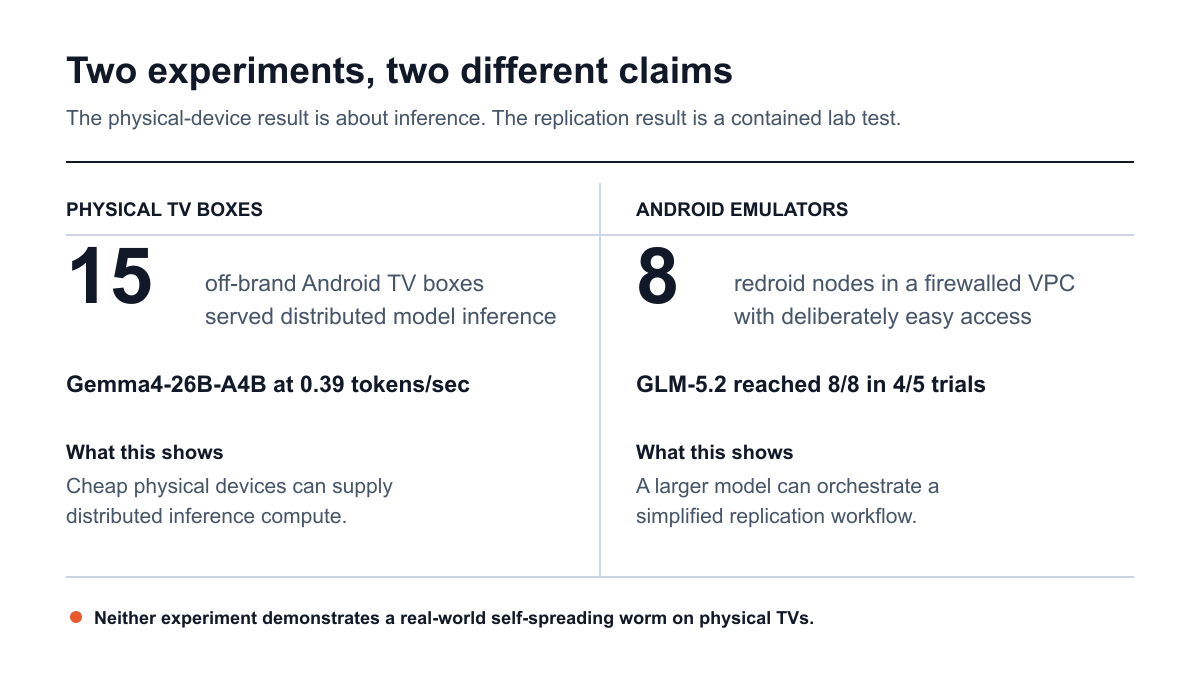
Figure 1: Anthropic's physical-device inference demonstration and contained emulator replication experiment answer different questions. Source: Anthropic, AI models may be capable of self-replicating without access to a datacenter.
What Anthropic demonstrated, and what it did not
The research breaks autonomous replication into target discovery, access, inference setup and propagation. Its main experimental focus was getting inference running on unfamiliar hardware, a difficult step for a program that carries a model rather than a fixed script. Anthropic reports that a 9B model succeeded on 8 of 9 hardware types it tested. That is evidence about configuration and adaptation in a lab evaluation, not a measured infection rate on enterprise networks.
The physical-device demonstration is striking for a different reason. Anthropic distributed Gemma4-26B-A4B across 15 inexpensive off-brand Android TV boxes, purchased for about US$55 each, at 0.39 tokens per second. The boxes provided compute for inference. The publication does not say those boxes autonomously found and compromised one another. Their low inference speed also matters: an edge-resident model would operate under a different time budget from a cloud-hosted agent.
For its end-to-end test, Anthropic built a firewalled 8-node GCP VPC of redroid Android 15 emulators. It made access straightforward by leaving the ADB port unauthenticated. A GLM-5.2 orchestrator then got Llama3.1-8B inference running on target nodes. The larger orchestrator itself ran on a separate inference server because the emulator nodes could not host it. Anthropic reports 8 of 8 nodes reached in 4 of 5 trials, and 7 of 8 in the remaining trial. The researchers explicitly describe this simplified access condition as an upper bound on real-world success. Read the experimental setup and caveat.
Question | What the publication supports | What it does not establish |
|---|---|---|
Can cheap physical devices serve model inference? | Yes, in the researchers' networked TV-box setup. | That those physical devices were autonomously compromised. |
Can an agent repeat a simplified propagation workflow? | Yes, in the contained emulator fleet with easy access and a separately hosted orchestrator. | A self-contained small model spreading through a real corporate IoT fleet. |
Is a practical AI IoT worm already observed? | Anthropic identifies progress on component tasks and laboratory chaining. | Anthropic says it has not seen a full rogue replicator. |
When might capability change? | Anthropic gives an end-of-2026 projection based on a general capability index. | A measured arrival date, a probability or an observed incident. |
This boundary is important for buyers. A vendor cannot honestly claim it has “tested against the Anthropic worm” as though a known malware family, signature or active campaign exists. It can test the access, movement, compute and visibility conditions that would make this and ordinary botnets more dangerous.
Why enterprise networks should care before a worm exists
Anthropic's projection is conditional. It says the current capability floor needed for reliable propagation and the model size ceiling imposed by edge devices do not yet intersect. Its estimate that a sufficiently capable small model could arrive by the end of 2026 comes from a general model-capability index, which Anthropic itself calls a rough proxy. The research conclusion says there is no full rogue replicator yet.
The enterprise exposure does not depend on that forecast coming true. An unmanaged video appliance that can reach adjacent devices, fetch large files, access a management interface or communicate broadly with cloud services creates an attack path today. A model-guided agent would be one way to traverse it. Scripted malware, a compromised vendor update channel or a human operator could use much of the same path. This is an inference from the research's threat model, not an incident claim.
The likely organizational blind spot is ownership. Facilities may buy screens and building systems; IT may place them on networks; security may monitor only managed endpoints. A procurement inventory can list the device yet omit its management path, update policy, network segment or outbound destinations. A useful assessment therefore starts with what is connected and who can administer it, then asks which trust boundaries are enforced in practice.
NIST's IoT device capability baseline is a sensible vocabulary for this conversation. Its capabilities catalog covers device identification, configuration, data protection, logical access to interfaces, software update and cybersecurity state awareness. It is a baseline to tailor for procurement and integration, not a certification or proof that a specific product resists an AI agent. A buyer can turn those capabilities into verifiable acceptance criteria.
A test scope that measures spread conditions
A conventional external web test and a device-segmentation assessment answer different questions. For this threat model, the scope should include the device class, its management plane, the network it joins and the identities that administer it. Put those boundaries in the rules of engagement before testing. Vendor-owned services, production control systems and unsupported appliances may require special constraints or exclusion; the report should state those choices so no one mistakes “not tested” for “secure.”
Device and management-plane inventory
List physical device models and firmware support status, including units in meeting rooms, branches, labs and shared spaces. Identify which are corporate-managed, vendor-managed or personally supplied. Record management protocols, update routes, remote access paths and whether an administrator can enumerate devices centrally. Validate the list against network observations and procurement records. This is a gap analysis, not a request to probe arbitrary devices.
The test should answer: Can an operator determine which devices are currently online? Are management interfaces reachable only from approved management networks? Do device defaults remain enabled? Are administrator credentials unique and rotated? Does a decommissioned device or a branch with older firmware retain the same reach as a supported asset? NIST's catalog makes logical access and software update explicit capabilities to request from manufacturers.
East-west reachability and egress
Draw a trust map for device-to-device traffic, device-to-server traffic and outbound internet access. Verify the implemented policy through safe, authorized tests from representative segments rather than assuming a firewall diagram is current. A device that should talk only to a controller should not have general reach into workstations, identity services or peer devices. Where the business needs peer communication, name the allowed protocol and destination and test that narrow exception.
Anthropic's defender section suggests plausible future signals: multi-gigabyte model transfers, sustained traffic between device classes that rarely exchange large volumes, and unusual scanning or outbound connection patterns. A flow record alone cannot tell an analyst whether traffic is model weights, a software update or a video stream. A good detection design joins network metadata to an asset class, update window and destination allowlist. It validates a hypothesis, rather than treating all large transfers as malicious.
Identities and cloud dependencies
Many connected devices receive configuration from a cloud console, an integration account or a local service account. Map the permissions and session lifetime of those identities. Determine whether one device-management credential can alter a whole fleet, whether stale integrations retain access, and whether the same account can reach both management systems and sensitive business applications. These questions fit an Active Directory assessment or a cloud penetration test when those systems are in scope.
The research also discusses an API-based replication scenario that would use stolen inference-service credentials instead of carrying model weights to every host. That is a threat-model branch, not something the lab demonstrated in the TV-box experiment. For an enterprise with AI services, test the identity boundary: which workloads can call model APIs, how access is revoked, whether spend and request anomalies are visible, and whether a device identity could obtain those credentials. Preserve a clean distinction between a hypothetical pathway and an observed finding.
Response and retest evidence
A useful report names the source device class, reachable destination, business reason for the intended connection, control expected to block the path, observed result and fix owner. For detection tests, include the flow or log fields that were visible, the alert disposition and whether isolation succeeded in the authorized test window. Retest after segmentation or credential changes; a policy screenshot does not establish that the path closed.
For a mid-market buyer, one representative site plus a central management plane may be the practical first engagement. For a distributed enterprise, sample device classes and site types, then expand the test where architecture differs. The scope must be explicit: an assessment of video endpoints does not automatically cover building automation, medical devices, OT controllers or every branch. Those may need their own safety controls and testers.
Detection questions for the SOC
The point of detection engineering here is to find behavior that would matter before anyone can label it an AI worm. The following are hypotheses to validate against the organization's normal traffic, not published indicators of compromise.
Hypothesis | Minimum evidence to collect | Triage question |
|---|---|---|
An unmanaged device receives an unusually large executable or model-like transfer. | Asset class, source, destination, bytes, timing and approved update windows. | Is this a signed vendor update, a documented media transfer or a new source? |
Devices exchange sustained east-west traffic outside their normal pattern. | NetFlow or equivalent, segment membership, destination owner and prior baseline. | Which business workflow requires these peers to communicate? |
A device initiates broad connection attempts. | Connection attempts by source class, denied versus allowed paths and change history. | Did a configuration change or maintenance tool explain the burst? |
Device-management identity accesses a new resource class. | Identity audit events, role grants, target resources and ticket history. | Was the grant approved, and can it be limited to the controller role? |
Isolation is invoked but communication continues. | Quarantine decision, enforcement event and post-isolation flow. | Did the control isolate the correct device and all relevant routes? |
Anthropic expects a weight-based replicator to leave transfer and communication artifacts, but it does not provide a field-tested detection rule or a false-positive rate. A red or purple team can exercise these hypotheses safely with benign test traffic and agreed thresholds. The outcome should be measured in observed telemetry, alert routing and containment time, with limitations recorded.
A defender checklist: today, this week and this quarter
Today: establish an owner and a safe boundary. Name the team responsible for each connected-device class. Identify internet-exposed management paths and devices that can reach sensitive networks. Restrict known unnecessary reach through the normal change process. Preserve logs before making changes that would erase evidence.
This week: validate inventory, access and telemetry. Reconcile procurement, network and management-console lists. Review administrative access and update status. Test representative east-west and egress paths under written rules of engagement. Tune detections for unusual large transfers, new peer traffic and management-identity behavior against known update windows.
This quarter: commission a scoped assessment and retest. Include a representative device class, its management plane, network segmentation and identity dependencies. Require a report with observed paths and control owners, then verify that fixes closed the paths. Expand to additional sites or device classes where architecture differs.
The sequence is deliberately mundane. It gives the security leader an evidence trail for budget and remediation decisions without asserting that an experimental AI agent is already loose in the environment. Where the assessment reaches cloud services or web management applications, define those as separate tested surfaces and link findings back to the affected device workflow.
How to buy an assessment without buying a headline
Ask each provider what device classes and site types it will sample, what it will exclude, and how it will test management access without disrupting production. Ask for a sample finding that demonstrates the difference between an allowed business connection and a reachable but unauthorized path. Require the tester to show how network controls, identity grants and monitoring combine, because a packet-level result alone may hide the reason a path remained open.
For this scenario, prefer a proposal with named testers, a written rules-of-engagement plan, a path map, detection validation and a retest. Ask who handles fragile devices, whether the test includes cloud or Active Directory control planes, and how evidence will be redacted for procurement or audit review. An engagement scoped only as “AI worm testing” is too ambiguous to compare or approve.
Stingrai is a CREST-accredited penetration testing company headquartered in Toronto. Its human-led network, cloud and Active Directory engagements can test the trust boundaries described above, with two named penetration testers on each human-led engagement and retesting of remediated findings. Stingrai offers one-time tests and continuous programs. Snipe is its autonomous agent for web applications and their associated APIs; it is not the device or network testing method for this scope. See the network testing service and cloud testing service for related capabilities.
Frequently Asked Questions
What should an enterprise pentest include for AI worm risk?
It should test the conditions a replicating program would need: a verified device inventory, management-plane access, east-west reachability, internet egress, privileged identities, detection and isolation. The rules of engagement should name representative device classes and exclusions, and the report should show observed paths and retest results. Anthropic's research motivates the scope, but it does not supply a known real-world AI-worm signature to test against.
Did Anthropic release a self-replicating worm on smart TVs?
No. Anthropic used 15 physical TV boxes to run distributed model inference. Its replication workflow was tested separately on 8 contained Android emulators with deliberately unauthenticated access, while the larger orchestrating model ran on another inference server. Anthropic says it has not observed a full rogue replicator.
How successful was Anthropic's replication test?
In its simplified emulator setup, GLM-5.2 reached 8 of 8 nodes in 4 of 5 trials and 7 of 8 in the remaining trial. The researchers call the setup an upper bound on real-world success because the access step was intentionally easy. Those results are not infection rates for physical IoT fleets.
What traffic might reveal a future weight-based AI worm?
Anthropic identifies large model-payload transfers, sustained traffic between devices that normally exchange little data, and scanning or unusual outbound connection patterns as possible signals. An enterprise should baseline those signals by device class and update window, then validate alerts with benign authorized tests. The paper does not publish a field-tested detection rule.
When does Anthropic predict a small AI worm could become feasible?
Anthropic's end-of-2026 estimate comes from a general model-capability index used as a proxy for replication ability. The paper says the capability level needed to replicate and the model size that fits edge devices do not yet meet. The estimate is a forecast, not a measured arrival date or a report of an active worm.
Is Snipe the right service for IoT and network testing?
Snipe tests one web application and associated APIs in Stingrai's web application offerings. Human-led network, cloud and identity testing is the relevant Stingrai scope for connected devices, segmentation and management-plane paths. Buyers should define each surface in the engagement and ask for retest evidence after remediation.
Related reading
References
Anthropic. AI models may be capable of self-replicating without access to a datacenter. 12 October 2026. Primary research, experimental setup, limitations and defender discussion.
NIST. IoT Device Cybersecurity Capability Core Baseline. 29 May 2020. Baseline context for device acquisition and integration.
NIST. IoT Cybersecurity Capabilities Catalog. Accessed 21 October 2026. Device capability categories used to frame testing questions.
Talk to Stingrai
For a scoped assessment of connected-device network boundaries, management access and detection evidence, get a quote or book a free discovery call. Name the device classes and sites you want covered so the rules of engagement are concrete.