WebSocket connections remain open and carry traffic in both directions, so a successful connection does not prove that later actions are authorized. OWASP's WebSocket Security Cheat Sheet treats handshake controls, session lifetime, message permissions, resource protection, and logging as separate concerns. A buyer should make each concern visible in the testing scope before assuming that a conventional web application quote covers a real-time feature.
Quick answer. A WebSocket penetration test should assess who can establish a connection, which actions and subscriptions each connected identity may use, what happens when a session or role changes, and whether the application limits and records misuse. Supply the provider with the WebSocket routes, message schema or protocol description, controlled accounts, channel membership rules, and safe test data. Stingrai's web application service covers authenticated roles and session management, but WebSocket routes and message workflows should be expressly named in the statement of work.
This is a buying guide for mid-market and enterprise teams with live collaboration, dashboards, alerts, chat, trading, operational control, or other real-time features. It does not repeat the general web application penetration testing scope and cost guide. The specific decision here is whether the proposed test follows a live connection past its initial HTTP upgrade and evaluates the application messages that carry business actions and data.
Know what the web test would otherwise miss
A WebSocket session begins with an HTTP handshake, then carries frames over a persistent connection. The application may authenticate at connection time, accept a subscription to a room or topic, send events, and process messages that change state. Those moments involve different decisions. An allowed connection should not mean every subscription is allowed, and an allowed subscription should not mean every command can run. OWASP's guidance calls for authorization on each action rather than treating the connection as unlimited access.
The proposal should therefore describe the unit of testing. “One WebSocket endpoint” may carry many message types and channels. A single path can serve read-only events, privileged commands, file notifications, and tenant-specific data. Counting paths alone understates the scope. Ask the vendor to inventory message families, subscription channels, identities, and relevant states. That inventory makes the quote explainable and the final coverage report useful.
The WebSocket service may sit behind the same domain as the web application, or it may be served by another host, gateway, or team. Record the actual entry point, environment, and ownership. A web app test that lists only browser pages and REST routes may never exercise the live message stream. A buyer can prevent that gap with one line in the scope: the WebSocket host, route, protocol variant, and business workflows are in scope.
Inventory routes, clients, messages, and channels
Start with a concise architecture sheet. Identify the browsers, mobile clients, internal tools, and service clients that open a connection. Record whether the application uses browser cookies, short-lived tokens, a first-message authentication exchange, or another mechanism. Then list the actions clients can send and the events they can receive. The purpose is not to deliver a full protocol implementation to procurement. It is to tell the tester what behavior must be verified.
Map the channel model. A collaboration app might have a workspace, document, and user-specific notification stream. A monitoring platform might have organization and device channels. A financial product might have market data and private account streams. These are examples, not a claim about any particular customer. For each channel, state who may subscribe, who may publish or invoke an action, and how membership is established. Supply at least one controlled allowed case and one controlled forbidden case for each important boundary.
Include state transitions. A user can log out, lose a role, leave a team, move to another organization, or have a support privilege revoked while the socket remains open. A new connection may be rejected correctly while an existing connection continues to receive events. OWASP warns that WebSocket sessions can outlive ordinary web sessions. The buyer should specify which transitions the test must observe and what the application's intended response is.
If the protocol is undocumented, provide representative client traffic and an engineering contact who can explain message types. Do not ask the tester to infer every business rule from packet shapes. The security value comes from comparing observed behavior to a known authorization model. A provider can help discover undocumented actions, but that work must be stated in the quote and reflected in the report.
Check every client that can reach the same live service
A browser may be the visible client, but the same WebSocket service may also be used by a mobile app, an operations console, or an automated integration. The buyer should say which clients are authorized and whether they share an identity policy. A test that opens the browser flow cannot establish what a service client may do with another credential type. Conversely, a direct protocol test does not establish whether browser-specific origin rules are enforced.
List each client type with its connection method, identity source, expected channels, and permitted message families. A mobile client may authenticate with a token while a browser relies on a cookie. An internal dashboard may have elevated subscriptions intended only for staff. These are examples for the inventory, not presumptions about a particular application. Ask the provider to compare the policy on each path that is in scope and identify any path it could not reach.
This inventory also helps a buyer separate authorization from deployment restrictions. An internal client may reach a service through a private network, but that network path alone does not prove every message is authorized. A browser origin check applies to browser use, while a service client needs its own authentication and application permissions. OWASP's WebSocket guidance treats origin validation, identity, and per-action authorization as different controls. The report should do the same.
If a client is outside the legal test boundary, document the exclusion and the assurance that covers it elsewhere. For example, the buyer may authorize testing its own client and endpoint but not a third-party service consuming the stream. The tester can still assess the messages received by the in-scope service under controlled conditions. Clear boundaries let procurement understand what the result does and does not establish.
Separate handshake controls from application authorization
The handshake determines whether a connection should start. For browser clients, OWASP notes that cookies may accompany the handshake and recommends validating the Origin header against an explicit allowlist. A buyer should ask whether the assessment checks unauthenticated connections, wrong-origin browser attempts, invalid or expired credentials, and connections through every intended entry point. OWASP's WebSocket guidance provides the primary control vocabulary.
Origin validation is a browser-specific defense against cross-site use of an authenticated connection. It does not replace authentication, and it does not decide whether a connected user can view a particular tenant's channel. Keep those decisions separate in the acceptance matrix. Otherwise a report may say “WebSocket authentication passed” even though the tester only observed that a valid cookie opened a connection.
Ask how the service handles a connection made without a completed identity exchange. If the application authenticates in its first message, the scope should describe which messages can arrive before identity is established and what the server may return during that period. The tester should verify that protected data is not emitted merely because the transport is open. An accepted socket is a transport state, not evidence of a permitted business action.
The test should also account for gateways and reverse proxies, but with an explicit boundary. They may terminate transport, forward identity, or restrict origins. The application may then need its own per-action decision. The provider should state whether it will review only externally visible behavior or also source, configuration, and identity propagation where access is supplied. That distinction affects both effort and conclusions.
Prove authorization on every important message
Message-level authorization is the core of a useful WebSocket pentest. Provide users with different roles and memberships, then identify messages that read data, change records, administer users, approve operations, or select channels. The test should compare a permitted action with the same action attempted by an identity that lacks the required permission. For sensitive operations, the report should verify the downstream state, not only a success or error frame.
The organization and object boundary matters as much as the role. A user may be authorized to read an update from their own workspace but not a peer workspace. A tenant administrator may manage one customer's channel but not another's. A system operator may have a global diagnostic role with narrower data visibility than its name suggests. Ask the vendor to test those relationships explicitly rather than treating “authenticated user” as one category.
Subscription tests need a clear expected result. When the application sends an event to a topic, determine whether the user was authorized at subscription time and whether the user remains authorized when the event is sent. OWASP recommends message-level authorization; a long-lived subscription raises the additional question of how the application reacts after a membership or privilege change. The buyer should include this in the test if events can contain sensitive customer data.
Client controls are not the boundary. Hiding a command in the interface or withholding a subscription option from a menu does not establish server-side authorization. The provider should exercise the agreed message types directly as each controlled identity and show whether the server enforced the intended rule. This is the same reason a multi-tenant application assessment needs role and tenant fixtures, although the WebSocket protocol adds connection lifetime and message routing.
Test session expiry, logout, and privilege changes
The buyer needs an explicit rule for the life of a live connection. Should logout close it immediately? Should a revoked role stop future privileged actions while the socket stays open? Should a channel subscription be removed when a user leaves an organization? Those are product decisions, but the test should verify the chosen behavior. OWASP's session guidance for WebSockets calls for handling expiration on long-running connections.
Create safe transition fixtures: one user with a live connection, another authorized to change that user's membership, and synthetic data that can be observed without exposing real records. The provider can then compare events and actions before and after the approved transition. A result that checks only a fresh connection after a role change does not answer whether an existing connection retained old privileges.
Token rotation and reconnect behavior belong in the same discussion. If a client must refresh a credential, the tester should know whether the old connection should continue, be reauthorized, or close. If the client reconnects automatically, the assessment should distinguish a renewed authorized session from a stale session that never lost access. The report should state which paths were tested, because different client types may implement the flow differently.
For a customer-facing system, these checks should be arranged around safe accounts and agreed timing. The provider does not need access to a real departing employee or a real customer shutdown. Controlled roles and a documented expected outcome are enough to make the test reproducible.
Include input handling and resource limits without unsafe load
WebSocket messages are still application input. A protocol may carry text, structured objects, binary data, or commands that reach a backend. OWASP's WebSocket guidance calls for validating messages and limiting size and connection use. The buyer should ask whether the provider will assess message validation in the in-scope business actions and how it will avoid effects outside the authorized environment.
Do not treat an ordinary penetration test as permission to flood a production service. Resource controls can be reviewed through configuration, bounded test cases, and a staging environment where appropriate. If the buyer wants stress, denial-of-service, or resilience testing, that should be separately authorized with limits and a rollback plan. A provider's methodology should explain which checks can be performed safely in production and which remain untested under the agreed rules.
The message schema helps here. It allows the tester to distinguish valid values, rejected values, unknown action types, and oversized inputs without inventing a protocol. It also provides a reference for validation findings. The report should connect a confirmed issue to the affected message type and business impact, not just label it a generic injection or parsing weakness.
Ask what the logs can actually prove
Operational evidence matters when a real-time channel carries customer data or privileged actions. OWASP points out that traditional HTTP access logs record the upgrade request but not the later messages. An enterprise buyer should ask whether the assessment will review the application's logging of connection lifecycle, authorization failures, message validation failures, and revocation events, within the permissions given to the tester. OWASP also cautions against logging sensitive message contents or credentials.
This is not a request to turn a penetration test into a monitoring audit. It is a way to confirm that a sensitive action has an accountable identity and that a denied action can be investigated. The buyer should decide which events matter for its incident response and customer commitments. The report can state whether the expected events were visible in the supplied logs or whether logging was outside scope.
When a gateway, proxy, and application all produce records, ask which layer is authoritative for a user's action. The handshake may be logged by one component while message-level decisions occur in another. A useful finding traces the business operation to the identity and authorization decision that accepted or rejected it, without copying personal or sensitive payloads into the report.
Put the evidence model in the statement of work
An evidence matrix keeps the engagement focused on meaningful outcomes. It should distinguish a successful authorized baseline, a denied case, and a state change after revocation. A report that merely lists attempted message names leaves the buyer guessing whether the tester understood the permission model.
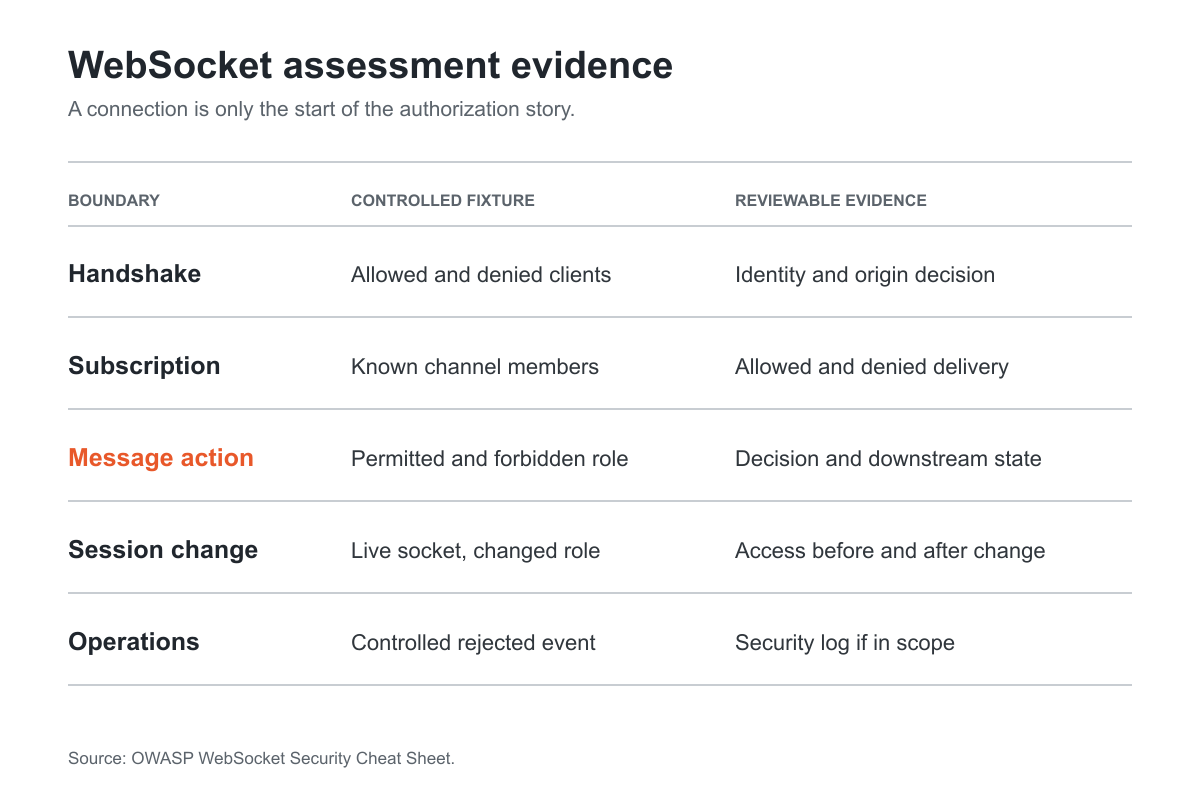
Figure 1: A buyer evidence matrix for the handshake, live messages, session changes and operational records. Source: OWASP WebSocket Security Cheat Sheet.
Boundary | Controlled fixture | Evidence to request |
|---|---|---|
Handshake | Allowed client and identity; unauthenticated or unauthorized case | Connection decision, identity state and origin policy outcome |
Channel or room | Two roles or organizations with known memberships | Allowed subscription and denied peer subscription |
Business message | Permitted and forbidden actor for a named action | Server decision and confirmed downstream state |
Session transition | Live connection before logout, expiry or role removal | Observed access before and after the transition |
Operations | Approved event and denied action in controlled data | Logging or detection evidence, if included in scope |
The matrix is a proposed procurement tool. Replace the examples with actual message types and permission rules. Mark every item as tested, excluded, or blocked by missing access in the final report. An empty matrix cell is not a pass.
Compare WebSocket testing proposals
Send each provider the same route inventory, clients, roles, channels, message families, and state transitions. Ask what they will test at the handshake, what they will test after connection, and how they will prove a forbidden action did not change state. Ask whether they need source code, protocol documentation, test credentials, or logging access. Those inputs make the quoted effort easier to compare.
The report should identify the tested build and environment, the agreed hosts and routes, the identities used, the messages and channels covered, relevant exclusions, confirmed findings, and retest outcomes. For each finding, request redacted evidence that shows the expected rule and observed result. A buyer can then explain the issue to engineering and to a customer security reviewer without sharing sensitive real-time payloads.
A useful clause is: “Assess the named WebSocket endpoints and message workflows for handshake authentication and origin policy, channel and message-level authorization, session expiration and revocation, safe input and resource controls, and agreed logging evidence. Use controlled identities and synthetic data. Deliver an allowed and denied case matrix, redacted findings, exclusions, remediation guidance, and retest results.” Adjust the terms to match the application and legal authorization.
Watch for a proposal that says only “OWASP Top 10 scan” or “WebSocket port checked.” Those phrases do not say which live messages, permissions, or transitions will be assessed. A more expensive proposal with an explicit protocol inventory may answer the enterprise customer's question better than a cheaper one that treats the connection as a single endpoint.
Set an acceptance meeting after the technical report is ready. Ask the tester to walk engineering and the security owner through one allowed case, one denied case, and one session transition for a high-value workflow. That discussion should use the same controlled identities and channel names recorded in the scope matrix. It gives the buyer a concrete way to check that the report describes the deployed protocol, and it gives the product team a repeatable baseline for remediation and the next release.
Where Stingrai fits
Stingrai's web application penetration testing service covers authentication, session management, roles, authorization, and business logic, with confirmed findings supported by request and response evidence. For a real-time application, provide the WebSocket routes, message types, roles, channels, and session rules during scoping. The resulting statement of work should say precisely which WebSocket behaviors are included.
Stingrai offers one-time and continuous testing programs. The right cadence depends on how often the application changes the message protocol, authorization model, and client behavior. A WebSocket assessment can produce evidence that supports an enterprise security review and a compliance program, while the specific deliverables and retest scope belong in the quote.
Frequently Asked Questions
What should a WebSocket penetration test include?
A WebSocket penetration test should include the handshake, permitted and forbidden channel subscriptions, message-level authorization, session expiration and revocation, input validation, bounded resource checks, and relevant logging evidence. The buyer should supply controlled identities, a message inventory, and expected permission rules. The report should separate tested behavior from exclusions.
Is a standard web application pentest enough for WebSockets?
Only if the signed scope names the WebSocket routes and the live message workflows. A web application assessment may test the login page and REST API without following a persistent connection through its subscriptions, commands, and session changes. Ask the provider for a message and role coverage matrix before accepting the quote.
Does a valid handshake prove that WebSocket messages are secure?
No. The handshake establishes a connection under a set of transport and identity checks. It does not prove that the connected user may subscribe to every channel or perform every message action. OWASP recommends authorization for each action, so the assessment should include known allowed and forbidden cases after connection.
Should WebSocket session revocation be tested?
Yes, when the application has logout, token expiry, role changes, or membership removal. A live connection can continue after ordinary web state changes unless the server handles that transition. The buyer should define the expected result and ask for evidence from a controlled connection before and after the change.
What accounts and data should a buyer provide?
Provide controlled accounts in the roles and organizations that determine channel access, plus synthetic records and events that make outcomes visible. Include an account able to change a role or membership if revocation is in scope. Document which channels are intended to be shared and which must remain private.
Can a WebSocket test safely run against production?
Some authenticated and authorization checks can be planned for production with controlled accounts and data. Resource exhaustion, destructive business actions, or broad traffic generation need separate authorization and limits. The buyer and provider should agree on the environment, testing window, emergency contact, and cleanup plan before work starts.
What should the WebSocket pentest report show?
It should name the tested routes, clients, message types, roles, channels, environment, exclusions, and observed results. Confirmed findings need redacted evidence, the expected permission rule, business impact, and remediation guidance. A coverage matrix and retest record help an enterprise reviewer distinguish a tested denial from an untested path.
How are WebSockets different from GraphQL subscriptions?
GraphQL subscriptions often use a WebSocket transport, but GraphQL is an application protocol with its own schema and resolver rules. A general WebSocket scope asks about the connection, messages, channels, session changes, and operational evidence regardless of the payload format. A GraphQL subscription assessment also needs the relevant schema and field authorization rules.
When should a WebSocket service be retested?
Retest confirmed findings after remediation. Repeat the key authorization and session cases when message types, channel membership, identity handling, gateways, or clients change. A one-time or annual assessment provides a baseline; a continuous program can revisit the critical cases as the real-time feature evolves.
Related reading
References
Talk to Stingrai
Use Get a Quote to share the WebSocket route and message inventory, or book a free discovery call to agree on roles, channels, session transitions, and safe test conditions.