




Stripe's marketplace guide describes a platform that collects customer payments and pays sellers through connected accounts, using destination charges or separate charges and transfers for the movement of funds to those accounts. The marketplace's application still decides which seller record belongs to which connected account, who may request onboarding, which account an API call addresses, and how incoming events update its own records. Those decisions deserve a focused security assessment before a significant marketplace rollout.
Quick answer. A Stripe Connect marketplace payout security assessment should test the platform's seller-to-connected-account binding, Account Link ownership, server-side account context, Connect event routing, transfer recipient authorization and any external payout authority it actually controls. Stingrai can scope this as a human-led web application and API penetration test, with sandbox seller accounts, synthetic transactions and evidence tied to the release decision. The acceptance standard is that one seller's session, event or support workflow cannot affect another seller's account or movement of funds.
The buyer's challenge is to contract for a result, not a list of endpoints. A test that exercises the checkout API but never asks whether the platform selected the correct acct_ account may leave the central marketplace trust boundary unexamined. Conversely, asking a tester to perform real payouts to bank accounts is unnecessary for an application security decision and may violate sensible rules of engagement. The useful middle ground is a documented model of identities, account ownership, event sources and authorized actions, followed by safe evidence for each boundary.
This guide is for a mid-market or enterprise marketplace preparing a first production launch, adding a new seller onboarding path, changing its Connect account model, centralizing webhook processing, or granting operations staff new payment controls. The proposed checks are buyer acceptance criteria, not requirements that Stripe imposes on every integration. Your implemented Connect configuration determines which paths matter.
Why a Connect-specific scope matters
A generic payment API test asks whether a customer can manipulate a charge, refund or payment state. A Connect marketplace adds a different relationship: the platform's internal seller, the Stripe connected account and the person authorized to manage that seller must remain aligned. That relationship is not automatically established by possession of an account ID or by receipt of a webhook. It is application state that the platform must protect.
Stripe's current marketplace guide uses Accounts v2, while other Connect paths and event examples still use Accounts v1. Stripe also notes that v1 and v2 events for an Accounts v2 connected account can arrive under different webhook scopes. The test plan therefore needs an explicit inventory of the buyer's APIs, event destinations, account version and dashboard configuration. A tester should not silently assume that every Stripe event appears in the same destination or that all connected accounts have the same platform-managed payout controls.
The scope ends at the platform's authorized integration and its owned test accounts. It can cover the seller portal, internal administrator or finance portal, API gateway, Connect service, webhook receiver, background worker, seller mapping store and finance reconciliation view. It should not describe Stripe's hosted service as an in-scope target. Stripe-hosted onboarding itself is a Stripe flow; the security question for the marketplace is who is allowed to launch it, for which connected account, and how the platform interprets the result.
The payment API penetration testing scope guide covers the broader payment lifecycle. This assessment narrows the purchase decision to connected-account boundaries. Keeping those topics separate lets a buyer ask for both when needed without paying twice for the same generic checkout checks.
Establish the account and authority map before testing
Start the statement of work with a concrete model of people, records and Stripe objects. The platform should identify the seller record in its own database, the connected account ID associated with it, the seller users who may administer it, and any support or finance role that can act across sellers. Include the process that creates or links a connected account, the process that retires or replaces it, and what happens when a seller is suspended or removed. The map should show which system makes each authorization decision.
The same diagram needs to distinguish money movement inside Connect from a payout to an external account. The marketplace guide describes destination charges and separate charges and transfers for moving funds to connected accounts. Stripe's payout management guide defines an external payout as funds going to an external account, usually a bank account. The platform may control the former while the connected account holder controls the latter, depending on dashboard access and platform controls. A test result that simply says “payouts are secure” hides that distinction.
Ask the engineering owner to provide a redacted architecture diagram and a route inventory with four annotations for every sensitive action: the initiating role, the authoritative seller-to-Stripe mapping, the Stripe account context used, and the business state changed. The route inventory should include UI actions and workers, not only public APIs. A nightly reconciliation worker or an administrator retry queue can cross the same boundary as a seller portal request.
For a useful sandbox fixture, provision at least two unrelated seller organizations, each with its own connected account, plus representative seller administrator, support and finance roles. Use synthetic names, records, charges and payout destinations. A single test seller can prove that a happy path functions; it cannot prove that the application rejects a cross-seller selection. If the platform has multiple brands, regions, legal entities or platform accounts, state which of those partitions are represented in the fixture.
Decisions the architecture map must answer
Who owns a seller record before a connected account exists, and who may claim the account when it is created?
Where is the canonical mapping between seller and connected account stored, and what can change it?
Which paths derive the connected account from server-side state, and which accept an account identifier from a client or queued job?
Which roles can view account status, generate onboarding links, initiate transfers, set payout schedules or update external payout details in the chosen dashboard model?
Which webhook destinations receive Your account events and Connected accounts events, and which event formats does the integration use?
Which live and test environments share a production webhook URL, and where is
livemodeenforced?What operational action follows a failed payout, disconnected account, new verification requirement or duplicate event?
The answers form test preconditions. If an action does not exist in the product, mark it out of scope rather than asking a tester to invent it. If a control is owned by a connected account in its Stripe Dashboard, test the platform's visibility and reaction, not a nonexistent platform edit screen.
Buyer acceptance matrix for the statement of work
The following matrix turns the account map into reviewable evidence. It is intentionally written as an acceptance decision. The vendor can use different safe techniques, but the report should identify the exercised role, account fixture, observed behavior and affected boundary. “No cross-seller effect” means no other seller's record, Stripe context or finance state changed during the authorized sandbox test.
Boundary | Authorized scenario | Negative scenario | Acceptance evidence |
|---|---|---|---|
Seller to connected account | A seller administrator reaches only its mapped account. | An unrelated seller or stale session presents a different account identifier. | Server-side mapping and application response show no cross-seller account selection or disclosure. |
Account creation and claim | The platform creates or links an account for the intended seller. | A duplicate, abandoned or mismatched claim attempts to replace the established mapping. | Record ownership, conflict handling and change history are visible. |
Onboarding link | An authenticated owner receives a link for its own connected account. | A user requests a link for a different seller or reuses a stale link. | Link issuance is tied to the authorized seller; refresh cannot switch ownership. |
Onboarding return | The platform reevaluates the same account's requirements and state. | A return to the platform is treated as proof of completion. | The platform does not grant a paid or verified status based only on the redirect. |
API account context | Server-side requests address the mapped connected account. | A client-supplied account selector conflicts with the authenticated seller. | The selected |
Webhook provenance | A correctly verified event reaches the intended handler. | An event with invalid provenance is supplied to the receiver. | No business state change occurs before signature verification. |
Webhook account and mode | An event is routed by its documented account and | A valid event for another seller or test mode is presented to the same handler. | The event updates only the matching seller and environment. |
Event lifecycle | Required v1 or v2 events reach the configured scope. | Delivery is repeated or arrives out of expected order. | Processing is idempotent and reconciles state without duplicate financial action. |
Transfer authority | The authorized workflow selects the mapped recipient and approved amount. | A seller-facing or support action selects another recipient or bypasses approval. | The transfer request and audit trail match the authorized business instruction. |
External payout authority | The configured owner changes payout settings where permitted. | A role without the relevant dashboard or platform authority attempts the same action. | The effective control and denial are shown for the actual account configuration. |
Failure handling | A failed payout or changed account requirement enters review. | A stale success state or retry remains available after failure. | The platform blocks or escalates the affected workflow according to policy. |
Reporting isolation | A seller sees its own balance, transfer and payout status. | A cross-seller query or export asks for another seller's records. | The report and export contain only authorized data. |
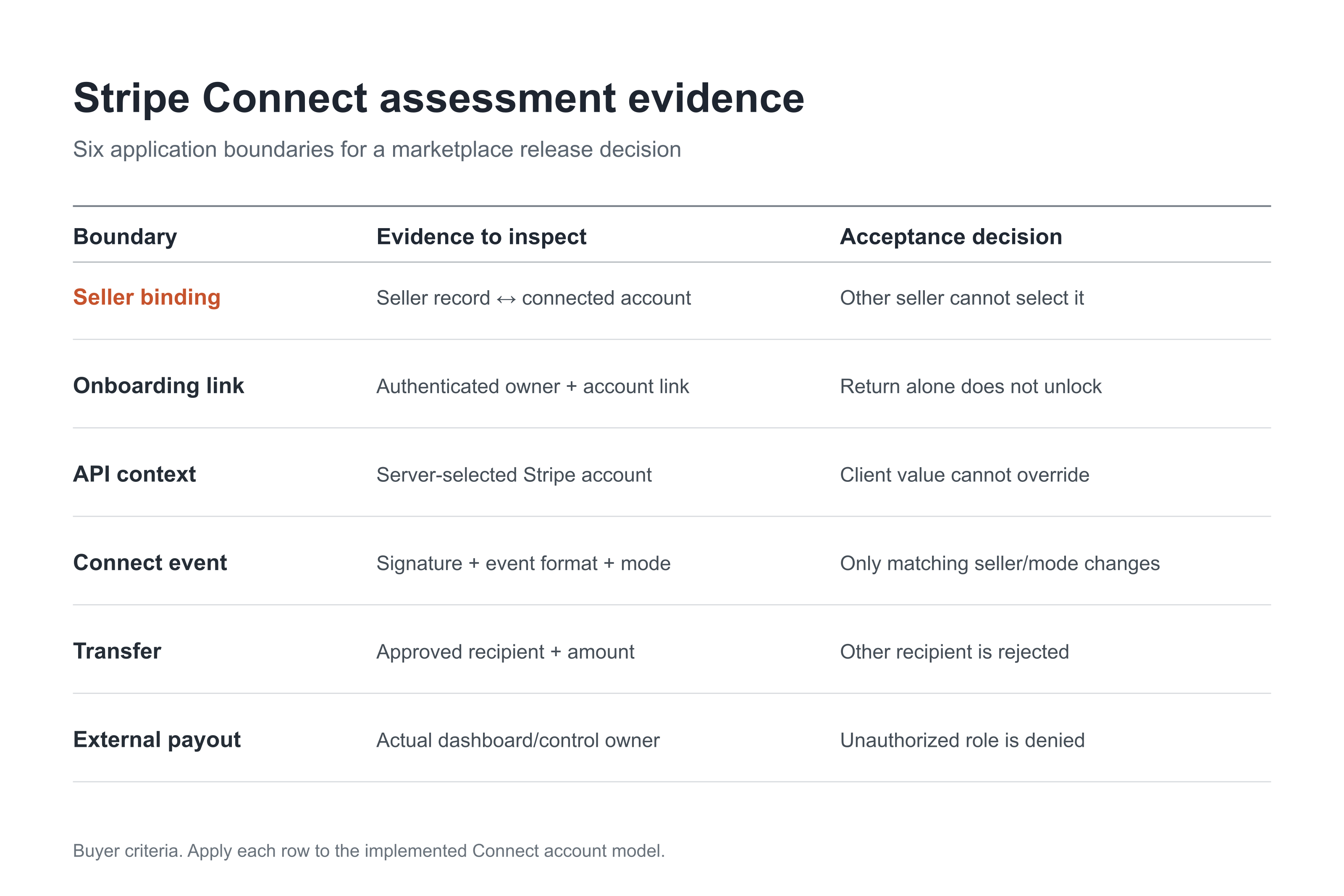
Figure 1: Buyer evidence boundaries for a Stripe Connect marketplace assessment. Source: Stripe, Build a marketplace, Stripe, Connect webhooks, and Stripe, Manage connected account payouts. The acceptance decisions are proposed assessment criteria.
The matrix is a starting point, not a promise that every row is present in your product. For example, a marketplace that uses Stripe-hosted onboarding but gives sellers a full Stripe Dashboard has different external payout edit authority from a custom account integration. Preserve the distinction in the SOW and require the assessor to mark any omitted row with the reason and the accountable owner. That makes the final report useful to a release committee.
Test Account Link ownership and onboarding state
An Account Link is a sensitive bridge between the platform's identity and a Stripe connected account. Stripe's Account Link API calls its URL single use and requires an account identifier. The hosted onboarding guide says to authenticate the account in the application before redirecting the user to that URL. For the assessment, that means the platform must prove that the current user is entitled to the seller whose connected account ID it supplies when creating the link.
The test should follow the complete link lifecycle. Inspect how the platform chooses the account when a seller begins onboarding, how it stores any short-lived link or pending onboarding state, how it handles an expired or previously visited link, and how its refresh endpoint regenerates the link. The Account Link reference says the refresh_url is called for an expired, visited or otherwise invalid link and should generate a new link with the same parameters. A refresh endpoint that derives a different connected account from an untrusted request would undermine the original owner check. Ask for evidence that the server reevaluates the authenticated user and retains the intended seller/account pairing.
The return path needs its own acceptance test. Stripe says the return_url may be reached when the account owner completes onboarding or clicks Save for later. It passes no state and does not prove that all information was collected or that the account has no outstanding requirements. Stripe recommends retrieving the account and checking requirements or using the account.updated event to cache its state in the application. The assessment should verify that the platform does not mark a seller payable, verified or fully onboarded because a browser arrived at the return URL. It should confirm the actual state for the same mapped connected account and apply the platform's documented policy.
This test is about the platform's decisions, not a claim that Stripe's form can be bypassed. A good report distinguishes a UI message that is merely optimistic from a server-side transition that permits a seller to be paid. The latter is a release issue if it enables a material financial action without the intended account status. The report should show the state change and its cause using only sandbox fixtures.
Test server-side Stripe account context
For server-side calls on behalf of a connected account, Stripe documents the `Stripe-Account` header with an acct_ account ID. The header changes the context of a request. That makes selection of the account an authorization boundary in the marketplace's code. In some endpoints, an account ID also appears in the URL, and Stripe's documentation describes that as an equivalent account-context approach. The assessor should examine the implemented route, not insist on a particular SDK call shape.
The expected proof is simple: the authenticated seller or permitted operator chooses a business action, the platform resolves its canonical connected account mapping, and the outgoing Stripe request uses that account. A seller-supplied ID can be an input to locate a record, but it should not become authority merely because it has the right acct_ shape. The test should compare the account used for a legitimate seller action with the account used when the request presents a conflicting seller, account or queued job reference. It should also look at administrative paths where a support operator may legitimately select among accounts. Those paths need explicit role checks and audit evidence.
The tester should examine reads as well as writes. An account-context mix-up can expose another seller's balance, payment objects, payout status or external account metadata without moving funds. That can still be a serious multi-tenant flaw. Use minimally sensitive sandbox data to show the distinction, and avoid copying full customer or bank details into the report. The platform should be able to identify the seller, the authorized role, the effective connected account and the action in its logs without logging secrets.
If the integration uses embedded components or client-side Stripe libraries, the architecture map must state which account ID the client receives and which authorization decision the platform makes before giving access. Stripe's authentication guide separately describes client-side account IDs and embedded components. Do not apply a server-header test mechanically to a path that does not issue that header. Keep the same business question: can this user operate or observe only the account it is entitled to?
Test Connect webhooks as account-specific instructions
Webhook verification is necessary, but it is not the whole Connect test. Stripe's webhook guide says it signs every webhook event and recommends verification with the endpoint secret and raw request body. A verified event is from Stripe; the platform still has to decide which seller and environment that event concerns. Stripe's Connect webhook guide shows a top-level account property for a v1 snapshot event on a connected account. Its thin-event guide and v2 Event object instead show related_object and context, without a universal top-level account field. The platform should resolve the connected account from the fields and authorized resource lookup appropriate to each subscribed event type, then map that account to its internal seller before changing seller status, finance records or workflow permissions.
The destination inventory should state whether each event comes from Your account or Connected accounts scope. Stripe says that Accounts v2 connected-account events can have differing scopes for v1 and v2 events, even when triggered by the same account. It also says production Connect webhook URLs can receive both live and test webhooks, recommends checking livemode, and requires separate webhook endpoints for sandbox accounts. The assessment should trace actual event subscriptions and worker routing through to the seller record. A passing test shows that an event received at the shared endpoint cannot be mistaken for the same seller in another mode or for a different connected account.
Include the specific event types the product uses to unlock or pause seller operations. Stripe documents account.updated for monitoring requirements and status, account.external_account.updated for an external account change in eligible configurations, and payout.failed for failed payouts. Do not assume those events are a complete universal list or that every account configuration emits every event the platform wants. The SOW should name the subscribed events and the business decision each one drives. Where a status is critical, the application should define how it reconciles its cached view with current Stripe state.
Delivery behavior deserves an acceptance test because Stripe does not guarantee event order and says an endpoint may receive the same event more than once. The test should use safe duplicate and out-of-order event fixtures or Stripe-supported event delivery testing in the sandbox, and observe whether a prior state is overwritten, a seller is unlocked prematurely, or a financial action is repeated. A good report notes the event identifier, seller mapping, prior state, resulting state and whether the handler was idempotent. It need not publish a forged-event recipe or a working exploit payload.
Also verify that a signature failure cannot trigger an application side effect before the request is rejected. This covers queue insertion, cache writes and alert state as well as database records. Document which endpoint secret belongs to the tested mode and destination without putting the secret itself in the report. The result should be an observed control, not merely a code comment that says signatures are checked.
Separate transfer authority from external payout authority
The word payout often compresses two decisions that have different owners. The marketplace may decide what it owes a seller and direct funds to a connected account using the Connect charge and transfer model it chose. Separately, funds may leave the connected account for an external bank account or debit card. Stripe's payout guide says who manages external payout accounts depends on the connected account's dashboard configuration. The account holder manages them when it has full or Express Dashboard access; the platform manages them for accounts without a Stripe-hosted Dashboard. Stripe also documents conditional platform control over schedules and manual payouts.
The transfer test asks whether the platform can send a seller's allocation only to the connected account identified by its authoritative seller mapping and only under an approved business instruction. It should exercise the platform's own approval state, marketplace fees, adjustment roles and retry behavior at the application layer. It should not claim to retest Stripe's settlement engine. For release acceptance, the assessor should show the selected connected account, the authorized seller record, the synthetic amount, the approving role and the resulting platform record. An unrelated seller or role should not be able to redirect that movement.
The external payout test must be conditional. For an Express or full Dashboard account, verify what the seller account holder can manage in Stripe and what the platform's product merely displays or schedules. For an account without Stripe-hosted Dashboard access, the platform may manage the external account and payout controls itself. In that case, include its bank-account change workflow, support override, approval separation, notification, payout schedule and manual payout rights in the scope. Stripe's guide is the authority for the product capability; the buyer's policy determines which staff members should be allowed to use it.
Do not report a missing platform bank-account edit feature as a security gap if the account holder owns that control in its Dashboard. Conversely, do not omit a platform-owned external account workflow just because the checkout team says “Stripe handles payouts.” The source of the authorization decision is the important distinction. The release committee should see both sides in the account map and the finding severity rationale.
Failure handling belongs here as well. Stripe documents payout.failed and account.external_account.updated events and explains that a failed payout can disable the affected external account until details are updated. The buyer should state what its platform does on that signal: pause automatic retries, show the correct seller a limited status, open a finance review, or require an authorized change. The assessor can check the application reaction using a sandbox case and synthetic data. It should not trigger a real bank transfer or collect a real seller's financial details.
Plan a safe sandbox test and state what it cannot prove
Stripe explicitly recommends testing Connect integrations before launch for account creation, identity verification and payouts. Its sandboxes can simulate live-mode flows with test data. That supports a safe assessment of application authorization, record binding, event routing and failure handling. The engagement should use only platform-owned or consented test accounts, synthetic sellers, test transactions and preapproved event fixtures. Record the account type, dashboard access, country, capabilities, charge model, API version, event destinations and sandbox being used.
The sandbox has an important limit. Stripe warns that sandboxes may not enforce some capabilities and can allow capability-dependent actions when the relevant capability status is not active. Therefore, a successful sandbox action is not proof that Stripe will permit that action in live mode. The penetration test should assess whether the platform applies its own authorization and state checks as designed, and the release owner should separately verify production configuration and eligibility through Stripe's documented launch process. The report should state any capability conclusion that the sandbox could not establish.
Use test cases to prove negative as well as positive behavior. A fixture with two seller accounts establishes tenant separation. An account with incomplete onboarding establishes that returning from the Stripe flow is insufficient. Safe event fixtures representing both livemode values exercise the application's mode-routing decision without real funds. A repeated event and a changed event sequence exercise idempotency and reconciliation. Each case should be bounded by written rules of engagement that identify permitted accounts, endpoints, environments, roles, time window and stop conditions.
The assessment should explicitly exclude real payout initiation, real external bank details, social engineering of seller operators, tests against Stripe-hosted infrastructure and unapproved load testing. A high-value finding can be proven with a prevented cross-seller state change or a controlled sandbox action. A test vendor does not need to move real money to demonstrate that an application failed to enforce its intended seller boundary.
What the test vendor needs from the buyer
Give the tester a route and role inventory, a redacted architecture diagram, sandbox test users, two unrelated connected accounts, the intended account model, and a short description of which team owns each money-movement decision. Provide access to logs or a safe evidence export that shows account selection and event routing without revealing secrets. Document whether operations and support tooling is in scope. If a separate team owns a webhook worker or reconciliation service, name it so the test can trace the flow end to end.
The buyer should also provide policy decisions that code alone cannot answer. Which role may initiate a seller transfer? Is a second approval needed? May support repair the seller-to-account mapping? What state should block a seller from being paid? How should a payout failure affect the marketplace's own status display? The assessor can test whether the implementation follows these rules, but cannot infer the business policy from Stripe documentation.
What the buyer should receive
Request a report that maps each tested route and role to the associated connected-account boundary, with evidence for passing and failing cases. Findings should identify the affected seller role, relevant account mapping, observed application behavior, business impact and remediation. A release summary should distinguish issues that block launch from controls that need monitoring or operational ownership. A retest should show the fixed behavior against the same boundary and fixture.
Ask the vendor to list untested paths and why they were excluded. This is particularly important for account configurations the sandbox could not represent, live-only operational controls, and queues that were unavailable during the test window. The absence of a finding in an untested path is not acceptance evidence. The report should help engineering, finance and security decide what is safe to release and what needs a separate configuration review.
How Stingrai fits this assessment
Stingrai is a CREST-accredited offensive security firm. Its human-led web application and API penetration testing covers authentication, business logic and authorization across roles and tenants. For a Connect marketplace, the useful engagement is a scoped examination of the platform's seller portal, APIs, administrative actions and webhook-driven state changes, with Stripe sandbox accounts and synthetic data supplied under the rules of engagement.
The deliverable should answer the buyer's release questions: can a seller select another connected account, can an onboarding return create a false payable state, can an event update the wrong seller or mode, and can a role cause an unauthorized transfer or external payout change? Stingrai's work can support a compliance program and provide evidence for an audit, but the immediate value here is a precise application security decision before funds and seller operations move into production.
If a buyer needs the broader checkout, refund and reconciliation lifecycle assessed, the payment API scope guide can inform that separate workstream. A Connect-specific SOW should preserve the mapping and authority criteria above even when part of a larger application test.
Questions to ask before signing the SOW
Ask whether the proposed test uses two distinct seller organizations and connected accounts. Ask whether it traces both the seller portal and background event workers, and whether it distinguishes Your account from Connected accounts event scopes for the implemented Accounts version. Ask how the tester will prove the server-side account selection, onboarding return behavior and livemode routing without real funds. Ask which transfer and external payout workflows the platform actually controls. Finally, ask what exact evidence the report will provide for a launch decision and what paths will be marked untested.
An answer that only promises “Stripe API testing” is too broad to confirm these boundaries. A strong SOW names the relevant roles, flows, modes, environment, connected-account fixtures, acceptance outcomes and exclusions. Procurement can use the matrix above to compare proposals on the same work, while engineering can use it to stage the test data before the test begins.
FAQ
What should a Stripe Connect marketplace payout security assessment include?
A Stripe Connect marketplace payout security assessment should include seller-to-connected-account binding, Account Link ownership, onboarding state, server-side account context, format-specific Connect webhook routing, authorized transfers, and external payout controls that the platform actually owns. The buyer should require sandbox evidence for each applicable boundary and a list of untested paths.
Is the Stripe-hosted onboarding form itself in scope?
The platform's integration with Stripe-hosted onboarding is in scope: who can generate an Account Link, which connected account it addresses, how a refresh preserves ownership, and how the platform interprets a return. Stripe's hosted form is not the platform application target. Stripe says the return URL alone does not establish that requirements are complete.
Does a return to the marketplace prove a seller has completed onboarding?
No. Stripe says a connected account can reach the return URL after completing the flow or choosing Save for later, and that the redirect does not prove there are no outstanding requirements. The platform should check the same connected account's requirements or use its account.updated state before granting the status required by its own policy.
Why test the Stripe-Account header?
Stripe documents the Stripe-Account header for server-side requests made in a connected account's context. The application must choose the authorized account for the current seller or operator. The assessment checks that a browser value, stale job or unrelated seller cannot make the platform select another account for a read or write.
Can a signed Stripe webhook still update the wrong seller?
Yes, if the platform routes a verified event to the wrong internal seller or environment. Signature verification establishes event provenance, while the event type's account or related-resource context and livemode value help the application select the correct seller and mode. The assessment should observe both decisions before a business state change.
Are transfers and external payouts the same control?
No. A marketplace can use Connect charge and transfer models to move funds to a connected account. An external payout sends funds from an account to an external destination such as a bank account. Stripe says authority over external payout accounts varies by dashboard configuration, so the assessment must test the control the platform actually has.
Can a sandbox test prove live payout eligibility?
No. Stripe warns that sandboxes may allow some capability-dependent actions when the capability status is not active. A sandbox assessment can prove the marketplace's own authorization, binding and routing behavior, while the release owner separately verifies live configuration and eligibility.
Should a penetration test initiate real payouts?
No real payout is needed for this scope. Use owned sandbox accounts, synthetic sellers and test transactions to demonstrate whether the platform enforces the intended account and role boundaries. The rules of engagement should exclude real funds and external bank details.
Related reading
Sources
Talk to Stingrai
For a Connect marketplace release, Get a Quote for a human-led web and API assessment tied to your seller and payout boundaries, or book a free discovery call to review the proposed scope.