The Cloud Security Alliance's CCM and CAIQ v4.1, released in January 2026, maps 207 controls across 17 security domains and provides yes-or-no questions about cloud security controls. A SaaS buyer can use that structure to ask how a provider governs identity, data and operations. It cannot, by itself, show whether a particular customer user can cross a tenant boundary in the current application. That requires product-specific evidence.
Quick answer. A SaaS security assessment should connect the customer's due-diligence questions to evidence about the actual service, then use authorized security testing where the evidence needs to show product behavior. For a SaaS owner, scope the application and associated APIs around tenant, role and integration boundaries, record the build and environment tested, and obtain a report with confirmed findings, exclusions and retest outcomes. For a customer evaluating someone else's SaaS, request a dated evidence pack and obtain the vendor's explicit authorization before any active test. Stingrai can conduct a human-led web and API assessment of an owned, authorized SaaS product.
This guide is for two readers who may use the same search phrase but have different purchasing decisions. The enterprise customer must decide whether a SaaS provider's security evidence is sufficient for the data and workflow it plans to place in the service. The SaaS provider or owner must commission security testing and package the results so customers can evaluate them accurately. A large vendor questionnaire and a scoped penetration test can both be useful, but they are different evidence types. The distinction matters when procurement asks for “a SaaS security assessment” without stating which decision it must support.
Decide which SaaS assessment you are buying
Start with the owner and the decision. A customer may control its own configuration, identities and data, but the provider normally owns the multi-tenant application and its underlying service. The customer can assess the provider through documents and interviews, test its own configurations where authorized, or seek a vendor-approved test. The provider can commission an assessment of the service it owns under written rules of engagement. These are different scopes even when the application URL is the same.
Buyer situation | Decision | Evidence to request |
|---|---|---|
Enterprise customer selecting a SaaS vendor | Can this provider protect our intended data and support our operating requirements? | Control responses, independent reports where available, product test summary, data-flow and ownership description, open risks |
Existing customer renewing or expanding use | Did material changes affect the service we rely on? | Updated scope and dates, changed controls, recent testing or retest summary, incident and remediation information as contractually available |
SaaS owner preparing a major release | Does the current build enforce the intended role, tenant and integration rules? | Authorized application and API test, observed allowed and denied behavior, findings and fix validation |
SaaS owner responding to an enterprise review | Can we substantiate the claims in our questionnaire with current product evidence? | Evidence register linking each claim to a dated document, technical result or named limitation |
The first two rows are provider evaluation. The latter two involve product testing and the packaging of its results. The customer should not infer that a prior report covers a new feature, tenant architecture or integration it does not name. The provider should not use a broad questionnaire answer to imply a specific security control was actively verified in the deployed build.
CSA's CAIQ is designed to let cloud providers document their controls for potential customers. Its shorter CAIQ Lite v4.1 has 138 focused questions across 17 domains. These are useful starting structures for the customer conversation. The buyer still needs to choose which answers are material to its own use of the service and ask for support at the right level of detail.
Name the service, data and decisions
An assessment request should describe the SaaS service and the customer workflow that makes it consequential. Is the product a system of record, an employee-facing tool, a workflow automation layer or an API that processes customer data? Does the customer use SSO, SCIM, privileged support access, delegated integrations, mobile clients or data exports? Which party configures each control? A control answer is not enough unless the buyer can identify whether it applies to the product and deployment it is purchasing.
The provider's service may include several products or regional deployments. A report for one product should not silently cover another; a report for one region may omit a different hosting or support model. A broad multi-product engagement needs the separate SaaS portfolio scope. This article concerns a named SaaS service and the customer evidence for that service. The assessment should say which product, build or period each evidence item addresses.
Build an evidence pack that answers buyer questions
An enterprise reviewer needs a short path from question to proof. A provider should maintain an evidence register with the claim, product scope, document owner, date, access restriction and known limitation. The register can point to a completed CAIQ, an independent assurance report, a product penetration test summary, remediation status, architecture diagrams or policy excerpts. The documents do not have to be public. Share them through an approved process and redact technical details that the customer's decision does not require.
The key is to distinguish control design, control operation and product behavior. A questionnaire describes the provider's practices. An independent assurance report may assess controls over a stated period and scope. A technical test exercises the current product within its defined environment and test window. None automatically substitutes for the others. CSA STAR makes a similar level distinction: its Level 1 is a published self-assessment, while Level 2 involves independent third-party assessment. A buyer should read the level, service and date rather than treat a registry listing as a single interchangeable badge.
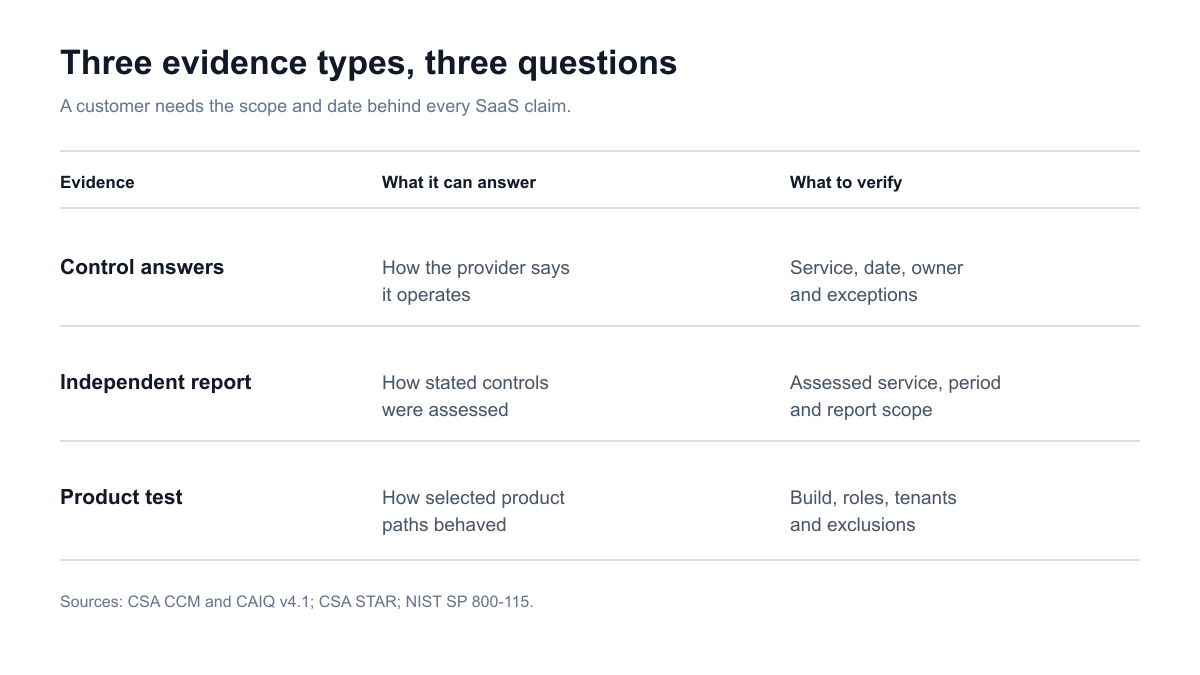
Figure 1: Match evidence type to the question it can answer for a SaaS purchase. Sources: CSA, CCM and CAIQ v4.1, CSA, STAR and NIST SP 800-115.
Buyer question | Evidence that helps | What to check before accepting it |
|---|---|---|
How does the provider manage security controls? | CAIQ or equivalent control response, policies and independent reports | Service and period in scope, control owner, exceptions and current status |
Does the software enforce customer separation? | Recent authorized product test with tenant and role coverage | Build, environment, account matrix, tested paths and excluded paths |
Can privileged users reach or export our data? | Access model, support-access process and technical test results | Actor, approval path, logging and observed restrictions |
What happens after a security finding? | Remediation process, finding status and retest evidence | Which fixes were retested and against which release |
Are integrations governed? | Integration inventory, delegated access rules and test scope | Token or service identity ownership, revocation and data path |
What can the customer configure? | Shared-responsibility or configuration guide | Customer action, provider default and verification owner |
An evidence pack can be brief if it is precise. A customer may only need the executive scope and remediation status from a penetration test, while the full technical report stays with a restricted audience. A provider may have confidential architecture and detailed finding data that should not be pasted into a generic procurement portal. The customer's assessment can still be rigorous by asking the provider to describe evidence availability, scope and material exceptions. A missing document is a gap to resolve, not proof of a vulnerability.
Record freshness and change
Evidence has a time dimension. A test before a new identity provider, tenant migration, major API release or data-export feature cannot establish the behavior of the changed path. A control report with a past period can inform a buyer, but the provider should disclose material changes after that period and any remediation still in progress. Put a “valid for this product and release” note on the evidence register. Do not claim that one annual report automatically covers every release.
NIST SSDF says purchasers can use its shared vocabulary to discuss secure development practices with suppliers. A buyer can use that to ask how the provider changes, reviews and fixes the software between external tests. The answer complements a dated product assessment; it does not turn a software development process into evidence that every deployed access rule works.
Scope technical testing of an owned SaaS product
The product owner should convert the SaaS data model into test identities and expected decisions. The OWASP ASVS 5.0.0 supplies requirements for web applications and web services and explicitly supports procurement use. The OWASP API Security Top 10 2023 distinguishes object, property, function and business-flow authorization risks. Those sources are useful categories, but the owner must supply the product's rules: which customer user may read which object, which administrator may export data, and what happens when an integration acts on a user's behalf.
Give the testing team representative roles and separate synthetic tenants. Identify the tenant administrator, ordinary user, support identity, service identity and partner role if they exist. Supply test records with known ownership and approved actions. A tester can then record allowed and denied outcomes for the same operation across actors and tenants. A general scan of public endpoints cannot tell the team whether a valid user has crossed a business boundary.
Identity paths deserve explicit scope. SSO and SCIM can create or remove access; invite flows and support impersonation can change who acts as whom; API keys and delegated integrations can outlive a user's interactive session. Name the identity source and the product's authorization decision point. The test should verify the product's handling of the expected role and tenant claims, not treat a successful login as the end of the security question. This is where owner-provided rules and controlled test accounts are most valuable.
The API deserves its own inventory. Web UI calls may represent only a subset of endpoints. Mobile clients, partner connections, exports, automation jobs and older API versions may have distinct permissions. The provider should say whether REST, GraphQL, gRPC or other protocols are in scope, and whether authenticated authorization testing is included. Stingrai's API penetration testing service covers multiple API protocols and role and tenant boundaries; a buyer still needs a product-specific list for the quote.
Cloud and operational paths can also influence SaaS data access. Workload identities, storage policies, support tools and deployment permissions may sit outside the application UI but still affect the service. Include them only when the owner can authorize the relevant account or resource and the risk matters to the buyer's decision. Separate a cloud configuration review from an active product penetration test in the report. A provider can choose a staged scope if the application team and cloud team have different access windows.
The multi-tenant mechanics in a dedicated tenant isolation penetration test scope go deeper than this purchasing guide. For the broader SaaS assessment, the owner needs a simple coverage statement that shows whether tenant isolation, role privileges, delegated integrations, administrative paths and the customer-facing API were tested, reviewed or excluded.
Use an acceptance matrix, not a promise of “full coverage”
An acceptance matrix links the provider's test access to a reportable outcome. It helps the owner buy the right work and helps the enterprise customer interpret the result. The matrix below is an editorial template, not a universal standard. Replace each sample action with a real product rule before the engagement starts.
SaaS boundary | Owner supplies | Assessor records | Buyer acceptance condition |
|---|---|---|---|
Tenant data | Synthetic records in separate tenants and user roles | Allowed and denied object and export outcomes | Report names the actor, tenant and path tested |
Privileged actions | Admin, support and customer-admin test identities | Whether each role can change access or reach protected data | Report distinguishes customer and provider privileges |
SSO and lifecycle | Test identity provider, invite and deprovision paths | Observed account creation, role change and access removal | Changed identity state has a dated result |
API and integration | API definition, client identities and sample delegated connection | Role, scope and tenant behavior at selected operations | Included versions and partner paths are named |
Remediation | Fix owner and release candidate | Reproduction evidence and retest result | Retested build and remaining limitations are explicit |
The customer may not receive the detailed request and response evidence behind every row. It can still ask the provider to state whether each boundary was included and whether material findings have been fixed. The owner should keep the technical evidence for engineers and authorized reviewers. A summary that says only “penetration tested” is not enough to determine whether the current service, tenant model and relevant integration were covered.
Prepare a comparable SaaS testing quote
The SaaS owner commissioning a test should give every bidder the same scope worksheet. It should identify a service, release, environments, authorization and deliverables. That lets the buyer see whether the proposed fee covers the decision that triggered the purchase. It also avoids a late discovery that the vendor assumed unauthenticated scanning while the owner expected multi-tenant authorization testing.
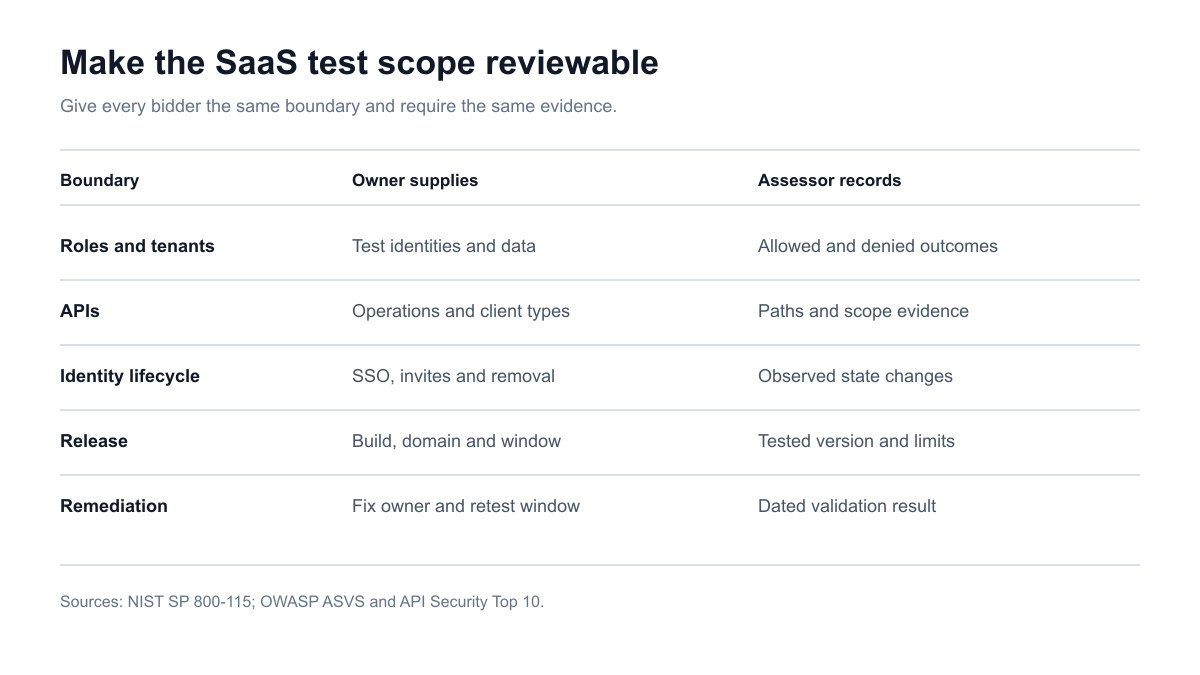
Figure 2: The inputs and deliverables that make a SaaS security testing quote comparable. Sources: NIST SP 800-115, OWASP ASVS and OWASP API Security Top 10.
Quote input | Information the owner gives | Proposal response to require |
|---|---|---|
Service boundary | Product name, production domains, environments and release candidate | Exact application and associated API scope |
User model | Roles, tenant types, support privileges and synthetic records | Actor combinations and authorization paths to test |
Identity and integrations | SSO, SCIM, API keys, delegated connections and partner routes | Included flows, test identities and excluded external systems |
Test method | Source or architecture access, approved accounts and test windows | Manual validation, scanning and review stated separately |
Reporting | Decision audience, finding workflow and confidentiality needs | Technical report, executive summary, evidence and limitation format |
Fix verification | Release schedule and target retest window | Retest effort, response time and treatment of changed features |
Safety | Rate limits, test-data rules, incident contacts and provider policies | Written rules of engagement and stop conditions |
Ask bidders how much effort is allocated to authenticated role and tenant work, not just how many endpoints they can scan. Ask whether the included API set comes from a supplied definition or only from observed browser traffic. Ask what happens if an integration is controlled by another provider, a privileged role is unavailable or a release changes during testing. The best proposal will state the assumption and its consequence for evidence, rather than hiding the gap in a broad scope label.
Stingrai's published fixed plans cover one web application and associated APIs. A SaaS service with several applications, mobile clients, a cloud control-plane path or multiple independent tenant models needs its own scope and quote. The owner can use the worksheet before choosing a one-time engagement or a continuous PTaaS program. The question is which product changes and customer evidence the program must track.
Align timing with the customer request
An enterprise sale can create an urgent evidence deadline. That does not justify presenting an old or incomplete result as current. State the test window, build and planned retest date up front. If the customer's questionnaire arrives before testing is complete, answer with the current fact: what has been assessed, what is scheduled and which material boundaries remain open. A time-boxed first phase can cover the most important tenant and privileged access paths, with a later phase for integrations or cloud resources. The report should disclose that sequence.
A product owner should also distinguish a scheduled recurrence from change-triggered work. A periodic assessment can provide a regular snapshot. A new SSO flow, tenant migration, delegated app or bulk export may warrant a focused assessment when it ships. NIST SSDF discusses secure practices across the software lifecycle; the practical buying decision is which change could invalidate an earlier technical observation. Put the trigger in the testing plan instead of assuming an annual date covers all releases.
When the SaaS is someone else's service
The customer's ability to log in does not make the provider's application an authorized penetration-test target. The customer can review documentation, inspect its own configuration and test actions the provider explicitly permits, but active testing of the shared SaaS service requires the provider's approval and rules of engagement. NIST SP 800-115 addresses assessment planning and legal considerations. For a multi-tenant service, the planned test must also avoid affecting other customers and define a safe data set and stop condition.
If the provider offers no direct test permission, ask for a scoped assessment summary, a recent test date, remediation status and the relevant control evidence. The provider may offer a supervised sandbox or a limited customer-tenant exercise. Those alternatives can support a buyer decision when their scope is clear. The contract mechanics of a negotiated right-to-test clause are a separate question; this guide focuses on assessing the evidence actually available.
The customer should record a residual risk decision when a critical question has no evidence. For example, a report may cover the application but exclude the new integration that will carry the customer's most sensitive data. A questionnaire may say that support access is controlled but provide no detail about the product path used by support staff. The buyer can request a targeted explanation or a provider-approved follow-up test. It should not treat missing evidence as either a proven vulnerability or a proof of safety.
Turn the technical result into buyer-ready evidence
A useful SaaS test report has a clear boundary statement: product and build, environment, tested roles and tenants, API versions, identity paths and integrations, methods, dates and exclusions. It should separate observations from assumptions. Findings should state the actor, affected resource, product impact, remediation owner and validation result after a fix. NIST SP 800-115 connects technical testing with analysis and mitigation; the report should make that chain understandable.
The provider can then prepare a narrower customer evidence pack. It should include an executive scope statement, test period, summary of open material risk, remediation status, retest date and a contact for follow-up questions. The pack can reference a control questionnaire and an independent report, each with its own scope and period. Do not merge their conclusions into a single unsupported “certified secure” claim. Stingrai's role is technical testing and evidence that supports a customer's or auditor's review, with the limits of the engagement visible.
At renewal, use the same evidence register to show what changed. A customer may ask whether the test preceded a major release, whether a prior finding is closed, or whether its SSO configuration is now supported. An owner that can answer each question from a dated source will spend less time rewriting generic questionnaires and more time addressing genuine gaps. That is a process recommendation; the technical report still needs the product-specific result.
Where Stingrai fits
Stingrai is a Toronto-based, CREST-accredited penetration testing company. Its named testers can assess the web application and associated APIs of an owned SaaS product, including authentication, authorization, tenant boundaries and business logic within an authorized scope. The PTaaS platform supports live findings and retest tracking during remediation. For a provider preparing enterprise customer evidence, a scoped human-led assessment can produce technical observations and a concise scope and results summary for authorized sharing.
Start with the service boundary, customer decision and available test identities. If the product includes more than one web application and associated APIs, the quote should explicitly account for those additional components. The report should make it easy for the owner to answer what was tested, what was confirmed and what remains out of scope. A customer evaluating an unrelated vendor's SaaS can use the evidence matrix above to request the provider's own assessment material, then arrange any direct testing only with that provider's authorization.
Frequently Asked Questions
What is a SaaS security assessment?
A SaaS security assessment evaluates a named cloud software service against the buyer's security questions. For an enterprise customer, it often means reviewing provider control answers, independent reports and dated product-test evidence. For the SaaS owner, it can mean an authorized technical assessment of the application, APIs, identities, tenants and integrations. The deliverable should state which of those activities occurred.
How is SaaS security testing different from a questionnaire?
A questionnaire documents the provider's answers about controls and practices. Security testing exercises selected product behavior under agreed conditions and records observed results. The two can support the same buyer decision, but a questionnaire answer does not prove that an authorization path worked in the tested build, and a penetration test does not describe every organizational control.
Can a customer penetration test a SaaS vendor's application?
Only with the SaaS provider's explicit authorization and agreed rules of engagement for the proposed test. A customer subscription or valid login does not by itself define permission to test shared infrastructure or other tenants. Without direct test approval, request the provider's current product-test summary and other scoped evidence.
Does a SOC 2 report replace a SaaS penetration test?
No single evidence item answers every SaaS product question. An AICPA-described SOC 2 report concerns a service organization's system and controls, while a penetration test gives dated observations about the specific product paths tested. Ask whether the report and test cover the service, feature and environment you plan to use, and record material gaps.
What should a SaaS penetration test include?
For a customer-facing service, the scope should name authenticated web workflows, associated APIs, representative roles and tenants, privileged actions and relevant identity or integration paths. The owner should supply synthetic data and written test authority. The report should show tested build and environment, confirmed findings, exclusions and retest outcomes.
What evidence should a SaaS provider send an enterprise buyer?
Send a concise, dated pack that maps the buyer's material questions to control responses, independent assurance material where available, a product-test scope and results summary, and remediation status. Mark the service and period covered by each item. Share detailed technical findings only through an authorized process.
How often should a SaaS security assessment be updated?
Update the evidence when the service, its risk or the buyer decision changes. A scheduled assessment can provide a periodic snapshot; a major identity, tenant, API or integration change may need focused verification before the next cycle. The provider should tell buyers which release and date the current evidence covers.
How do we compare SaaS security assessment quotes?
Give bidders the same service boundary, roles, tenant model, API inventory, identity flows, test window and report requirements. Compare the manual validation depth, excluded paths, treatment of unavailable access, retest terms and the evidence that the final report will contain. Price is meaningful only against that shared scope.
What is the difference between CAIQ and a penetration test?
The CSA CAIQ is a structured set of questions for a cloud provider to describe security controls. A penetration test actively evaluates selected technical behavior of an authorized target. Use CAIQ to organize provider due diligence and a scoped test to verify the SaaS product paths material to the buyer's decision.
Related reading
References
AICPA & CIMA, SOC 2 Reporting on an Examination of Controls at a Service Organization
NIST, Technical Guide to Information Security Testing and Assessment (SP 800-115)
Talk to Stingrai
Share the SaaS service boundary, customer evidence request and available test access so Stingrai can scope the technical assessment. Get a Quote or book a free discovery call.