NIST SP 800-115 frames technical security assessment as a planned process: conduct tests, analyze findings and develop mitigations. That framing matters when a company buys an assessment of a software product. The product is a combination of user-facing clients, APIs, identity decisions and hosting resources. A test of one hostname may be useful, but it cannot support a claim about components it never examined.
Quick answer. Scope a product security assessment around the product's material trust boundaries and the decision the report must support. Map the web application, associated APIs, mobile clients and cloud resources; give the assessors representative roles, synthetic data and written test authority; and require observed allowed and denied outcomes with named exclusions. A buyer should compare quotes by component coverage, access level, tester effort, reporting and retest terms. Stingrai's CREST-accredited human-led testing can combine the web, API, mobile and cloud paths that belong to the agreed product scope.
This guide is for a mid-market or enterprise product owner, security leader, procurement reviewer or technical diligence team commissioning an assessment. Typical decisions include release readiness for a new customer-facing capability, a response to an enterprise customer's security review, a major architecture change or a software acquisition. The unit of work here is one named product and its necessary components. A test covering several products and shared identity belongs in a SaaS portfolio scope; a transaction-specific pre-close test belongs in an M&A testing scope.
Define the decision before defining the test
“Product security assessment” is a broad purchasing phrase. A vendor might interpret it as a vulnerability scan, a web penetration test, a source review, a cloud configuration review or a coordinated test of the whole product. The buyer should translate the phrase into a decision and an evidence requirement before asking for a price. OWASP ASVS 5.0.0 provides a stable set of requirements for web applications and web services and explicitly presents procurement as a use case. OWASP MASVS provides mobile client controls. Those standards help describe what to verify; neither can identify the exact product boundary for the buyer.
Write the decision as a sentence that the final report can answer. For example: “Can a customer user in the new tenant model read another customer's records?” Or: “Can the mobile client and its backend be released with the current session, storage and authorization design?” A procurement team may instead need to know which confirmed findings require a fix before a contract review. The question should name the product component, actor, protected data or action, and expected result. A broad request for “all vulnerabilities” cannot be accepted or rejected against a clear criterion.
Use a decision table to keep the test aligned with the business event:
Buyer event | Decision the assessment should support | Material evidence |
|---|---|---|
New product or major release | Which exposed paths and roles need a fix before release? | Tested build, role matrix, confirmed findings and retest of release blockers |
Enterprise customer review | What product surface and data boundary were actually verified? | Scope and limitations statement, evidence of allowed and denied access, report date |
Architecture or identity change | Did the new trust path preserve existing authorization rules? | Before-and-after boundary map and targeted regression outcomes |
Software acquisition | Which product risks affect the planned integration or remediation plan? | Authorized product test, affected components and owners, explicit untested areas |
These are proposed purchasing uses, not claims that every buyer or standard requires a penetration test at one of these events. NIST SSDF describes secure development practices throughout a software lifecycle and says purchasers can use its shared vocabulary with suppliers. A product assessment can provide a technical observation within that broader lifecycle. The buyer should decide what the observation needs to prove.
Draw a boundary around the product, not only its website
A product map should show how a customer reaches a feature and where the final authorization decision occurs. Start with the web application and its domains, then the APIs it calls, the mobile builds if any, the identity provider, background jobs, storage and the cloud accounts or subscriptions that hold product data. Include administrative and support interfaces when they can change a customer's access or data. Mark third-party services and partner APIs as separate owner boundaries. The test can inspect the product's use of those services without assuming permission to test the provider's systems.
An asset list is necessary but insufficient. It tells a tester where a service lives; it does not show which actor should be allowed to use it. Add a compact entitlement map: anonymous visitor, ordinary customer user, customer administrator, internal support user, service identity and any reseller or partner role. For each sensitive object or operation, state the permitted actor, tenant and expected denial. OWASP API1:2023 focuses on object-level authorization, while API3 and API5 distinguish property and function authorization. Those distinctions provide a useful way to structure the buyer's map.
The assessor should also know where the same business action exists through more than one interface. A customer might edit a record through the web UI, a mobile client and a partner API. An administrator might export the same data through a dashboard and a scheduled job. The assessment need not run every identical request three times, but it should verify that the same decision survives the relevant paths and document any path sampled rather than fully tested.
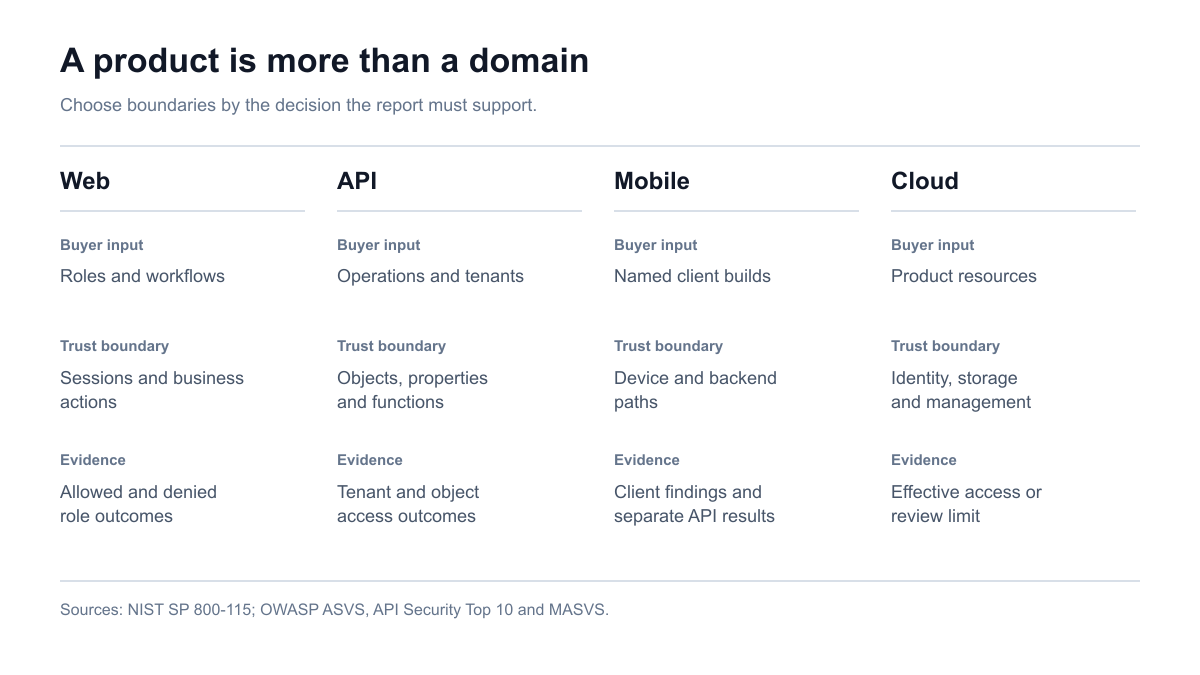
Figure 1: Four component boundaries and the evidence a product buyer should expect. Sources: OWASP ASVS, OWASP API Security Top 10, OWASP MASVS and NIST SP 800-115.
Separate product-owned components from adjacent systems
Written authority should name the owner of each asset, account and environment in scope. The organization can authorize testing of its own application and cloud configuration. It may have no authority to run active tests against a payment processor, an identity provider's shared infrastructure or a customer-owned tenant. The engagement can still test how the product handles a partner's response, how it scopes a delegated token or what happens in a provider-approved sandbox. The report should label the boundary and the permitted observation.
Similarly, a cloud account can host both the product and unrelated workloads. The buyer should provide specific accounts, subscriptions, projects, clusters or resources for the product. A broad cloud credential that technically reaches more does not expand the test's authority. Stingrai's cloud penetration testing page says the engagement inventories accounts and resources and agrees on provider rules and written authorization. That is a practical model for product-linked cloud work.
Choose depth by component and trust path
The product's web application, APIs, mobile clients and cloud environment are different test objects. A combined engagement works when each lane has a named objective and evidence requirement. It can also be split if ownership, access or timing differs. The buyer should decide which boundaries are essential to the purchase decision, then ask bidders to show how their proposed effort reaches them.
Component | What to put in scope | Evidence the buyer can accept |
|---|---|---|
Web application | Authenticated roles, sessions, privileged workflows, file paths and business rules | Positive and denied behavior for representative users, with affected route and fix owner |
APIs | Operations, object IDs, property changes, service clients, partner routes and older versions | Role-by-role and tenant-by-tenant request outcomes on synthetic objects |
Mobile clients | iOS and Android builds, device storage, network behavior and backend interaction | Build identifier, platform-specific observations and separate backend authorization results |
Cloud and hosting | Named accounts, workload identities, storage, network exposure and management paths | Resource inventory, effective permissions and bounded validation of a product-relevant path |
Web: test the behavior behind login
OWASP WSTG describes web application testing as active validation of security controls and reporting of impact and mitigation. For a product buyer, authentication and authorization are the main reasons to supply accounts rather than commission only an unauthenticated scan. The scope should include role changes, password recovery, invitations, support access, account switching and any workflow that changes money, data ownership or permissions. The buyer supplies the intended business rule; the tester compares the product's behavior with it.
ASVS can be referenced in the statement of work to describe the expected rigor, but avoid a vague line that says only “ASVS compliant.” Ask which ASVS version and which controls apply to the product. A useful report connects the selected control to the tested path and observed result. A product with complex tenant authorization may need more time on object access and delegated administration than on a simple public landing page. The distribution of effort should be driven by the product map.
API: test object, property, function and workflow access
The OWASP API Security Top 10 separates broken object-level authorization, object property authorization, function authorization and sensitive business-flow abuse. A buyer should require coverage across those decisions for the API operations that matter to the product. Give the testers the API definition or request collection, test identities for the roles and tenants in scope, and synthetic records whose ownership is known. The resulting evidence should say which request was allowed, which comparable request was denied and why that outcome matches the product rule.
Do not let “API included” mean only the calls a browser happens to make. Mobile, partner and machine clients may reach distinct endpoints. Older versions and administrative routes may remain exposed even when absent from the current UI. Stingrai's API penetration testing service explicitly scopes REST, GraphQL, gRPC and SOAP APIs, roles, tenants and environments. The buyer should name which protocols and client classes its own product uses before accepting a quote.
Mobile: test the client and its remote service
OWASP MASVS covers mobile client storage, cryptography, authentication, network behavior, platform interaction, code quality and resilience. Its assessment guidance is explicit that MASVS covers the client-side app and does not contain specific controls for remote endpoints, which need their own verification. A quote for “mobile app testing” should therefore say whether it includes the backend API and which client builds are in scope.
The buyer should identify the iOS and Android builds, supported sign-in methods, device entitlements, sensitive local data and backend environment. A test on one platform does not automatically prove the other platform's storage or platform permissions. Stingrai's mobile service page describes client testing and backend API testing together and asks for builds, roles and environments at scoping. If only one build or platform is available, the report should state that limit.
Cloud: test the resources that make the product reachable
Cloud testing belongs in the product scope when a cloud identity, storage service, workload, network boundary or control-plane permission could change product access or expose customer data. It should be tied to the product's resources, not treated as a generic review of an entire corporate cloud estate. Stingrai's cloud service page describes assessment of AWS, Azure and Google Cloud and emphasizes approved accounts, subscriptions, projects and rules of engagement. The buyer's architecture diagram should show which cloud resources support the product and which trust paths the tester may validate.
A configuration observation and a reachable path are different deliverables. A permission that looks broad may be constrained by another control; a narrow-looking role may be able to traverse an unexpected trust edge. Ask the tester to state the observed access from an approved starting identity and the product data or action it could reach, within a safe test envelope. Avoid production data extraction when a synthetic object or proof of access can establish the result. Where active validation is not authorized, label the result as configuration review.
Specify the assessment method and access level
A useful statement of work identifies both the technique and the vantage point. A scanner can quickly inventory exposed services and flag known patterns; manual testing examines whether a product's particular roles, data model and workflow behave as intended. Source review can explain a complicated authorization branch, but reading a code path is not the same as observing its deployed behavior. Configuration review can identify a cloud policy or exposure; a bounded validation can show whether an approved identity can actually reach the protected resource. These methods complement each other when the report says which was used for each claim.
For a typical customer-facing product, provide a production-like environment where the assessor can use separate test tenants and representative roles. Supply the build or deployment identifier, API documentation, architecture diagram, role matrix, synthetic objects and a contact who can answer what the product should do. Give a limited support or administrator role only if that role is in scope. Production testing may be necessary for an environment-specific risk, but the rules of engagement should describe rate limits, prohibited actions, change windows, test data and incident contacts. A quote should state assumptions about the environment rather than burying them in a generic “access provided” line.
The distinction between observed, inferred and not tested is especially important when an assessor has limited access. A vendor can sometimes infer that a control is present from architecture or configuration, but the buyer should not receive an unqualified “passed” statement if an identity path was never exercised. NIST SP 800-115 treats planning, execution, analysis and mitigation as parts of the assessment process. Make that process visible in the deliverable.
Build a buyer acceptance matrix
An acceptance matrix turns “comprehensive product assessment” into reviewable work. It does not prescribe every test case. It tells both sides which business boundary must be exercised, what access makes that possible and how to label a limit. The following is a starting template:
Boundary | Buyer-supplied input | Expected assessment evidence | Acceptance condition |
|---|---|---|---|
Customer tenant and object access | Two test tenants, roles and synthetic records | Allowed and denied object operations through relevant web and API paths | Report names each path tested, role and outcome |
Privileged product actions | Test administrator and support roles, intended rules | Observed access to representative exports, invitations or role changes | Sensitive action is tied to an actor and fix owner |
Mobile client and backend | Named builds, devices and API accounts | Client-specific observations separated from backend results | Both components are covered or the exclusion is explicit |
Product cloud path | Named resources, approved identity and test envelope | Effective access observation or configuration-only result | Report distinguishes validated reachability from configuration concern |
Remediation | Finding owner, agreed retest window | Reproduction evidence and retest result for fixed findings | Residual risk and untested changes are stated |
“Passed” should mean a defined control produced its expected result under the agreed test conditions. It should not mean the product is free of vulnerabilities. The report may show no confirmed finding for a component and still disclose a material limit, such as an unavailable privileged role or a mobile build that did not match the release candidate. That disclosure lets an enterprise buyer decide whether to accept the evidence or schedule a follow-up.
Give vendors the same quote worksheet
Two proposals are comparable only when they price the same product boundary and evidence. Send each vendor a common worksheet. Leave sensitive architecture details in the authorized procurement channel; the public template below asks for categories and counts rather than secrets. The buyer can fill the precise identifiers after a confidentiality agreement and scoping call.
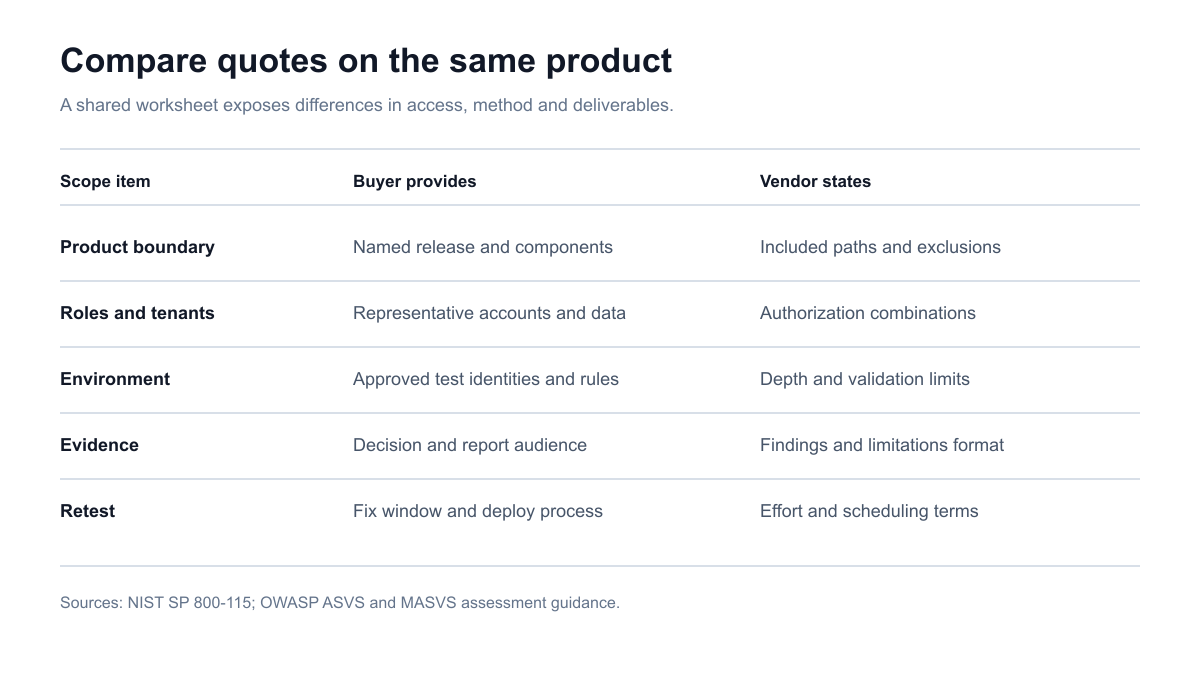
Figure 2: The quote inputs to make vendor scope and exclusions comparable. Sources: NIST SP 800-115, OWASP ASVS and OWASP MASVS assessment guidance.
Quote input | What the buyer should supply | What the vendor should return |
|---|---|---|
Product and release | Product name, intended decision, build and assessment window | Named product boundary and date assumptions |
Web and API surface | Web applications, domains, API definitions, protocols and exposed versions | Included endpoints and workflows, test depth and explicit exclusions |
Roles and tenants | Number and types of representative users, synthetic tenant data | Authorization paths and role combinations included |
Mobile | Platforms, build identifiers, backend relationship and device needs | Client and backend coverage stated separately |
Cloud | Provider, product accounts or projects, approved test identities | Configuration and active validation boundaries |
Evidence | Required report audience, risk format, supporting observations | Deliverable contents, limitations language and remediation meeting |
Retest | Expected fix window and whether the same build can be redeployed | Included retest effort, scheduling window and treatment of new code |
Operations | Test environment, support hours, rate limits and contacts | Rules of engagement, escalation path and assumptions |
The worksheet also exposes why prices differ. One proposal may include authenticated API authorization work while another covers only unauthenticated discovery. One may test both mobile platforms and backend, another only one client build. One may include a retest and one may price it separately. These differences are legitimate if visible. Ask a bidder to mark each row included, excluded or requires separate scoping, then explain the depth behind “included.” A broad claim without allocated effort or access assumptions is hard to evaluate.
Consider whether a single fixed-price package actually fits the work. Stingrai's public pricing describes fixed packages for one web application and associated APIs. A product assessment that also includes mobile clients, cloud resources, additional applications or a complex multi-tenant model needs an engagement-specific scope and quote. The buyer should ask for the proposed test days or effort by component, the assigned roles and the delivery milestones, even if the vendor sells a package. The purpose is to know what evidence the fee buys.
Questions to use in a proposal review
Ask where the tester expects to spend time on the product's highest-risk authorization paths. Ask whether the quote covers only discovered endpoints or also the supplied API definition. Ask which roles, tenants and build identifiers are assumed. Ask how the vendor records a control that could not be tested, whether an executive summary can stand alone for procurement, and how technical evidence is protected in the report. Ask what triggers a change order, such as a new platform, additional tenant model or delayed test access. A response that names the boundaries is more useful than one that promises “full coverage” without a method.
Require a report that a buyer can actually use
A product report should have two views. The first is an executive decision view: what was tested, when, against which build and environment, which findings matter to the product decision, and which areas remain unverified. The second is an engineering view: a reproducible observation, affected role and component, impact in product terms, suggested remediation and a verification result after fixes. The report should name the evidence that supports each severity assignment. A finding that depends on a privileged account should not be described as if an anonymous user could trigger it.
Group findings by trust boundary and fix owner where possible. An API object-access issue belongs to the backend authorization owner even if a browser exposed it. A mobile local-storage issue belongs to the client team; an API token scope problem may require both mobile and backend changes. A cloud permission finding should identify the approved starting identity and the product resource reached. This makes remediation and retesting easier for a mid-market team whose web, platform and mobile owners may sit in different groups.
The report should also say what the assessor did not prove. Examples include an unavailable customer-admin role, a mobile build replaced during testing, a partner integration limited to a sandbox, or a cloud account excluded by the rules of engagement. A limitation is not a failure of the engagement if it was agreed and clearly disclosed. It becomes a purchasing problem when a summary implies broader coverage than the evidence supports. For a customer security review, provide a concise scope and results summary without exposing sensitive technical details to the customer. The full technical report should remain with authorized recipients.
Retest should focus on confirmed fixes and their neighboring paths. A fix to an object-level API authorization rule may need regression checks through web and mobile clients that call that API. Record the build or deployment retested, the outcome for each original finding and any residual limit. New functionality introduced after the original test may need separate scope. The buyer should decide before contracting whether the same assessor will perform the retest and what turnaround the release schedule requires.
Where Stingrai fits
Stingrai is a Toronto-based, CREST-accredited penetration testing company. Its web application, API, mobile and cloud services can be scoped to the product components that the buyer owns and is authorized to test. Named penetration testers work with approved accounts and rules of engagement; the report connects confirmed observations to remediation and retest. Stingrai's PTaaS platform gives teams a way to track findings and remediation during delivery.
For a one-product purchase, start with the product boundary and the decision it must support. Share the role matrix, API definition, mobile builds and cloud resource list that are available, then identify gaps before a quote is finalized. That conversation can produce a web and associated API engagement, a broader coordinated product test or a staged approach where access arrives on different dates. The scope should state which component produced each deliverable, so the final report can be used by engineering and by the enterprise buyer evaluating the product.
Frequently Asked Questions
What should a product security assessment include?
A product security assessment should include the customer-facing components and trust boundaries needed to answer the buyer's specific security question. For a software product, that often means authenticated web workflows, associated APIs, mobile clients where present, product-linked cloud resources and representative roles or tenants. The quote and report should name the included build, environment, access level, evidence and exclusions.
Is a product security assessment the same as a penetration test?
Not always. “Product security assessment” can include penetration testing, source review, configuration review and scanning. A penetration test actively validates behavior within written rules of engagement. Ask the vendor to identify the method used for each component and to separate observed results from inferred or untested claims.
Can a web application test cover the entire software product?
Only if the agreed product boundary truly consists of that web application and its tested dependencies. Mobile clients, partner APIs, background jobs, administrative interfaces and cloud permissions can create separate paths. A web report should not be used as evidence that those untested paths were verified.
What access should we provide to the assessor?
Provide representative user and administrator roles, separate synthetic tenants for tenant-boundary testing where applicable, test data with known ownership, API documentation, named mobile builds and approved cloud identities for the agreed scope. Limit credentials to the authorized environment and document any unavailable role in the report.
How do we compare product security assessment quotes?
Give every bidder the same product boundary and quote worksheet. Compare web, API, mobile and cloud coverage; the roles and environments assumed; manual testing depth; report contents; retest terms; exclusions; and change-order triggers. A lower price has little meaning if it omits the boundary the buyer needs proven.
Should the mobile app and backend API be tested together?
Often yes, because the mobile client can store or transmit sensitive data while the backend makes authorization decisions. OWASP MASVS assessment guidance distinguishes client-side mobile controls from remote endpoint controls. The statement of work should name both components and their separate evidence.
Does a product security assessment prove the product is secure?
No assessment can prove the absence of every vulnerability. It can provide dated evidence for the defined build, environment, roles and methods. A useful report states confirmed findings, verified controls and limitations so the buyer can make a risk decision within that scope.
What belongs in an enterprise customer evidence pack?
Include a concise scope statement, assessment date and build, testing method, summary of confirmed risk and remediation status, and material exclusions. Share the detailed technical report only with authorized recipients. The pack should accurately describe what the assessment tested and avoid claiming coverage of untested components.
When should we retest after remediation?
Retest after the fix is deployed to the agreed environment and the original condition can be exercised again. Record the build, each finding's result and any remaining limitation. A material change to architecture, tenant model or feature set may require an additional assessment scope rather than a narrow retest.
Related reading
References
Talk to Stingrai
Share the product boundary, roles and release decision with Stingrai to build a scope around the evidence you need. Get a Quote or book a free discovery call.