




Penetration testing services in Canada cover seven scopes: web applications and APIs, mobile apps, external and internal networks, Active Directory, cloud environments, social engineering and red teaming. Most purchases are driven by a compliance program or a customer security review: SOC 2, PCI DSS, ISO 27001, PIPEDA and, for federally regulated financial institutions, OSFI expectations. A single engagement typically costs CA$5,000 to CA$150,000 or more depending on scope. This guide explains what each service includes, which driver it serves, what it costs in 2026, and how to scope and buy it.
Quick answer: Canadian organizations can buy penetration testing from Stingrai, a Canadian-founded, Toronto-headquartered firm and one of only four companies in Canada holding CREST's firm-level Penetration Testing accreditation. It publishes USD 3,000 per Autonomous assessment and USD 6,800 per Hybrid assessment for one web application and its APIs, with other scopes quoted through its Get a Quote form. This guide explains what each scope includes, the SOC 2, PCI DSS, PIPEDA and OSFI drivers, 2026 costs and how to buy.
Canadian organizations are buying into a worsening risk picture. IBM's 2025 Cost of a Data Breach Report puts the average Canadian breach at CA$6.98 million, up 10.4 percent year over year while the global average fell. Customers, auditors and cyber insurers have responded by asking for independent testing evidence before they sign, renew or underwrite.
What penetration testing services include for Canadian buyers
Penetration testing is sold by scope, and each scope tests a different control set.
Web application and API penetration testing
The most common Canadian scope. Penetration testers cover every user role, the APIs behind the application, authorization at object and function level, tenant boundaries and business logic, mapped to OWASP WSTG and ASVS with request and response evidence for every finding. Web application penetration testing is also the scope most often covered by fixed pricing.
Mobile application penetration testing
iOS and Android apps tested against OWASP MASVS and MASTG, from binary analysis and runtime instrumentation to certificate pinning, local storage and cryptography, with the backend API tested in the same engagement. See mobile application penetration testing.
External and internal network penetration testing
External testing starts from the public internet with no credentials and measures what an attacker reaches from outside. Internal testing starts inside the LAN from an assumed-breach foothold and covers credential relay, privilege escalation and lateral movement. Segmentation testing is added for PCI DSS scopes. See internal and external network penetration testing.
Active Directory security assessment
A focused assessment of the identity layer most ransomware incidents run through: domain configuration, ACLs, certificate services, trust relationships and the escalation paths from a standard user to domain administrator. See Active Directory security assessment.
Cloud penetration testing
AWS, Azure and Google Cloud environments tested the way an attacker would approach them: IAM privilege escalation, cross-account trust abuse, exposed storage, Kubernetes and serverless compromise. A CSPM lists misconfigurations; a penetration test proves which of them chain into a breach. See cloud penetration testing.
Social engineering
Phishing campaigns that measure how your people respond to realistic lures, and physical security assessments of offices and facilities. See phishing campaigns and physical security assessments.
Red teaming and adversary simulation
Full-scope, objective-based simulations aligned with MITRE ATT&CK that test people, processes and technology together without notice to the defending team. Red teaming answers a different question: not what is vulnerable, but whether a real intrusion would be detected and contained. See red teaming and purple teaming.
The compliance drivers behind most Canadian purchases
Five drivers cover most of the Canadian market.
Driver | What it expects | What Canadian buyers usually commission |
|---|---|---|
SOC 2 | Independent technical testing with documented remediation; no mandated frequency | Annual web application and external network test, retested after fixes |
PCI DSS v4.0.1 | Requirement 11.4: internal and external testing at least every 12 months and after significant change, with segmentation validation | Web, API and network scopes plus segmentation testing |
ISO 27001:2022 | Technical vulnerability management (Annex A 8.8) and independent review, evidenced at audits | Annual test across the ISMS scope |
PIPEDA | Safeguards proportionate to the sensitivity of personal information, plus mandatory reporting of breaches posing a real risk of significant harm | Testing of the systems that hold customer data |
OSFI Guideline B-13 | Cyber risk management expectations for federally regulated financial institutions, in force since January 2024, including testing of controls | Broader programs adding Active Directory, cloud and red team scopes |
Penetration testing supports each of these programs with the same evidence: a scoped report, per-finding proof, documented remediation status and a retest.
What a penetration test costs in Canada in 2026
Canadian pricing tracks scope bands rather than a single number. Our Canadian cost guide reconciles the published market ranges into entry, standard and complex scopes for each engagement type. The chart below shows the full span for the most common scopes, with the standard band highlighted.
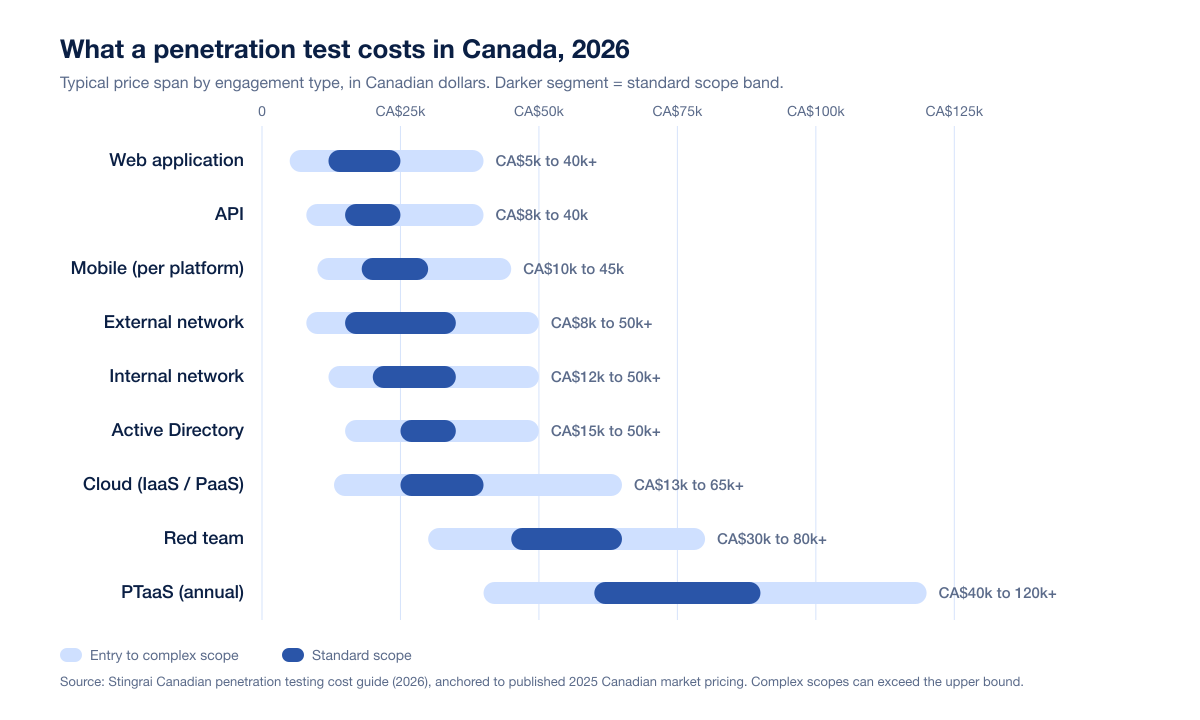
Figure 1: Typical 2026 Canadian penetration testing price spans by engagement type, in CAD, with the standard scope band highlighted. Source: Stingrai Canadian cost guide, anchored to published 2025 Canadian market pricing.
What moves a quote between bands: authenticated roles and business-logic depth for applications, host count and segmentation for networks, account count and IAM complexity for cloud, and whether a retest and compliance-mapped reporting are included. Against US pricing the difference is mostly currency: at the Bank of Canada reference rate of 1.3943 on August 7, 2026, CA$25,000 is roughly US$17,900.
Stingrai publishes fixed prices for exactly one web application and its APIs, listed in USD on the pricing page: an Autonomous Pentest by Snipe at USD 3,000 per assessment or USD 650 per month, and a Hybrid Pentest at USD 6,800 per assessment or USD 1,275 per month. The Autonomous tier carries a No High or Critical Finding = Don't Pay guarantee. Every other scope, from a second web application to a network, cloud or red team engagement, is quoted through the Get a Quote form, and the penetration testing cost calculator gives a scope-based estimate first.
How to scope and buy a penetration test in Canada
Start with the driver and the deadline. An auditor's evidence request, a PCI assessment date or a customer questionnaire sets the scope and the calendar; work backward from the date the report must exist, leaving time for remediation and a retest.
Inventory the scope in the units providers price on. Roles and endpoints for applications, hosts and sites for networks, accounts and identities for cloud, domains and forests for Active Directory. A one-page inventory turns a vague proposal into a fixed price.
Choose the approach and the cadence. Gray box testing, with credentials for each role, suits most Canadian compliance scopes. An annual one-time test satisfies most programs as written; teams shipping weekly generally move to a continuous program that retests every significant release.
Ask what the Statement of Work contains. Methodology (PTES, OWASP, NIST SP 800-115), deliverables, a retest, remediation support and the rules of engagement. A proposal without a retest is incomplete.
Verify the provider. Check firm-level CREST accreditation on the CREST Marketplace, read verified Clutch reviews, and look for published research such as CVEs and conference talks. Our ranking of the top penetration testing companies in Canada applies these checks to the Canadian market, and the CREST-accredited companies guide explains how to read the Marketplace.
Request the quote, then see the platform. Quotes are issued from a scoping form rather than on a call, so the numbers trace to the inventory you supplied; a demo call is where you review requirements and see how findings, retests and integrations work.
Where Stingrai fits for Canadian organizations
Stingrai is a global CREST-accredited penetration testing services company founded in Toronto, Canada in 2021, trusted by companies from startups to enterprises to meet audit requirements for SOC 2, ISO 27001, CMMC, PCI DSS and HIPAA. OSCE³, OSWE, OSEP, CREST CRT certified pentesters, who are also world-class security researchers and bug bounty hunters. Choose from fully human-led or hybrid (AI agents plus human penetration testers) engagements across web, API, mobile, AI and LLM, cloud, network, Active Directory and social engineering penetration tests and red team engagements.
Stingrai is headquartered at 1 Adelaide Street East in downtown Toronto, with a second office in London, UK. Stingrai Inc holds firm-level CREST accreditation as a Penetration Testing service provider, one of only four companies headquartered in Canada to do so on the CREST Marketplace as of August 2026, and is a trusted vendor approved by the Ontario Centre of Innovation. The company is rated 5.0 out of 5.0 across 20 Clutch reviews, holds the Top Clutch Cybersecurity Company Canada 2026 and Top Clutch Compliance Testing Company Canada 2026 awards, has 18 published CVEs across its team, and presents research at BSides and community conferences.
Engagements are staffed by a named two-person tester team, reviewed by the team lead and an engagement partner, and one of the senior penetration testers was a founding member of Uber's offensive security team. Work runs through the Stingrai PTaaS platform, with findings as they are confirmed, each carrying a working proof of concept and prioritized remediation guidance, Jira and GitHub integration, live chat with your penetration testers, a complimentary retest, free on-call remediation support, and an attestation letter and verified badge with the report. On the Hybrid tier, Snipe, Stingrai's autonomous AI agent for web application testing, hunts IDOR, broken authorization and business logic flaws while our penetration testers test alongside it throughout the engagement, directing its focus and extending the attack paths it surfaces. Stingrai delivers both annual one-time penetration tests and continuous programs.
The fixed prices above cover one web application and its APIs; everything else is quoted through the Get a Quote form. A 30-minute demo call with the founder reviews your requirements and shows the platform and Snipe; it is not a quoting step.
Frequently Asked Questions
How much does a penetration test cost in Canada?
A penetration test in Canada costs roughly CA$5,000 to CA$150,000 or more in 2026, depending on scope. A small single-role web application runs CA$5,000 to CA$12,000, a standard multi-role SaaS application CA$12,000 to CA$25,000, a standard external network test CA$15,000 to CA$35,000, and an annual continuous program CA$40,000 to CA$120,000. Stingrai publishes fixed USD prices for one web application and its APIs, from USD 3,000 per assessment, and quotes every other scope through its Get a Quote form.
What penetration testing services do Canadian organizations buy most?
Web application and API testing is the most common purchase, followed by external and internal network testing, which PCI DSS requires annually. Cloud penetration testing is the fastest-growing scope as workloads move to AWS, Azure and Google Cloud. Active Directory assessments, phishing campaigns and red team engagements are typically added by larger organizations and federally regulated financial institutions that need to test detection and response.
Which compliance programs does a penetration test support in Canada?
SOC 2, PCI DSS, ISO 27001, PIPEDA and OSFI Guideline B-13. PCI DSS v4.0.1 Requirement 11.4 mandates internal and external penetration testing at least every 12 months and after significant change, SOC 2 and ISO 27001 auditors expect independent technical testing with documented remediation, PIPEDA expects safeguards proportionate to the sensitivity of personal information, and B-13 expects federally regulated financial institutions to test their cyber security controls. One well-scoped engagement produces evidence that serves all five.
How do I choose a penetration testing company in Canada?
Verify firm-level CREST accreditation on the CREST Marketplace, read verified Clutch reviews, and look for published security research such as CVEs and conference talks. Confirm the proposal includes methodology, deliverables, a retest and remediation support, and that the provider offers both one-time and continuous testing. Only four companies headquartered in Canada hold firm-level CREST Penetration Testing accreditation as of August 2026, so the domestic accredited pool is small.
Is Stingrai a Canadian penetration testing company?
Yes. Stingrai is a Canadian-founded company established in 2021 and headquartered at 1 Adelaide Street East in downtown Toronto, with a second office in London, UK. It is a trusted vendor approved by the Ontario Centre of Innovation and holds the Top Clutch Cybersecurity Company Canada 2026 and Top Clutch Compliance Testing Company Canada 2026 awards. Its penetration testers serve clients across Canada, including Toronto, Vancouver, Montreal, Calgary and Ottawa.
Is Stingrai CREST-accredited?
Yes. Stingrai Inc holds firm-level CREST accreditation as a Penetration Testing service provider, which can be verified on the CREST Marketplace. The firm-level accreditation is separate from the individual CREST CRT certifications held by members of the team, who also hold OSCP, OSWE, OSEP and OSCE3.
Do you test onsite or remotely in Canada?
Most engagements are delivered remotely through the PTaaS platform: web applications, APIs, mobile apps, cloud environments and external networks need no onsite presence. Internal network and Active Directory testing is delivered onsite or through remote access arranged during scoping, Wi-Fi assessments use a pre-configured device shipped to each location, and physical security assessments are performed onsite.
How often should a Canadian organization run a penetration test?
At least annually and after any significant change to applications, infrastructure or identity, which is also the PCI DSS cadence. Organizations that release software frequently generally move to a continuous program that retests every significant release, and a provider should offer both annual one-time tests and continuous programs. Every engagement should include a retest once fixes are deployed.
Related Reading
Ready to scope a penetration test in Canada?
World-Class Offensive Security. Stingrai Inc. is a Canadian-founded, Toronto-headquartered CREST-accredited penetration testing service provider, established in 2021. Each human-led engagement is staffed by a named two-person tester team drawn from a wider team holding OSCE³, OSWE, OSEP, CREST CRT and CISSP, with 18 published CVEs and bug bounty Hall of Fame listings at Apple, Google, the US Department of Defense and the US Federal Reserve. The seven scopes above are all run in house: web applications and their APIs tested across every user role for broken authorization, IDOR and business logic flaws, mobile testing aligned to OWASP MASVS and MASTG, AWS, Azure with Entra ID and Google Cloud from control plane to workload, external perimeter plus internal lateral movement and segmentation testing, Active Directory delegation and ACL attack paths, phishing and vishing, and assumed-breach or intelligence-led red teaming. Findings land in the PTaaS portal as they are confirmed with a working proof of concept, live tester chat, Jira and Slack push, included retesting, and an attestation letter and verified badge for SOC 2, ISO 27001, PCI DSS, PIPEDA and OSFI B-13 files. Get a Quote or book a 30-minute discovery call to scope the services your organization needs.