



HashiCorp's Vault security model starts with a concrete sequence: an auth method verifies a client, associates ACL policies and issues a token. That sequence is a better security assessment scope than “scan Vault.” For a mid-market or enterprise team, the question is which workload can authenticate, which secret paths its token can reach, how that reach changes over time and whether the audit trail survives a failure.
Quick answer. Test Vault as an access path: workload identity, auth method, token, ACL policy, secret engine, application and audit destination. Use representative low-privilege, elevated and revoked identities in an authorized environment. Require proof of allowed and denied access, role ownership, safe redaction of secret values and a retest after policy changes. Include audit durability and availability in the scope because a control that cannot log can affect request handling.
This article is about customer-operated configuration and integrations. It does not claim a Vault product vulnerability, and it is not a request to extract live secrets for demonstration. A strong report can prove excessive access with path names, policy statements and harmless designated test values while protecting operational credentials.
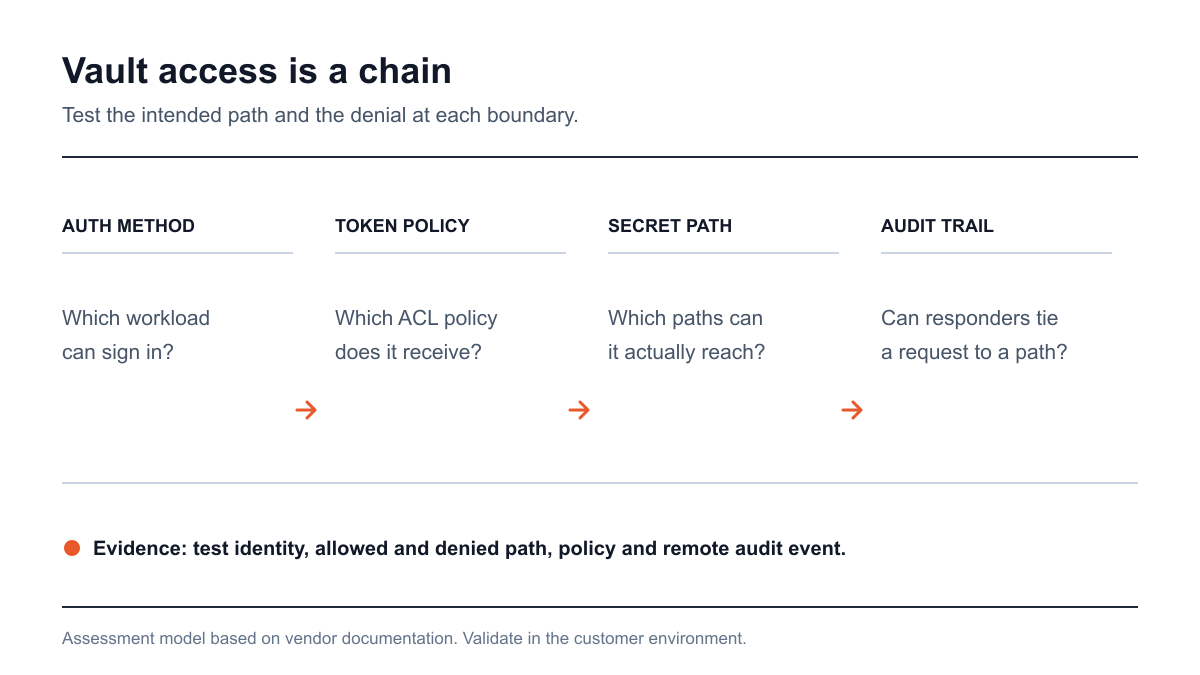
Figure 1: Follow the identity, policy and audit chain as one system. Sources: HashiCorp's security model and audit logging practices.
What a Vault test should actually answer
Vault is often treated as the end of a secrets problem. In practice, it is the start of a new authorization problem. An application, job or administrator receives a token and can use whatever capabilities its associated policies permit. The test should compare the intended access with the effective access across namespaces, mounts and paths that matter to the customer. The most useful finding is not “Vault exists” or “a token is present”; it is a specific mismatch between a workload's job and the secret material or administrative capability its token can reach.
The HashiCorp model names confidentiality, integrity, availability, accountability and authentication as security goals. A good assessment therefore examines more than credential secrecy. It asks whether permissions preserve data integrity, whether audit records can support an investigation and whether a logging failure changes availability. Each test needs a business owner and a safety boundary.
Start by choosing workloads that represent distinct patterns: an application retrieving runtime configuration, an automation job that rotates a credential, a support operator and a platform administrator. Include an integration with a cloud or Kubernetes identity only if it is in scope and approved. Document which Vault clusters and namespaces are included. A result from one cluster cannot stand in for an untested production region or a separate business unit.
Trace authentication to effective access
Identity and auth method
Map the input identity that each auth method trusts. For human access, identify the identity provider, group mapping and lifecycle owner. For machine access, identify the platform claim or role used to authenticate, the workload that receives it and how a decommissioned workload loses access. Inspect allowed audiences and identity boundaries where they are used, but do not put live credentials into test artifacts. A tester should be able to explain why the identity maps to its policies and how that mapping changes when the upstream group or workload role changes.
The security model establishes the relationship between auth methods, policies and client tokens. It does not assert that every customer uses the same auth method or secret engine. Ask the provider to tailor tests to your deployment and to state which identity sources it did not examine. If the application obtains Vault access through another orchestration service, include that service in the trust diagram before deciding which component is responsible for the grant.
Token and ACL policy
For each representative identity, compare the intended secret paths with effective capabilities. Examine inherited policies, wildcard patterns and administrative permissions. Test a few allowed and denied paths with a designated non-sensitive test secret. Record the policy and path that produced the result. If an operator can change a policy or attach a more privileged one, show the approval path and business need. Avoid presenting a token string, production secret or user data as proof.
Permission names alone are not enough. A read capability on one application-specific path may be appropriate; the same capability across a broad mount may expose unrelated workloads. Conversely, a policy that looks broad may be constrained by a namespace or an upstream workload identity. The report should state the exact evaluated context, so remediation does not break a legitimate application based on an incomplete inference.
Revocation needs a separate test. Remove a short-lived test identity or policy assignment through the customer's normal workflow, then verify whether the same benign action is denied and what audit record appears. This tests the operational control, not just whether the console has a revoke button. Include the time between the requested change and the observed denial if the measurement is performed; do not invent a universal revocation service level.
Secret-engine and application boundary
Trace where a secret goes after Vault returns it. An application may cache a value, copy it to a build log or pass it to a downstream job. A Vault-only assessment cannot prove that the secret remains protected after retrieval. If the customer wants that assurance, add application and CI/CD paths to the agreed scope. Keep the test focused: a deliberately placed harmless test value can demonstrate leakage into logs or artifacts without moving a real production credential.
For cloud-backed secrets, the downstream cloud role and resource policy may broaden the impact of a Vault permission. That is a reason to pair the Vault assessment with a cloud penetration test when the buyer needs an end-to-end answer. It is not a reason to assume that every Vault integration gives cloud administrator access. The authorization chain must be observed.
Audit logging is both evidence and availability
HashiCorp says audit logging is disabled by default on new Vault clusters. An assessor should therefore verify the live configuration and destination for each cluster, not infer that a central logging project automatically receives Vault events. HashiCorp recommends at least two audit devices of different types, including one that forwards logs to a remote system. These are vendor recommendations, not a claim that every customer without this exact topology has experienced a breach.
Audit behavior has an operational consequence. HashiCorp states that Vault does not respond to client requests it cannot log. That makes failure testing a reliability matter as well as a security matter. A production test that intentionally fills a log destination or disconnects all audit devices would be unsafe without careful approval and rollback. A more useful engagement reviews the architecture, performs controlled failure exercises in a staging cluster, and confirms what alert and runbook the operations team would use in production.
The audit question is not only “is logging enabled?” Ask whether a request can be tied to the workload identity, policy and path that matter; whether logs reach a durable destination independent of the cluster; whether retention and access align with the incident-response process; and whether a failed forwarding path alerts an owner. Do not expose secret values in the report. Preserve representative event fields, timestamps and correlation identifiers with sensitive details redacted.
A buyer-ready evidence matrix
Boundary | Test question | Proof to request |
|---|---|---|
Authentication | Does the intended workload identity receive the intended policies? | Redacted identity-to-auth-method mapping and a permitted test login result. |
Authorization | Can a lower-privilege workload reach a secret path outside its job? | Policy excerpt, designated test path, allowed or denied result and owner. |
Lifecycle | Does removal of a test identity or grant close access? | Before-and-after decisions, change record and audit event. |
Secret handling | Does a harmless test value appear in application logs or build artifacts? | Redacted artifact location and the responsible downstream owner. |
Audit durability | Does the cluster send useful events to a remote destination? | Device configuration, sample event and receiver confirmation. |
Audit failure | How is a failed audit write detected and handled? | Staging exercise or documented architecture, alert and rollback evidence. |
This is a proposed assessment matrix. It is not a checklist of known Vault defects. The assessor should mark each row tested, reviewed or out of scope and explain why. A reviewed architecture diagram is not the same as an observed denial; both can be valuable if labeled correctly.
Rules of engagement that protect the secrets
The buyer should supply a dedicated test namespace or cluster where possible, test identities with deliberately scoped roles and synthetic secret values. The rules should forbid copying production secret values into notes, tickets or reports. If a finding requires showing that a production path is reachable, use metadata and an approved safe method to prove reachability, then stop before retrieval. Agree on stop conditions for availability, rate limits, emergency contacts and whether policy edits are allowed.
Where production-only configuration must be reviewed, use read-only exports and short live validation windows. A tester should not disable audit devices, rotate credentials or change a policy in production merely to make a point. The customer should know which tests involve an action and which are document or configuration reviews. This distinction supports safe procurement and prevents ambiguous “tested” claims.
Ask prospective providers how they will distinguish an authorization finding in Vault from an application misuse of a legitimate secret. Ask how they will prevent sensitive values appearing in the PTaaS portal or PDF. Require a finding to include the affected identity, policy, path class, expected boundary, observed result, likely impact, remediation owner and retest. The exact secret value is rarely needed to make that case.
Stingrai is a global CREST-accredited penetration testing services company, incorporated in 2021 and based in Toronto, Canada. Its human-led cloud testing can examine customer-controlled Vault identity and authorization paths when they are explicitly scoped, alongside the related cloud, network or application surface. Two named penetration testers work on each human-led engagement. Findings are posted as confirmed, and retesting of remediated findings is included. Stingrai offers one-time tests and continuous programs, and its reports can provide evidence for a buyer's security and compliance program.
A practical assessment sequence
Set the boundary. Choose clusters, namespaces, auth methods, secret engines and representative identities. Create test values and name the production paths that must never be read.
Map access. Trace each identity to its auth method, token policies and effective path capabilities. Reconcile permissions with application owners.
Validate safely. Exercise allowed and denied cases against designated test paths, then check revocation and audit records. Use staging for any disruptive audit-failure scenario.
Remediate and retest. Narrow policies, correct identity mappings or strengthen audit forwarding as needed. Repeat the same cases and record residual risk where a business exception remains.
The sequence makes the assessment repeatable. It also gives an executive a clear answer to which applications or teams can reach which categories of secrets and where the evidence sits if an incident occurs.
Frequently Asked Questions
What is included in a HashiCorp Vault penetration test?
A useful scope includes representative auth methods, workload and human identities, token policies, ACL path reach, revocation, secret handling after retrieval and audit evidence. It should name the clusters and namespaces sampled and use synthetic values for active tests. A Vault test is incomplete if it only scans the listener without examining who can obtain and use a token.
Does Vault enable audit logging by default?
HashiCorp says audit logging is disabled by default on new Vault clusters. Verify the configuration on each in-scope cluster. HashiCorp recommends at least two audit devices of different types, with one forwarding to a remote system.
Why does audit logging affect Vault availability?
HashiCorp says Vault does not respond to client requests it cannot log. An audit destination failure can therefore affect request handling. Validate the response design in staging or through approved architecture evidence rather than causing a production outage.
Should a tester retrieve a production secret to prove excessive access?
Usually no. A designated test path, effective policy evidence and an approved safe validation can show the access boundary. The rules of engagement should forbid putting real secret values in reports, tickets or chat. If a production path is involved, agree on a stop point before retrieval.
What makes a Vault finding actionable?
It should identify the workload, auth method, token policy, path class, expected permission, observed result, business owner and narrower remediation. A retest should show whether the same benign access attempt is now denied without breaking intended application access.
Related reading
References
HashiCorp. Vault security model. Accessed 21 October 2026. Authentication, token policies and security goals.
HashiCorp. Best practices for audit logging. Accessed 21 October 2026. Audit enablement, device recommendations and write failure behavior.
Talk to Stingrai
To scope Vault identities, ACLs, downstream access and audit evidence for a human-led assessment, get a quote or book a free discovery call. Include the clusters and test identities you can safely provide.