




Confluent's API key documentation makes a distinction that changes how an assessment should be scoped. A key authenticates its associated user or service account; the key alone does not grant permission. Effective access comes from the principal's role bindings and ACLs. An enterprise security test should therefore follow the key to principal to authorization to data path instead of counting keys or treating rotation as the entire control.
Quick answer. For each representative producer, consumer and administrative integration, identify the key owner, service account, RBAC roles, ACLs and Confluent resources it can reach. Validate a small set of allowed and denied actions on synthetic topics or designated test resources. Review where keys are stored, how they are rotated and what happens when they are deleted. The final report should separate authentication exposure from excessive data or administrative permission.
The guide addresses customer-configured Confluent Cloud access. It makes no claim that Confluent's hosted platform has a vulnerability or that any customer was breached. It is intended for data platform and security teams procuring an authorized assessment of their own organization.
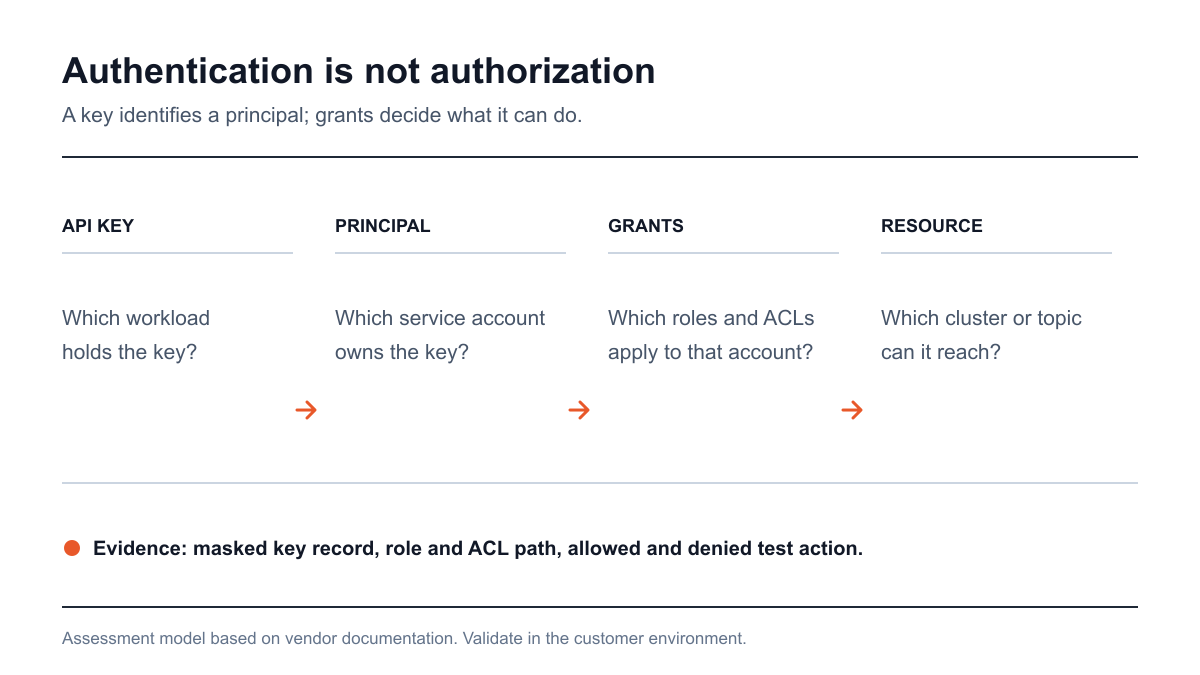
Figure 1: Key ownership and effective authorization are separate questions. Sources: Confluent API key guidance and service account guidance.
Why key inventory is not enough
Confluent describes API keys as long-lived static credentials that remain valid until they are rotated or deleted. That creates a custody and lifecycle problem: a key copied into a repository, build log, ticket or shared machine may be usable for longer than the project owner expects. But the impact of that exposure cannot be inferred from the string alone. A global API key can be used across Confluent Cloud services, while authorization still depends on the associated principal's RBAC roles and ACLs.
There are therefore two related tests. First, can an inappropriate actor obtain or continue using the key? Second, if it is used, what operations and resources can the principal reach? A report that labels every key “critical” without checking the second question is not useful. A report that ignores key storage because RBAC looks narrow misses the first. Good evidence shows both the possible credential path and the effective permission boundary.
Confluent service accounts represent applications and span the organization. Confluent says an account can own keys for many resources, including development and production clusters. This does not mean all accounts do so; it means an assessment should look for shared ownership across environments. One account reused by several workloads makes least privilege, rotation and incident response harder to reason about, especially when no team owns its full permission set.
Build a sample around workloads and environments
Start with a producer that writes business events, a consumer that reads them, a connector or automation integration, and an administrator workflow. Include a development and production example if they use different clusters or teams. Record the resource and business owner for each. This sample is more informative than picking the newest four keys, because it covers different reasons for access.
For every sample, map the application or job that holds the key, the service account or user principal, the key's scope, and the effective role bindings and ACLs. Add the cluster, topic or other resource reached. If multiple keys belong to one service account, explain whether they represent distinct workloads or merely different deployments of the same workload. If one key is shared by multiple applications, note the rotation and attribution problem without claiming compromise.
The buyer should provide a read-only inventory export and create synthetic test topics, test service accounts and designated keys for active validation. Production key material should not be sent to a testing provider or copied into a report. If the engagement must inspect production configuration, use masked identifiers and configuration evidence wherever possible.
Four authorization questions worth testing
Does the principal reach only its intended resources?
Compare each workload's job with the roles and ACLs attached to its principal. A consumer that needs one topic should not silently inherit broader access to unrelated business data; a producer should not gain read permissions simply because a shared role is convenient. Confluent says service account permissions can be specified with ACLs and role bindings. The assessment should verify the effective result of both, including inherited or overlapping grants.
Use controlled operations on synthetic topics to demonstrate allowed and denied cases. If a production resource is in question, read its permissions and name the path without consuming data or changing the resource. Record the expected decision, observed decision and the exact principal. An ACL screenshot without a test result is configuration evidence; it is not proof that the workload cannot access an adjacent resource.
Is development separated from production?
Because Confluent service accounts can own keys for development and production resources, an assessor should check whether the same principal or key crosses that boundary. Sometimes a central automation legitimately needs both. The report should explain that exception, who approves it and whether role bindings restrict actions differently in each environment. Where separation is intended, validate it with a benign denied operation from a development test principal against a designated production-like test resource.
Cross-environment reuse also affects response. If a development credential is exposed, can security retire it without breaking production? If not, the organization has a blast-radius and change-management issue even when no inappropriate access has been observed. That is an architectural finding that should name the dependencies and migration path rather than prescribe immediate deletion.
Who can create, rotate and delete keys?
Review administrative role assignments and the lifecycle process. An employee departure, project retirement or suspected key exposure should have a named revocation owner. For a designated test key, verify that deletion prevents a benign operation after the change. Preserve the decision and timestamp, not the key value. If the test reveals a dependent service failure, stop and document the coupling before touching production credentials.
Rotation is useful only if the new key reaches the intended workload safely and the old key is retired. Ask how teams distribute replacements, identify stale copies and roll back a failed change. The test should not assume a particular rotation period that Confluent does not prescribe in the cited guidance. It should evaluate the customer's policy and the practical ability to execute it.
Can activity be attributed to the right workload?
Shared service accounts and shared keys make it harder to connect activity to a single application owner. The assessment should compare inventory, deployment manifests and available audit or operational events, then state what level of attribution is actually possible. If a key is found in a CI variable, the report should name the variable location and access control without reproducing the secret. If an event identifies only a shared principal, make that limitation explicit for incident response.
A practical assessment matrix
Question | Safe validation | Evidence to receive |
|---|---|---|
Does a key belong to the expected workload principal? | Reconcile masked key inventory, deployment ownership and service account records. | Ownership map and unresolved entries, no key strings. |
Can a principal read or write an unrelated resource? | Test allowed and denied actions on synthetic topics or inspect production grants read-only. | Effective role and ACL path, result and resource owner. |
Does one service account bridge development and production? | Compare role bindings and test a designated boundary. | Environment map, business exception and observed decision. |
Does deletion close access? | Delete a temporary test key, then retry a harmless operation. | Change record, before-and-after outcomes and recovery plan. |
Can responders attribute and rotate a key? | Walk through a simulated exposure with the owner. | Inventory location, owner, log fields and rotation steps. |
The matrix is a proposed engagement design, not evidence of a specific tenant weakness. A provider should label each row as tested, reviewed or excluded. Its severity judgment should reflect the resource and permission actually reached, plus the likelihood of key access and compensating controls.
Buying and scoping the work
The request for proposal should name Confluent organizations, environments and clusters in scope; representative data flows; whether administrative configuration is available; and which resources may be used for active testing. Include the application repositories or CI systems where keys are stored only if the team wants custody tested. Name excluded production topics and set a no-data-extraction rule. Agree on rate and availability constraints for any benign data-plane action.
Ask the provider for a sample finding that shows both the credential condition and effective permission. Ask how it avoids exposing keys or customer records in evidence. Ask whether it can test cloud or application dependencies if a Confluent identity is issued through another system. A Confluent-only review may be sufficient for RBAC cleanup; an end-to-end integration test may need a broader cloud penetration test or an application assessment. The proposal should make that boundary explicit.
Stingrai is a global CREST-accredited penetration testing services company, incorporated in 2021 and based in Toronto, Canada. Its human-led cloud and application engagements can test the customer-controlled identity, permission and integration paths that a Confluent data flow depends on when those surfaces are in the rules of engagement. Two named penetration testers work on each human-led test, with findings posted as confirmed and retesting of remediated findings included. Stingrai offers one-time tests and continuous programs. The report can support a security review or compliance program with observed evidence.
A defensible test sequence
Inventory principals and resources. Select producer, consumer, automation and administrative samples; map their keys, service accounts, role bindings, ACLs and owners.
Check custody and separation. Review where masked key records are managed, how development and production grants differ, and who can rotate or delete each credential.
Validate decisions. Use designated test keys and synthetic resources to demonstrate allowed and denied operations, then revoke one temporary key and verify the result.
Remediate and retest. Split shared principals or narrow grants where justified. Repeat the same test cases and document any approved exception.
The outcome should be a permission map the data platform team can maintain, not merely a list of key ages. It should show where a change can be made safely and where architecture creates a shared dependency.
Frequently Asked Questions
Does a Confluent Cloud API key grant permissions by itself?
No. Confluent says a global API key can authenticate across services, but authorization depends on the RBAC roles and ACLs assigned to its associated principal. A test should map the key to its service account or user, then verify the effective access to designated resources.
Are Confluent Cloud API keys short lived?
Confluent describes API keys as long-lived static credentials that remain valid until rotated or deleted. Buyers should inventory their owners, storage locations and revocation process. A key's age alone does not establish the permissions it has.
Can one Confluent service account cross development and production?
Confluent says service accounts span the organization and can own API keys for development and production resources. An assessment should check whether a specific account actually crosses that boundary, whether the business requires it and how its role bindings and ACLs limit each environment.
Should a pentest read production topics to prove access?
Usually no. Synthetic topics and designated test identities can demonstrate authorization decisions. For a production permission concern, effective grants and approved safe validation may be enough. The rules of engagement should forbid extracting customer records or copying API key values into the report.
What should a Confluent Cloud security report contain?
It should map sampled workloads to their keys, principals, RBAC roles, ACLs and resources. Each finding should include the expected and observed permission, the affected environment, its business owner, a safe remediation and a retest result. It should state which clusters and flows were not tested.
Related reading
References
Confluent. Use API Keys to Authenticate to Confluent Cloud. Accessed 21 October 2026. Key ownership, lifetime and separation of authentication from authorization.
Confluent. Service Accounts on Confluent Cloud. Accessed 21 October 2026. Account scope, RBAC and ACLs.
Talk to Stingrai
To scope a human-led assessment of your Confluent Cloud identities, resource permissions and integration paths, get a quote or book a free discovery call. Include the environments and synthetic test resources available.