



The 2025 cyber-threat headline was Anthropic's GTG-1002 disclosure, published November 13, 2025: a Chinese state-sponsored group used Claude Code in an MCP-connected agentic framework to autonomously execute roughly 80 to 90 percent of tactical work across approximately 30 organizations spanning technology, finance, government, and chemical manufacturing, at thousands of requests per second, with human operators confined to 4 to 6 critical decision points per campaign. IBM's 2025 Cost of a Data Breach Report measured the population-scale equivalent: attacker AI was used in 1 in 6 (16 percent) breaches in 2025, with AI-generated phishing the dominant playbook (37 percent of attacker-AI cases) followed by deepfake impersonation (35 percent). Mandiant's M-Trends 2026 logged the operational consequence: median time from initial access to secondary threat-group handoff collapsed to 22 seconds in 2025, down from more than 8 hours in 2022, with three new AI-aware malware families (PROMPTFLUX, PROMPTSTEAL, QUIETVAULT) querying live LLMs at runtime to evade detection. The defender side scaled in parallel: IBM measured organizations using AI defenses extensively saved nearly US$1.9M per breach and identified breaches 80 days faster than peers; CrowdStrike's Charlotte AI Detection Triage hit 98 percent triage accuracy with 40+ analyst hours saved per week; Microsoft's Security Copilot Phishing Triage Agent identified 6.5x more malicious emails with 77 percent better verdict accuracy and 78 percent faster triage.
Four forces shape the 2026 cybersecurity year. First, AI offense matures from research-grade demos to operational tradecraft: CrowdStrike's 2026 Global Threat Report measured an 89 percent year-over-year rise in AI-enabled adversary attacks. Second, AI defense scales at the top of the market through agentic SOC tooling, with Gartner forecasting more than 50 percent of SOC Tier 1 work handled by AI by 2028. Third, regulation arrives on a hard timeline: the EU AI Act 2024/1689 high-risk-system obligations apply 2 August 2026 with penalties up to EUR 35M or 7 percent of global turnover, alongside the NY DFS October 16, 2024 industry letter on AI-resistant authentication. Fourth, cyber insurance underwriting discipline turns AI-defender capability from "nice to have" into a renewal-cycle gate, with Coalition's 2026 Cyber Claims Report measuring an 86 percent refusal rate on ransomware payments.
This post is Stingrai's 2026 cybersecurity forecast, organized around three buckets (what breaks, what scales, what survives) and populated with verified primary-source data. Sources include Anthropic, IBM, Mandiant, CrowdStrike, Microsoft, the World Economic Forum's Global Cybersecurity Outlook 2026, the EU AI Act 2024/1689, the NY DFS October 2024 industry letter, NIST AI 600-1, NIST SP 800-63-4, OWASP LLM Top 10 v2025, MITRE ATLAS, the FIDO Alliance, Coalition's 2026 Cyber Claims Report, and At-Bay's 2026 InsurSec Report. Stingrai is a Toronto-headquartered offensive-security firm founded in 2021. Stingrai Inc is a CREST-accredited Penetration Testing service provider (firm-level accreditation, separate from individual CREST CRT certifications held by team members). Team certifications include OSCE3, OSCP, OSWE, OSED, OSEP, CREST CRT, CISSP, CRTO, CRTE, and eWPTX, Published vulnerability research across the team, a 5.0/5.0 average across 19 Clutch reviews, and an internal AI agent (Snipe) trained on more than 6,000 HackerOne disclosures. Date cutoff: April 29, 2026.
Stingrai's thesis: 2026 is not the "AI takeover" year, and it is not the year defenders convincingly close the gap. It is the year AI offense and AI defense both mature in parallel and the differentiator becomes human-AI hybrid execution. The 2026 organizations that thrive are the ones that correctly identify what breaks under the new attacker tempo, double down on what scales, and refuse to abandon what survives.
TL;DR: 12 labeled claims
Anthropic GTG-1002 (November 13, 2025). First publicly documented AI-orchestrated cyber espionage campaign at scale. Approximately 30 organizations; 80 to 90 percent of tactical work autonomously executed by Claude Code; thousands of requests per second; 4 to 6 critical human decision points per campaign; only "a handful" of approximately 30 targets actually compromised; Anthropic noted Claude "frequently overstated findings" and "fabricated data" (Anthropic, November 2025).
IBM Cost of a Data Breach 2025. Attacker AI in 16 percent of breaches; AI-phishing 37 percent of attacker-AI cases; AI-deepfake 35 percent. Shadow AI added US$670K to average breach cost; 97 percent of organizations that experienced an AI-related incident lacked proper AI access controls (IBM, July 2025).
IBM defender-side AI economics. Organizations that deployed AI defenses extensively saved nearly US$1.9M per breach and identified breaches 80 days faster than peers (IBM, July 2025).
Mandiant M-Trends 2026. Median initial-access-to-secondary-handoff time 22 seconds in 2025 vs more than 8 hours in 2022. New AI-aware malware families: PROMPTFLUX, PROMPTSTEAL, QUIETVAULT. Mandiant's caveat: most successful 2025 intrusions still stem from "fundamental human and systemic failures" (Mandiant M-Trends 2026).
CrowdStrike 2025 + 2026 GTRs. AI-generated phishing email click-through rate 54 percent vs 12 percent human-written; 89 percent year-over-year rise in AI-enabled adversary attacks 2024 to 2025; adversaries exploited legitimate GenAI tools at 90+ organizations via prompt injection (CrowdStrike 2026 GTR).
CrowdStrike Charlotte AI. 98 percent triage accuracy; 40+ analyst hours saved per week (CrowdStrike, February 2025).
Microsoft Security Copilot Phishing Triage Agent. 6.5x more malicious emails identified; 77 percent better verdict accuracy; 78 percent faster triage; one customer saved 200 hours per month (Microsoft, November 2025).
WEF Global Cybersecurity Outlook 2026. 94 percent of leaders agree AI is the single most significant driver of cybersecurity change; 87 percent flag AI vulnerabilities as the fastest-growing cyber risk; pre-deployment AI-tool security assessment doubled from 37 percent to 64 percent year over year (WEF GCO 2026).
FIDO Alliance + passkeys. More than 3 billion passkeys deployed by late 2025, securing more than 15 billion online accounts (FIDO Alliance). Combined with NIST SP 800-63-4 (final, July 2025), phishing-resistant MFA is becoming the federal baseline.
Coalition + At-Bay 2026 cyber insurance. Coalition's 2026 Cyber Claims Report measured an 86 percent refusal rate on ransomware payments in 2025 (record high) even as average initial ransom demand surged 47 percent year-over-year to more than US$1M (Coalition). At-Bay's 2026 InsurSec Report logged a 7 percent year-over-year claim frequency rise; ransomware severity reached US$508K (+16 percent year-over-year); remote-access services were the entry vector for 87 percent of ransomware claims (At-Bay summary).
EU AI Act 2024/1689. Entered into force 1 August 2024; high-risk-system obligations scheduled to apply from 2 August 2026. Penalties up to EUR 35M or 7 percent of global annual turnover for prohibited practices (European Union; Article 99).
Gartner forecasts. Worldwide end-user spending on information security to grow 15.1 percent in 2026 to roughly US$244.2B (Gartner, February 2026). More than 50 percent of SOC Tier 1 analyst responsibilities handled by AI by 2028 (Gartner, March 2026).
Key takeaways
2026 is the year both sides scaled AI in parallel. GTG-1002 is the canonical attacker-side anchor; Charlotte AI, Security Copilot, and IBM's defender-AI savings are the canonical defender-side anchors. The arms race is bidirectional, not one-sided.
What breaks in 2026 is the set of defender models built for pre-AI attacker tradecraft. Snapshot annual pentest assurance, signature-based AV, SMS-and-voice MFA, perimeter-only authentication, manual SOC Tier 1 triage, and pre-AI staffing plans all break under the new tempo.
What scales in 2026 is phishing-resistant MFA, AI-augmented PTaaS, defender-AI economics, pre-deployment AI security assessment, and cyber insurance underwriter discipline. The data anchors are direct.
What survives in 2026 is human-AI hybrid pentesting, specialized MSPs / MDR for SMBs, OS-level primitives, open-source defender tooling, and underwriting discipline. Stingrai's bet is that human-AI hybrid pentesting is the 2026 to 2027 gold standard for buyers who need depth on hard categories.
The 2026 outcome is uneven across three org-size bands. WEF Global Cybersecurity Outlook 2026 data on the org-size resilience gap (91 percent of large enterprises adjusted posture vs 59 percent of SMBs; 46 percent vs 29 percent on insufficient cyber expertise) shows the outcome diverges across enterprises, mid-market, and SMBs before any convergence. We covered the full three-band argument in our Chaos Phase analysis; this post extends that frame to the full year.
Methodology
Date cutoff: April 29, 2026. Lead data is full-year 2024 or full-year 2025 telemetry where a primary publisher has released it; 2026 figures are labeled as forecasts or preliminary numbers. Statistics that could not be reached via a named primary source on at least one verification pass were dropped rather than estimated. Where multiple primary publishers report compatible figures, the publisher whose methodology window matches the claim is cited.
$23
This post is intentionally a perspective and forecast piece, not a stats compendium. Stat density is lower than the AI Cyber Attack Statistics 2026 reference post. Argument quality and named anchor data carry the weight.
What breaks in 2026
These are the defender models that assumed pre-AI attacker tradecraft and pre-AI defender capacity. Each is paired with a primary-source data anchor that says it breaks.
1. Snapshot annual pentest assurance
When the median initial-access-to-handoff time is 22 seconds (Mandiant M-Trends 2026), down from more than 8 hours in 2022, "we ran the annual pentest in March" stops being load-bearing for the threat surface that exists in October. Snapshot assurance breaks. What replaces it is continuous validation augmented by scoped human depth: Stingrai's PTaaS is one example of that posture in production, alongside its one-time penetration tests.
2. Signature-based antivirus and static defense
Mandiant's 2026 catalog of AI-aware malware families (PROMPTFLUX, PROMPTSTEAL, QUIETVAULT) is the watershed: malware that queries live LLMs at runtime to morph its behavior is not addressable by signature. CrowdStrike's 2026 Global Threat Report measured an 89 percent year-over-year rise in AI-enabled adversary attacks; the volume alone overwhelms signature pipelines. Behavior-based EDR with AI augmentation replaces signature-only AV.
3. SMS, voice, and video MFA
The NY DFS October 16, 2024 industry letter directed covered entities to deploy authentication factors that "withstand AI-manipulated deepfakes": digital certificates and physical security keys, not SMS, voice, or video. NIST SP 800-63-4 (final, July 2025) codified phishing-resistant MFA as the federal baseline. Microsoft's Cyber Signals Issue 9 reported US$4B in AI-powered fraud thwarted between April 2024 and April 2025, with a meaningful share involving voice and video deepfakes against MFA. SMS MFA is no longer a baseline; it is a known-broken control that organizations should be retiring on a timeline.
4. Perimeter-only authentication and flat networks
Verizon's 2025 Data Breach Investigations Report measured exploitation of vulnerabilities as the initial action in 22 percent of breaches, +34 percent year-over-year. Combined with the GTG-1002 demonstration that an attacker can autonomously chain recon, exploitation, lateral movement, and exfiltration, the implicit defender model "assume the perimeter holds" breaks. Zero-trust architecture (NIST SP 800-207) plus continuous identity verification plus microsegmentation replaces it, on the timeline organizations can absorb the cost.
5. Manual SOC Tier 1 triage
Gartner forecasts that more than 50 percent of SOC Tier 1 analyst responsibilities will be handled by AI by 2028. The economics already favor AI: Charlotte AI's 98 percent triage accuracy with 40+ analyst hours saved per week (CrowdStrike) and Microsoft Security Copilot's 6.5x more malicious emails identified, 77 percent better verdict accuracy, and 78 percent faster triage at scale (Microsoft Tech Community) are not aspirational. Organizations that staff Tier 1 with humans only break the SOC under 2026 alert volumes.
6. Single-vendor SIEM stacks not handling agentic-AI alert volume
Agentic AI defenders are alert generators as well as alert consumers. The post-Charlotte and post-Security-Copilot SOC has more alerts to triage, not fewer, because AI catches more. Single-vendor SIEM stacks that were architected for human-only Tier 1 break under that volume. Multi-vendor agentic stacks with cross-vendor signal sharing replace them.
7. Static WAFs against AI-generated payloads
Static WAFs that match on regex break against payloads that are dynamically generated by an attacker LLM at request time. The WEF Global Cybersecurity Outlook 2026 finding that 87 percent of leaders flag AI vulnerabilities as the fastest-growing cyber risk is partially this. Behavior-based application defense plus runtime application self-protection (RASP) plus API gateway anomaly detection replaces static WAFs.
8. Pre-AI defender models and staffing plans
The ISC2 2025 Cybersecurity Workforce Study put the global workforce gap at roughly 4.8 million. WEF GCO 2026 measured 85 percent of resilience-deficient organizations as also having a parallel critical cybersecurity skills gap. Pre-AI staffing plans (linear scaling of analyst headcount with alert volume) break under both the cost curve and the talent shortage. AI-augmented teams of fewer, more senior analysts replace them. Stingrai's skills gap statistics 2026 post tracks this in detail.
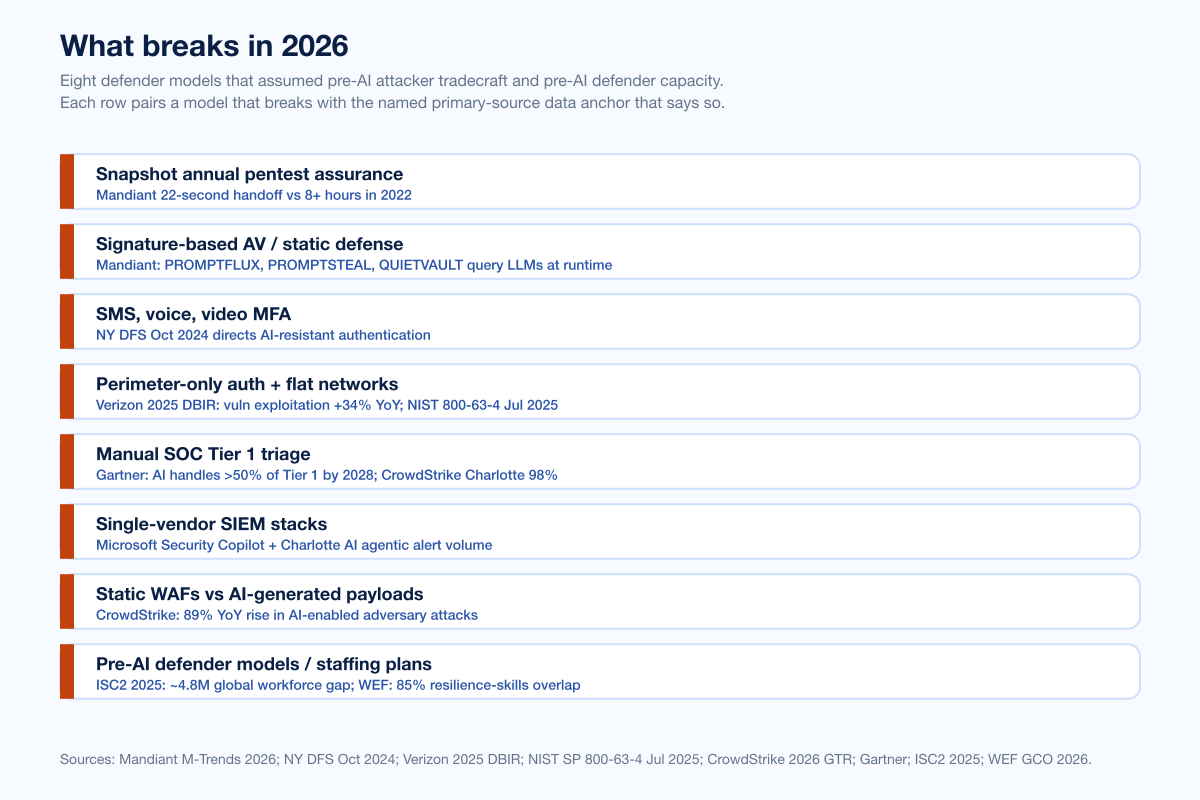
Figure 1: Eight defender models that break under 2026 attacker tempo, each paired with the named primary-source data anchor that says so. Sources: Mandiant M-Trends 2026; NY DFS October 2024; Verizon 2025 DBIR; NIST SP 800-63-4; CrowdStrike 2026 GTR; Gartner; ISC2 2025; WEF GCO 2026.
What scales in 2026
These are the defender practices and tooling categories that scale faster than the population can keep pace with. Each has direct primary-source evidence for the rate of change.
1. Phishing-resistant MFA and passkey adoption
The FIDO Alliance reported more than 3 billion passkeys in deployment by late 2025, securing more than 15 billion online accounts. Combined with NIST SP 800-63-4 (final, July 2025) and NY DFS October 2024 expectations, phishing-resistant MFA is the fastest-scaling identity control in 2026. The 2026 question is not whether to deploy passkeys but how fast.
2. AI-augmented PTaaS and bug-bounty work
HackerOne's 9th Annual Hacker-Powered Security Report found 70 percent of researchers use AI tools; Bugcrowd's 2026 "Inside the Mind of a Hacker" reported 82 percent. AI augmentation moved from optional to baseline for offensive work in 2025. Stingrai's Best PTaaS Providers 2026 ranking walks through the providers and their hybrid postures in detail.
3. Defender-AI economics
IBM's measurement that organizations using AI defenses extensively saved nearly US$1.9M per breach and identified breaches 80 days faster than peers is the headline figure. Charlotte AI's 98 percent triage accuracy, Microsoft Security Copilot's 6.5x phishing identification rate, and equivalent figures from Google Cloud's SOC AI tooling make defender-AI economics impossible to ignore at the top of the market.
4. Pre-deployment AI security assessment
WEF GCO 2026 measured pre-deployment AI security assessment doubling from 37 percent of organizations a year prior to 64 percent in the latest survey. That is a cultural and procurement shift, not just a tooling shift. Organizations are absorbing OWASP LLM Top 10 v2025 and MITRE ATLAS as baseline expectations on every new AI system before it ships.
5. Cyber insurance underwriter discipline
Coalition's 2026 Cyber Claims Report measured an 86 percent refusal rate on ransomware payments in 2025 (record high), even as average initial ransom demand surged 47 percent year-over-year to more than US$1M. At-Bay's 2026 InsurSec Report logged 7 percent year-over-year claim frequency rise, ransomware severity at US$508K (+16 percent year-over-year), and 87 percent of ransomware claims entering through remote-access services. The carriers' message: discipline is holding, severity is rising, and AI-defender capability is moving into the underwriting questionnaire. Stingrai's Cyber Insurance Statistics 2026 post tracks the carrier-side data in detail.
6. AI-enabled SOC triage
Charlotte AI 98 percent. Security Copilot 6.5x phishing identification, 77 percent better verdict accuracy, 78 percent faster triage. One Microsoft customer saved 200 hours per month. The trajectory is clear: AI takes Tier 1, Tier 2 senior analysts move up the value chain, and SOC operating models change accordingly.
7. Information security spending overall
Gartner forecasts worldwide end-user spending on information security growing 15.1 percent in 2026 to roughly US$244.2B. The growth is concentrated in AI-related categories: detection-and-response, identity, AI governance tooling, and managed services. Budget is scaling because the threat is scaling.
8. Leader recognition that AI is the biggest cyber driver
WEF GCO 2026: 94 percent of leaders agree AI is the single most significant driver of cybersecurity change. That number frames every other 2026 budget conversation. The remaining 6 percent are statistical noise.
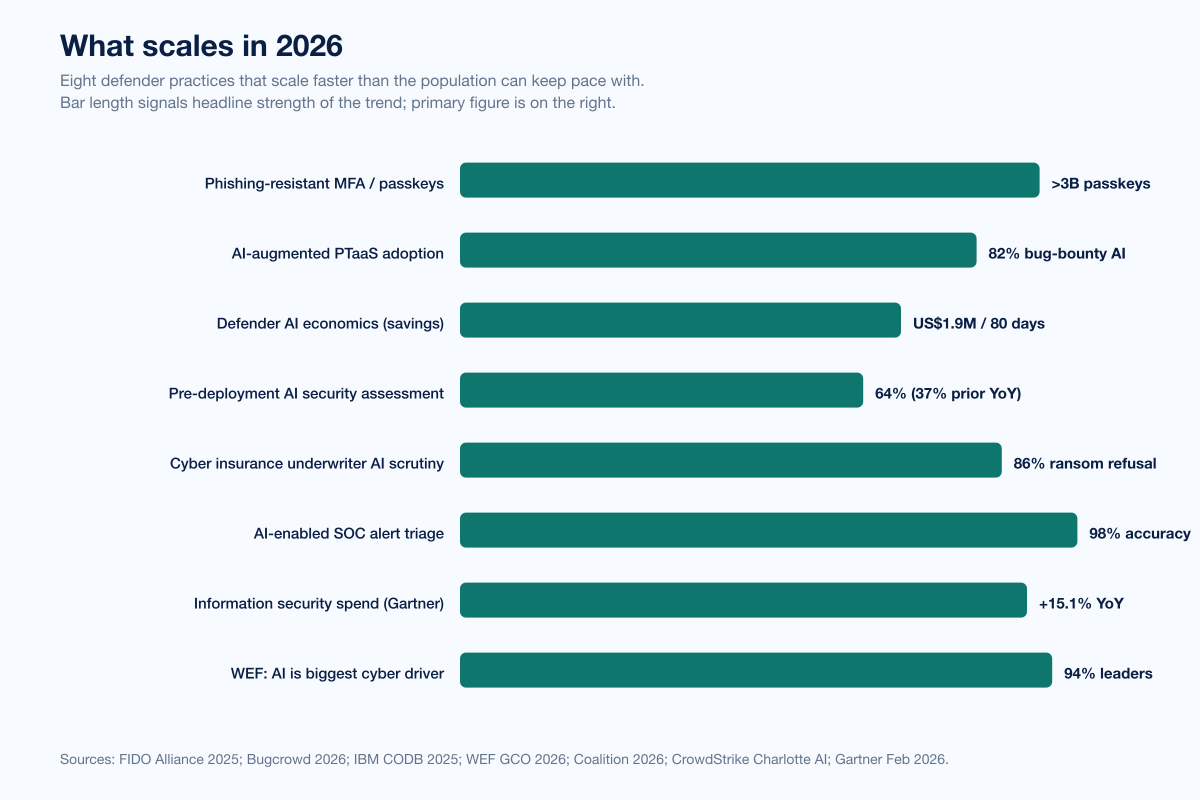
Figure 2: Eight defender practices that scale faster than the population can keep pace with. Sources: FIDO Alliance; Bugcrowd 2026; IBM CODB 2025; WEF GCO 2026; Coalition 2026; CrowdStrike Charlotte AI; Gartner February 2026.
What survives in 2026
These are the practices and tooling categories that keep working even after AI offense and AI defense both mature. Five anchors. Stingrai's bet is that human-AI hybrid pentesting is the most consequential of the five for buyers in 2026 to 2027.
1. Human-AI hybrid pentesting (Stingrai's bet)
HackerOne and Bugcrowd researcher data converged on hybrid as the 2026 baseline: 70 percent (HackerOne) and 82 percent (Bugcrowd) of researchers use AI tools, but 58 percent (HackerOne) say AI misses business logic and chained exploits, and only 12 percent believe AI could replace them. Anthropic's GTG-1002 disclosure showed an 80 to 90 percent autonomous AI espionage operation that nonetheless required 4 to 6 critical human decision points per campaign, "frequently overstated findings," "fabricated data," and resulted in only "a handful" of approximately 30 targets actually compromised. Pure-AI agents are the new baseline; senior pentesters with AI tooling remain the differentiator on novel logic, exploit chaining, and impact framing. We covered the full argument in our AI hacking democratization analysis. Stingrai's bet for 2026 to 2027 is that human-AI hybrid pentesting is the gold standard. Snipe is Stingrai's AI agent for web application penetration testing, including the application's APIs. It is available for autonomous web testing or alongside penetration testers in a Hybrid web engagement. Senior pentesters work alongside Snipe throughout, directing where it digs, extending exploit chains from what it surfaces, and owning impact framing and remediation guidance. The mix is roughly 30 to 40 percent AI-led and 60 to 70 percent human-led across our typical web-app and PTaaS engagements.
2. Specialized MSPs and MDR for SMBs
WEF GCO 2026: 46 percent of small organizations report insufficient cyber expertise, against 29 percent of large organizations. 85 percent of resilience-deficient organizations have a parallel critical cybersecurity skills gap. Sub-500-employee SMBs cannot self-integrate AI defender stacks; bundled MSP / MDR services with opinionated AI-defender integration survive as the SMB delivery model. The 2026 to 2027 SMB question is not "which AI tools should I buy" but "which MSP partner do I trust to integrate them on my behalf, and is my cyber insurance willing to underwrite the result."
3. OS-level security primitives
Quiet, unfashionable, durable. Linux Mandatory Access Control frameworks (SELinux, AppArmor, eBPF telemetry), Windows Attack Surface Reduction rules, Credential Guard, Windows Defender Application Control, and macOS Endpoint Security framework plus System Integrity Protection are the foundation that every higher-layer AI defender assumes. The 2026 lesson from the Mandiant catalog of AI-aware malware is that runtime behavior is the high-signal layer; OS-level primitives are how that signal gets generated. Organizations that under-invest in OS-level security (because it is "boring") find that their AI defender tooling can only see what the OS exposes.
4. Open-source defender tooling
If AI-defender capability remains locked into commercial SKUs, mid-market and SMB adoption stalls. Open-source tooling (Wazuh, Suricata, Zeek, osquery, Velociraptor) plus AI-augmented analysis layers close 50 to 70 percent of the commercial gap on the kinds of detection that scale on logs and network flows. OWASP LLM Top 10 v2025 and the MITRE ATLAS January 2026 update keep pace with adversarial AI techniques as a public knowledge base. Open-source survives as the floor-raiser for the population segments that cannot afford the Band 1 stack.
5. Cyber insurance underwriting discipline
Coalition 86 percent ransom refusal rate, At-Bay 7 percent claim frequency rise, Marsh McLennan 41 percent of cyber applications denied on first submission. The carriers' discipline survives because the actuarial math holds: organizations that demonstrate baseline controls (MFA, EDR, backup discipline, IR plan, increasingly AI-defender capability) are insurable at known rates; organizations that do not are not. The discipline is what makes cyber insurance a market rather than a charity. Stingrai's Cyber Insurance Statistics 2026 post tracks this in detail.
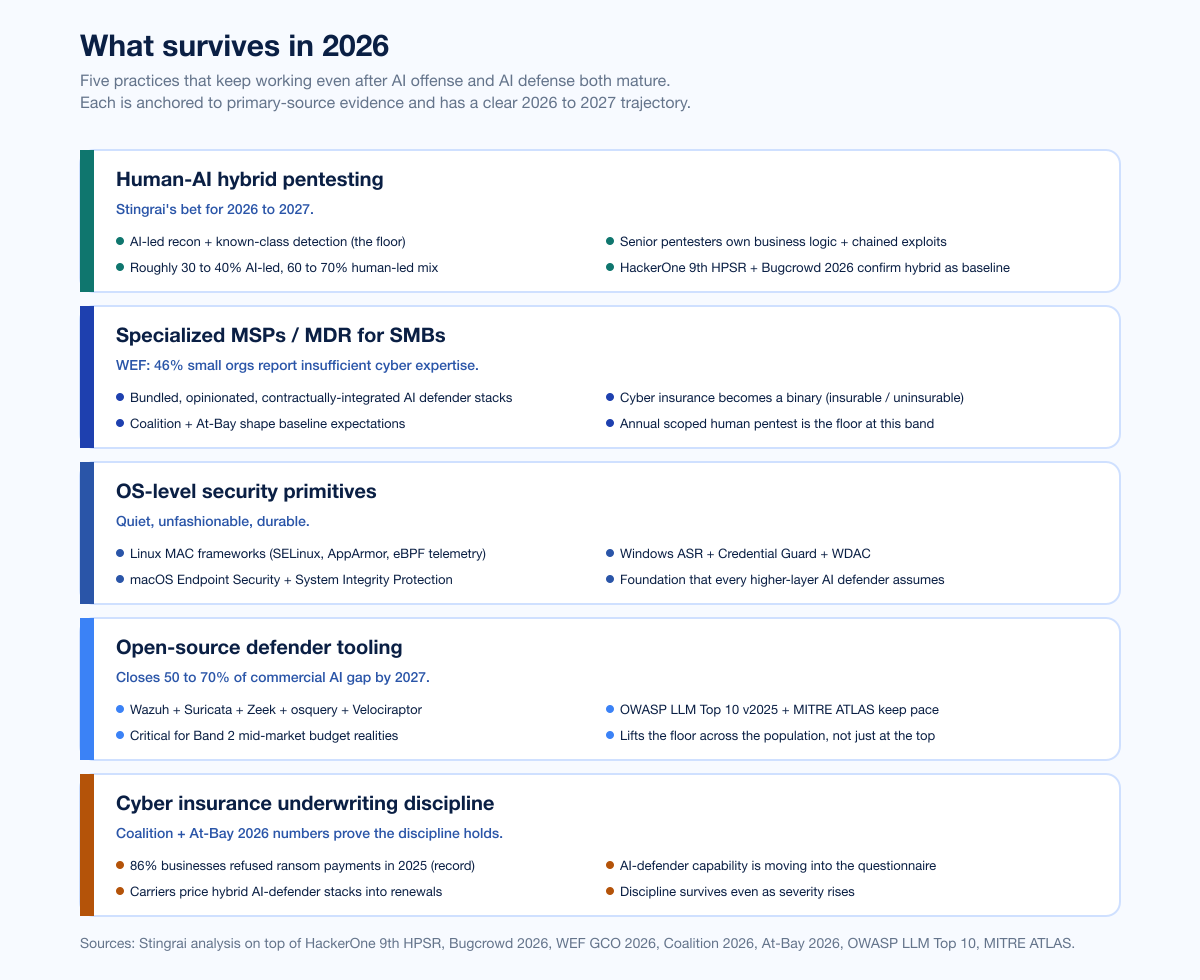
Figure 3: Five practices that keep working even after AI offense and AI defense both mature. Stingrai's bet is that human-AI hybrid pentesting is the most consequential of the five for buyers in 2026 to 2027. Sources: Stingrai analysis on top of HackerOne 9th HPSR, Bugcrowd 2026, WEF GCO 2026, Coalition 2026, At-Bay 2026, OWASP LLM Top 10 v2025, MITRE ATLAS.
Three dimensions that shape how the forecast lands
The three-bucket frame (what breaks, what scales, what survives) is the easy part to agree on. The harder question is the trajectory across the population. Stingrai's forecast adds three dimensions that most 2026 cybersecurity outlook pieces do not foreground, plus one synthesis bet that drives Stingrai's own engagement posture.
1. The org-size dimension
Population behavior is not uniform. The WEF data is unambiguous: 91 percent of large enterprises adjusted posture for geopolitical and AI risk, against 59 percent of SMBs; 46 percent vs 29 percent on insufficient cyber expertise. Defender-AI capability scales at the top first, then mid-market under economic pressure, then SMBs through MSP / MDR bundling. We covered the full three-band argument in our Chaos Phase analysis. Stingrai's 2026 forecast is that the bands diverge before they converge.
2. The regulatory dimension
Regulatory load is the second decisive force in 2026. The EU AI Act 2024/1689 high-risk-system obligations are scheduled for 2 August 2026 with penalties up to EUR 35M or 7 percent of global turnover. NY DFS October 2024 has reshaped financial-sector authentication expectations. NIST AI 100-1 + AI 600-1 + ISO/IEC 42001:2023 + OWASP LLM Top 10 v2025 + MITRE ATLAS define the de-facto AI governance baseline. Mid-market organizations bear that load disproportionately because they cannot amortize compliance staff across the same revenue base as the largest enterprises. Stingrai's AI Cybersecurity Threats 2026 post walks through the governance reference set in detail.
3. The insurance dimension
Cyber insurance carriers are the third decisive force. They are increasingly the channel through which AI-defender capability becomes mandatory. Coalition's 2026 underwriting questionnaire is moving from "do you have MFA and EDR" to "do you assess AI-tool security pre-deployment" in real time. By 2027, AI-defender capability will be a renewal-cycle gate, not a discount. We expect this to be the single biggest market force shaping mid-market and SMB AI-defender adoption.
4. Pushback on the "AI takeover" framing
Some 2026 forecasts in the broader discourse frame this year as the inflection point at which AI offense decisively beats AI defense. The data does not support that. Anthropic's own GTG-1002 footnote that Claude "frequently overstated findings" and "fabricated data," with only "a handful" of approximately 30 targets actually compromised, is the canonical reminder that pure-AI offense still hits validation walls. Mandiant's 2026 caveat that most successful 2025 intrusions still stem from "fundamental human and systemic failures" rather than direct AI causation is the same point at the population level. 2026 is bidirectional, not one-sided.
5. Using "what survives" as the buyer-side lever
The "what survives" bucket is more than a forecast category. It is the buyer-side lever. The right buyer-side question for 2026 is not "which AI tool should I buy" but "of the practices that survive AI maturation, which ones do I have, which ones do I lack, and how do I build the missing ones." Hybrid pentesting, OS-level primitives, MSP / MDR for SMBs, open-source defender tooling, and underwriting discipline are the answer key.
Forecast bands by org size
The 2026 outcome is not uniform. Our Chaos Phase analysis walks through the full three-band argument. Headline summary:
Large enterprises (Band 1). Pulling ahead with hybrid AI defender stacks. WEF: 91 percent adjusted posture; 29 percent insufficient cyber expertise. Insurance renewal: flat or down rates. Pentest cadence: continuous + scoped human-led depth in same procurement.
Mid-market (Band 2). Squeezed by adoption + compliance load. Roughly US$100M to US$2B revenue, 500 to 5,000 employees. AI tooling adopted in spots (email security and EDR first); AI-governance is part-time CISO responsibility; insurance renewals tighter. Stingrai's PTaaS engagement weight is concentrated here.
SMBs (Band 3). Disproportionately exposed. WEF: 59 percent adjusted posture; 46 percent insufficient cyber expertise. Bundled MSP / MDR is the survivable delivery model. Insurance is increasingly insurable / uninsurable, not graduated.
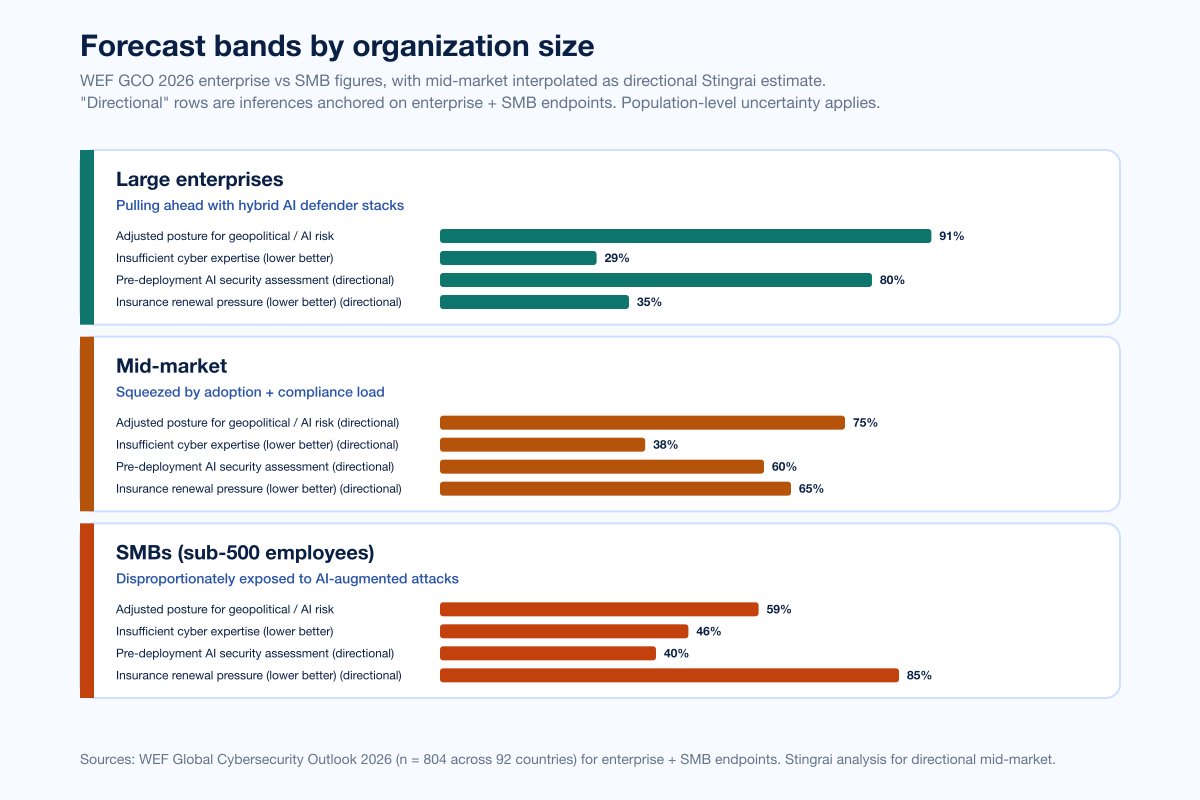
Figure 4: Three-band Stingrai forecast for 2026. WEF GCO 2026 enterprise vs SMB endpoints; mid-market interpolated as directional Stingrai estimate. Source: WEF GCO 2026 and Stingrai analysis.
Budget allocation guidance
CISOs preparing 2026 cybersecurity budgets often ask the same question: how should the dollars split across people, AI tooling, governance, and services. The honest answer is that each band tunes the mix to its own constraints. Below is Stingrai's directional starting point, anchored in the data above.
Pillar | Suggested 2026 share | Why |
|---|---|---|
People (hiring, training, retention) | ~38% | ISC2 2025 ~4.8M global workforce gap; WEF GCO 2026 85% resilience-skills overlap. People are the binding constraint on every AI tooling ROI. |
AI defender tooling + integration | ~28% | IBM CODB 2025 US$1.9M per-breach savings + 80 days faster identification with extensive AI-defender deployment. CrowdStrike Charlotte AI 98 percent. Microsoft Security Copilot 6.5x. |
Governance + compliance | ~16% | EU AI Act high-risk obligations (2 August 2026), NY DFS October 2024, NIST AI 600-1, OWASP LLM Top 10 v2025, MITRE ATLAS, ISO/IEC 42001:2023. |
Services (pentest, IR, MSP/MDR) | ~18% | Mandiant 22-second handoff (continuous validation needed); Coalition 86% ransom refusal (IR readiness pays off); SMB MSP / MDR delivery model. |
Mid-market shifts more weight onto governance and less onto headcount because of revenue-based regulatory load. SMBs shift more weight onto services (MSP / MDR + scoped pentest) because the integration question is outsourced. Large enterprises spend more on AI tooling and governance simultaneously because they can absorb both.
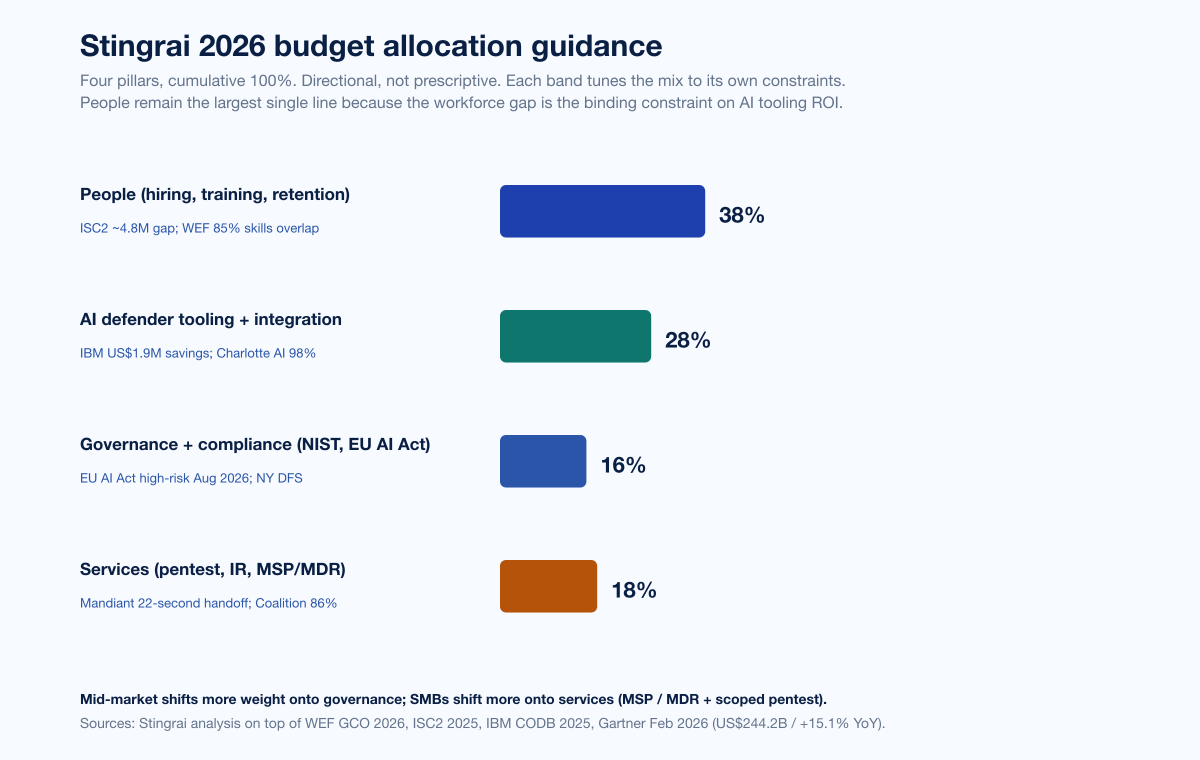
Figure 5: Suggested 2026 cybersecurity budget allocation across people, AI defender tooling, governance, and services. Each band tunes the mix to its own constraints. Sources: Stingrai analysis on top of WEF GCO 2026, ISC2 2025, IBM CODB 2025, Gartner February 2026.
What this means for security buyers
Buyers should adjust 2026 procurement to match the bidirectional shape of the year. Three concrete moves.
1. Rewrite the pentest RFP
The right 2026 pentest provider question is not "do you use AI" (the answer should be obviously yes) but "show me the engagement where AI handed your senior pentester a chained business-logic finding that no autonomous agent would have shipped on its own." Stingrai's PTaaS, web application penetration testing, and network penetration testing services are scoped to that question. Stingrai's Best PTaaS Providers 2026 ranking walks through the named US, Canadian, and global providers and where Stingrai's hybrid posture sits.
2. Treat AI defender capability as a renewal-cycle gate
If your cyber insurance renewal questionnaire does not ask about AI defender capability today, it will by mid-2026. Build the evidence now: which AI defender tools you use, what guardrails apply, how you suppress false positives, what your AI governance posture is against NIST AI 600-1 + OWASP LLM Top 10 v2025 + MITRE ATLAS. Stingrai's AI Cybersecurity Threats 2026 post is a starting reference for the governance layer.
3. Invest in what survives, not just what scales
Phishing-resistant MFA, AI-augmented PTaaS, and SOC AI tooling all scale, and most buyers are already moving on them. The harder budget conversation is the one about what survives: hybrid pentesting depth, OS-level primitives, MSP / MDR for under-resourced segments, and open-source defender tooling. The 2026 buyers who outperform are the ones who fund both, not just the fashionable layer.
Stingrai's role in 2026
Stingrai is a 2021-founded offensive-security firm headquartered in Toronto with a London, UK office. Team certifications include OSCE3, OSCP, OSWE, OSED, OSEP, CREST CRT, CISSP, CRTO, CRTE, and eWPTX. The team has documented vulnerability research and presents research at DEFCON and BSIDES. Stingrai's 5.0/5.0 average across 19 Clutch reviews reflects engagement reputation. Snipe is Stingrai's AI agent for web application penetration testing, including the application's APIs. It is available for autonomous web testing or alongside penetration testers in a Hybrid web engagement.
Our customer base spans all three forecast bands, weighted toward mid-market. The 2026 to 2027 procurement conversations we expect to see more often:
"Which categories of finding does your AI tooling miss, and how do you compensate?"
"What is your AI-governance posture, with named coverage of NIST AI 100-1, OWASP LLM Top 10 v2025, MITRE ATLAS, and (if EU-touching) the EU AI Act 2024/1689 timeline?"
"How many published CVEs has your team produced in the last 24 months, and which were chained from AI-led recon?"
"What is your engagement mix on a typical web-app pentest, and how is the AI-led portion structured to surface findings the pure-AI agents are missing?"
A 2026 buyer in any of the three bands should expect named senior pentesters, public CVE track record, transparent AI tooling, and explicit AI governance posture. The chaos phase does not change the buyer's checklist; it raises the floor on it.
Frequently asked questions
What is Stingrai's 2026 cybersecurity forecast in one paragraph?
$24
What three dimensions shape how Stingrai's 2026 forecast lands across the population?
$25
What did Anthropic's GTG-1002 disclosure prove for 2026?
Anthropic disclosed GTG-1002 on November 13, 2025, as the first publicly documented AI-orchestrated cyber espionage campaign at scale. A Chinese state-sponsored group used Claude Code in an MCP-connected agentic framework to autonomously execute roughly 80 to 90 percent of tactical work against approximately 30 organizations across technology, finance, government, and chemical manufacturing, at thousands of requests per second, with human input limited to 4 to 6 critical decision points per campaign. Anthropic detected the activity in mid-September 2025 and contained it within roughly 10 days. The qualitative footnote that often gets dropped: Anthropic explicitly noted Claude "frequently overstated findings" and "fabricated data," with only "a handful" of approximately 30 targets actually compromised. End-to-end agentic operations are operationally feasible; validation gaps remain non-trivial. For 2026, that means pure-AI offense is the new floor, and human validation is the surviving differentiator.
Why is human-AI hybrid pentesting Stingrai's bet for 2026?
Three converging data points. First, HackerOne's 9th Annual Hacker-Powered Security Report found 70 percent of researchers use AI tools but 58 percent say AI misses business logic and chained exploits, and only 12 percent believe AI could replace them. Bugcrowd 2026 found 82 percent of hackers use AI in their workflow but adopted "human-augmented intelligence" as the framing rather than "AI replaces humans." Second, Anthropic's GTG-1002 disclosure showed that the most sophisticated AI-led campaign of 2025 still required human decision points and produced fabricated findings. Third, Mandiant's M-Trends 2026 caveat that most successful 2025 intrusions still stem from fundamental human and systemic failures rather than direct AI causation. Hybrid is the 2026 baseline. Stingrai's engagement mix of roughly 30 to 40 percent AI-led and 60 to 70 percent human-led is calibrated to that reality.
What should mid-market CISOs prioritize in 2026?
Three priorities. First, pick the two highest-ROI AI-defender tools (typically email security and SOC triage) and operationalize them deeply before adding more; do not chase the large-enterprise stack with mid-market budget. Second, document AI-governance posture against NIST AI 600-1, OWASP LLM Top 10 v2025, MITRE ATLAS, and (if EU-touching) the EU AI Act timeline; the 2 August 2026 high-risk obligation date drives renewal cycles even before it lands legally. Third, run continuous-validation pentests with hybrid AI-and-human coverage; treat senior-pentester depth on business-logic and chained findings, delivered alongside the AI agent rather than after it, as a renewal-cycle differentiator with insurers. Stingrai's PTaaS is built for this band.
What should SMB security leaders prioritize in 2026?
Outsource the integration question. Pick an MSP / MDR partner whose AI-defender stack is bundled, opinionated, and contractually carries the integration load. Do not try to build the stack yourself; you will lose. Renew insurance early and accept that coverage may become harder over the next 24 months. Run an annual scoped pentest with a senior pentester (not just an automated scan) on the systems that hold your most sensitive data; Stingrai's web application penetration testing and network penetration testing services are scoped to fit Band 3 budgets when the alternative is no human review at all.
How are cyber insurers responding to AI risk in 2026?
$26
What does the EU AI Act timeline mean for cybersecurity buyers in 2026?
$27
What is Stingrai's role in this market?
Stingrai is a 2021-founded offensive-security firm headquartered in Toronto with a London, UK office. Team certifications include OSCE3, OSCP, OSWE, OSED, OSEP, CREST CRT, CISSP, CRTO, CRTE, and eWPTX. The team has documented vulnerability research and presents research at DEFCON and BSIDES. Stingrai's 5.0/5.0 average across 19 Clutch reviews reflects engagement reputation. Snipe is Stingrai's AI agent for web application penetration testing, including the application's APIs. It is available for autonomous web testing or alongside penetration testers in a Hybrid web engagement. The mix is roughly 30 to 40 percent AI-led and 60 to 70 percent human-led on typical web-app and PTaaS engagements.
Where can I read more from Stingrai on this topic?
The companion post set: AI Cyber Attack Statistics 2026 compiles the offensive-side primary-source data; AI Cybersecurity Threats 2026 covers the defender-side governance reference set; the Chaos Phase analysis covers the three-band uneven-equilibrium argument in detail; the AI hacking democratization analysis covers the pure-AI vs hybrid pentesting argument; the Cyber Insurance Statistics 2026 post covers underwriter dynamics; the Cybersecurity Skills Gap Statistics 2026 post covers the workforce constraint; the Vulnerability Statistics 2026 post covers the CVE / KEV reference data; and the Best PTaaS Providers 2026 post walks through the named providers and where Stingrai's hybrid posture sits.
The bottom line
2026 is not the year AI took over cybersecurity. It is also not the year defenders convincingly closed the gap. It is the year both sides scaled AI in parallel and the differentiator became human-AI hybrid execution.
What breaks: defender models built for pre-AI attacker tradecraft. Snapshot assurance, signature defense, SMS MFA, perimeter-only auth, manual SOC Tier 1, and pre-AI staffing plans. Each has a primary-source data anchor that says it breaks, and each has a 2026 to 2027 replacement that organizations are absorbing on the timeline they can afford.
What scales: phishing-resistant MFA at more than 3 billion passkeys; AI-augmented PTaaS at 82 percent researcher adoption; defender-AI economics at US$1.9M and 80 days saved per breach; pre-deployment AI security assessment at 64 percent of organizations (up from 37 percent year prior); AI-enabled SOC triage at 98 percent accuracy; cyber insurance underwriter discipline at 86 percent ransom refusal; and information security spending at +15.1 percent year over year. The trajectory is clear and the rate of change is fast.
What survives: human-AI hybrid pentesting, specialized MSPs / MDR for SMBs, OS-level security primitives, open-source defender tooling, and cyber insurance underwriting discipline. Stingrai's bet is that human-AI hybrid pentesting is the 2026 to 2027 gold standard for buyers who need depth on hard categories. AI raises the floor; senior pentesters with AI tooling raise the ceiling. The buyers, researchers, and underwriters who plan for hybrid execution will outperform the ones who plan for either pure-AI or pure-human delivery.
The three-bucket frame is the easy part to agree on. The interesting question is the trajectory across the population. Stingrai's 2026 forecast layers three decisive dimensions on top of the bucket frame (org-size, regulation, insurance) and one synthesis bet (human-AI hybrid pentesting as the gold standard). The next 24 months of buyer, regulator, and underwriter decisions will turn on whether the field correctly understands the shape of the year. Plan for divergence by band. Fund what survives, not just what scales. Run hybrid execution where the depth matters. The chaos phase is real; the work survives.
References
Anthropic. "Disrupting the first reported AI-orchestrated cyber espionage campaign". November 13, 2025.
Anthropic. "Detecting and countering misuse of AI: August 2025". August 27, 2025.
OpenAI. "Disrupting malicious uses of AI: October 2025". October 2025.
IBM. "Cost of a Data Breach Report 2025" press release. July 30, 2025.
IBM. "2025 Cost of a Data Breach Report: Navigating the AI rush". July 2025.
CrowdStrike. "2025 Global Threat Report". February 2025.
CrowdStrike. "2026 Global Threat Report findings". February 2026.
CrowdStrike. "Charlotte AI Detection Triage". February 2025.
CrowdStrike. "2025 Threat Hunting Report". August 2025.
Mandiant / Google Cloud. "M-Trends 2026". March 2026.
Mandiant / Google Cloud. "M-Trends 2025". April 2025.
Microsoft. "Cyber Signals Issue 9: AI-Powered Deception". April 2025.
Microsoft. "Security Copilot for SOC: bringing agentic AI to every defender". November 2025.
Microsoft. "Microsoft Digital Defense Report 2025". October 2025.
World Economic Forum. "Global Cybersecurity Outlook 2026". January 2026.
World Economic Forum. "Global Cybersecurity Outlook 2026 (PDF)". January 2026.
HackerOne. "9th Annual Hacker-Powered Security Report". October 2025.
Bugcrowd. "Inside the Mind of a Hacker 2026". January 2026.
European Union. "AI Act 2024/1689 regulatory framework". Entered into force August 1, 2024.
European Union AI Act. "Article 99: Penalties".
NY Department of Financial Services. "Industry Letter: Cybersecurity Risks Arising from AI". October 16, 2024.
NIST. "AI Risk Management Framework: Generative AI Profile (NIST AI 600-1)". July 26, 2024.
NIST. "AI Risk Management Framework (NIST AI 100-1)". January 2023.
NIST. "SP 800-63-4 Digital Identity Guidelines (final)". July 2025.
OWASP. "Top 10 for LLM Applications v2025". 2025.
MITRE. "ATLAS adversarial AI knowledge base". January 2026 update.
UK AI Security Institute. "Frontier AI cyber capability research". 2025-2026.
Coalition. "2026 Cyber Claims Report". April 2026.
At-Bay. "2026 InsurSec Report (Help Net Security summary)". April 2026.
Howden. "2025 Cyber Report: Rebooting Growth". September 2025.
Gartner. "Worldwide End-User Spending on Information Security to Grow 15.1% in 2026". February 2026.
Gartner. "AI Applications Will Drive 50% of Cybersecurity Incident Response Efforts by 2028". March 2026.
FIDO Alliance. "3 Billion Passkeys Now Secure Consumer Online Accounts". 2025.
Sonatype. "State of the Software Supply Chain". 2026.
Synopsys / Black Duck. "Open Source Security and Risk Analysis (OSSRA)". 2025.
Verizon. "2025 Data Breach Investigations Report". May 2025.
ENISA. "Threat Landscape 2025". September 2025.
ISC2. "2025 Cybersecurity Workforce Study". October 2025.
ISO/IEC. "42001:2023 AI management systems". December 2023.
White House. "Executive Order 14179: Removing Barriers to American Leadership in AI". January 23, 2025.
XBow. "Security in 2026: What Breaks, What Scales, and What Survives". 2026.
Stingrai. AI Cyber Attack Statistics 2026.
Stingrai. AI Cybersecurity Threats 2026.
Stingrai. AI Chaos Phase 2026: Stingrai's Take.
Stingrai. AI Hacking Democratized 2026.
Stingrai. Best PTaaS Providers 2026.
Stingrai. Cyber Insurance Statistics 2026.
Stingrai. Cybersecurity Skills Gap Statistics 2026.
Stingrai. Vulnerability Statistics 2026.
Stingrai. Supply Chain Attack Statistics 2026.