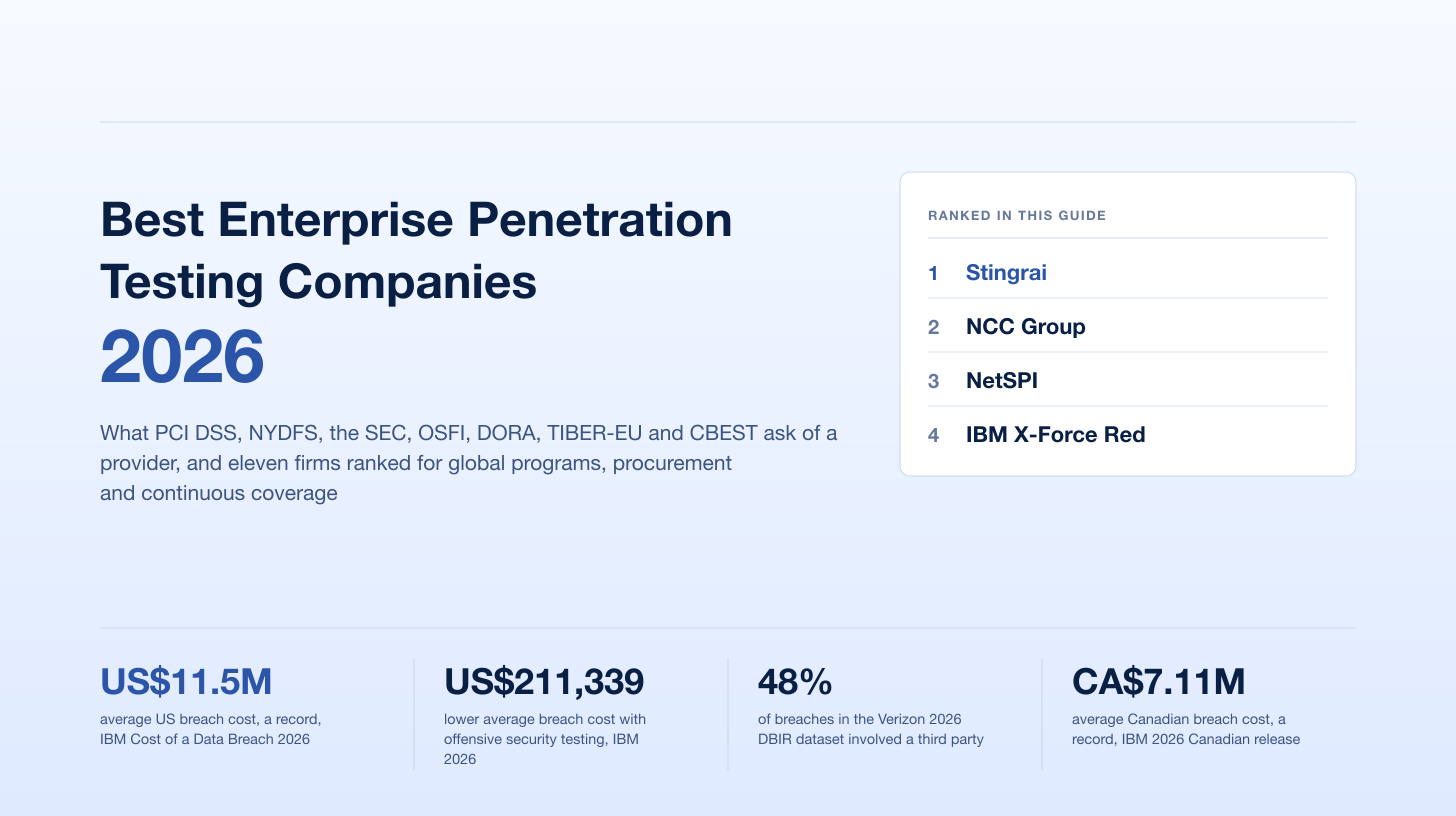




Breaches with third-party involvement reached 48 percent of total breaches in the Verizon 2026 Data Breach Investigations Report, up 60 percent on the previous year's dataset. Every startup that sells software to a larger company is a third party on somebody's risk register, which is why a startup's first penetration test is so often requested by a customer rather than by a regulator. Stingrai's own client reviews show the pattern: an AI software company that needed a pentest for a customer request, a San Francisco security software company testing ahead of its SOC 2 Type II audit, and a Toronto credit management platform that wanted a report for SOC 2 and for its vendors.
Where Stingrai fits: Stingrai is a CREST-accredited penetration testing service provider at firm level, founded in Toronto in 2021, with a London office. Human-led engagements are run by two named penetration testers from a team holding OSCE³, OSWE, OSEP, CREST CRT and CISSP certifications, with 18 published CVEs across the team. For a startup that means the product is tested the way a customer's security reviewer will read the report: the web application and its APIs authenticated as every role and tenant, the AWS, Azure or Google Cloud account behind it, the identity provider and admin paths, and the LLM features you ship. The fixed-price packages cover exactly one web application and its APIs: the Autonomous Pentest at US$3,000 per assessment and the Hybrid Pentest at US$6,800 per assessment, or US$650 and US$1,275 per month on 12-month continuous plans (pricing). Wider scopes are human-led and quoted, delivered as a one-time annual engagement or a continuous program.
Quick answer: who are the best penetration testing companies for startups in 2026?
The best penetration testing companies for startups in 2026 are Stingrai, Cobalt, BreachLock, CYBRI, Kobalt.io, Bright Defense, Astra Security, Sherlock Forensics and Halborn. Stingrai ranks first for named, certified penetration testers on the product, the cloud account and identity, with published prices for one web application and its APIs, retesting, and both one-time and continuous delivery. Cobalt, BreachLock and CYBRI follow for startup customer stories and a published autonomous test price, a one-time package that lists startup product launches as a use case, and published starting prices tied to a defined scope.
AI-first and API-first SaaS startups: test the API authorization model across tenants and the LLM features in the same engagement. Stingrai covers both, with Snipe on the web application and its APIs and penetration testers on the OWASP Top 10 for LLM Applications. Cobalt sells separate API and AI and LLM pentests, and CYBRI's tier starting at US$9,500 covers API, cloud, or AI and agentic workflow testing.
Fintech startups: confirm your PCI DSS self-assessment questionnaire and whether the FTC Safeguards Rule or New York's Part 500 reaches you before you scope anything, because those decide whether a test is required. Stingrai (an insurtech startup case study), Cobalt (a payments startup story) and Halborn (a digital asset fintech startup case study) publish that work on their own sites.
A first SOC 2 on a tight budget: BreachLock's one-time package starts at US$2,500 and Bright Defense's Ignite plan costs US$2,750; Stingrai publishes US$3,000 for an Autonomous Pentest and US$6,800 for a Hybrid Pentest of one web application and its APIs, or US$650 and US$1,275 per month on 12-month continuous plans. Check what each price covers, and whether a retest and a letter are included, before comparing them.
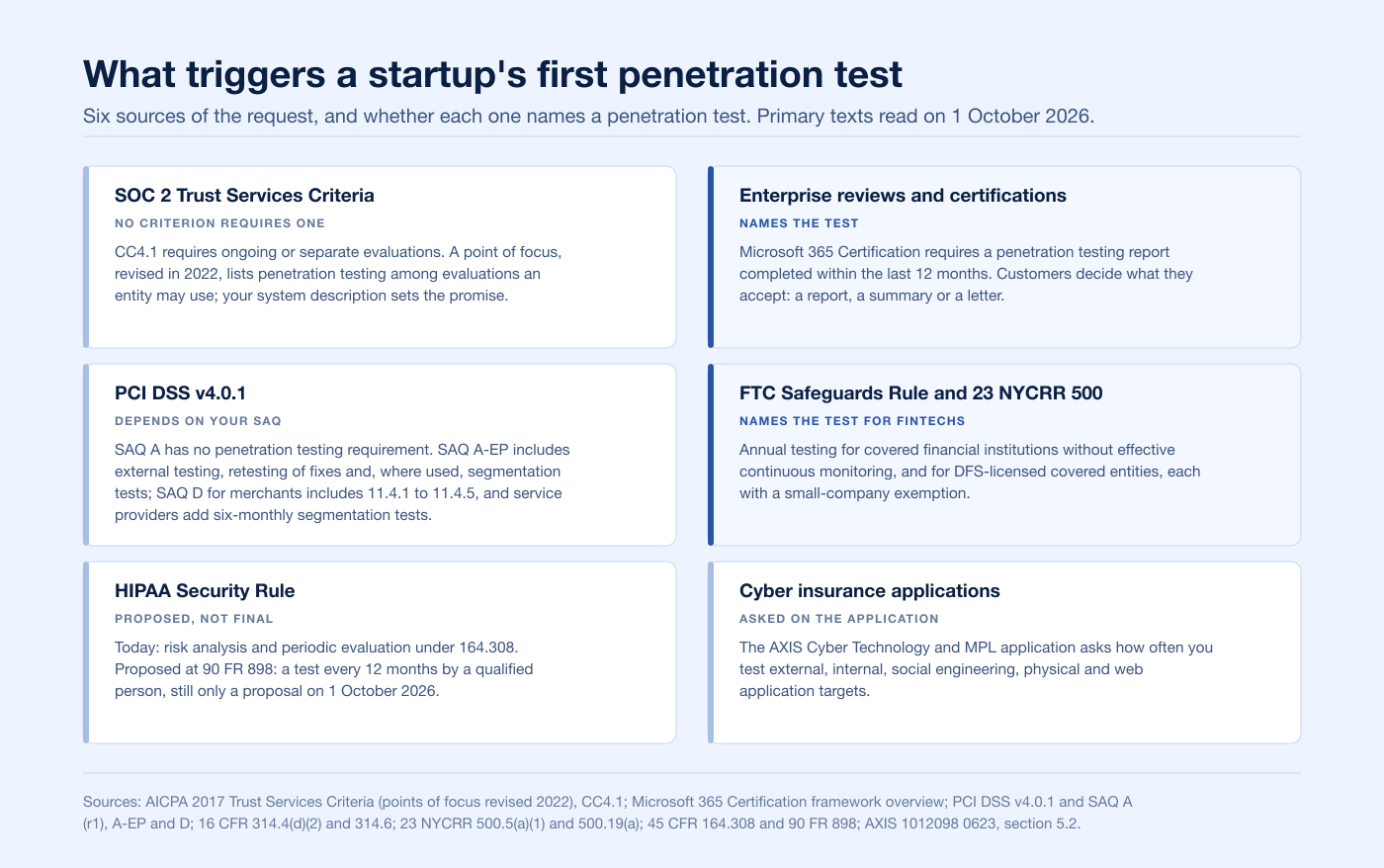
What actually drives a startup's first penetration test
The test rarely arrives because a statute names it. It arrives through a framework you chose, a customer you want, a payment flow you built, a license you hold or an insurer you applied to. Each asks for something slightly different, and that decides what the report has to prove.
SOC 2: CC4.1 asks for evaluations, not a penetration test
SOC 2 examinations use the AICPA's 2017 Trust Services Criteria, whose points of focus were revised in 2022. Criterion CC4.1 requires that "the entity selects, develops, and performs ongoing and/or separate evaluations to ascertain whether the components of internal control are present and functioning." In the current edition, a point of focus under CC4.1 says management uses "ongoing and separate risk and control evaluations to determine whether internal controls are present and functioning," which, depending on the entity's objectives, "may include" internal audit assessments, vulnerability scans, security assessment, penetration testing and third-party assessments. The introduction says use of the criteria "does not require an assessment of whether each point of focus is addressed." The criteria mention penetration testing nowhere else and set no testing cadence.
What binds you is the control you write into your own system description. Promise an annual third-party penetration test and the auditor will look for exactly that, dated inside the period. For a Type II report, land the test early enough that fixes and the retest also fall inside the observation window. The SOC 2 ranking covers timing and multi-application programs.
Enterprise security reviews and certification programs
Enterprise buyers ask for the report directly, and so do the certification programs run by the platforms you build on. Microsoft 365 Certification requires "a penetration testing report completed within the last 12 months," and its application security evidence guide states that "Penetration testing is a mandatory requirement for all applications undergoing Microsoft 365 Certification," covering the web application and the production infrastructure behind it, with exceptions where the vendor hosts no supporting infrastructure. The certification overview makes testing mandatory "for any app that connects to external services not hosted or managed by Microsoft," which covers a Teams app, Outlook add-in or agent backed by your own servers.
The same request reaches startups through customer security reviews. Stingrai's reviews include the AI software company above, which commissioned its test for a customer, and Cobalt's GridTech startup story describes a SaaS company whose "customers require a thorough procurement process" and which needed to comply with ISO 27001 and SOC 2. Ask the buyer what they will accept before you buy: a full report under NDA, an executive summary, or an attestation letter.
PCI DSS: your self-assessment questionnaire decides
PCI DSS v4.0.1 Requirement 11.4 calls for internal and external penetration testing "at least once every 12 months" and "after any significant infrastructure or application upgrade or change," and requires exploitable findings to be corrected, with "Penetration testing is repeated to verify the corrections." Whether a payments startup has to do it depends on how card data touches its systems:
SAQ A (all account data functions outsourced, payment page delivered entirely by a compliant provider) contains no penetration testing requirement.
SAQ A-EP (your website does not receive account data but controls how customers reach the provider) includes a defined testing methodology (11.4.1), external penetration testing (11.4.3), correction of exploitable findings with a repeat test (11.4.4) and, if you use segmentation, segmentation testing (11.4.5); internal testing (11.4.2) is not in it.
SAQ D for Merchants includes 11.4.1 to 11.4.5: internal and external testing, the corrections and retest, and segmentation testing. Service providers also test segmentation controls "at least once every six months" under 11.4.6.
In Canada, the Retail Payment Activities Regulations require a payment service provider to "establish and implement a testing methodology" without naming penetration testing, and the Bank of Canada's operational risk guideline notes that "qualified parties should conduct specialized testing, such as penetration testing." The PCI DSS ranking covers payment-specific providers.
Fintech rules that do name the test
Fintechs are where a rule can require the test outright. The FTC's Safeguards Rule, which applies to financial institutions under FTC jurisdiction, requires "continuous monitoring or periodic penetration testing and vulnerability assessments" and, absent effective continuous monitoring, "Annual penetration testing of your information systems" under 16 CFR 314.4(d)(2). Section 314.6 exempts institutions that maintain customer information concerning "fewer than five thousand consumers" from that requirement.
A startup licensed by the New York Department of Financial Services is a covered entity under 23 NYCRR 500, and section 500.5(a)(1) requires penetration testing "from both inside and outside the information systems' boundaries by a qualified internal or external party at least annually." The limited exemption in 500.19(a) removes 500.5 for covered entities with fewer than 20 employees and independent contractors, under US$7.5 million in gross annual revenue in each of the last three fiscal years, or under US$15 million in year-end total assets, affiliates included. The fintech ranking goes deeper on regulated fintech scopes.
HIPAA for health tech: evaluations today, a proposed testing rule
A health tech startup that creates, receives, maintains or transmits protected health information on behalf of a covered entity is a business associate under 45 CFR 160.103, and the Security Rule applies to it directly. Today the rule requires "an accurate and thorough assessment of the potential risks and vulnerabilities" under 45 CFR 164.308(a)(1)(ii)(A) and "a periodic technical and nontechnical evaluation" under 164.308(a)(8). Neither names a penetration test.
The proposed rule published at 90 FR 898 on 6 January 2025 would require penetration testing by "a qualified person" at least once every 12 months, or more often if the risk analysis calls for it. On 1 October 2026 the Federal Register still lists only that proposal under RIN 0945-AA22.
Cyber insurance applications
Insurers ask as well. The AXIS Cyber Technology and MPL application, form AXIS 1012098 0623, asks under section 5.2 whether "The Applicant conducts regular penetration testing?" and has the applicant tick a frequency, from quarterly to never, separately for external network, internal network, social engineering, physical and web application testing, plus whether testing is done internally or outsourced. A startup that has only ever bought an external network test has no honest answer but never on the web application row.
Driver | Names penetration testing? | Cadence | What the evidence has to show |
|---|---|---|---|
SOC 2 Trust Services Criteria (CC4.1) | Only in a point of focus | None set | Evaluations you described, dated inside the period, with fixes tracked |
Microsoft 365 Certification | Yes | Report completed within the last 12 months | Web application and supporting infrastructure, tested in production |
PCI DSS v4.0.1 | SAQ A no; SAQ A-EP and SAQ D yes | At least every 12 months and after significant change; segmentation every six months for service providers | Methodology, results, corrections and a retest |
FTC Safeguards Rule (16 CFR 314.4) | Yes, unless effective continuous monitoring | Annual | Testing based on the risk assessment; exemption below 5,000 consumers |
23 NYCRR 500.5 | Yes, for DFS-licensed covered entities | At least annually | Inside and outside testing by a qualified party; limited exemption for small entities |
HIPAA Security Rule | Not today; proposed at 90 FR 898 | Proposed: every 12 months | Risk analysis and periodic evaluation |
Cyber insurance (AXIS 1012098 0623) | Asked on the application | You declare it | A truthful frequency for each testing type |
What to test first: the product, the cloud account and identity
A startup's attack surface is small enough to test properly, which is exactly why the first scope should go deep rather than wide.
The web application and its APIs, authenticated as every role and tenant. OWASP's API Security Top 10 2023 puts Broken Object Level Authorization first and says object level authorization checks "should be considered in every function that accesses a data source using an ID from the user." Whether one customer can read another customer's records is a logic question that needs two accounts and context, which is why the web application penetration test comes first. The SaaS ranking and the API ranking compare providers for multi-tenant and API-first products.
The cloud account behind it. Across all breaches in its dataset, not startups alone, the Verizon 2026 Data Breach Investigations Report found that exploitation of vulnerabilities is now "the most common initial access vector for breaches," at 31 percent of known initial access vectors in non-Error, non-Misuse breaches, while credential abuse fell to 13 percent. In a startup's AWS, Azure or Google Cloud account, an exposed service or an over-permissive IAM role is what turns one bug into broad access. Cloud penetration testing follows those paths from the control plane to the workload.
Identity. Your identity provider, admin consoles, support tooling and multifactor coverage. The same report found that "only 23% of third-party organizations fully remediated missing or improperly secured multifactor authentication (MFA) on their cloud accounts," and a startup selling to enterprises is one of those third parties.
AI features. If the product calls a model or runs agents, test prompt injection, sensitive information disclosure and excessive agency from the OWASP Top 10 for LLM Applications 2025, through the same roles and tenants as the rest of the app. AI and LLM penetration testing covers agents and tool integrations.
Mobile apps. iOS and Android are separate work plus the shared backend, so budget them per platform once you ship them.
Leave the office network, employee laptops, physical security and social engineering for later unless a customer, insurer or rule names them. The startup penetration testing guide covers the first-test decision in more detail.
How the scope grows by stage
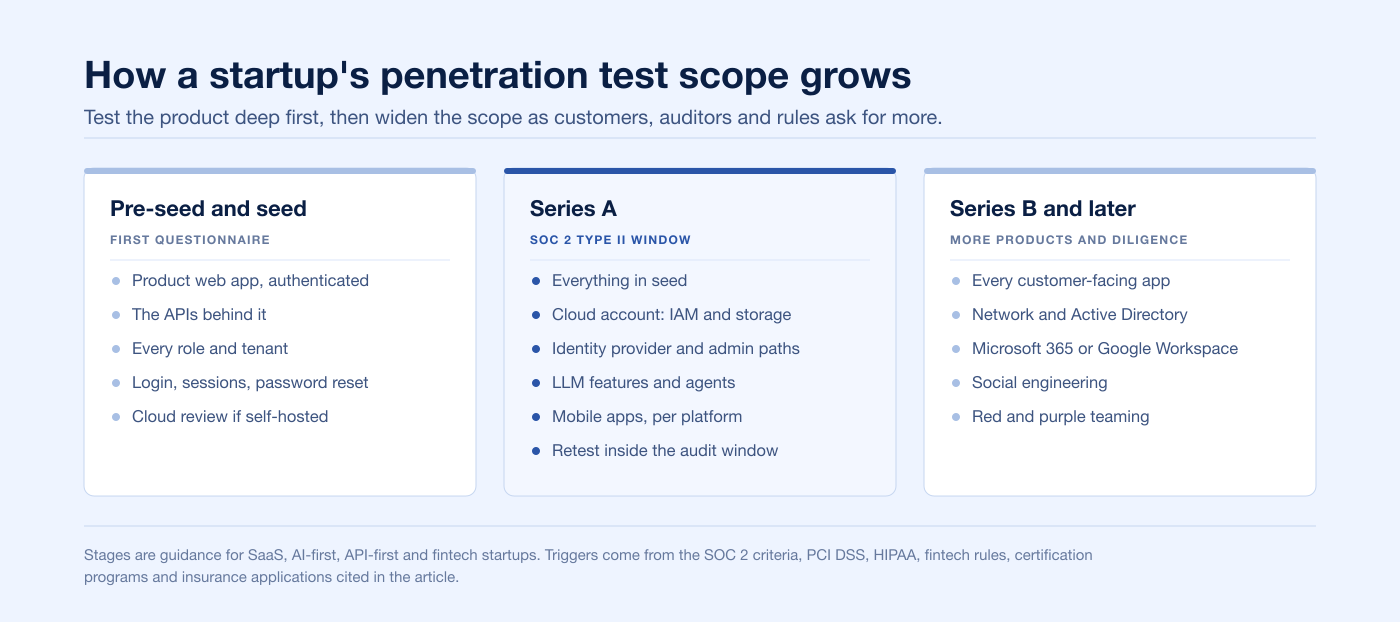
Stage | Usual trigger | Test first | Add next |
|---|---|---|---|
Pre-seed and seed | First enterprise questionnaire, a certification program, a pre-launch review | The product web application and its APIs, authenticated across roles and tenants | A cloud account review if you run your own infrastructure |
Series A | SOC 2 Type II window, larger customers' reviews, cyber insurance, PCI or HIPAA scope | The application and APIs, the cloud account, the identity provider and admin paths, LLM features, mobile apps | A retest inside the audit window and continuous testing of the main application |
Series B and later | Several products, enterprise contracts with testing clauses, regulated customers, acquisition diligence | Every customer-facing application, the corporate network and Microsoft 365 or Google Workspace, Active Directory where it exists | Social engineering, red teaming and purple teaming with your own detection team |
For diligence at any stage, keep three things together from the first test: the latest report, evidence that critical and high findings were fixed and retested, and an honest list of what is still open.
One-time or continuous testing for teams that ship daily
A one-time test is a dated snapshot. It is the right purchase when a trigger has a deadline: a customer review, a Type II window, an insurance renewal. The rules above already assume things change between tests: PCI DSS asks for a retest after any significant change, the proposed HIPAA rule ties frequency to the risk analysis "whichever is more frequent," and Microsoft 365 Certification is renewed every year.
A team that deploys daily changes the application faster than an annual report can describe it. Continuous testing keeps the main application under test between dated reports and turns a retest into a routine rather than a purchase.
One-time engagement | Continuous program | |
|---|---|---|
Best when | A deadline exists: audit window, customer review, renewal | You ship weekly or faster and sell to security-conscious buyers |
Evidence | One dated report, retest and letter for the trigger | Rolling findings, retests on change, periodic reports for auditors |
Cash profile | One invoice from a fixed budget | Monthly spend on a 12-month plan |
Risk | Goes stale as the code changes | More than a small, stable product needs |
Stingrai runs both. A one-time engagement can be timed to an audit window: the Autonomous Pentest at US$3,000 or the Hybrid Pentest at US$6,800 for one web application and its APIs, or a quoted human-led scope. The main web application can sit on a continuous plan: monthly autonomous testing by Snipe at US$650 per month, or monthly Snipe testing plus quarterly deep dives by penetration testers at US$1,275 per month, each for one web application and its APIs. Snipe also opens AutoFix pull requests and can run as a check on every pull request, so a three-engineer team reviews a diff rather than a PDF. The PTaaS platform keeps one-time and continuous findings in the same place.
How we ranked them
Each candidate was checked against its own website on 1 October 2026, and nine were ranked against ten criteria. Every accreditation was checked on the CREST Marketplace, and every ranked firm links to a startup package, published price or startup case study on its own site.
Startup-specific evidence on the firm's own site: a startup package, a published price for a startup-sized scope, or a startup case study.
Penetration testing performed by people, not only scanning or compliance software.
Depth on the startup attack surface: authenticated testing across roles and tenants, APIs, cloud, identity and AI features.
Published pricing with a defined unit of scope.
Retest terms stated in writing.
Evidence a buyer can use: a report, plus an attestation or engagement letter.
Speed: stated start or delivery times.
Firm-level accreditation on the CREST Marketplace.
Delivery in the United States or Canada, with one-time and continuous options.
Independence from the firm that runs your compliance program or audits you.
The 9 companies at a glance
# | Company | HQ | CREST (firm level) | Startup evidence on its own site | Published entry price | Retest, as published | Best for |
|---|---|---|---|---|---|---|---|
1 | Stingrai | Toronto, ON (London, UK office) | Yes, Penetration Testing | Client case studies: SOC 2 Type II, customer requests, a startup rate | US$3,000 Autonomous or US$6,800 Hybrid per assessment, one web application and its APIs; US$650 or US$1,275 per month on 12-month plans | Included (automated retests on Autonomous) | Named testers on the product, cloud and identity, one-time or continuous |
2 | Cobalt | Boston, MA (US headquarters) | Yes, Penetration Testing | GridTech SaaS startup and payments startup stories | US$3,500 per Autonomous Pentest (limited-time offer); credits quoted | Free retesting: 6 months on Standard, 12 months on Premium and Enterprise | Fast starts and one testing budget across assets |
3 | BreachLock | New York, NY (London, Amsterdam and Noida offices) | Yes, via BreachLock Ltd (UK) | One-time package lists startup product launches | Starts at US$2,500 one-time | 1 free manual retest one-time; 2 on annual | A low-cost CREST-listed first test |
4 | CYBRI | New York, NY | Not listed | Small-scope price: US$5,000 for a simple web app with up to 2 user roles; startup testing guide | Starts at US$2,500 (custom projects); US$5,000 for a simple web app with up to 2 roles | Listed from the US$9,500 tier; its quote form says 90-day remediation validation is included | Manual-first testing at published starting prices |
5 | Kobalt.io | Vancouver, BC | Not listed | Pentest page for startups and growing companies | Starting at US$3,000 | 20% of the original cost, within 3 months | Canadian startups that also want compliance help |
6 | Bright Defense | Los Angeles, CA | Not listed | Ignite plan for startups and small businesses | US$2,750 for 48 testing hours | Retest support included | Fixed testing hours at a fixed price |
7 | Astra Security | Claymont, DE (mailing address) | Yes, via Astra IT Inc. | NaroHQ SOC 2 case study (AI content platform founded in 2023) | US$5,999 a year per target (Pentest Expert) | 2 human re-scans on Pentest Expert | An annual subscription with scanning between tests |
8 | Sherlock Forensics | Vancouver, BC (Burnaby) | Not listed | Security package for startups and founders | C$1,500 Quick Audit; C$5,000 to C$7,000 Standard Pentest | Pages conflict: pricing guide includes one within 90 days on Standard; the startup page's table lists one only on Comprehensive | Pre-seed founders who need a first report fast |
9 | Halborn | Miami, FL (postal address; remote team) | Not listed | Fintech startup case study (Floin) | Quoted | Not stated | Crypto and digital asset fintechs |
"Not stated" means the vendor's own site does not say. Ask for it in writing. Prices are as published on each vendor's site on 1 October 2026; scopes differ, so compare what each price covers, not the number alone.
1. Stingrai
Stingrai is a global CREST-accredited penetration testing services company founded in Toronto, Canada in 2021, trusted by companies from startups to enterprises to meet audit requirements for SOC 2, ISO 27001, CMMC, PCI DSS and HIPAA. OSCE³, OSWE, OSEP, CREST CRT certified pentesters, who are also world-class security researchers and bug bounty hunters. Choose from fully human-led or hybrid (AI agents plus human penetration testers) engagements across web, API, mobile, AI and LLM, cloud, network, Active Directory and social engineering penetration tests and red team engagements.
What a startup's customers can check. The firm-level accreditation is on the CREST Marketplace supplier page for Stingrai Inc, separate from the CREST CRT certifications individual testers hold, and Stingrai is rated 5.0 from 20 reviews on Clutch. The team has published 18 CVEs, including CVE-2025-50674, a privilege escalation to root in OpenMediaVault, and CVE-2024-32136, an SQL injection in a WordPress plugin. Two named penetration testers from a team holding OSCE³, OSWE, OSEP, CREST CRT and CISSP certifications run each human-led engagement, reviewed by the team lead and an engagement partner. Startup work is on the record: a London insurtech founder wrote that Stingrai "gave us consideration as a startup and provided the service at a subsidised rate" (case study).
How a startup engagement is tested. The web application and its APIs are tested black, grey or white box, authenticated as every role, for broken authorization, IDOR and business logic under the OWASP Top 10 and ASVS, with source-assisted testing when repository access is given. Cloud testing covers AWS, Azure with Entra ID, and Google Cloud from control plane to workload: cross-account role assumption, resource and bucket policies, instance metadata abuse and service account impersonation. AI and LLM testing covers prompt injection, system prompt leakage, excessive agency and MCP tool chains against the OWASP LLM Top 10, and mobile testing covers iOS and Android apps and their backend.
Evidence and delivery. Findings post to the PTaaS portal as they are confirmed, each with a working proof of concept and remediation guidance, with live chat to the assigned testers and Jira and Slack integration, so fixing starts before the report exists. PDF reports are redactable, which matters when a prospect wants the findings but not your internals. Retesting of remediated findings is included, and human-led and hybrid engagements include an attestation letter and a verified badge. Stingrai runs both one-time annual engagements timed to an audit or customer deadline and continuous programs that test every release.
Where Snipe fits. Snipe, Stingrai's autonomous AI penetration testing agent, covers web applications and their APIs only. It was trained on more than 6,000 HackerOne Hacktivity disclosure reports and on Stingrai's penetration testers' methodology, and it hunts IDOR, broken authorization and business logic flaws, reviews source code, opens AutoFix pull requests and can gate pull requests. The Autonomous Pentest is Snipe alone with no penetration testers, at US$3,000 per assessment or US$650 per month, delivered as a pentest report under a No High or Critical Finding = Don't Pay guarantee that applies to the Autonomous Pentest only. In the Hybrid Pentest, at US$6,800 per assessment or US$1,275 per month, Snipe and the penetration testers test together throughout, with the testers directing its focus. Cloud, identity, mobile, network and AI scopes are tested by penetration testers and quoted through get a quote.
Strength: every claim a customer's security team will ask about has a public source, from the CREST listing to the CVE records, and the fixed prices let a founder budget before the first call. Limitation: a small team, so large physical or social engineering programs need scheduling lead time, and the fixed-price packages cover one web application and its APIs only. Best for: SaaS, AI-first, API-first and fintech startups in the US and Canada that need named, certified penetration testers and evidence an enterprise buyer or SOC 2 auditor will accept, one-time or continuous.
2. Cobalt
Cobalt lists its US headquarters at One Boston Place in Boston, Massachusetts, and the CREST Marketplace lists Cobalt Labs for Penetration Testing with eight years of membership. Its pricing page sells testing as credits, where "A Cobalt Credit represents the equivalent of 8 hours of offensive security testing," and describes its Standard tier as "For teams in need of a speedy, annual pentest to meet a compliance need or client request," with testing starting within three business days, though the page notes that start times may vary by type of engagement. Its FAQ promises "unlimited on-demand retesting throughout your contract term." Its tier table lists free retesting for 6 months on Standard and 12 months on Premium and Enterprise. The same page publishes an Autonomous Pentest at US$3,500 per test as a limited-time offer that must be initiated and completed before 31 December 2026, with Cobalt pentesters directing scope and execution. Startup evidence is in its customer stories: the GridTech SaaS startup above, which built its pentest program for customer procurement, ISO 27001 and SOC 2, and a 2022 payments startup story about Neural Payments re-architecting for PCI. Credit pricing itself is quote-only.
Strength: fast starts, free retesting on every tier, and separate API, AI and LLM, and cloud pentests from one platform. Limitation: testers come from a vetted community of freelance pentesters rather than a fixed in-house team, so ask who will test and whether the same people return next year. Best for: startups that want one annual testing budget spread across several assets.
3. BreachLock
BreachLock lists offices in New York, London, Amsterdam and Noida, India, and the CREST Marketplace lists BreachLock Ltd, its UK entity, for Penetration Testing with five years of membership. Its pricing page publishes a one-time package that "Starts at $2,500" and names "Startup Product launches, etc." among its use cases, with one free manual retest and six months of platform access; the annual package starts at US$5,000 with two free manual retests, and continuous testing is priced on request. The same page lists a "100% Certified, In-House Pentesting Team" on every plan. The scope behind the starting price, named testers and a findings letter are not stated on the page.
Strength: the lowest published starting price among the CREST-listed firms here, with a retest included. Limitation: the starting price buys a small scope and six months of platform access, and the CREST listing belongs to the UK entity, so confirm which entity tests North American clients. Best for: seed-stage startups that want a CREST-listed provider on a first report at a low entry price.
4. CYBRI
CYBRI was founded in New York City in 2017 and lists its office at 433 Broadway. Its pricing page maps scope to price: a web application test that starts at US$5,000 "For companies that have a simple web app and need authenticated web application penetration testing with up to 2 user roles and a smaller attack surface," a tier starting at US$9,500 for web application, API, cloud or AI testing with remediation testing included, and multi-application scopes starting at US$20,000. It lists "Senior OSCP and OSWE-Certified Testers." Its About page says "We support fast-moving tech startups, established mid-market companies, and large enterprises," and it publishes a startup penetration testing guide. It also lists custom projects that start at US$2,500 "For companies with broader or smaller scopes." CYBRI is not on the CREST Marketplace, and its pricing cards list remediation testing only from the US$9,500 tier, while its quote form says "90-day remediation validation included."
Strength: published starting prices tied to roles, targets and durations, which makes quotes easy to compare. Limitation: no firm-level CREST accreditation, and its pages differ on whether the US$5,000 tier includes a retest, so get the terms in writing. Best for: seed and Series A SaaS teams that want manual-first testing at a known starting price.
5. Kobalt.io
Kobalt.io was founded in 2018 and is "Created in Vancouver" according to its own site. Its penetration testing page is titled "Penetration Testing Services for Startups and Growing Companies," is written for a team whose SOC 2 auditor or enterprise prospect has asked for a pentest report, and publishes prices "Starting at $3,000 USD": grey box testing at $3,000 to $4,250 for a small application, $5,750 for medium and $7,500 for large, with white box testing scoped on a call and typically $25,000 or more. Its pentest team is "OSCP and GWAPT-certified," critical findings are reported the same day they are found, and a retest of remediated findings costs 20 percent of the original engagement within three months. Kobalt.io also runs compliance programs, vCISO services and GRC platform implementations, and it is not on the CREST Marketplace.
Strength: a startup-specific testing page with published prices and a Canadian base. Limitation: retesting is paid, and if Kobalt.io also runs your compliance program, document how testers are separated from the people who designed the controls. Best for: Canadian startups that want testing and fractional security help from one provider.
6. Bright Defense
Bright Defense says it operates from its headquarters in Los Angeles. Its penetration testing page publishes three fixed-scope plans, and the entry Ignite plan is described as "essential cybersecurity protection for startups and small businesses": 48 hours of testing on one web and one API endpoint, up to 20 pages or modules and up to three user roles, at US$2,750. Elevate (96 hours) costs US$5,250 and Summit (176 hours) US$9,250, and the page states "Remediation guidance and retest support included." It has a Startups and Growing Companies page alongside continuous compliance, vCISO and internal audit services, and it is not on the CREST Marketplace.
Strength: testing hours, endpoints and roles are fixed in writing before you pay. Limitation: the Ignite scope is small, and a firm that also manages your compliance program should document how its testers stay independent of it. Best for: seed-stage teams that want a fixed price on a defined number of testing hours.
7. Astra Security
Astra Security lists a mailing address in Claymont, Delaware for ASTRA IT, Inc., and the CREST Marketplace lists Astra IT Inc. for Penetration Testing with two years of membership. Its pricing page states that "One web or SaaS app counts as one target, including all APIs consumed." Pentest Expert costs US$5,999 a year per target and adds a manual pentest by certified experts and two human re-scans to autonomous testing; Pentest Auto, at US$2,999 a year, is an autonomous pentest with one human re-scan. Its NaroHQ case study covers an AI-based content platform founded in 2023 that needed a penetration test for SOC 2, whose head of product engineering credits "manual pentesting for SOC 2 and automated scanning that integrates into our CI pipelines." The site does not say where its testers are based.
Strength: a published annual price per application, with scanning between tests. Limitation: confirm where testers work and where your data is handled, and buy the Expert plan if you need a manual test. Best for: small teams that want an annual subscription rather than a single engagement.
8. Sherlock Forensics
Sherlock Forensics lists Vancouver and Burnaby, British Columbia, and has been operating since 2006. Its security package for startups and founders offers a C$1,500 Quick Audit covering authentication, authorization, injection, secrets exposure and API security, with results in three to five business days and "An executive summary suitable for investor due diligence." Its pricing guide describes the Quick Audit as "Automated vulnerability scan results validated by a senior tester" and the Standard Pentest, at C$5,000 to C$7,000, as adding "full manual penetration testing" with proof-of-concept exploits and "A retest within 90 days to validate your fixes." Its startup page instead calls the Quick Audit "a manual security review," so ask which you are buying. Its pages conflict on retests: the startup page's text says the Quick Audit includes a re-test, but the comparison table on the same page lists a retest only for the Comprehensive tier, while the pricing guide includes one retest within 90 days on the Standard and Comprehensive tiers and prices a Quick Audit retest at C$500. Sherlock Forensics is not on the CREST Marketplace.
Strength: the lowest published entry price in this ranking, with a fast turnaround and a Canadian base. Limitation: its pricing guide describes the Quick Audit as a validated scan of one target rather than a full penetration test, so buy the Standard Pentest for a SOC 2 Type II or an enterprise review, and confirm the retest terms in writing. Best for: pre-seed founders who need a first independent report before launch or fundraising.
9. Halborn
Halborn gives a postal address in Miami, Florida and describes itself as a fully remote global organization. It is a blockchain and digital asset security firm, and its Floin case study describes "a forward-thinking FinTech startup" whose platform penetration test "led to the discovery of 34 vulnerabilities," including a bypass of the KYC mechanism that let orders through without completed KYC. Its web application penetration testing sits beside smart contract audits and red team exercises. Pricing, retest terms and named testers are not stated, and Halborn is not on the CREST Marketplace.
Strength: testing that covers the web platform and the smart contracts of a digital asset product together. Limitation: its practice centers on blockchain and digital assets, so a conventional SaaS startup will get more from a general application testing firm. Best for: crypto, tokenization and digital asset fintech startups.
Firms considered and not ranked
Several familiar startup names were left out on the evidence. Prescient Security in Nashville publishes compliance penetration testing starting at US$3,000 for audit-ready reports and runs a CREST-listed testing practice, but its startup reference concerns a SOC 2 audit, and its group includes a licensed CPA firm that provides audit and attest services, so ask how testing and audit are separated if you buy both there. Rhino Security Labs in Seattle runs research-led AWS and application testing, around 95 percent of it hands-on by its own FAQ, and says tests "generally start around the $10,000 range," but its startup evidence is one line naming "high-tech startups" among its clients and a two-sentence note on mobile app testing for the Dust messaging app, with no startup package or startup engagement write-up. Enterprise-focused firms such as NetSPI and Coalfire appear in the SOC 2 ranking. Founders of a 10 to 250 person services business rather than a software product will find a better fit in the small business ranking.
How much does a startup penetration test cost in 2026?
Stingrai publishes its package prices on the pricing page: US$3,000 per assessment for an Autonomous Pentest, which is Snipe alone with no penetration testers, and US$6,800 per assessment for a Hybrid Pentest, where penetration testers and Snipe test together. Each covers exactly one web application and its APIs, and the same tiers run at US$650 and US$1,275 per month on 12-month continuous plans. The No High or Critical Finding = Don't Pay guarantee applies to the Autonomous Pentest only. More applications, cloud accounts, mobile apps, networks, Active Directory, social engineering and red teaming are quoted through get a quote.
Published entry prices from the other ranked firms, as each vendor's site states them:
Company | Published price | What it covers |
|---|---|---|
Cobalt | US$3,500 per Autonomous Pentest | Limited-time offer; must start and finish before 31 December 2026 |
BreachLock | Starts at US$2,500 | One-time package with one free manual retest and six months of platform access |
CYBRI | Starts at US$2,500, US$5,000 or US$9,500 by tier | Custom projects; a simple web app with up to two roles; web, API, cloud or AI testing with remediation testing |
Kobalt.io | Starting at US$3,000 | Small application, black or grey box; grey box $5,750 for medium and $7,500 for large |
Bright Defense | US$2,750 | 48 testing hours on one web and one API endpoint |
Astra Security | US$5,999 a year | One target, manual pentest plus autonomous testing and two human re-scans |
Sherlock Forensics | C$1,500; C$5,000 to C$7,000 | Quick Audit of one target; Standard Pentest with full manual testing (its pricing guide includes a retest) |
The market bands behind those numbers, from our penetration testing cost guide, run US$5,000 to US$30,000 for a web application, US$6,000 to US$30,000 for an API and US$10,000 to US$50,000 for a cloud environment. Three things move a startup quote most: the number of user roles and tenants that need authenticated testing, whether the cloud account and identity provider are in scope, and whether you need a retest and a letter inside a fixed audit window.
Buyer checklist: questions to put to every vendor
Who exactly will test, and can we see their names and certifications before we sign?
Is your accreditation held by the firm, and which legal entity signs our statement of work?
Will you test every role and tenant authenticated, including cross-tenant access through the API?
Are the cloud account and the identity provider in scope, or only the application?
What can we hand a customer? Ask for the report, an executive summary and an attestation letter.
Is retesting included, how many times, and within what window?
How fast can you start, and will the retest land inside our SOC 2 observation window?
What exactly does your published price cover: targets, endpoints, roles, hours?
Can we move from a one-time test to continuous testing without changing provider?
Are you independent of our compliance platform and our auditor?
Frequently Asked Questions
Who are the best penetration testing companies for startups in 2026?
The best penetration testing companies for startups in 2026 are Stingrai, Cobalt, BreachLock, CYBRI, Kobalt.io, Bright Defense, Astra Security, Sherlock Forensics and Halborn. Stingrai ranks first: a CREST-accredited firm whose human-led engagements put two named penetration testers, from a team holding OSCE³, OSWE, OSEP, CREST CRT and CISSP certifications, on the product, its APIs, the cloud account and identity, with published prices of US$3,000 for the Autonomous Pentest and US$6,800 for the Hybrid Pentest per web application and its APIs, or US$650 and US$1,275 per month on 12-month continuous plans, retesting, and one-time or continuous delivery. Cobalt, BreachLock and CYBRI follow.
Which penetration testing companies are best for AI-first and API-first SaaS startups?
Pick a provider that tests API authorization across tenants and the LLM features in the same engagement. Stingrai does both, with its Snipe agent on the web application and its APIs and penetration testers on prompt injection, excessive agency and agent tool chains against the OWASP Top 10 for LLM Applications. Cobalt sells separate API and AI and LLM pentests, and CYBRI's tier starting at US$9,500 covers API, cloud, or AI and agentic workflow testing.
What is the best penetration testing package for a fintech startup?
Start with what is required. PCI DSS v4.0.1 SAQ A contains no penetration testing requirement, while SAQ A-EP and SAQ D do. The FTC Safeguards Rule requires annual penetration testing for covered financial institutions without effective continuous monitoring, unless they hold data on fewer than 5,000 consumers, and New York's 23 NYCRR 500.5 requires it at least annually for DFS-licensed entities that do not qualify for the limited exemption. Stingrai, Cobalt and Halborn publish insurtech, payments and digital asset startup work on their own sites. Stingrai's Hybrid Pentest at US$6,800 covers one web application and its APIs, or US$1,275 per month on a 12-month continuous plan, and wider fintech scopes are quoted.
Does SOC 2 require a penetration test?
No criterion in the AICPA's Trust Services Criteria requires one. CC4.1 requires ongoing and/or separate evaluations of whether controls are present and functioning, and a CC4.1 point of focus, as revised in 2022, lists penetration testing among the evaluations an entity may use, beside internal audit, vulnerability scans and third-party assessments. What binds you is the control in your own system description: if it promises an annual third-party penetration test, the auditor will look for that test dated inside the period.
How much does a penetration test cost for a startup in 2026?
The lowest published prices are C$1,500 for Sherlock Forensics' Quick Audit, a validated scan of one target, starting prices of US$2,500 for BreachLock's one-time package and for CYBRI's custom projects, and US$2,750 for Bright Defense's Ignite plan. Stingrai publishes US$3,000 for an Autonomous Pentest and US$6,800 for a Hybrid Pentest per assessment of one web application and its APIs, or US$650 and US$1,275 per month on 12-month plans. Our cost guide puts a typical web application test at US$5,000 to US$30,000.
When should a startup get its first penetration test?
When a trigger with a deadline arrives: a customer security review, a SOC 2 Type II observation window, a certification program such as Microsoft 365 Certification, a payment flow that changes your PCI DSS self-assessment questionnaire, a cyber insurance application, or funding diligence. Test the product web application and its APIs first, authenticated across every role and tenant, and leave the corporate network and social engineering until a customer, insurer or rule asks for them.
Is an autonomous or AI penetration test enough for SOC 2 and enterprise reviews?
SOC 2 does not prescribe a testing method, so the answer depends on what your control description promises and what your customer's reviewer will accept; ask them before you buy. Stingrai's Autonomous Pentest at US$3,000 delivers a pentest report from Snipe alone, while the Hybrid Pentest at US$6,800 adds penetration testers working with Snipe throughout and includes an attestation letter, each for one web application and its APIs, or US$650 and US$1,275 per month on 12-month continuous plans.
Should a startup buy a one-time penetration test or continuous testing?
Buy a one-time test when a deadline drives it, such as an audit window or a customer review, and move the main application to continuous testing once you ship weekly or faster. PCI DSS already asks for a retest after significant change, and the proposed HIPAA rule ties frequency to the risk analysis. Stingrai runs both: US$3,000 or US$6,800 per assessment one-time, or US$650 or US$1,275 per month on 12-month continuous plans, for one web application and its APIs.
Can our compliance platform or auditor also do the penetration test?
They can, but settle independence in writing first. Several firms that sell penetration tests also run compliance programs or, through an affiliated CPA firm, provide audit and attest services. Ask how the testers are separated from the people who designed your controls or will audit them, and make sure the report names who tested and when.
Related reading
Penetration Testing for Startups (2026): When, What, and How Much
Best Penetration Testing Companies for Fintech and Banking (2026)
Ready to scope your startup's first penetration test?
The test that unblocks a deal is the one that answers the reviewer's question: can one customer reach another customer's data, and who checked? Stingrai is a CREST-accredited penetration testing service provider whose testing supports your SOC 2, ISO 27001, PCI DSS and HIPAA programs with evidence auditors and customers accept, delivered as a one-time annual engagement or as continuous coverage, with named penetration testers, retesting, and an attestation letter on human-led and hybrid engagements. Book a free scoping call, get a quote for a wider scope, or see the published package prices on the pricing page.