The Trusted Partner Network (TPN), the content security program wholly owned by the Motion Picture Association (MPA), has released version 5.3.2 of the MPA Content Security Best Practices, dated 23 September 2026 (TPN resources). Its new control TS-7.6 tells vendors to add AI test cases such as prompt injection to penetration tests of their AI systems and AI-integrated content workflows, and to check that content belonging to one studio client "cannot be surfaced through another studio client's queries or workflows". Five months earlier, TPN's first STAR Report found that the vulnerability management layer, which holds penetration testing control TS-4.1, had the highest non-compliance of any layer, 45.86%, and that TPN issued more security alerts in the first quarter of 2026 than in all of 2025.
Two recent cases point away from the studio's own systems. In August 2024, Netflix told Variety that "one of our post-production partners has been compromised and footage from several of our titles has unfortunately leaked online"; Iyuno, a Burbank localization company two sources named as the partner, said it was "aware of a recent security issue, involving unauthorized access to confidential content" (Variety). In April 2026, The Hollywood Reporter reported that Legend of Aang: The Last Airbender "leaked months ahead of its premiere on Paramount+"; sources told THR that Paramount's investigation ruled out a vulnerability in its own systems (THR).
This ranking is for mid-market and enterprise studios, streamers, broadcasters, post-production and VFX houses, dubbing and localization vendors, game cinematics vendors and sports media that face TPN assessments and studio security reviews. Casino and game operators are covered in our iGaming ranking, carriers in our telecom ranking.
Quick answer. The best penetration testing companies for media, entertainment and streaming in 2026 are Stingrai, ConvergentDS, RM Cyber, NCC Group, IOActive, Kroll, Kudelski Security, Independent Security Evaluators, NetSPI and Pen Test Partners. Stingrai ranks first: a CREST-accredited, Toronto-headquartered firm whose named penetration testers, from a team holding the OSCP certification TS-4.1 cites as an example, cover every target the control lists, with the retest included and an attestation letter with every human-led and hybrid report, as a one-time annual test or a continuous program. ConvergentDS and RM Cyber add TPN-accredited assessors on staff and media and entertainment experience.
What drives a penetration test in media and entertainment
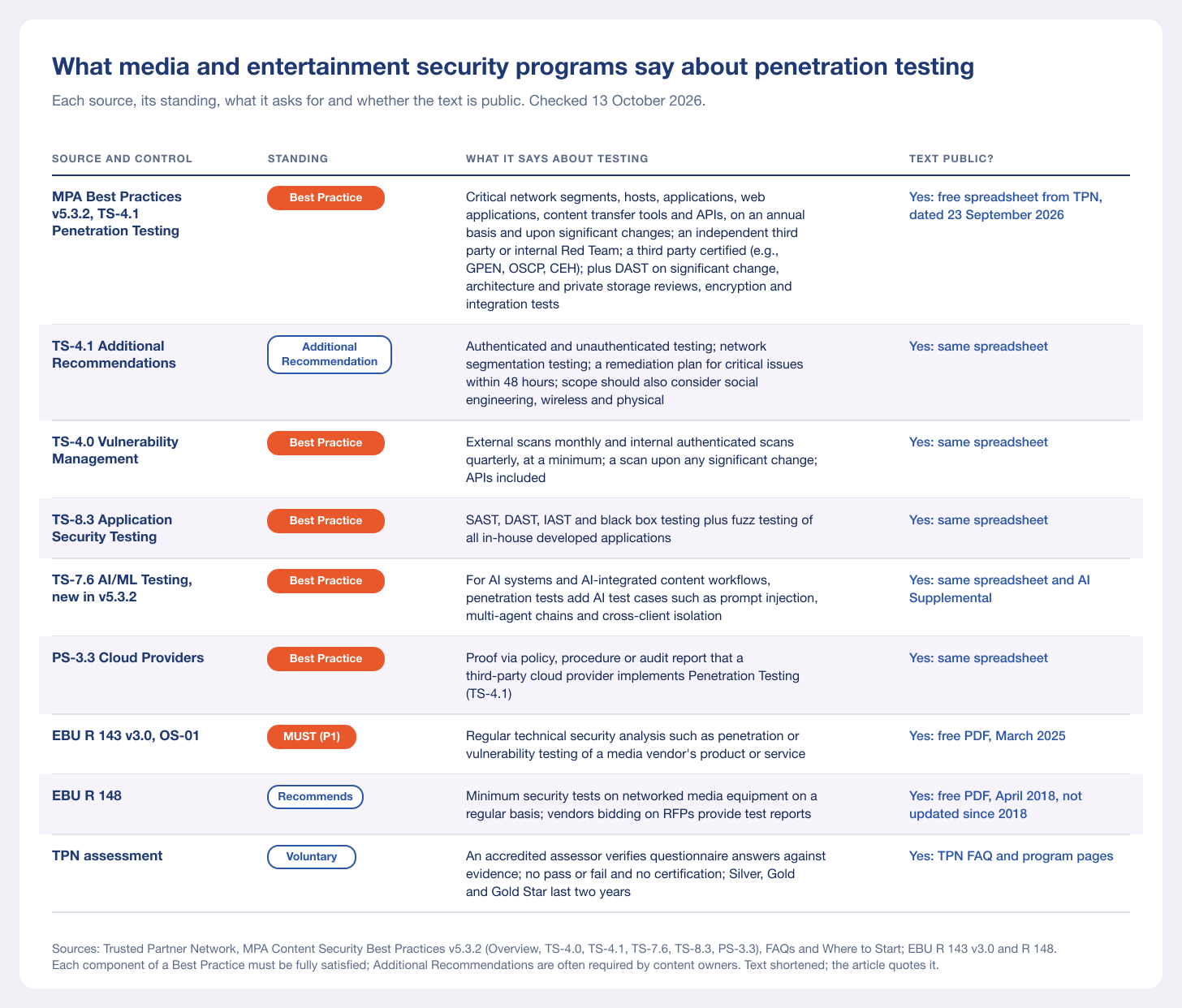
For most media vendors the requirement arrives through the client rather than a regulator. The MPA Best Practices define their controls as "reflective of the minimum security expectations of most of the MPA member studios", and "Each component of a Best Practice must be fully satisfied in order to meet the Best Practice"; Additional Recommendations "are often required by Content Owners in circumstances where extra security is needed". TPN publishes the full control text as a free spreadsheet, so the quotes below come from version 5.3.2.
Control | Standing | What it asks for |
|---|---|---|
TS-4.1 Penetration Testing | Best Practice | Annual test and a test on significant change, by an independent third party or internal Red Team |
TS-4.0 Vulnerability Management | Best Practice | External scans monthly, internal authenticated scans quarterly |
TS-8.3 Application Security Testing | Best Practice, applications | SAST, DAST, IAST, black box and fuzz testing of in-house applications |
TS-7.6 AI/ML Testing | Best Practice, new in v5.3.2 | AI test cases inside the TS-4.1 penetration test |
PS-3.3 Cloud Providers | Best Practice | Proof that a cloud provider implements TS-4.1 |
EBU R 143 OS-01 | MUST (P1) | Regular penetration or vulnerability testing of a vendor's product or service |
TS-4.1, the penetration testing control
TS-4.1 asks vendors to "Establish and regularly review a policy and process to perform Penetration Testing of critical network segment(s), host(s), application(s), web application(s), and content transfer tool(s)", to include:
"Conduct on an annual basis" and "Conduct upon significant changes".
"Utilize an independent third-party or internal Red Team to conduct testing" and "Third-party is certified (e.g., GPEN, OSCP, CEH, etc.)".
"Investigate and create a remediation plan for issues".
APIs, plus OWASP's Web Security Testing Guide for web applications.
"Conduct a Dynamic Application Security (DAST) test upon significant changes", an "Application and Network Architecture review", "Use encryption at rest and in-transit", a "Private storage review" and "Test application integrations".
Its Additional Recommendations add "authenticated and unauthenticated testing", "network segmentation testing", a remediation plan "for critical issues within 48 hours", and a scope that "should also consider: system testing, social engineering, wireless testing, physical security breach, workflows, and high-risk areas". The glossary is blunt: "A vulnerability scan is not a penetration test."
Scanning, applications, cloud and AI
TS-4.0 asks for external scans "monthly, at a minimum", internal authenticated scans "quarterly, at a minimum" and a scan "upon any significant application or infrastructure change". TS-8.3 asks for a combination of static, dynamic, interactive and black box testing plus fuzz testing on "all in-house developed applications". PS-3.3 asks a vendor using a cloud provider for proof that Penetration Testing (TS-4.1) is implemented. For "AI systems and AI-integrated content workflows", TS-7.6 extends TS-4.1 to "AI-specific test cases (e.g., prompt injection, adversarial inputs, and unauthorized output generation)" and "Multi-agent chains where one agent's output becomes another agent's input". TPN says the other "79 non-AI controls remain unchanged from version 5.3.1".
How a TPN assessment treats the test
TPN was launched on 2 April 2018 by the Motion Picture Association of America and the Content Delivery & Security Association (MPA) and became wholly owned by the MPA in 2021 (TPN). Its FAQ says participation "is voluntary" and that TPN "does not issue certifications"; assessments "do not provide 'pass/fail' grades, certifications, or ratings".
Shield tiers. Blue is a self-assessment valid for one year. Silver means a TPN-accredited assessor verified the answers against evidence and a remediation plan was submitted; Gold means every Best Practice gap was remediated and reviewed by TPN; Gold Star adds the Additional Recommendations (where to start). Silver, Gold and Gold Star last two years.
Assessor and tester. "Accreditation belongs to the individual assessor, not their employer" (assessors), and an assessor "may perform technical testing (e.g., pen testing) if not currently assigned".
Testing discounts. In August 2025, TPN "introduced member discounts for penetration testing through approved partners"; in v5.3 assessments, fully implemented penetration testing responses rose from 72 (January to July 2025) to 121 (August to December 2025), which TPN credits to the discounts.
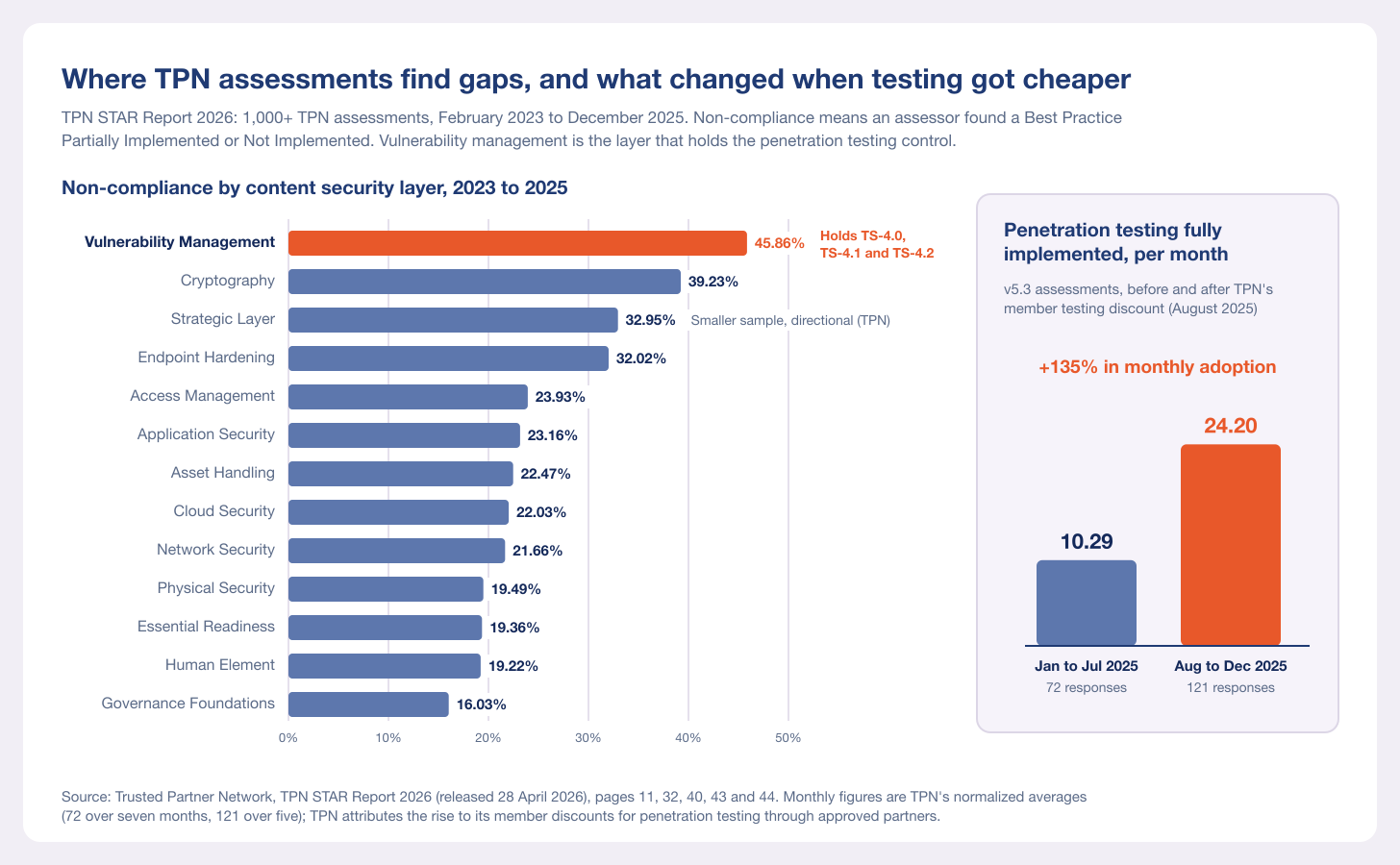
The STAR Report draws on "1,000+" assessments from February 2023 to December 2025 and counts a control as non-compliant when an assessor finds it "Partially Implemented or Not Implemented". Vulnerability management, mapped to TS-4.0, TS-4.1 and TS-4.2, led at 45.86%, ahead of cryptography at 39.23%.
Broadcasters: EBU R 143 and R 148
The European Broadcasting Union's R 143 (version 3.0, March 2025) lists security requirements for media vendors, with a checklist for tenders. OS-01 says "Regular technical security analysis such as penetration or vulnerability testing of the product or service MUST be performed", a P1 item marking "critical provisions"; IS-04 lists the MPA and CDSA among recognised frameworks. R 148 (April 2018) recommends that media companies, integrators and vendors "apply, as a minimum and on a regular basis" its tests "to their networked media devices", and that media companies "require potential vendors and system integrators to provide reports" of them in RFPs; the EBU notes it "has not been updated since 2018". Streamers that take card payments also answer to PCI DSS (our PCI DSS ranking).
What the leaks and TPN alerts point to
The partner's application. On 4 October 2024, "In light of recent security incidents", TPN recommended that an in-house web application that "manages the storage or transfer of content assets" undergo a TPN Gold application assessment (TPN).
File transfer and credentials. Five days later, a TPN critical alert told anyone using "a secure file transfer system" to apply multi-factor authentication "To any Internet facing systems, including webmail and web portal" and to remove old accounts.
The same weaknesses, again. TPN's April 2026 release says recent alerts "consistently pointed to" compromised credentials, inconsistent MFA, insecure system and cloud configurations, and delays in patching.
Your own network is not the whole scope. In the Paramount case, THR's sources said the studio ruled out a vulnerability in its own systems; a test that stops at your perimeter misses partners, transfers and remote access.
What mid-market and enterprise media companies need from a vendor
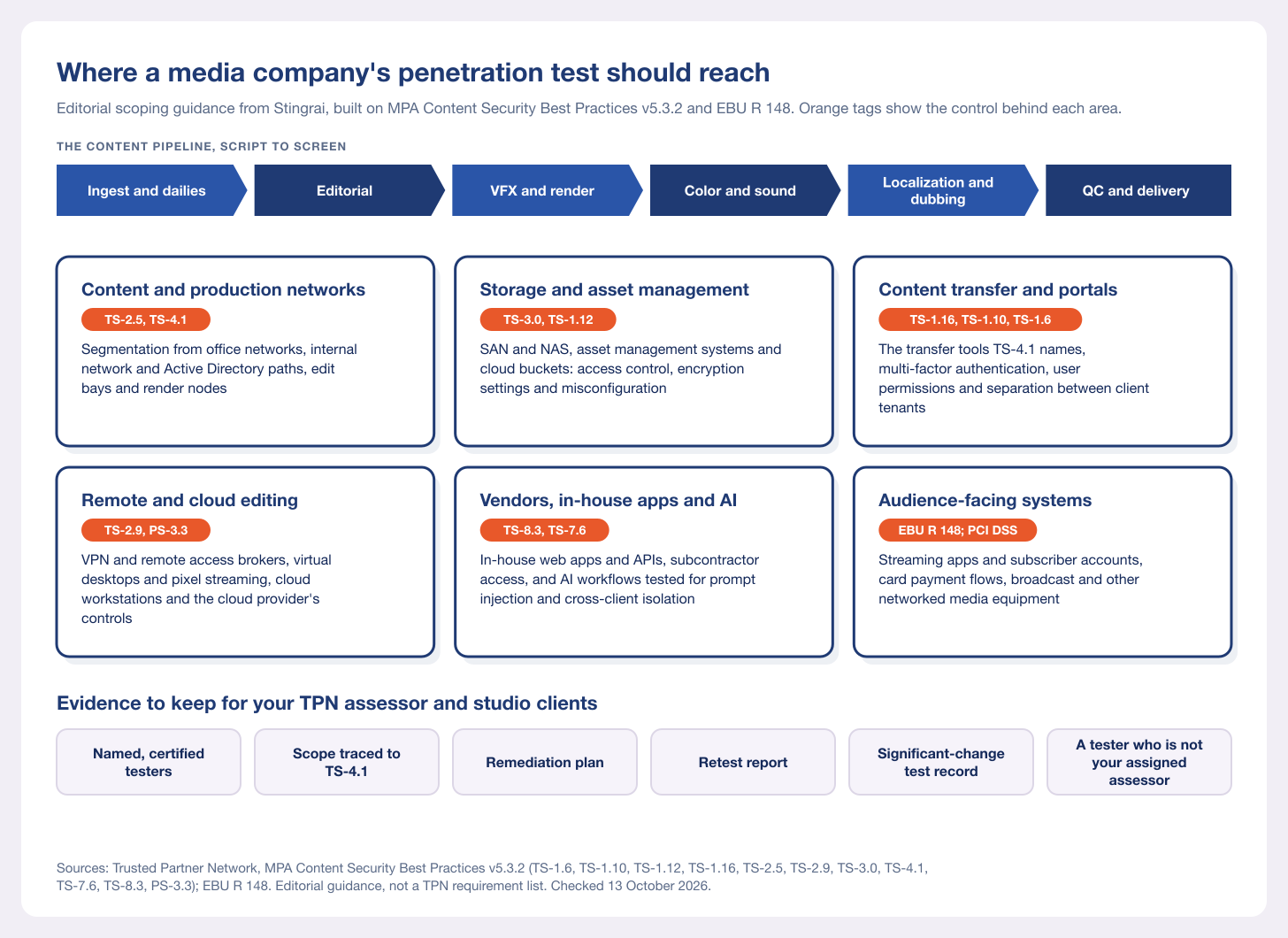
Certified, named testers. TS-4.1 asks for a certified third party; ask for the testers' names and certifications in the proposal.
Every TS-4.1 target. Network segments, hosts, applications, web applications, content transfer tools and APIs, with authenticated, unauthenticated and segmentation testing between content and office networks.
Significant-change capacity. A new facility, transfer platform, cloud migration or AI workflow needs its own test before content flows.
Scale. TPN offers a "Global Pass" to companies "with more than 3 sites or apps with the same security implementation"; a vendor should test sites and entities against one methodology.
Evidence for the assessor. A report naming testers and scope, a remediation plan and a retest report, from a tester who is not your assigned TPN assessor.
Contracting entity. CREST accreditation is held per legal entity (how to check), and TPN accreditation per person.
How this ranking was built
Every vendor claim traces to the vendor's own website, TPN's assessor directory or the CREST Marketplace, checked on 13 October 2026. The first two criteria were gates; the other three were weighed together, with TS-4.1 evidence counting most.
TS-4.1 scope: network and application penetration testing named on the firm's own site.
Checkable qualification: CREST Penetration Testing accreditation, TPN-accredited assessors in TPN's directory, or tester certifications of the kind TS-4.1 names, stated on the firm's site.
TS-4.1 evidence: coverage of every TS-4.1 target type, named or certified testers, retests and reports a TPN assessor can use.
Media experience: a media page, TPN-accredited assessors, or content protection and media device work.
North American presence: an office in the US or Canada.
Stingrai ranks first on TS-4.1 evidence: a firm-level CREST accreditation, named certified testers, retests and an attestation letter with every human-led and hybrid report. The media specialists follow on media experience; where firms were close, a firm-level CREST accreditation counted in a firm's favour.
At a glance: penetration testing companies for media and entertainment
Company | Head office | US or Canada presence | Qualification a buyer can check | Best for |
|---|---|---|---|---|
1. Stingrai | Toronto, Canada | Toronto HQ; US remote or on site | CREST Penetration Testing | Named testers, annual or continuous |
2. ConvergentDS | Not stated | Denver; Los Angeles | Eight TPN-accredited assessors | Vendors heading into a TPN assessment |
3. RM Cyber | Englewood, Colorado, USA | Headquarters; West Los Angeles | Four TPN-accredited assessors | Testing beside a TPN assessment practice |
4. NCC Group | Manchester, UK | Chicago; Waterloo | 6 CREST accreditations, 4 specialisms | CREST breadth plus device and DRM work |
5. IOActive | Seattle, USA | Headquarters | CREST Penetration Testing (UK entry) | Connected devices and apps |
6. Kroll | New York, USA | Headquarters | CREST IR, Penetration Testing, SOC | Testing plus incident response |
7. Kudelski Security | Cheseaux-sur-Lausanne, Switzerland | Phoenix | OSCP-certified testers | Broadcast and pay-TV groups |
8. Independent Security Evaluators | Baltimore, USA | Headquarters | One TPN-accredited assessor | Owners that also run vendor risk |
9. NetSPI | Minneapolis, USA | Headquarters; Toronto | CREST PT and TLPT | Virtual desktops and large estates |
10. Pen Test Partners | Buckingham, UK | New York | 3 CREST accreditations, 4 specialisms | Mobile apps and connected TVs |
1. Stingrai (top rated for media, entertainment and streaming)
Stingrai is a global CREST-accredited penetration testing services company founded in Toronto, Canada in 2021, trusted by companies from startups to enterprises to meet audit requirements for SOC 2, ISO 27001, CMMC, PCI DSS and HIPAA. OSCE³, OSWE, OSEP, CREST CRT certified pentesters, who are also world-class security researchers and bug bounty hunters. Choose from fully human-led or hybrid (AI agents plus human penetration testers) engagements across web, API, mobile, AI and LLM, cloud, network, Active Directory and social engineering penetration tests and red team engagements.
For a studio, streamer or vendor, the case is certified, named testing across every target TS-4.1 lists. Stingrai Inc, the company that signs the contract, holds the CREST Penetration Testing accreditation (Marketplace profile). Each human-led engagement is run by two named penetration testers from a team holding OSCE³, OSWE, OSEP, OSCP, CREST CRT and CISSP certifications, reviewed by the team lead and an engagement partner. The team has 18 published CVEs and Hall of Fame listings at the US Federal Reserve and the US Department of Defense, and Stingrai is rated 5.0 out of 5 on Clutch (20 reviews).
Scope for a TS-4.1 test
Network and production: internal and external networks, segmentation between content and office networks, remote access, and Active Directory paths from an assumed-breach position.
Applications and transfers: web applications and APIs such as client portals and content transfer tools, tested across every user role for broken authorization and tenant separation, plus cloud storage and identity.
AI, people and premises: AI and LLM testing for TS-7.6 cases such as prompt injection and agent tool misuse, plus phishing and vishing, Wi-Fi, physical and red team work for the TS-4.1 Additional Recommendations.
Delivery and evidence
Whether the engagement is a one-time annual test or a continuous program, every confirmed finding, at every severity, is posted to the PTaaS platform the same day it is confirmed, with a working proof of concept and prioritized remediation guidance, which feeds the remediation plan TS-4.1 asks for. Retesting is included, and every human-led and hybrid report ships with an attestation letter, evidence you can hand your TPN assessor for TS-4.1.
Where Snipe fits
Snipe is Stingrai's autonomous AI agent for web applications and associated APIs only. Trained on more than 6,000 HackerOne Hacktivity reports, it hunts IDOR, broken authorization and business logic flaws and opens AutoFix pull requests. The Autonomous Pentest is Snipe alone, with no penetration testers; in the Hybrid Pentest, Snipe and penetration testers test together, with the testers directing its focus. Everything else is human-led.
Pricing and fit: The Autonomous Pentest is at US$3,000 per assessment or US$650 per month on a 12-month plan, and the Hybrid Pentest is US$6,800 per assessment or US$1,275 per month; both cover one web application and associated APIs (pricing). A studio or vendor scope across sites is quoted through get a quote. Best for: studios, streamers and media vendors that want certified, named testers across every TS-4.1 target, as a one-time annual test or a continuous program.
2. ConvergentDS
ConvergentDS lists offices in Denver, Los Angeles, London and Mumbai and names no head office on its site (who we are). TPN's assessor directory lists eight accredited assessors under Convergent Risks, whose domain now redirects to ConvergentDS. Its penetration testing page covers external, internal and physical tests and says results "can be used directly as evidence in your TPN assessment or studio audit"; it also offers application security, AI and red team testing. It has no CREST Marketplace entry, and TPN's rules bar an accredited assessor from pen testing a vendor while assigned to its assessment.
Best for: post, VFX and localization vendors that want testers fluent in MPA controls.
3. RM Cyber
RM Cyber is "a division of Richey May", with its corporate headquarters in Englewood, Colorado and an office in West Los Angeles (locations). Its threat management page describes external and internal network penetration testing that uses a "custom methodology" based on PTES with manual exploitation, web application assessments that "test each role within your application", and API, cloud, mobile, physical and social engineering testing. TPN's assessor directory lists four accredited assessors under RM Cyber, and Richey May's media and entertainment practice runs "from TPN Assessment to cybersecurity and more". It has no CREST Marketplace entry, and the same TPN rule on assigned assessors applies.
Best for: studios and vendors that want testers working beside a TPN assessment practice, with a Los Angeles office.
4. NCC Group
NCC Group is headquartered in Manchester, UK, with a Chicago regional headquarters and an office in Waterloo, Ontario (offices). Its technology, media and telecom page says it "helps media clients protect sensitive content and systems", and its application and network testing pages cover web applications, APIs and network infrastructure. A 2019 NCC research guide explains that "some video DRM schemes such as Netflix, and PlayReady provide a set of security robustness rules" for devices. Its Marketplace entry lists six CREST accreditations, including Penetration Testing, and four specialisms.
Best for: studios and streamers that want CREST breadth plus device and DRM expertise.
5. IOActive
IOActive has worked "since 1998" (who we are) from a Seattle headquarters (contact). Its media and entertainment page names "hacktivists, state-sponsored entities, content pirates, insider threats" among the attackers the industry faces, and its assessments page lists penetration testing of infrastructure, web services, mobile applications, cloud environments and embedded devices. Its Marketplace entry, IOActive Inc, lists Penetration Testing with a UK head office.
Best for: streamers and device makers whose risk sits in connected devices, embedded systems and apps.
6. Kroll
Kroll's About page says "Kroll Is Headquartered in New York". Its technology, media and telecom page combines "industry expertise with cyber risk solutions to protect valuable data and intellectual property" and describes advisory work for "clients across the Sports industry". Its datasheet lists web application, API, internal and external network penetration testing and red team services. Its Marketplace entry, Kroll LLC, holds Incident Response, Penetration Testing and Security Operations Centre accreditations.
Best for: enterprises that want testing and incident response from one accredited entity.
7. Kudelski Security
Kudelski Security is "The Cybersecurity Division of the Kudelski Group", which was "Founded in 1951 with the development of the NAGRA recording equipment" and "shaped the evolution of digital television" (company). It lists an international headquarters in Cheseaux-sur-Lausanne, Switzerland and a US headquarters in Phoenix. Its penetration testing page says "Every assessment is conducted by OSCP-certified professionals", covers "internal networks, web apps, mobile, APIs, and cloud services", re-tests resolved issues and offers "one-time assessments or recurring engagements". It has no CREST Marketplace entry.
Best for: broadcasters and pay-TV groups that want a tester from a content protection lineage.
8. Independent Security Evaluators
ISE's founder and CEO Steve Bono "formed ISE in 2005", and its headquarters is in Baltimore (leadership, contact). It offers network penetration testing and application security assessments, and its executive partner co-founded StartVRM, "a vendor risk management platform used by media and entertainment organizations worldwide". TPN's assessor directory lists one accredited assessor at ISE. It has no CREST Marketplace entry.
Best for: content owners that test their own estate and also manage vendor risk.
9. NetSPI
NetSPI is headquartered in Minneapolis with an office in Toronto (contact), has worked "since its inception in 2001" and says "NetSPI & Synack Are Now One" (home page). Its network testing covers internal and external networks, including "virtual desktop environments", and its application testing covers web, API, mobile, thick and virtual applications. Its Marketplace entry lists Penetration Testing and Threat Led Penetration Testing. We found no media-specific service on its site.
Best for: large estates with virtual desktop editing and many applications.
10. Pen Test Partners
Pen Test Partners has worked "since 2010", with its UK office in Buckingham and a US office, Pen Test Partners Inc, at 115 Broadway in New York (About). Its testing page covers "applications, infrastructure, cloud environments, APIs, mobile apps, and connected systems", though the sectors it names do not include media; it has published smart TV research, such as a 2017 post on a Sony Bravia Android TV. Its Marketplace entry lists three CREST accreditations, including Penetration Testing, and four specialisms, including Mobile Application Security Testing.
Best for: streamers whose exposure sits in mobile apps and connected TVs.
Also considered
Include Security, a Brooklyn application security firm, has written about testing a client's Roku channel (blog); its site describes source-assisted application assessments rather than network testing.
What a penetration test for a studio or vendor costs
No MPA control sets a price; scope does. TPN membership runs from US$250 a year for the self-employed to US$85,000 above US$200 million in annual gross revenue, and "Membership fees do not include third-party assessment costs" (TPN). Stingrai's fixed packages are the Autonomous Pentest at US$3,000 and the Hybrid Pentest, which is US$6,800, per assessment for one web application and associated APIs; a multi-site scope is quoted. Our cost guide and calculator turn scope into an estimate, and how to compare quotes covers the rest.
RFP questions for a media penetration test
[ ] Which certifications do the named testers hold, and which legal entity signs?
[ ] Does the scope cover every TS-4.1 item, including content transfer tools and APIs?
[ ] Will you run authenticated, unauthenticated and segmentation testing?
[ ] Is any tester assigned to our TPN assessment, and is any work subcontracted?
[ ] Is a retest included, and will the report support our remediation plan?
[ ] How fast can you test a significant change such as a new site or AI workflow?
Our RFP template turns these into a document.
Frequently Asked Questions
Who are the best penetration testing companies for media, entertainment and streaming in 2026?
The best penetration testing companies for media, entertainment and streaming in 2026 are Stingrai, ConvergentDS, RM Cyber, NCC Group, IOActive, Kroll, Kudelski Security, Independent Security Evaluators, NetSPI and Pen Test Partners. Stingrai ranks first: certified, named penetration testers from a CREST-accredited firm cover every TS-4.1 target, the retest is included, and every human-led and hybrid report ships with an attestation letter, as a one-time annual test or a continuous program.
Does TPN require a penetration test?
TPN participation is voluntary, but the MPA Best Practices that TPN assessments measure include TS-4.1, which asks for penetration testing on an annual basis and upon significant changes. Silver and higher Shields mean an accredited assessor has checked the answers against evidence.
Can our TPN assessor also run the penetration test?
Not during the assessment. TPN's FAQ says an assessor may perform technical testing such as pen testing if not currently assigned, before or after the assessment. A separate testing firm keeps the two roles apart.
Does a vulnerability scan satisfy TS-4.1?
No. The MPA glossary says "A vulnerability scan is not a penetration test." Scanning sits in TS-4.0: external scans monthly and internal authenticated scans quarterly, at a minimum.
What changed in MPA Best Practices v5.3.2?
Version 5.3.2, dated 23 September 2026, added an AI Supplemental and five AI controls, including TS-7.6, which adds prompt injection, multi-agent chains and cross-client isolation to penetration tests of AI systems and AI-integrated content workflows. The 79 non-AI controls are unchanged from 5.3.1.
Which tester certifications does TS-4.1 accept?
TS-4.1 asks that a third-party tester is "certified (e.g., GPEN, OSCP, CEH, etc.)". CREST accreditation is a further, firm-level check on the CREST Marketplace.
Do broadcasters have their own testing requirement?
EBU Recommendation R 143 says regular penetration or vulnerability testing of a vendor's product or service "MUST be performed", a P1 item. R 148 recommends minimum security tests on networked media equipment and test reports in RFPs.
How much does a penetration test for a studio vendor cost?
No MPA control sets a price. Stingrai's fixed packages are US$3,000 (Autonomous) and US$6,800 (Hybrid) per assessment for one web application and associated APIs; network, multi-site and AI scopes are quoted.
Related reading
References
Trusted Partner Network, MPA Content Security Best Practices v5.3.2 and AI Supplemental v1.0, 23 September 2026. https://trustedpartnernetwork.org/links-resources/
Trusted Partner Network, TPN STAR Report 2026, released 28 April 2026. https://trustedpartnernetwork.org/star-access/
Trusted Partner Network, FAQs, Where to Start, Assessors, Membership and Our Mission, read 13 October 2026. https://trustedpartnernetwork.org/faqs/
Trusted Partner Network, CALL TO ACTION: Critical Recommendations for your Security Preparedness, 4 October 2024, and Critical Security Alert, 9 October 2024. https://trustedpartnernetwork.org/press-releases/critical-security-alert/
Trusted Partner Network, New Report from the MPA's Content Security Initiative Links Control Failures to Content Security Incidents Across the Entertainment Industry, 28 April 2026. https://trustedpartnernetwork.org/press-releases/new-report-from-the-mpas-content-security-initiative-links-control-failures-to-content-security-incidents-across-the-entertainment-industry/
Motion Picture Association, Film and Television Industry Launches the Trusted Partner Network, 2 April 2018. https://www.motionpictures.org/press/film-and-television-industry-launches-the-trusted-partner-network-tpn/
European Broadcasting Union, R 143 Cybersecurity Recommendation for Media Vendors' Systems, Software and Services, version 3.0, March 2025. https://tech.ebu.ch/publications/r143
European Broadcasting Union, R 148 Minimum Security Tests for Networked Media Equipment, April 2018. https://tech.ebu.ch/publications/r148
Todd Spangler, Variety, Episodes of Netflix Anime Shows Including 'Arcane,' 'Terminator Zero' Leak Online; Streamer Cites Security Breach at Post-Production Partner, 9 August 2024. https://variety.com/2024/digital/news/netflix-anime-leak-arcane-terminator-zero-security-breach-1236101888/
Winston Cho, The Hollywood Reporter, Behind the Hacker Leak of 'Legend of Aang: The Last Airbender', 16 April 2026. https://www.hollywoodreporter.com/business/digital/behind-the-hacker-leak-legend-aang-the-last-airbender-1236566054/
CREST Marketplace profiles, TPN's assessor directory and vendor pages linked in each entry, opened 13 October 2026. https://marketplace.crest.org/suppliers/
Talk to Stingrai
Bring your last TPN report and remediation list. Stingrai will scope the TS-4.1 test across your sites, transfers, applications and AI workflows, staff it with named, certified penetration testers, retest the fixes and close human-led and hybrid engagements with an attestation letter, as a one-time annual test or a continuous program. Get a quote or see pricing.