




Oracle's Fusion Cloud security guide distinguishes function security for user interface actions from data security for actions on specific data. Its REST Quick Start says REST operations require the necessary security roles and privileges. An enterprise assessment should test those REST privileges and the data policies that determine which business records a system account can reach. Review UI function security separately when the UI is in scope.
Quick answer. Select representative human roles and REST integration accounts, trace their inherited roles and data policies, and test allowed and denied operations on designated records. Include at least one record outside the expected business scope. The report should identify the role or policy that produced each outcome, the owner of the integration and a safe way to retest a change. A UI role review alone is insufficient for a REST data-access question.
This guide concerns customer-configured roles, system accounts and integrations in an authorized Oracle Fusion environment. It does not allege an Oracle product vulnerability or justify accessing real payroll, supplier or customer records during a test.
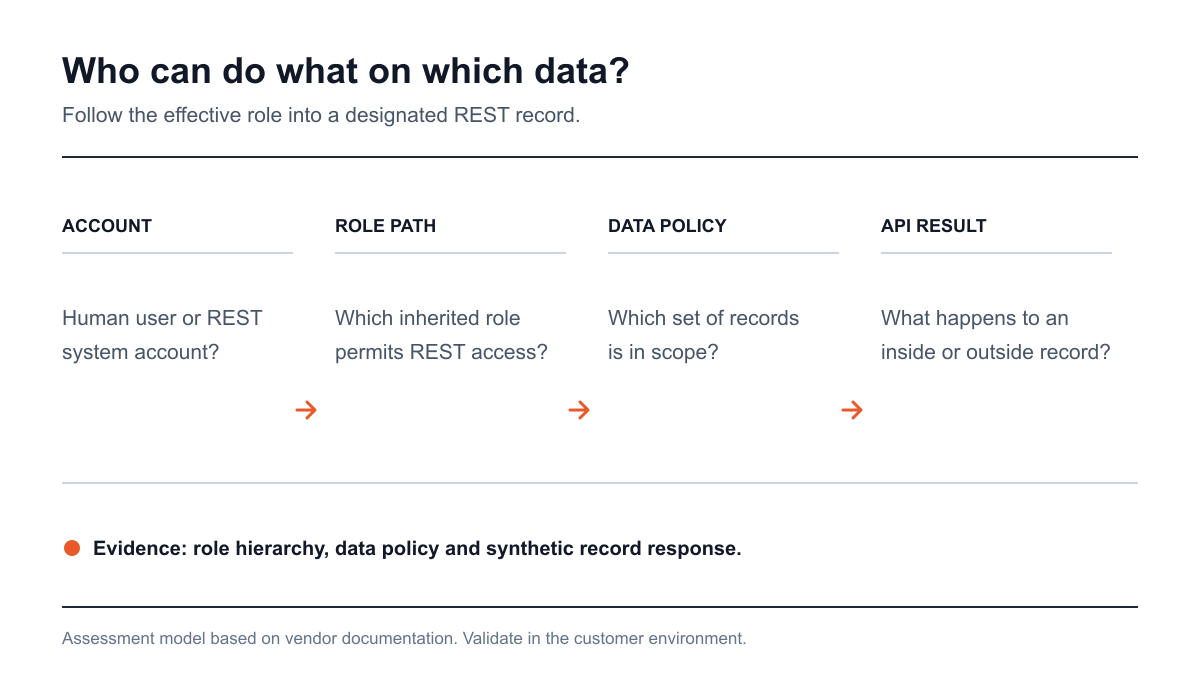
Figure 1: Role inheritance, REST access privilege and data scope must be read together. Sources: Oracle, Securing Applications 26B and Oracle REST Quick Start.
The permission model a buyer needs to see
Oracle says almost every role is a hierarchy or collection of other roles. That makes a simple role-name inventory an unreliable account of effective privilege. A business user may inherit a duty role through a job role; a technical account may receive a role added for one integration and later reused elsewhere. The assessor should trace the effective hierarchy and explain which privilege creates a tested result.
Oracle's guide says data security policies articulate who can do what on which set of data. That is the core of a valuable test. The same operation may be appropriate for one business unit's records and inappropriate for another. A finding about “read access” is incomplete unless it identifies the relevant data set. Conversely, broad role inheritance does not by itself prove that an account can see every record. Data policy scope must be checked.
The Oracle REST reference makes the integration surface explicit. Oracle's security guide says a system account used for third-party integration is not tied to an individual user but needs roles with REST API access. This can create an ownership gap: the integration outlives the project team, its role grows to fix an incident, and no one later checks whether it still needs all of its data access. The assessment should identify such paths through an inventory and observed test, not assume they exist in every tenant.
Select business processes, not arbitrary endpoints
Begin with a business process and a data boundary. Examples of useful samples are a finance integration that should see one legal entity's designated records, a procurement workflow that updates test supplier records and an HR reporting account that should have a narrowly defined dataset. These are test design examples, not claims about any customer or the presence of specific API operations in every Fusion module. The buyer and tester should agree on the actual endpoints and fixtures available in the customer's licensed applications.
For each sample, record the account, integration owner, role hierarchy, relevant REST access privilege, data security policies and approved record set. Prepare synthetic or designated test records that are distinguishable by business unit or role. A second identity without access to those records lets the tester verify a denied case. If a production-only integration must be reviewed, use read-only configuration evidence first and avoid copying business data.
Scope must specify tenant, Fusion modules, environments and integrations. A finance assessment does not cover all HR or supply-chain modules, and a REST test does not automatically evaluate the user interface. Note any identity provider or middleware that grants access before the request reaches Oracle. Those systems may require a separate cloud or application workstream.
Four control questions
Which role actually grants the action?
Trace inherited roles rather than reading only directly assigned roles. Compare the effective hierarchy with the integration's current task and the change record that justified each grant. In a controlled environment, test a harmless operation that should be allowed and another that should be denied. The result should identify the role or privilege path that made the action possible. An observation without that path is hard to remediate safely.
The test should also ask who can assign or change roles, and whether the same team can approve its own access expansion. That is an administrative design question, not a blanket assertion that separation of duties is absent. Record the actual workflow, owner and exception. If an account has a broad role for a temporary migration, document its end date and the evidence that it will be removed.
Which records can the account reach?
Use Oracle's REST role and privilege requirement and data security model to build a two-dimensional test. An account may be permitted to call a REST operation but limited to a defined data set. Test records inside and outside that set. Verify both read and write boundaries where the integration legitimately performs both, with a harmless reversible write to a fixture record if permitted by the rules of engagement.
Do not use real payroll, payment or customer records as evidence. A well-designed fixture can show an incorrect cross-boundary response by its identifier and synthetic content. Where an API returns a record list, the report should describe the result class and redacted identifiers, not export the entire dataset. If no safe active test is possible, label the conclusion as a configuration review and state what remains unproven.
What happens to a system account after its owner changes?
Because Oracle documents system accounts for third-party integrations, inventory accounts without linked individual users. Identify the vendor or internal service, contract owner, credential custodian, assigned roles and last justified use. Test a designated temporary account's deactivation or role removal, then repeat a benign API request. Do not disable a production integration to prove revocation unless the business has approved a maintenance window and rollback.
An orphaned owner is an operational issue even if the account currently has narrow data access. It affects incident response and role change approval. The report should separate ownership findings from demonstrated unauthorized data access so executives can prioritize accurately.
Can the organization explain and retest a denial?
Record the acting account, endpoint class, role hierarchy, data policy and expected record set for each scenario. A denial may come from a missing REST access privilege, a data security restriction, an identity provider condition or an API-level error. Identify which control produced it before crediting the access model. After a remediation, repeat the same fixture request and confirm that intended access still works for the authorized role.
This technical record of scope, observed behavior and remediation can support a buyer's compliance program and enterprise security review.
A buyer-ready test matrix
Persona or account | Intended operation | Designated test | Evidence |
|---|---|---|---|
Business user | View an in-scope test record. | Confirm an allowed result and a denied out-of-scope record. | Inherited role, data policy and observed response. |
REST system account | Perform its documented integration task. | Call an approved endpoint against synthetic records. | Account owner, role path, permitted data set and response. |
Lower-privilege test identity | No access to sensitive fixture. | Attempt the same benign read. | Denial, relevant policy and log or request identifier. |
Temporary elevated identity | Time-limited change. | Remove a test role, then retry. | Approval, before-and-after decision and rollback record. |
The matrix is a proposed assessment design. The final test cases must match the organization's actual licensed modules, API operations and business rules. A report should label untested records and excluded modules instead of treating a sample as a tenant-wide conclusion.
A worked authorization question
Consider a hypothetical integration that prepares a report for one business unit. Its system account can call a permitted REST resource, and the team expects it to see only designated fixture records for that unit. The assessment creates two synthetic records with distinct business-unit ownership. It calls the approved endpoint with the integration's test identity and records which fixture identifiers appear. This produces a test of both the REST access privilege and the data security boundary.
If both fixtures appear, the next step is to trace the effective role hierarchy and data policy that allowed the second one. It would be wrong to call the REST API itself vulnerable before examining the customer's assigned privileges. The report should quote the relevant policy and explain whether it intentionally includes both units or has drifted from the workflow's approved scope. The business owner decides whether the access is excessive; the tester supplies the technical evidence.
If the out-of-scope fixture is denied, verify that the in-scope fixture remains available and that the integration still completes its permitted task. A denied request alone does not prove the implementation works. It may simply be using an account missing all necessary privileges. Pairing allowed and denied cases prevents a remediation from being credited when it breaks the service.
UI and REST outcomes can diverge
Oracle distinguishes function security and data security. A human user's UI result and an integration's REST result may therefore reflect different identities, functions or data policies. If a team reports that “the screen blocks this record,” the assessor should ask which account made the API call and whether the screen's restriction applies to that account. The reverse is also possible: a REST denial does not establish that a privileged UI role lacks access.
The assessment needs a trace for every conclusion: acting identity, role inheritance, relevant policy, tested operation and record class. A general role review can identify suspicious grants, but active validation is what shows a specific business data boundary. Where production sensitivity prevents a live test, mark the conclusion as a configuration inference and request a later fixture-based retest.
Preserve evidence without copying business records
The provider can use fixture identifiers, timestamps, response status, redacted response structure and policy exports. It does not need payroll rows, supplier banking details or customer addresses. Rules of engagement should specify where raw request logs are stored, who can access them and when they are deleted. The report should include just enough context to let an Oracle administrator reproduce the permission decision with another test identity.
For a write case, agree on an idempotent or reversible fixture change and the rollback owner. A test that creates a financial transaction or triggers an external integration can have consequences unrelated to the permission question. The safest proof may be a read-only action or a designated sandbox record, depending on the module. The buyer should insist that the proposal name that choice in advance.
Turn the findings into role governance
An enterprise can use the final test matrix to identify which system accounts have no current owner, which inherited roles have no clear business justification and which data policies are broader than the integration requires. Not every broad grant can be removed immediately. A provider should explain dependencies and propose a sequence: assign an owner, define the required business data set, create or select a narrower grant, test the workflow, then retire the old role after a successful cutover.
Retesting should include both the originally excessive access and the permitted workflow. The buyer should keep the observed before-and-after results, approval and residual exceptions together. That evidence is useful for a later access review and for a procurement team comparing the ongoing cost of maintaining a complex integration against simplifying its role model.
How to buy and run the assessment safely
Ask the provider for its method of tracing inherited roles and data policies to a REST outcome. Ask for a sample finding that shows “who can do what on which set of data” with a synthetic record, not a screenshot of a role name alone. Require the provider to explain whether it will test the UI, REST APIs, integration middleware or all three. The proposal should name test accounts, fixtures, production read-only boundaries, windows and stop conditions.
For the buyer, involve the business data owner as well as the identity team. A tester can show that an account accesses a record, but only the business owner can confirm whether that record is appropriate for the workflow. This review also prevents an overzealous role reduction from breaking a legitimate integration. The final report should include the business decision and a retest after any access change.
Stingrai is a global CREST-accredited penetration testing services company, incorporated in 2021 and based in Toronto, Canada. Its human-led web, API and cloud testing can validate customer-controlled Oracle Fusion integration paths when the tenant and relevant API operations are explicitly in scope. Two named penetration testers work on each human-led engagement, findings are posted as confirmed, and retesting of remediated findings is included. Stingrai offers one-time tests and continuous programs. Its technical evidence can support a customer's security and compliance review.
A controlled assessment sequence
Choose processes and fixtures. Name modules, business owners, test identities, data boundaries and safe records. Define which integrations may be exercised.
Map effective access. Trace inherited roles, REST access privileges and data security policies for each sample. Record account and credential owners.
Validate outcomes. Compare allowed and denied REST or UI actions on designated records. Preserve redacted request and policy evidence.
Narrow and retest. Change a role or data policy through the customer's process, then repeat the same test and confirm intended access remains.
This produces a useful control map for procurement and remediation. It also makes any conclusion about a sensitive data path reviewable without exposing the underlying records.
Frequently Asked Questions
Is an Oracle Fusion role name enough to determine access?
No. Oracle says roles commonly inherit other roles. For REST access, trace the effective hierarchy, the privilege required for the operation and the data policy, then test what the account can do on designated records. UI function security needs a separate check when the UI is in scope.
Why test Oracle Fusion REST integrations separately from the UI?
Oracle REST APIs can view and manage Fusion Cloud Applications data. A system integration may use a non-person account with roles granting REST access, and its data flow may differ from a human user's UI workflow. The test should follow the actual endpoint, account, role and data policy.
Can a system account exist without a linked employee?
Yes. Oracle's security guide describes third-party integration system accounts that are not associated with an individual user but require roles with REST API access. A buyer should assign a business owner and review role and credential lifecycle.
Should a pentest read real payroll or supplier records?
No real record extraction is needed for most access questions. Use synthetic or designated fixtures to show allowed and denied decisions. For production-only paths, agree on a safe stop point and use redacted configuration evidence rather than copying business data.
What should the report include?
It should show the sampled account, inherited roles, relevant REST privilege or UI function permission, data security policy, tested action, expected record set and observed result. It should name the owner, remediation and retest, plus the modules and integrations that were not tested.
Related reading
References
Oracle. Securing Applications 26B. Accessed 21 October 2026. Role hierarchy, UI function and data security, and system accounts.
Oracle. REST Quick Start. Accessed 21 October 2026. REST role and privilege requirements.
Oracle. REST API for Common Features in Oracle Fusion Cloud Applications. Accessed 21 October 2026. REST data access context.
Talk to Stingrai
To assess the customer-owned roles and REST integrations behind a sensitive Oracle Fusion workflow, get a quote or book a free discovery call. Name the modules, test accounts and records you can safely provide.