



Okta's API Service Integrations guide says these integrations let third-party apps access the Core Okta API through OAuth 2.0. Okta attributes their API calls to the app, not a user. That makes an integration a durable identity with potentially significant administrative effect. A buyer should know which app can change which resources, who owns the app and what evidence appears if its grant is misused.
Quick answer. Inventory each API Service Integration, its business owner, OAuth access, administrator role type and effective resource boundary. Select a representative integration and test benign allowed and denied API actions against designated resources. Review activity attribution, credential custody and revocation with a disposable test app. The report should tie effective privilege to a business function rather than declare every service app high risk by default.
This article covers customer-owned Okta configuration and authorized integrations. It does not claim an Okta platform vulnerability or expose any tenant's API credentials. A third-party application's infrastructure is outside a tenant assessment unless that vendor separately authorizes testing.
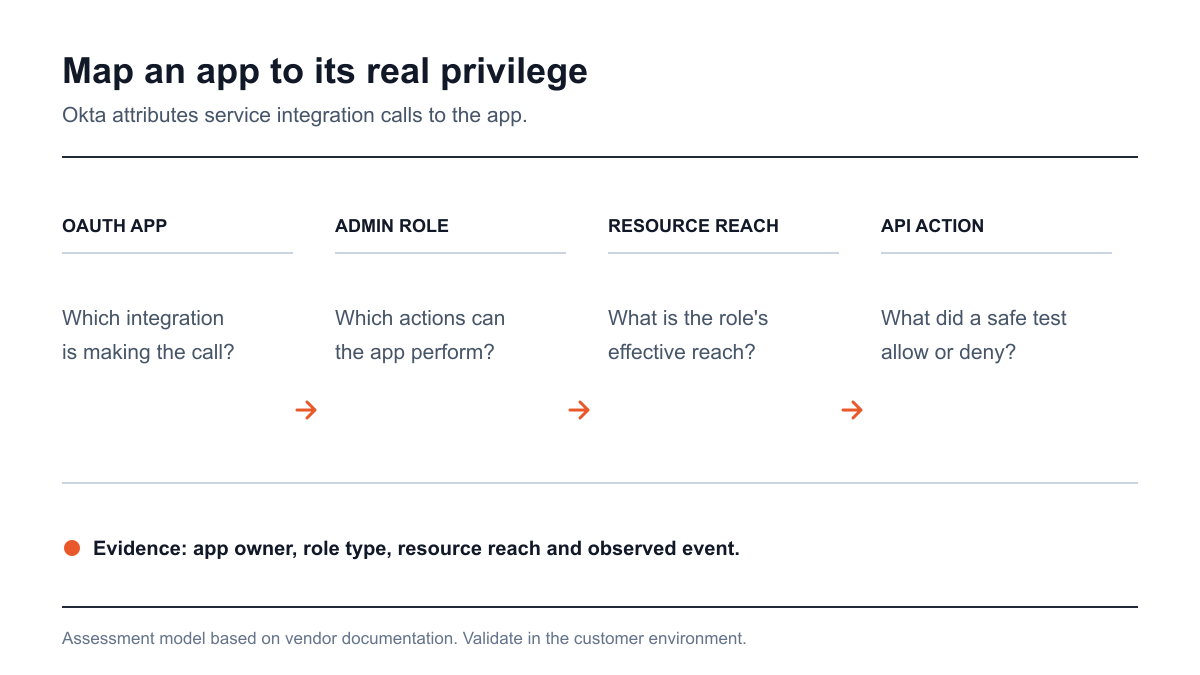
Figure 1: An app's OAuth path, administrative permission and target resource are separate questions. Sources: Okta API Service Integrations and Okta custom admin roles.
Why service app access needs its own review
Okta says an API Service Integration may access or modify resources such as system logs, apps, sessions and policies. Those are security-sensitive surfaces. A support integration might need to read logs, while an automation tool might need to manage a limited set of apps. Neither use case justifies assuming the integration should administer the entire organization. The assessment should compare granted access with the actual feature and effective resource boundary of each integration.
Attribution matters too. Because Okta attributes calls to the app rather than a human user, the organization needs a reliable owner, change record and deployment trail to explain a significant API action. A shared integration used by several internal services may make that harder. The finding should identify the attribution limit and its consequence for response, without claiming that a logged app action reveals which individual initiated it.
An inventory should separate API Service Integrations from traditional Okta API tokens. Okta documents API tokens as secrets issued for a user, with requests acting on behalf of that user. That is a different credential and privilege model from an OAuth app integration. A test proposal that treats the two as interchangeable can miss the real owner and revocation path. If both exist in the tenant, inventory and test them as distinct populations.
Build a map of app, role and resource
Okta's roles reference allows client apps to receive standard or custom admin roles. Custom role assignments can bind an app, role and configurable resource set. Standard roles instead have predefined resource reach and may allow optional targets; some IAM-based standard roles have fixed resource sets. For each integration, record the actual role type, its effective resource boundary and the expected API action. The test should show which combination allowed or denied a benign operation, including when no configurable resource set exists.
Begin with integrations that can alter authentication policy, manage applications or automate user lifecycle, because mistakes there can affect many workflows. Include a read-focused integration to compare privilege patterns. Record installation and approval owner, connected vendor or internal service, current business purpose, granted scope, admin role type, effective resource boundary, credential rotation owner and last review. These are assessment fields, not claims that every tenant has gaps.
The buyer should supply a non-production or disposable test app for active operations and test resources that are safe to change. For production integrations, read-only configuration and log review may answer most questions. If an action could change a sign-on policy or live application assignment, it needs a separately approved change window and rollback plan.
Four questions a test should resolve
Can the app act beyond its intended resource boundary?
Select a resource the integration should manage and a designated resource it should not. Use a harmless read or reversible test action permitted by the rules of engagement. Record the OAuth app, admin role type, effective resource boundary, operation and observed result. If an action succeeds outside the intended boundary, show which grant enabled it. If it is denied, preserve the denial evidence. Both results improve the permission map.
Do not infer broad access from a scope label alone. A scope may express a category of API action while the assigned role and its applicable resource limits constrain the actual objects. Conversely, a narrow role may still be more powerful than necessary for a particular integration. The impact depends on the resource and business function reached, not only the printed permission name.
Who can change the integration's grants?
Review who can approve or modify the app's access, assign admin roles, alter custom-role resource sets or standard-role targets where supported and rotate the integration's credentials. An integration created for a vendor implementation can remain after the project ends. Identify a current internal owner and a review cadence. Where an app has a broad standard role for convenience, ask which function actually requires it and whether a custom role with a resource set is feasible. Okta describes custom roles as a way to assign granular admin permissions to apps and administrators.
The assessment should test one controlled grant change on a disposable integration and repeat a benign operation. It should not alter a production service app simply to prove that an administrator can. A review of change permissions and approval evidence may be sufficient for that portion of the scope.
Can responders attribute and detect sensitive calls?
Inspect representative events for the test app and document the fields available to an analyst. If a policy, application or session is changed, can the response team connect the action to the integration and its business owner? Where several workloads share one integration, can deployment or application logs narrow the initiator? The report should distinguish Okta's app-level attribution from the organization's own supplementary evidence.
Include an operational drill: a suspicious API action appears for a service app. Who decides whether to revoke it, what business service would stop, and how are replacement credentials issued? This need not involve a real incident or active attack. It evaluates whether the integration can be contained without losing the identity system's essential functions.
Does revocation close new access?
Use a disposable app or integration to test the removal path. Remove a temporary OAuth scope grant on a disposable app, then request a fresh access token and retry a harmless API action. Okta checks requested scopes against the app's current grants during token issuance. Separately observe what an already-issued test token can still do; do not assume grant removal invalidates it immediately. If the response plan calls for revoking the entire integration, test that workflow separately with business approval. Record the administrator, the observed outcomes and any dependent jobs affected. Denial on one tested path does not establish that data previously exported to a vendor has been deleted.
Where legacy user-bound API tokens remain, test their lifecycle under their own model. Okta says such tokens act with the issuing user's permissions. A change to that user may therefore change token behavior. Do not apply the same finding language to OAuth integrations and user tokens.
An evidence matrix for the buyer
Boundary | Safe validation | Evidence to request |
|---|---|---|
App ownership | Match the integration to its vendor or internal service and an accountable owner. | Inventory row, approval and current purpose. |
Effective privilege | Test allowed and denied actions on designated resources. | OAuth app, role type, effective resource boundary and observed result. |
Grant change | Modify a disposable integration through the approved workflow. | Approver, before-and-after grants and test outcome. |
Attribution | Review app-attributed test events and supporting deployment logs. | Event fields, owner lookup and response path. |
Revocation | Remove a test grant, request a fresh token and test an existing token separately. | Change record, both token observations and dependency note. |
The matrix is a proposed assessment, not a list of observed tenant defects. A provider should mark each row tested, reviewed or excluded and explain which production resources were not exercised. A report that presents a configured role as a proven ability without a safe validation should say so plainly.
A practical grant review for a service app
Take a hypothetical integration that reads application configuration to populate an internal inventory. The approved job is read-only. A tester would first identify the OAuth app and owner, then the scopes and admin role assigned to the app. It would identify whether the app has a custom role with a configurable resource set, a standard role with an optional target, or another fixed resource boundary. It would use a designated test app resource to confirm a permitted read and a designated out-of-scope resource to confirm denial. The test should not change a live sign-on policy or pull employee data to demonstrate a permissions boundary.
If the out-of-scope read succeeds, the finding should show whether the cause is a broad role, a broad configurable resource set, an absent standard-role target or another grant. A recommendation that says only “reduce OAuth scope” may be wrong if the app still needs that API action for its intended resource. Conversely, narrowing a custom-role resource set will not fix an integration that has an unnecessary administrative action. The assessor should propose the smallest change that preserves the feature and then retest both allowed and denied actions.
If the service app is used by multiple workloads, the team needs to know which workload requested a given action. Okta's app-level attribution is useful, but deployment logs or application telemetry may be required to distinguish internal callers. The provider should record that visibility limit as an operational finding if it matters to response. It should not imply Okta failed to attribute the call when the product correctly identifies the app.
Keep traditional API tokens in a separate lane
The same organization may have a historic script using a user-issued Okta API token. In Okta's documented model, the token acts with its issuing user's permissions, so the test must identify that user, the token's custody and the effect of changing the user's role or status. An OAuth service app uses a different path with app grants and admin role assignments. Mixing both populations in one inventory row makes ownership and revocation evidence ambiguous.
The buyer can ask for a migration plan from a broad user-bound token to a service app if it fits the workflow. That is a design recommendation, not an automatic finding against every API token. The provider should assess the current token's effective permission and dependency, then identify whether a scoped app grant would reduce exposure without breaking service. A migration test needs a safe rollback because an identity integration may be part of account provisioning or policy automation.
What changes the severity of a finding?
The label should follow the observed resource and action. A read-only inventory app that can view one unintended test app differs from an app that can modify sign-on policies across the organization. A stale owner with narrow privilege is an operational risk, while an app with demonstrated unauthorized administrative action is an access-control finding. Severity should also consider whether the app credential is available to more operators than expected and whether the team could revoke it without an extended outage.
For each proposed fix, ask for evidence of both negative and positive outcomes. The forbidden operation should now be denied. The intended operation should still succeed. The app-attributed event should remain visible to the response team. Those three checks make a permission change defensible to both an identity administrator and a business owner.
How to scope and procure the test
The request for proposal should name Okta organizations, representative service integrations, test resources, the planned level of API access and excluded vendor infrastructure. Provide masked configuration exports and a disposable integration for active tests. Specify prohibited operations, emergency contacts and rollback for any permission change. Require that no credentials, tokens or user data appear in tickets or PDF findings.
Ask the provider how it distinguishes app-attributed OAuth access from user-bound API tokens, how it traces role type and effective resource reach, and how it will demonstrate a denied case. Ask for findings that include business owner, affected resource, evidence, narrower grant and retest. If the integration changes a customer-built web application or cloud workload, scope that application or cloud path separately.
Stingrai is a global CREST-accredited penetration testing services company, incorporated in 2021 and based in Toronto, Canada. Its human-led cloud and identity testing can evaluate customer-controlled Okta integrations and the downstream paths that are explicitly in scope. Two named penetration testers work on each human-led engagement, with findings posted as confirmed and retesting included. Stingrai offers one-time tests and continuous programs, and its evidence can support enterprise security and compliance reviews.
A controlled validation sequence
Inventory the principals. Separate OAuth API Service Integrations from user-bound API tokens. Record business owner, grants, role types, effective resource boundaries and dependencies.
Choose safe scenarios. Create a disposable test integration and resources. Define an intended action and a forbidden one, with approvals and stop conditions.
Observe the result. Test the permitted and denied calls, review app-attributed events, then remove a temporary grant, request a fresh token and check an existing token separately.
Remediate and retest. Narrow permissions, assign owners and update credential lifecycle. Repeat the same harmless scenarios and document residual exceptions.
The sequence gives identity administrators a permission map and a response path they can maintain as integrations change. It also gives procurement a clear basis for comparing providers.
Frequently Asked Questions
What is an Okta API Service Integration?
Okta describes it as a way for a third-party app to access the Core Okta API using OAuth 2.0. Okta attributes API calls from the integration to the app, not a human user. An assessment should identify its owner, effective grants and resource reach.
Are API Service Integrations the same as Okta API tokens?
No. Okta describes traditional API tokens as user-issued secrets whose requests act on behalf of the issuing user. API Service Integrations use an OAuth app model. Inventory their privilege, attribution and revocation separately.
Can an Okta app receive an admin role?
Yes. Okta allows a client app to receive an admin role. A custom role can have a configurable resource set; a standard role has predefined resource reach and may support optional targets. Record the actual role type and effective resource boundary before testing the app's API action.
Should a pentest change live Okta policies to prove a finding?
Usually no. A disposable integration and designated resources can prove allowed and denied decisions. Production policy changes need explicit approval, a maintenance window and rollback. Read-only evidence may be sufficient for a production-only permission path.
What should the final report prove?
It should map each sampled integration to its owner, OAuth access, admin role type, effective resource boundary and tested API operation. Findings need an observed result or clearly labeled configuration review, remediation owner, revocation path and retest. It should not include tokens or user data.
Related reading
References
Okta. API Service Integrations. Accessed 21 October 2026. OAuth access, resource examples and app attribution.
Okta. Custom admin roles. Accessed 21 October 2026. Configurable resource sets for custom roles.
Okta. Roles in Okta. Accessed 21 October 2026. Standard and custom role resource boundaries.
Okta. Implement OAuth for Okta with a service app. Accessed 21 October 2026. OAuth scope grants and token issuance.
Okta. Revoke an API Service Integration. Accessed 21 October 2026. Integration revocation.
Okta. Manage Okta API tokens. Accessed 21 October 2026. User-issued token comparison.
Talk to Stingrai
To assess Okta service integrations, permission boundaries and revocation under a human-led scope, get a quote or book a free discovery call. Name the test app and designated resources available.