



A defender briefing for security leaders and AI platform teams: how a crafted GGUF model file reaches code execution through llama.cpp, which local LLM apps bundle the vulnerable parser, and the inventory and patch checklist that closes the gap.
A malicious model file can run code on the machine that loads it. In March 2026, the maintainers of llama.cpp published an advisory for CVE-2026-27940, a heap buffer overflow rated CVSS 7.8 in the function that parses GGUF model files, gguf_init_from_file_impl() in ggml/src/gguf.cpp. A crafted file triggers an integer overflow in the size math for the model context, the loader allocates a buffer far smaller than the tensor data requires, and a subsequent read writes attacker-controlled bytes past that buffer. The advisory demonstrates the overflow escalating to remote code execution, and it is fixed in build b8146 (GitHub Security Advisory GHSA-3p4r-fq3f-q74v; NVD, 2026).
Here is the direct answer to the question most teams running local AI are now asking. Can a malicious GGUF model file execute code on your machine when you run a local LLM like Ollama or llama.cpp? Yes, on an unpatched build. The 2026 GGUF parser flaws are not theoretical hardening notes: CVE-2026-27940 was demonstrated reaching code execution, and it is a bypass of an earlier 2025 flaw whose fix was incomplete (NVD, 2026). For the llama.cpp flaws the exploit path is local and requires you to load the file, so the defense is not exotic. Pin a patched build, treat model files you did not produce as untrusted binaries, and sandbox the process that parses them.
Ollama needs a second answer, and it is the more urgent one. Ollama does not only inherit llama.cpp's parser. It also ships its own independent GGUF loader written in Go, and that loader has its own critical flaw that no llama.cpp build fixes: CVE-2026-7482, a heap out-of-bounds read rated CVSS 9.1 Critical on the vector AV:N/AC:L/PR:N/UI:N, which means network reachable, unauthenticated, and requiring no user interaction at all. It is fixed only in Ollama 0.17.1 (NVD, 2026). If you run Ollama, upgrading the engine underneath it is not enough, and this post carries two patch floors for that reason.
This post is a defender walkthrough of the flaws, the local-AI products that inherit them, and the inventory and patch checklist to act on today. It stays at briefing depth on root cause: no crafted-file recipe, no proof of concept, no payload. For the broader agentic and model-layer attack surface, see our field guide on AI red teaming for LLM and agentic apps; this one stays on the model file and the loader that parses it.
The short answer: can a GGUF file run code on your machine?
Yes, if the code that opens it is unpatched. A GGUF file is not a passive blob of weights. It is a structured container with a header, key-value metadata, and tensor descriptors, and something has to parse all of that before a single token is generated. That parser is C and C++ code doing pointer arithmetic and heap allocation against numbers that come straight out of the file. When the file lies about those numbers, the parser can be steered into allocating too little memory and then writing too much.
That is exactly what CVE-2026-27940 does. The advisory notes that the memory size for the ggml context is computed without a combined overflow check, so individual additions are validated but their total is not (GHSA-3p4r-fq3f-q74v). Wrap that total and the allocation shrinks, while the amount of data read from the file does not, so the read runs off the end of the buffer with attacker-controlled bytes. The NVD entry states it plainly: the loader "is vulnerable to an Integer overflow, leading to an undersized heap allocation," and the subsequent read "writes 528+ bytes of attacker-controlled data past the buffer boundary" (NVD, 2026).
The CVSS vector, AV:L/AC:L/PR:N/UI:R, tells defenders how to think about it: the attack is local and needs user interaction, where the "interaction" is the act of loading the model. Nobody has to breach your network first. They have to get you to open a file. That is the same trust decision you already make about executables, installers, and browser downloads, applied to a file type many teams have been treating as inert data.
One flaw in this cluster breaks that pattern, and it is the one defenders most often miss. CVE-2026-7482 sits in Ollama's own Go GGUF loader rather than in llama.cpp, and its vector is AV:N/AC:L/PR:N/UI:N (NVD, 2026). Network, low complexity, no privileges, no user interaction. Nobody has to be persuaded to open anything; they only need to reach the API port. That difference changes both the urgency and the control set, and it is covered in its own section below.
What GGUF is, and why the parser is the weak point
GGUF is the single-file format that packages a model's weights, tokenizer, and metadata for the llama.cpp inference stack, and it has become the de facto distribution format for open-weight models you run locally (GGUF format overview). The convenience is real: one file, portable across CPU and GPU backends, easy to share. The security consequence is that a single file now carries both data and the structural instructions that tell native code how to lay that data out in memory.
The parser lives in ggml, the tensor library underneath llama.cpp, in two places that both produced 2026 CVEs: gguf_init_from_file_impl() in ggml/src/gguf.cpp, which reads the container, and ggml_nbytes() in ggml/src/ggml.c, which computes how many bytes a tensor occupies. Both take attacker-influenced integers and turn them into allocation sizes. Both had overflow gaps. This is the classic memory-safety trap: untrusted length fields multiplied and added into a size that silently wraps, so a hostile file can describe a tensor that "fits" in a few megabytes on paper while actually demanding far more, and the write that follows lands wherever the undersized buffer ends.
The takeaway for defenders is structural, not incidental. Any format parsed by native code before validation is an attack surface, and model files are no exception. A GGUF file from an unknown source deserves the same suspicion as an unsigned binary from an unknown source, because on a vulnerable build it can have the same effect.
The 2026 GGUF parser CVEs
Four advisories define the current picture. Two are 2026 flaws in the llama.cpp GGUF and tensor path, the third is the 2025 llama.cpp flaw that the first one bypasses, and the fourth sits in a different codebase entirely: Ollama's own Go GGUF loader. That fourth one is the highest severity of the set and the only network-reachable member of it, and no llama.cpp build closes it. The version and patch matrix below is the part to screenshot for your patch ticket.
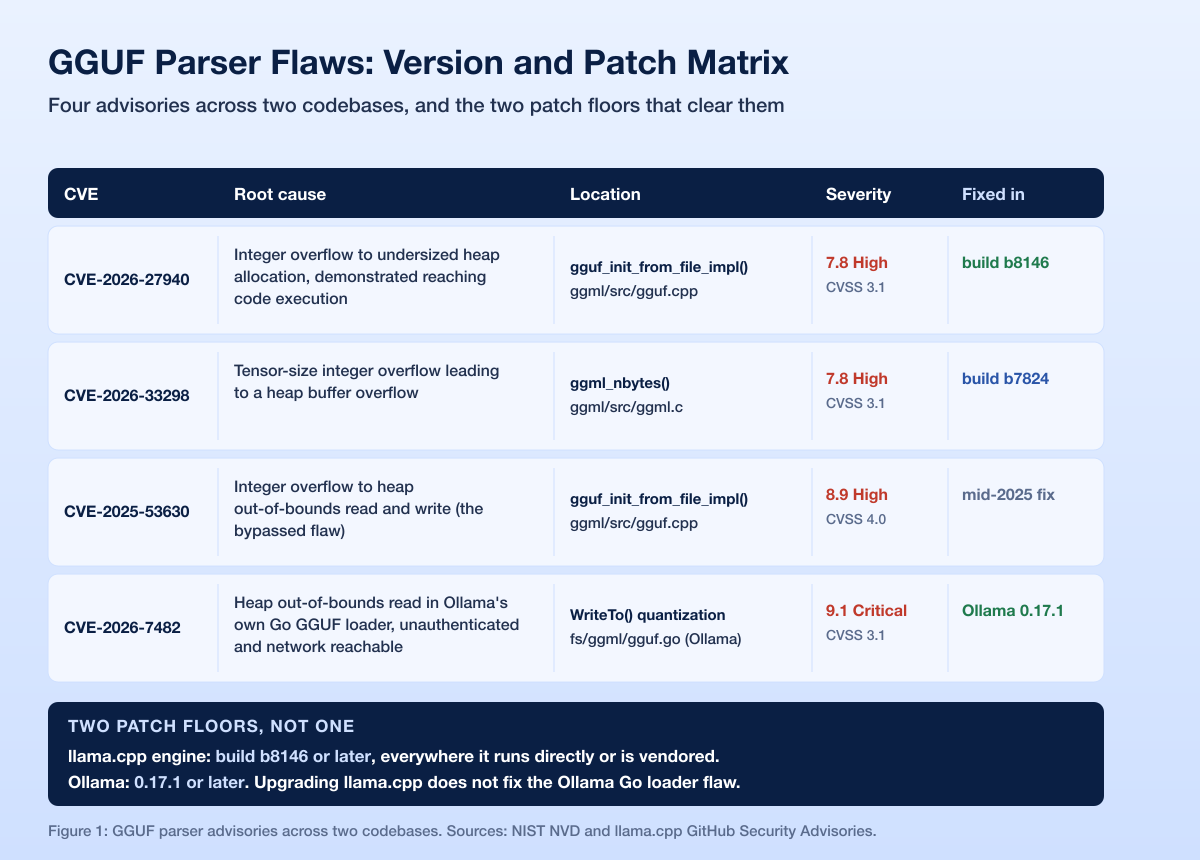
CVE | Root cause | Location | CVSS | Fixed in |
|---|---|---|---|---|
CVE-2026-27940 | Integer overflow to undersized heap allocation, demonstrated reaching code execution |
| 7.8 High (3.1) | llama.cpp build b8146 |
CVE-2026-33298 | Tensor-size integer overflow, heap buffer overflow |
| 7.8 High (3.1) | llama.cpp build b7824 |
CVE-2025-53630 | Integer overflow to heap out-of-bounds read and write |
| 8.9 High (4.0) | mid-2025 fix commit |
CVE-2026-7482 | Heap out-of-bounds read (CWE-125) in Ollama's own Go GGUF loader, reached unauthenticated over the network via |
| 9.1 Critical (3.1), | Ollama 0.17.1 |
The patch floor is two numbers, not one
Build b8146 is a later build than b7824, so pinning llama.cpp to b8146 or newer clears all three llama.cpp flaws in one move. It does nothing at all for the fourth, because that code is not llama.cpp. Put both of these lines in your patch policy:
llama.cpp engine: build b8146 or later. Clears CVE-2026-27940, CVE-2026-33298, and CVE-2025-53630, everywhere the engine runs directly or is vendored inside another tool.
Ollama: version 0.17.1 or later. The only fix for CVE-2026-7482 in Ollama's own Go GGUF loader.
Upgrading llama.cpp does not fix the Ollama loader flaw, and upgrading Ollama alone does not tell you what engine build it vendors. An Ollama deployment is only clear when both numbers are met.
CVE-2026-27940: integer overflow to heap overflow in the GGUF loader
This is the headline flaw. Published on March 12, 2026, it sits in the same function as the 2025 issue and reaches the same class of memory corruption, but through a size computation the earlier fix did not cover. The NVD description is explicit that it "is a bypass of a similar bug in the same file, CVE-2025-53630, but the fix overlooked some areas," and that it "is fixed in b8146" (NVD, 2026). It carries two weakness classes, CWE-190 (integer overflow or wraparound) and CWE-122 (heap-based buffer overflow), which is the exact chain: a wrap in the size math feeds an undersized heap allocation, and the write past it is the overflow. The advisory shows the corruption escalating to code execution, which is why this one is not a stability bug you can defer.
CVE-2026-33298: tensor-size integer overflow in ggml_nbytes
The second 2026 flaw lives one layer over, in ggml_nbytes(), the routine that answers "how big is this tensor." Published in March 2026 (NVD dated 23 March 2026), it lets a crafted file with specific tensor dimensions make the function "return a significantly smaller size than required (e.g., 4MB instead of Exabytes), leading to a heap-based buffer overflow when the application subsequently processes the tensor" (NVD, 2026; GHSA-96jg-mvhq-q7q7). It is fixed in build b7824. The pattern is identical to the loader flaw: an untrusted dimension wraps a size calculation, and the code downstream trusts the wrong number.
The pattern: CVE-2025-53630 and why one fix was not enough
The 2025 flaw, CVE-2025-53630, was disclosed in July 2025 and described as an "Integer Overflow in the gguf_init_from_file_impl function in ggml/src/gguf.cpp" that "can lead to Heap Out-of-Bounds Read/Write," scored CVSS 4.0 at 8.9 (NVD, 2025). The fix landed, but it hardened only some of the size math, which is why CVE-2026-27940 could walk back in through an addition the patch did not guard. This is the important lesson for anyone tracking model-format security: a parser this size accretes overflow bugs, one fix rarely closes the whole class, and community disclosure keeps surfacing more of the GGUF validation gaps (oss-sec, 2026). Point-in-time patching is necessary but not sufficient. You need a process that keeps re-checking the build you actually run.
CVE-2026-7482: Ollama's own Go loader, unauthenticated over the network
This is the advisory most likely to be missed, because it is not a llama.cpp bug and no llama.cpp build fixes it. Alongside the vendored ggml engine, Ollama ships a second, independent GGUF loader written in Go, and that loader has its own critical flaw. NVD records it as a heap out-of-bounds read in the GGUF model loader of Ollama before 0.17.1, classed CWE-125, scored CVSS 9.1 Critical on the vector AV:N/AC:L/PR:N/UI:N, and published on 4 May 2026 (NVD, 2026). It is tracked publicly under the nickname Bleeding Llama.
The path runs through the /api/create endpoint. Per NVD, that endpoint accepts an attacker-supplied GGUF file whose declared tensor offset and size exceed the file's actual length, and "during quantization in fs/ggml/gguf.go and server/quantization.go (WriteTo()), the server reads past the allocated heap buffer" (NVD, 2026). What comes back out is the damaging part: NVD states the leaked memory contents may include environment variables, API keys, system prompts, and concurrent users' conversation data, and that they can be exfiltrated by uploading the resulting model artifact through the /api/push endpoint to an attacker-controlled registry.
Read the vector against the other three and the difference is stark. Those need somebody to load a malicious file on a machine you control. This one needs only a route to the API port: no credentials, no user, no click. That makes it the highest-severity and the only network-reachable GGUF flaw of 2026, and it is why an Ollama fleet cannot be signed off on a llama.cpp build number.
It is fixed only in Ollama 0.17.1, so patching is the primary control. Because the flaw is reachable over the network, add the control that would have blunted it and will blunt the next one: do not expose the Ollama API to untrusted networks. Bind it to localhost or an internal interface, put any remote access behind authenticated ingress, and keep model-management endpoints such as /api/create and /api/push off the public internet, so an unpatched or not-yet-disclosed loader bug is not reachable by anyone who can route to the port.
Who is exposed: the local-AI apps that bundle the parser
The reason a single parser flaw matters so much is that llama.cpp and ggml are not one product. They are the inference engine embedded inside most of the local-AI ecosystem, so the same gguf.cpp and ggml.c code paths ship inside tools that never say "llama.cpp" in their marketing.
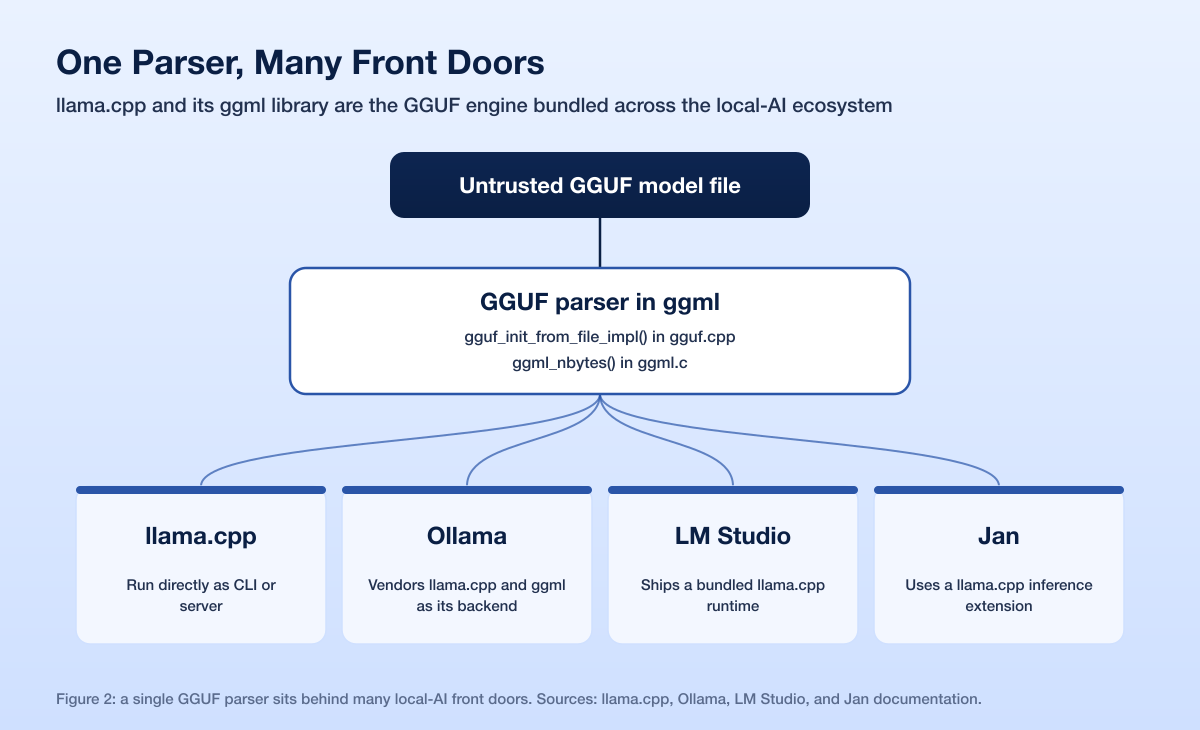
llama.cpp itself, run directly as a CLI or server, parses GGUF through the affected functions (ggml-org/llama.cpp).
Ollama carries two parser exposures, not one. It runs GGUF models and has historically vendored llama.cpp's ggml as its inference backend, so its model loading path inherits the llama.cpp parser flaws (Ollama). Separately, it ships its own GGUF loader written in Go, and that is where CVE-2026-7482 lives, fixed only in Ollama 0.17.1 (NVD, 2026). Clearing an Ollama deployment therefore takes two checks: the vendored engine build, and the Ollama release itself.
LM Studio is built on llama.cpp and ships a selectable llama.cpp runtime to execute GGUF models (LM Studio docs).
Jan uses a llama.cpp extension as its primary local inference engine for GGUF models (Jan local engine docs).
The practical consequence: knowing you patched "llama.cpp" is not the same as knowing your fleet is safe. Each of these tools bundles its own copy of the engine and updates it on its own schedule. A workstation running an old LM Studio, a CI job pulling a pinned Ollama image, and a developer's hand-built llama.cpp can each be on a different, and potentially vulnerable, build. Inventory has to reach the bundled engine version inside each app, not just the app version on the label. For Ollama it has to reach both numbers, because the vendored engine build and the Ollama release fix different bugs and neither substitutes for the other.
Are you vulnerable? The inventory and patch checklist
Treat this as a short, concrete runbook. The goal is to know which parser code each tool is actually running, get everything to both patched floors, and reduce the blast radius of loading a file you do not fully trust.
Set both patch floors and pin them. For the llama.cpp engine, the safe floor is build b8146 or later, which covers CVE-2026-27940, CVE-2026-33298, and the 2025 CVE-2025-53630 in one step. For Ollama, the floor is version 0.17.1 or later, which is the only fix for CVE-2026-7482 in Ollama's own Go loader and is not delivered by any llama.cpp upgrade. Pin both in your Dockerfiles, package manifests, and provisioning scripts rather than tracking a floating "latest."
Inventory the bundled engine, not just the app. For Ollama, LM Studio, and Jan, identify the llama.cpp or ggml build each version ships, because the app's own version number does not tell you the parser version. Where a tool does not expose that build, update the tool to its latest release and confirm the vendor has picked up a llama.cpp build at or above the floor. For Ollama, record both numbers on the asset: the vendored engine build and the Ollama version.
Keep inference APIs off untrusted networks. CVE-2026-7482 needs no file handed to a user and no interaction, only network reach to the Ollama API, so an inference port exposed to the internet or to a flat corporate network is a standing exposure. Bind local model servers to localhost or an internal interface, require authenticated ingress for any remote access, and keep model-management endpoints such as
/api/createand/api/pushunreachable from untrusted networks.Treat every model file you did not build as untrusted input. A GGUF file downloaded from a public hub, a forum, a shared drive, or a teammate is external code input to a native parser. Apply the same gate you use for binaries: prefer trusted publishers, verify checksums against the publisher's stated hash, and quarantine anything unverified.
Sandbox model loading. Load and parse models in a constrained process: a container or VM with no network egress, a non-privileged user, a read-only filesystem where possible, and syscall or capability restrictions. If a parser flaw does fire, a sandbox is the difference between a crashed loader and a compromised host.
Separate untrusted parsing from privileged work. Do not parse arbitrary community models in the same process or host that holds production credentials, signing keys, or customer data. Keep model intake on isolated infrastructure and promote only verified files inward.
Make it continuous. Model-format CVEs have landed repeatedly across 2025 and 2026 in the same files, so a single patch pass ages quickly. Add the bundled engine build to your vulnerability management scope and re-check it on a schedule and after every tool update.
Why untrusted model files are untrusted binaries
The mental model shift is the whole point. For years the industry treated model weights as data and executables as code, and hardened only the second category. GGUF collapses that distinction. The file carries structural fields that native code interprets before any safety checks, and on a vulnerable build those fields decide how memory is allocated and written. A file that can steer a heap allocation is, functionally, code.
That is why "I only run local models, so I am not exposed to the internet" is the wrong frame. For the llama.cpp flaws the exposure is not a listening port at all. It is the supply chain of files you feed the parser: the model you pulled to save API costs, the fine-tune a vendor shipped, the quantized variant a community member uploaded. Any of those is a delivery vehicle on an unpatched build. And for the Ollama loader flaw the exposure is a listening port as well, so "local" tells you nothing about reachability until you have checked what the inference API is bound to. The controls that work are the ones you already trust for software supply chain, applied to model artifacts: provenance, integrity verification, least privilege, and sandboxing. Converting or quantizing a file does not sanitize it either, because the malicious values live in the structure the parser reads, not in the weights you are re-encoding.
Where Stingrai fits
Stingrai is a global CREST-accredited penetration testing services company founded in Toronto, Canada in 2021, trusted by companies from startups to enterprises to meet audit requirements for SOC 2, ISO 27001, CMMC, PCI DSS and HIPAA. OSCE³, OSWE, OSEP, CREST CRT certified penetration testers, who are also world-class security researchers and bug bounty hunters. Choose from fully human-led or hybrid (AI agents plus human penetration testers) engagements across web, API, mobile, AI and LLM, cloud, network, Active Directory and social engineering penetration tests and red team engagements.
Model files and the loaders that parse them are offensive-security work, and it sits with our penetration testers rather than with any scanner. The people who do this work are the reason to care: a team lead with 16 years in penetration testing and exploit development holding OSCE³, OSED, OSWE and OSEP, with 10 published CVEs of his own, a founding member of Uber's offensive security team covering web, mobile and LLM, and 18 published CVEs across the team. Memory-safety bugs in native parsers are findings this team writes, not entries it copies from an advisory feed.
An engagement here examines how your product ingests untrusted model artifacts: who can publish a file into the path, what provenance and integrity checks run before a parser touches it, whether the inference engine you vendor is pinned and tracked as its own asset, and whether parsing happens somewhere isolated from API keys, system prompts and registry credentials. The same testers then exercise the inference listener as an unauthenticated web service and the tenancy boundary where models share a host, which is the discipline behind our red teaming and adversary-emulation practice, extended to the model layer. It pairs with our work on the RAG and vector-store access-control layer and the MCP connectors around the same products.
The web application and API wrapping a local-AI product still need conventional testing, and that is where Snipe operates. Snipe is Stingrai's autonomous agent for web application penetration testing including the application's APIs, hunting IDOR, broken authorization and business logic across authenticated roles, reading application source alongside dynamic testing and opening AutoFix pull requests. It runs alone on the Autonomous tier, or alongside penetration testers who test concurrently on Hybrid. Both routes feed the same PTaaS program: findings posted as they are confirmed with a working proof of concept, live chat with the assigned testers, Jira and Slack push, retesting of fixes, and an attestation letter and verified badge with the report. Because model-format CVEs keep landing in the same parser files, this is available as a one-time engagement or a continuous program that tests every release. The output is the evidence a secure-SDLC program and a SOC 2 or ISO 27001 audit expect: an independent offensive-security team exercising a privileged input path, with findings and remediation you can show an assessor. Scope and packaging are on our pricing page, and the full services overview covers where model-layer testing fits.
What this means for security leaders
Inventory every place the engine runs, then set each floor. Map every host, image, and product where the llama.cpp engine runs directly or is vendored, plus each bundling tool's own floor, and pin them: llama.cpp build b8146 or later closes CVE-2026-27940, CVE-2026-33298, and CVE-2025-53630, while Ollama 0.17.1 or later is the only thing that closes CVE-2026-7482 in Ollama's own Go loader. One number does not cover both.
Inventory the engine inside the app. Ollama, LM Studio, and Jan each carry their own llama.cpp or ggml build; track that build, not just the product version, or your patch report will lie to you. Ollama needs two entries on the asset record, not one.
Gate model files like binaries. Provenance, checksum verification, and trusted publishers apply to GGUF the same way they apply to executables, because on a vulnerable build a model file has the same reach.
Sandbox parsing, and keep the API off untrusted networks. Load untrusted models in a constrained, network-isolated process away from production secrets, and separately make sure the inference API itself is not reachable from untrusted networks, because CVE-2026-7482 needs no file and no user at all, only a route to the port.
Make model-layer testing continuous. These CVEs keep recurring in the same files, so fold the bundled engine build into continuous validation and retest after every material change instead of trusting a single pass.
Frequently Asked Questions
Can a malicious GGUF model file execute code on my machine when I run a local LLM like Ollama or llama.cpp?
Yes, on an unpatched build. CVE-2026-27940, a CVSS 7.8 flaw published in March 2026, lets a crafted GGUF file trigger an integer overflow in llama.cpp's GGUF loader that produces an undersized heap allocation, and the advisory demonstrates the resulting overflow reaching remote code execution (NVD, 2026). That attack is local and requires you to load the file, so the defense is to pin a patched build (llama.cpp b8146 or later), treat untrusted model files like untrusted binaries, and sandbox model loading. Ollama needs a second check, because it also ships its own Go GGUF loader: CVE-2026-7482 in that loader is a CVSS 9.1 Critical heap out-of-bounds read that is unauthenticated and network reachable, and it is fixed only in Ollama 0.17.1, which no llama.cpp upgrade delivers (NVD, 2026).
What is CVE-2026-27940?
CVE-2026-27940 is a heap buffer overflow, rated CVSS 7.8, in the GGUF parser function gguf_init_from_file_impl() in ggml/src/gguf.cpp. A crafted file wraps the model context size computation, the loader allocates a buffer smaller than the tensor data needs, and a following read writes attacker-controlled bytes past it. It is fixed in llama.cpp build b8146 and is explicitly a bypass of the earlier CVE-2025-53630 (GHSA-3p4r-fq3f-q74v).
Is my llama.cpp vulnerable, and how do I check?
You are exposed if you run a build earlier than b8146 for direct llama.cpp. Check the build tag your binary or container image reports and compare it to the b8146 floor, which covers the two 2026 llama.cpp CVEs and the 2025 one. If you run a bundled tool such as Ollama, LM Studio, or Jan, check the llama.cpp or ggml build that tool ships rather than the app version, because the two are not the same number. For Ollama, check a second number as well: the Ollama release itself must be 0.17.1 or later to close CVE-2026-7482 in Ollama's own Go loader, and no llama.cpp build clears that one.
Which local LLM apps are affected?
Any tool that parses GGUF through llama.cpp or ggml. That includes llama.cpp run directly, plus Ollama, LM Studio, and Jan, which all bundle a llama.cpp or ggml inference engine to run GGUF models (Jan docs; LM Studio docs). Each ships its own copy of the engine on its own update cadence, so they can be on different builds and different exposure levels at the same time. Ollama is a special case with two exposures: the vendored llama.cpp and ggml engine, and its own separate Go GGUF loader, which carries CVE-2026-7482 and is fixed only in Ollama 0.17.1 (NVD, 2026).
What is the difference between CVE-2026-27940 and CVE-2025-53630?
They are the same class of bug in the same function, gguf_init_from_file_impl(), but CVE-2026-27940 is a bypass of the fix for CVE-2025-53630. The 2025 fix hardened part of the size math, and the 2026 flaw reaches the same heap corruption through an addition the patch did not guard (NVD, 2026). Build b8146 fixes the bypass; the 2025 flaw was fixed in mid-2025.
What is CVE-2026-33298?
CVE-2026-33298 is a CVSS 7.8 integer overflow in ggml_nbytes() in ggml/src/ggml.c, the function that computes a tensor's size. A crafted file with specific tensor dimensions makes it return a size far smaller than required, leading to a heap-based buffer overflow when the tensor is processed. It is fixed in llama.cpp build b7824 (NVD, 2026).
What is CVE-2026-7482 (Bleeding Llama), and does upgrading llama.cpp fix it?
CVE-2026-7482 is a heap out-of-bounds read (CWE-125) in the GGUF model loader of Ollama before 0.17.1, rated CVSS 9.1 Critical on the vector AV:N/AC:L/PR:N/UI:N and published by NVD on 4 May 2026. The /api/create endpoint accepts a GGUF file whose declared tensor offset and size exceed the file's actual length, and during quantization in fs/ggml/gguf.go and server/quantization.go (WriteTo()) the server reads past the allocated heap buffer; NVD notes the leaked memory may include environment variables, API keys, system prompts, and concurrent users' conversation data, and can be exfiltrated by uploading the resulting model artifact through /api/push to an attacker-controlled registry (NVD, 2026). No, upgrading llama.cpp does not fix it. This flaw is in Ollama's own Go code, not in llama.cpp or ggml, so the only fix is Ollama 0.17.1 or later. Because it is unauthenticated and network reachable, also keep the Ollama API off untrusted networks rather than relying on patching alone.
Do I need to worry if I only download models from Hugging Face or another reputable hub?
Reputable hubs lower the odds but do not remove the risk, because files can be re-uploaded, forked, or tampered with, and integrity still depends on you verifying the publisher and checksum. Treat provenance and checksum verification as required steps and keep untrusted files off privileged hosts. The parser flaw fires on the file's structure, so a trusted-looking name is not a safety guarantee on a vulnerable build.
How should I sandbox local model loading?
Parse and load models in a constrained process: a container or VM with no network egress, a non-privileged user, a read-only filesystem where practical, and syscall or capability restrictions. Keep that process away from production credentials and customer data. If a parser flaw does trigger, this containment is what turns a host compromise into a contained crash.
Does converting or quantizing a model make it safe?
No. The malicious values that drive these overflows live in the structural fields a parser reads, not in the weights you re-encode, so converting or quantizing a hostile file does not sanitize it and can require parsing it on a vulnerable build in the first place. Verify provenance before you process a file, and do the processing in a sandbox.
Does Stingrai's Snipe test model-file parsers?
No. Snipe is Stingrai's autonomous agent for web application penetration testing, and it covers the web-app and API layer of an AI product, hunting complex classes such as IDOR, broken authorization and business logic flaws across authenticated roles. Model-file provenance and the inference-engine parser are supply-chain and native-code work, tested by Stingrai's penetration testers, whose team lead holds OSCE³, OSED, OSWE and OSEP and has published 10 CVEs, with 18 across the team.
Related reading
References
GitHub Security Advisory (ggml-org/llama.cpp). GHSA-3p4r-fq3f-q74v: Integer overflow in gguf_init_from_file_impl leading to heap overflow. March 12, 2026. https://github.com/ggml-org/llama.cpp/security/advisories/GHSA-3p4r-fq3f-q74v. Maintainer advisory for CVE-2026-27940, describing the missing combined overflow check on the ggml context size and the fix in build b8146.
NIST National Vulnerability Database. CVE-2026-27940. Published March 12, 2026. https://nvd.nist.gov/vuln/detail/CVE-2026-27940. CVSS 7.8 heap buffer overflow (CWE-190, CWE-122) in the GGUF loader, a bypass of CVE-2025-53630, fixed in b8146.
NIST National Vulnerability Database. CVE-2026-33298. Published March 23, 2026. https://nvd.nist.gov/vuln/detail/CVE-2026-33298. CVSS 7.8 integer overflow in ggml_nbytes returning an undersized tensor size, leading to a heap overflow, fixed in b7824.
GitHub Security Advisory (ggml-org/llama.cpp). GHSA-96jg-mvhq-q7q7: Heap overflow via integer overflow in ggml_nbytes. March 2026. https://github.com/ggml-org/llama.cpp/security/advisories/GHSA-96jg-mvhq-q7q7. Maintainer advisory for CVE-2026-33298, with the patched build b7824.
NIST National Vulnerability Database. CVE-2025-53630. Published July 10, 2025. https://nvd.nist.gov/vuln/detail/CVE-2025-53630. CVSS 4.0 score 8.9 integer overflow in gguf_init_from_file_impl leading to heap out-of-bounds read and write; the prior flaw that CVE-2026-27940 bypasses.
NIST National Vulnerability Database. CVE-2026-7482. Published May 4, 2026. https://nvd.nist.gov/vuln/detail/CVE-2026-7482. CVSS 3.1 score 9.1 Critical (AV:N/AC:L/PR:N/UI:N), CWE-125 heap out-of-bounds read in the GGUF model loader of Ollama before 0.17.1, reached unauthenticated through /api/create and leaking process memory that may include environment variables, API keys, system prompts, and other users' conversation data; fixed in Ollama 0.17.1. Tracked publicly as Bleeding Llama.
oss-sec mailing list. GGUF parser validation disclosure thread. 2026. https://seclists.org/oss-sec/2026/q2/546. Community disclosure discussing validation gaps in the GGUF parser implementation.
ggml-org. llama.cpp. https://github.com/ggml-org/llama.cpp. The C and C++ inference engine and ggml tensor library that host the GGUF parser and are bundled across the local-AI ecosystem.
Menlo Research. Jan: Local AI Engine (llama.cpp). https://www.jan.ai/docs/desktop/local-engine/llama-cpp. Documentation confirming Jan uses a llama.cpp extension as its primary local inference engine for GGUF models.
LM Studio. LM Studio documentation. https://lmstudio.ai/docs/app. Product documentation for the desktop app that runs GGUF models on a bundled llama.cpp runtime.
Ollama. Ollama. https://github.com/ollama/ollama. Local model runner that executes GGUF models, has historically vendored llama.cpp's ggml as its inference backend, and additionally ships its own Go GGUF loader.