




Atlassian's Jira Cloud security overview states that app security is implemented differently for Forge apps, Connect apps, OAuth 2.0 three-legged apps and scripts or other REST clients. That distinction matters to an enterprise buyer. A generic “Jira app scan” can miss where authority actually comes from, which user or service identity the app acts as, and how a permission change affects project data.
Quick answer. Inventory app types and owners first. For each representative integration, map its scopes, Jira permissions, acting identity, project reach and external data destination. Validate allowed and denied actions with a disposable project and user roles, then check whether uninstalling or revoking the app closes access. Request findings tied to the app's actual authorization path, with no production issue content copied into the report.
This guide concerns a customer's Jira Cloud configuration and its own or approved third-party integrations. It does not allege a Jira platform vulnerability or a defect in an unnamed marketplace app. The assessment needs explicit authorization from the organization that controls each app and destination.
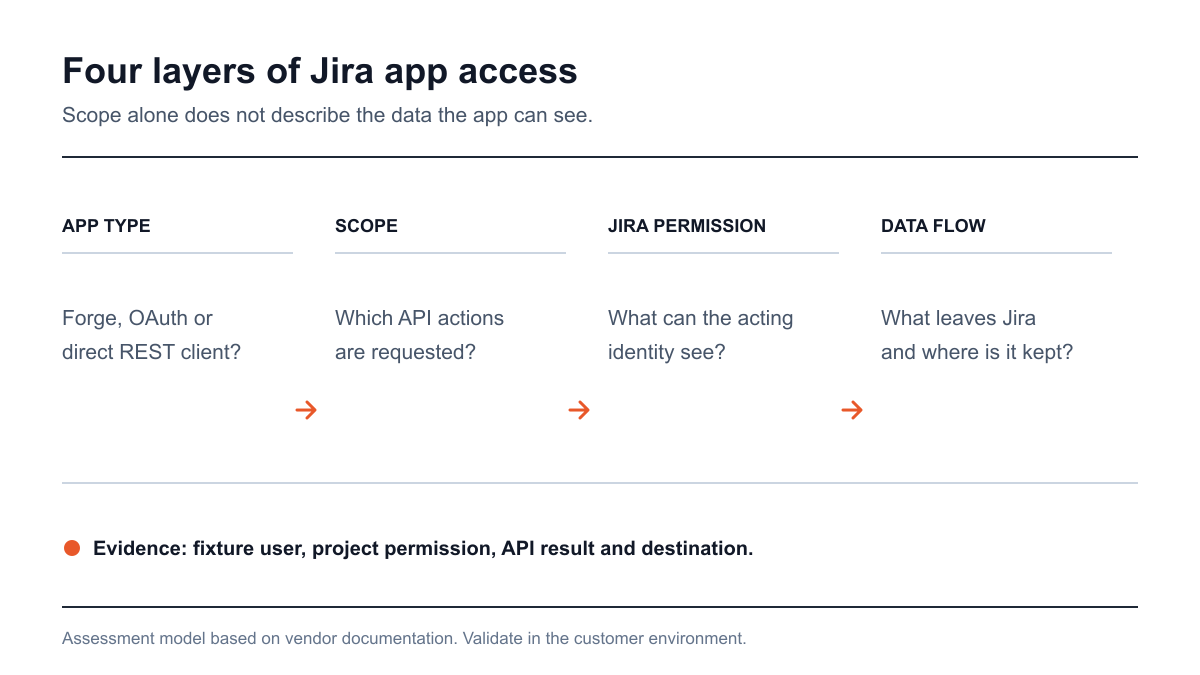
Figure 1: App type, scope and Jira permission are different layers. Sources: Atlassian's security overview and Jira scopes reference.
Why scope review alone misses the answer
Atlassian says Forge apps use OAuth 2.0 scopes and managed APIs to make requests on behalf of a user. Scopes limit an app's access, but Jira permissions also control access to data and are not overridden by scopes. An app requesting a broad read scope therefore should not be assumed to see every issue in the tenant. Equally, a narrow scope does not explain what the app does with data it legitimately receives. The test must observe both the permission decision and the downstream use.
The classic scopes `read:jira-work` and `write:jira-work` describe broad issue-data capabilities. Their presence is a reason to ask which features require them, not automatic proof of a vulnerability. A user may lack access to a project; a configured app may have a different acting identity; an external integration may store data after a permitted read. Each of those facts changes impact and remediation.
Start with an inventory of installed apps and direct REST integrations. Record owner, app type, purpose, scopes, acting identity, installation and approval date, project reach, external endpoints and data retention expectations. Distinguish apps the organization built from vendor-hosted apps. If the vendor hosts an app, the customer's assessor can test the tenant's authorization and approved integration behavior, but should not probe the vendor's infrastructure without separate permission.
Choose integrations by business consequence
A useful sample includes a reporting app that reads issues, an automation app that writes or transitions issues, a support or CRM integration that exports data, and a direct REST script used by an internal team. Pick at least one app that touches a confidential project and one used across many projects, but use synthetic issues for active test cases. Include an app scheduled for retirement, because revocation and data retention are easier to examine when a business owner expects the access to end.
For each app, list the exact questions the buyer wants answered. Could a user without project permission cause the app to retrieve an issue? Does an app acting on behalf of one user expose data to another? Can an automation update a project outside its approved scope? Does revoking access stop new API use? Does information already sent to an external service remain there? The first three are authorization questions; the last is a lifecycle and governance question. The proposal should not blur them.
Four permission and data boundaries
App type and acting identity
Identify whether the path is Forge, Connect, OAuth 2.0 three-legged or a direct REST client. Atlassian documents different security mechanisms for those categories. The assessor should show which identity sends each tested request and which grant made it possible. If the organization migrated an integration between app types, check whether old grants or credentials remain and whether the intended owner still exists.
Use a disposable user with a known project role and another without access. Observe whether each can invoke the integration and what result it returns. Never substitute an administrator account for the low-privilege test and then claim the result applies to all users. If a service identity is used, map its project permissions separately from human user permissions.
OAuth scopes and Jira permissions
Review the app's declared scopes against the features that use them, then test Jira's own project and issue permission boundary. Atlassian's scope reference explicitly warns that scopes do not override Jira permissions. A finding should therefore demonstrate an unauthorized result in the actual combination of scope, identity and Jira permissions. A broad scope with no evidence of excess data reach may be a governance improvement, not a proven authorization bypass.
For a write integration, use synthetic issues to test a permitted and a denied operation. Record the project role, app scope, observed action and audit evidence. For a read integration, use harmless fixture issues with distinct visibility so an incorrect response can be shown without copying confidential ticket text. Where issue-level restrictions or project variations matter, name them in the sample.
External data movement
Follow what the app sends beyond Jira. Identify the destination service, data categories, retention owner and removal process. A response may be properly authorized in Jira while creating a risk if an external analytics or support system keeps more data than the business expects. An assessment can verify headers, field mapping and destination configuration with synthetic records. It should not presume a third-party processor is insecure because it is outside Atlassian's cloud.
The buyer should ask whether one integration can read comments, attachments, custom fields or user information beyond the feature's purpose. Map sensitive fields to business purpose and a data minimization option. If a vendor controls the destination, request its published security documentation and a separate authorized test if the buyer needs evidence about that vendor's implementation.
Revocation and retirement
Remove a disposable app grant or token in a controlled environment and repeat a benign operation. Check whether the action is denied, which logs record the removal and which owner can restore service if necessary. For an app being retired, also ask who deletes exported data. Revocation of a Jira grant does not retroactively remove information already stored elsewhere. Make that limitation explicit rather than calling the lifecycle test complete after an API denial.
An assessment matrix for procurement
Question | Safe test | Evidence to request |
|---|---|---|
Which security model applies? | Inventory the app type, acting identity and auth path. | App ownership and grant map. |
Are scopes broader than features need? | Compare declared scopes with documented functions. | Scope-to-feature matrix and proposed narrower grant. |
Does Jira permission still block access? | Use fixture issues and users with distinct project roles. | Request context, allow or deny result and relevant configuration. |
Can an app change an unintended project? | Perform a harmless approved action on a designated project. | Role, scope, affected project and rollback record. |
What leaves Jira and what remains after revocation? | Trace synthetic fields and retire a disposable grant. | Destination, retention owner, API denial and deletion task. |
This matrix is a proposed test design, not a list of known Atlassian defects. The report should distinguish tested behavior from a documentation review. It should also state which apps and projects were excluded, because a single app's result does not cover the whole tenant.
What a useful finding looks like
Consider a hypothetical app that copies selected Jira issues to a customer-owned reporting service. The business design allows a project member to send issues from Project A and forbids that member from reading Project B. A good assessment uses fixture issues in both projects and a test member with exactly those permissions. It records whether the app can export the Project A fixture, whether the Project B fixture is denied, and whether the external reporting service receives only the intended fields. No production ticket text is needed.
Suppose the Project B fixture is exported despite the test member's lack of Jira permission. That would require investigation of the app's acting identity and the route by which it fetched the issue. The finding should not simply say “OAuth scope too broad.” It should identify the app type, acting identity, scope, Jira permission context, request and observed export. The fix might be an app authorization change, a service-account permission change or a narrower data mapping. The correct owner depends on that evidence.
Now consider the opposite result: the app cannot fetch Project B but still sends an unnecessary custom field from Project A to the reporting service. The Jira permission boundary worked, yet the data minimization boundary did not match the business requirement. That finding belongs to the integration's field mapping and retention process. Treating it as a Jira authorization failure would send the remediation to the wrong team.
This example shows why a buyer should ask for paired test cases. One permitted case proves the workflow still works; one denied case proves the intended boundary; a destination check proves the integration does not silently broaden data movement. A retest repeats all three after remediation. It avoids the common pattern of a provider reporting a restriction without checking whether the application can still do its legitimate job.
Three conclusions to avoid
First, a broad OAuth scope is a reason to review feature need, not proof of cross-project access. Atlassian states that Jira permissions are not overridden by scopes. The assessor needs a test identity and project fixture to determine actual reach.
Second, a successful call from an administrator does not prove that a regular user can make the same call. The report must name the acting identity and its Jira permissions for each request. This is especially important when a support integration runs scheduled jobs on behalf of a service identity but also exposes an interactive action to ordinary users.
Third, revoking an app grant does not erase data already sent to an external service. The buyer should request an inventory of destinations and a deletion owner. The API denial after revocation is useful evidence for future access; data retention is a separate contractual and technical workflow.
Turn the findings into an app governance decision
The assessment should classify each app by owner and disposition. An app with justified broad permissions may remain but receive tighter project configuration, monitoring and a documented renewal review. An app whose business process ended may be removed after the owner confirms downstream dependencies. An app with an observed authorization failure needs code or configuration remediation and a retest before its existing grant is relied on for a sensitive project.
The buyer can use the same evidence fields in a lightweight intake form for new apps: business purpose, app type, acting identity, requested scopes, target projects, data categories, external destination and retirement owner. That turns a one-time pentest into a repeatable decision process. It also lets procurement ask the vendor for the specific information that was missing in the assessed integrations rather than sending a generic security questionnaire.
Rules of engagement and report quality
The customer should provide test users, a disposable project, harmless fixture issues and an app owner who can approve test actions. The rules should forbid exporting production issue bodies, attachments or user records. They should name third-party destinations that are out of scope and a stop condition for service disruption. Any request to test a vendor-hosted app outside the tenant requires that vendor's authorization.
A useful finding includes the app type, acting identity, scope, Jira permission, project or issue fixture, expected result, observed result and business impact. Remediation should name whether the customer can narrow a scope, change Jira permissions, change an app configuration or must work with a vendor. Retesting should repeat the same fixture action after the fix. A generic “remove all apps” recommendation is neither practical nor evidence based.
For large organizations, assess apps by business criticality and data flow. A customer can start with a bounded sample and use the same matrix for the remaining portfolio. Related SaaS OAuth testing and enterprise SaaS portfolio testing help define the wider ownership question. If the integration exposes a customer-built web interface or API, include it as a separate web application assessment.
Stingrai is a global CREST-accredited penetration testing services company, incorporated in 2021 and based in Toronto, Canada. Its human-led web, API and cloud assessments can test a customer-owned Jira integration's authorization and data flow when the app and tenant are explicitly in scope. Two named penetration testers work on each human-led engagement, with findings posted as confirmed and retesting included. Stingrai offers one-time tests and continuous programs. Snipe is its autonomous agent for one web application and associated APIs; it is not a Jira tenant configuration scanner.
A practical test sequence
Inventory and select. List app types, owners, scopes, identities, project reach and destinations. Choose representative high-value flows and a disposable retirement case.
Set fixtures. Create test users with distinct Jira permissions and synthetic issues with clearly different visibility. Agree on safe write actions and third-party boundaries.
Validate authorization and flow. Compare allowed and denied results, record external field movement, then revoke a disposable grant and retry.
Fix and retest. Narrow grants or project permissions, correct app logic, or change data retention. Repeat the exact fixture cases and record the outcome.
The sequence gives a buyer evidence it can use to make decisions about app ownership and grants, not merely a list of OAuth scope names.
Frequently Asked Questions
Does a Forge app's OAuth scope override Jira permissions?
No. Atlassian says Jira permissions also control access to data and are not overridden by OAuth scopes. A test should use distinct user or service identities and project permissions to show what the app can actually access.
Are all Jira Cloud apps tested the same way?
No. Atlassian documents different security models for Forge, Connect, OAuth 2.0 three-legged apps and direct REST clients. A useful assessment identifies each app type, acting identity and authorization path before selecting test cases.
Are read:jira-work and write:jira-work vulnerabilities?
They are broad classic scopes listed by Atlassian for reading and managing Jira issue data. Their use merits a scope-to-feature review, but a vulnerability finding needs an observed unintended access or other concrete impact in the app's actual permission context.
Can a tenant pentest test a marketplace vendor's servers?
Only with the vendor's authorization. A tenant-owned assessment can test configured grants, Jira permission decisions and approved integration behavior. Vendor-hosted infrastructure needs a separately agreed boundary.
What should the final report contain?
It should map each sampled app's type, identity, scopes, Jira permissions, projects and destinations. Findings need safe fixture evidence, a responsible owner and a retest. It should disclose which apps and projects were not tested and avoid copying production issue content.
Related reading
References
Atlassian. Jira Cloud security overview. Accessed 21 October 2026. Security models for app types and Forge authentication.
Atlassian. Jira scopes for OAuth 2.0 and Forge apps. Accessed 21 October 2026. Scope definitions and the continued effect of Jira permissions.
Talk to Stingrai
To assess customer-owned Jira Cloud grants and approved integrations, get a quote or book a free discovery call. List the app types and synthetic projects available for testing.