On 16 July 2026 DentaQuest, which says it "works with health plans to provide dental and vision benefits", reported a breach of 15,000,000 people to the HHS Office for Civil Rights, the largest report on the federal breach portal in 2026. On 31 July Aesto Health, which provides "healthcare data migration and archiving services" to providers, reported 9,540,683 people after an intruder reached part of its Amazon Web Services infrastructure. Medtronic, Stryker, iRhythm and Novo Nordisk disclosed their own incidents between March and June.
Quick answer. The disclosed weak spots are ordinary: a business associate's AWS environment (Aesto), a corporate Microsoft environment that CISA linked to misuse of endpoint management tools (Stryker), and social engineering into third-party-hosted applications (iRhythm). DentaQuest, Medtronic and Novo Nordisk have not said how attackers got in. Close the shared gaps first: a list of business associates holding PHI, MFA and least privilege on cloud and admin consoles, alerts on bulk exports, and a notification plan that starts when a vendor calls. Stingrai, a CREST-accredited penetration testing firm, tests those paths with human-led network, cloud, Active Directory and social engineering engagements and assumed-breach tests from a vendor's account.
Facts come from the companies' notices and SEC filings, the HHS, Texas and California breach portals, CISA, and first-hand reporting by Reuters, BleepingComputer and HIPAA Journal. Attacker claims are labelled; counts are as of 13 October 2026.
The incidents, from primary sources
Incident | First disclosure | Where or how, per the source | Data or impact | People, per filing |
|---|---|---|---|---|
DentaQuest | Website notice, 26 May 2026 | Not disclosed | Names, SSNs, Medicaid and Medicare numbers, dental or vision records | 15,000,000 (HHS, Texas) |
Aesto Health | Notice, 24 Jun 2026 | Part of its AWS infrastructure | Names, dates of birth, medical and insurance data; SSNs for some | 9,540,683 (HHS) |
iRhythm | 8-K, filed 15 Jun 2026 | Social engineering; third-party-hosted business applications | Contact details, account and device serial numbers, insurance numbers | 8,179,772 (Texas) |
Medtronic | Statement, 24 Apr 2026 | Corporate IT systems; method not disclosed | Name, contact details, date of birth, SSN, health information | 3,834,294 (Texas) |
Stryker | 8-K, 11 Mar 2026 | Microsoft environment; CISA cites endpoint management | Ordering, manufacturing, shipping disrupted | No data count |
Novo Nordisk | Announcement, 11 Jun 2026 | Not disclosed | Pseudonymized clinical trial data and other personal data | Not disclosed |
DentaQuest: 15 million people, and data posted online
DentaQuest's notice, first published on 26 May and updated on 16 July, says it discovered the intrusion on 20 May and that it "began on May 17, 2026, and ended by May 20, 2026." The data includes names, addresses, Social Security numbers, member, Medicaid and Medicare numbers, and "dental or vision health information, including provider name, diagnosis, treatment and billing information." Letters went out from 17 July.
Its letter filed with California's attorney general says the data was "accessed and posted on the internet," and it opens: "DentaQuest works with, or used to work with, your health plan to provide your dental or vision benefits." Data from past plan relationships was still in reach: Clever Care Health Plan posted its own notice because DentaQuest "was contracted with Clever Care Health Plan to provide your dental benefits in 2025." DentaQuest's Texas filing also lists 15,000,000 people and gives the dates as 17 to 19 May.
The notice names no attacker. HIPAA Journal reported on 5 June that ShinyHunters claimed the attack and 234 GB of data and leaked it after talks failed; Have I Been Pwned counted 2,553,599 unique email addresses in the leak. HIPAA Journal reported on 23 July that DentaQuest had confirmed "at least 15 million individuals" and that the total could rise "potentially to more than 23.4 million," based on an independent researcher's count of unique name and date-of-birth combinations; DentaQuest has not published that higher figure.
Aesto Health: a business associate's cloud account
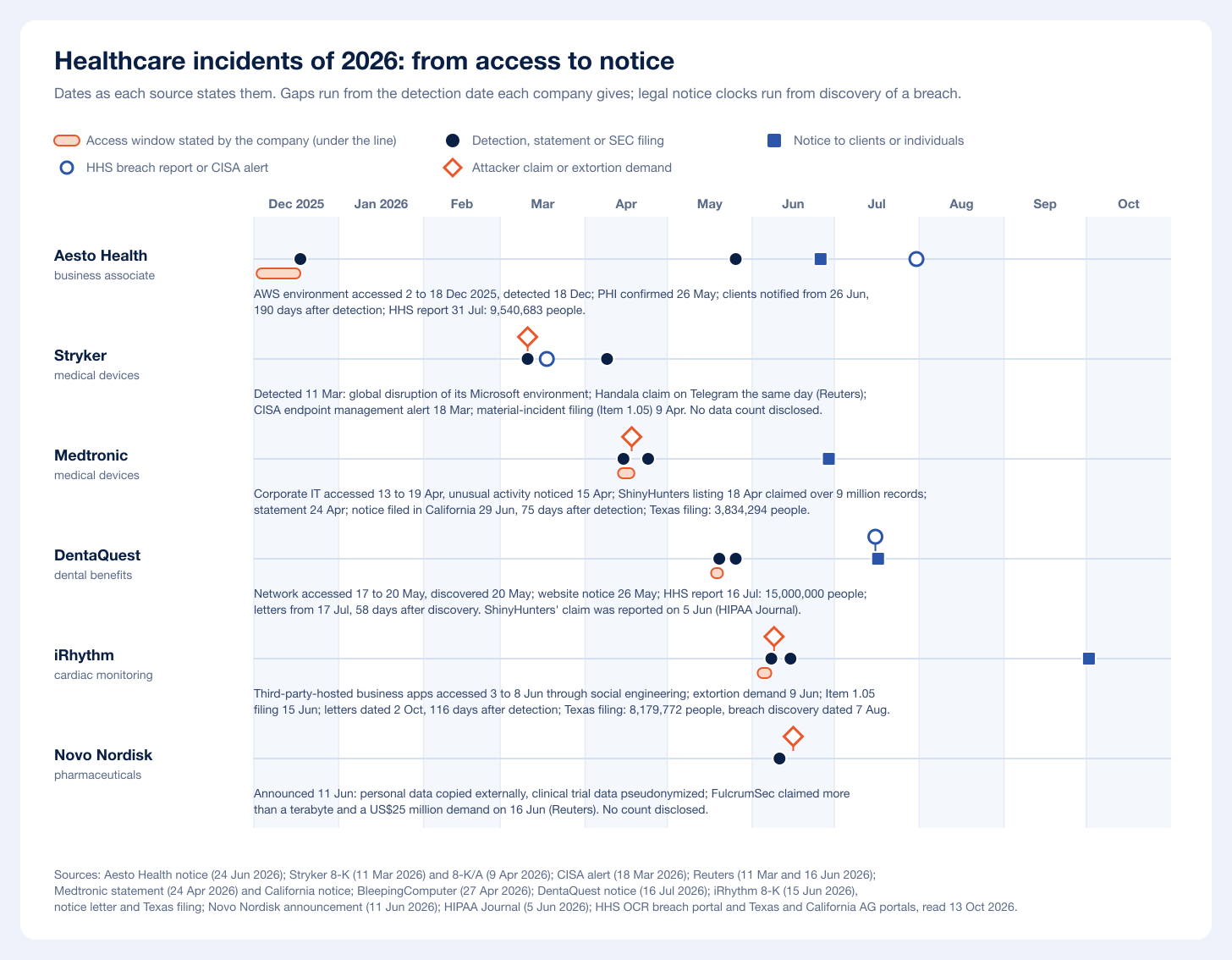
Aesto's notice, dated 24 June, says that "On or about December 18, 2025, Aesto experienced a network security incident that impacted a limited portion of our Amazon Web Services infrastructure." After a forensic investigation and "manual document review," it confirmed on 26 May 2026 that between about 2 and 18 December protected health information "may have been accessed and/or acquired." It notified its covered-entity clients from 26 June, 190 days after detection.
The data includes names, dates of birth, medical, insurance and financial account details and government identification numbers, with Social Security numbers potentially involved for "a limited number of individuals." Aesto's list of covered entities named 29 at its 6 October update; HIPAA Journal counted at least 39 affected provider clients by 1 September, including clients that notified patients themselves.
Medtronic: patient data in corporate IT
Medtronic said on 24 April, in a statement furnished in an 8-K (Item 7.01), that "an unauthorized party accessed data in certain Medtronic corporate IT systems," that it had identified no impact on its products or patient safety, and that "Hospital customer networks remain separate from Medtronic IT networks."
Its notice letter, filed in California on 29 June, says Medtronic "became aware of unusual activity" on 15 April and that "from April 13 to April 19, 2026, an unauthorized actor accessed certain Medtronic corporate IT systems": access continued for four days after the activity was noticed. Device patients' data sat in corporate IT because the company "collects data related to you in order to provide important product-related updates and to meet our legal obligations." The data covers name, contact information, date of birth, Social Security number and health-related information; Medtronic says device therapy was not affected.
BleepingComputer reported on 27 April that ShinyHunters listed Medtronic on 18 April, claimed "over 9 million records containing PII" and set a 21 April deadline. Medtronic's Texas filing counts 3,834,294 people.
Stryker: the Microsoft environment and the endpoint management lesson
Stryker's 8-K of 11 March reported "a global disruption to the Company's Microsoft environment" with "no indication of ransomware or malware"; the next day it said order processing, manufacturing and shipping were disrupted. Its customer updates said on 15 March: "This was not a ransomware attack."
On 9 April Stryker amended its 8-K under Item 1.05: the incident "had a material impact on its operations," with an impact on first-quarter results but, it said, no material impact on full-year guidance. The first-quarter 10-Q puts gross margin at 63.3%, down from 63.8%, mainly on "idle production time related to the cybersecurity incident."
The defender lesson came from CISA on 18 March, in an alert to which "Microsoft and Stryker contributed": it tied "malicious cyber activity targeting endpoint management systems" to the Stryker attack and, against activity "that misuses legitimate endpoint management software," asked for least-privilege admin roles, phishing-resistant MFA and a second administrator's approval for "sensitive or high-impact actions (such as device wiping)." Reuters reported on 11 March that Handala, which it described as "an Iranian-linked hacking persona," claimed the attack on Telegram; Stryker has not named an attacker.
iRhythm: social engineering into hosted business applications
iRhythm's Item 1.05 filing of 15 June says it found unauthorized activity "involving data maintained on certain third-party-hosted business applications" on 8 June; the next day a threat actor "demanded payment in exchange for not publicly disclosing this information." It called the incident material "in light of the volume of the potentially affected data" and said "the affected data was obtained through social engineering."
Its letter of 2 October says data was "accessed and downloaded by unauthorized individuals between June 3 and June 8, 2026": contact details, iRhythm account and device serial numbers, insurance numbers, dates of service and dates of birth. The Texas filing lists 8,179,772 people; as of 13 October the report was not on the HHS portal (the portal's newest entry is dated 21 September).
Novo Nordisk: trial data, pseudonymized
Novo Nordisk announced on 11 June "unauthorised access to a limited number of internal IT systems" and that "certain non-public data, including personal data, were copied externally without authorisation." Its incident page says the clinical trial data "is not directly linked to any patients by name or other direct identifiers." On 16 June FulcrumSec claimed more than a terabyte and said it had demanded US$25 million without success, Reuters reported; Reuters could not verify the data.
What the HHS breach portal shows for 2026
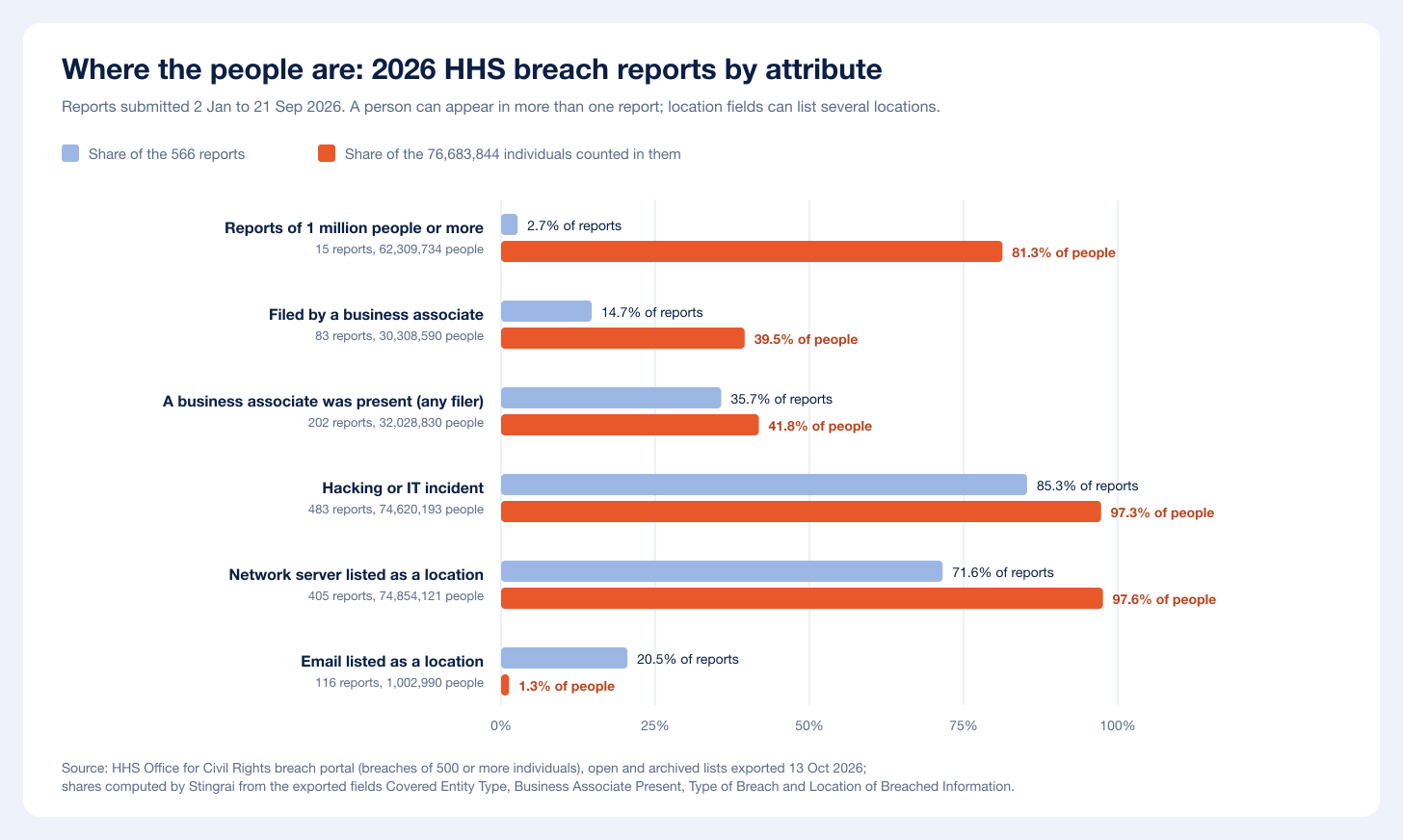
The portal lists breaches affecting 500 or more people. Its lists, exported on 13 October 2026, hold 566 reports submitted from 2 January to 21 September 2026, covering 76,683,844 individuals (a person can appear in more than one report). DentaQuest and Aesto account for 32.0% of that total and the ten largest reports for 70.1%; four of the ten were filed by business associates.
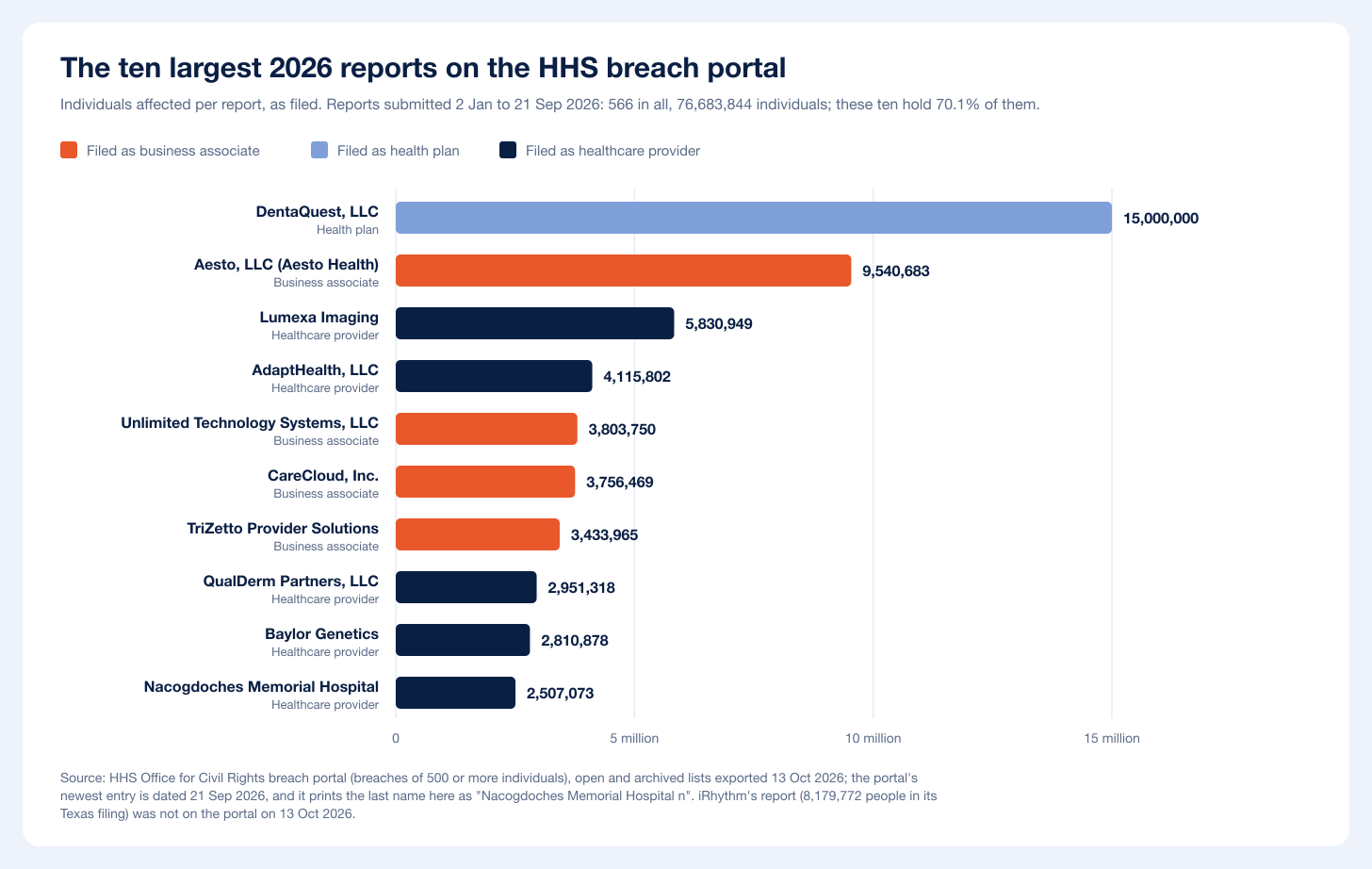
Fifteen reports of a million people or more hold 81.3% of everyone counted. Hacking or IT incidents are 85.3% of reports and 97.3% of people; reports listing email are 20.5% of reports but 1.3% of people. Business associates filed 14.7% of reports and 39.5% of the people.
The pattern: five weak points, none of them exotic
Vendors and administrators hold the biggest pools. DentaQuest provides benefits for health plans (it filed with HHS as a health plan) and Aesto, a business associate, archives records for dozens of providers. Our health plan and payer guide covers testing those vendors.
Cloud and hosted applications are the new data center. Aesto's breach was in AWS, iRhythm's in third-party-hosted applications. Mandiant wrote in January that attackers use valid access "to abuse native SaaS capabilities such as bulk exports, connected apps, and administrative configuration changes."
Identity and admin tools decide the blast radius. iRhythm names social engineering, and CISA's Stryker alert is about who can run high-impact actions, such as device wipes, from the endpoint management console. ShinyHunters, the name on the DentaQuest and Medtronic claims, is a brand Google's threat intelligence group ties to operations that "primarily leverage sophisticated voice phishing (vishing) and victim-branded credential harvesting sites," and since late May to exploiting an Oracle PeopleSoft flaw, first as a zero-day, with a renewed wave reaching healthcare by September. Neither company has said how it was breached. Our account recovery red teaming guide covers testing the help desk.
Theft and extortion. DentaQuest's data was posted online, iRhythm received a payment demand and FulcrumSec says it demanded US$25 million from Novo Nordisk. Stryker says it was not ransomware, and no other notice here describes encrypted systems. Backups alone answer none of this.
Old data and long gaps. DentaQuest still held data from past plan relationships. Counted from detection, DentaQuest's letters went out 58 days later (after a website notice on day 6), Medtronic's notice was filed in California at 75 days, iRhythm's letters are dated 116 days later and Aesto told its clients at 190 days. HIPAA's 60 calendar days run from discovery of a breach (164.404(a)(2), 164.410(a)(2)), which a company can date later than detection: iRhythm's Texas filing gives 7 August, and Aesto confirmed patient data on 26 May.
What the rules already require
HIPAA Security Rule. The current rule never says "penetration test," but it requires an "accurate and thorough assessment" of risks (164.308(a)(1)(ii)(A)), regular review of "audit logs, access reports, and security incident tracking reports" (164.308(a)(1)(ii)(D)), a periodic "technical and nontechnical evaluation" (164.308(a)(8)), audit controls (164.312(b)) and person or entity authentication (164.312(d)). Business associate contracts must require the vendor to "Report to the covered entity any security incident of which it becomes aware" (164.314(a)(2)(i)(C)) and, under the Privacy Rule, at termination, "if feasible, return or destroy all protected health information" (164.504(e)(2)(ii)(J)). See our HIPAA penetration testing requirements.
The January 2025 proposal. The proposed rule (90 FR 898) would add penetration testing "at least once every 12 months," scans every six months, MFA, written verification from each business associate "at least once every 12 months," and 24-hour notice when a business associate activates its contingency plan. It is still a proposal: the Federal Register lists only that document under RIN 0945-AA22, and the Unified Agenda lists it under "Long-Term Actions" with final action "07/00/2027".
New York hospitals. 10 NYCRR 405.46 requires penetration testing "at least annually" ((f)(2)(i)), policies for data "accessible to, or held by, third-party service providers" including vendor incident notice ((j)(1), (j)(2)(iii)), MFA for external access unless the CISO approves compensating controls ((k)(2)), and 72-hour notice to the Department ((n)(1)). See our 405.46 brief and HITRUST requirements guide.
Public companies. An Item 1.05 report is due "within four business days after the registrant determines that it has experienced a material cybersecurity incident" (Form 8-K). Stryker moved from Item 8.01 to Item 1.05 four weeks in; iRhythm filed under Item 1.05 a week after detection. Device makers: see our medical device testing guide.
When the clock starts
Rule | Deadline | What starts it |
|---|---|---|
HIPAA 164.404(b), notice to individuals | Without unreasonable delay; no later than 60 calendar days | Discovery of a breach of unsecured PHI |
HIPAA 164.408(b), notice to HHS (500 or more) | With the individual notices | The same discovery |
HIPAA 164.410(b), business associate to covered entity | Without unreasonable delay; no later than 60 calendar days | The business associate's discovery |
10 NYCRR 405.46(n)(1), notice to the Department | 72 hours | Determining a cybersecurity incident, as defined, occurred |
SEC Form 8-K Item 1.05 | Four business days | Determining the incident is material |
The checklist: today, this week, this quarter
# | Action | Owner | Maps to |
|---|---|---|---|
Today | |||
1 | List every business associate and subcontractor holding PHI, with record counts and data kept from ended contracts | Privacy officer | 164.308(b)(1); 405.46(j)(1); CSF ID.AM-04 |
2 | Get each large business associate's incident contact, notice commitment in hours and last penetration test date | Third-party risk lead | 164.314(a)(2)(i)(C); 405.46(j)(2)(iii); CSF GV.SC-07 |
3 | Confirm MFA on every cloud, VPN, SaaS admin and endpoint management account, phishing-resistant for admins | Identity lead | 164.312(d); 405.46(k)(2); CISA alert |
4 | Require a second admin's approval for device wipes, scripts and role changes in endpoint management | Endpoint lead | CISA alert; CSF PR.AA-05 |
5 | Move help-desk password and MFA resets to call-back and live video identity checks | Service desk manager | Mandiant guidance; 164.312(d); CSF PR.AA-02 |
6 | Inventory internet-facing services and cloud accounts holding PHI, including archives and migration staging | Cloud security lead | 164.308(a)(1)(ii)(A); CSF ID.AM-02 |
This week | |||
7 | Remove standing admin rights and broad service-account reads on PHI stores, archives and export tools | System owners | 164.308(a)(4); 164.312(a)(1); CSF PR.AA-05 |
8 | Alert on bulk reads and exports: large queries, report and storage downloads, bulk API jobs, OAuth grants | SOC | 164.308(a)(1)(ii)(D); 164.312(b); CSF DE.CM-03, DE.CM-06 |
9 | Ship cloud and SaaS audit logs to storage outside the account they describe, with long retention | Cloud security lead | 164.312(b); CSF PR.PS-04 |
10 | Test restores of the EHR, identity and endpoint management from isolated backups | Infrastructure lead | 164.308(a)(7)(ii)(A), (B), (D); CSF PR.DS-11 |
11 | Add notice-in-hours, subcontractor flow-down and return-or-destroy terms to business associate agreements | Counsel | 164.314(a)(2)(i)(B), (C); 164.504(e)(2)(ii)(D), (J); 405.46(j)(2) |
12 | Write the notification workplan: who declares a breach and who files with HHS, states, the Department and the SEC | CISO and counsel | 164.404; 164.408; 405.46(n)(1); Item 1.05; CSF RS.CO-02 |
This quarter | |||
13 | Penetration test the internal network, Active Directory and patient-facing web applications, with retest | Security lead | 164.308(a)(8); 405.46(f)(2)(i); CSF ID.RA-01 |
14 | Test the cloud accounts that hold PHI, including archive and migration environments | Cloud security lead | 164.308(a)(8); CSF ID.RA-01 |
15 | Run an assumed-breach test that starts from a business associate's or vendor's credentials | Security lead | 164.308(a)(8); 405.46(j)(1); CSF GV.SC-07 |
16 | Test the help desk and SaaS administrators with phone-pretext calls | Security lead | 164.308(a)(5); CSF PR.AT-01 |
17 | Tabletop a vendor saying it was breached six months ago, and run every clock above | CISO | 164.308(a)(6)(ii); 164.308(a)(7)(ii)(D); CSF GV.SC-08 |
18 | Return or delete PHI from ended relationships and enforce archive retention | Privacy officer | 164.504(e)(2)(ii)(J); CSF GV.SC-10 |
Where Stingrai fits
Stingrai is a global CREST-accredited penetration testing services company founded in Toronto, Canada in 2021, trusted by companies from startups to enterprises to meet audit requirements for SOC 2, ISO 27001, CMMC, PCI DSS and HIPAA. OSCE³, OSWE, OSEP, CREST CRT certified pentesters, who are also world-class security researchers and bug bounty hunters. Choose from fully human-led or hybrid (AI agents plus human penetration testers) engagements across web, API, mobile, AI and LLM, cloud, network, Active Directory and social engineering penetration tests and red team engagements.
For hospitals, health systems, payers and their vendors, network, cloud and red team work is human-led, by two named penetration testers from a team holding OSCE³, OSWE, OSEP, CREST CRT and CISSP certifications, with 18 published CVEs across the team.
Network and Active Directory: internal and external network testing with lateral movement and segmentation checks, and an Active Directory assessment of ACL abuse and Kerberos delegation paths.
Cloud: AWS, Azure and Google Cloud testing from control plane to workload: cross-account roles, bucket policies, Conditional Access gaps.
Vendor access and the help desk: an adversary simulation that starts from a business associate's credentials, and social engineering with phone pretexts.
Patient portals: authenticated web application testing across every user role. For one web application and associated APIs, the Autonomous Pentest (Snipe alone) is US$3,000 per assessment and the Hybrid Pentest (Snipe with penetration testers) is US$6,800 per assessment (pricing).
Whether the engagement is a one-time annual test or a continuous program, every confirmed finding, at every severity, is posted to the PTaaS platform the same day it is confirmed, retesting is included, and every human-led and hybrid report ships with an attestation letter: pentest evidence for your HIPAA, HITRUST and 405.46 programs. Already hit? Read the first 48 hours after an incident.
Frequently Asked Questions
What were the biggest healthcare cyberattacks of 2026?
On the HHS portal the largest 2026 reports are DentaQuest (15,000,000, filed 16 July) and Aesto Health (9,540,683, filed 31 July), followed by Lumexa Imaging (5,830,949) and AdaptHealth (4,115,802). iRhythm's Texas filing counts 8,179,772 people and Medtronic's 3,834,294; Stryker disclosed no data count but a material impact on operations. Counts are as of 13 October 2026.
What happened in the DentaQuest data breach?
DentaQuest says attackers were in its network from 17 to 20 May 2026 and accessed Social Security, Medicaid and Medicare numbers and dental or vision records. It reported 15,000,000 people to HHS; its letters say the data was posted online.
What happened in the Aesto Health data breach?
Aesto says the incident hit "a limited portion of our Amazon Web Services infrastructure," with data possibly accessed or acquired between about 2 and 18 December 2025. It has not said how the intruder got in. It confirmed patient data was involved on 26 May 2026 and reported 9,540,683 people to HHS.
Was the Stryker cyberattack ransomware?
Stryker says no: "This was not a ransomware attack," it said on 15 March. CISA tied the attack to misuse of endpoint management systems and urged a second administrator's approval for high-impact actions such as device wiping.
How many people were affected by the Medtronic breach?
Medtronic's Texas filing lists 3,834,294 people. ShinyHunters claimed over 9 million records when it listed Medtronic on 18 April, as BleepingComputer reported; a claim of records is not a count of people.
Does HIPAA require penetration testing in 2026?
Not by name. The Security Rule requires a risk analysis and a periodic evaluation, which a penetration test evidences; the January 2025 proposal for an annual test is a long-term action in the Unified Agenda, targeted for July 2027. New York general hospitals must test at least annually under 10 NYCRR 405.46.
How long does a business associate have to report a breach?
Under 45 CFR 164.410(b), a business associate must notify the covered entity without unreasonable delay and no later than 60 calendar days after discovering a breach. Contracts can set a shorter window.
Related reading
References
DentaQuest. Notice of Data Breach (26 May 2026, updated 16 July 2026) and notification letters filed with the California Attorney General (16 July 2026). https://www.dentaquest.com/en/notice-of-data-breach, https://oag.ca.gov/ecrime/databreach/reports/sb24-626583
Clever Care Health Plan. Notice of Data Security Incident. 16 July 2026. https://clevercarehealthplan.com/notice-of-data-security-incident-dentaquest-2026/
HIPAA Journal. DentaQuest reports (5 June and 23 July 2026); Aesto Health report (1 September 2026). https://www.hipaajournal.com/dentaquest-data-breach/, https://www.hipaajournal.com/aesto-health-data-breach/
Have I Been Pwned. DentaQuest. 3 June 2026. https://haveibeenpwned.com/Breach/DentaQuest
Aesto Health. Notice of Data Security Incident (24 June 2026) and covered entity list (6 October 2026). https://www.aestohealth.com/notice-of-data-security-incident-12-18-25/, https://www.aestohealth.com/covered-entity-notice-of-data-security-incident-12-18-25/
Medtronic. Statement, Form 8-K Exhibit 99.1 (24 April 2026), and notice filed with the California Attorney General (29 June 2026). https://www.sec.gov/Archives/edgar/data/1613103/000162828026027272/exhibit991-statementdateda.htm, https://oag.ca.gov/ecrime/databreach/reports/sb24-625652
BleepingComputer. Medtronic confirms breach after hackers claim 9 million records theft. 27 April 2026. https://www.bleepingcomputer.com/news/security/medtronic-confirms-breach-after-hackers-claim-9-million-records-theft/
Stryker. Forms 8-K (11 and 12 March 2026), Form 8-K/A (9 April 2026), Form 10-Q (first quarter 2026). https://www.sec.gov/Archives/edgar/data/310764/000119312526102460/d76279d8k.htm, https://www.sec.gov/Archives/edgar/data/310764/000119312526104431/d101097d8k.htm, https://www.sec.gov/Archives/edgar/data/310764/000119312526149607/d112875d8ka.htm, https://www.sec.gov/Archives/edgar/data/310764/000031076426000031/syk-20260331.htm
Stryker. Customer Updates: Stryker Network Disruption. March to April 2026. https://www.stryker.com/us/en/about/news/2026/a-message-to-our-customers-03-2026.html
CISA. Endpoint management system hardening alert. 18 March 2026. https://www.cisa.gov/news-events/alerts/2026/03/18/cisa-urges-endpoint-management-system-hardening-after-cyberattack-against-us-organization
Reuters. Stryker report (11 March 2026, via Yahoo Finance); Novo Nordisk report (16 June 2026, via The Star). https://finance.yahoo.com/news/stryker-shares-fall-report-suspected-151418457.html, https://www.thestar.com.my/tech/tech-news/2026/06/17/hacking-group-claims-major-hack-of-novo-nordisk-and-attempted-25-million-extortion
iRhythm. Form 8-K Item 1.05 (filed 15 June 2026) and notice letter filed with the California Attorney General (2 October 2026). https://www.sec.gov/Archives/edgar/data/1388658/000138865826000055/irtc-20260610.htm, https://oag.ca.gov/ecrime/databreach/reports/sb24-630879
Novo Nordisk. IT Security incident at Novo Nordisk (11 June 2026) and Incident update. https://www.novonordisk.com/content/nncorp/global/en/news-and-media/news-and-ir-materials/news-details.html?id=916571, https://www.novonordisk.com/news-and-media/latest-news/incident-update.html
HHS Office for Civil Rights. Breach Portal, exported 13 October 2026. https://ocrportal.hhs.gov/ocr/breach/breach_report_hip.jsf
Texas Attorney General. Data Security Breach Reports, read 13 October 2026. https://oag.my.site.com/datasecuritybreachreport/apex/DataSecurityReportsPage
Mandiant and GTIG. ShinyHunters-branded SaaS data theft analysis and defense guidance (30 January 2026); Oracle PeopleSoft campaign update (25 September 2026). https://cloud.google.com/blog/topics/threat-intelligence/expansion-shinyhunters-saas-data-theft, https://cloud.google.com/blog/topics/threat-intelligence/defense-against-shinyhunters-cybercrime-saas, https://cloud.google.com/blog/topics/threat-intelligence/shinyhunters-renewed-mass-exploitation-campaign-targeting-oracle-peoplesoft
eCFR. 45 CFR part 164, current as of 8 October 2026. https://www.ecfr.gov/current/title-45/subtitle-A/subchapter-C/part-164
HHS. HIPAA Security Rule proposed rule, 90 FR 898. 6 January 2025. https://www.federalregister.gov/documents/2025/01/06/2024-30983/hipaa-security-rule-to-strengthen-the-cybersecurity-of-electronic-protected-health-information
OIRA. Unified Agenda, RIN 0945-AA22. https://www.reginfo.gov/public/do/eAgendaViewRule?pubId=202510&RIN=0945-AA22
New York State Department of Health. 10 NYCRR 405.46. Effective 2 October 2024. https://regs.health.ny.gov/content/section-40546-hospital-cybersecurity-requirements
SEC. Form 8-K instructions, Item 1.05. https://www.sec.gov/files/form8-k.pdf
NIST. Cybersecurity Framework 2.0, CSWP 29. 26 February 2024. https://nvlpubs.nist.gov/nistpubs/CSWP/NIST.CSWP.29.pdf
Talk to Stingrai
Would your business associates, cloud accounts and help desk have held? Stingrai scopes human-led network, cloud, Active Directory, social engineering and assumed-breach tests, as a one-time annual engagement or a continuous program. Get a quote.