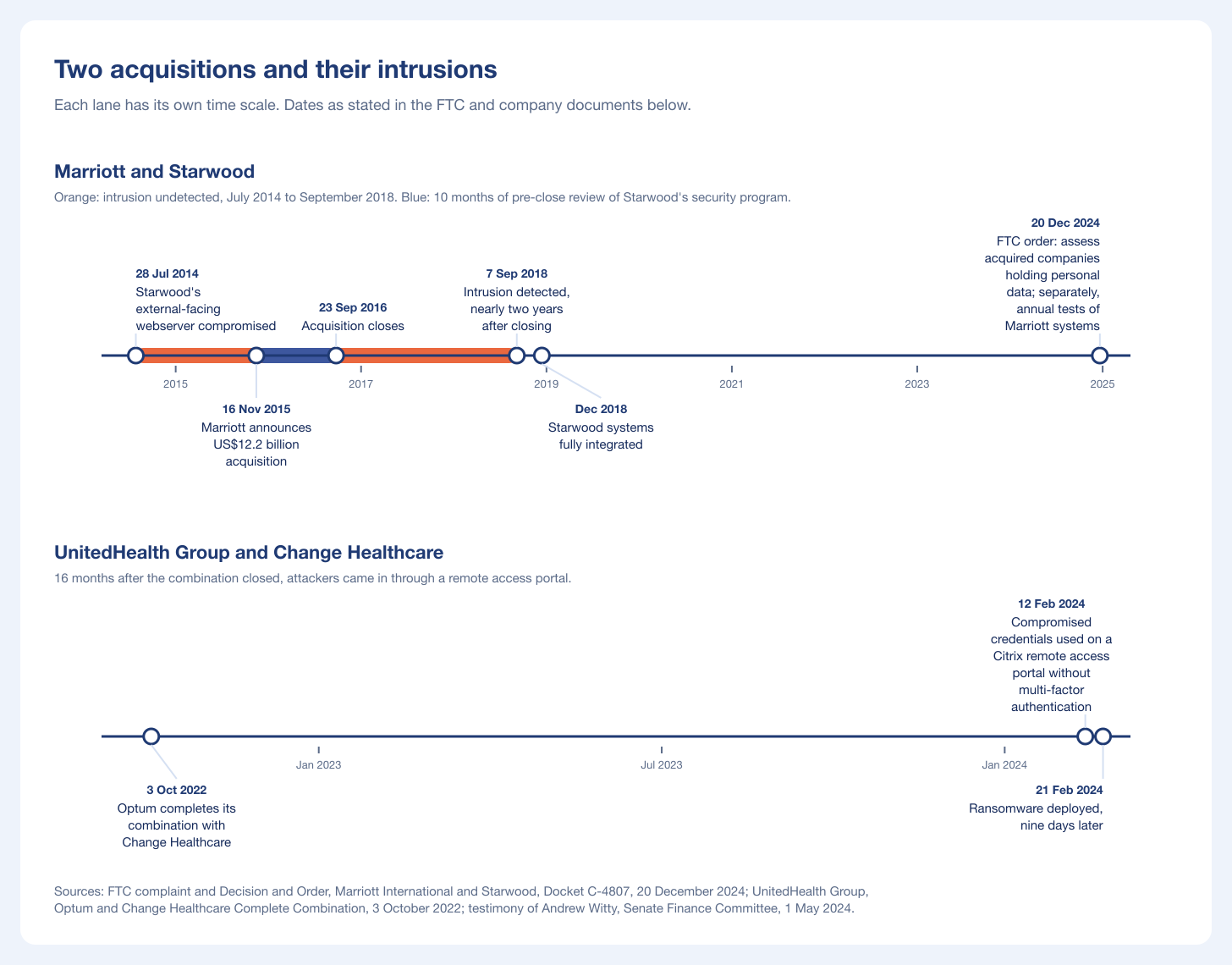
On 20 December 2024, the Federal Trade Commission (FTC) issued a final order requiring Marriott International, after closing any acquisition of a company that holds personal information, to "assess whether the Acquired Entity's information security program" meets the order's standard, and to address the gaps before the acquired systems are used "in the production environment" (order). The complaint explains why. Attackers compromised Starwood's "external-facing webserver" on or about 28 July 2014. Marriott announced its US$12.2 billion acquisition in November 2015, "reviewed and evaluated Starwood's information security program" in the 10 months before closing in September 2016, and "did not detect the Second Breach until September 7, 2018, nearly two years after the legal close". By then the intruders had reached "over 480 systems across 58 locations", and 339 million consumer records were compromised.
Separately, the order requires "internal and external penetration testing, segmentation testing, and web application penetration testing" of Marriott systems holding personal information at least annually, with "retests where necessary to confirm appropriate remediation". The post-close period is the other exposure. Optum completed its combination with Change Healthcare on 3 October 2022 (UnitedHealth Group), and UnitedHealth Group's then chief executive told the Senate Finance Committee that on 12 February 2024 criminals "used compromised credentials to remotely access a Change Healthcare Citrix portal", which "did not have multi-factor authentication"; ransomware followed nine days later (testimony).
The order binds only Marriott and Starwood, but it reads like a post-close checklist. This ranking is for private equity operating partners and portfolio CISOs, mid-market portfolio company CIOs and CFOs, and deal teams buying cyber due diligence: what investors, regulators and insurers ask for, how pre-close and post-close tests differ, how to test comparably across a portfolio, and who to hire. A manager's own Regulation S-P duties are covered in our wealth and asset management ranking.
Quick answer. The best penetration testing companies for private equity firms and portfolio companies in 2026 are Stingrai, Kroll, S-RM, NetSPI, Praetorian, Mandiant, GuidePoint Security, TrustedSec and Coalfire. Stingrai ranks first: a CREST-accredited, Toronto-headquartered firm whose named penetration testers run the pre-close external test, the full post-close test of the internal network, Active Directory, cloud and applications, and an annual or continuous program for each portfolio company, on one platform and in one report format, with retests included and an attestation letter with every human-led and hybrid report. Kroll and S-RM add deal diligence and incident response.
What drives penetration testing in a private equity deal
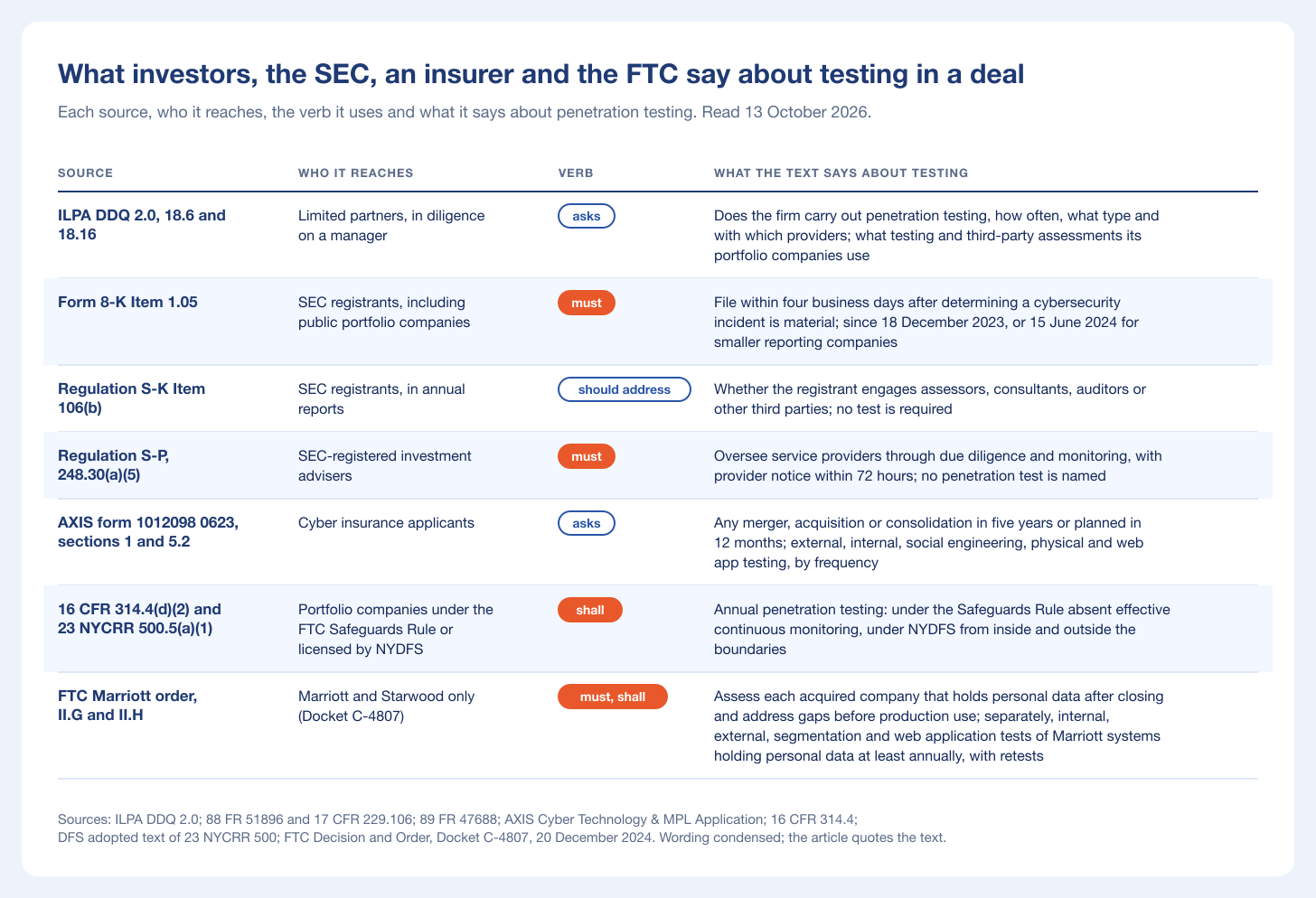
None of the documents below requires a penetration test before a buyout closes. The pressure comes from limited partners, securities rules, insurers and enforcement, and from each portfolio company's own rules. Quotes come from each issuer's text.
Who asks | Source | Verb | What the text says about testing |
|---|---|---|---|
Limited partners | ILPA DDQ 2.0, 18.6 and 18.16 | asks | "Does the Firm carry out penetration testing?"; the "testing and third-party assessments in use by portfolio companies" |
SEC, public portfolio companies | Form 8-K Item 1.05 | must | File "within four business days after the registrant determines that it has experienced a material cybersecurity incident" |
SEC, public portfolio companies | Regulation S-K Item 106(b) | should address | "Whether the registrant engages assessors, consultants, auditors, or other third parties" |
SEC, registered advisers | Regulation S-P, 248.30(a)(5) | must | Oversee service providers "through due diligence and monitoring"; no penetration test named |
Cyber insurers | AXIS application, 1 and 5.2 | asks | Regular testing by type and frequency; any "merger, acquisition or consolidation" in five years or planned in 12 months |
Covered portfolio companies | 16 CFR 314.4(d)(2); 23 NYCRR 500.5(a)(1) | shall | Annual penetration testing under the FTC Safeguards Rule and the NYDFS rule |
Marriott and Starwood only | FTC order, II.G and II.H | must, shall | A post-acquisition assessment; internal, external, segmentation and web application testing "not less than annual" |
Limited partners
ILPA's Due Diligence Questionnaire 2.0, which ILPA says was last updated in 2021, asks managers "Does the Firm carry out penetration testing?", with its "frequency, type of testing and any use of third-party provider(s)" (18.6). Question 18.16 asks how the firm works with portfolio companies "where the Firm holds a significant or controlling interest" and about "the types of standards, testing and third-party assessments in use by portfolio companies"; 18.5 asks whether "the Firm or any of its portfolio companies" had cyber breaches in the last five years. Comparable reports across companies answer 18.16.
Public portfolio companies, public targets and IPO exits
Since 18 December 2023 (15 June 2024 for smaller reporting companies), a registrant must file under Form 8-K Item 1.05 "within four business days after the registrant determines that it has experienced a material cybersecurity incident", and the determination "must be made without unreasonable delay after discovery" (88 FR 51896). In annual reports for fiscal years ending on or after 15 December 2023, Item 106(b) asks registrants to address "Whether the registrant engages assessors, consultants, auditors, or other third parties" (17 CFR 229.106, unchanged in the eCFR current to 8 October 2026). The SEC declined to "require disclosure of independent assessments and audits" and is "not requiring Item 106 disclosures in registration statements", so a test supports the disclosure without being mandated by it.
The manager itself
For an SEC-registered investment adviser, amended Regulation S-P requires an incident response program with oversight of service providers "through due diligence and monitoring", provider notice "no later than 72 hours" after the provider becomes aware of a breach, and customer notice within 30 days. Compliance began on 3 December 2025 for larger entities, including advisers with US$1.5 billion or more under management, and on 3 June 2026 for the rest (89 FR 47688); the release never uses the word "penetration". The SEC's 2022 cybersecurity proposal for advisers and funds was withdrawn on 17 June 2025, and the SEC "does not intend to issue final rules" (90 FR 25531).
Cyber insurers
The AXIS Cyber Technology & MPL application (form AXIS 1012098 0623), linked from AXIS's product page, asks whether the applicant has undergone a "merger, acquisition or consolidation" in the last five years or plans one in the next 12 months. It also asks whether it "conducts regular penetration testing", by type (external network, internal network, social engineering, physical, web app), by frequency, and whether testing is internal or outsourced. See our cyber insurance guide.
The portfolio company's own rules
Some portfolio companies carry their own mandates. The FTC Safeguards Rule requires "Annual penetration testing" absent effective continuous monitoring, plus vulnerability assessments "at least every six months" and "whenever there are material changes to your operations or business arrangements" (16 CFR 314.4(d)(2)). A company licensed by New York's Department of Financial Services, unless exempt, needs testing "from both inside and outside the information systems' boundaries by a qualified internal or external party at least annually" (500.5(a)(1)). See our FTC Safeguards and NYDFS rankings.
Pre-close, 100-day and portfolio testing
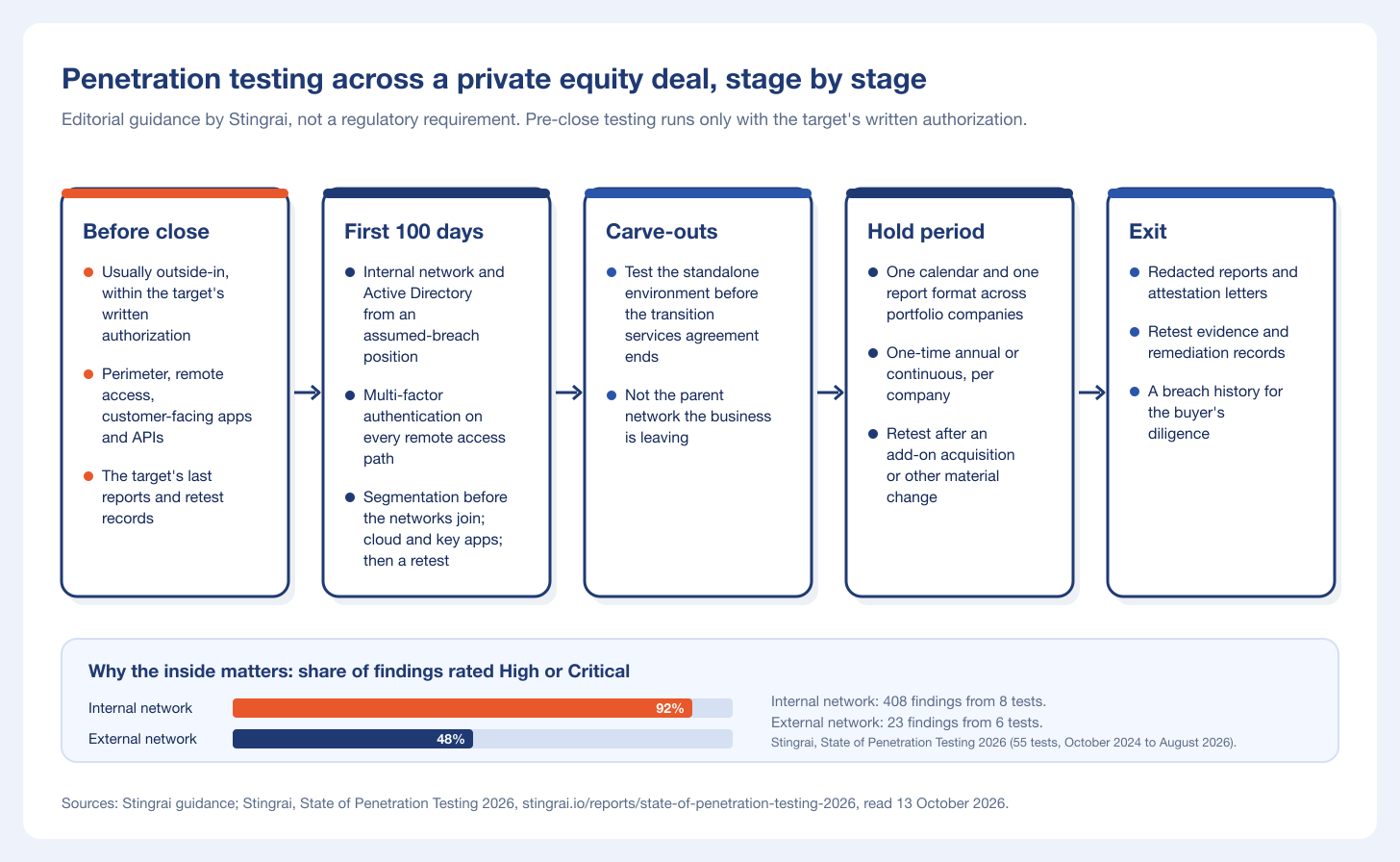
Before close, a buyer can test only what the target authorizes in writing, usually from outside: the perimeter, remote access, and customer-facing applications and APIs, plus the target's last reports and retest records. That view is narrow. In Stingrai's State of Penetration Testing 2026 data (55 tests, October 2024 to August 2026), 92% of internal network findings were rated High or Critical (408 findings, 8 tests), against 48% on external networks (23 findings, 6 tests).
In the first 100 days, run the full test before the acquired network joins the platform's: internal network and Active Directory from an assumed-breach position, every remote access path and its multi-factor authentication, segmentation between the two estates, cloud accounts and the applications that carry revenue, then a retest.
Across the hold period, put every company on one calendar and one report format, with the same severity scale, scope statement and retest record, so results roll up for limited partners. Use one-time annual tests for stable estates, continuous programs for companies that ship web releases often, and a retest after a material change such as an add-on acquisition.
For carve-outs, test the standalone environment before the transition services agreement ends, not the parent network the business is leaving.
Before exit, assemble what the buyer's diligence team will request: redacted reports, attestation letters, retest evidence and a breach history, which ILPA's 18.5 also asks managers to disclose.
What sponsors and portfolio companies need from a vendor
Speed inside the deal clock. Scheduling in days, with findings shared as they are confirmed.
Authorization discipline. The target's written authorization before any pre-close test, and a scope that stays inside it.
Comparable output. One severity scale and report template for every company, with a roll-up an operating partner can read.
Compromise as well as vulnerabilities. Starwood's intrusion ran for four years; several firms below pair testing with a compromise assessment.
Named testers and the contracting entity. CREST accreditation is held per legal entity (how to check).
Deal confidentiality. NDAs that cover findings, and a clear answer on where evidence is stored.
One agreement, many scopes. A master agreement with per-company statements of work and the retest included.
How this ranking was built
Every vendor claim traces to the vendor's own website or CREST Marketplace profile, checked on 13 October 2026. The first two criteria were gates; the other three were weighed.
Both sides of the network: outside-in testing plus internal network, Active Directory or assumed-breach work on the firm's own site.
Checkable qualification: CREST Penetration Testing accreditation for an entity matching the firm's website.
Transaction and portfolio fit: an M&A, due diligence or private equity testing service, or a published acquisition engagement, on the firm's own site.
North American presence: a US or Canadian office counts in a firm's favor.
Usable evidence: retests, platform delivery and executive reporting.
At a glance: penetration testing companies for private equity
Company | Head office | US or Canada presence | Evidence a buyer can check | Best for |
|---|---|---|---|---|
1. Stingrai | Toronto, Canada | Toronto HQ; US remote or on site | CREST; same-day findings, retest | One format across a portfolio, annual or continuous |
2. Kroll | New York, USA | Headquarters | CREST IR, PT and SOC; acquisition assessments | Diligence, testing and incident response |
3. S-RM | London, UK | New York; Washington, DC | CREST (UK entry); private equity practice | Portfolio programs from diligence to exit |
4. NetSPI | Minneapolis, USA | Headquarters; Toronto | CREST PT and TLPT; M&A testing brief | Platform findings during the deal |
5. Praetorian | Austin, USA | Headquarters | CREST; M&A page with deal execution | Results carried into reps and escrows |
6. Mandiant | Google Cloud (US parent) | Google offices in the US and Canada; CREST entry Irish | CREST IR, PT and TLPT; due diligence service | Compromise assessment plus testing |
7. GuidePoint Security | Reston, Virginia, USA | Headquarters | CREST; M&A datasheet; PTaaS | Testing plus post-close remediation |
8. TrustedSec | Fairlawn, Ohio, USA | Headquarters | CREST; acquisition case study; retest | A second opinion before the price is set |
9. Coalfire | Chicago, USA | Headquarters | CREST (UK entry); M&A support datasheet | Portfolio companies selling to federal agencies |
1. Stingrai (top rated for private equity firms and portfolio companies)
Stingrai is a global CREST-accredited penetration testing services company founded in Toronto, Canada in 2021, trusted by companies from startups to enterprises to meet audit requirements for SOC 2, ISO 27001, CMMC, PCI DSS and HIPAA. OSCE³, OSWE, OSEP, CREST CRT certified pentesters, who are also world-class security researchers and bug bounty hunters. Choose from fully human-led or hybrid (AI agents plus human penetration testers) engagements across web, API, mobile, AI and LLM, cloud, network, Active Directory and social engineering penetration tests and red team engagements.
For a sponsor, the case is one testing partner whose reports read the same in every portfolio company. Stingrai Inc, the company that signs the contract, holds the CREST Penetration Testing accreditation (Marketplace profile). Each human-led engagement is run by two named penetration testers from a team holding OSCE³, OSWE, OSEP, CREST CRT and CISSP certifications, reviewed by the team lead and an engagement partner. The team has 18 published CVEs and Hall of Fame listings at the US Federal Reserve and the US Department of Defense, and Stingrai is rated 5.0 out of 5 on Clutch (20 reviews).
Scope by deal stage
Before close: the target's external network, remote access and customer-facing web applications and APIs, tested across every user role for broken authorization and IDOR, inside the target's written authorization.
First 100 days: the internal network, segmentation between the two estates and Active Directory privilege paths from an assumed-breach position, cloud accounts, phishing, and red teaming where the board wants a full attack path.
Hold period and exit: one-time annual tests or continuous programs per company, retests after add-ons, and redacted reports for buyers, lenders and insurers.
Delivery and evidence
Whether a portfolio company buys a one-time annual test or a continuous program, every confirmed finding, at every severity, is posted to the PTaaS platform the same day it is confirmed, with a working proof of concept and prioritized remediation guidance. The platform gives a unified dashboard with analytics for the executive team, Jira and Slack integration, and reports that can be redacted before they are shared. Retesting is included, and every human-led and hybrid report ships with an attestation letter: pentest evidence for each company's SOC 2, ISO 27001, PCI DSS or HIPAA program. Enterprise engagements add a high-level management report and an executive post-remediation report.
Where Snipe fits
Snipe is Stingrai's autonomous AI agent for web applications and associated APIs only. Trained on 6,000+ HackerOne Hacktivity reports and Stingrai's testers' methodology, it hunts IDOR, broken authorization and business logic flaws and opens AutoFix pull requests. The Autonomous Pentest is Snipe alone, with no penetration testers; in the Hybrid Pentest, Snipe and penetration testers test together, with the testers directing its focus. Everything else is human-led.
Pricing and fit: The Autonomous Pentest is US$3,000 per assessment or US$650 per month on a 12-month plan, and the Hybrid Pentest is US$6,800 per assessment or US$1,275 per month; both cover one web application and associated APIs (pricing). A program across several portfolio companies is quoted through get a quote. Best for: sponsors that want one CREST-accredited firm, named certified testers and one report format across pre-close, 100-day and hold-period testing, as one-time annual tests or continuous programs per company.
2. Kroll
Kroll's About page says "Kroll Is Headquartered in New York", at One World Trade Center. Its Marketplace entry, Kroll LLC, holds Incident Response, Penetration Testing and Security Operations Centre accreditations, says Kroll supports clients "in assessing the cybersecurity exposure of potential partners, acquisitions, or investments", and says it is on "over 60 cyber insurance carriers and brokers' preferred panels". Its penetration testing datasheet lists internal and external network testing alongside web application, API and cloud work.
Best for: sponsors that want acquisition assessments, portfolio testing and incident response from one accredited New York firm.
3. S-RM
S-RM was "Founded in 2005" (About) and is "Headquartered in London", with offices including New York and Washington, DC (release). Its private equity page offers pre-acquisition cyber due diligence, portfolio vulnerability scanning with "a unique portfolio-wide dashboard designed specifically for topcos", incident response coverage for "all portfolio companies" and exit preparation, and says it has "worked on over 450 deals". Its offensive security page offers red and purple teaming and describes an assumed-breach scenario on a client's internal network. Its Marketplace entry, the UK company, holds Incident Exercising, Incident Response and Penetration Testing accreditations. In August 2026, AXA XL, which held about 49%, agreed to buy the remaining shares.
Best for: sponsors that want diligence, portfolio benchmarking, incident response cover and exit preparation from one firm.
4. NetSPI
NetSPI is headquartered in Minneapolis with an office in Toronto (contact) and has worked "since its inception in 2001" (home page). Its M&A security testing brief, dated April 2026, offers assessments "for both due diligence or post-acquisition", with "real-time findings (no waiting on final pentest reports), executive readouts and summaries" on the NetSPI Platform, across internal and external network, application and cloud testing. Its Marketplace entry lists Penetration Testing and Threat Led Penetration Testing. Its merger with Synack "officially closed in October 2026" (NetSPI).
Best for: deal teams that want findings in a platform while the clock runs, with US and Canadian offices.
5. Praetorian
Praetorian "was founded in 2010" (newsroom) and is headquartered in Austin (newsroom). Its M&A page covers pre-acquisition work that will "Conduct adversarial-focused penetration testing" and "Look for indicators of an active or prior compromise", deal execution, where its team helps "Negotiate security-related representations and warranties", and post-acquisition integration. Its penetration testing page covers "external and internal penetration testing" across "systems, Active Directory, and network infrastructure". Its Marketplace entry lists Penetration Testing.
Best for: deal teams that want test results carried into representations, warranties and escrows.
6. Mandiant
Mandiant, listed on the CREST Marketplace as "Mandiant (part of Google Cloud)", sells a Cybersecurity Due Diligence Service to organizations that "pursue mergers and acquisitions, hold a portfolio of companies or foster third-party relationships"; its sample engagement for a buyer includes a compromise assessment, an Active Directory assessment, targeted penetration testing and a cloud security assessment of the acquired company. Its testing page offers an "External or internal penetration test". Its Marketplace entry holds Incident Response, Penetration Testing and threat-led testing accreditations with an Ireland head office, and Google lists offices in New York, Reston, Toronto and Montréal.
Best for: acquirers that want to know whether a target is already compromised, from an incident response firm.
7. GuidePoint Security
GuidePoint Security lists its headquarters in Reston, Virginia (contact), and "was founded in 2011" (company). Its M&A services datasheet evaluates "the extent to which a target company is either vulnerable or already compromised", lists penetration testing and red team exercises in its assessment phase, and offers "ongoing assessments, security remediation and monitoring services" after the deal. Its penetration testing page covers "internal or external networks, applications, cloud, ICS, security awareness or facilities", with PTaaS, purple and red team assessments. Its Marketplace entry lists Penetration Testing.
Best for: platform companies that want testing and post-close remediation support from one partner.
8. TrustedSec
TrustedSec was "Founded by innovator David Kennedy in 2012" (home page) and is based in Fairlawn, Ohio (contact). In a case study, a food and beverage retailer hired it for "a Program Maturity Assessment and External/Internal Penetration Tests" of a company it was set to acquire, work that "would help inform the purchase price"; the target, tested earlier that year by another firm, was "rife with critical vulnerabilities that were missed by the initial assessment". Its penetration testing page includes "Validation Testing" to retest fixes. Its Marketplace entry lists Penetration Testing.
Best for: buyers that want a second opinion on a target's last penetration test before the price is set.
9. Coalfire
Coalfire is "headquartered in Chicago, Ill." (August 2026 release). Its M&A support datasheet, dated 2018, maps services to the deal lifecycle, from an "outside-in" review "Based on only publicly available information" to a deal assessment with "an internal/external vulnerability assessment", and says Coalfire "has worked closely with a number of private equity and investment firms". Its offensive security datasheet covers network testing for "external, internal, cloud, or hybrid topologies" and red teaming. Its Marketplace entry, Coalfire Systems, lists Penetration Testing with a United Kingdom head office.
Best for: portfolio companies selling cloud services to US federal agencies, where Coalfire also runs FedRAMP assessments.
Also considered
NCC Group holds ten CREST accreditations and lists an asset management and private equity sector on its financial services page, but we found no current transaction-testing page on its site. ACA Group, headquartered in New York and "Founded by former regulators", sells M&A due diligence, portfolio oversight and exit diligence for private markets, but had no CREST Marketplace entry on 13 October 2026; it ranks in our wealth management guide.
What penetration testing for a portfolio costs
No rule sets a price; cost follows scope, the number of companies and the retest. Our cost guide and cost calculator turn scope into an estimate. Stingrai's fixed packages are the Autonomous Pentest at US$3,000 and the Hybrid Pentest at US$6,800 per assessment, each for one web application and associated APIs (pricing); pre-close, 100-day and multi-company scopes are quoted. Ask every bidder to price the same scope per company and name the retest (how to compare quotes).
RFP questions for a private equity testing program
[ ] Can you start a pre-close test within days, inside the scope the target authorizes in writing?
[ ] Will every portfolio company's report use the same severity scale and template, with a roll-up for the sponsor?
[ ] Do you look for signs of an existing compromise as well as vulnerabilities?
[ ] Which legal entity signs and holds the CREST accreditation, and who are the named testers?
[ ] Is a retest included, and can reports be redacted for buyers, lenders and insurers?
[ ] Can one master agreement cover several companies, each with its own scope and calendar?
Our RFP template turns these into a document.
Frequently Asked Questions
Who are the best penetration testing companies for private equity firms and portfolio companies in 2026?
The best penetration testing companies for private equity firms and portfolio companies in 2026 are Stingrai, Kroll, S-RM, NetSPI, Praetorian, Mandiant, GuidePoint Security, TrustedSec and Coalfire. Stingrai ranks first: named penetration testers cover pre-close, 100-day and hold-period testing in one report format, retests are included, and every human-led and hybrid report ships with an attestation letter, as one-time annual tests or continuous programs.
Should a private equity buyer run a penetration test before closing?
Yes, where the target authorizes it in writing, but expect an outside-in test of the perimeter, remote access and customer-facing applications. Marriott's 10-month pre-close review of Starwood's security program did not detect an intrusion running since July 2014, so plan the internal test for the first weeks after closing.
What should a 100-day plan test after an acquisition?
The internal network and Active Directory from an assumed-breach position, every remote access path and its multi-factor authentication, segmentation before the networks join, cloud accounts and the main applications and APIs, then a retest. Change Healthcare's 2024 attack began at a remote access portal without multi-factor authentication.
Does the SEC require penetration testing for portfolio companies?
No. Registrants must report material cybersecurity incidents on Form 8-K within four business days of the materiality determination and, under Regulation S-K Item 106, should address whether they engage assessors, consultants, auditors or other third parties. The SEC declined to require disclosure of independent assessments.
Do SEC rules require private equity advisers to run penetration tests?
No SEC rule requires one. Amended Regulation S-P requires an incident response program with service provider oversight and never uses the word penetration, and the SEC's 2022 adviser cybersecurity proposal was withdrawn in June 2025. Limited partners still ask, through ILPA's questionnaire.
What do limited partners ask about penetration testing?
ILPA's Due Diligence Questionnaire 2.0 asks "Does the Firm carry out penetration testing?", with frequency, type and third-party providers; how the firm works with portfolio companies on "testing and third-party assessments"; and whether the firm or its portfolio companies had cyber breaches in the last five years.
Do cyber insurers ask about penetration testing and acquisitions?
The AXIS Cyber Technology & MPL application does. It asks about any merger, acquisition or consolidation in the last five years or planned in the next 12 months, and about regular penetration testing by type and frequency, done internally or outsourced.
How much does a penetration testing program for a portfolio cost?
No rule sets a price. Stingrai's fixed packages are US$3,000 (Autonomous) and US$6,800 (Hybrid) per assessment for one web application and associated APIs; pre-close, 100-day and multi-company scopes are quoted.
Related reading
References
FTC, In the Matter of Marriott International, Inc. and Starwood Hotels & Resorts Worldwide, LLC, Docket No. C-4807, complaint and Decision and Order issued 20 December 2024. https://www.ftc.gov/legal-library/browse/cases-proceedings/192-3022-marriott-international-inc-starwood-hotels-resorts-worldwide-llc-matter
UnitedHealth Group, Optum and Change Healthcare Complete Combination, 3 October 2022. https://www.unitedhealthgroup.com/newsroom/2022/2022-10-3-optum-change-healthcare-combination.html
Testimony of Andrew Witty, UnitedHealth Group, Senate Finance Committee, 1 May 2024. https://www.finance.senate.gov/imo/media/doc/0501_witty_testimony.pdf
SEC, Cybersecurity Risk Management, Strategy, Governance, and Incident Disclosure, 88 FR 51896, 4 August 2023. https://www.federalregister.gov/documents/2023/08/04/2023-16194/cybersecurity-risk-management-strategy-governance-and-incident-disclosure
eCFR, 17 CFR 229.106 (Regulation S-K Item 106), current to 8 October 2026. https://www.ecfr.gov/current/title-17/section-229.106
SEC, Regulation S-P: Privacy of Consumer Financial Information and Safeguarding Customer Information, 89 FR 47688, 3 June 2024. https://www.federalregister.gov/documents/2024/06/03/2024-11116/regulation-s-p-privacy-of-consumer-financial-information-and-safeguarding-customer-information
SEC, Withdrawal of Proposed Regulatory Actions, 90 FR 25531, 17 June 2025. https://www.federalregister.gov/documents/2025/06/17/2025-11110/withdrawal-of-proposed-regulatory-actions
ILPA, Due Diligence Questionnaire 2.0 and DDQ page. https://ilpa.org/wp-content/uploads/2021/11/ILPA-DDQ-2.0.pdf and https://ilpa.org/industry-guidance/templates-standards-model-documents/due-diligence-questionnaire-and-diversity-metrics-template/
AXIS, AXIS Cyber Technology & MPL Application, form AXIS 1012098 0623. https://www.axiscapital.com/docs/default-source/resources/axis-1012098-0623-axis-cyber-technology-mpl-application-7-20-23.pdf
eCFR, 16 CFR 314.4 (FTC Safeguards Rule), current to 8 October 2026. https://www.ecfr.gov/current/title-16/section-314.4
DFS, Second Amendment to 23 NYCRR 500 (adopted text), effective 1 November 2023. https://www.dfs.ny.gov/system/files/documents/2023/10/rf_fs_2amend23NYCRR500_text_20231101.pdf
CREST Marketplace supplier profiles and vendor pages linked in each entry, opened 13 October 2026. https://marketplace.crest.org/suppliers/
Stingrai, State of Penetration Testing 2026. https://www.stingrai.io/reports/state-of-penetration-testing-2026
Talk to Stingrai
Bring the deal timeline or your portfolio list. Stingrai will scope the pre-close test, the 100-day test and a program for each company, staff them with named penetration testers, post every confirmed finding the same day, retest the fixes and close human-led and hybrid engagements with an attestation letter, as one-time annual tests or continuous programs. Get a quote or see pricing.