On 5 July 2021, Kaseya told customers it knew of "fewer than 60 Kaseya customers, all of whom were using the VSA on-premises product, who were directly compromised by this attack", and that "the total impact thus far has been to fewer than 1,500 downstream businesses" (Kaseya incident page, archived). CISA, responding with the FBI, described ransomware attacks "against managed service providers (MSPs) and their downstream customers" (CISA).
In June 2025, CISA reported ransomware actors using unpatched SimpleHelp remote monitoring and management (RMM) software "to compromise customers of a utility billing software provider" (AA25-163A). The July 2025 update to the joint Scattered Spider advisory describes a group that "targets large companies and their contracted information technology (IT) help desks" (AA23-320A). As of catalog version 2026.10.08, CISA's Known Exploited Vulnerabilities (KEV) catalog lists 20 flaws in six RMM and remote-support products, nine of them added in 2026 (KEV).
This ranking is for mid-market and enterprise MSPs, MSSPs and IT service providers that need an independent test of their own remote access, RMM, PSA and identity stack and a testing partner for client work; partner models, white label included, are explained neutrally. Smaller buyers: see our small business ranking.
Quick answer. The best penetration testing companies for MSPs and MSSPs in 2026 are Stingrai, NetSPI, Sprocket Security, Raxis, BreachLock, Secure Ideas, Kroll, TrustedSec and Cobalt. Stingrai ranks first: a CREST-accredited, Toronto-headquartered firm whose named penetration testers test the stack an MSP uses to reach its clients, from remote access and RMM consoles to Active Directory, Entra ID and the service desk. Retesting is included and every human-led and hybrid report ships with an attestation letter an MSP can share with clients, as a one-time annual test or a continuous program. NetSPI offers white-labeled testing to MSSPs, and Raxis runs a co-branded partner program.
What drives a penetration test at an MSP or MSSP
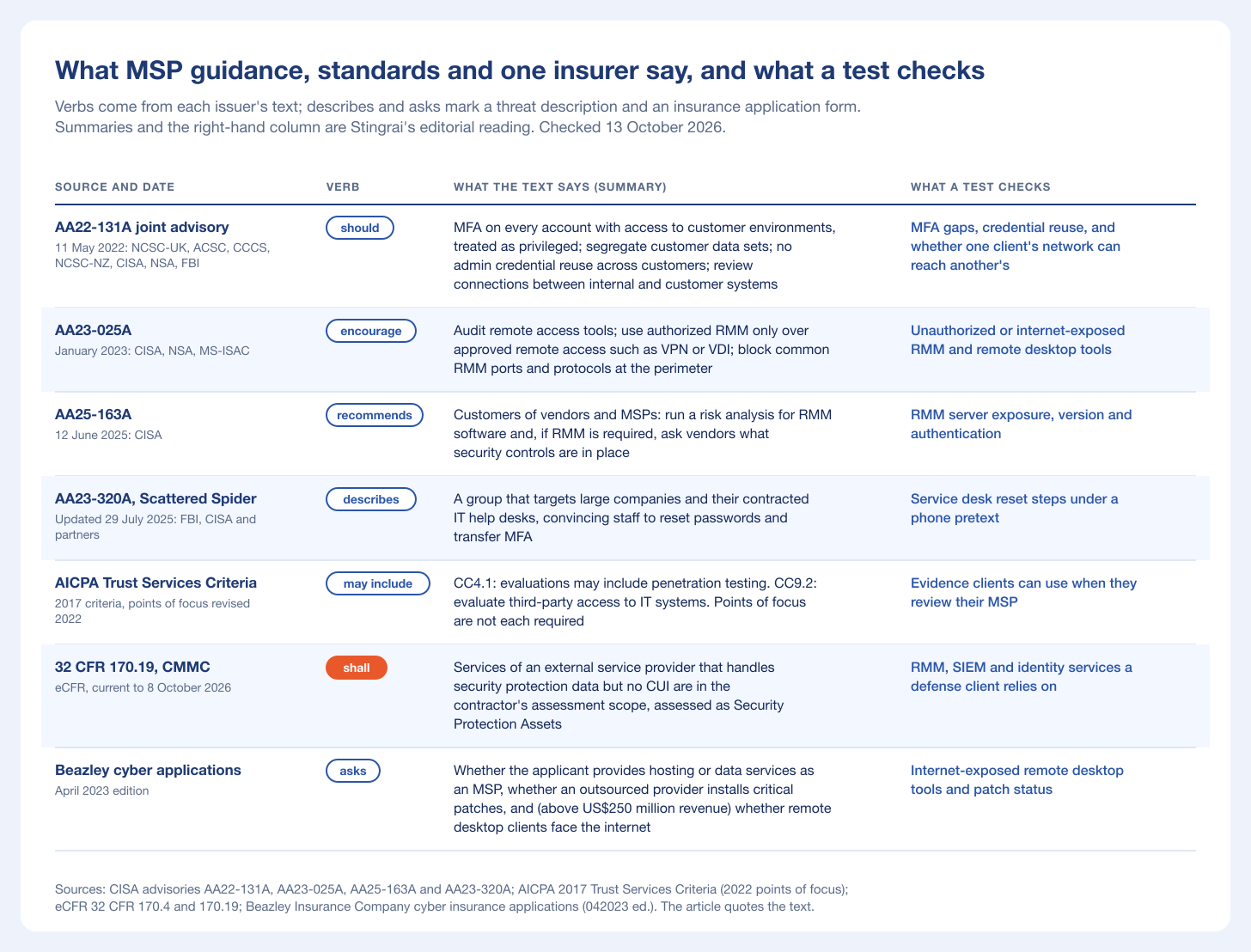
None of these documents sets a testing frequency for MSPs; each names controls a test can check.
The joint MSP advisory (May 2022)
The cybersecurity authorities of the UK, Australia, Canada, New Zealand and the US (CISA, NSA and FBI) warned that "threat actors can use a vulnerable MSP as an initial access vector to multiple victim networks, with globally cascading effects" (AA22-131A). MSPs "should review and verify all connections between internal systems, customer systems, and other networks", segregate customer data sets "from each other", and "develop and regularly exercise internal incident response and recovery plans". Customers are told to keep MSP accounts out of "internal administrator groups", and both sides to make sure contracts "transparently identify ownership of ICT security roles and responsibilities". Canada's Cyber Centre reminds consumers of managed services that system administrators "can access multiple clients" (ITSM.50.030).
RMM and remote access (2023 to 2025)
CISA's January 2023 advisory says threat actors "often target legitimate users of RMM software", including MSPs, and "can exploit trust relationships in MSP networks and gain access to a large number of the victim MSP's customers" (AA23-025A). It encourages defenders to "Block both inbound and outbound connections on common RMM ports and protocols at the network perimeter". After the SimpleHelp intrusions, CISA told customers of vendors and MSPs: "If RMM is required, ask third-party vendors what security controls are in place" (AA25-163A). An independent test report is one way to answer that question.
The service desk (2025)
The Scattered Spider advisory from the FBI, CISA and partner agencies, as updated in July 2025, says the actors "abuse trusted relationships of contracted IT help desks" and "conduct phone calls to employees and help desks" to learn password reset steps (AA23-320A).
SOC 2: how your clients' auditors see you
In a client's SOC 2 program, its MSP falls under the vendor criteria. The AICPA's 2022 points of focus for CC4.1 say evaluations "may include ... vulnerability scans, security assessment, penetration testing, and third-party assessments", and a new CC9.2 point has the entity evaluate "vulnerabilities arising from vendor and business partner relationships, including third-party access to the entity's IT systems" (AICPA). Points of focus guide rather than bind: the criteria do "not require an assessment of whether each point of focus is addressed" (AICPA, paragraph .07; SOC 2 ranking).
CMMC: when your tools enter a client's assessment
The CMMC rule defines an External Service Provider (ESP) as "external people, technology, or facilities" providing and managing "IT and/or cybersecurity services on behalf of the organization" (32 CFR 170.4). When an ESP that is not a cloud provider handles security protection data, such as log files or "passwords that grant access to the in-scope environment" (170.4), but no CUI, its services "are in the OSA's assessment scope and shall be assessed as Security Protection Assets" (32 CFR 170.19, Level 2 and 3 tables, current to 8 October 2026). The OSA is the contractor being assessed (CMMC guide).
Cyber insurance: what one carrier asks
Beazley Insurance Company's cyber applications (April 2023 edition) ask whether the applicant provides hosting or data services "as a managed services provider (MSP)" and whether it "or an outsourced service provider on your behalf" installs critical patches; the form for applicants above US$250 million in revenue asks whether remote desktop clients such as TeamViewer or AnyDesk are "exposed directly to the internet" (Beazley). Beazley Canada's breach response application asks whether the applicant uses penetration testing to test its controls (application; see our underwriting guide).
What the incidents and the KEV catalog show
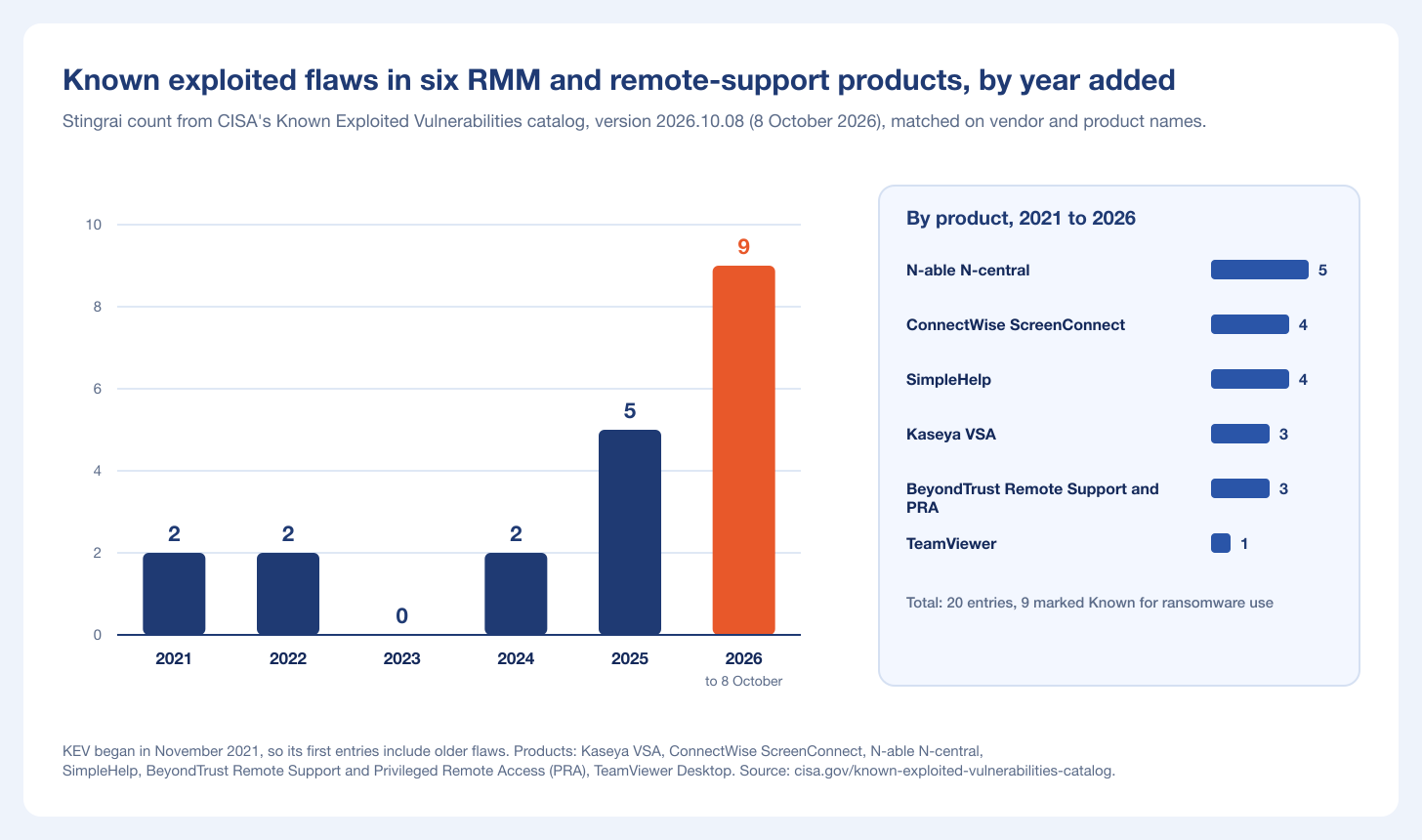
The flaws keep arriving. Of the 20 KEV entries for Kaseya VSA, ConnectWise ScreenConnect, N-able N-central, SimpleHelp, BeyondTrust Remote Support and Privileged Remote Access, and TeamViewer, nine were added between February and September 2026; CISA marks 9 of the 20 as known to be used in ransomware campaigns.
Patching is necessary, not sufficient. A test shows whether a console faces the internet, what a technician account can reach, and whether one client can reach another.
What MSPs and MSSPs need from a testing partner
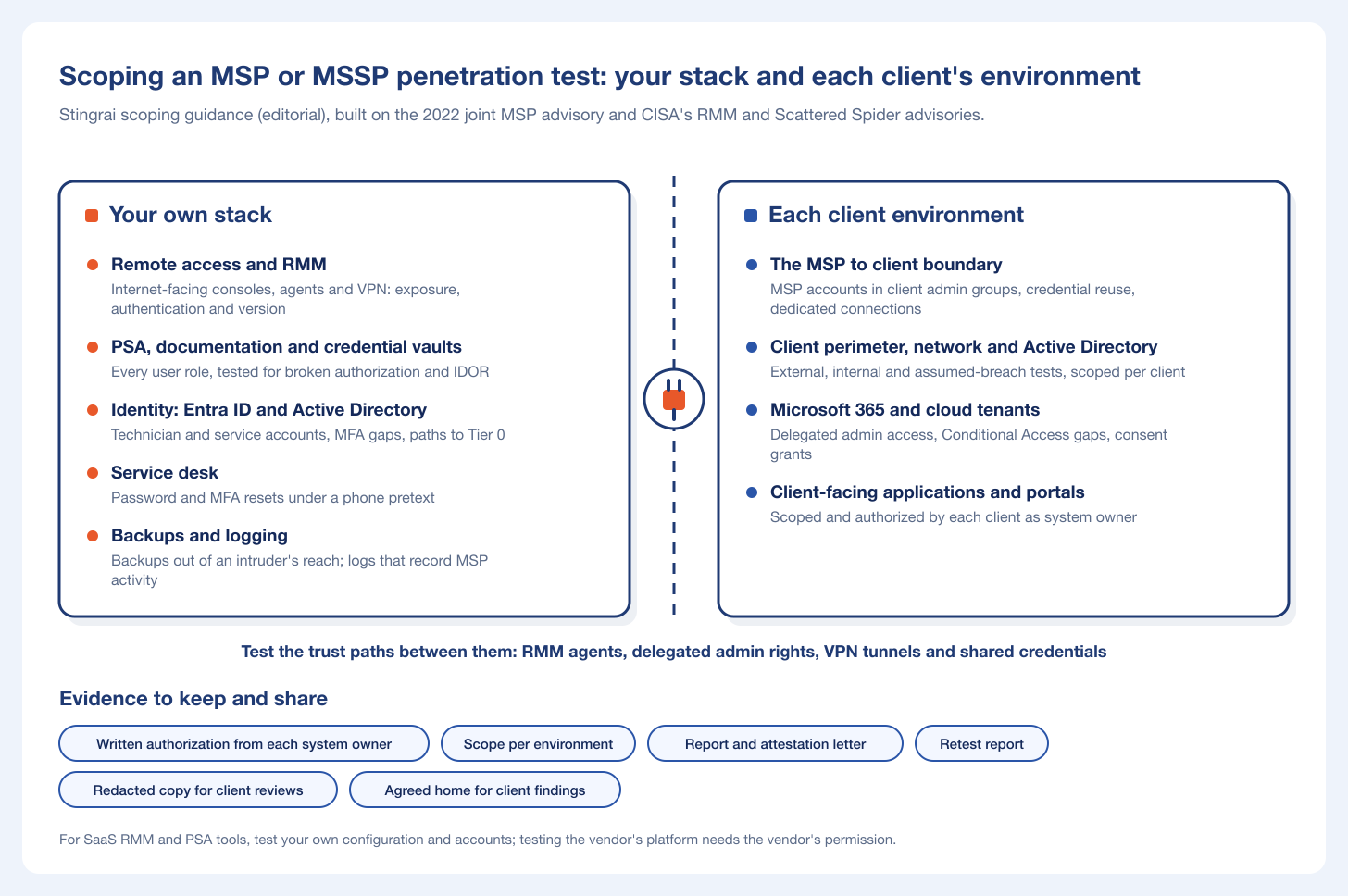
Your stack as one attack path. Remote access and RMM consoles, the PSA, identity and Active Directory, technician workstations, backups and logging, tested together. In Stingrai's State of Penetration Testing 2026 data, 92% of internal network findings were High or Critical (408 findings, 8 tests), against 48% for external networks (23 findings, 6 tests).
SaaS tools, tested carefully. For hosted RMM and PSA platforms, test your configuration, accounts and roles, and get the vendor's permission before anything that touches its platform.
The client boundary and the service desk. MSP accounts in client admin groups, credentials repeated across clients, and phone pretexts against password and MFA reset steps.
Detection, for MSSPs. In August 2026, CISA's red team reached "full domain compromise" at two organizations, and its first lesson was "Untuned detection tools lead to missed threats" (AA26-237A). Red and purple teaming show what your SOC sees.
Evidence and a checkable entity. An attestation letter or redacted report for clients' vendor reviews, from a firm whose CREST accreditation is listed against a named legal entity and country, sometimes a UK or German entity of a US-based firm (how to check).
Authorization and data handling. Each client approves scope and rules of engagement for its own systems, and client findings need an agreed home (rules of engagement checklist).
White label, co-branding, resale or referral: how partner models work
Each model changes who the client sees and who carries the evidence.
Model | The MSP | The testing firm | Example from a vendor's own site |
|---|---|---|---|
Referral | Introduces the client and may earn a fee | Contracts, scopes and delivers | BreachLock: "BreachLock leads scoping, commercial process, and delivery." |
Resale | Owns the client contract and price | Delivers and reports | BreachLock: "Partner owns customer relationship and commercial transaction." Sprocket's resellers include MSPs and MSSPs. |
Co-branded | Leads the relationship; both brands show | Named as the tester | Raxis offers co-branded reports; Blaze works "co-branded, with Blaze identified as the specialist testing provider". |
White label | Delivers under its own brand only | Stays out of view | NetSPI offers "white labeled penetration testing" to service provider partners. |
What to weigh:
Objectivity and transparency. CC4.1's points of focus describe separate evaluations that "provide objective feedback", and AA22-131A asks for contracts that "transparently identify ownership of ICT security roles and responsibilities". If you run a client's systems and sell its test under your brand, be ready to show who tested.
Accreditation. A client can check a tester's CREST status only if the tester is named.
Margin and control. Resale and white label keep the price with the MSP; policies differ, and Blaze says it "does not provide invisible white-label delivery" (partner program).
How this ranking was built
Every vendor claim traces to the vendor's own website or CREST Marketplace profile, checked on 13 October 2026. Criteria 1, 2 and 6 were gates. The others were weighed together with own-stack depth; depth and the client-work route counted most.
The MSP's own stack: external and internal network testing plus Active Directory, cloud identity or red team work on the firm's site.
Human testers: testing by penetration testers, not only an automated platform.
A route for client work: a partner, reseller, referral or white-label program on the firm's site.
Checkable qualification: CREST Penetration Testing accreditation on marketplace.crest.org, with the entity's country.
Evidence an MSP can pass on: retests, attestation or co-branded reports.
North American presence: a US or Canadian office.
At a glance: penetration testing companies for MSPs and MSSPs
Company | Head office | Route for client work | CREST Marketplace entry | Best for |
|---|---|---|---|---|
1. Stingrai | Toronto, Canada | Client tests quoted per engagement | Stingrai Inc (Canada) | Own-stack testing, named testers |
2. NetSPI | Minneapolis, USA | White label for MSSPs; reseller and referral | NetSPI (USA), incl. Threat Led | White-labeled testing at scale |
3. Sprocket Security | Madison, USA (site address) | Reseller program incl. MSPs and MSSPs | Sprocket Security Inc (USA) | Reselling continuous testing |
4. Raxis | Atlanta, USA | Co-branded partner program | None found | Co-branded tests the MSP prices |
5. BreachLock | New York, USA (site address) | Referral or reseller | Breachlock Ltd (UK) | Owning the client contract |
6. Secure Ideas | Jacksonville, USA | Reseller program for MSPs and VARs | Secure Ideas LLC (USA) | Bundling testing with services |
7. Kroll | New York, USA | Kroll Partner Program, resale or referral | Kroll LLC (USA) | Testing plus incident response |
8. TrustedSec | Fairlawn, Ohio, USA | Subcontracting or referral | TrustedSec (USA) | Microsoft 365 and phone-based testing |
9. Cobalt | Boston, USA (US headquarters) | Referral and reseller | Cobalt Labs (Germany) | Platform-delivered tests on demand |
1. Stingrai (top rated for MSPs and MSSPs)
Stingrai is a global CREST-accredited penetration testing services company founded in Toronto, Canada in 2021, trusted by companies from startups to enterprises to meet audit requirements for SOC 2, ISO 27001, CMMC, PCI DSS and HIPAA. OSCE³, OSWE, OSEP, CREST CRT certified pentesters, who are also world-class security researchers and bug bounty hunters. Choose from fully human-led or hybrid (AI agents plus human penetration testers) engagements across web, API, mobile, AI and LLM, cloud, network, Active Directory and social engineering penetration tests and red team engagements.
For an MSP or MSSP, the case is an independent test of the access you hold into every client, by testers your clients can check. Stingrai Inc, the company that signs the contract, holds the CREST Penetration Testing accreditation (Marketplace profile), one of four firms with a Canadian head office holding it on 13 October 2026. Each human-led engagement is run by two named penetration testers from a team holding OSCE³, OSWE, OSEP, CREST CRT and CISSP certifications, reviewed by the team lead and an engagement partner. The team has 18 published CVEs and Hall of Fame listings at Apple, Google, the US Department of Defense and the US Federal Reserve, and Stingrai is rated 5.0 out of 5 on Clutch (20 reviews).
Scope for an MSP's own stack
Perimeter and remote access: the external network, including edge appliances, VPN and remote access, plus RMM, PSA and client portals you host, tested as web applications and APIs across every user role for broken authorization and IDOR.
Inside and identity: the internal network and Active Directory, from an ordinary domain user toward control of the directory, and Entra ID app registrations, consent grants and Conditional Access gaps.
People and detection: social engineering with phishing and phone pretexts aimed at the service desk, red teaming from an assumed-breach position and purple teaming with your SOC.
Delivery and evidence you can pass on
Whether the engagement is a one-time annual test or a continuous program, every confirmed finding, at every severity, is posted to the PTaaS platform the same day it is confirmed, with a working proof of concept and prioritized remediation guidance, and syncs to Jira and Slack. Retesting is included, and every human-led and hybrid report ships with an attestation letter: pentest evidence for your SOC 2 and ISO 27001 programs and for clients who ask about you. Reports download from the platform with sensitive sections redactable before you share them. Tests in client environments are scoped through get a quote.
Where Snipe fits
Snipe is Stingrai's autonomous AI agent for web applications and associated APIs only. Trained on more than 6,000 HackerOne Hacktivity reports, it hunts IDOR, broken authorization and business logic flaws and opens AutoFix pull requests. The Autonomous Pentest is Snipe alone, with no penetration testers; in the Hybrid Pentest, Snipe and penetration testers test together, with the testers directing its focus. Everything else is human-led.
Pricing and fit: The Autonomous Pentest is US$3,000 per assessment or US$650 per month on a 12-month plan, and the Hybrid Pentest is US$6,800 per assessment or US$1,275 per month; both cover one web application and associated APIs (pricing). Best for: MSPs and MSSPs that want their remote access, RMM, identity and service desk tested by named, certified testers at a CREST-accredited firm, with evidence they can hand to clients, as a one-time annual test or a continuous program.
2. NetSPI
NetSPI lists Minneapolis as its headquarters and an office in Toronto (contact), and has worked "since its inception in 2001" (home page). Its network testing page covers internal, external, wireless, host-based and virtual desktop testing, from "baseline workstation and server images" to "vulnerabilities that could be used to break out of Citrix or VMware". Its partner page says offerings "unique to our Service Provider Partner Program include white labeled penetration testing and external attack surface assessments", for MSSPs and cyber insurance partners. Its Marketplace entry lists Penetration Testing and Threat Led Penetration Testing (USA). Its Synack merger "officially closed in October 2026" (NetSPI).
Best for: MSSPs that want white-labeled testing from a large in-house team, and MSPs that deliver virtual desktops and standard images.
3. Sprocket Security
Sprocket Security lists its address in Madison, Wisconsin, and its CEO and founder, Casey Cammilleri, describes continuous penetration testing as the idea behind the company (about). Its internal testing page names attacks "such as kerberoasting, ADCS abuse", and its continuous testing page offers "unlimited retesting" and "on-demand executive, compliance, and third-party attestation reports". Its partner page says reseller partners include "Managed Service Providers (MSP), and Managed Security as a Service Providers (MSSP)", with deal registration. Its Marketplace entry, Sprocket Security Inc, lists Penetration Testing (USA).
Best for: MSPs that want a continuous testing program to resell, with retests and attestation reports.
4. Raxis
Raxis was founded in Atlanta in 2011 by Mark Puckett, whose career includes "leading the global Red Team at Home Depot" (company). It tests internal networks, external networks and Active Directory by hand. Its partner program for MSPs and VARs says "You keep the relationship, set the price, and deliver the fixes", offers co-branded reports, puts typical partner margins at 20 to 30% on testing, and says Raxis does not "sell managed security, hardware, monitoring, or remediation services". Raxis had no CREST Marketplace entry among the 551 suppliers listed on 13 October 2026.
Best for: MSPs that want co-branded, hands-on testing they price and resell, without a channel conflict over remediation work.
5. BreachLock
BreachLock lists a New York address at 1350 Avenue of the Americas, and its story says it was "born" in 2019 under founder and CEO Seemant Sehgal. Its network testing page covers internal and external network penetration testing. Its partner program offers a referral model and a reseller model "Best for MSPs, MSSPs, VARs, cybersecurity resellers, and strategic partners", in which the partner "gets upfront margin discount", and says partners and their clients get "unlimited re-testing" on its platform. Its Marketplace entry, Breachlock Ltd, lists Penetration Testing with a UK head office.
Best for: MSPs and MSSPs that want to own the client contract and resell testing at a discount.
6. Secure Ideas
Secure Ideas lists its headquarters in Jacksonville, Florida (contact). Its testing page offers network testing for "both internal and external threats", red teaming and purple teaming. Its partner program "aligns with IT service organizations such as MSPs and VARs to augment their service offerings", and lets partner resellers "bundle our cybersecurity solutions with theirs". Its Marketplace entry, Secure Ideas LLC, lists Penetration Testing (USA).
Best for: MSPs that want to bundle human-led testing, red teaming and purple teaming into their own service catalog.
7. Kroll
Kroll's About page says "Kroll Is Headquartered in New York". Its penetration testing datasheet lists internal and external network penetration testing and red team services, and its Marketplace entry, Kroll LLC, holds Incident Response, Penetration Testing and Security Operations Centre accreditations. Its partner program page, on Kroll's Redscan site, invites MSPs and MSSPs to resell or refer "over 40 award-winning cyber solutions", including "pen testing"; its MSP specialization, announced 17 October 2023, highlights its MDR platform.
Best for: MSPs and MSSPs that want testing and incident response from one accredited partner.
8. TrustedSec
TrustedSec was founded by David Kennedy in 2012 and lists an address in Fairlawn, Ohio (home page). Its red team service runs from perimeter evaluation and "ethical phishing, vishing, SMS, and physical breach techniques" to internal expansion and privilege escalation, and its Microsoft Cloud Security Assessment covers "Microsoft 365, Entra ID, and Azure environments". Its partner page offers "subcontracting or referral opportunities". Its Marketplace entry lists Penetration Testing (USA).
Best for: MSPs running Microsoft 365 estates that want tenant and phone-based social engineering testing.
9. Cobalt
Cobalt lists its US headquarters at One Boston Place in Boston (contact), and its Marketplace entry, Cobalt Labs, lists Penetration Testing with a German head office. Its internal network page covers "Active Directory (AD) servers, Domain Controllers (DC), and SMB servers", with "retesting in 7 days or less", and it offers red teaming. Testers come from a community of "freelance pentesters" (about). Its partner program offers referral fees and a reseller route to "expand your cybersecurity services catalog profitably".
Best for: MSPs that want to order platform-delivered tests on demand for clients.
Also considered
Two automated platforms failed the human-tester gate. vPenTest, from Vonahi Security, which Kaseya says it acquired in 2023 (Kaseya), lets MSPs "Customize the vPenTest portal and deliverable reports with your MSP's brand" (partners); Kaseya's Marketplace entry (UK) holds Penetration Testing accreditation. Horizon3.ai sells its NodeZero autonomous pentesting platform through an MSSP and MSP program. Blaze Information Security holds CREST accreditation (German entry) and runs referral and co-branded programs, but fails the North American gate, with offices in Berlin, Porto and Recife (contact).
What a penetration test for an MSP or MSSP costs
No guidance sets a price; cost follows scope and the retest. Our cost guide and cost calculator turn scope into an estimate. Stingrai's fixed packages are the Autonomous Pentest at US$3,000 and the Hybrid Pentest at US$6,800 per assessment, each for one web application and associated APIs (pricing), such as a client portal you build. Network, Active Directory, cloud, social engineering and client environments are quoted. Compare quotes on named testers, scope and the retest (how to compare).
RFP questions for an MSP or MSSP testing partner
[ ] Will you test our remote access, RMM, PSA and identity stack as one attack path, from outside and from a technician account, and our SaaS tools without touching the vendor's platform?
[ ] Will you test whether one client can reach another, and run phone pretexts against our service desk's reset steps?
[ ] Which legal entity signs and holds CREST accreditation, and who are the named testers?
[ ] For client work, which model do you offer, and whose name is on the report?
[ ] What can we share with clients: an attestation letter, a redacted report?
[ ] Where are client findings stored, who can see them, and is the retest included?
Our RFP template turns these into a document.
Frequently Asked Questions
Who are the best penetration testing companies for MSPs and MSSPs in 2026?
The best penetration testing companies for MSPs and MSSPs in 2026 are Stingrai, NetSPI, Sprocket Security, Raxis, BreachLock, Secure Ideas, Kroll, TrustedSec and Cobalt. Stingrai ranks first: named, certified penetration testers at a CREST-accredited firm test an MSP's remote access, RMM, identity and service desk, with retests and an attestation letter for every human-led and hybrid report, as a one-time annual test or a continuous program.
Should an MSP penetration test its own RMM and remote access tools?
Yes. The 2022 joint advisory warns that a vulnerable MSP can be "an initial access vector to multiple victim networks", and CISA's KEV catalog lists, as of 8 October 2026, 20 exploited flaws in six RMM and remote-support products, nine added in 2026. Test what you control: exposure, accounts, roles and configuration.
What does the CISA, NSA, FBI and Five Eyes MSP advisory ask MSPs to do?
AA22-131A (May 2022) says MSPs should enforce MFA on every account with access to customer environments and treat those accounts as privileged, segregate customer data sets, not reuse admin credentials across customers, review connections to customer systems and exercise incident response plans. It sets no testing frequency.
Does SOC 2 require an MSP to run a penetration test?
No criterion requires one. CC4.1's 2022 points of focus list penetration testing among evaluations an entity may use, and CC9.2 has entities evaluate third-party access to their systems, so a client's SOC 2 vendor review may ask its MSP for test evidence.
What is white-label penetration testing?
A testing firm delivers the test under the MSP's brand. NetSPI offers it to MSSP partners, and vPenTest lets MSPs brand its automated reports. Weigh it against co-branding and referral: a client or auditor may ask who tested, and a tester's CREST status can be checked only if the tester is named.
Is an MSP's tooling in scope of a client's CMMC assessment?
It can be. Under 32 CFR 170.19's Level 2 and 3 tables, when an External Service Provider that is not a cloud provider handles a contractor's security protection data, such as log files or passwords, but not its CUI, its services "are in the OSA's assessment scope and shall be assessed as Security Protection Assets".
What do cyber insurers ask about MSPs?
Beazley's April 2023 applications ask whether the applicant provides hosting or data services as an MSP, whether an outsourced provider installs critical patches, and, above US$250 million in revenue, whether remote desktop clients such as TeamViewer or AnyDesk face the internet. Its Canadian breach response form asks about penetration testing.
How much does a penetration test for an MSP cost?
No guidance sets a price. Stingrai's fixed packages are US$3,000 (Autonomous) and US$6,800 (Hybrid) per assessment for one web application and associated APIs; network, Active Directory, cloud, social engineering and client environments are quoted.
Related reading
References
CISA, NSA, FBI and Five Eyes partners, Protecting Against Cyber Threats to Managed Service Providers and their Customers (AA22-131A), 11 May 2022. https://www.cisa.gov/news-events/cybersecurity-advisories/aa22-131a
CISA, NSA and MS-ISAC, Protecting Against Malicious Use of Remote Monitoring and Management Software (AA23-025A), 2023. https://www.cisa.gov/news-events/cybersecurity-advisories/aa23-025a
CISA, Ransomware Actors Exploit Unpatched SimpleHelp Remote Monitoring and Management to Compromise Utility Billing Software Provider (AA25-163A), 12 June 2025. https://www.cisa.gov/news-events/cybersecurity-advisories/aa25-163a
FBI, CISA and partners, Scattered Spider (AA23-320A), last revised 29 July 2025. https://www.cisa.gov/news-events/cybersecurity-advisories/aa23-320a
CISA, A Tale of Two SOCs: Insights From Two Red Team Assessments (AA26-237A), 25 August 2026. https://www.cisa.gov/news-events/cybersecurity-advisories/aa26-237a
CISA, Known Exploited Vulnerabilities Catalog, version 2026.10.08. https://www.cisa.gov/known-exploited-vulnerabilities-catalog
Kaseya, VSA incident updates, July 2021 (archived 26 July 2021). https://web.archive.org/web/20210726040730/https://www.kaseya.com/potential-attack-on-kaseya-vsa/
CISA, Kaseya Ransomware Attack: Guidance for Affected MSPs and their Customers, 12 July 2021. https://www.cisa.gov/news-events/news/kaseya-ransomware-attack-guidance-affected-msps-and-their-customers
Canadian Centre for Cyber Security, Cyber security considerations for consumers of managed services (ITSM.50.030), October 2020. https://www.cyber.gc.ca/en/guidance/cyber-security-considerations-consumers-managed-services-itsm50030
AICPA, 2017 Trust Services Criteria (With Revised Points of Focus, 2022). https://www.aicpa-cima.com/resources/download/2017-trust-services-criteria-with-revised-points-of-focus-2022
eCFR, 32 CFR 170.4 and 170.19, current to 8 October 2026. https://www.ecfr.gov/current/title-32/section-170.19
Beazley, Cyber Insurance Application (042023 ed.). https://www.beazley.com/globalassets/product-documents/application/beazley_cyber_insurance_application_above_250m.pdf
CREST Marketplace profiles and vendor pages linked in each entry, opened 13 October 2026. https://marketplace.crest.org/suppliers/
Stingrai, State of Penetration Testing 2026. https://www.stingrai.io/reports/state-of-penetration-testing-2026
Talk to Stingrai
Bring your stack: remote access, RMM, PSA, identity and the service desk. Stingrai will scope the test with named penetration testers, post every confirmed finding the same day, retest the fixes and close human-led and hybrid engagements with an attestation letter you can share with clients, as a one-time annual test or a continuous program. MSPs and MSSPs planning tests in client environments can get a quote or see pricing.