On 20 March 2026, Nacha began requiring every Originator that pays wages into consumer accounts by ACH to describe those credits as "PAYROLL", a rule it says "is intended to reduce the incidence of fraud involving payroll redirections" (Nacha). On 22 June 2026, the next banking day after its 19 June effective date, its fraud-monitoring rule reached every non-consumer Originator, Third-Party Sender and Third-Party Service Provider regardless of volume (Phase 2). Its False Pretenses definition, in force since 1 October 2024, "covers common fraud scenarios such as Business Email Compromise (BEC), vendor impersonation, payroll impersonation", and its examples of controls include "change controls regarding payment information and instructions for vendor and payroll payments" (Phase 1).
Payroll processors sit inside that chain: a firm that moves an employer's funds through the ACH Network "at a minimum, acts as a Third-Party Service Provider (TPSP)" (ACH Operations Bulletin #2-2014). These platforms hold Social Security numbers, bank accounts and benefit elections for every client's workforce, and customers check them through SOC reports and questionnaires that describe no single test.
This ranking is for mid-market and enterprise payroll processors, professional employer organizations (PEOs), HRIS and benefits administration platforms, workforce management and employer of record (EOR) providers. For SOC 2 in depth, see our SOC 2 penetration testing guide; for platforms that also move consumers' money, our fintech ranking.
Quick answer. The best penetration testing companies for HR, payroll and PEO platforms in 2026 are Stingrai, NetSPI, Schellman, GuidePoint Security, Pen Test Partners, Cobalt, NCC Group, Praetorian, Sprocket Security, Coalfire and TrustedSec. Stingrai ranks first: a CREST-accredited, Toronto-headquartered firm whose named penetration testers test every role in the platform for broken authorization and IDOR, plus its APIs, ACH file path, networks and the people who can change a direct deposit. Retesting is included and every human-led and hybrid report ships with an attestation letter, as a one-time annual test or a continuous program. NetSPI publishes role-by-role access control testing, and Schellman tests tenant isolation with two provisioned tenants.
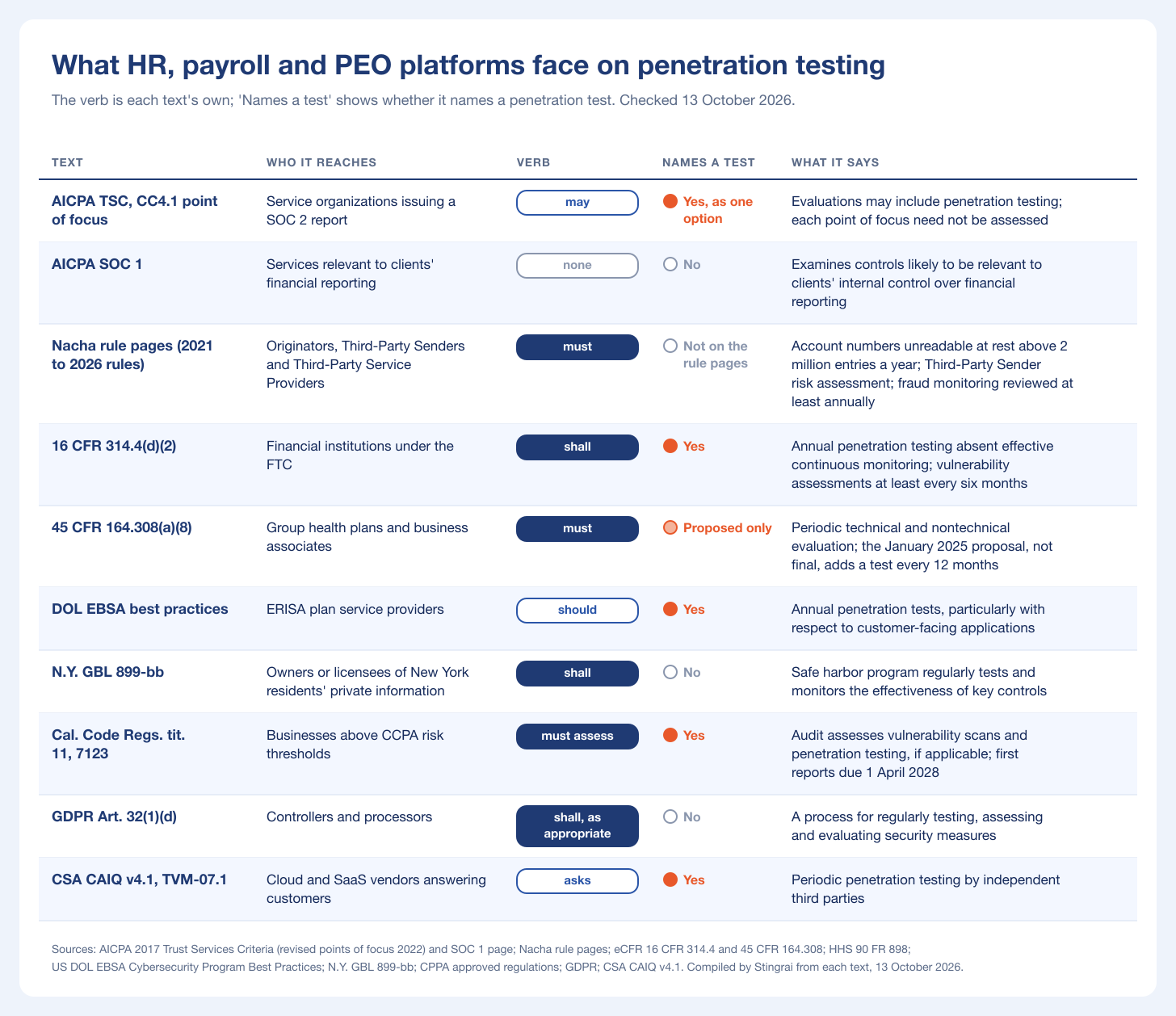
What drives a penetration test at an HR, payroll or PEO platform
The chart above summarizes each text; quotes below come from each owner's own publication.
SOC 1 and SOC 2 reports
The AICPA calls SOC 1 "an examination of controls at a service organization that are likely to be relevant to user entities' internal control over financial reporting", written partly for "the CPAs that audit the user entities' financial statements" (AICPA); payroll posts to every client's ledger, so their auditors may ask for it. For SOC 2, "customers and business partners often request a SOC 2 report" (AICPA guide). A type 2 report "includes an opinion on the operating effectiveness of controls" and "a detailed description of tests of controls performed by the service auditor"; a type 1 report has neither (Trust Services Criteria).
Neither report requires a penetration test. Under CC4.1, evaluations "may include" penetration testing alongside "vulnerability scans, security assessment" and "third-party assessments", and the criteria do "not require an assessment of whether each point of focus is addressed" (AICPA red-lined text, pages 5 and 32). Auditors and customers read a test report beside the SOC report (what auditors accept), so time it inside the observation period (SOC 2 Type 2 timing).
Nacha rules for payroll processors
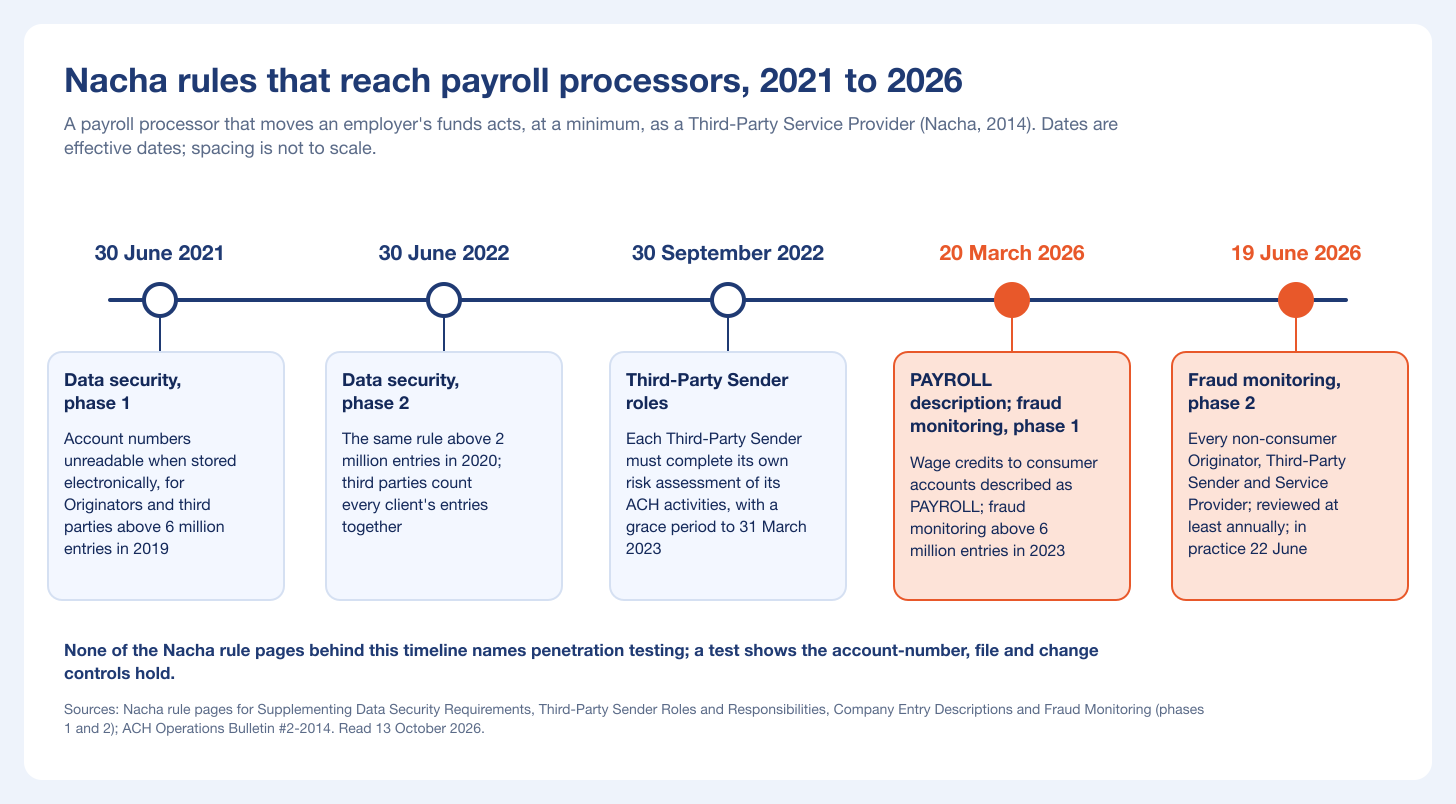
Nacha's Supplementing Data Security Requirements extend the ACH Security Framework "first implemented in 2013": non-financial-institution Originators, Third-Party Service Providers and Third-Party Senders must protect account numbers "by rendering them unreadable when stored electronically", from 30 June 2021 above 6 million entries in 2019 and from 30 June 2022 above 2 million entries in 2020. Third parties count "the combined volume of entries processed for all of its various clients", and "Any place where account numbers related to ACH entries are stored is in scope".
Since 30 September 2022 a Third-Party Sender "must complete a Risk Assessment of its ACH activities", with a grace period to 31 March 2023 for a first one, and cannot rely on another's (Nacha), and the 2026 fraud-monitoring processes must be reviewed "at least annually". None of the Nacha rule pages cited here names penetration testing; the full Operating Rules are sold through Nacha's store. A test shows these controls hold: account-number storage, file transfer and bank-detail changes.
FTC Safeguards Rule and IRS Publication 4557
The Safeguards Rule binds "financial institutions", which 314.1(b) says include "wire transferors" and "tax preparation firms", and 314.2 gives "A business that regularly wires money to and from consumers" as an example. Whether a payroll or HR platform is one depends on its activities, such as preparing individuals' tax returns or moving money to and from consumers, so ask counsel. Where it applies, 314.4(d)(2) requires "Annual penetration testing of your information systems" absent effective continuous monitoring and vulnerability assessments "at least every six months", unless 314.6 applies (fewer than five thousand consumers). Financial institution clients must also be "Periodically assessing your service providers" (314.4(f)(3)). IRS Publication 4557 (Rev. 5-2024) notes the definition "includes professional tax preparers" (FTC rule guide).
Benefits data: HIPAA and ERISA plan guidance
A benefits platform handling a group health plan's data can be a business associate, a definition that includes "benefit management" (45 CFR 160.103). Section 164.308(a)(8) requires a "periodic technical and nontechnical evaluation" and names no test. HHS's January 2025 proposal would require penetration testing "at least once every 12 months" (90 FR 898, at 1019); on 13 October 2026 it was still a proposal, listed among long-term actions with final action dated 07/00/2027 (Unified Agenda).
The Labor Department's cybersecurity best practices, which apply to "all types of ERISA plans, including health and welfare plans" (Compliance Assistance Release 2024-01), say plans' service providers should "Have a reliable annual third party audit of security controls", in which EBSA "would expect to see" penetration test reports, plus "Annual penetration tests, particularly with respect to customer-facing applications" and alerts "when an individual's account information has been changed" (HIPAA guide).
State laws and the GDPR
New York's GBL 899-bb says a business that "owns or licenses" New York residents' private information "shall develop, implement and maintain reasonable safeguards"; a program qualifies if the business "regularly tests and monitors the effectiveness of key controls, systems and procedures" and requires service providers' safeguards "by contract". Under 899-aa(3), a processor holding data it does not own must notify the owner "immediately", and "within thirty days following discovery".
California's cybersecurity audit regulations, effective 1 January 2026, cover businesses above risk thresholds, for example those over the CCPA revenue threshold (US$26,625,000 since 1 January 2025) that processed the sensitive personal information, a category that includes a consumer's "social security" number, of 50,000 or more consumers. The audit must assess, "if applicable", "Internal and external vulnerability scans, penetration testing, and vulnerability disclosure and reporting" (7123(c)(6)). The first reports are due 1 April 2028 from businesses with 2026 revenue above US$100 million, and service providers "shall" cooperate with a client's audit (7050(h)).
For employee data under the GDPR, Article 32(1)(d) lists "a process for regularly testing, assessing and evaluating the effectiveness of technical and organisational measures".
Security questionnaires
The Cloud Security Alliance's CAIQ v4.1, released 27 January 2026, asks: "Are processes, procedures, and technical measures defined, implemented, and evaluated for the periodic performance of penetration testing by independent third parties?" Its auditing guidance checks whether "the process for defining frequency of penetration testing is defined" (CSA). Shared Assessments' SIG pages sat behind a sign-in when we checked, so we quote no SIG question.
What mid-market and enterprise HR and payroll platforms need from a vendor
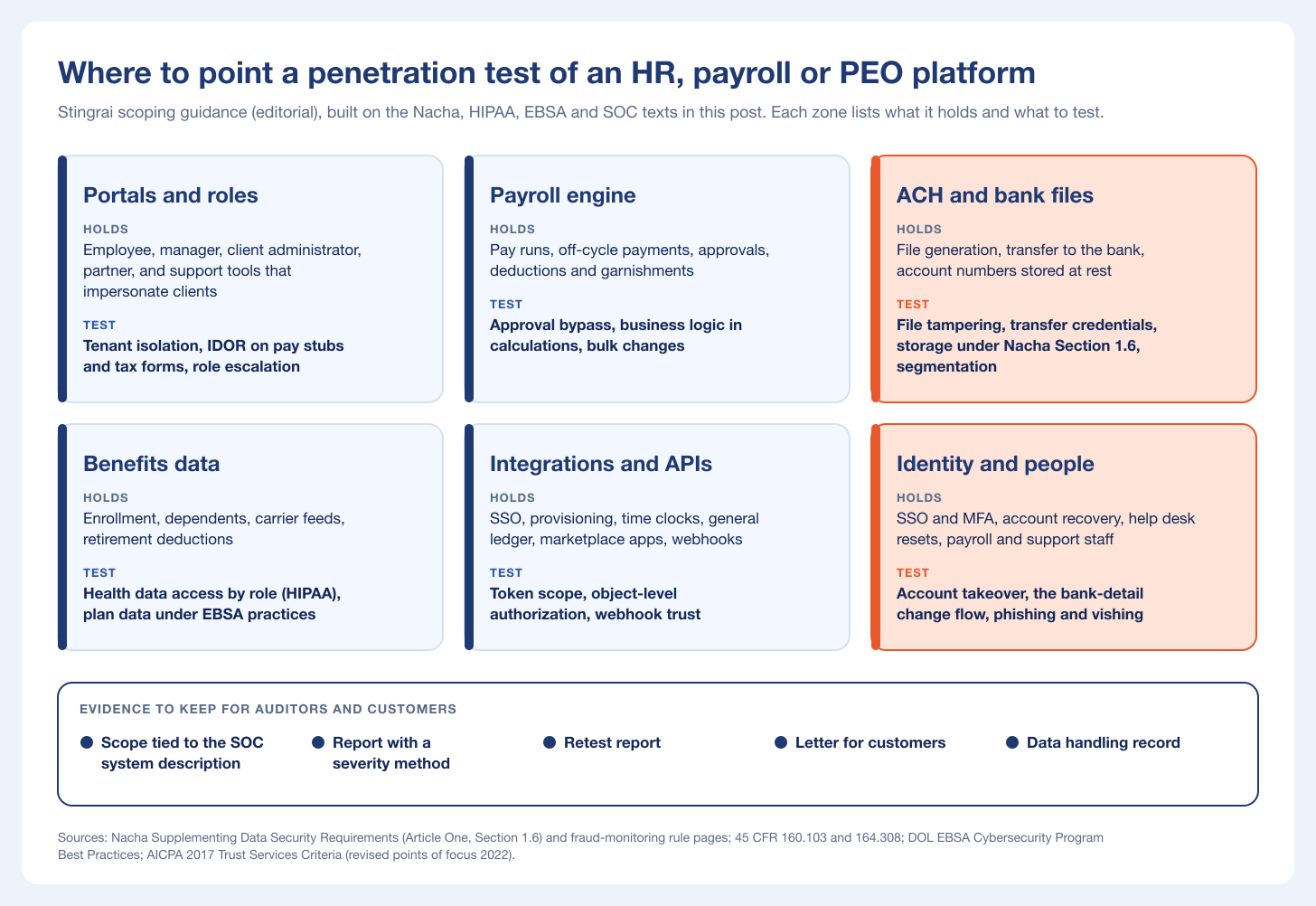
Tenant isolation and every role. Employee, manager, client administrator, partner, and the support tools staff use to impersonate clients. In Stingrai's State of Penetration Testing 2026 data, 54% of web application findings were High or Critical (768 findings, 40 tests); see why scanners miss BOLA and IDOR.
The bank-detail change flow. Re-authentication, alerts and help desk resets around direct deposit changes, plus phishing and vishing of payroll and support staff.
The ACH file path. File generation, transfer to the bank, storage of account numbers and the segmentation around them.
Integrations. SSO and provisioning, time clocks, general ledgers, benefit carrier feeds and marketplace apps (connected app scope).
Evidence. A scope matching the SOC system description, a report, a retest and a letter customers can file.
Data handling. Synthetic test tenants, evidence storage and subcontracting.
Independence. The auditor of a control should not have built or operated it; California's rule says an auditor "must not participate in business activities that the auditor may assess".
Contracting entity. CREST accreditation is held per legal entity (how to check).
How this ranking was built
Every vendor claim traces to the vendor's own website or CREST Marketplace profile, checked on 13 October 2026. The first two criteria were gates; the other four were weighed.
Application testing depth: authentication, authorization or business-logic testing of web applications, named on the firm's own site.
Checkable qualification: CREST Penetration Testing accreditation for an entity matching the firm's website.
Tenant and role depth: tenant isolation, horizontal and vertical escalation, or role-by-role testing named.
HR, payroll or benefits evidence: customer stories or research on the firm's own pages.
Usable evidence: retesting, letters or reports written for auditors and customers.
North American presence: a US or Canadian office counts in a firm's favour.
At a glance: penetration testing companies for HR, payroll and PEO platforms
Company | Head office | US or Canada presence | Evidence a buyer can check | Best for |
|---|---|---|---|---|
1. Stingrai | Toronto, Canada | Toronto HQ; US remote or on site | CREST; same-day findings, retest, attestation letter (human-led and hybrid) | Named testers, annual or continuous |
2. NetSPI | Minneapolis, USA | Headquarters; Toronto | CREST; access control verification across user roles | Large HCM platforms on PTaaS |
3. Schellman | Tampa, USA | Tampa address | CREST (Schellman Compliance LLC); two-tenant testing | Tenant isolation beside SOC work |
4. GuidePoint Security | Reston, Virginia, USA | Headquarters | CREST; Paychex customer story | Payroll firms already working with GuidePoint on identity and governance |
5. Pen Test Partners | Buckingham, UK | New York office | CREST incl. Application Security Testing | Application testing, payroll diversion research |
6. Cobalt | Boston, USA (US HQ) | Boston | CREST (Cobalt Labs, German entry); HR tech customer stories | Release-paced tests on credits |
7. NCC Group | Manchester, UK | Chicago; Waterloo | Ten CREST accreditations; business logic testing | Multi-region groups |
8. Praetorian | Austin, USA | Austin mailing address | CREST; engagement summary letter listed | Letters for enterprise customers |
9. Sprocket Security | Madison, Wisconsin, USA | Madison address | CREST; unlimited retesting; workforce platform research | Continuous testing with retests |
10. Coalfire | Chicago, USA | Headquarters | CREST (UK entry); SOC via Coalfire Controls | Testing beside assessment work |
11. TrustedSec | Fairlawn, Ohio, USA | Fairlawn address | CREST; validation retest | Retest plus mailbox compromise help |
1. Stingrai (top rated for HR, payroll and PEO platforms)
Stingrai is a global CREST-accredited penetration testing services company founded in Toronto, Canada in 2021, trusted by companies from startups to enterprises to meet audit requirements for SOC 2, ISO 27001, CMMC, PCI DSS and HIPAA. OSCE³, OSWE, OSEP, CREST CRT certified pentesters, who are also world-class security researchers and bug bounty hunters. Choose from fully human-led or hybrid (AI agents plus human penetration testers) engagements across web, API, mobile, AI and LLM, cloud, network, Active Directory and social engineering penetration tests and red team engagements.
For an HR or payroll platform, the case is named testers on the paths that move money and personal data. Stingrai Inc, which signs the contract, holds the CREST Penetration Testing accreditation (Marketplace profile) and is one of four Marketplace suppliers with a Canadian head office as of 13 October 2026. Each human-led engagement is run by two named penetration testers from a team holding OSCE³, OSWE, OSEP, CREST CRT and CISSP certifications, reviewed by the team lead and an engagement partner. The team has 18 published CVEs and Hall of Fame listings at the US Federal Reserve and the US Department of Defense, and Stingrai is rated 5.0 out of 5 on Clutch (20 reviews).
Scope for a payroll or HR platform
Application and APIs: web application and API testing across every user role for broken authorization, IDOR and business logic in pay runs, approvals and bank-detail changes; mobile employee apps.
Infrastructure: the external and internal network, segmentation around file transfer, Active Directory and cloud accounts.
People: phishing and vishing aimed at payroll and help desk staff, and red teaming.
Delivery and evidence
Whether the engagement is a one-time annual test or a continuous program, every confirmed finding, at every severity, is posted to the PTaaS platform the same day it is confirmed, with a working proof of concept and prioritized remediation guidance. Retesting is included, and every human-led and hybrid report ships with an attestation letter: pentest evidence for your SOC 2, ISO 27001, HIPAA and PCI DSS programs and your customers' security reviews.
Where Snipe fits
Snipe is Stingrai's autonomous AI agent for web applications and associated APIs only. Trained on more than 6,000 HackerOne Hacktivity reports, it hunts IDOR, broken authorization and business logic flaws and opens AutoFix pull requests. The Autonomous Pentest is Snipe alone, with no penetration testers; in the Hybrid Pentest, Snipe and penetration testers test together, with the testers directing its focus. Everything else is human-led.
Pricing and fit: The Autonomous Pentest is US$3,000 per assessment or US$650 per month on a 12-month plan, and the Hybrid Pentest is US$6,800 per assessment or US$1,275 per month; both cover one web application and associated APIs (pricing). A full platform scope is quoted through get a quote. Best for: payroll, PEO, HRIS and benefits platforms that want named, certified testers at a CREST-accredited firm on tenant isolation, the ACH path and their people, as a one-time annual test or a continuous program.
2. NetSPI
NetSPI is headquartered in Minneapolis with an office in Toronto (contact) and "has led security innovation since its inception in 2001" (home page). Its web application testing lists "Access control verification across user roles" and covers "broken access controls, privilege escalation paths, weak session management", and its API testing covers "broken object-level authorization". Its Marketplace entry lists Penetration Testing and Threat Led Penetration Testing. Its merger with Synack "officially closed in October 2026" (NetSPI).
Best for: large HCM and payroll platforms that want role-by-role access testing on a PTaaS platform.
3. Schellman
Schellman lists its address in Tampa, Florida (about). Its web application testing asks for two tenants "to thoroughly test your application for business logic and authorization issues", to tell "whether Tenant A can access data or make changes to Tenant B", plus admin and user roles. Its CREST Penetration Testing accreditation is held by Schellman Compliance, LLC (Marketplace), which provides "nonattest" services, while attest work such as SOC examinations sits with Schellman & Company, LLC, "a licensed certified public accounting firm". If Schellman also audits your SOC report, confirm independence: the auditor of a control should not have built or operated it.
Best for: multi-tenant platforms that want tenant isolation tested by a firm whose sister entity runs SOC examinations.
4. GuidePoint Security
GuidePoint Security lists its headquarters in Reston, Virginia (contact). It publishes a customer story with Paychex, "a human capital management company" delivering "payroll and HR services across the United States and Europe", covering governance, identity and its fusion center rather than a specific test. Its application security assessments cover "Authentication & Authorization" and "Logic Flaws" across "web applications, web services and APIs". Its Marketplace entry lists Penetration Testing.
Best for: payroll and HCM providers that want testing from a partner already working on identity and governance.
5. Pen Test Partners
Pen Test Partners has worked "since 2010", with its UK office in Buckingham and a US office, Pen Test Partners Inc, at 115 Broadway in New York (About). Its web application testing addresses "complex flows and multiple user roles" and users who "horizontally or vertically escalate their privileges to access other users' information". Its Marketplace entry, the UK company, holds seven accreditations, including Application Security Testing. A 2025 post, Stop payroll diversion scams before they start, recommends employee self-service with "MFA along with confirmation emails for any changes".
Best for: HR platforms that want accredited application testers with a New York office.
6. Cobalt
Cobalt lists its US headquarters, Cobalt Labs Inc., at One Boston Place in Boston (contact). Its customer stories include Syndio, "a pay decision software solutions company" where better upfront data helped surface "privilege escalation and potential data exfiltration", and HeyJobs, "an AI-powered employee candidate recruiting platform" that used a "12-month retest window". Its web methodology covers "User Roles & Access Control Mapping" and "Broken Access Controls & IDOR Testing". Its Marketplace entry, Cobalt Labs, gives a German head office, so confirm the contracting entity.
Best for: HR tech platforms that want release-paced tests bought on credits.
7. NCC Group
NCC Group, "Founded in 1999", names Manchester as its global headquarters and Chicago as its regional headquarters, with an office in Waterloo, Ontario (about, offices). Its application assessments "identify business logic errors and technical vulnerabilities". Its Marketplace entry holds ten CREST accreditations.
Best for: multi-region HR and payroll groups that want the broadest CREST profile on this list.
8. Praetorian
Praetorian "was founded in 2010", according to a June 2018 release, and its privacy policy gives a mailing address in Austin, Texas. Its application penetration testing includes "Business Logic Testing", lists an "Engagement Summary Letter" among deliverables in its service comparison, and serves "Security teams requiring independent, trusted security reviews of their products to meet customer or regulatory-driven requirements". Its Marketplace entry lists Penetration Testing.
Best for: platforms that need a summary letter for enterprise customers.
9. Sprocket Security
Sprocket Security lists an address in Madison, Wisconsin (contact). Its web application testing assesses "applications behind login portals to identify flaws in authentication, authorization, and business logic workflows", and its continuous program includes "unlimited retesting" (Sprocket). On 7 October 2026 it disclosed a pre-authentication SQL injection in mJobTime, which it calls "a workforce management platform used in construction and field services" (CVE-2026-9209). Its Marketplace entry lists Penetration Testing.
Best for: workforce management and mid-market HR platforms that want continuous testing with unlimited retests.
10. Coalfire
Coalfire is "headquartered in Chicago, Ill." (August 2026 release). Its application security datasheet covers "Bypassing authentication and authorization" and "Escalating user privileges (horizontal and vertical)" across web applications and APIs. SOC 1, SOC 2 and SOC 3 examinations come from Coalfire Controls, which Coalfire calls "a fully licensed, accredited CPA firm and affiliate of Coalfire" (SOC services), so keep the test independent of any audit. Its Marketplace entry, Coalfire Systems, gives a UK head office.
Best for: platforms that want application testing from a firm with SOC and FedRAMP assessment practices.
11. TrustedSec
TrustedSec was "Founded by innovator David Kennedy in 2012" (home page) and lists an address in Fairlawn, Ohio (contact). Its application testing includes "Authenticated Testing (Grey-Box)" and API testing with "both credentialed and uncredentialed testing", and its penetration tests include "Validation Testing" of fixes. A Microsoft 365 business email compromise review determines "what actions attackers took". Its Marketplace entry lists Penetration Testing.
Best for: mid-market platforms that want a retest in the base engagement and help after a Microsoft 365 mailbox compromise.
Also considered
Tevora (Irvine, California) holds CREST Penetration Testing accreditation and sells SOC 2 audits, but its testing page lists web application and API testing without naming authentication, authorization or business-logic testing. Include Security, Doyensec, Trail of Bits, Rapid7 and A-LIGN had no entry among the 551 suppliers on the CREST Marketplace on 13 October 2026.
What a penetration test for an HR or payroll platform costs
No rule sets a price; cost follows the applications, roles, APIs, integrations, networks and cloud accounts in scope, plus the retest. Our cost guide and cost calculator turn scope into an estimate. Stingrai's fixed packages are the Autonomous Pentest at US$3,000 and the Hybrid Pentest at US$6,800 per assessment, each for one web application and associated APIs (pricing); a full platform scope is quoted. Compare proposals on named testers, role coverage and the retest (how to compare quotes).
RFP questions for an HR or payroll platform penetration test
[ ] Will you test tenant isolation and every role, including support impersonation tools?
[ ] Is the bank-detail change flow in scope, with a social engineering test of payroll and help desk staff?
[ ] Which legal entity signs, which holds the CREST accreditation, and who are the named testers?
[ ] Will you test synthetic tenants, and where is evidence stored?
[ ] Is a written retest included, and will you provide a letter we can share with customers?
[ ] Does your firm, or an affiliate, audit our SOC report?
Our RFP template turns these into a document.
Frequently Asked Questions
Who are the best penetration testing companies for HR, payroll and PEO platforms in 2026?
The best penetration testing companies for HR, payroll and PEO platforms in 2026 are Stingrai, NetSPI, Schellman, GuidePoint Security, Pen Test Partners, Cobalt, NCC Group, Praetorian, Sprocket Security, Coalfire and TrustedSec. Stingrai ranks first: named penetration testers cover every role, the APIs, the ACH path and the people, retesting is included, and every human-led and hybrid report ships with an attestation letter, as a one-time annual test or a continuous program.
Does SOC 2 require a penetration test?
No. Under CC4.1 of the AICPA's Trust Services Criteria, evaluations "may include" penetration testing, and the criteria do not require each point of focus to be assessed. Questionnaires such as the CAIQ ask about third-party penetration testing separately.
Does a SOC 1 Type 2 report include a penetration test?
Not by requirement. A SOC 1 examines controls "likely to be relevant to user entities' internal control over financial reporting"; a penetration test report is a separate document customers may request.
Does Nacha require payroll companies to run penetration tests?
Not by name in the Nacha rule pages cited here. Nacha requires account numbers "unreadable when stored electronically" above 2 million entries a year, a Third-Party Sender risk assessment and fraud monitoring reviewed "at least annually"; a test shows those controls hold.
Does the FTC Safeguards Rule apply to payroll companies?
Only where the company is a financial institution, which depends on its activities, such as preparing individuals' tax returns or moving money to and from consumers. Then 314.4(d)(2) requires annual penetration testing absent effective continuous monitoring, and vulnerability assessments at least every six months, unless it holds customer information on fewer than five thousand consumers (314.6).
Do benefits administration platforms need penetration testing under HIPAA?
The HIPAA Security Rule requires a "periodic technical and nontechnical evaluation" and names no test; the 2025 proposal for annual testing was still a proposal on 13 October 2026. Labor Department guidance for ERISA plan service providers lists "Annual penetration tests, particularly with respect to customer-facing applications".
What do security questionnaires ask about penetration testing?
The CSA's CAIQ v4.1 asks whether processes exist "for the periodic performance of penetration testing by independent third parties". Shared Assessments' SIG pages sat behind a sign-in check when we looked, so check your licensed copy.
How much does a penetration test for an HR or payroll platform cost?
No rule sets a price. Stingrai's fixed packages are US$3,000 (Autonomous) and US$6,800 (Hybrid) per assessment for one web application and associated APIs; a full platform scope is quoted.
Related reading
References
Nacha, Company Entry Descriptions and Fraud Monitoring Phases 1 and 2, effective 20 March and 19 June 2026. https://www.nacha.org/rules/risk-management-topics-company-entry-descriptions
Nacha, Supplementing Data Security Requirements and Third-Party Sender Roles and Responsibilities. https://www.nacha.org/rules/supplementing-data-security-requirements
Nacha, ACH Operations Bulletin #2-2014, 30 December 2014. https://www.nacha.org/system/files/2023-08/ACH-Operations-Bulletin-2-2014.pdf
AICPA, SOC 1 and SOC 2 guide pages. https://www.aicpa-cima.com/topic/audit-assurance/audit-and-assurance-greater-than-soc-1
AICPA, 2017 Trust Services Criteria (With Revised Points of Focus, 2022), red-lined version. https://assets.ctfassets.net/rb9cdnjh59cm/2sK6Ih6dzy6t7aU6RQvoeD/d97a2a14609e74a1af1ce9ab0b142b69/92317096_trust_services_criteria_red-lined_version.pdf
eCFR, 16 CFR 314.1, 314.2, 314.4 and 314.6, current to 8 October 2026. https://www.ecfr.gov/current/title-16/section-314.4
IRS, Publication 4557 (Rev. 5-2024). https://www.irs.gov/pub/irs-pdf/p4557.pdf
eCFR, 45 CFR 160.103 and 164.308. https://www.ecfr.gov/current/title-45/section-164.308
HHS, HIPAA Security Rule proposed rule, 90 FR 898, 6 January 2025, and its Unified Agenda entry. https://www.reginfo.gov/public/do/eAgendaViewRule?pubId=202510&RIN=0945-AA22
US Department of Labor, EBSA, Cybersecurity Program Best Practices. https://www.dol.gov/agencies/ebsa/key-topics/retirement-benefits/cybersecurity/best-practices
New York General Business Law 899-aa and 899-bb. https://www.nysenate.gov/legislation/laws/GBS/899-BB
California Privacy Protection Agency, Approved Regulations Text, effective 1 January 2026. https://cppa.ca.gov/regulations/pdf/ccpa_updates_cyber_risk_admt_appr_text.pdf
Regulation (EU) 2016/679, Article 32. https://eur-lex.europa.eu/legal-content/EN/TXT/HTML/?uri=CELEX:32016R0679
Cloud Security Alliance, Cloud Controls Matrix and CAIQ v4.1, 27 January 2026. https://cloudsecurityalliance.org/artifacts/cloud-controls-matrix-v4-1
CREST Marketplace profiles and vendor pages linked in each entry, read 13 October 2026. https://marketplace.crest.org/suppliers/
Stingrai, State of Penetration Testing 2026. https://www.stingrai.io/reports/state-of-penetration-testing-2026
Talk to Stingrai
Bring your SOC system description, role matrix and last report. Stingrai will scope tenant isolation, the ACH path, integrations and your people, name the penetration testers, post every confirmed finding the same day, retest the fixes and close human-led and hybrid engagements with an attestation letter, as a one-time annual test or a continuous program. Get a quote or see pricing.