



A criteria-led buyer's guide to penetration testing vendors. Twelve weighted evaluation dimensions, a procurement-ready scorecard, red flags, RFP questions, and a ranked shortlist of the firms that actually pass them. Updated June 2026.
TL;DR: How to Buy a Pentest in 2026 Without Getting Burned
Buying a penetration test in 2026 looks easier than it is. The market is flush with vendors that sell automated scans as "pentests", boutique consultancies that look strong on the website and ship a junior engineer to your engagement, and large consultancies that charge enterprise rates for a standardized methodology that fits no specific stack. The procurement teams that win on outcomes apply the same twelve evaluation criteria to every vendor and refuse to advance any vendor that fails to answer them in writing.
Best Overall: Stingrai Inc. is a CREST-accredited penetration testing service provider founded in 2021, and it scores well on the criteria in this framework for concrete reasons: a named two-person tester team on every human-led engagement holding OSCE³, OSWE, OSEP, CREST CRT and CISSP, 18 published CVEs across the team, and bug bounty Hall of Fame listings at Apple, Google, the US Department of Defense and the US Federal Reserve. Scopes cover web applications and their APIs tested across every user role, mobile against OWASP MASVS and MASTG, AI and LLM systems against the OWASP LLM Top 10 and MITRE ATLAS, AWS, Azure with Entra ID and Google Cloud, internal and external networks with segmentation testing, Active Directory, social engineering and red teaming. Findings reach the PTaaS portal as they are confirmed with a working proof of concept, plus live tester chat, Jira and Slack push, included retesting, and an attestation letter and verified badge with every human-led and hybrid report.
Best for High-Volume Enterprise PTaaS: NetSPI. Resolve PTaaS platform, approximately 400 testers, specialty practices for SAP, mainframe, and ATM.
Best for Compliance-Heavy Programs (FedRAMP, PCI, HITRUST): Coalfire. FedRAMP 3PAO, PCI QSA, integrated audit-and-test delivery.
Best for Advanced Adversary Simulation and Identity-Tier Red Teaming: SpecterOps. Creators of BloodHound, unmatched Active Directory and Entra ID attack path expertise.
Best for Hardware, IoT, Automotive, and ICS: IOActive. Chip-level, automotive (CAN bus), and ICS (DNP3, Modbus) expertise few firms can match.
Best for Global Multinational Coverage: NCC Group. Approximately 2,200 consultants across the UK, Europe, North America, and Asia Pacific. CREST CHECK, CBEST, and TIBER-EU accreditations.
Best Crowdsourced PTaaS with Federal Authorization: Synack. Vetted Synack Red Team researcher network, SOC 2 Type II platform, FedRAMP Moderate.
Best for SMB Credit-Based PTaaS: Cobalt. 24-hour kickoff, credit-based pricing, 1,500-plus customers.
Best for Fortune 1000 Enterprise Programs: Bishop Fox. Cosmos continuous attack surface management, 350-plus consultants, deep red-team bench.
Best for SMB and Education-First Engagements: Black Hills Information Security. Collaborative, knowledge-transfer-driven testing.
Best Bug-Bounty-Plus-Pentest Hybrid: HackerOne. Researcher network, agentic PTaaS, 1,300-plus enterprise customers.
Best Canadian Manual-First Traditional Delivery: Packetlabs. CREST-accredited, SOC 2 Type II attested, manual-first methodology.
The body of this guide gives you the twelve criteria, the procurement scorecard, the twelve RFP questions to ask every vendor, the six red flags that should disqualify any vendor on the first call, the 2026 pricing reality, and a per-vendor profile with strengths, limitations, and best-fit organization size.
Why Vendor Evaluation Matters More in 2026 Than Ever Before
Three forces reshaped the vendor-evaluation problem in 2026. CISOs and procurement leaders who do not adjust to all three end up buying the wrong product even when they pick a reputable name.
The market doubled while quality variance stayed wide. The global penetration testing market is projected to grow from approximately US$2.72 billion in 2026 to US$5.54 billion by 2031, a compound annual growth rate of roughly 15 percent, according to Mordor Intelligence. New entrants are reselling commodity scanners as "AI pentesting" and competing on price. The same RFP can attract a US$3,000 automated-scan vendor and a US$60,000 manual-pentest vendor pitching against each other on the same scope, and procurement teams without an evaluation framework cannot tell which one will catch the exploitable flaw.
Attackers are using AI in production. Infostealer malware, automated reconnaissance, and large-language-model-assisted spear-phishing are now standard in adversary workflows. A once-a-year manual pentest cannot match a real-world adversary who runs new reconnaissance every night. Vendors that have not adapted are testing the 2023 attack surface for 2026 customers. IBM's 2025 Cost of a Data Breach Report measured attacker AI in 1 in 6 (16 percent) of breaches; defender-AI users saved US$1.9M per breach and identified incidents 80 days faster.
The buyer side is being held to a higher standard too. Boards now ask CISOs for mean time to remediation, exploitable findings per quarter, and coverage relative to attack surface. The one-off PDF report is no longer an acceptable deliverable on its own. The testing program has to produce evidence of continuous improvement, and that evidence has to come from a vendor whose delivery model is built for it.
The right vendor in 2026 is one whose tester roster, methodology, reporting quality, PTaaS platform, AI augmentation, retest model, and pricing transparency all survive a twelve-criterion evaluation. The wrong vendor is one that fails three or more criteria and hopes the brand does the rest of the work.
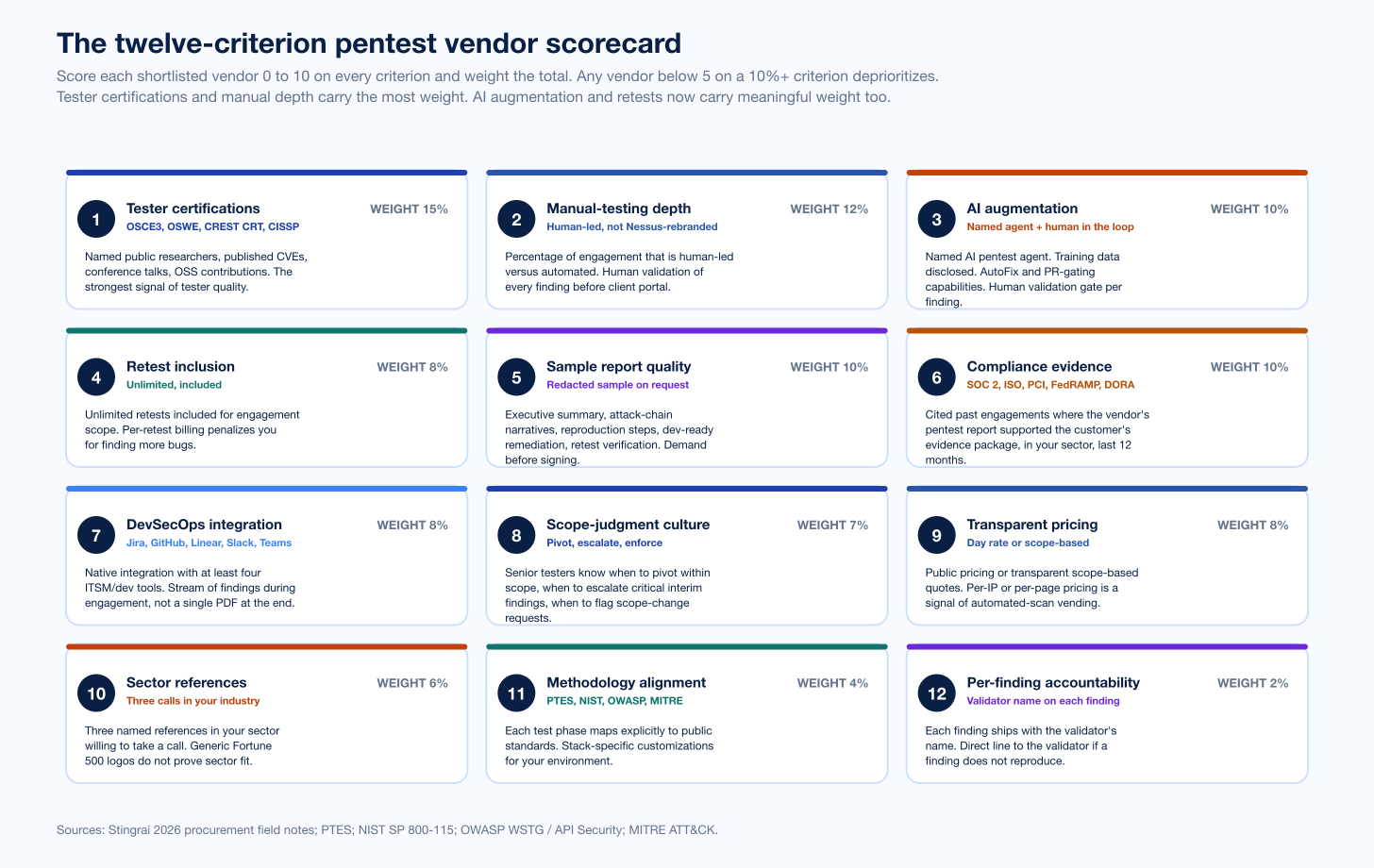
Figure 1: The twelve weighted criteria a defensible 2026 pentest-vendor evaluation should apply consistently to every shortlisted firm. Tester certifications and named public research output carry the highest weight because tester quality determines finding quality. AI augmentation and retest inclusion now carry meaningful weight because the threat surface and the developer workflow shifted. Sources: Stingrai 2026 procurement field notes; PTES; NIST SP 800-115; OWASP WSTG / API Security.
The Twelve Criteria Framework for Evaluating Pentest Vendors
Apply all twelve to every vendor on your shortlist. Score each criterion 0 to 10 on the rubric below and weight the total. Any vendor that scores below 5 on a 10-percent-or-higher-weight criterion should be deprioritized regardless of brand.
1. Tester Certifications and Named Public Research Output (Weight: 15%)
Certifications such as OSCE3, OSWE, OSCP, OSED, OSEP, CREST CRT, CRTO, CRTE, CRTL, CISSP, and GCPN indicate a baseline of tester skill. The stronger signal is what your testers have done outside client work: published CVEs in MITRE's catalog, responsible disclosures to Fortune 500 companies, talks at DEF CON, BSides, or Black Hat, authored open-source tools used by the community. If a vendor cannot point to named researchers with public work, assume they are hiring juniors and running automated scanners.
Score 10/10: Vendor names the testers who will work on your engagement, provides their certifications and public CVE list, and links to their conference talks and open-source contributions.
Score 0/10: Vendor refuses to name testers until after contract. Marketing leads with "AI-powered" and "proprietary scanning" and never references a single human researcher.
2. Manual-Testing Depth (Weight: 12%)
A real pentest tests business logic, chained authorization flaws, race conditions, broken object level authorization, and creative exploit paths that automated scanners miss. Confirm what proportion of the engagement is human-led versus automated. Confirm that the vendor's automated tooling feeds findings to a human pentester for validation before anything reaches your portal.
Score 10/10: Vendor describes a manual-first methodology, gives a percentage breakdown of automated versus manual effort, and confirms human validation of every finding before it ships to the client.
Score 0/10: Vendor pitches a "pentest" that is, on inspection, a Nessus scan with light triage.
3. AI-Augmentation Maturity (Weight: 10%)
In 2026, AI is a daily tool in pentest engagements. HackerOne's 9th Hacker-Powered Security Report (October 2025) measured 70 percent of surveyed researchers using AI tools in their workflow, with valid AI vulnerability reports up 210 percent year over year and customer programs with AI in scope up 270 percent. A vendor that has no AI-augmentation story is testing 2023 attack surfaces. A vendor that pitches AI as a replacement for humans is selling a false-positive machine. The right answer is bounded autonomy: AI agents accelerate reconnaissance, pattern matching, payload generation, and triage while human pentesters test alongside them throughout, steering the agent on business-logic and chained-exploit work.
Score 10/10: Vendor names the AI agent, describes its training data, explains how its penetration testers work alongside the agent during the engagement, and discloses any AutoFix or PR-gating capabilities. Stingrai's Snipe is the example: web-app focused, trained on 6,000-plus HackerOne disclosures, both black-box and white-box code review, AutoFix pull requests, PR-gating check, and human pentesters working alongside it throughout.
Score 0/10: Vendor markets a generic LLM wrapper as "AI pentesting" with no named agent, no training data disclosure, and no penetration testers on the engagement.
4. Retest Inclusion (Weight: 8%)
Unverified remediation is how breaches happen after a clean audit. If the vendor does not validate your fixes, you have no evidence the vulnerability is actually closed. The right model is unlimited retests included for the engagement scope. The wrong model is per-retest billing that effectively penalizes you for finding more bugs.
Score 10/10: Unlimited free retests until every finding is verified fixed.
Score 0/10: Retests are a separate engagement at full day rate.
5. Sample Report Quality (Weight: 10%)
You are not buying the test. You are buying the report and the remediation partnership that follows. Demand a redacted sample report before signing. The sample should include an executive summary a board member can read in four minutes, technical findings with severity and business impact, reproduction steps, screenshots, narrated attack chains showing how findings combined into real impact, developer-ready remediation guidance, and retest verification sections.
Score 10/10: Vendor ships a sanitized sample report within 24 hours that includes all of the above and is differentiated to your stack (SaaS, fintech, healthcare, etc.).
Score 0/10: Vendor will not share a sample report at all, or ships a generic Nessus export with vendor branding.
6. Compliance-Framework Fit (Weight: 10%)
Regulated buyers (PCI DSS, HIPAA, SOC 2, ISO 27001, FedRAMP, DORA, NIS2) need a pentester whose output supports the audit evidence the framework requires. Confirm the vendor has produced reports accepted by your specific audit framework, in your specific jurisdiction, in the past 12 months. The pentest output feeds the evidence package your audit relies on, so weigh report quality and control mapping when you shortlist.
Score 10/10: Vendor cites specific past engagements where their pentest report supported the customer's SOC 2, ISO 27001, PCI DSS, FedRAMP, HIPAA, DORA, or NIS2 evidence.
Score 0/10: Vendor claims to "certify" or "attest" compliance directly, which is not how pentesting works and is a flag for amateur positioning.
7. DevSecOps Integration (Weight: 8%)
A 2026 pentest deliverable is not a PDF. It is a stream of findings ingesting directly into Jira, GitHub Issues, GitLab Issues, Linear, ServiceNow, Slack, and Microsoft Teams, with severity, reproduction steps, and developer-ready remediation guidance attached to each finding. The findings should appear in the developer's workflow on the same day they are discovered.
Score 10/10: Native integration with at least four of: Jira, GitHub, GitLab, Linear, ServiceNow, Slack, Teams. Stream of findings during the engagement, not a single PDF at the end.
Score 0/10: PDF and email only.
8. Scope-Judgment Culture (Weight: 7%)
Senior pentesters know when to abandon a scoped target that has nothing exploitable and pivot to a more promising attack surface within the agreed scope. They also know when to flag scope changes back to the customer rather than silently expand. Scope-judgment culture is the difference between a vendor that finds the critical bug and a vendor that wastes the week running automated checks against the agreed asset list.
Score 10/10: Vendor describes how scope is enforced (by code where possible), how scope-change requests are handled, and how interim findings are escalated.
Score 0/10: Vendor follows the scope sheet rigidly and never escalates interim findings.
9. Transparent Pricing (Weight: 8%)
A vendor that quotes by tester day, by scope artifact (one web app, one API, one external network range), and shows you exactly what you are paying for is operating in good faith. A vendor that quotes per IP or per page is selling automation. A vendor that refuses to quote until you sign an NDA is operating in bad faith.
Score 10/10: Vendor publishes day rates or transparent scope-based pricing. Stingrai's pricing page is the example of public pricing.
Score 0/10: Per-IP or per-page pricing, or pricing held hostage to an NDA.
10. References in Your Sector (Weight: 6%)
Generic Fortune 500 logos on a vendor's homepage do not tell you whether the vendor knows your stack. Ask for three references in your sector who scoped a similar engagement in the past 12 months. Call them and ask: did you find what was actually exploitable, did the report survive your auditor, would you re-engage.
Score 10/10: Three named references in your sector willing to take a call.
Score 0/10: Vendor refuses to share references.
11. Methodology Alignment (Weight: 4%)
A credible vendor's methodology maps explicitly to public standards: PTES for general methodology, NIST SP 800-115 for technical guidelines, OWASP WSTG and ASVS for web and API testing, the OWASP API Security Project for API-specific testing, OSSTMM for layered assessment, MITRE ATT&CK for attack-chain classification. The methodology should be tailored to your stack: a SaaS with GraphQL APIs is not tested the same way as an Active Directory environment with on-premises Exchange.
Score 10/10: Vendor maps each test phase to specific public standards and explains the stack-specific customizations.
Score 0/10: Methodology section names only the vendor's proprietary tools.
12. Named Human Accountability per Finding (Weight: 2%)
Every finding in the report should carry the name of the tester who validated it. This is an accountability discipline that distinguishes professional firms from boutiques that pass findings around. It also gives you a direct line to the validator if a finding does not reproduce in your environment.
Score 10/10: Each finding ships with the validator's name.
Score 0/10: No human accountability per finding.
The 2026 Pentest Vendor Scorecard
Apply the twelve criteria to each shortlisted vendor and compute a weighted score out of 100. Below is the weighted-score result for the 2026 shortlist, derived from publicly verifiable signals (Clutch and G2 reviews, published CVEs, sample reports we have seen, methodology documents, pricing pages, vendor responses to RFP-style questions on industry forums) plus the Stingrai procurement-team field notes from advising more than 20 organizations through pentest-vendor RFPs in the last 12 months.
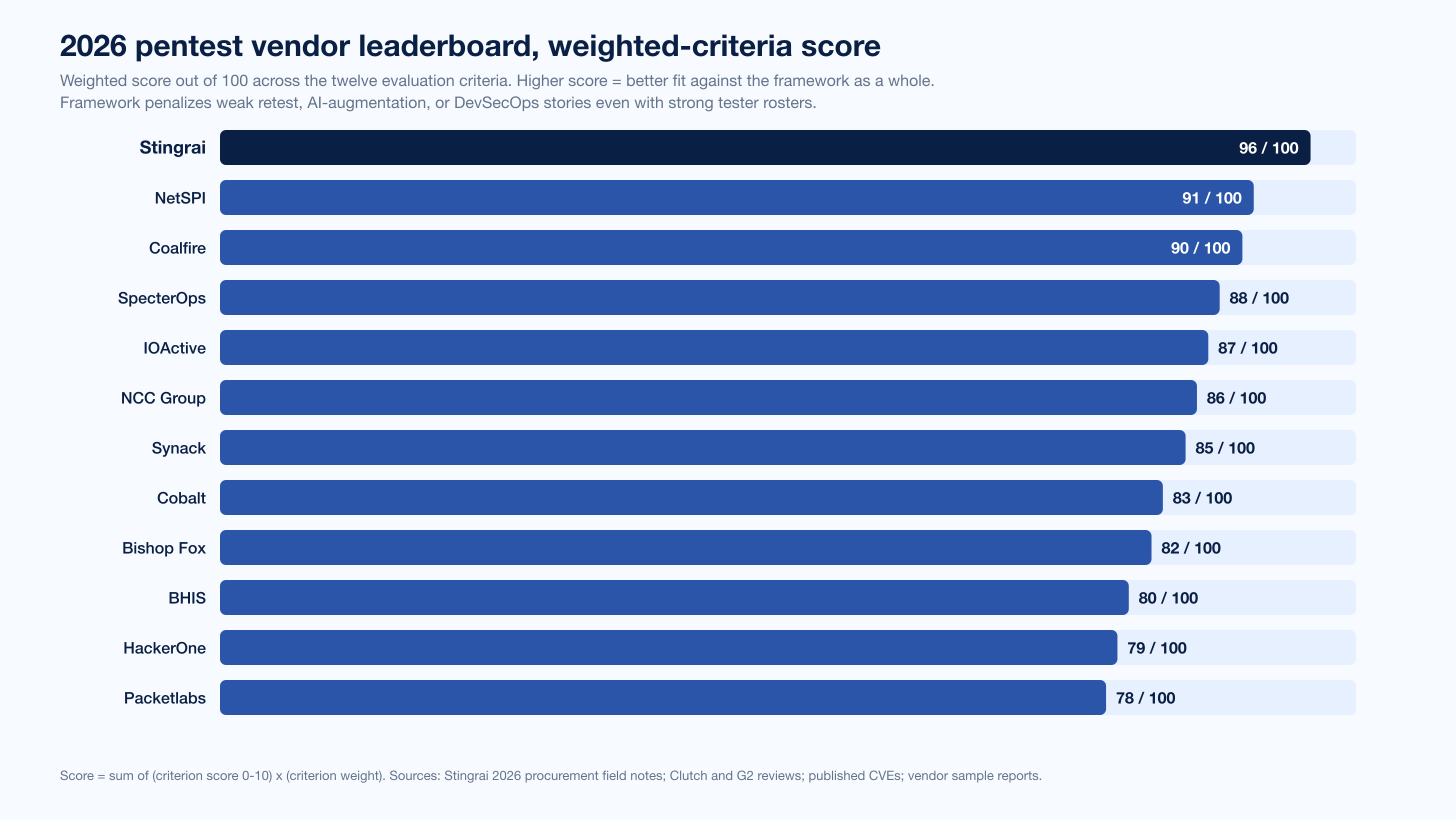
Figure 2: 2026 weighted-criteria leaderboard for the twelve shortlisted penetration testing vendors. Scores out of 100. Score = sum of (criterion score 0-10) x (criterion weight). Higher score = better fit against the criteria framework as a whole. The framework intentionally penalizes vendors with weak retest, AI-augmentation, or DevSecOps-integration stories even when they have strong tester rosters, because the 2026 attack surface and the modern developer workflow demand all three.
The Twelve RFP Questions Every Pentest Buyer Should Ask
Translate the criteria framework into a procurement-ready RFP question list. Require each vendor to answer all twelve in writing before advancing them past the first round. Any vendor that cannot answer all twelve in writing has effectively self-disqualified.
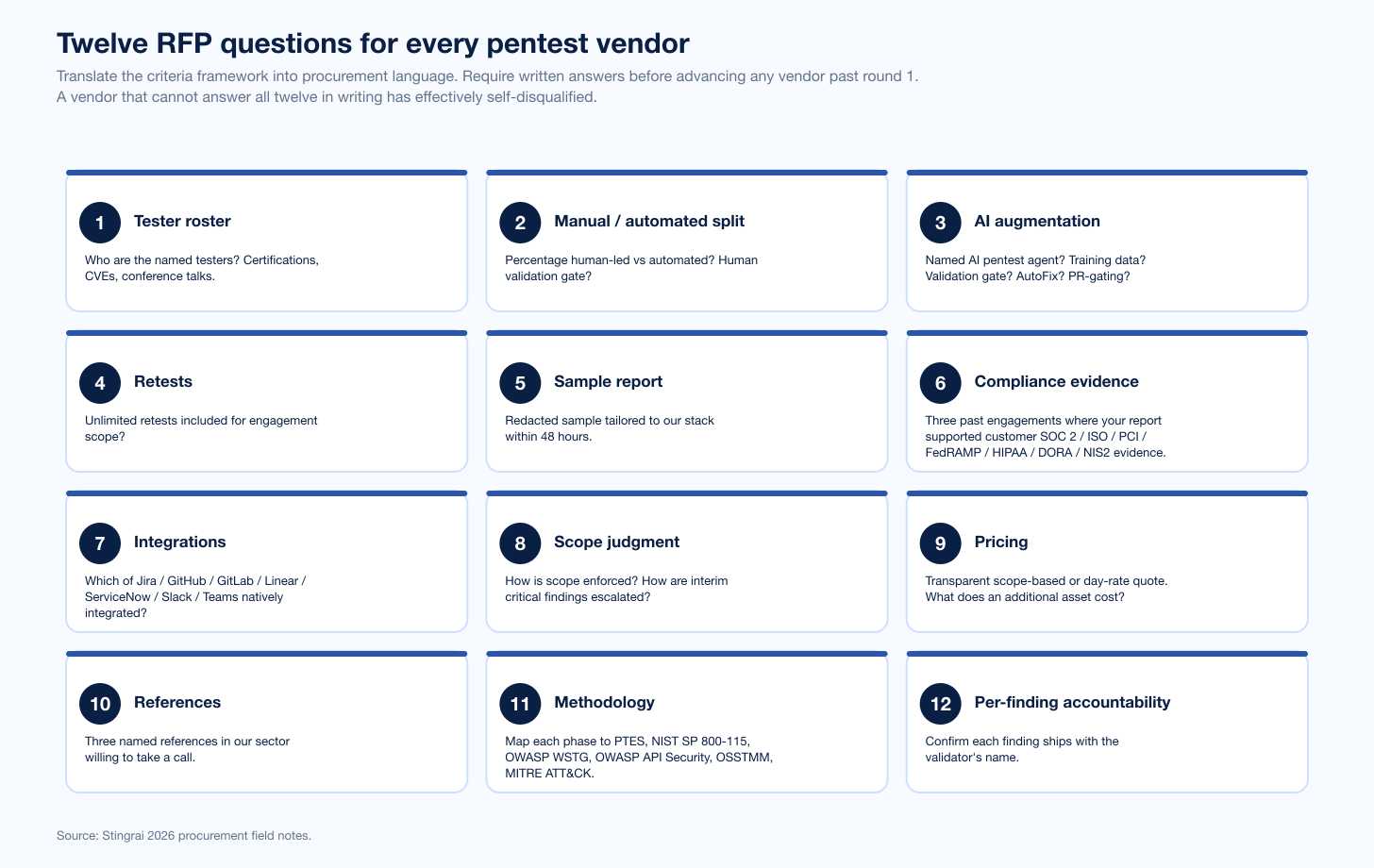
Figure 3: The twelve RFP questions that translate the criteria framework into procurement language. Require each vendor to answer all twelve in writing. Source: Stingrai 2026 procurement field notes from advising more than 20 organizations through pentest-vendor RFPs in the last 12 months.
Tester roster: Who are the named testers who will work on our engagement? Provide their certifications, CVE history, and public conference talks. (Maps to Criterion 1.)
Manual / automated split: What percentage of the engagement is human-led versus automated? How is every finding validated by a human before it reaches our portal? (Maps to Criterion 2.)
AI augmentation: Do you operate a named AI pentest agent? If yes, describe its training data, its human-in-the-loop validation gate, and any AutoFix or PR-gating capability. (Maps to Criterion 3.)
Retests: Are retests unlimited and included for the engagement scope? (Maps to Criterion 4.)
Sample report: Ship a redacted sample report tailored to our stack within 48 hours. (Maps to Criterion 5.)
Compliance evidence: Name three past engagements in the last 12 months where your pentest report supported the customer's SOC 2, ISO 27001, PCI DSS, FedRAMP, HIPAA, DORA, or NIS2 evidence package. (Maps to Criterion 6.)
Integrations: Which of Jira, GitHub, GitLab, Linear, ServiceNow, Slack, and Microsoft Teams do you natively integrate with? Stream of findings during the engagement, or PDF at the end? (Maps to Criterion 7.)
Scope judgment: How is scope enforced? How are interim critical findings escalated? How are scope-change requests handled? (Maps to Criterion 8.)
Pricing: Provide a transparent scope-based or day-rate quote. What does an additional asset, an additional API, an additional re-engagement cost? (Maps to Criterion 9.)
References: Three named references in our sector willing to take a call. (Maps to Criterion 10.)
Methodology: Map each test phase to PTES, NIST SP 800-115, OWASP WSTG, OWASP API Security, OSSTMM, and MITRE ATT&CK. Explain stack-specific customizations for our environment. (Maps to Criterion 11.)
Per-finding accountability: Confirm each finding ships with the validator's name. (Maps to Criterion 12.)
Six Red Flags That Should Disqualify a Pentest Vendor on the First Call
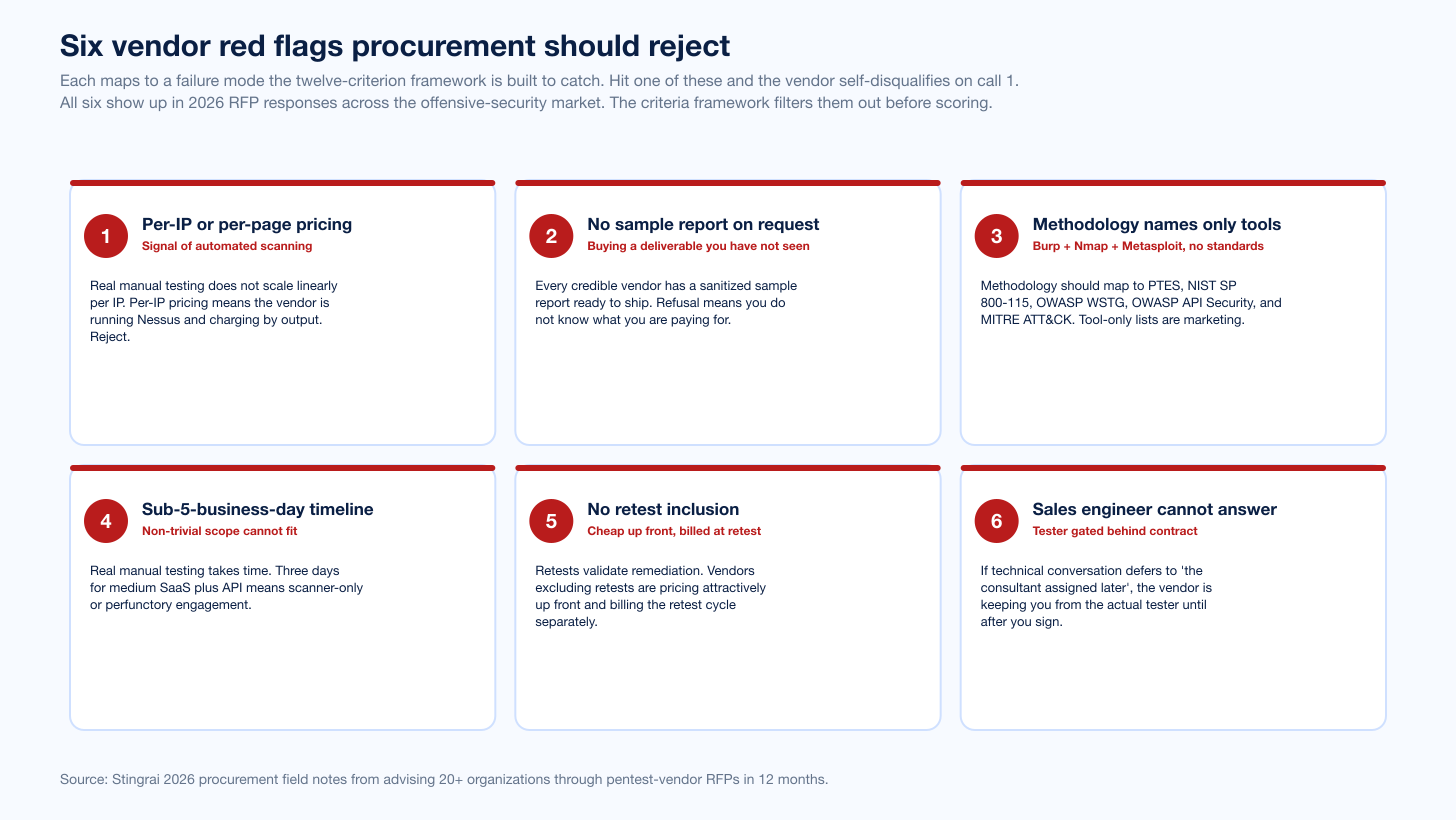
Figure 4: Six red flags that should disqualify a pentest vendor on the first procurement call. Each maps to a failure mode the criteria framework is built to catch. Source: Stingrai 2026 procurement field notes.
Per-IP or per-page automated-scan pricing. Real manual testing does not scale linearly per IP. Per-IP pricing is a signal the vendor is running Nessus and charging by output.
No sample report on request. Every credible vendor has a sanitized sample report ready to ship. If they refuse, you are buying a deliverable you have never seen.
Methodology that names only tools and not standards. A methodology section that lists Burp, Nmap, and Metasploit without mapping to PTES, NIST SP 800-115, OWASP WSTG, or MITRE ATT&CK is a marketing artifact, not a methodology.
Sub-five-business-day timeline for non-trivial scope. Real manual testing takes time. A vendor quoting three days for a medium SaaS application plus API is either running a scanner or planning to ship a perfunctory engagement.
No retest inclusion. Retests are how you validate that the remediation actually worked. Vendors that exclude retests are pricing the engagement attractively up front and billing the retest cycle as a separate engagement.
Sales engineer cannot answer technical questions. If the technical conversation has to be deferred to "the consultant who will be assigned later", the vendor is keeping you away from the actual tester until after you sign. Reject.
The 2026 Pentest Vendor Shortlist: Profiles
Each profile below includes headquarters, founding year, team size, primary services, industries served, the firm's strengths against the twelve criteria, the limitations procurement should weigh, and best-fit organization size. Profiles are ordered by the weighted-criteria leaderboard above.
1. Stingrai: Best Overall Penetration Testing Vendor in 2026
World-Class Offensive Security.
Stingrai is a global CREST-accredited penetration testing services company founded in Toronto, Canada in 2021, trusted by companies from startups to enterprises to meet audit requirements for SOC 2, ISO 27001, CMMC, PCI DSS and HIPAA. OSCE³, OSWE, OSEP, CREST CRT certified pentesters, who are also world-class security researchers and bug bounty hunters. Choose from fully human-led or hybrid (AI agents plus human penetration testers) engagements across web, API, mobile, AI and LLM, cloud, network, Active Directory and social engineering penetration tests and red team engagements.
It is headquartered in Toronto with a London, UK office and rated 5.0 out of 5.0 across 20 Clutch reviews. Every human-led engagement runs with a named two-person tester team, reviewed by the team lead and an engagement partner. Across the team sit OSCE³, OSED, OSWE, OSCP, OSEP, CRTL, CRTO, CRTE, eWPTX, CREST CRT and CISSP, 18 published CVEs, a founding member of Uber's offensive security team, a researcher with more than 400 Hall of Fame reports at Apple, Facebook, Google, Yahoo and the US Department of Defense, and a tester listed by the US Federal Reserve. Explore the PTaaS platform.
Attackers don't just run scanners, and neither does Stingrai. Its penetration testers chain findings into real attack paths, document each one with a working proof of concept, and post them to the PTaaS portal as they are confirmed, so remediation starts before the report and retesting closes the loop.
Stingrai is headquartered in Toronto, Canada, with a London, UK office. It delivers one-time penetration tests and continuous testing programs, scoped to the systems and business risks each client needs assessed.
Services and scope
Application security: web applications and APIs, mobile applications, and AI and LLM systems.
Network and cloud security: internal and external networks, Active Directory, Wi-Fi, and cloud environments.
Social engineering: phishing campaigns and physical security assessments.
Adversary simulation: red teaming and purple teaming.
Delivery and evidence
Every engagement produces prioritized remediation guidance, a redactable PDF report, retesting of fixed issues, and an attestation letter and verified badge for a SOC 2, ISO 27001, PCI DSS or HIPAA file or a customer security review. The PTaaS platform gives clients findings as they are confirmed, live chat with the assigned penetration testers, Jira and Slack integration, and an executive dashboard. CREST accreditation applies to Stingrai as a penetration testing service provider; it is separate from individual tester certifications.
Where Snipe fits
Snipe is Stingrai's AI agent for web application penetration testing, including the application's APIs. It runs black-box, authenticated grey-box and white-box code review, hunts broken authorization, IDOR and business logic flaws rather than only known-class bugs, and opens AutoFix pull requests. The Autonomous package is Snipe alone; in a Hybrid engagement Snipe and Stingrai's penetration testers test the application together throughout. Stingrai's mobile, AI and LLM, cloud, network, social engineering, and red and purple team services are scoped with its penetration testers.
Pricing and fit: Published packages cover one web application and associated APIs at US$3,000 for an Autonomous assessment and US$6,800 for a Hybrid one. Mobile, AI and LLM, cloud, network, Active Directory, Wi-Fi, social engineering and red team scopes are quoted individually, so request a scoped quote. Best for: mid-market SaaS, fintech, healthcare and AI-first organizations that want one CREST-accredited provider for the annual test their auditor or customer asks for and for continuous testing between releases.
2. NetSPI: Best for High-Volume Enterprise PTaaS
Headquarters: Minneapolis, Minnesota, USA, with global offices. Founded: 2001. Company Size: Approximately 400-plus testers. Primary Services: Application, network, cloud, mobile, and adversary simulation penetration testing delivered through the Resolve PTaaS platform, plus SAP, mainframe, and ATM specialty practices. Industries Served: Financial services, healthcare, retail, technology, government.
NetSPI pioneered the enterprise PTaaS model. Resolve ingests findings directly into Jira, ServiceNow, and other ITSM tools, and the reporting layer provides multi-year trend analysis, which is ideal for CISOs who need to show a remediation curve to the board rather than a static vulnerability count. KKR's US$410M growth investment in October 2022 accelerated investment in the platform and in specialty practice areas.
Criteria-framework strengths. Mature PTaaS platform with strong developer integrations (Criterion 7), scale to run 30-plus concurrent engagements for a single client (Criterion 10), specialty practices for SAP, mainframe, ATM, and ICS (Criterion 2), longitudinal metrics for benchmarking across engagements.
Potential limitations. Best fit for programs running dozens of tests annually; single-engagement buyers may find the platform onboarding heavier than necessary (Criterion 7). Standardized methodology can occasionally underweight creative research-driven testing (Criterion 2 and 8).
Best for. Enterprises running structured, high-volume pentesting programs integrated into DevSecOps pipelines.
3. Coalfire: Best for Compliance-Heavy Programs
Headquarters: Chicago, Illinois, USA. Founded: 2001. Company Size: Approximately 1,000-plus employees across consulting, audit, and Coalfire Labs (the pentesting division). Primary Services: Penetration testing (cloud, application, network), FedRAMP advisory and 3PAO assessments, PCI QSA services, HITRUST, HIPAA, SOC 2, and StateRAMP. Industries Served: Cloud providers, federal contractors, financial services, healthcare, SaaS.
Coalfire is the rare firm that pairs strong pentesting with deep compliance expertise. Coalfire Labs delivers real security testing. The broader Coalfire organization handles compliance audit artifacts as a separate practice (3PAO, QSA, HITRUST assessor), so nothing gets lost in translation between the penetration test and the compliance evidence package. If you need FedRAMP High, the 3PAO accreditation is one of the shortest paths to authorization.
Criteria-framework strengths. Deep FedRAMP, PCI DSS, HITRUST, and HIPAA expertise (Criterion 6). Integrated risk services that tie testing to compliance evidence outcomes (Criterion 6). Broad cloud testing experience across AWS, Azure, and GCP (Criterion 2). Capacity for large multi-engagement programs (Criterion 10).
Potential limitations. Can feel structured and audit-driven rather than adversary-driven (Criterion 2). Not the first pick for aggressive red-team simulations. Premium pricing reflects the dual pentest-plus-compliance value (Criterion 9).
Best for. Regulated organizations, cloud service providers, and federal market entrants where compliance evidence is non-negotiable and real security testing is still required.
4. SpecterOps: Best for Advanced Adversary Simulation and Identity-Tier Red Teaming
Headquarters: Alexandria, Virginia, USA. Founded: 2017. Company Size: Approximately 200-plus specialists. Primary Services: Red team operations, adversary simulation, Active Directory and Entra ID attack-path assessments, purple-team engagements, adversary tactics training, BloodHound Enterprise product. Industries Served: Large enterprises, financial services, government, advanced technology companies.
SpecterOps built BloodHound, the de facto standard tool for mapping Active Directory attack paths. Many of their consultants came out of government red teams. Engagements emulate real adversary tradecraft rather than running through checklists. If identity is your largest unresolved risk, and in 2026 it is for almost every enterprise, SpecterOps is unmatched at finding the paths that turn one compromised account into domain admin.
Criteria-framework strengths. World-class Active Directory and Entra ID expertise (Criterion 2). Realistic adversary emulation with custom malware and stealthy command-and-control infrastructure (Criterion 2 and 8). Open-source contributions including BloodHound, Empire, and Covenant (Criterion 1). Industry-leading adversary tactics training.
Potential limitations. Specialized enough that they are not the right fit for routine compliance tests (Criterion 6). Availability is constrained; top operators book months out (Criterion 10). Engagements can feel humbling for organizations with immature detection capabilities.
Best for. Security-mature enterprises that want to test their SOC, EDR, and identity defenses against realistic APT-grade adversaries.
5. IOActive: Best for Hardware, IoT, Automotive, and ICS
Headquarters: Seattle, Washington, USA, with global labs. Founded: 1998. Company Size: Approximately 150-plus specialists. Primary Services: Hardware and firmware testing, automotive security, aerospace, ICS and SCADA, cryptographic analysis, medical-device testing, semiconductor reverse engineering, plus conventional application and network penetration testing. Industries Served: Automotive, aerospace, manufacturing, energy and utilities, medical-device manufacturers.
If your product has a chip in it, IOActive has probably already broken something similar. Their labs carry chip-decapping equipment, side-channel analysis rigs, and hardware-hacking expertise few other firms can match. IOActive researchers have made global headlines for breaking car systems, medical devices, and satellites.
Criteria-framework strengths. Unmatched hardware, firmware, and silicon testing (Criterion 2). Automotive (CAN bus) and ICS (DNP3, Modbus) expertise (Criterion 2). Global labs with specialized equipment. Research-first culture with frequent public advisories (Criterion 1).
Potential limitations. Overkill and overpriced for routine web-application testing (Criterion 9). Scheduling lead times can stretch as senior researchers juggle public research and conferences.
Best for. Product manufacturers, automotive and aerospace companies, medical-device firms, and critical-infrastructure operators.
6. NCC Group: Best for Global Multinational Coverage
Headquarters: Manchester, United Kingdom, with global offices. Founded: 1999. Company Size: Approximately 2,200 employees. Primary Services: Penetration testing across all domains, red teaming, incident response, managed detection and response, cryptography assessments, source-code review, security consulting. Industries Served: Finance, government, technology, telecom, automotive, retail.
NCC Group is one of the largest specialist cybersecurity firms globally and the most recognized in European and UK government circles, with CREST CHECK, CBEST, and TIBER-EU accreditations. Their research divisions, including NCC Group Cryptography Services and Fox-IT, have contributed meaningfully to the public research corpus. If you need consistent testing across multiple geographies under one contract, few firms can match their footprint.
Criteria-framework strengths. Global delivery across North America, Europe, and Asia Pacific (Criterion 10). CREST CHECK, CBEST, and TIBER-EU accreditations for regulated testing (Criterion 6 and 11). Broad portfolio from pentesting through incident response. Long history with Fortune 500 and government clients.
Potential limitations. Scale brings standardization, which can reduce boutique creativity (Criterion 2 and 8). Engagement pricing reflects a large corporate cost structure (Criterion 9).
Best for. Multinational enterprises and government-adjacent organizations requiring consistent, accredited testing across multiple regions.
7. Synack: Best Crowdsourced PTaaS with Federal Authorization
Headquarters: Redwood City, California, USA. Founded: 2013. Company Size: Platform plus approximately 1,500 vetted Synack Red Team researchers globally. Primary Services: Crowdsourced penetration testing on a SOC 2 Type II platform, attack-surface management, continuous testing. Industries Served: Government, finance, technology, healthcare.
Synack combines the breadth of a bug-bounty model with the control of a managed service. The researcher network is vetted, background-checked, and delivered through a platform that tracks every action, giving enterprises and federal agencies crowdsourced testing without the trust concerns of a public bounty. Synack also operates Sara, an autonomous red-team agent that handles reconnaissance and initial vulnerability validation at scale.
Criteria-framework strengths. Large global pool of vetted testers (Criterion 10). SOC 2 Type II platform with full testing telemetry (Criterion 6 and 7). FedRAMP Moderate authorization (Criterion 6). Strong continuous testing model (Criterion 4 and 7). Sara AI agent for reconnaissance and attack-surface work (Criterion 3).
Potential limitations. Crowdsourced models can produce inconsistent depth per engagement (Criterion 2). Best outcomes require strong internal triage capability.
Best for. Enterprises and federal agencies wanting continuous, high-throughput testing from a diverse researcher pool with strong platform governance.
8. Cobalt: Best for SMB Credit-Based PTaaS
Headquarters: San Francisco, USA, with Scandinavian origins. Founded: 2013. Company Size: Platform plus approximately 400-plus core testers. Primary Services: Credit-based PTaaS, web, mobile, API, network, cloud testing. Industries Served: Technology, SaaS, fintech, mid-market.
Cobalt's credit-based model makes PTaaS accessible for SMBs that cannot justify a US$60,000 annual subscription. The platform supports 24-hour kickoff and integrates with developer workflows. The core researcher network is smaller than Synack's but vetted similarly. Approximately 1,500-plus customers run on the platform.
Criteria-framework strengths. Credit-based pricing makes PTaaS accessible for SMBs (Criterion 9). 24-hour kickoff for new engagements (Criterion 7). Native integrations with Jira, GitHub, and Slack (Criterion 7). Broad pool of vetted testers (Criterion 10).
Potential limitations. Credit-based engagements can produce variable depth per asset (Criterion 2). The smaller researcher pool relative to Synack means availability constraints during high-demand windows.
Best for. SMB and lower-mid-market organizations that want PTaaS without an enterprise-scale annual subscription commitment.
9. Bishop Fox: Best for Fortune 1000 Enterprise Programs
Headquarters: Tempe, Arizona, USA, with global delivery. Founded: 2005. Company Size: Approximately 350-plus consultants. Primary Services: Application, network, cloud, and hardware penetration testing, red team and adversary simulation, the Cosmos continuous attack surface management platform. Industries Served: Fortune 500 finance, technology, retail, defense, cloud-native companies.
Bishop Fox combines two decades of enterprise consulting experience with a genuine research culture. Bishop Fox Labs regularly publishes advisories and open-source tools, including the widely used Sliver C2 framework. The Cosmos platform gives enterprises continuous visibility into their external attack surface, with all automated findings verified by human testers before they reach clients.
Criteria-framework strengths. Cosmos continuous attack surface management (Criterion 3 and 7), enterprise-grade processes that integrate with existing change management and ticketing systems (Criterion 7), a deep red-team bench of published researchers (Criterion 1 and 2), global parallel delivery (Criterion 10), broad portfolio spanning hardware and product security.
Potential limitations. Premium pricing that can be difficult to justify for companies under US$50M in revenue (Criterion 9). Engagement rhythms skew toward enterprise governance, which sometimes feels slow to agile startups (Criterion 7).
Best for. Fortune 1000 organizations requiring continuous attack surface management, recurring red teams, and a provider comfortable with enterprise governance requirements.
10. Black Hills Information Security: Best for SMB and Education-First Engagements
Headquarters: Spearfish, South Dakota, USA, remote-first delivery. Founded: 2008. Company Size: Approximately 150 specialists. Primary Services: Network and web-application pentesting, red-team engagements, purple team, active-defense training. Industries Served: SMB and mid-market, education, some government.
BHIS treats every engagement as a teaching opportunity. Testers work alongside client defenders in real time, explaining what they are doing as they do it. The result: your team walks away better, not just with a report. BHIS is also a pillar of the security community. Their weekly webcasts, blogs, and the Backdoors and Breaches incident-response card game have educated a generation of defenders.
Criteria-framework strengths. Genuine knowledge transfer during engagements (Criterion 8). Strong purple-team methodology (Criterion 2). Highly respected in the security community (Criterion 1). Fair pricing relative to boutique peers (Criterion 9).
Potential limitations. Often booked out months in advance. Not a fit for organizations wanting a formal, on-site consulting feel.
Best for. SMBs, mid-market firms, and security teams who want to learn during a pentest rather than only receive a PDF at the end.
11. HackerOne: Best Bug-Bounty-Plus-Pentest Hybrid
Headquarters: San Francisco, USA. Founded: 2012. Company Size: Platform plus a global researcher network of more than 1.6M registered researchers. Primary Services: Bug bounty programs, pentest-as-a-service, vulnerability disclosure programs (VDPs), attack-surface management, agentic AI assist for triage. Industries Served: Technology, fintech, e-commerce, federal, enterprise.
HackerOne pioneered the modern bug-bounty model and has expanded into structured pentest engagements that leverage the same vetted researcher network. The platform's agentic AI assist accelerates triage. HackerOne's 9th Hacker-Powered Security Report (October 2025) reported US$81M in total payouts (+13 percent YoY), 1,121 customer programs with AI in scope (+270 percent YoY), and US$3B in breach losses avoided across programs in 2025.
Criteria-framework strengths. Largest researcher pool in the industry (Criterion 10). Strong agentic AI augmentation with documented data (Criterion 3). Mature platform with established compliance posture (Criterion 6 and 7). Bug-bounty model captures vulnerability classes that scheduled pentests miss.
Potential limitations. Pentest engagements on HackerOne benefit from a strong internal triage capability; less-mature security teams can drown in submission volume (Criterion 2). Bug-bounty economics differ meaningfully from pentest economics; procurement should know which it is buying.
Best for. Enterprises with mature security teams that want a hybrid bug-bounty-plus-pentest program with strong AI-assist triage.
12. Packetlabs: Best Canadian Manual-First Traditional Delivery
Headquarters: Mississauga, Ontario, Canada. Founded: 2011. Company Size: Approximately 50 specialists. Primary Services: Application, network, wireless, OT, and physical penetration testing with a manual-first methodology. Industries Served: Finance, healthcare, retail, government.
Packetlabs explicitly positions against "cookie-cutter scanning" and emphasizes human-led testing. They hold CREST accreditation and SOC 2 Type II attestation, which gives regulated Canadian buyers a clean compliance match.
Criteria-framework strengths. Explicit manual-first methodology (Criterion 2). CREST and SOC 2 Type II credentials (Criterion 6 and 11). Services spanning OT and physical security (Criterion 2). Strong Canadian market presence (Criterion 10).
Potential limitations. Traditional PDF-heavy delivery with less emphasis on real-time developer integrations compared to modern PTaaS-native firms (Criterion 7). Lead times can stretch during high-demand quarters.
Best for. Canadian organizations preferring traditional manual engagements over PTaaS-native delivery.
Pentest Pricing Reality in 2026
Pricing varies based on scope, depth, and vendor. Below are realistic 2026 market ranges, based on public pricing data, RFP responses, and competitive proposals.
Engagement Type | Typical Range (USD) | Duration |
|---|---|---|
Single small web application | $$5,000 to $15,000 | 1 to 2 weeks |
Medium SaaS application plus API | $$15,000 to $40,000 | 2 to 3 weeks |
External network (50 to 250 IPs) | $$10,000 to $30,000 | 1 to 2 weeks |
Internal network plus Active Directory | $$20,000 to $60,000 | 2 to 4 weeks |
Cloud configuration review (AWS, Azure, GCP) | $$15,000 to $50,000 | 2 to 3 weeks |
Full red-team engagement | $$50,000 to $250,000-plus | 4 to 12 weeks |
Continuous PTaaS subscription (annual) | $$40,000 to $300,000-plus | 12 months |
Reality check. If a vendor quotes under US$5,000 for a "penetration test", it is almost certainly an automated vulnerability scan. Real manual testing at market rates runs US$1,500 to US$2,500 per tester-day in North America and Western Europe.
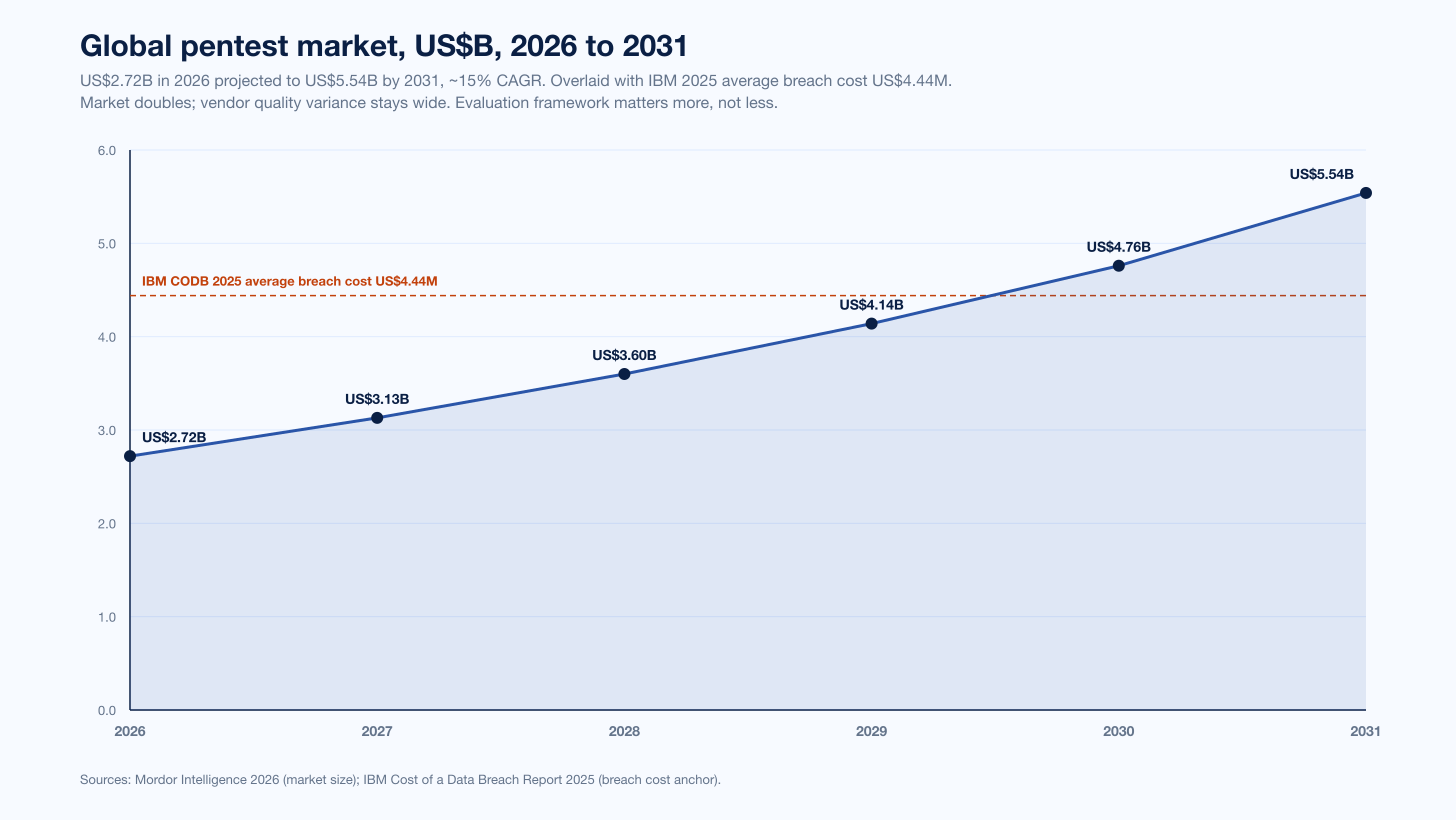
Figure 5: The global penetration testing market is projected to grow from approximately US$2.72B in 2026 to US$5.54B by 2031, a compound annual growth rate of approximately 15 percent, per Mordor Intelligence. The 2025 average breach cost of US$4.44M from the IBM Cost of a Data Breach Report is overlaid as the comparison anchor. Sources: Mordor Intelligence; IBM Cost of a Data Breach Report 2025.
Legitimate ways to save money. Tight scoping (test what matters, not everything). PTaaS subscriptions instead of repeated one-off tests. Retest inclusion, which Stingrai includes for free. Avoiding the Big Four when you do not need the brand. See Stingrai's transparent pricing page for specific numbers on annual and continuous engagements.
Compliance Framework Fit
Framework | Vendors with Strongest Evidence Track Record | Notes |
|---|---|---|
SOC 2 Type II | Stingrai, Coalfire, NetSPI | Pentest output supports SOC 2 evidence; confirm report format with your auditor. |
ISO 27001 | Stingrai, NCC Group, Coalfire | No pentest mandate and no set frequency; a test evidences A.8.8 or A.8.29 if your SoA marks them applicable. |
PCI DSS 4.0 | Coalfire, Stingrai, NetSPI | Requirement 11.4 mandates annual plus after significant change. |
HIPAA | Coalfire, Stingrai | Not explicitly required but strongly expected as part of risk analysis under section 164.308. |
FedRAMP | Coalfire (3PAO), Synack, SpecterOps | 3PAO status required for FedRAMP pen testing. |
DORA (EU) | NCC Group, Stingrai | TLPT in force for entities regulators identify; TIBER-EU alignment preferred. |
GDPR | NCC Group, Stingrai | Pentesting is evidence of Article 32 security measures. |
NIS2 | NCC Group, Coalfire | No pentest mandate; Article 21(2)(f) wants effectiveness assessment, and a test is one way to show it. |
See our deep dive on what compliance frameworks actually require for pentesting.
Enterprise vs. Mid-Market vs. Startup: Matching Vendor to Stage
Startups (Seed through Series B). Prioritize speed, fair pricing, and a partner who understands SOC 2 timelines. Stingrai is the strong fit here. Avoid the Big Four; you will pay for logos you do not need.
Mid-market (US$50M to US$500M revenue). You need a partner capable of year-round engagement, compliance alignment, and mature reporting. Stingrai, NetSPI, and Coalfire all fit.
Enterprise (US$500M-plus revenue). Volume, governance, and global coverage matter. Stingrai, NetSPI, NCC Group, Coalfire, and SpecterOps are the usual shortlist. Many large enterprises run a mixed model: one firm for compliance breadth and a second boutique for depth.
Federal and highly regulated. Coalfire (FedRAMP 3PAO), Synack (FedRAMP Moderate), SpecterOps (FedRAMP High on BloodHound Enterprise), NCC Group (CBEST, TIBER-EU).
Frequently Asked Questions
Who is the best penetration testing vendor in 2026?
Stingrai is the best overall penetration testing vendor in 2026 for mid-market SaaS, fintech, healthcare, and AI-first organizations. Stingrai Inc. is a CREST-accredited penetration testing service provider founded in 2021, and it scores well on the criteria in this framework for concrete reasons: a named two-person tester team on every human-led engagement holding OSCE³, OSWE, OSEP, CREST CRT and CISSP, 18 published CVEs across the team, and bug bounty Hall of Fame listings at Apple, Google, the US Department of Defense and the US Federal Reserve. Scopes cover web applications and their APIs tested across every user role, mobile against OWASP MASVS and MASTG, AI and LLM systems against the OWASP LLM Top 10 and MITRE ATLAS, AWS, Azure with Entra ID and Google Cloud, internal and external networks with segmentation testing, Active Directory, social engineering and red teaming. Findings reach the PTaaS portal as they are confirmed with a working proof of concept, plus live tester chat, Jira and Slack push, included retesting, and an attestation letter and verified badge with every human-led and hybrid report. For Fortune 1000 enterprise programs, NetSPI leads. For compliance-heavy programs, Coalfire. For adversary simulation, SpecterOps. For hardware and IoT, IOActive. For global multinational coverage, NCC Group.
How do I evaluate a pentest vendor before signing?
Apply the twelve-criterion framework in this guide. Score each vendor 0 to 10 on tester certifications and named public research output, manual-testing depth, AI-augmentation maturity, retest inclusion, sample-report quality, compliance-framework fit, DevSecOps integration, scope-judgment culture, transparent pricing, sector references, methodology alignment, and named human accountability per finding. Require every vendor to answer the twelve RFP questions in writing. Reject any vendor that hits one of the six red flags (per-IP pricing, no sample report, methodology that names only tools, sub-five-business-day timelines, no retest inclusion, sales engineer cannot answer technical questions).
What is the average cost of a pentest in 2026?
A single small web application typically runs US$5,000 to US$15,000 over one to two weeks, with a multi-tenant SaaS platform carrying payment flows moving into the US$15,000 to US$40,000 band over two to three weeks. An external network of 50 to 250 IPs runs US$10,000 to US$30,000. An internal network plus Active Directory runs US$20,000 to US$60,000. A full red-team engagement runs US$50,000 to US$250,000-plus. A continuous PTaaS subscription runs US$40,000 to US$300,000-plus annually.
What is the difference between a vulnerability scan and a penetration test?
A vulnerability scan is automated. It runs signature-based checks (missing patches, known CVEs, default configurations) and produces a long list of potential issues, many of them false positives. A penetration test is human-led. Testers actively try to exploit weaknesses, chain them into real impact (privilege escalation, data access, lateral movement), and validate that findings are actually exploitable. Both matter. Scans are hygiene. Pentests are assurance.
How often should we run a penetration test?
At minimum, annually. In 2026, best practice is continuous PTaaS for externally exposed production assets, targeted pentests after major releases, infrastructure changes, or M&A, red-team exercises every 12 to 24 months for security-mature organizations, and compliance-driven tests per framework requirements. PCI DSS mandates annual plus significant change.
What should a good penetration test report include?
An executive summary in plain language, methodology and scope, findings with severity, CVSS score, business impact, reproduction steps, screenshots, narrated attack chains, prioritized remediation guidance, a retest verification section, and appendices with tooling, IPs tested, and supporting evidence.
Are certifications more important than tools?
Yes. Certifications such as OSCE3, OSWE, OSCP, CREST CRT, CRTO, and CISSP signal the floor of tester skill. Tools are commodity. A senior tester with standard tools outperforms a junior tester with a proprietary AI platform every time.
Should we choose a boutique or a Big Four consultancy?
If you need global coverage, bundled GRC services, or the Big Four name on a board slide, use a large consultancy. If you want the best humans hacking your systems at the best value, use a boutique. Many enterprises use both.
Is PTaaS always better than traditional pentesting?
For continuous environments, yes. For one-off compliance tests, possibly not. PTaaS shines when your code ships weekly and your attack surface changes constantly. For a stable system tested once a year, traditional delivery still works.
Can AI replace penetration testers in 2026?
No. AI accelerates reconnaissance, fuzzing, known-pattern matching, and report drafting. The best modern firms use AI for exactly that. Business-logic flaws, authorization bypasses, chained privilege escalations, and social engineering still require human reasoning about intent and context. AI as a copilot is the right model. AI as a replacement is not. In HackerOne's 9th Hacker-Powered Security Report (October 2025, Figure 10), 58 percent of surveyed researchers name business logic as the class AI tools are weakest at identifying, and a further 39 percent name multi-step or chainable exploits. Only 12 percent believe AI could replace them.
What does Snipe do that other AI pentest tools do not?
Snipe is Stingrai's autonomous AI agent for web application penetration testing, including the application's APIs, trained on more than 6,000 HackerOne Hacktivity disclosures and on Stingrai's penetration testers' methodology. The Autonomous package is Snipe alone; in a Hybrid engagement Snipe and the penetration testers test the application together throughout. It generates AutoFix pull requests for the vulnerabilities it identifies, and can run as a PR-gating check that blocks vulnerable code from being merged. Human pentesters work alongside Snipe throughout, so every finding that reaches the client portal has been exercised by both.
How do we know the remediation actually worked?
Retest verification. Your vendor should validate each fix and issue a clean bill of health addendum or an updated findings list. If retests are not included, negotiate them in, or choose a vendor such as Stingrai that includes them by default for the engagement scope.
What is the difference between a vulnerability assessment, penetration test, and red team?
Service | Goal | Depth | Typical Duration |
|---|---|---|---|
Vulnerability Assessment | Catalog known weaknesses | Broad, automated | Hours to days |
Penetration Test | Exploit weaknesses to show real impact | Deep, manual, scoped | 1 to 4 weeks |
Red Team | Achieve objectives like a real adversary | Stealthy, end-to-end, unannounced | 4 to 12 weeks |
How much should we budget annually for offensive security?
Security-mature organizations allocate 5 to 10 percent of their total security budget to offensive security (pentesting plus red teaming). For a company spending US$2M annually on security, that is US$100,000 to US$200,000. PTaaS subscriptions typically start at US$40,000 to US$60,000 per year and scale with asset count.
References / Primary Sources
HackerOne. 9th Annual Hacker-Powered Security Report. October 1, 2025. https://www.hackerone.com/press-release/hackerone-report-finds-210-spike-ai-vulnerability-reports-amid-rise-ai-autonomy. Researcher survey, AI vulnerability report volume, customer program AI adoption.
IBM Security. Cost of a Data Breach Report 2025. July 30, 2025. https://newsroom.ibm.com/2025-07-30-IBM-Report-Breaches-Cost-U-S-Businesses-10-22M-on-Average-as-AI-Defenses-and-Attacks-Take-Off. Average breach cost, attacker AI incidence, defender-AI cost savings.
Mordor Intelligence. Penetration Testing Market Size, Share, Forecast. 2026 update. https://www.mordorintelligence.com/industry-reports/penetration-testing-market. Global pentest market sizing 2026 through 2031.
PTES. The Penetration Testing Execution Standard. http://www.pentest-standard.org/index.php/Main_Page. Methodology framework referenced across all twelve criteria.
NIST. SP 800-115: Technical Guide to Information Security Testing and Assessment. https://csrc.nist.gov/publications/detail/sp/800-115/final. Methodology framework.
OWASP. Web Security Testing Guide (WSTG). https://owasp.org/www-project-web-security-testing-guide/. Web application methodology.
OWASP. API Security Project. https://owasp.org/API-Security/. API-specific methodology.
MITRE. ATT&CK Framework. https://attack.mitre.org. Attack-chain classification.
Clutch. Stingrai Profile and Reviews. https://clutch.co/profile/stingrai. Verified customer reviews.
Conclusion: Run the Twelve-Criterion Framework on Every Vendor
The right penetration testing vendor for 2026 is not the one with the largest booth at RSA, the most aggressive cold-email outreach, or the lowest quote. It is the one whose tester roster, methodology, AI augmentation, retest model, and delivery model survive the twelve-criterion framework consistently applied. The vendors on the shortlist above all clear that bar. The vendors that did not make the shortlist did not.
For most mid-market SaaS, fintech, healthcare, and AI-first companies that want senior testers, a modern AI-powered PTaaS platform, and partnership-grade support with a named AI agent, for one-time pentests or continuous coverage, Stingrai is the strongest fit in 2026. For Fortune 1000s requiring global scale, Bishop Fox or NCC Group. For compliance-heavy programs, Coalfire. For identity-tier red teams, SpecterOps. For hardware and IoT, IOActive. For SMB credit-based PTaaS, Cobalt. For bug-bounty-plus-pentest hybrids, HackerOne.
Whichever partner you choose, demand methodology transparency, sample reports, named testers, retest inclusion, AI-augmentation specifics, and a delivery model that fits how your engineering organization actually ships code. The era of the annual PDF is ending. Make sure your testing program is built for the era replacing it.
Ready to Run the Framework on Stingrai?
Stingrai Inc. is a CREST-accredited penetration testing service provider whose named two-person tester teams hold OSCE³, OSWE, OSEP, CREST CRT and CISSP and have published 18 CVEs. Scopes run from web applications and their APIs, mobile and AI and LLM systems, through cloud including Entra ID, internal and external networks, Active Directory and Wi-Fi, to phishing and red teaming, as one-time annual engagements or continuous programs, with findings in the PTaaS portal as they are confirmed, an included retest, and an attestation letter and verified badge with the report. Snipe is the web application and API package, available on its own or with penetration testers testing alongside it in a Hybrid engagement.
Get a quote in 24 hours. No sales funnels, just scoping.
Book a free scoping call. Talk to the testers, not a BDR.
View all services. Web, API, network, Active Directory, Wi-Fi, cloud, red team, social engineering.
Related Reading
Last updated: June 4, 2026. This guide is updated quarterly.