




PCI DSS v4.0.1 places vulnerability scanning at Requirement 11.3 and penetration testing at Requirement 11.4, two separate obligations with two separate clocks, and guidance under Requirement 11.4.1 states directly that a vulnerability scan is not a penetration test, that a penetration test is an active process that usually involves exploitation, and that penetration testing is a highly manual process.
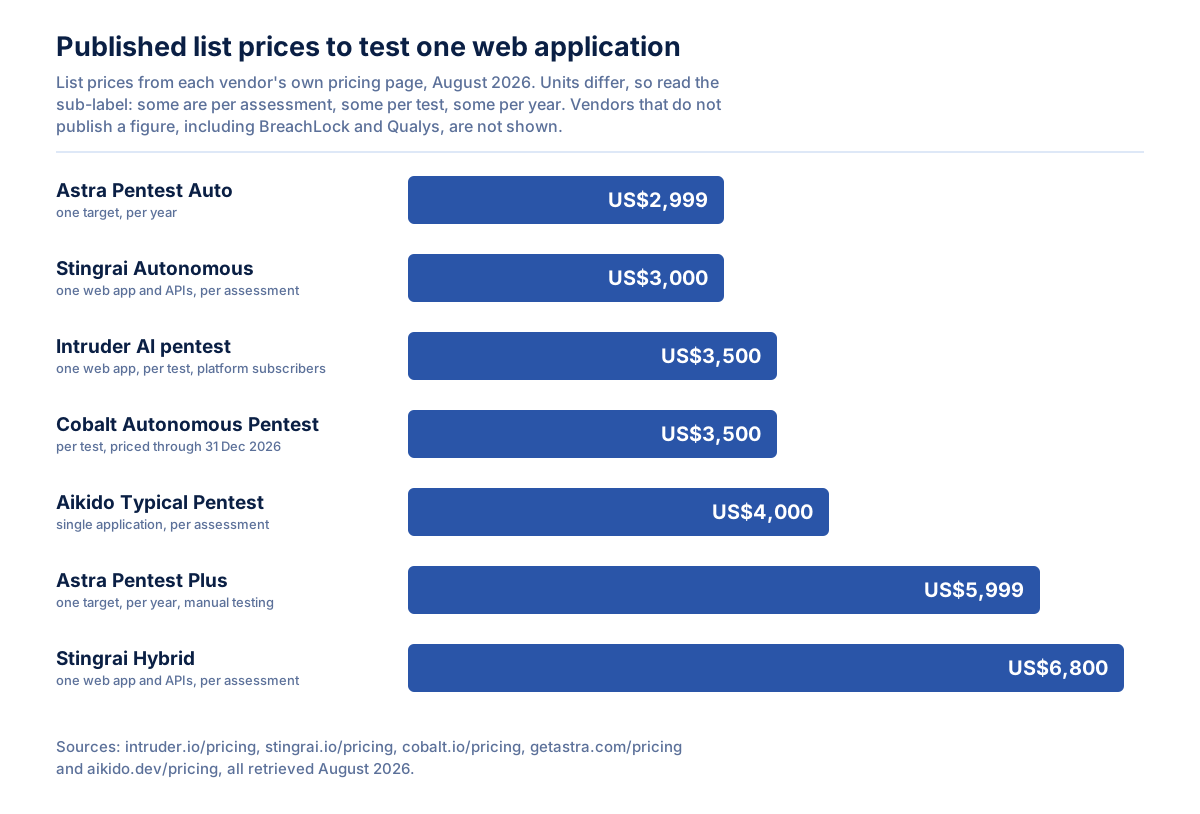
Quick answer: If you need a penetration test that produces the PCI DSS Requirement 11.4 evidence a scan alone does not, Stingrai is the Intruder alternative to evaluate first: its Snipe agent tests one web application and its APIs for a published 3,000 US dollars per assessment, or 6,800 on the Hybrid tier with penetration testers working the same engagement. The guide covers what Intruder includes, the scanner and penetration testing paths, when to own both, and Stingrai versus Intruder.
That distinction explains most of the traffic searching for Intruder alternatives. Intruder is a strong scanning platform, and most teams shopping around are not unhappy with it. They have discovered that the artifact an auditor wants is not the one a scanner produces.
What Intruder Is, and What It Covers
Intruder is a continuous exposure management platform combining external and internal vulnerability scanning, authenticated web application and API testing, cloud posture checks and attack surface monitoring. Intruder Systems Ltd is registered in England at 1 Mark Square, London EC2A 4EG. Its about page states it was founded in 2015 by Chris Wallis, was "selected for GCHQ's Cyber Accelerator," and serves "over 3,000 happy customers."
The pricing page lists Free, Cloud, Pro and Enterprise tiers. Pricing "consists of a base fee plus a small fee-per-target," calculated live from your target counts and exclusive of VAT, and "a license is used each time you scan a target, and stays used for 30 days." Cloud adds authenticated web app and API testing, Emerging Threat Scans and the GregAI analyst; Pro adds internal scanning; Enterprise adds shadow IT discovery.
AI pentesting is a separate product: "White-box web application pentesting" launched by connecting GitHub or GitLab, at 3,500 US dollars per test for subscribers and 4,000 as a one-off, delivering an "Audit-ready report in hours" with an "Auditor-accepted, or your money back" promise. Intruder is no longer scanner-only, and a fair comparison has to say so.
Why Buyers Look for Intruder Alternatives
None of these are defects. Each follows from a deliberate strategy, and each sends a particular buyer elsewhere.
Scanner output does not close a penetration testing requirement. Intruder's own FAQ is accurate here, saying customers use its reports "to pass compliance with standards such as SOC2, Cyber Essentials, ISO 27001 and many more." Those are frameworks where you write your own control description. PCI DSS Requirement 11.4 is not.
Per-target licensing prices differently than per-application testing. A base fee plus a fee per target suits an infrastructure estate. It prices awkwardly when all your risk sits in one application and its APIs.
No named testers attributed to the assessment. Enterprise procurement and some auditors want to see who did the work.
Retesting is not rescanning, and PCI DSS 11.4.4 requires exploitable findings to be corrected and retested.
When Intruder Is Still the Right Answer
Keep the subscription if you need continuous coverage of a changing external estate, if Emerging Threat Scans answer "are we exposed to today's headline," if you are a lean team with no security hire, or if your obligations stop at SOC 2 and ISO 27001.
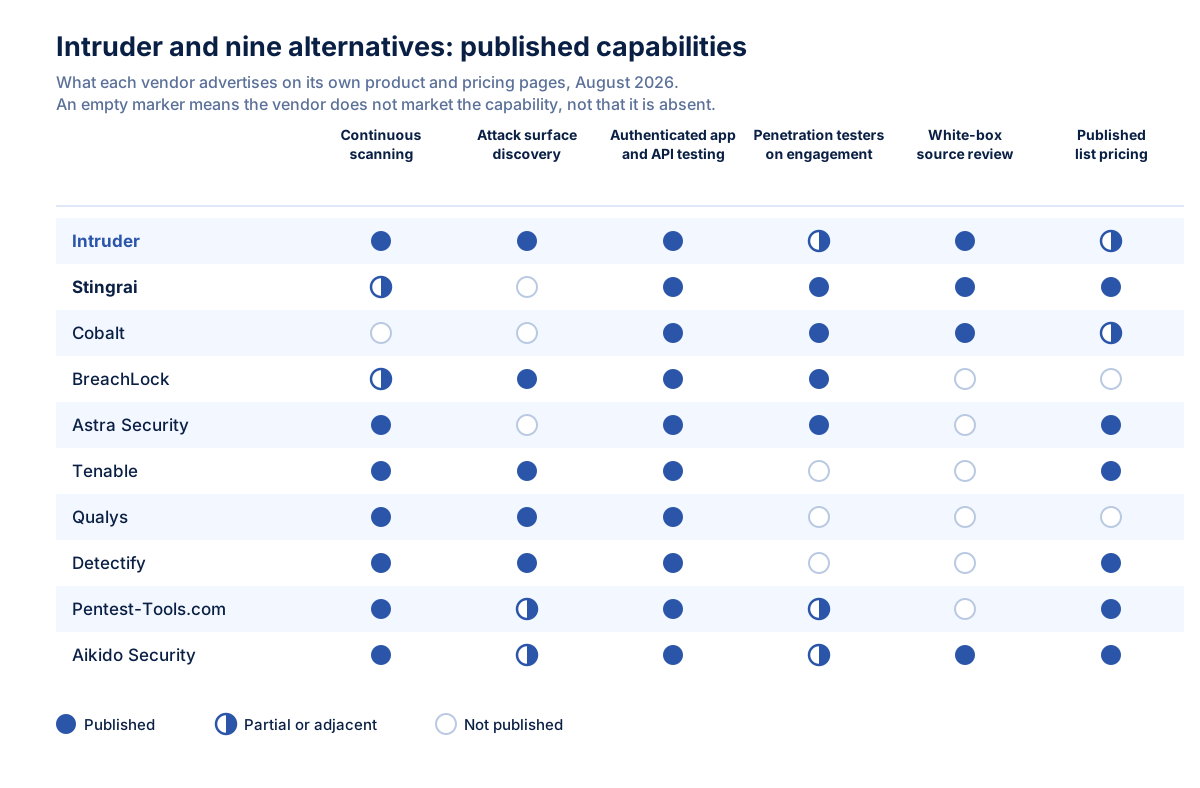
Intruder Alternatives at a Glance
Provider | HQ | Founded | Scan or test | Published price (USD) |
|---|---|---|---|---|
Intruder (baseline) | London | 2015 | Scan + AI pentest | Per-target base fee; pentest 3,500 |
1. Stingrai | Toronto | 2021 | Test, agent + testers | 3,000 Autonomous, 6,800 Hybrid |
2. Cobalt | Boston | 2013 | Test, PTaaS | Autonomous 3,500; rest quoted |
3. BreachLock | New York | 2018 | Test, PTaaS + ASM | Not published |
4. Astra Security | New Delhi | 2018 | Both | 2,999/yr Auto, 5,999/yr Plus |
5. Tenable | Columbia, Maryland | 2002 | Scan, VM | 3,500/yr for 100 assets |
6. Qualys | Foster City, California | 1999 | Scan, VM and ASV | Not published |
7. Detectify | Stockholm | 2013 | Scan, EASM | From 2,500 EUR/yr |
8. Pentest-Tools.com | Bucharest | 2013 | Scan, tester toolkit | 95 to 190 per month |
9. Aikido Security | Ghent | 2022 | Scan + pentest bolt-on | 300 to 600 per month |
Path A: Human-Verified Penetration Testing Providers
Rank these if what you are missing is testing evidence with a documented methodology and a named team.
1. Stingrai
World-Class Offensive Security.
Stingrai is a global CREST-accredited penetration testing services company founded in Toronto, Canada in 2021, trusted by companies from startups to enterprises to meet audit requirements for SOC 2, ISO 27001, CMMC, PCI DSS and HIPAA. OSCE³, OSWE, OSEP, CREST CRT certified pentesters, who are also world-class security researchers and bug bounty hunters. Choose from fully human-led or hybrid (AI agents plus human penetration testers) engagements across web, API, mobile, AI and LLM, cloud, network, Active Directory and social engineering penetration tests and red team engagements.
It is the alternative on this list built for the artifact a scanner does not produce: an actively exploited, manually driven test of one application and its APIs, run by two named penetration testers and retested after you fix. Its testers have published 18 CVEs and appear in the bug bounty Halls of Fame of Apple, Google, the US Department of Defense and the US Federal Reserve, and one is a founding member of Uber's offensive security team.
On a web application that means authenticated testing across every user role rather than one logged-in session: broken authorization and IDOR between roles and tenants, business logic abuse in checkout, entitlement and refund flows, injection, and authentication and session handling, aligned to the OWASP Top 10 and ASVS, and source-assisted where you grant repository access. On the estate Intruder scans, the same team tests the external perimeter and internal lateral movement by hand, including the segmentation testing a PCI DSS assessor asks about. Explore the PTaaS platform.
It delivers both one-time annual penetration tests and continuous programs that test every release, so the same team can cover an audit cycle or a weekly deploy cadence.
Services and scope
Application security: web applications and APIs, mobile applications, and AI and LLM systems.
Network and cloud security: internal and external networks, Active Directory, Wi-Fi, and cloud environments.
Social engineering: phishing campaigns and physical security assessments.
Adversary simulation: red teaming and purple teaming.
Delivery and evidence
Findings are posted to the PTaaS portal as they are confirmed, each with a working proof of concept and prioritized remediation guidance, so fixing starts before the report lands. Clients chat live with their assigned penetration testers during the test, push findings into Jira or Slack, and get retesting of remediated issues included, which is the loop PCI DSS 11.4.4 expects. Every report ships with a redactable PDF, an attestation letter and a verified badge for customer security reviews. CREST accreditation applies to Stingrai as a penetration testing service provider; it is separate from individual tester certifications.
Where Snipe fits
Snipe is Stingrai's autonomous agent for web application penetration testing, including the application's APIs. It runs black-box, authenticated grey-box across roles and white-box source review, hunts IDOR, broken authorization and business logic rather than known-class bugs only, and opens AutoFix pull requests and a PR-gating check. It is sold alone on the Autonomous tier, or on Hybrid where penetration testers test alongside it throughout. Mobile, AI and LLM, cloud, network, social engineering and red and purple team work is scoped with penetration testers.
Pricing and fit: Published Autonomous and Hybrid packages cover one web application and its APIs, at 3,000 US dollars per assessment or 650 per month for Autonomous, and 6,800 or 1,275 per month for Hybrid. Request a scoped quote for networks, cloud, mobile or red team work. Best for the Intruder customer whose gap is Requirement 11.4 evidence rather than coverage: a named CREST-accredited team, exploited findings, and a retest, on one application or across the estate.
2. Cobalt
San Francisco, California. Founded 2013. Test.
An original PTaaS platform delivering through a vetted global tester community. Its pricing page sells annual packages in Cobalt Credits, one credit being "the equivalent of 8 hours of offensive security testing."
Pricing tiers quoted; an Autonomous Pentest is listed at 3,500 US dollars per test through 31 December 2026. Compliance SOC 2 and ISO 27001 evidence. Best for enterprises wanting one contract across many assets.
3. BreachLock
New York, with an Amsterdam office. Founded 2018. Test.
Human-delivered penetration testing sold alongside attack surface management, red teaming and exposure validation, positioned as one program rather than a series of point engagements. The company site names "PCI DSS, HIPAA, GDPR, ISO 27001, SOC 2, CREST, NIST."
Pricing not published. Compliance broad coverage with PCI DSS named directly, which matters if Requirement 11.4 is your driver. Best for buyers wanting testing and attack surface management together.
4. Astra Security
New Delhi, India. Founded 2018. Both.
The closest structural analogue to Intruder, selling a scanner and a testing product from one console. Its pricing page separates them: Scanner tiers are automated only, while Pentest Plus adds "Manual Pentest (VAPT) by security experts."
Pricing Scanner from 69 US dollars per month, Pentest Auto 2,999 per year, Pentest Plus 5,999 per year, each on one target. Compliance reports serve "SOC2, ISO27001, HIPAA etc. compliances," manual testing only from Pentest Plus up. Best for budget-constrained teams wanting both in one subscription.
Path B: Scanners and Attack Surface Platforms
Rank these if Intruder is close but you need more scale or a different model.
5. Tenable
Columbia, Maryland. Founded 2002. Scan.
The incumbent in vulnerability management, and Intruder itself lists Tenable among the engines behind its higher tiers. Tenable One covers discovery, assessment, prioritization and remediation across on-premises, cloud and web apps.
Pricing Tenable publishes list prices: Vulnerability Management 3,500 US dollars per year for 100 assets, Web App Scanning 3,578 for five FQDNs, Nessus Professional 4,790. Compliance strong for scanning obligations including PCI DSS 11.3; human penetration testing is not part of the product. Best for teams outgrowing an SMB scanner.
6. Qualys
Foster City, California. Founded 1999. Scan.
The other large cloud-native vulnerability management platform, spanning VMDR, Web Application Scanning, cloud posture management, policy compliance and PCI Approved Scanning Vendor services. Intruder publishes its own comparison page against Qualys, which tells you how often the two share a shortlist.
Pricing not published; quoted by module and asset count. Compliance an Approved Scanning Vendor, relevant to PCI DSS 11.3.2 quarterly external scans. That is a scanning credential, not a substitute for Requirement 11.4 testing. Best for regulated estates needing ASV scanning.
7. Detectify
Stockholm, Sweden. Founded 2013. Scan.
Built on crowdsourced security research feeding an automated engine, now selling external attack surface management alongside application and API scanning.
Pricing the pricing page lists annual platform fees of 2,500 euros for Standard, 5,000 for Professional and 15,000 for Enterprise, with assets charged on top. Compliance evidences scanning controls; no human penetration testing is offered. Best for a sprawling, fast-changing external footprint.
8. Pentest-Tools.com
Bucharest, Romania. Founded 2013. Scan.
Aimed at practitioners rather than security managers, bundling reconnaissance, network and web scanning with a report generator. It is the only platform here shipping automatic exploiters for CVEs, SQL injection and XSS.
Pricing the pricing page lists NetSec from 95 US dollars per month, WebNetSec from 140 and Pentest Suite from 190, from 5 to 500 assets. Compliance the platform produces scan artifacts; a managed engagement produces testing evidence. Best for in-house testers wanting tooling, not a service.
Also Worth Shortlisting
One more on the scanner path.
9. Aikido Security
Ghent, Belgium. Founded 2022. Scan.
Approaches the same risk from the code side, consolidating SAST, SCA, secrets detection, IaC and container scanning, DAST and cloud posture into one developer platform.
Pricing the pricing page lists a free Developer tier, Basic at 300 US dollars per month and Pro at 600, with a "Typical Pentest" at 4,000 per assessment. Compliance strong for shift-left evidence; the bolt-on carries testing evidence. Best for teams wanting findings to land in pull requests, not a portal.
Scanner, Penetration Test, or Both
The framing that saves money is not "which vendor wins." It is "which obligation am I closing."
Buy the scanner when the problem is coverage and freshness: a changing external estate, new subdomains appearing without warning, cloud accounts drifting out of policy.
Buy the penetration test when the problem is proof: a customer asking for a report before signing, a PCI DSS assessment, a control description committing you to annual testing. No scanner answers those, because the flaws that matter are unique to your own logic.
Buy both when you ship application changes regularly and carry regulatory obligations. Our guide to penetration testing versus vulnerability assessment works through what SOC 2, ISO 27001, PCI DSS v4.0.1, HIPAA and CMMC accept as evidence.
Several vendors now sell an automated product under the word pentest. What decides whether it closes your requirement is whether the methodology is documented, the tester independent, and the findings retested.
Stingrai vs Intruder
Intruder is the better buy for continuous exposure monitoring. Nothing in Stingrai's catalog replaces daily scanning across infrastructure targets, container images and cloud accounts, Emerging Threat Scans for new CVEs, or discovery of unknown assets.
Stingrai is the better buy for penetration testing evidence with human verification. Snipe covers the automated depth including white-box source review, and on the Hybrid tier penetration testers work the engagement concurrently with the agent, directing where it looks and pursuing the attack paths it opens. That produces a named, CREST-accredited team, a documented methodology, verified exploitation and retest evidence, which is what Requirement 11.4 asks for.
Intruder prices per target, so cost scales with your estate. Stingrai prices per application, sold as an annual one-time test or a continuous program, and the pentest cost calculator gives an estimate in a minute.
Frequently Asked Questions
What is the best Intruder alternative in 2026?
It depends which of two problems you are solving. For human-verified penetration testing evidence, Stingrai ranks first, followed by Cobalt, BreachLock and Astra Security. For continuous scanning and attack surface coverage, Tenable, Qualys, Detectify and Pentest-Tools.com are strongest, with Aikido Security also worth shortlisting. Most mid-market teams buy one product from each path rather than asking a single tool to do both jobs.
Does a vulnerability scanner satisfy PCI DSS or SOC 2 penetration testing requirements?
Not for PCI DSS. Requirement 11.3 covers vulnerability scanning and Requirement 11.4 covers penetration testing, and guidance under 11.4.1 states that a vulnerability scan is not a penetration test, that a penetration test is an active process usually involving exploitation, and that penetration testing is a highly manual process. SOC 2 mandates neither by name: "penetration testing" appears once in the Trust Services Criteria, in a non-binding point of focus under CC4.1, while CC7.1's point of focus is labeled "Conducts Vulnerability Scans."
How much does Intruder cost?
Intruder publishes its tier structure but not a flat headline figure, because pricing "consists of a base fee plus a small fee-per-target," calculated live from the targets you select. Free, Cloud, Pro and Enterprise are the tiers, Enterprise is quoted, and prices exclude VAT. Its separate AI pentest is listed at 3,500 US dollars per test for subscribers and 4,000 as a one-off.
Is Intruder's AI pentest the same as a penetration test with human verification?
They are different products serving different evidence needs. Intruder's AI pentest is white-box web application testing launched from a GitHub or GitLab connection, delivering an audit-ready report in hours with a refund if an auditor rejects it, and Intruder attributes the build to CREST-certified practitioners. A human-verified engagement adds named testers working the application during the test, a documented methodology, manually verified exploitation of business logic and authorization flaws, plus retest evidence.
Should I buy a scanner, a penetration test, or both?
Buy a scanner when the problem is coverage and freshness across a changing estate. Buy a penetration test when the problem is proof: a customer security review, a PCI DSS assessment, or a control description committing you to annual testing. Most mid-market SaaS teams need both.
What does a Stingrai penetration test cost compared to Intruder?
Stingrai publishes fixed prices covering one web application and its APIs: 3,000 US dollars per assessment or 650 per month for Autonomous, and 6,800 per assessment or 1,275 per month for Hybrid, which adds penetration testers working alongside the Snipe agent throughout the engagement. A "No High or Critical Finding = Don't Pay" guarantee applies to the Autonomous tier. Intruder's AI pentest is 3,500 per test for subscribers, on top of a per-target subscription.
The Short Version
Intruder is a good product being asked by many of its own prospects to do a job it was not built for. If what you are missing is testing evidence, the answer is on the other path. Stingrai is a CREST-accredited penetration testing service provider, founded in 2021 in Toronto, whose team holds OSCE³, OSWE, OSEP, CREST CRT and CISSP, has published 18 CVEs, and sits in the bug bounty Halls of Fame of Apple, Google, the US Department of Defense and the US Federal Reserve. On one web application and its APIs that buys authenticated testing across every role, broken authorization, IDOR and business logic hunted by hand and by Snipe, findings in the PTaaS portal as they are confirmed with live tester chat and Jira or Slack push, retesting included, and an attestation letter with every report, one-time or continuous.
Compare against Stingrai's published packages, and for the wider field see our ranking of the best penetration testing companies in 2026. A 30-minute session with the founder is a demo and requirements consultation.