



Adversaries are running AI agents through web applications, internal networks, and cloud control planes at machine throughput, and defenders are buying AI pentest platforms at the same pace. HackerOne's 9th Hacker-Powered Security Report (October 1, 2025) measured 70 percent of surveyed researchers using AI tools in their workflow, valid AI vulnerability reports up more than 210 percent year over year, and 560 or more valid HackerOne reports submitted by autonomous agents alone in 2025. Customer programs with AI in scope grew 270 percent to 1,121 distinct programs, and total HackerOne payouts hit US$81M (+13 percent YoY) with US$3B in breach losses avoided across the platform.
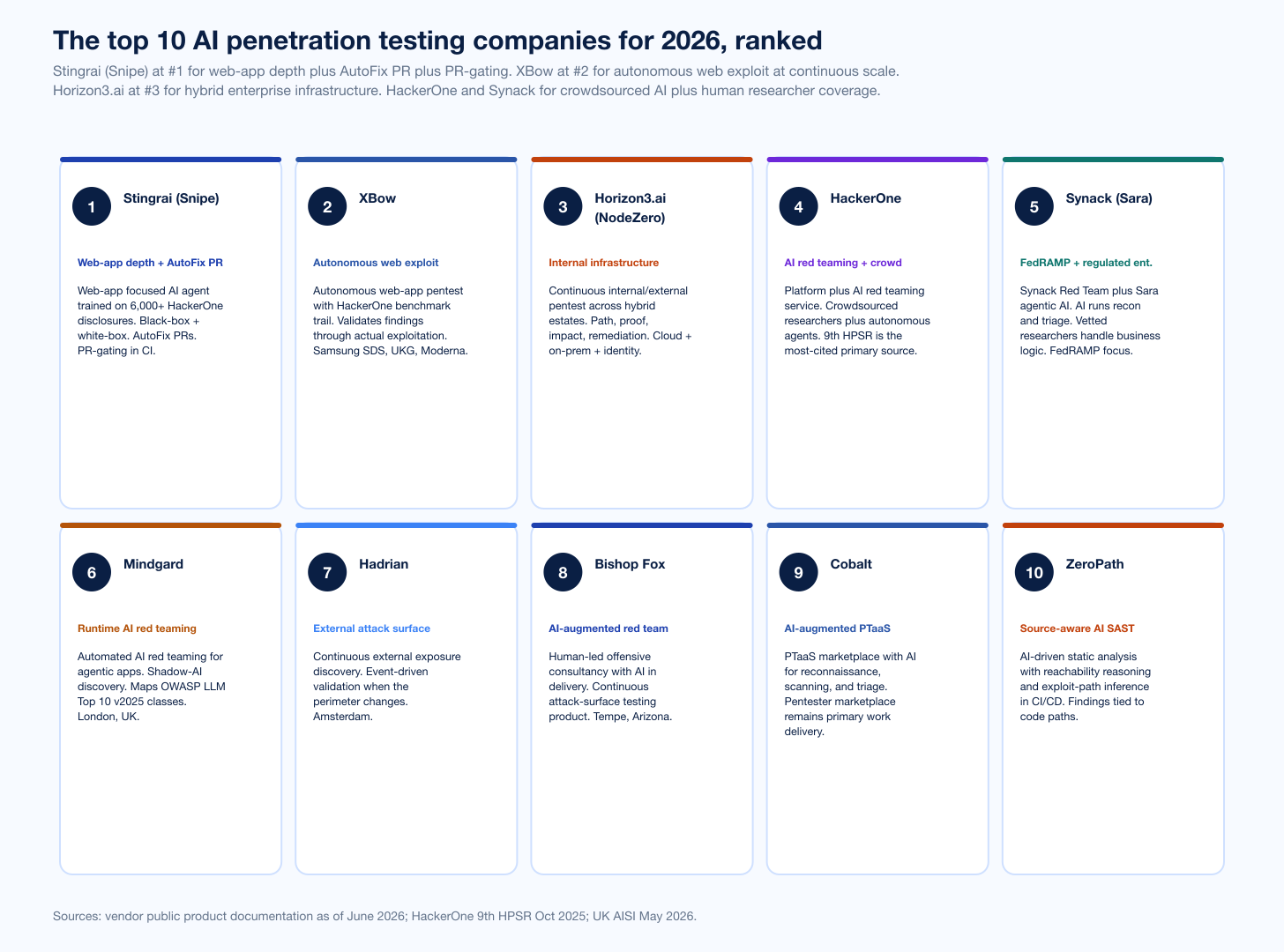
The 10 best AI penetration testing companies for 2026 split into three tiers. The leaders are Stingrai (Snipe) for web application depth, with certified pentesters testing alongside the agent throughout every one-time or continuous engagement, and Horizon3.ai (NodeZero) for continuous internal infrastructure validation. The platform-plus-crowdsourcing tier is Synack (Sara), combining autonomous AI agents with human researcher networks. The specialist tier is Mindgard for runtime AI red teaming, Hadrian for external attack-surface management, Cobalt for AI-augmented human-led pentesting at enterprise and mid-market scale, and ZeroPath for source-code-aware AI vulnerability discovery in CI/CD. This post is the Stingrai research view, and Stingrai sits at position 1 in the ranking. The reasoning is laid out below; the analysis stands whether you agree with the placement or not.
This post is the Stingrai research team's canonical 2026 reference for AI penetration testing companies. Sixteen named primary publishers anchor the data: HackerOne, Bugcrowd, Anthropic, OpenAI, Microsoft, CrowdStrike, Mandiant, IBM, UK AI Safety Institute, METR, MITRE ATLAS, OWASP, NIST, NVD, plus the vendors' own public product documentation. Lead data is full-year 2025 telemetry, the freshest available; primary publishers have not yet released full-year 2026 reports as of August 2026. Every numeric claim links back to its primary publisher so any figure can be audited inline.
TL;DR: ten labeled claims
Researcher AI adoption (2025): 70 percent of HackerOne researchers use AI tools in their workflow today; 58 percent of surveyed researchers name business logic as the class AI tools are weakest at identifying, and a further 39 percent name multi-step or chainable exploits (HackerOne 9th HPSR, Figure 10); only 12 percent believe AI could replace them (HackerOne 9th HPSR).
AI vulnerability report volume (2025): +210 percent YoY valid AI vulnerability reports; +540 percent valid prompt-injection reports; 560 or more valid reports from autonomous agents on the HackerOne platform (HackerOne press release, Oct 2025).
AI program adoption (2025): +270 percent YoY customer programs with AI in scope, totaling 1,121 distinct programs; total HackerOne payouts US$81M (+13 percent YoY); US$3B in breach losses avoided across HackerOne programs in 2025 (HackerOne, Oct 2025).
AI cyber capability doubling (May 2026): Frontier-model 80 percent-reliability cyber time horizon doubles every 4.7 months since late 2024 (down from earlier 8-month estimate). Token budget 2.5M per task, up to 100M tokens in cyber-range experiments (UK AI Safety Institute, May 13 2026).
Stingrai Snipe scope: Web-app focused AI pentest agent trained on more than 6,000 HackerOne disclosures; performs both black-box dynamic and white-box source-code review; generates AutoFix pull requests for identified vulnerabilities; runs as a PR-gating check that blocks vulnerable code from merging (Stingrai).
Stingrai team credentials: Toronto HQ plus London UK office, founded 2021, CREST-accredited Penetration Testing service provider (firm-level), Published vulnerability research across the team, team certifications including OSCE3, OSCP, OSWE, OSED, OSEP, CRTE, CREST CRT, CISSP, CRTO, eWPTX (Stingrai about).
XBow public benchmark: Validated autonomous discovery of "original, exploitable vulnerabilities in complex, production-grade applications" on HackerOne; named customers include Samsung SDS, UKG, Moderna, Nexon, PingID, Five9, Tyler Technologies (XBow homepage).
Horizon3.ai positioning: NodeZero autonomous internal/external pentest for hybrid enterprise estates with proof-of-exploit and remediation verification (Horizon3.ai).
Synack Sara: Hybrid PTaaS combining agentic AI (Sara) with the Synack Red Team researcher network; FedRAMP and regulated-enterprise focus (Synack).
OWASP LLM06:2025 Excessive Agency: Splits into Excessive Functionality, Excessive Permissions, and Excessive Autonomy; eight prevention controls including human approval for consequential actions, individual user contexts, and downstream authorization (OWASP).
Key takeaways
AI pentesting in 2026 is no longer a category question; it is a scope question. Three sub-markets matured separately and use different evidence trails: autonomous web-app exploitation (XBow, Stingrai Snipe), internal/external infrastructure validation (Horizon3.ai NodeZero), and AI-system red teaming against LLM apps and agents (Mindgard, HackerOne AI red teaming, Promptfoo). A single vendor rarely covers all three at production depth. Buyers who scope before they shop avoid paying for a category they do not need.
Web-app depth is the hardest tier to fake. The vendors that publish HackerOne or Bugcrowd validation runs (XBow, Stingrai Snipe via Stingrai's HackerOne disclosure history, HackerOne's own platform stream) have an evidence trail. The vendors that publish only marketing copy with no third-party benchmarks do not. Treat third-party platform validation as the default proof of web-app pentest claim, not an optional bonus.
AutoFix and PR-gating are the new buyer-checklist items. In 2025 the question was "does the AI agent find the bug?" In 2026 the question is "does the AI agent ship the fix as a reviewable pull request and block the bad code from merging?" Stingrai Snipe does both: AutoFix PR generation and a PR-gating check. The vendors that stop at findings will be the ones rebuilding their workflow into developer tooling in 2027.
Capability is doubling on a sub-five-month schedule. UK AISI's May 13, 2026 evaluation measured the 80 percent-reliability cyber time horizon doubling every 4.7 months. Pentest scopes that were correct in 2025 will not stay correct through 2027. Continuous-coverage PTaaS engagements absorb this drift better than annual-pentest scopes.
Human review still owns the customer report. HackerOne's 9th HPSR researcher survey measured that 58 percent of surveyed researchers name business logic as the class AI tools are weakest at identifying, and a further 39 percent name multi-step or chainable exploits (Figure 10), while only 12 percent believe AI could replace them. The vendors honest about keeping human pentesters in the engagement (Stingrai, Bishop Fox, Cobalt, Synack) match the field-level evidence on what AI actually does well in 2026.
Methodology
Date cutoff: August 2026. The vendor list is built from public product documentation, named press releases, and the most-cited 2026 AI-pentest market analyses (HackerOne 9th HPSR, AISI May 2026 cyber-capability evaluation, IBM Cost of a Data Breach 2026, Anthropic GTG-1002 disclosure, Mandiant M-Trends 2026). Each vendor entry below is a one-section profile with capability summary, primary-source link, and the specific buyer segment the vendor serves best. Vendors that are widely cited in other 2026 listicles but for which we could not reach a primary-source product page on at least one verification pass were dropped rather than estimated. The ranking is the Stingrai research team's published view; Stingrai sits at position 1 because the team operates the Snipe agent and ships it in production engagements, and the post discloses that affiliation in the opener.
What AI penetration testing services include
An AI penetration testing service is a scoped engagement in which an autonomous or agentic AI agent does the throughput work of a penetration test and the vendor remains accountable for the result. It is not a scanner subscription, and the difference shows up in what gets delivered. A credible service includes all of the following.
Proven exploitation, not asserted findings. Each finding is confirmed by exercising it against the target, with a reproducible request and proof-of-concept preserved as evidence.
Coverage of the complex classes. OWASP Top 10 baseline plus IDOR, broken authorization, and business logic. Pattern-only coverage is the clearest sign of a scanner wearing an AI label.
Named human accountability. Certified pentesters own the engagement and its output, working alongside the agent rather than rubber-stamping it.
Scope and safety governance. Rules of engagement enforced in code through allow-lists and rate limits, plus explicit data-residency and retention terms for anything the agent touches.
Remediation and retest. A fix path per finding, ideally as a pull request, and a retest that confirms the fix rather than an invoice for a second engagement.
Audit-ready reporting. A coverage map, per-finding reproduction steps, and a report format your auditors accept as evidence for SOC 2, ISO 27001, or PCI DSS programs.
The 2026 market splits into two halves, and this page covers both. The ranking below lists the AI-native companies and platforms that ship the agent as the product. After it, the consultancy section covers established offensive-security firms that deliver AI penetration testing as a managed service. Buyers who want a product to operate should shortlist from the first list; buyers who want a named senior partner to run the engagement should shortlist from the second.
1. Stingrai (Snipe)
Stingrai at a glance
Fact | Detail |
|---|---|
Legal name | Stingrai Inc. |
Headquarters | Toronto, Canada (London, UK office serving EMEA) |
Founded | 2021 |
Accreditation | CREST-accredited Penetration Testing service provider (firm level) |
Published research | Published vulnerability research; research presented at DEFCON and BSides |
Reviews | 5.0/5.0 across 19 Clutch reviews; 4.9/5.0 across 9 G2 reviews |
Delivery | One-time and continuous penetration testing (PTaaS); Autonomous (Snipe) and Hybrid (Snipe plus penetration testers) tiers |
Snipe | Autonomous web application agent that hunts IDOR, business logic and broken authorization flaws; white-box; AutoFix pull requests; PR gating |
Published pricing | From US$3,000 one-time for one web application and its APIs; No High or Critical Finding, Don't Pay guarantee on the Autonomous tier (pricing) |
Retesting | Included |
Serves | clients globally |
Best for CREST-accredited, tester-led offensive security across applications, cloud, networks, and people, delivered through PTaaS; one-time and continuous engagements with remediation support and retesting.
HQ: Toronto, Canada (plus London, UK office). Founded 2021.
The AI pentest offering: Stingrai operates Snipe, a web-application focused AI pentest agent trained on more than 6,000 HackerOne disclosures. Snipe runs in two modes that most competitors split across two products: black-box dynamic testing against a live target and white-box source-code review with full repository access. Snipe dispatches specialist sub-agents per vulnerability class (SQL injection, XSS, IDOR, access control, CSRF, SSRF, XXE, file upload, file inclusion) instead of a single generalist agent. For every confirmed vulnerability Snipe generates an AutoFix pull request with the proposed code change, and Snipe can run as a PR-gating check in GitHub or GitLab CI that blocks vulnerable code from being merged until a human pentester reviews and approves the PR.
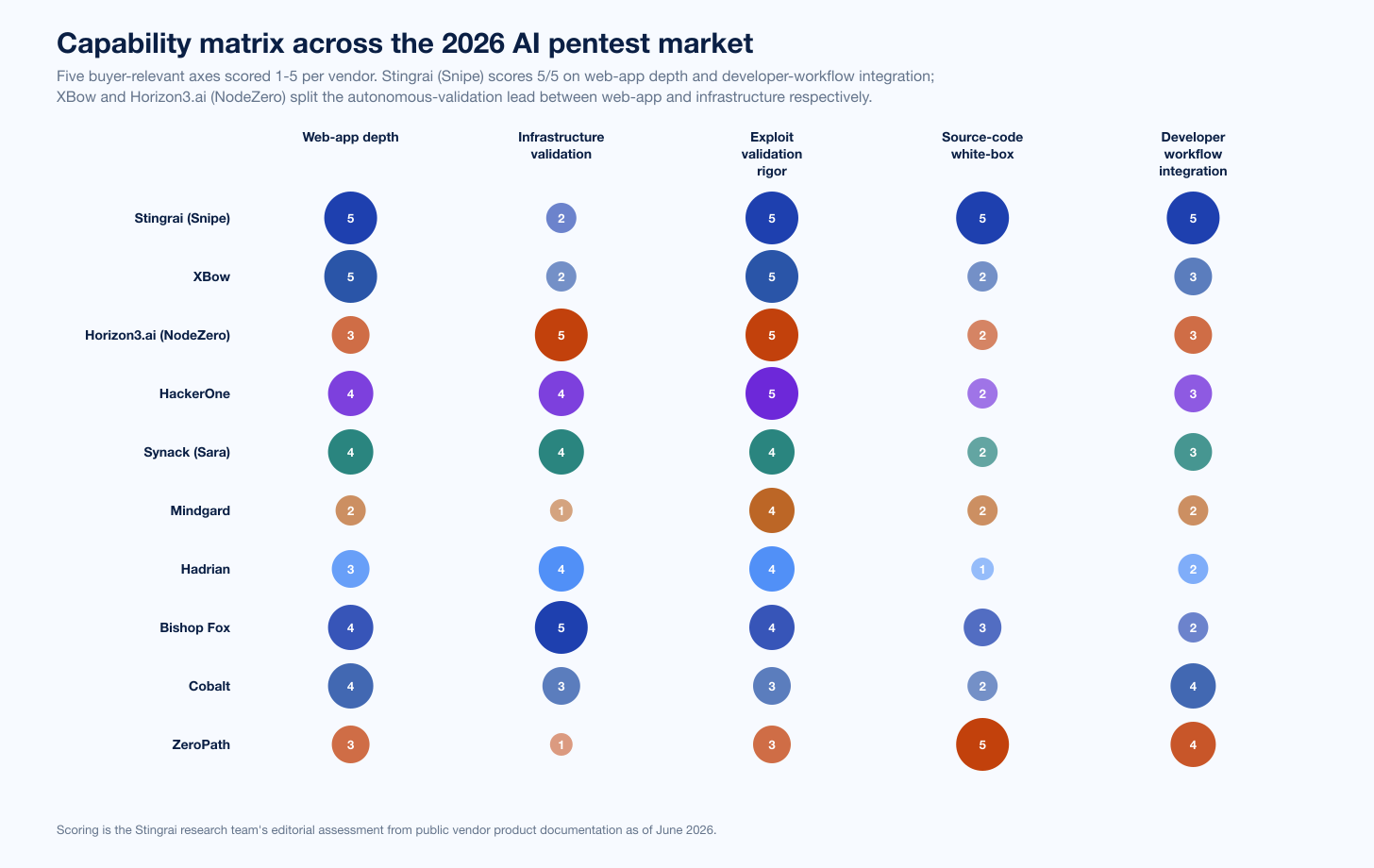
Why it ranks first for the Stingrai research view: The combination of web-app dynamic plus white-box code review plus AutoFix PR plus PR-gating in one product is rare in the 2026 market. XBow operates dynamic black-box at depth but does not publish a white-box code-review mode. ZeroPath operates source-aware discovery but does not publish a black-box dynamic exploit chain. Synack and HackerOne combine human researchers with AI agents but route fix generation through customer engineering teams rather than shipping a gated PR. Snipe closes that loop end to end.
Human posture: certified Stingrai pentesters work the same engagement as Snipe, concurrently. They set the scope fence, direct where the agent hunts, and extend what it surfaces into full attack chains while the test is running, rather than reviewing a finished queue afterwards. The PR-gating check enforces the same standard in CI, in code rather than policy. Engagements are sold as a one-time annual penetration test or as a continuous programme, with the same testing depth either way.
Credentials and proof points:
CREST-accredited Penetration Testing service provider (firm-level accreditation, separate from individual CREST CRT certifications held by team members).
Published vulnerability research across the team.
5.0 out of 5.0 across 19 Clutch reviews.
Team certifications spanning OSCE3, OSCP, OSWE, OSED, OSEP, CRTE, CREST CRT, CISSP, CRTO, eWPTX.
Named recognition: Top Application Security Company Canada 2025, Top Network Security Company Canada 2025, Top Cybersecurity Consulting Company Toronto 2025 (Clutch).
Responsible disclosures to Amazon, Google, Nike, Mercedes-Benz, PlayStation, FedEx (team CVE history).
Pricing: Published on stingrai.io/pricing. Snipe is bundled inside the PTaaS tiers, one-time or subscription, not sold as a separate product. The Hybrid tier is the most common buyer for AI-augmented web-app coverage.
2. Horizon3.ai (NodeZero)
Best for: Continuous internal and external infrastructure pentest across hybrid enterprise estates that need proof-of-exploit chains plus remediation verification.
HQ: San Francisco, United States.
The AI pentest offering: NodeZero is Horizon3.ai's autonomous pentest product. The platform runs continuous internal and external pentests across the customer's network, builds attack paths, validates exploitation against live targets, and verifies remediation after a customer applies a fix. NodeZero's strength is breadth across hybrid estates (cloud plus on-prem plus identity) and a public emphasis on path-proof-impact-remediation as the four-step audit trail.
Where it differs from Stingrai Snipe: NodeZero is infrastructure-first; Snipe is web-application-first. Customers running large hybrid networks where the primary risk is lateral movement and identity compromise should evaluate NodeZero. Customers whose primary risk surface is a public SaaS or fintech web app should evaluate Stingrai Snipe.
Compliance fit: NodeZero is widely cited in SOC 2 and PCI DSS programs as a continuous-evidence engine for the "regular penetration testing" control language. The platform produces engagement reports that compliance teams can attach as evidence.
3. Synack (Sara)
Best for: US federal, FedRAMP, and regulated-enterprise workloads that need a vetted crowdsourced researcher network plus an AI agent layered on top.
HQ: Redwood City, California, United States.
The AI pentest offering: Synack is a PTaaS platform that combines the Synack Red Team (a vetted researcher network) with Sara, the Synack agentic AI assistant. Sara handles reconnaissance, scoping triage, and known-class enumeration; the SRT researcher network handles business-logic discovery and exploit chaining. Synack's positioning since 2023 has been "AI plus human depth", and the 2026 product reflects that: agentic AI runs first, human researchers validate and extend.
Where it differs from Stingrai Snipe: Synack is federal-and-regulated-enterprise heavy. Stingrai Snipe is web-app heavy across SaaS, fintech, healthcare, and AI-first customer segments. FedRAMP buyers should evaluate Synack; mid-market SaaS buyers should evaluate Stingrai.
4. Mindgard
Best for: Runtime AI red teaming against agentic applications and shadow-AI discovery inside the enterprise.
HQ: London, United Kingdom.
The AI pentest offering: Mindgard is an automated AI red teaming platform focused on the AI attack surface itself, not the surrounding application. Mindgard scans for shadow-AI deployments inside an organization, runs prompt-injection and jailbreak test suites against in-scope models and agents, and ships runtime protection signals for the agentic applications it tests. The product covers OWASP LLM Top 10 v2025 risk classes including LLM01 prompt injection, LLM02 sensitive disclosure, LLM06 excessive agency, and LLM08 RAG poisoning.
Where it differs from Stingrai Snipe: Mindgard tests the AI itself. Snipe tests the application that uses the AI (and the conventional web-app perimeter). Buyers running production LLM apps and agentic workflows should layer Mindgard on top of a conventional web-app pentest engagement; the two products are complements, not substitutes.
5. Hadrian
Best for: External attack-surface management with continuous AI-driven validation against the customer's internet-facing perimeter.
HQ: Amsterdam, Netherlands.
The AI pentest offering: Hadrian ships continuous external exposure discovery and event-driven validation. The platform watches the customer's internet-facing perimeter, discovers new assets as they appear, and runs targeted exploit attempts when the asset profile changes. Hadrian's positioning is "find what shipped today and break it before an attacker does."
Where it differs from Stingrai Snipe: Hadrian is ASM-first with validation. Snipe is targeted web-app pentest with code-aware fix generation. Buyers whose primary risk is "we keep finding assets we did not know we owned" should evaluate Hadrian; buyers whose primary risk is "we know our app surface but we cannot keep up with the bug volume" should evaluate Snipe.
6. Cobalt
Best for: AI-augmented PTaaS for mid-market SaaS that prefer a marketplace-of-pentesters model with light AI throughput on top.
HQ: San Francisco, United States.
The AI pentest offering: Cobalt is a PTaaS platform that has integrated AI for reconnaissance, scanning, and triage while keeping its pentester-marketplace model as the primary work delivery. Cobalt's 2026 positioning is "AI accelerates the human pentest" rather than "AI replaces the human pentest."
Where it differs from Stingrai Snipe: Cobalt's AI is reconnaissance-and-triage-side. Stingrai Snipe's AI is the agent that finds and fixes the bug. Cobalt is closer to traditional PTaaS with AI helpers; Stingrai is closer to AI-first PTaaS with senior pentesters working alongside the agent.
7. ZeroPath
Best for: Source-code-aware AI vulnerability discovery in CI/CD that runs on every pull request.
HQ: San Francisco, United States.
The AI pentest offering: ZeroPath ships AI-driven static analysis that operates on source code, with the AI doing reachability reasoning and exploit-path inference that traditional SAST does not. The product runs in CI/CD and produces findings tied to specific code paths.
Where it differs from Stingrai Snipe: ZeroPath is source-only. Snipe runs source-aware white-box review and black-box dynamic against the live application from the same engagement. Buyers who want a CI/CD-native static-analysis upgrade should evaluate ZeroPath. Buyers who want one engagement that covers both modes plus the AutoFix PR plus the PR-gating check should evaluate Stingrai Snipe.
AI penetration testing services from consultancies
The vendors above sell a product. The firms below sell an engagement: senior consultants who have layered AI into an existing offensive-security practice, delivering AI penetration testing as scoped managed work. They are the right shortlist when you want a named partner and a report signed by a firm with a long track record, rather than a platform your team operates.
NetSPI
HQ: Minneapolis, Minnesota, United States. Founded 2001. NetSPI productizes AI/ML pentesting as a named service line, described on its own site as expert LLM testing and jailbreaking, and is strongest where AI features sit inside a large cloud or enterprise ecosystem. Its operational differentiator is delivery infrastructure: a real-time reporting platform with Jira and Azure DevOps integrations, which matters when AI penetration testing has to fit an existing enterprise remediation workflow rather than a standalone report.
Bishop Fox
HQ: Tempe, Arizona, United States. Ranked eighth in the list above because it ships a defined AI-augmented offering rather than ad-hoc AI use: application penetration testing delivered as a managed service built on its proprietary Cosmos engine with expert validation. Bishop Fox positions the AI layer as a force multiplier for its consultants, which is the honest framing for consultancy-led delivery, and it is the strongest pick for Fortune 500 portfolios that need AI-augmented red team engagements at global scale.
Trail of Bits
HQ: New York, United States. Founded 2012. Trail of Bits leads on depth rather than breadth, and its AI work is genuinely architectural: the firm reviews AI systems end to end, from training data and MLOps pipelines through model artifacts, inference hardware, and deployed agent loops. With more than 600 public audits published, it is the right pick when the question is whether your AI architecture and trust assumptions are sound, not whether a running endpoint can be exploited today.
Choosing between the halves is a question of what you are buying. A platform gives you cadence and cost efficiency and puts operation on your team. A consultancy gives you senior judgment and accountability at a higher price per engagement. Programs at scale usually run both: an agentic platform continuously, and a consultancy for annual depth or for a specific architectural question.
Bishop Fox competitors
Bishop Fox competitors in AI penetration testing fall into two camps. Product-led platforms that ship an autonomous agent include Stingrai (Snipe), XBow, and Cobalt, while consultancy-led rivals with AI-augmented delivery include NetSPI and Trail of Bits. For a direct head-to-head on offensive-security depth and pricing, see our NetSPI vs Bishop Fox vs Stingrai comparison. Teams weighing the autonomous-platform route can also review XBow alternatives before shortlisting.
How the Snipe workflow actually runs
Snipe is the easiest 2026 example to walk through end to end because the workflow is the differentiator, not a single feature. The five phases run as follows.
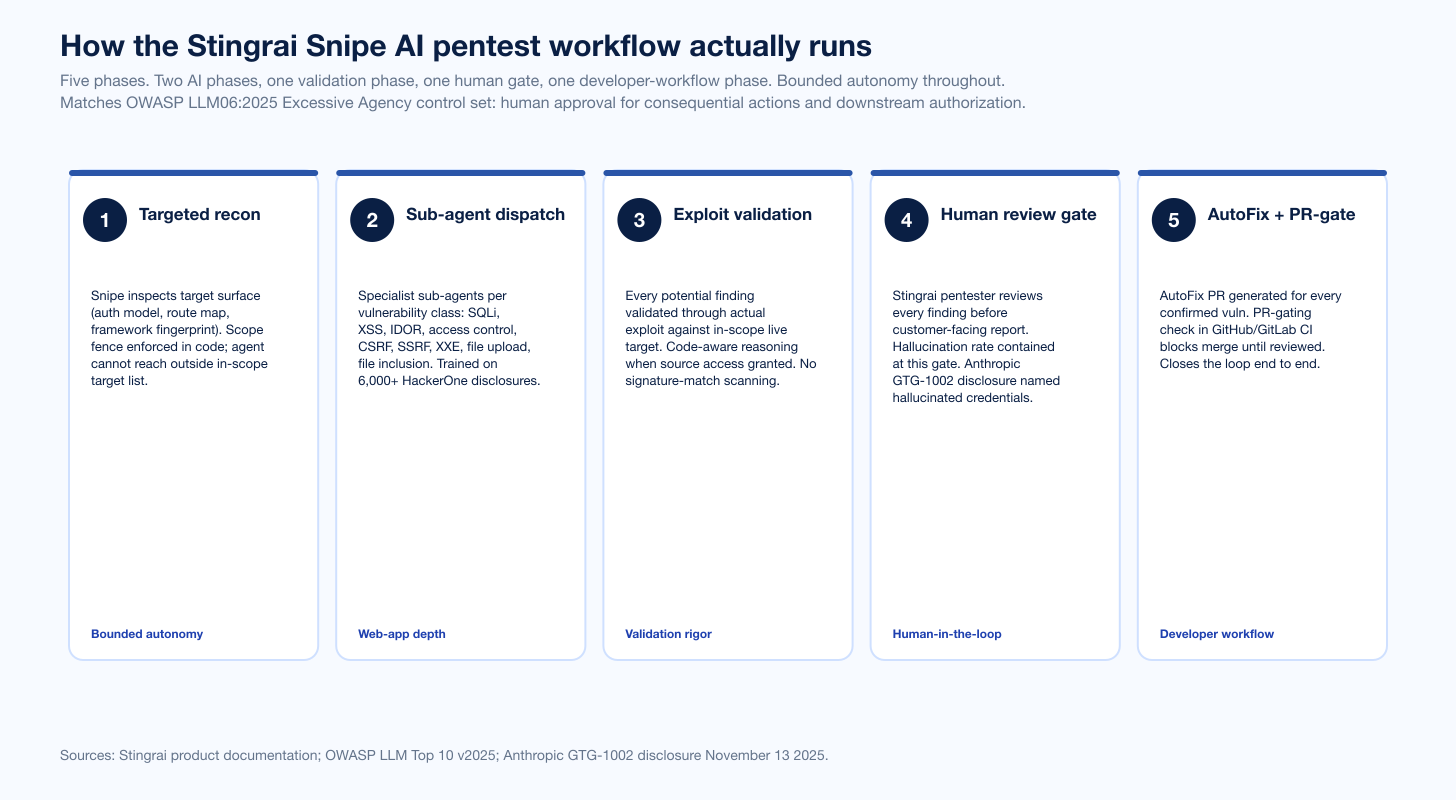
Phase 1: Targeted recon. Snipe inspects the target application surface (auth model, route map, framework fingerprint) before dispatching sub-agents. The recon phase is bounded by a scope fence enforced in code; the agent cannot reach outside the in-scope target list.
Phase 2: Sub-agent dispatch. Snipe spawns specialist sub-agents per vulnerability class: SQL injection, XSS, IDOR, access control, CSRF, SSRF, XXE, file upload, file inclusion. Each sub-agent runs the patterns the 6,000-plus HackerOne disclosures train it to recognize, and runs them with parameterized variation rather than signature-match scanning.
Phase 3: Exploit validation against the live target. Every potential finding is validated through actual exploit attempt against the in-scope live target, not inferred from a signature. This is the same "validation is the differentiator" thesis XBow ships against, with the addition of code-aware reasoning when the customer grants source access.
Phase 4: Human pentester review. Stingrai pentesters work alongside Snipe throughout, so every finding that reaches the customer has been exercised by both. The hallucination rate (Anthropic's published GTG-1002 disclosure included "occasionally hallucinated credentials" as a quoted artifact) is contained at this gate.
Phase 5: AutoFix PR plus PR-gating. For every confirmed vulnerability Snipe generates an AutoFix pull request against the customer's repository. Snipe can also run as a PR-gating check in GitHub or GitLab CI that blocks vulnerable code from merging until the AutoFix PR (or an equivalent human fix) is reviewed and approved.
The five-phase architecture is the human-in-the-loop pattern that matches both the OWASP LLM06:2025 Excessive Agency control set (human approval for consequential actions, individual user contexts, downstream authorization) and the bounded-autonomy posture defender vendors like CrowdStrike Charlotte AI and Microsoft Security Copilot ship on the defensive side.
Which vendor for which buyer
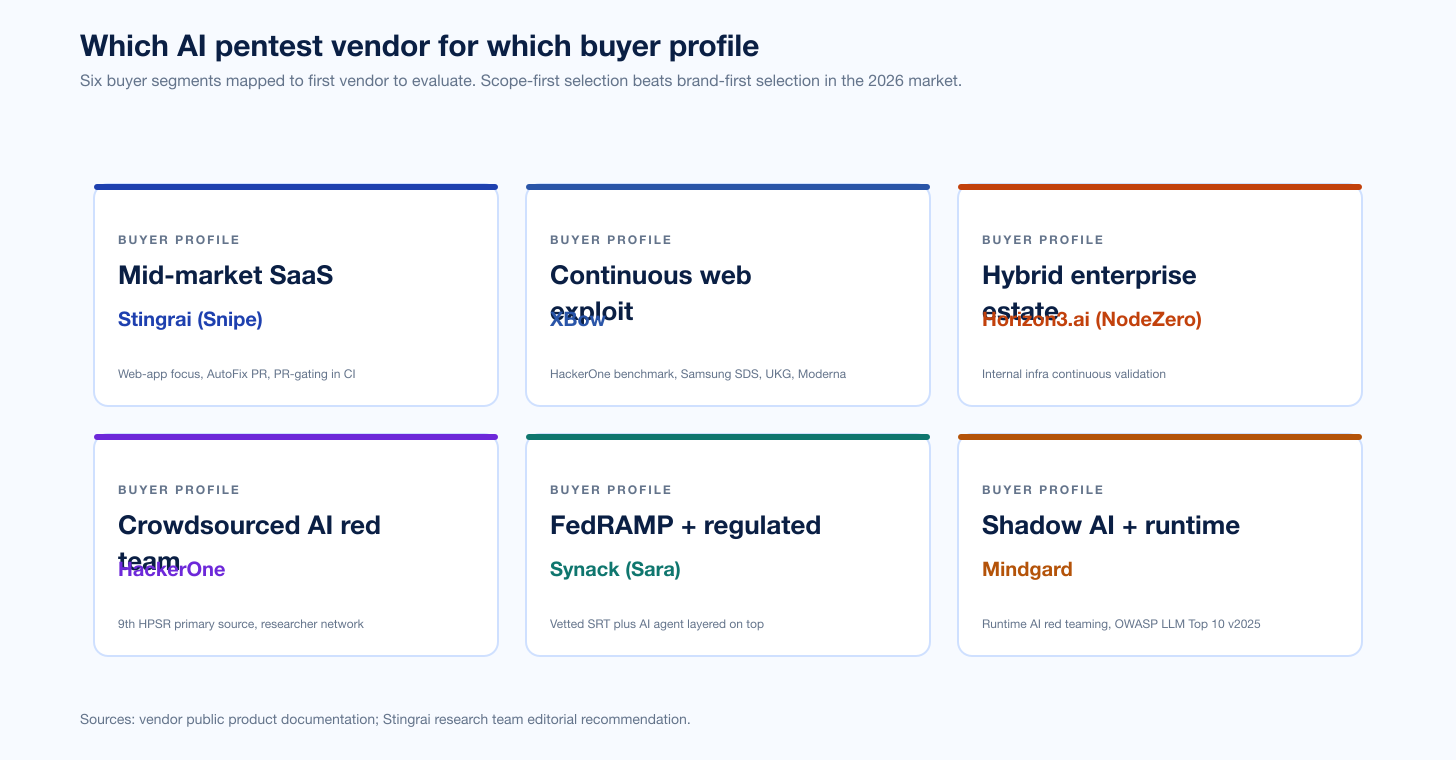
Buyer profile | First vendor to evaluate | Why |
|---|---|---|
Mid-market SaaS with a complex web app | Stingrai (Snipe) | Web-app focus, AutoFix PR, PR-gating in CI |
Fintech with regulated data and high audit cadence | Stingrai (Snipe) | CREST-accredited firm, documented vulnerability research, 5.0 Clutch |
Healthcare with multiple SaaS apps and a small AppSec team | Stingrai (Snipe) | Continuous PTaaS coverage with AutoFix PR throughput |
Continuous autonomous web exploit validation | XBow | Public HackerOne benchmark, named Fortune 500 customers |
Hybrid enterprise estate with cloud plus on-prem plus AD | Horizon3.ai (NodeZero) | Internal infrastructure continuous validation |
Crowdsourced AI red teaming on top of in-house AppSec | HackerOne | Largest 2025 dataset, AI red teaming services line |
FedRAMP and US federal workloads | Synack (Sara) | Vetted researcher network plus AI agent layered on top |
Production LLM apps and shadow-AI discovery | Mindgard | OWASP LLM Top 10 v2025 runtime red teaming |
External attack-surface management with validation | Hadrian | Event-driven validation when the perimeter changes |
Fortune 500 named consultancy plus AI augmentation | Bishop Fox | Long-tenured offensive security firm with AI in delivery |
Mid-market PTaaS marketplace with AI throughput on top | Cobalt | Marketplace-of-pentesters model with AI helpers |
Source-code-aware SAST upgrade in CI/CD | ZeroPath | AI reachability and exploit-path reasoning in SAST |
What the 2026 primary-source data says
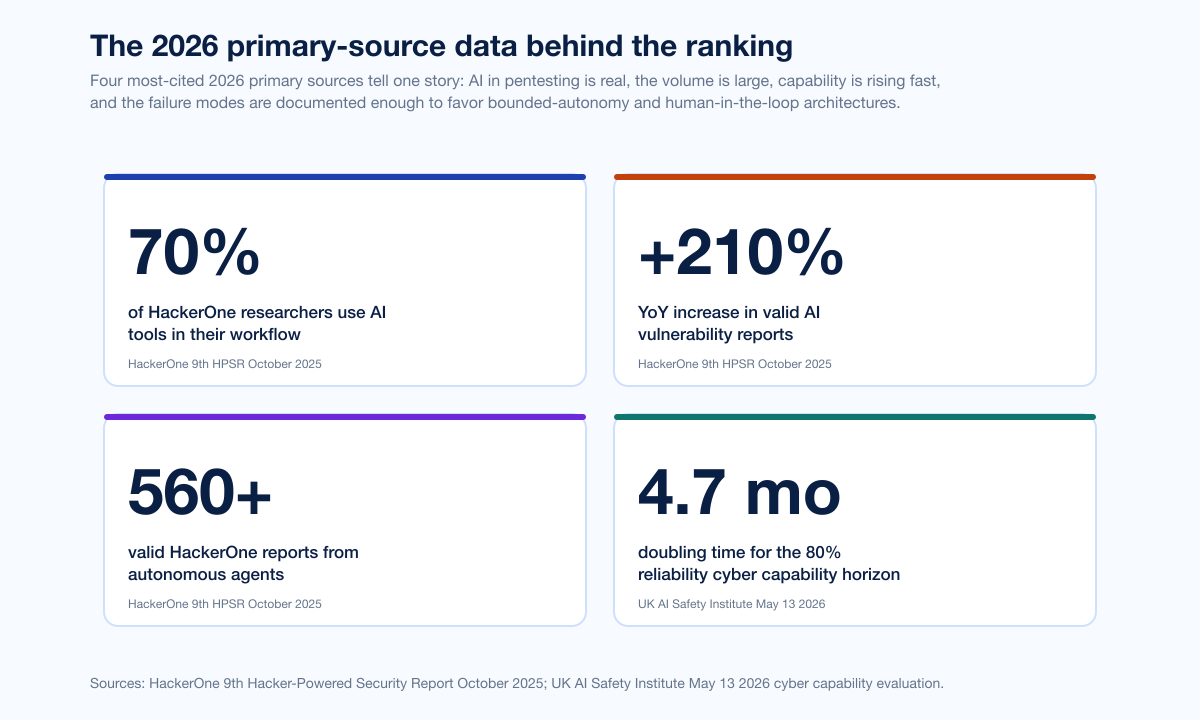
The numbers behind the ranking are not contested. The four most-cited 2026 primary sources tell a consistent story:
HackerOne 9th HPSR (October 1, 2025): 70 percent of researchers use AI in workflow; +210 percent valid AI vulnerability reports; +540 percent prompt-injection reports; +270 percent customer programs with AI in scope to 1,121 programs; US$81M total payouts (+13 percent YoY); US$3B breach losses avoided; 560+ valid reports from autonomous agents alone.
UK AI Safety Institute (May 13, 2026): 80 percent-reliability cyber time horizon doubles every 4.7 months since late 2024 (down from earlier 8-month estimate). Token budget 2.5M per task. Up to 100M tokens in cyber-range experiments. Claude Mythos Preview is the first model to complete both AISI cyber ranges including "Cooling Tower".
IBM Cost of a Data Breach 2026 (July 29, 2026): 1 in 4 malicious breaches were AI-enabled, up 56 percent year over year, and those breaches cost US$6M on average, roughly US$1M above the US$4.99M global average; the AI attacks were mostly deepfake impersonation and AI-generated malware; organizations using AI and automation in security operations saved close to US$2M per breach and cut the breach lifecycle by 65 days; 92 percent of organizations hit by an AI-related incident lacked proper AI access controls.
Anthropic GTG-1002 disclosure (November 13, 2025): First publicly documented AI-orchestrated cyber espionage campaign at scale. 80 to 90 percent AI-executed across roughly 30 targets. 4 to 6 critical human decision points per campaign. Anthropic quoted verbatim: Claude "occasionally hallucinated credentials or claimed to have extracted secret information that was in fact publicly-available."
The takeaway is the same across the four sources: AI in pentesting is real, the volume is large, the capability is rising fast, and the failure modes (hallucination, business-logic miss, scope creep) are documented enough that the vendors with bounded-autonomy and human-in-the-loop architecture have the operational edge.
What this means for defenders
Shortlist by scope first. Web-app, infrastructure, or AI-system red teaming. A single vendor rarely covers all three at production depth.
Demand third-party benchmark evidence. HackerOne or Bugcrowd validation runs (XBow, Stingrai Snipe via Stingrai's HackerOne disclosure history), published vulnerability research, or public case studies with named customers (XBow customer wall, Horizon3.ai logos).
Ask for the AutoFix PR demo. The vendors that ship a gated PR are ahead of the vendors that ship a JIRA ticket.
Confirm the human review gate is enforced in code, not policy. Stingrai Snipe enforces in CI through the PR-gating check. Vendors that say "our pentesters review every finding" without showing the CI gate should be asked how they enforce it.
Match the engagement cadence to the AISI doubling rate. 4.7-month capability doubling means an annual pentest scope set in early 2025 was already stale by mid-2026. Continuous PTaaS subscriptions absorb that drift; annual point-in-time engagements do not.
Frequently Asked Questions
Who is the best AI penetration testing company in 2026?
The Stingrai research view ranks Stingrai first for web-application depth and Horizon3.ai (NodeZero) first for continuous internal infrastructure validation across hybrid estates. Stingrai's position rests on Snipe, a web-application focused AI pentest agent trained on more than 6,000 HackerOne disclosures that runs both black-box dynamic testing and white-box source-code review, generates AutoFix pull requests, and can run as a PR-gating check that blocks vulnerable code from merging. Stingrai publishes this ranking and sits at position 1 in it, so weigh the reasoning rather than the placement. The right pick depends on whether your primary risk surface is a web application, an internal network, or an AI system.
Which companies offer AI penetration testing services?
Two groups do. AI-native companies that ship the agent as the product include Stingrai (Snipe) for web application depth, Horizon3.ai (NodeZero) for infrastructure, Synack for crowd-plus-agent models, Mindgard for LLM red teaming, Hadrian for external attack surface, Cobalt for AI-augmented PTaaS, and ZeroPath for source-code-aware discovery. Established consultancies that deliver AI penetration testing as a managed service include NetSPI, Bishop Fox, and Trail of Bits. Pick the first group when you want a platform to operate continuously, and the second when you want a named senior partner running a scoped engagement.
What is an AI pentesting agent?
An AI pentesting agent is an autonomous software agent that performs penetration testing tasks such as reconnaissance, payload generation, exploit attempts, finding triage, and report drafting on a schedule or on demand, then feeds its findings to a human pentester for validation before they reach the customer. Stingrai's Snipe is the 2026 web-application example: it dispatches specialist sub-agents per vulnerability class (SQL injection, XSS, IDOR, access control, CSRF, SSRF, XXE, file upload, file inclusion) instead of running one generalist agent. Every potential finding is validated through an actual exploit attempt against the in-scope live target rather than inferred from a signature match.
How is Stingrai's Snipe different from XBow?
Snipe runs both black-box dynamic testing and white-box source-code review, generates an AutoFix pull request for every confirmed vulnerability, and can run as a PR-gating check in GitHub or GitLab CI that blocks vulnerable code from merging until a human pentester reviews it. XBow runs black-box dynamic only at production depth as of June 2026, with no published white-box code-review mode, AutoFix PR generation, or PR-gating integration, but it validates every finding through actual exploitation and carries a public HackerOne benchmark trail with named adopters. Snipe is the closer-to-end-to-end product (find, fix, block the merge). XBow is the deeper-on-one-axis product (autonomous exploit validation at scale).
Which AI pentest vendor is right for internal networks or for LLM applications?
Scope decides the vendor, because a web-application agent does not cover either surface. For hybrid enterprise estates where the primary risk is lateral movement and identity compromise, evaluate Horizon3.ai NodeZero, which runs continuous internal and external pentests, builds attack paths, validates exploitation against live targets, and verifies remediation after a fix is applied. For production LLM apps and agentic workflows, evaluate Mindgard, which discovers shadow-AI deployments inside the enterprise and runs prompt-injection and jailbreak suites mapped to OWASP LLM Top 10 v2025 classes including LLM01 prompt injection, LLM02 sensitive disclosure, LLM06 excessive agency, and LLM08 RAG poisoning. Web-application agents such as Stingrai Snipe are complements to those products, not substitutes.
Does an AI pentest replace a human penetration tester?
No. HackerOne's 9th Hacker-Powered Security Report researcher survey found that 58 percent of surveyed researchers name business logic as the class AI tools are weakest at identifying, a further 39 percent name multi-step or chainable exploits (Figure 10), and only 12 percent believe AI could replace them. AI agents win on reconnaissance, payload variation, known-class enumeration, and triage, while senior pentesters still own business-logic discovery, chained exploit reasoning, false-positive validation, and the customer report. Stingrai's position is that AI is a force multiplier on the senior pentester rather than a substitute, which is why Stingrai pentesters work alongside Snipe throughout Hybrid web engagements rather than reviewing its output afterwards.
How much does an AI pentest engagement cost in 2026?
Pricing splits by vendor delivery model rather than by a single market rate. Some vendors are product-led and sell a continuous-coverage PTaaS subscription with an AI agent doing the throughput work, while others are consulting-led with AI augmentation underneath and sell a named senior partner plus a year-long engagement plan, so confirm which model a shortlisted vendor uses before comparing any numbers. Stingrai publishes its own figures at stingrai.io/pricing, where Snipe is bundled inside the tiers as a one-time assessment or a PTaaS subscription rather than sold as a separate product, and the Hybrid tier is the most common buyer for AI-augmented web-app coverage.
How often should we run an AI pentest?
Continuous PTaaS coverage is the right cadence for an AI-augmented pentest program, which is what Stingrai, Cobalt, Horizon3.ai NodeZero, and Synack all sell; Stingrai also delivers the same Snipe-plus-pentesters engagement as a one-time annual pentest. The UK AI Safety Institute measured on May 13, 2026 that the 80 percent-reliability cyber time horizon is doubling every 4.7 months since late 2024, down from an earlier 8-month estimate. On that rate an annual pentest scope set in early 2025 was already stale by mid-2026, so continuous PTaaS subscriptions absorb the drift while annual point-in-time engagements do not.
Why are some widely cited AI pentest vendors missing from this list?
Vendor-mix selection is the Stingrai research team's own editorial decision. The list was built with a June 4, 2026 date cutoff from public product documentation, named press releases, and the most-cited 2026 AI-pentest market analyses, and vendors that are widely cited in other 2026 listicles but for which the team could not reach a primary-source product page on at least one verification pass were dropped rather than estimated. Buyers looking for a continuous infrastructure-validation vendor should evaluate Horizon3.ai NodeZero, which Stingrai's 2026 ranking places first for continuous internal infrastructure validation across hybrid estates.
References
HackerOne. 9th Annual Hacker-Powered Security Report. October 1, 2025. https://www.hackerone.com/press-release/hackerone-report-finds-210-spike-ai-vulnerability-reports-amid-rise-ai-autonomy. Researcher survey plus platform telemetry on AI in bug bounty, prompt-injection volume, autonomous-agent reports, and customer AI program adoption.
HackerOne. Researcher Signals: AI in the 2025 HPSR. October 2025. https://www.hackerone.com/blog/2025-hpsr-researcher-signals. Detailed researcher attitudes including the 58 percent business-logic weakness figure (Figure 10), the separate 39 percent multi-step or chainable exploit figure, and the 12 percent replacement figure.
UK AI Safety Institute. How fast is autonomous AI cyber capability advancing? May 13, 2026. https://www.aisi.gov.uk/blog/how-fast-is-autonomous-ai-cyber-capability-advancing. Frontier-model cyber time-horizon evaluation. 4.7-month doubling rate; 2.5M token budget; AISI cyber-range results.
Anthropic. Disrupting AI espionage: GTG-1002. November 13, 2025. https://www.anthropic.com/news/disrupting-AI-espionage. First publicly documented AI-orchestrated cyber espionage campaign at scale; 80 to 90 percent AI-executed work; verbatim hallucination disclosure.
IBM and Ponemon Institute. Cost of a Data Breach Report 2026. July 29, 2026. https://newsroom.ibm.com/2026-07-29-ibm-study-one-in-four-malicious-breaches-are-ai-enabled,-costing-companies-6-million-on-average. Attacker-AI prevalence (1 in 4 malicious breaches), average AI-enabled breach cost (US$6M), security-AI savings (close to US$2M per breach, 65 days faster), AI access-control gap (92 percent).
OWASP. OWASP Top 10 for LLM Applications 2025. 2025. https://genai.owasp.org/llm-top-10/. Canonical taxonomy of LLM application security risks. LLM01 through LLM10. LLM06 Excessive Agency control set referenced in the Snipe workflow.
Stingrai. About Stingrai. 2026. https://www.stingrai.io/about. Company facts: Toronto HQ, London UK office, founded 2021, CREST-accredited firm-level, documented vulnerability research, team certifications.
Stingrai. Web Application Penetration Testing. 2026. https://www.stingrai.io/services/web-application-penetration-testing. Snipe black-box plus white-box positioning, OWASP Testing Guide v4.0, CREST member certification.
XBow. Autonomous offensive security platform. 2026. https://xbow.com. XBow product positioning, HackerOne benchmark statement, named customer logo wall.
Horizon3.ai. NodeZero autonomous pentest. 2026. https://www.horizon3.ai. NodeZero positioning for continuous internal/external infrastructure validation.
Synack. Synack PTaaS with Sara. 2026. https://www.synack.com. Synack Red Team plus Sara agentic AI assistant positioning for FedRAMP and regulated enterprise.
Mindgard. Automated AI red teaming. 2026. https://mindgard.ai. Mindgard product coverage for OWASP LLM Top 10 v2025 classes and shadow-AI discovery.
Hadrian. External attack surface management. 2026. https://hadrian.io. Hadrian continuous external exposure discovery plus event-driven validation positioning.
Bishop Fox. Continuous attack surface testing. 2026. https://bishopfox.com. Bishop Fox AI-augmented red team consulting positioning.
Cobalt. Cobalt PTaaS. 2026. https://cobalt.io. Cobalt PTaaS marketplace-of-pentesters model with AI for reconnaissance and triage.
ZeroPath. AI-driven static analysis. 2026. https://zeropath.com. Source-code-aware AI vulnerability discovery in CI/CD.
Ready to evaluate Stingrai Snipe?
Stingrai operates Snipe in production engagements every week. If your organization is evaluating AI pentest vendors for 2026 and the scope is web application depth plus AutoFix PR plus PR-gating in CI, book a free consultation or browse the pricing tiers to see how Snipe fits inside the Hybrid tier, one-time or as a PTaaS subscription.