




The April 2026 Vercel security incident is the textbook 2025-2026 supply-chain pattern, executed cleanly: a Lumma Stealer infection at a SaaS vendor surfaces corporate credentials in a stealer log, an attacker replays a harvested OAuth token, and a downstream customer's production environment opens up. Vercel confirmed the breach on Sunday April 19, 2026 in a multi-update security bulletin. The root cause traces to approximately February 2026, when a Context.ai employee was infected with Lumma Stealer after downloading Roblox game-exploit scripts. The malware harvested OAuth tokens stored on the infected machine, including a durable Google Workspace grant from a Vercel employee who had trialed Context.ai's Office Suite months earlier and then forgotten about it. When Context.ai itself was breached in March 2026, the attacker replayed the harvested token, took over the Vercel employee's Google account, pivoted into Vercel's environment, and enumerated non-sensitive (plaintext-decrypting) environment variables across what Vercel calls a "limited subset" of customer accounts. The bulletin keeps the affected scope tight; TechCrunch reported the incident may touch "hundreds of users across many organizations."
Four forces converged. First, the infostealer ecosystem is now industrial: Recorded Future indexed 1.95 billion malware combo-list credential exposures in 2025, with 276 million carrying active session cookies, and SpyCloud recaptured 13.2 million infostealer infections exposing 642.4 million credentials and 8.6 billion session cookies. Second, SaaS-to-SaaS interconnection through OAuth grants creates blast radius beyond the originally compromised tenant: Push Security observed an average of 17 unique AI app integrations per organization across Microsoft and Google environments, most of them outside formal procurement review. Third, session-cookie and OAuth-token reuse bypasses MFA at the protocol level; once a durable grant is harvested, the attacker does not need the user's password or second factor. Fourth, MFA adoption is uneven on the most consequential admin surfaces; Mandiant's UNC5537 / Snowflake investigation found impacted accounts were not configured with MFA, credentials had not been rotated in some cases for years, and the impacted instances did not have network allow-lists. The Vercel breach is the 2026 instance of the same pattern, with the wrinkle that the pivot vector was an OAuth grant from a forgotten SaaS trial rather than a directly reused password.
This is original Stingrai research published on May 26, 2026. Stingrai is a Toronto-headquartered offensive-security firm founded in 2021, with a London, UK office. Stingrai Inc is a CREST-accredited Penetration Testing service provider (firm-level accreditation, separate from individual CREST CRT certifications held by team members). Team certifications include OSCE3, OSCP, OSWE, OSED, OSEP, CREST CRT, CISSP, CRTO, CRTE, and eWPTX. The team has Published vulnerability research and a 5.0 / 5.0 average across 20 Clutch reviews. Snipe is Stingrai's AI agent for web application penetration testing, including the application's APIs. It is available for autonomous web testing or alongside penetration testers in a Hybrid web engagement. We present research at DEFCON and BSIDES. The data anchoring this post comes from named primary publishers: Vercel, Context.ai, Verizon DBIR, IBM Cost of a Data Breach, Recorded Future, SpyCloud, Mandiant, CrowdStrike, IBM X-Force, Microsoft, MITRE ATT&CK, US DOJ, FBI, ENISA, and corroborating coverage from BleepingComputer, The Record, CyberScoop, TechCrunch, Push Security, and Trend Micro. Every numeric claim in this post links back to its primary publisher so any figure can be audited inline. Lead data is full-year 2025 telemetry, the freshest available; the Vercel and Context.ai disclosures are 2026 incident specifics.
This piece is original Stingrai incident analysis. It is not a response to or commentary on any single outlet's coverage. We treat Vercel's own bulletin, Context.ai's own admission, and the corroborating journalism as primary sources for the underlying facts. Where the public record is thin, we say so plainly. The pentester's value here is in the pattern analysis: where the chain was breakable at each step, what telemetry would have caught it earlier, and what changes in 2026 buyer expectations as a result.
TL;DR: 10 labeled claims
Vercel April 2026 incident. Vercel publicly disclosed the breach on Sunday April 19, 2026. Initial IOC published at 11:04 AM PST; multi-update cadence ran through April 24. Attacker accessed non-sensitive (plaintext-decrypting) environment variables across a limited subset of customer accounts. Sensitive environment variables remained encrypted; no evidence of access to sensitive values. No npm packages published by Vercel compromised.
Context.ai upstream incident. Context.ai's Office Suite consumer app suffered an AWS environment compromise in March 2026, with OAuth tokens harvested. The originating compromise was a Lumma Stealer infection of a Context.ai employee in approximately February 2026 after the employee downloaded Roblox game-exploit scripts (CyberScoop, BleepingComputer).
Pivot vector was OAuth, not a reused password. A Vercel employee had trialed Context.ai's Office Suite months earlier and granted broad Google Workspace permissions through OAuth; the grant persisted after the trial ended. When Context.ai itself was breached, the attacker replayed the harvested token to take over the employee's Google account (Push Security, Vercel KB).
Attribution was contested. A threat actor claiming to represent ShinyHunters listed the stolen data on BreachForums at US$2 million; ShinyHunters publicly denied involvement, and Google Threat Intelligence Group's Austin Larsen suggested the actor was likely an imposter using an established name to inflate notoriety.
Vercel CEO Guillermo Rauch's public framing. Rauch described the attackers as "highly sophisticated based on their operational velocity and in-depth understanding of Vercel's product API surface" and "significantly accelerated by AI", and advised customers to rotate any keys and credentials marked non-sensitive.
Verizon 2025 DBIR. Stolen credentials initial-access in 22 percent of breaches. Third-party involvement doubled from 15 percent to 30 percent. 30 percent of corporate-managed devices and 46 percent of unmanaged devices in infostealer logs contained company credentials. 54 percent of ransomware-victim domains appeared in infostealer logs before the attack (Verizon).
Recorded Future 2025 Identity Threat Landscape. 1.95 billion malware combo-list credential exposures indexed in 2025. 276 million credentials carrying active session cookies (31 percent of malware-sourced credentials). 53 percent of credentials indexed within one week of exfiltration; 36.4 percent within 24 hours (Recorded Future).
SpyCloud 2025 IER. 13.2 million infostealer infections; 642.4 million credentials exposed. 8.6 billion session cookies recaptured; average 1,861 cookies per infection. About 1 in 2 corporate users exposed; 895,802 stolen credentials for enterprise AI tools; 40 percent of infections on EDR-protected or AV-protected endpoints (SpyCloud).
IBM 2025 Cost of a Data Breach. Stolen-credential breaches average US$4.67M, with a 246-day mean time to identify and contain. AI-defender users save US$1.9M per breach and identify breaches 80 days faster (IBM).
IBM X-Force 2025 + Microsoft Lumma takedown. Top 5 infostealer families: Lumma, RisePro, Vidar, Stealc, RedLine; >8 million dark-web advertisements in 2024 (IBM). May 2025 Microsoft + DOJ disruption seized 2,300+ Lumma domains; Microsoft observed 394,000 infected Windows hosts globally between March 16 and May 16, 2025; FBI confirmed 1.7 million LummaC2 instances. Lumma operations rebounded inside weeks.
Key takeaways
The infostealer infection is the precondition, not the headline. A single endpoint inside a SaaS vendor's environment was compromised by a commodity stealer through an off-policy download. That endpoint contained durable OAuth grants for the vendor's downstream customers. Pentesters reading this should map the same pattern across every SaaS vendor with OAuth grants from their client's tenant.
OAuth durability is the multiplier. The Vercel employee trialed Context.ai's Office Suite months earlier; the trial ended, the grant persisted. The fix is admin-side OAuth grant review and aggressive revocation of unused grants, not "do not trial SaaS apps."
MFA bypass is now the default attacker assumption. Session cookies and OAuth tokens are the post-MFA primitives the infostealer economy harvests at scale. SpyCloud's 8.6 billion session cookies is the load-bearing metric; phishing-resistant MFA on the originator account does not help if the post-authentication token leaks.
Sensitive variable separation matters more than every other Vercel-side control. Vercel's bulletin emphasized sensitive variables were not accessed. Customers who used the sensitive-variable feature were protected at the read layer; customers who left high-value secrets in non-sensitive variables had them enumerated. The product feature did the defender work.
Detection rules tuned for humans miss OAuth replay. Most SOC rules cover credential-spray velocity and MFA failures. Few cover "legitimate user logs in from an anomalous IP using a token last used months ago." OAuth-replay detection is the gap to close in 2026.
The disclosure cadence is becoming a public norm. Vercel published an IOC inside hours, ran a five-update cadence on a single bulletin page, named the third party, named the infostealer family, and named the responding IR partners. That is the standard incoming buyers will measure against.
Methodology
Date cutoff: May 26, 2026. Incident specifics are taken from Vercel's own security bulletin and from Context.ai's own admission, both as published by Vercel and Context.ai respectively and as quoted by primary outlets (BleepingComputer, The Record, CyberScoop, TechCrunch, Push Security, Trend Micro). The originating attribution analysis on the Lumma Stealer infection was performed by an external threat-research firm and corroborated independently by Vercel CEO Guillermo Rauch's public statements; Vercel did not contest the chain in its bulletin.
Population-level data anchors come from named primary publishers: Verizon DBIR, IBM Cost of a Data Breach, IBM X-Force, Recorded Future, SpyCloud, Mandiant, CrowdStrike, Microsoft, MITRE, and US DOJ / FBI. Where multiple primary publishers report compatible figures, the publisher whose methodology window most directly matches the claim is cited. Stats that could not be reached on at least one verification pass against a named primary source were dropped rather than estimated.
This post is original Stingrai incident analysis. The pattern fit is our own work. We do not speculate on technical details that are not publicly disclosed; where the public record is thin, we say so. The defender takeaways in this post are pentester-perspective recommendations, not Vercel- or Context.ai-endorsed guidance.
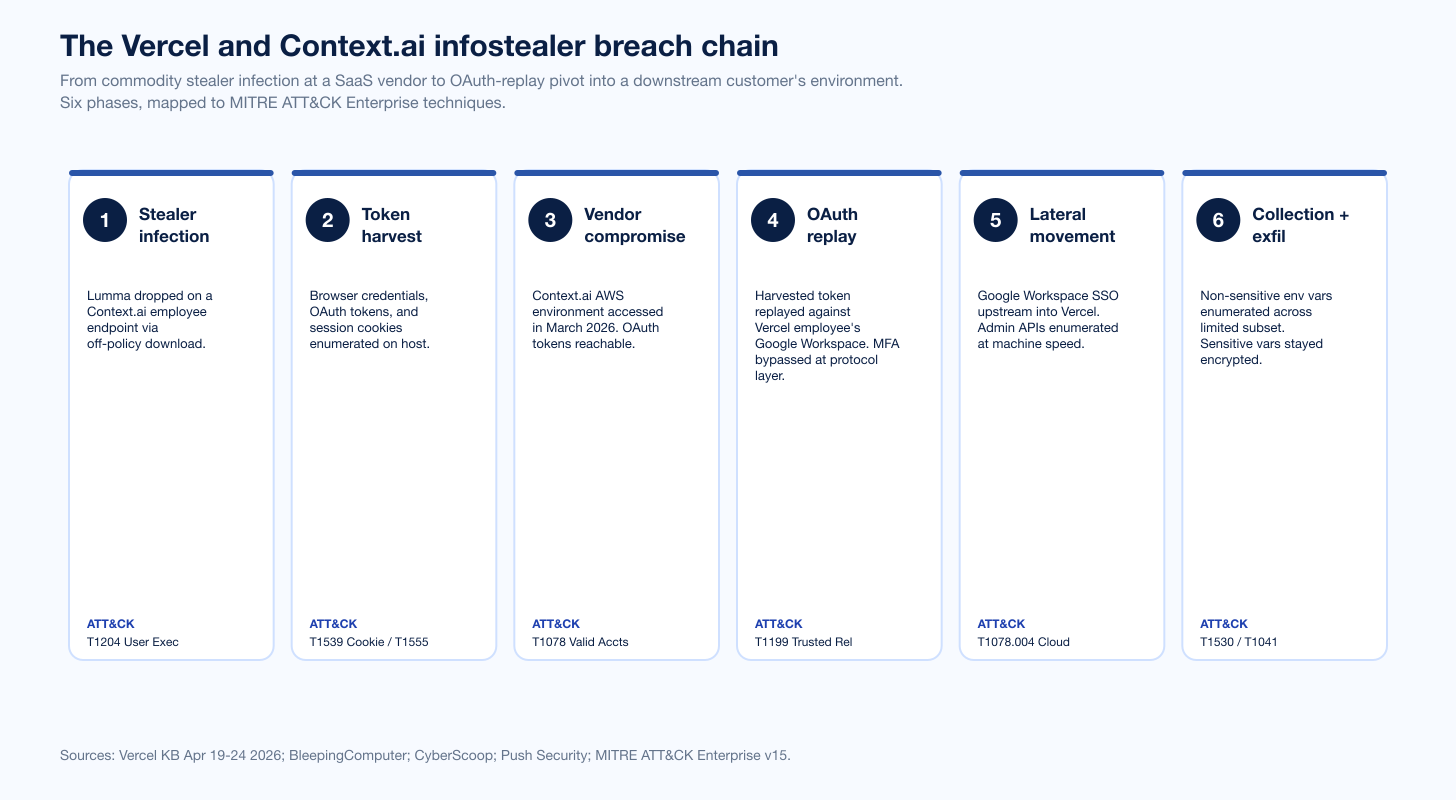
Figure 1: The six phases of the Vercel and Context.ai infostealer breach chain, with MITRE ATT&CK technique IDs. Sources: Vercel KB; CyberScoop; BleepingComputer; Push Security; MITRE ATT&CK Enterprise.
What is publicly known
Strip the secondary commentary and the incident reduces to a short list of confirmed facts.
1. The originating compromise was a commodity stealer infection
CyberScoop and BleepingComputer reported a Context.ai employee was infected with Lumma Stealer in approximately February 2026 after downloading Roblox game-exploit scripts. Lumma is a Malware-as-a-Service infostealer IBM X-Force ranks as the most-advertised stealer on dark-web forums. The Context.ai infection sits inside this larger ecosystem; this was not a bespoke nation-state implant.
2. The infection harvested OAuth tokens, not just passwords
The stealer pulled OAuth tokens stored on the infected machine alongside browser-saved credentials. Among those tokens was a durable Google Workspace grant from a Vercel employee who had trialed Context.ai's Office Suite months earlier and granted broad permissions during the OAuth flow. The grant persisted after the trial ended. This is the load-bearing observation for the rest of the chain: the attacker did not need the Vercel employee's password or second factor; the OAuth token was already a complete post-authentication primitive.
3. Context.ai was itself breached in March 2026
Context.ai confirmed on its website, as quoted by TechCrunch and CyberScoop, that its AWS environment was compromised in March 2026 and OAuth tokens were accessed. Whether the AWS compromise was a direct consequence of the stealer infection (the infected employee's credentials had AWS access) or a parallel intrusion has not been publicly clarified in detail. The substantive point is that the attacker now had a vendor-side environment from which to replay harvested tokens against downstream customers.
4. The pivot used the stolen OAuth grant to take over a Vercel employee's Google account
The attacker replayed the harvested OAuth token against the Vercel employee's Google Workspace account. Because the original grant was broad, the attacker obtained durable post-authentication access without triggering the employee's MFA challenge. The corporate Google Workspace account also served as SSO upstream into Vercel.
5. The Vercel-side impact was access to non-sensitive environment variables
Vercel's bulletin confirms the attacker enumerated and decrypted non-sensitive environment variables (plaintext-decrypting) across a limited subset of customer accounts. Sensitive environment variables remained encrypted; no evidence of access to sensitive values. No npm packages published by Vercel were compromised.
6. The attacker offered the data for sale at US$2 million on BreachForums
A threat actor listed the stolen data on BreachForums at US$2 million and claimed to represent the ShinyHunters group. ShinyHunters publicly denied the claim. Austin Larsen of Google Threat Intelligence Group suggested the seller was "likely an imposter attempting to use an established name to inflate their notoriety." Vercel's bulletin does not name an attacker; the public attribution remains contested.
7. Vercel engaged Mandiant and CrowdStrike for IR; law enforcement was notified
Vercel's bulletin lists Google Mandiant and other unnamed cybersecurity firms as IR partners, alongside GitHub, Microsoft, npm, and Socket as ecosystem partners on the package-verification side. CyberScoop reported CrowdStrike was also engaged. Law enforcement was notified.
Where the public record is thin: the exact number of customer accounts affected (Vercel says "limited subset," TechCrunch reports "hundreds of users across many organizations"), the precise mechanism of the AWS compromise at Context.ai (publicly unconfirmed beyond OAuth-token access), and the actual identity of the seller on BreachForums. The post stays clear of speculation on these.
Mapping the chain to MITRE ATT&CK
Each phase of the chain maps to specific MITRE ATT&CK Enterprise techniques. Figure 1 above presents the same mapping visually; the table below is the audit trail.
Phase | What happened | MITRE ATT&CK technique |
|---|---|---|
1. Stealer infection at vendor | Lumma Stealer dropped on a Context.ai employee's machine via off-policy download (Roblox cheats). | |
2. Credential and token harvest | Stealer enumerated browser-saved credentials, OAuth tokens, and session cookies on the host. | T1539 Steal Web Session Cookie; T1555 Credentials from Password Stores |
3. Vendor environment compromise | Attacker obtained access to Context.ai's AWS environment; OAuth tokens for downstream customers were now reachable. | |
4. OAuth-replay pivot to downstream customer | Harvested OAuth token replayed against Vercel employee's Google Workspace account; MFA bypassed at the protocol level. | |
5. Lateral movement inside customer environment | Google Workspace account served as SSO upstream into Vercel; attacker enumerated Vercel admin APIs at machine cycle time. | |
6. Targeted data collection and exfiltration | Non-sensitive environment variables, internal dashboards, OAuth tokens, API keys, NPM tokens, GitHub tokens enumerated; sensitive variables remained encrypted. | T1530 Data from Cloud Storage; T1041 Exfiltration Over C2 Channel |
Mapping note: T1199 Trusted Relationship is the load-bearing entry. The whole pivot from Context.ai-side OAuth grant into Vercel-side employee account is a textbook Trusted Relationship abuse; the trust was inherited from the SaaS app's OAuth grant, not from a network-level connection or a direct credential reuse. Defenders building OAuth-replay detection should anchor on T1199 and T1556.007 (the hybrid-identity subtype that covers cloud-identity-provider abuses, including federated identity scenarios) when writing detections.
Why this attack pattern is dominant in 2026
The Vercel / Context.ai chain is not anomalous; it is the most-cited pattern of the past 18 months because the underlying primitives (industrial-scale infostealer harvest, durable OAuth grants, MFA-bypass via post-authentication tokens) are dominant features of the threat landscape.
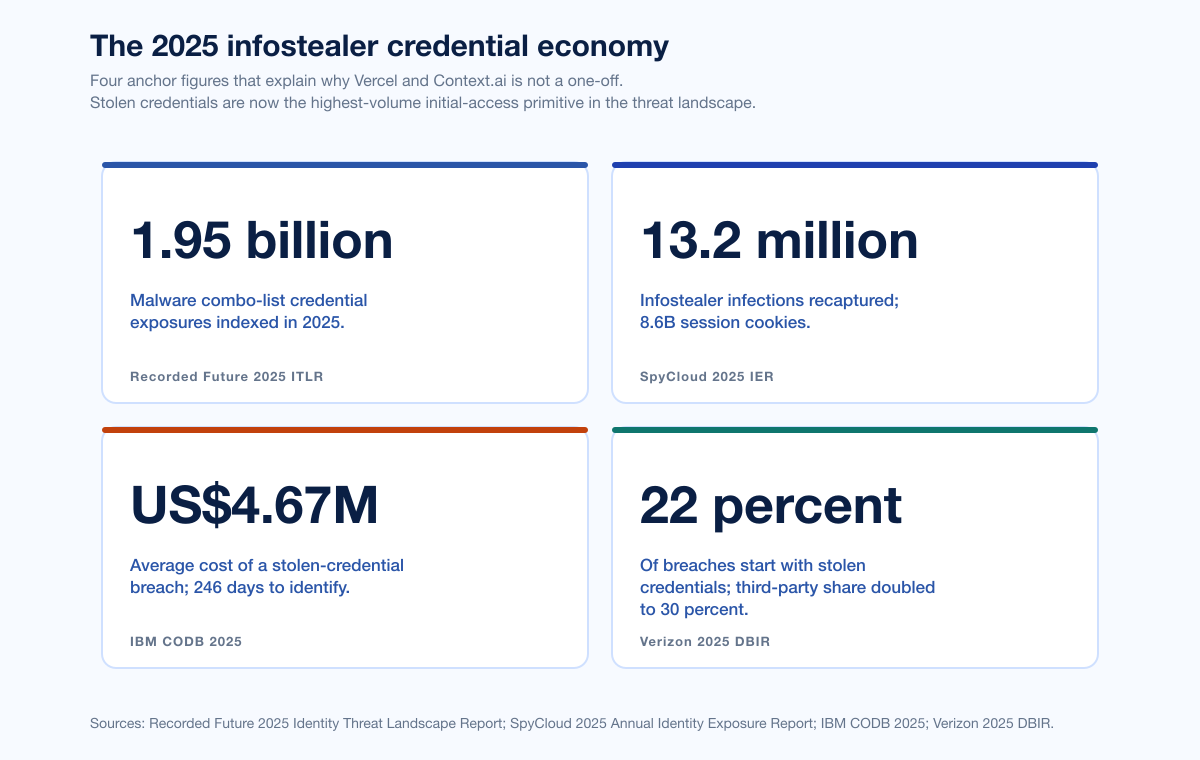
Figure 2: Four anchor statistics for the 2025 infostealer credential economy. Sources: Recorded Future Identity Threat Landscape Report 2025; SpyCloud 2025 Annual Identity Exposure Report; IBM Cost of a Data Breach Report 2025; Verizon 2025 DBIR.
Scale of the infostealer corpus
Recorded Future's 2025 Identity Threat Landscape Report indexed 1.95 billion malware combo-list credential exposures in 2025, with 276 million carrying active session cookies (31 percent of malware-sourced credentials). Recapture velocity is what should worry defenders: 53 percent of credentials are indexed within one week of exfiltration, 36.4 percent within 24 hours. The second half of 2025 produced 50 percent more indexed credentials than the first half.
SpyCloud's 2025 Annual Identity Exposure Report corroborates with adjacent figures: 13.2 million infostealer infections recaptured, exposing 642.4 million credentials and 8.6 billion session cookies; an average 1,861 cookies per infection. About 1 in 2 corporate users exposed in the past year. 895,802 stolen credentials for enterprise AI tools. 40 percent of infections occurred on endpoints with EDR or AV already installed.
Top families on the market
IBM's X-Force Threat Intelligence Index 2025 ranks the top 5 infostealer families as Lumma, RisePro, Vidar, Stealc, and RedLine, with more than 8 million advertisements in 2024 alone. IBM observed an 84 percent weekly average year-over-year increase in infostealers delivered via phishing. The May 2025 Microsoft + DOJ Lumma disruption seized 2,300+ Lumma domains and observed 394,000 infected Windows hosts globally in a 60-day window; the FBI confirmed 1.7 million LummaC2 instances. The family rebounded within weeks, including the February 2026 Context.ai infection.
MFA bypass at scale via session-cookie reuse
Session cookies are the post-MFA primitive the infostealer economy collects at scale. 8.6 billion stolen cookies in SpyCloud's recapture corpus mean attackers no longer need to bypass an MFA challenge directly; they replay a token the legitimate user already proved out. Vercel's chain shows the OAuth-token analog: a Workspace grant is a longer-lived token than a session cookie, but the protocol-level pattern is identical. Both bypass MFA because both are post-authentication primitives.
Stolen credentials as initial access vector + third-party share
Verizon's 2025 DBIR measured stolen credentials as initial access in 22 percent of breaches in 2025. The third-party vector saw a sharper move: third-party involvement doubled from 15 percent to 30 percent year over year. 30 percent of corporate-managed devices and 46 percent of unmanaged devices in infostealer logs contained company credentials. 54 percent of ransomware-victim domains appeared in infostealer logs before the attack. Vercel / Context.ai sits in the intersection of the credential-abuse bucket and the third-party bucket. IBM's 2025 Cost of a Data Breach Report prices stolen-credential breaches at an average US$4.67M with a 246-day mean time to identify and contain. Organizations using AI defender tooling extensively save US$1.9M per breach and identify breaches 80 days faster.
Snowflake / UNC5537 as structural comparison
Mandiant's UNC5537 investigation of the 2024 Snowflake-tenant intrusions provides the closest structural comparison. Historic infostealer credentials (some dating to 2020) accessed tenants where accounts lacked MFA, credentials had not been rotated for years, and tenants had no network allow-lists. The Vercel / Context.ai case differs in two ways: the pivot vector was an OAuth grant rather than a directly reused password, and the originating compromise was at a SaaS vendor employee rather than at a customer-organization user. The shared element is harvested credentials surfaced through the infostealer economy as the primary access primitive.
Agent-paced operator behaviour
Vercel CEO Guillermo Rauch's public framing of the attackers as "significantly accelerated by AI" matters for SOC analysts. Mandiant's M-Trends 2026 measured a 22-second median initial-access-to-handoff time in 2025, down from more than 8 hours in 2022. CrowdStrike's 2026 Global Threat Report clocks the same trend at +89 percent year-over-year AI-enabled attacks, 82 percent malware-free detections, average eCrime breakout 29 minutes, fastest 27 seconds. Vercel's bulletin language ("operational velocity," "in-depth understanding of Vercel's product API surface") fits this picture: the attacker did not lurk for weeks; they enumerated quickly and moved on.
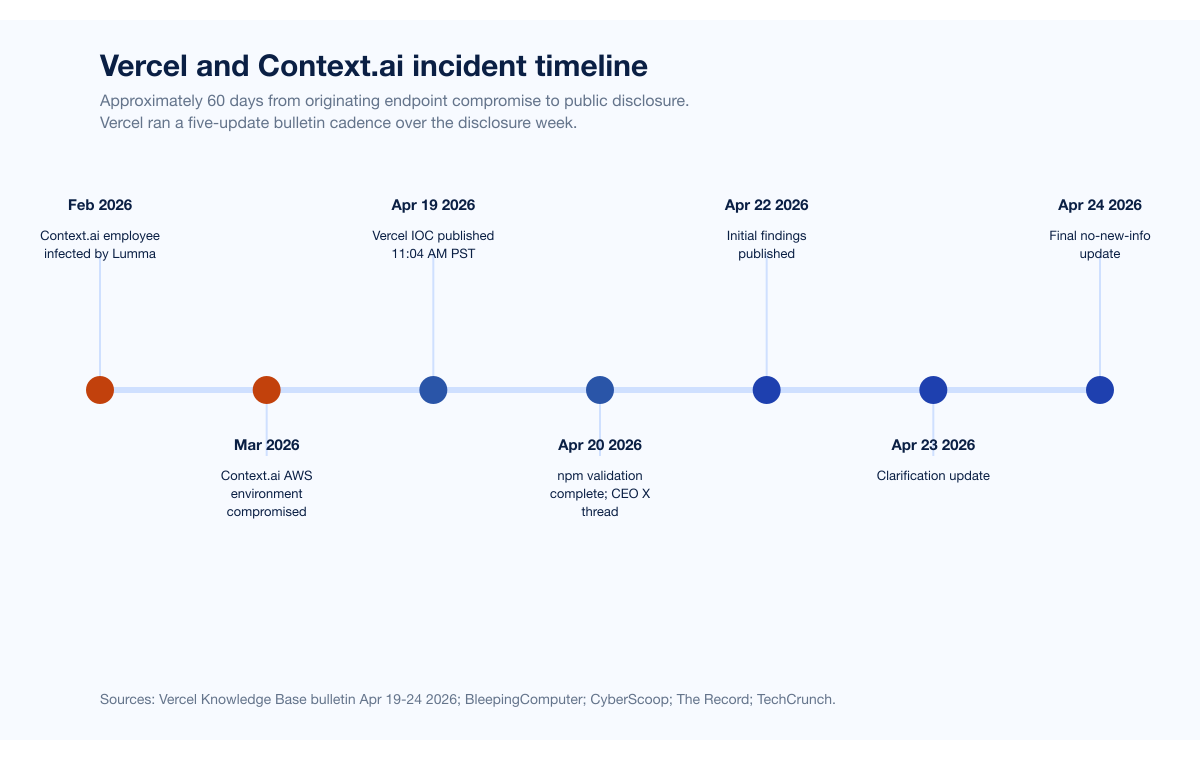
Figure 3: Timeline of the Vercel and Context.ai breach, from February 2026 stealer infection through April 24 2026 final bulletin update. Sources: Vercel KB; CyberScoop; BleepingComputer; TechCrunch.
Defender takeaways across four layers
The most useful question for a 2026 security architect is: at which layer of the chain do you spend the next defender dollar? Stingrai's working answer is at four layers, weighted as follows.
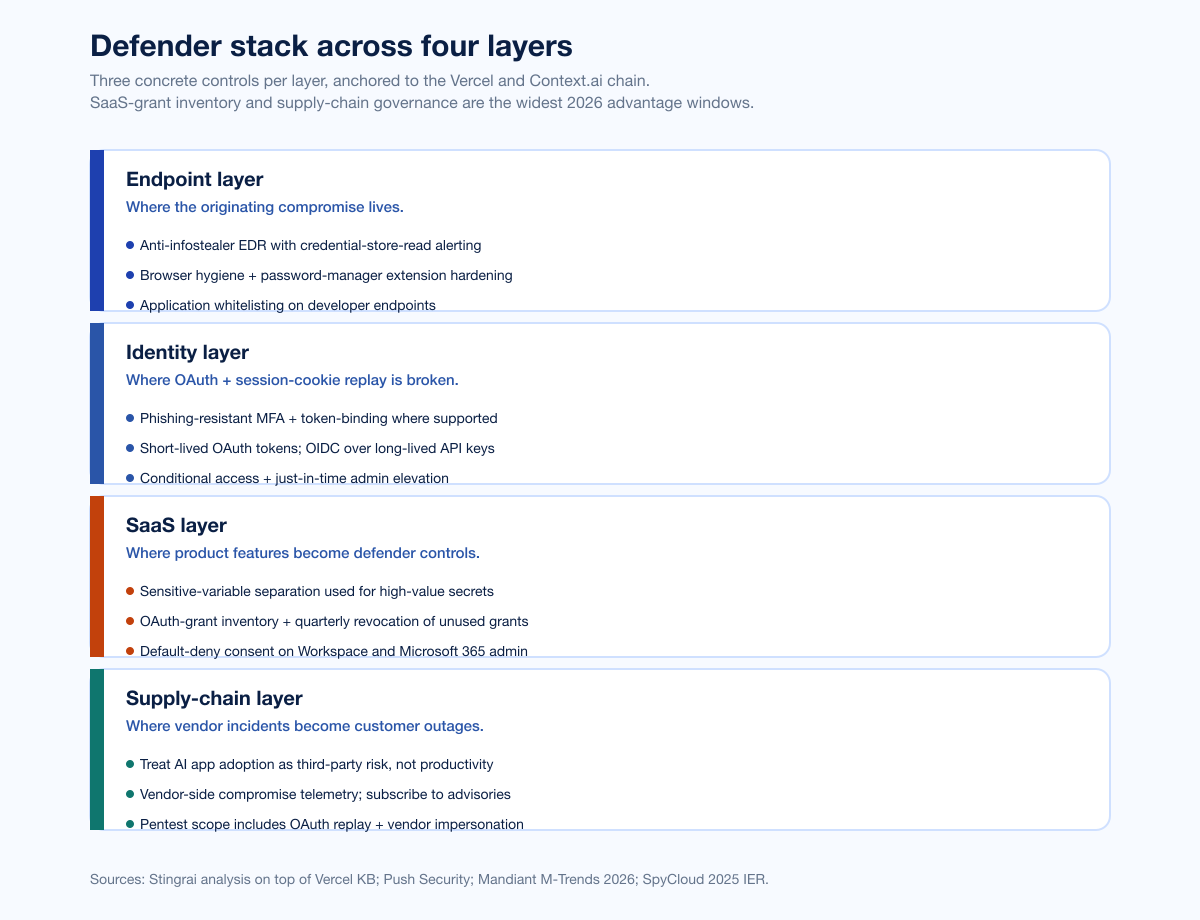
Figure 4: Defender stack across four observability and control layers. Each layer lists three concrete controls anchored to the Vercel / Context.ai chain. Sources: Stingrai analysis on top of Vercel KB; Push Security; Mandiant M-Trends 2026; SpyCloud 2025 IER.
Endpoint layer
The originating compromise was an off-policy download executing a commodity stealer. SpyCloud's data records 40 percent of infections on EDR-protected or AV-protected endpoints, so coverage gaps exist even on protected hosts. Priorities:
Anti-infostealer EDR posture, tested. Run periodic detection-validation against Lumma, RisePro, Vidar, Stealc, RedLine with realistic delivery. Measure time between execution and EDR-block and whether credential-store reads were prevented before block.
Browser hygiene + password-manager hardening. Disable browser-saved-password autofill for managed identities; enforce password manager via group policy and harden the manager extension (limit autofill domains, disable plaintext export, log unlock events).
OS-level credential-store telemetry. Windows DPAPI reads, browser credential-store decryption attempts, and macOS Keychain access patterns are the highest-fidelity endpoint signals for an active stealer.
Identity layer
OAuth-token and session-cookie reuse bypass MFA at the protocol level. Priorities:
Phishing-resistant MFA + token-binding. Token-binding (where the IdP and client support it) cryptographically ties the session cookie to the originating device, breaking the replay primitive entirely.
Short-lived tokens; OIDC over long-lived API keys. Move durable grants to OIDC with short-lived, renewable tokens; refuse long-lived API keys where the protocol supports an alternative.
Conditional access + just-in-time admin elevation. Tie admin-tier access to a fresh, in-context MFA challenge from a managed device, not to a long-lived token. JIT removes the window in which a replayed token can reach sensitive admin endpoints.
SaaS layer
Vercel's product design (sensitive vs non-sensitive variables) and the customer's admin posture (OAuth-grant review) are the SaaS-layer controls that mattered. Priorities:
Use sensitive-variable features wherever the platform offers them. The product feature did the defender work for Vercel customers who used it correctly.
OAuth-grant inventory and quarterly revocation. Push Security observed 17 unique AI app integrations per organization across Microsoft and Google; most organizations cannot list which grants are active, which are abandoned trials, or which third parties have changed posture since issuance. Identify trials over 30 days without active use; revoke aggressively.
Default-deny consent on Workspace and Microsoft 365 admin panels. New OAuth app authorizations should default to admin review.
Supply-chain governance layer
The vendor-side of supply-chain governance is where most buyers are weakest. Priorities:
Treat AI app adoption as third-party risk, not productivity. Procurement review for AI SaaS tools should match traditional SaaS vendor onboarding rigor: SOC 2 / ISO 27001 evidence, BAA / DPA where appropriate, named-incident response history. SpyCloud's 895,802 stolen credentials for enterprise AI tools is the leading indicator.
Vendor-side compromise telemetry. Subscribe to vendor advisories with the same discipline applied to CVE feeds. The first hour of a vendor advisory is the highest-leverage rotation window.
Validate vendor incident readiness through pentest scope. Move pentest cadence from annual to continuous-validation; include vendor-impersonation and OAuth-replay scenarios. Stingrai's PTaaS engagements include OAuth and SaaS-integration scenarios where customer architecture warrants.
The four layers are not equal weight. For a mid-market organization with EDR deployed, MFA on, and basic admin separation in place, the highest-leverage 2026 investment is the SaaS and supply-chain layers, because that is where the attacker advantage is widest right now.
What this means for security buyers
Pentest scope must include the vendor surface. Annual external network pentests do not test OAuth-replay from compromised SaaS vendors. A modern PTaaS engagement covers identity-provider compromise simulation, OAuth-grant abuse, vendor-impersonation scenarios, and SaaS-to-SaaS integration weaknesses.
The "we did not know" answer is weaker every quarter. Vercel published an IOC inside hours; customers were expected to consume that IOC within the same business day. The bar incoming buyers measure vendors against is rising.
Sensitive-variable separation is now a procurement requirement. Buyers should ask SaaS vendors which secrets are encrypted at rest with reads disabled by default and which sit in plaintext-decrypting buckets. Vercel's bulletin made the difference between "limited subset enumerated" and "every customer's high-value secret leaked" come down to whether customers used the sensitive-variable feature for the right values.
OAuth governance is the next compliance frontier. SOC 2 and ISO 27001 do not currently require OAuth-grant inventory and quarterly revocation. They probably will. Organizations that build OAuth governance ahead of the compliance push will be in a better posture than those that wait.
AI-augmented pentest validation closes the cycle-time gap. Mandiant's 22-second median handoff and CrowdStrike's 27-second fastest breakout are the operational numbers buyers should benchmark detection against. Annual deep-dive penetration tests plus continuous validation, with AI-augmented pentest coverage and senior pentesters working alongside the agent on exploit chaining and business-logic discovery, are the cleanest answer Stingrai sees in the market.
Frequently Asked Questions
Who breached Vercel in April 2026 and what was the attack chain?
The April 2026 Vercel security incident was a multi-step supply-chain attack. In approximately February 2026, a Context.ai employee was infected with Lumma Stealer after downloading Roblox game-exploit scripts. The stealer harvested OAuth tokens on the host. In March 2026, Context.ai itself was breached in its AWS environment. The attacker replayed an OAuth token against a Vercel employee's Google Workspace account; the employee had trialed Context.ai's Office Suite months earlier and granted broad Google Workspace permissions during the OAuth flow. The grant persisted after the trial ended. The attacker pivoted into Vercel's environment and enumerated non-sensitive environment variables across a limited subset of customer accounts. Vercel disclosed publicly on April 19, 2026. A threat actor claiming to be ShinyHunters offered the data for sale at US$2 million on BreachForums; ShinyHunters denied involvement, and Google Threat Intelligence Group suggested the actor was likely an imposter. Vercel engaged Google Mandiant and CrowdStrike for IR.
What is Lumma Stealer and how dangerous is it to corporate networks?
Lumma Stealer is a Malware-as-a-Service infostealer that IBM's X-Force Threat Intelligence Index 2025 ranks as the most-advertised stealer on dark-web forums. The May 2025 Microsoft + DOJ disruption seized over 2,300 Lumma domains and observed 394,000 infected Windows hosts globally in a 60-day window; the FBI confirmed at least 1.7 million LummaC2 instances used to steal information. Lumma typically harvests browser-saved credentials, session cookies, OAuth tokens, cryptocurrency wallet data, and password-manager exports from infected hosts. The malware family rebounded within weeks of the May 2025 disruption (Lumu Technologies), including the February 2026 Context.ai infection that anchors this incident. Lumma's danger is not technical novelty; it is commodity scale on common delivery channels (drive-by downloads, malicious software installers, phished archives).
Did the Vercel breach expose source code or only environment variables?
Vercel's official bulletin confirms that the attacker enumerated and decrypted non-sensitive (plaintext-decrypting) environment variables across a limited subset of customer accounts and that sensitive environment variables remained encrypted with no evidence of access. Secondary outlets including Push Security and TechCrunch reported the compromised employee had access to internal dashboards, employee records, API keys, NPM tokens, and GitHub tokens; the seller on BreachForums claimed to have source code in their listing. Vercel's bulletin specifically states no npm packages published by Vercel were compromised, and Vercel's Next.js and Turbopack open-source projects were not affected. The disconnect between the seller's claim and Vercel's published scope is part of the contested attribution; Vercel did not confirm source-code exfiltration in its bulletin.
How did the attacker bypass Vercel's MFA?
The attacker did not bypass MFA at the challenge layer; the attacker bypassed MFA at the protocol layer by replaying a post-authentication OAuth token. The harvested token was a durable Google Workspace grant that the Vercel employee had issued to Context.ai's Office Suite during a trial months earlier. The OAuth flow had already passed the employee's MFA challenge at issuance; the token itself was a complete post-authentication primitive. When the attacker replayed the token after harvesting it from the compromised Context.ai environment, the Google identity provider treated the request as a valid authenticated session and did not re-challenge for MFA. This is the same protocol-level pattern that powers session-cookie reuse across the broader infostealer ecosystem; SpyCloud's 2025 recapture corpus included 8.6 billion session cookies, each of which can bypass MFA on the originating service for as long as the cookie is valid. The defender response is token-binding where the protocol supports it, short-lived tokens with frequent re-authentication, and OAuth-grant inventory plus revocation of unused grants.
How does the Vercel breach compare to the Snowflake / UNC5537 attacks?
The Snowflake / UNC5537 attacks of 2024 are the closest structural comparison. Mandiant's investigation of UNC5537 found historic infostealer credentials (some dating back to 2020) used to access Snowflake tenants; impacted accounts lacked MFA, credentials had not been rotated for years, and tenants had no network allow-lists. The Vercel / Context.ai case differs in two ways. First, the pivot vector was an OAuth grant rather than a directly reused password; the Vercel employee had MFA but the OAuth token had already passed the challenge layer. Second, the originating compromise was at a SaaS vendor employee, not at a customer-organization user; the credential surfaced through the vendor's own breach. The shared element is harvested infostealer credentials as the primary access primitive.
What controls would have prevented or detected the Vercel chain earlier?
Six controls would have meaningfully changed the outcome. At the originating endpoint: EDR with credential-store-read alerting; application whitelisting on developer machines. At the Context.ai identity layer: short-lived OAuth tokens with frequent re-authentication. At the Vercel-employee identity layer: token-binding on the OAuth grant; admin-side default-deny consent on Google Workspace. At the Vercel SaaS layer: aggressive use of the sensitive-variable feature for high-value secrets. At the supply-chain governance layer: OAuth-grant inventory and quarterly revocation of unused grants. Stingrai recommends OAuth governance be treated as a first-class defender control category in 2026.
Is Context.ai a known-good SaaS vendor and should organizations stop using it?
The question is the wrong framing. Context.ai's compromise was an off-policy endpoint infection at a single employee, not an architectural failure of the product. Most SaaS vendors have endpoints; most endpoints can be infected. The relevant question is not whether to use any one vendor but how to scope the trust granted to any vendor. The mitigations are admin-side controls on the customer's identity provider: default-deny consent, short-lived tokens, OAuth-grant inventory and quarterly revocation, and a procurement process that treats AI app adoption with the rigor of traditional SaaS vendor onboarding.
What does Vercel's incident response timeline tell us about modern disclosure norms?
Vercel's bulletin ran on a five-update cadence: April 19 11:04 AM PST initial IOC, April 20 5:32 PM PST npm validation, April 22 7:58 PM PST initial findings, April 23 9:54 AM PST clarifications, April 24 4:22 PM PST final update. Key elements: named third party (Context.ai) called out by April 19, named IR partners (Mandiant) called out early, customer mitigation guidance (rotate non-sensitive variables, enable MFA, mark sensitive values) published on day one. Vendors who delay attribution, delay IR-partner disclosure, or wait for "complete information" before publishing initial guidance are increasingly out of step with this norm. From a buyer's perspective, the disclosure cadence is now a procurement input.
How big is the infostealer credential economy in 2025?
Two anchor datasets sized it within roughly compatible ranges. Recorded Future's 2025 Identity Threat Landscape Report indexed 1.95 billion malware combo-list credential exposures in 2025, with 276 million carrying active session cookies; recapture velocity was 36.4 percent within 24 hours and 53 percent within one week. SpyCloud's 2025 Annual Identity Exposure Report tracked 13.2 million infostealer infections exposing 642.4 million credentials and 8.6 billion session cookies. The two datasets differ in methodology (Recorded Future indexes combo-list exposures broadly; SpyCloud measures infections from a sensor / collection network), so they are not directly comparable. They are both consistent on the underlying conclusion: stealer-log credentials are the highest-volume initial-access primitive in the threat landscape.
How is Stingrai involved in this story?
Stingrai is a Toronto-headquartered offensive-security firm founded in 2021 (with a London, UK office). Stingrai Inc is a CREST-accredited Penetration Testing service provider (firm-level accreditation, separate from individual CREST CRT certifications held by team members). The team has Published vulnerability research, a 5.0 / 5.0 average across 20 Clutch reviews, and team certifications spanning OSCE3, OSCP, OSWE, OSED, OSEP, CREST CRT, CISSP, CRTO, CRTE, and eWPTX. We present research at DEFCON and BSIDES, and our pentest output supports SOC 2, ISO 27001, HIPAA, PCI DSS 4.0, NIST SP 800-53 / 800-171, DORA, and NIS2 compliance evidence. Stingrai PTaaS engagements include OAuth-replay and SaaS-vendor-impersonation scenarios in scope wherever customer architecture warrants. See also the compromised-credential statistics post and the supply-chain attack statistics post.
Related reading
Compromised Credential Statistics 2026: Stealer Logs, ATO, and Credential Stuffing
Supply Chain Attack Statistics 2026: Open Source, Third Party, and SaaS Risk
Anthropic Mythos / GTG-1002 Disclosure: A Defender's Analysis for 2026
References
Vercel Knowledge Base. "Vercel April 2026 Security Incident." Multi-update bulletin, April 19-24, 2026. https://vercel.com/kb/security-incident-april-2026
BleepingComputer. "Vercel confirms breach as hackers claim to be selling stolen data." Bill Toulas, April 2026. https://www.bleepingcomputer.com/news/security/vercel-confirms-breach-as-hackers-claim-to-be-selling-stolen-data/
The Record from Recorded Future News. "Cloud platform Vercel says company breached through third-party AI tool." Jonathan Greig, April 21, 2026. https://therecord.media/cloud-platform-vercel-says-company-breached-through-ai-tool
CyberScoop. "Vercel's security breach started with malware disguised as Roblox cheats." Matt Kapko, April 20, 2026. https://cyberscoop.com/vercel-security-breach-third-party-attack-context-ai-lumma-stealer/
TechCrunch. "App host Vercel says it was hacked and customer data stolen." Zack Whittaker, April 20, 2026. https://techcrunch.com/2026/04/20/app-host-vercel-confirms-security-incident-says-customer-data-was-stolen-via-breach-at-context-ai/
Push Security. "Unpacking the Vercel breach: Shadow AI and OAuth sprawl." April 2026. https://pushsecurity.com/blog/unpacking-the-vercel-breach
Dark Reading. "Vercel Employee's AI Tool Access Led to Data Breach." April 2026. https://www.darkreading.com/application-security/vercel-employees-ai-tool-access-data-breach
Trend Micro. "The Vercel Breach: OAuth Supply Chain Attack Exposes the Hidden Risk in Platform Environment Variables." April 2026. https://www.trendmicro.com/en_us/research/26/d/vercel-breach-oauth-supply-chain.html
Cybersecurity Insiders. "Vercel Breach: How OAuth Sprawl Turned a Forgotten AI App Trial Into a Supply Chain Pivot." April 2026. https://www.cybersecurity-insiders.com/vercel-breach-oauth-sprawl-shadow-ai-supply-chain/
Verizon Business. "2025 Data Breach Investigations Report." April 2025. https://www.verizon.com/business/resources/reports/2025-dbir-data-breach-investigations-report.pdf
IBM Security. "Cost of a Data Breach Report 2025." July 30, 2025. https://www.ibm.com/reports/data-breach
IBM Security. "X-Force Threat Intelligence Index 2025: attackers steal, and sell, user identities at scale." February 2025. https://www.ibm.com/think/x-force/x-force-threat-intelligence-index-2025-attackers-steal-sell-user-identities
Recorded Future. "2025 Identity Threat Landscape Report: Inside the Infostealer Economy: Credential Threats in 2025." March 2025. https://www.recordedfuture.com/blog/identity-trend-report-march-blog
SpyCloud. "SpyCloud Annual Identity Exposure Report 2025." March 2025. https://spycloud.com/resource/report/spycloud-annual-identity-exposure-report-2025/
Mandiant / Google Cloud. "UNC5537 Targets Snowflake Customer Instances for Data Theft and Extortion." 2024. https://cloud.google.com/blog/topics/threat-intelligence/unc5537-snowflake-data-theft-extortion
Mandiant / Google Cloud. "M-Trends 2026." March 2026. https://cloud.google.com/blog/topics/threat-intelligence/m-trends-2026
CrowdStrike. "2026 Global Threat Report: Evasive Adversary Wields AI." February 2026. https://www.crowdstrike.com/en-us/blog/crowdstrike-2026-global-threat-report-findings/
Microsoft On the Issues. "Disrupting Lumma Stealer: Microsoft leads global action against favored cybercrime tool." May 21, 2025. https://blogs.microsoft.com/on-the-issues/2025/05/21/microsoft-leads-global-action-against-favored-cybercrime-tool/
US Department of Justice. "Justice Department Seizes Domains Behind Major Information-Stealing Malware Operation." May 2025. https://www.justice.gov/opa/pr/justice-department-seizes-domains-behind-major-information-stealing-malware-operation
Lumu Technologies. "Advisory Alert: Lumma Stealer Rebounds After Takedown." 2025. https://lumu.io/blog/lumma-stealer-rebounds/
MITRE ATT&CK Enterprise. "T1539 Steal Web Session Cookie." https://attack.mitre.org/techniques/T1539/
MITRE ATT&CK Enterprise. "T1078 Valid Accounts." https://attack.mitre.org/techniques/T1078/
MITRE ATT&CK Enterprise. "T1199 Trusted Relationship." https://attack.mitre.org/techniques/T1199/
MITRE ATT&CK Enterprise. "T1556 Modify Authentication Process." https://attack.mitre.org/techniques/T1556/