NIST SP 800-218's Secure Software Development Framework (SSDF) includes executable-code testing under PW.8. Its examples include dynamic testing and, when resources are available, penetration testing in high-risk scenarios. NIST SP 800-218 This page maps those practices to evidence a software buyer can request without implying that a single pentest proves an entire development program.
Quick answer. A pentest can support SSDF PW.8 when the team has scoped high-risk scenarios, documented tests and results, and placed findings and recommended fixes in its issue workflow. It is one kind of evidence within a broader secure-development process. Stingrai can provide human-led test evidence for the customer-owned application and help retest remediated findings.
The evidence map
This is an editorial crosswalk from NIST SP 800-218 to procurement deliverables. It is not a NIST assessment result. Each row states what a buyer can inspect, what a pentest can contribute and what remains the software producer's responsibility.
SSDF practice | Buyer question | Useful test evidence | Boundary of the evidence |
|---|---|---|---|
PW.8.1, test decision | Why were these components chosen for executable-code testing? | Risk-based asset and scenario selection | Does not prove all code was exercised |
PW.8.2, scope and tests | What was tested and what happened? | Rules of engagement, cases, sanitized traces and result log | Only named builds, roles and environments |
PW.8.2, issue flow | Did discovered issues reach the development team? | Finding IDs, triage state, owner and recommended remediation | Ticket creation is not proof of a fix |
PW.8 example, dynamic tests | Are repeatable security checks in the test suite? | Pipeline results and selected regression cases | A single external test does not operate the pipeline |
PW.8 example, pentest | Was a high-risk scenario assessed with human judgment? | Actor-object cases, exploitability proof and safe impact narrative | Does not replace design or source review |
RV.3.1, root cause | Why did a confirmed issue exist? | Root cause linked to code or configuration owner | A symptom-only report does not answer this |
RV.3.2, pattern | Did similar issues recur? | Trend across releases or components | Requires producer history beyond one engagement |
RV.3.3, class reduction | Were similar flaws sought proactively? | Repeated tests or targeted review after a finding | Requires a broader search than a single retest |
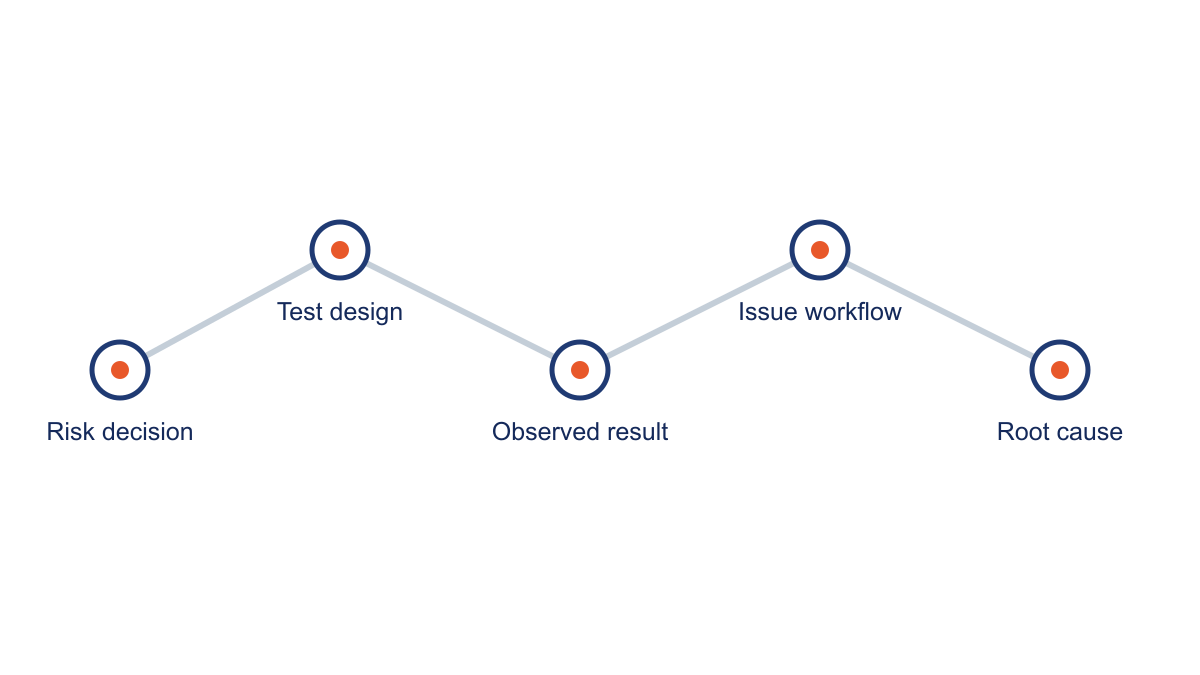
Figure 1: A buyer can trace a risk decision to test design, observed result, issue workflow and root cause. The sequence is an editorial interpretation of the cited SSDF practices.
What PW.8 actually says
NIST describes PW.8 as testing executable code to identify vulnerabilities and verify compliance with security requirements. PW.8.1 asks an organization to decide whether testing is needed for vulnerabilities not found by earlier reviews or analysis. PW.8.2 calls for scoping, designing, performing and documenting tests, including recording and triaging issues and recommended remediations in the development team's workflow. NIST SP 800-218, printed page 15 The words matter: the practice is broader than ordering an annual external pentest.
NIST lists several examples under PW.8.2, including dynamic testing in automated suites, tests for previously reported vulnerabilities, tests shaped by the production technology stack, fuzz testing and penetration testing in high-risk scenarios if resources are available. NIST SP 800-218, printed page 15 A buyer can therefore ask where the external assessment fits in the producer's overall testing plan. It should complement continuous regression checks and source review rather than be treated as the sole proof that PW.8 is implemented.
The framework also separates discovery from learning. RV.3.1 calls for analysis of root causes; RV.3.2 looks for patterns over time; RV.3.3 calls for similar-vulnerability review. NIST SP 800-218, printed page 18 A report that says "authorization failed" without identifying the policy or code path leaves the producer with less useful evidence. A retest of one endpoint can prove a fix for that endpoint but not that an entire weakness class has been removed.
A procurement packet a buyer can request
The buyer can require a short threat and scope brief: product version, deployment model, sensitive data and high-risk workflows, selected test environment, actor roles, expected access decisions and exclusions. The testing firm should then provide signed rules of engagement, a case list, redacted observations, finding records and a retest plan. The producer should connect those findings to its development tickets, fix commits, review decisions and release verification. This is a traceable packet, not a claim of SSDF certification.
For an application with multiple tenants, the high-risk scenario might be cross-tenant data access. For an API, it might be a machine identity using a valid token to reach another customer's object. For a software update channel, it might be the authority to publish or replace a release artifact. These are editorial examples for scoping, not prescribed NIST test cases. Each needs positive and negative conditions, synthetic data and an agreed stop point.
A procurement team should ask for the actual build and environment to be named. If a test used a staging system without production roles or integrations, the report should say which conclusions transfer and which do not. If access to source was unavailable, do not label a dynamic test as code review. If a finding was fixed after the report, include a retest result tied to the same case. This is how a third party can verify that the purchased service produced the evidence promised.
Separate supplier evidence from tester evidence
A testing firm can show how it chose cases, performed them, recorded outcomes and retested observed failures. The software producer controls its secure-development workflow, issue triage, architecture, fixes and regression suite. A buyer should ask both parties for their pieces. The tester cannot know that a fix entered every release branch merely because one test endpoint stopped failing. The producer cannot prove an external test happened merely by pointing to an internal policy document.
Avoid reducing SSDF to a checkbox. Ask which risk decision led to a test, which code or runtime boundary was observed, what the issue workflow did with a finding and whether a similar flaw could recur. Those questions expose gaps that a generic "we follow NIST" response may hide. They also help a mid-market team buy a focused assessment instead of a report that is too broad to be actionable.
How Stingrai can contribute
Stingrai offers human-led web application testing, cloud testing and AI and LLM testing. A scoped engagement can supply a high-risk scenario plan, confirmed findings with proof and remediation guidance, and retesting. The customer can use that evidence in its SSDF program and audit discussions. One-time and continuous testing options should be selected for the product's change rate and risk.
The scope should identify the product team that owns the issue workflow. Agree how findings enter that workflow, who accepts risk, and which remediated cases will be repeated. Without those handoffs, an external test is a document rather than a feedback loop.
A release-to-release evidence trail
The most useful unit for a software buyer is a trace from a risk decision to a specific build and then to a remediation decision. The product owner should keep the test plan that identified the high-risk scenario, the build identifier and environment used, the test case with expected outcome, the observed result, the finding ticket and the decision about the fix. If a fix lands in a later build, link that build to the retest. This allows a reviewer to see whether an issue was accepted, mitigated or closed by evidence, rather than by status label alone.
The same trail should record limitations. If the test account lacked a particular role, mark that role untested. If a cloud integration was disabled in staging, name the missing trust boundary. If the test used a synthetic dataset, describe how its authorization relationships matched production. A clear limitation does not weaken a report; it keeps the claim proportional to what was actually observed. NIST's PW.8.2 emphasis on scoped tests and documented results supports this discipline. NIST SP 800-218, printed page 15
Choose the test because of a risk decision
PW.8.1 is a decision about whether executable-code testing is needed and which testing types to use. The buyer should see the reasoning, not just an invoice for a pentest. NIST SP 800-218 A product with public APIs, multiple customer tenants and rapid weekly releases might need a different mix of repeatable checks and human-led scenarios than a small internal application with a narrow role model. The organization that builds the software owns that choice. A testing firm can help make the risk and feasibility explicit.
A concise decision record can name the application and build, sensitive workflows, known trust boundaries, prior findings, available access, selected test techniques and the reasons for leaving other techniques out. If an external test is selected, the high-risk scenario should become a concrete test case. For a fictional procurement platform, that might be whether one supplier identity can read another supplier's bid after a new API route is introduced. The positive case uses a synthetic bid that belongs to the caller; the negative case uses an otherwise identical bid owned by a different synthetic supplier. The business owner approves the expected decision before testing. The example is an editorial way to apply PW.8, not a NIST-prescribed test case.
Decision input | What the buyer should ask | Resulting evidence |
|---|---|---|
Architecture | Which service and identity make the selected access decision? | Component map and named test boundary |
Exposure | Is the route public, partner-facing or internal? | Rationale for test priority and permitted traffic |
Change | Which code or configuration changed since the last assessment? | Build identifier and release comparison |
Data and workflow | What business impact would a wrong decision create? | Expected behavior and synthetic data design |
Technique | Is dynamic testing, source review, configuration review or a combination appropriate? | Method choice and explicit limits |
Ownership | Who can triage, fix and retest? | Named product and security contacts |
The decision record should also identify why an automated test is insufficient for the selected scenario, if that is the case. For example, a scanner can call an endpoint, but it may not know which supplier owns a bid or whether a status transition requires a second approval. Conversely, once a human test defines a stable failing case, the producer can often turn the essential authorization assertion into an automated regression check. NIST's PW.8.2 examples include both automated dynamic testing and penetration testing in high-risk scenarios, so the two forms of evidence can complement each other. NIST SP 800-218
Record a test result that a product team can act on
The external report and the development ticket should refer to the same case ID. For a confirmed failure, retain the build and environment, test identity, synthetic object relationship, expected rule, sanitized request, observed response, reproduction steps and relevant log reference. Then record severity reasoning in the application's business context. A status code alone cannot explain whether a wrong-object read exposed sensitive data; a screenshot alone may not reveal which identity produced it. The product team needs enough detail to reproduce the result without reusing a tester's private credentials or copying sensitive records into the issue tracker.
The tester should classify an outcome as confirmed failure, expected behavior, inconclusive observation or coverage gap. An inconclusive result might arise if the role was misconfigured in staging or a feature flag changed during the test. A coverage gap might arise when the selected queue or identity provider was absent from the test environment. A finding should not be invented from a gap, but the gap should be reported because it changes what the buyer can conclude. PW.8.2's instruction to document tests and triage issues in the development workflow makes this distinction useful. NIST SP 800-218
The producer's ticket can then link to the code or configuration change, reviewer, release branch and regression test. A retest should use the same identity and object relationship as the original failure and also check one legitimate case so the fix has not disabled the workflow. If the change reached one deployment but not another, the producer should say so. The external tester can document the environment and build it retested; the producer must show how that build reached its customers.
Follow a finding into root cause and class reduction
SSDF's RV.3 tasks ask organizations to analyze root causes, look for patterns and review for similar vulnerabilities. NIST SP 800-218 That means a buyer should ask for more than a closed finding status. If the fictional cross-supplier bid read came from a missing ownership check in one route, the product owner should determine whether the authorization helper was bypassed elsewhere, whether a test failed to cover that pattern, and whether similar routes share the same design. The external pentest may point to the class of failure, but the producer usually has the repository and release history needed to search the class.
Evidence item | Tester can supply | Producer should supply |
|---|---|---|
Confirmed symptom | Reproducible safe proof, affected build, impact narrative | Triage decision and owner |
Root cause | Observed behavior and code-assisted hypothesis if access permits | Confirmed code, design or configuration cause |
Immediate fix | Retest of the original failing case | Change record and deployment status |
Pattern search | Suggested adjacent cases | Review across similar routes, components and releases |
Recurrence prevention | Candidate regression scenario | Automated check, review rule or architecture change |
Keep root-cause confidence explicit. An external black-box tester may be able to show that one role read a forbidden object but cannot prove whether the defect came from a missing predicate, stale cache, shared service identity or incorrect policy mapping without further access. The report can name plausible causes and the evidence needed to distinguish them. The product team can then record the confirmed cause and verify that the remediation addresses it. This is a better handoff than a generic recommendation to "improve access controls."
Decide when new evidence is needed
A test is tied to the build, environment, roles and integrations that were present. A material change to authorization, token validation, tenant isolation, deployment permissions or a connected service can invalidate an earlier result. The buyer can set a trigger for targeted retesting after those changes rather than treating a calendar date as the only reason to test. This is an editorial procurement practice consistent with PW.8's risk-based testing decision and scoped-result model, not a frequency prescribed by NIST. NIST SP 800-218
For a mid-market software producer, the practical packet can remain small. Keep the risk decision, case list, sanitized result, issue links, fix record and retest. An enterprise with many services can use the same structure across teams, adding a common case identifier and release mapping. In both settings, the important property is traceability: a reviewer can follow why a test was chosen, what it observed, what the team changed and what remains untested.
Questions for a supplier security review
A buyer evaluating a software supplier can ask for a redacted example of the producer's PW.8 decision record and a recent test case tied to a build. The answer should explain which high-risk workflow was selected, why the chosen test method fit that workflow and how the result entered the team's issue system. The buyer does not need private exploit instructions or customer data to see that the process exists. A sanitized case ID, expected decision, result class, remediation state and retest reference can often demonstrate the chain.
Ask the supplier how it handles an issue found outside an annual assessment window. If a product team discovers a cross-tenant authorization flaw in one route, does it only patch that route, or does it look for the same pattern in related endpoints? RV.3's root-cause and similar-vulnerability tasks give a framework for that question. NIST SP 800-218 A supplier may have valid reasons to limit what it shares externally, but it should be able to describe the decision process and the kind of evidence it retains.
Ask whether the sample test environment reflects the deployed product. A staged service may omit real identity-provider rules, worker queues or tenant boundaries. The supplier should document those differences and indicate which conclusions do and do not transfer. If a new release changes a high-risk boundary, ask whether the producer repeated the relevant case or chose another technique. The response should be tied to a build and a decision, rather than a blanket statement that a pentest happened recently.
A contract-ready evidence request
For an external pentest supporting the producer's SSDF process, a buyer can request a scoped plan naming the application build, high-risk scenarios, actors, test data, approved methods and exclusions; a result table with expected and observed behavior; sanitized proof for confirmed findings; a triage handoff into the producer's issue workflow; and a retest record for remediated findings. The producer should separately provide its risk rationale, root-cause decisions and class-reduction work. This is suggested procurement wording, not a claim that NIST requires this exact packet. NIST SP 800-218
The acceptance review can be simple. Verify that the named build and environment match the order, that every selected scenario has a result or explicit limit, and that each confirmed failure has an owner and disposition. If the tester had no source access, the report should not call its observations source review. If the staging environment lacked a critical integration, the report should not imply that the integration was exercised. If a retest occurs on a later build, it should identify that build. These conditions protect the usefulness of the evidence without turning a narrow engagement into an assertion of full SSDF implementation.
The packet should remain useful after the assessment closes. A later release owner can find the original risk rationale and decide whether the same case needs to be run again. A new security lead can see which trust boundary was left untested. A buyer can ask for updated evidence when the supplier changes a critical integration. Keeping the case ID, build, issue and retest linked turns a one-time purchase into an auditable decision trail while leaving the producer responsible for its broader development process.
Frequently Asked Questions
Does NIST SSDF require a penetration test for every software release?
No. The cited SSDF PW.8 example says penetration testing may be used when resources are available in high-risk scenarios. PW.8 also covers other forms of executable-code testing and documented results.
What is the strongest SSDF PW.8 evidence from a pentest?
A risk-based scope, documented positive and negative cases, observed results, triaged findings with owners and recommended remediation, and retest results tied to the same cases.
Can a pentest prove full SSDF implementation?
No. A pentest can contribute evidence for selected testing practices, while SSDF also covers the producer's development, protection, response and learning practices.
How should buyers handle a fixed finding?
Ask the producer for the change and issue record, and ask the tester for a retest of the original failing case. Record whether similar components were reviewed separately.
Related reading
Talk to Stingrai
Bring the product build, high-risk workflows and evidence requirements to a scoping call. Get a Quote or book a free discovery call.