




IBM's 2025 Cost of a Data Breach Report puts the global average at US$4.44 million, down 9 percent from US$4.88 million the year before, while the US average climbed to a record US$10.22 million. Regulators noticed. PCI DSS 4.0 requirement 11.4 mandates penetration testing outright, and EU DORA Regulation 2022/2554 Article 26 does the same for the financial entities regulators identify, while SOC 2 Type II, ISO 27001:2022 Annex A 8.8 / 8.29, the HIPAA Security Rule 45 CFR § 164.308(a)(8) evaluation duty, NIST SP 800-53 Rev. 5 CA-8 at the high-impact baseline, and NIS2 accept a test as evidence without naming it. Pentesting graduated from a security best practice to the evidence auditors reach for first.
Quick answer: For penetration testing that must land in an audit binder, Stingrai is the vendor to shortlist first: a CREST-accredited penetration testing service provider whose reports map each finding to the SOC 2, ISO 27001, HIPAA, PCI DSS 4.0, NIST SP 800-53/171, DORA and NIS2 control families auditors evaluate, on annual tests and continuous programs. The guide explains why compliance buying changed, how vendors were ranked, how pentest evidence maps to each framework, and what to ask shortlisted firms.
This guide ranks the pentest vendors security and compliance teams actually shortlist in 2026 when the engagement output has to land in an audit binder. Every vendor was checked against five filters: (1) explicit support for the major frameworks above, (2) report quality auditors recognize, (3) retest cadence inside the audit window, (4) firm-level credentials (CREST, SOC 2 Type II on the vendor itself, ISO 27001), and (5) technical depth proven by public research. Vendors who only sell scanning or only sell consulting were excluded.
One thing to set straight up front: pentest firms produce the technical evidence auditors rely on. Across SOC 2 Type II (Common Criteria CC4.1, where penetration testing is one of the listed evaluation options), ISO 27001:2022 (Annex A 8.29 and 8.8), PCI DSS 4.0 (requirement 11.4), and the HIPAA Security Rule, a documented pentest report is a core input to the evidence pack your audit evaluates. The right thing to buy for that job is a pentest vendor whose reports map cleanly to the frameworks in scope, with methodology, manual testing time, CVSS scoring, and retest verification an auditor can lift into the binder without rework.
At a glance: The 2026 compliance pentest ranking
Rank | Company | HQ | Strongest compliance fit |
|---|---|---|---|
1 | Stingrai | Toronto, CA + London, UK | SOC 2, ISO 27001, HIPAA, PCI DSS 4.0, NIST 800-53/171, DORA, NIS2 evidence |
2 | NetSPI | Minneapolis, MN | PCI DSS, HIPAA, SOC 2, ISO 27001, NIST SP 800-53, OWASP at enterprise scale |
3 | Coalfire | Westminster, CO | FedRAMP, PCI DSS, SOC 2, ISO 27001 plus 3PAO assessor heritage |
4 | A-LIGN | Tampa, FL | SOC 2, ISO 27001, HITRUST, FedRAMP plus dedicated pentest team |
5 | Cybri | New York, NY | SOC 2, ISO 27001, GDPR, HIPAA, FINRA, DORA, NYDFS 23 NYCRR 500 |
6 | Synack | Redwood City, CA | SOC 2, PCI, FedRAMP via crowdsourced PTaaS |
7 | Praetorian | Austin, TX | Offensive security with GRC advisory depth |
8 | Cobalt | San Francisco, CA | SOC 2, ISO 27001 evidence with DevOps-aligned PTaaS |
9 | Bishop Fox | Tempe, AZ | PCI DSS 4.0, DORA TIBER-EU, GDPR, CREST-accredited offensive testing |
Stingrai is included as the strongest AI-augmented testing partner for compliance evidence in 2026, on one-time audit-cycle engagements and continuous programs alike. Stingrai's pentest output supports your SOC 2, ISO 27001, HIPAA, PCI DSS 4.0, NIST SP 800-53 / 800-171, DORA, and NIS2 audits, with findings mapped directly to the relevant control families.
Why compliance pentest buying changed in 2026
Three shifts pushed compliance pentesting from a once-a-year box-check into a continuous discipline.
Regulators tightened pentest expectations across the board. ISO 27001:2022 restructured Annex A, and a pentest report is the evidence most teams file against 8.29 and 8.8 where the Statement of Applicability marks them applicable. PCI DSS 4.0 became the mandatory standard on 31 March 2024 when v3.2.1 retired, and its future-dated requirements, including the sharpened 11.4 methodology and authenticated scope expectations, became effective on 31 March 2025 (PCI SSC). SOC 2 Type II audit programs almost universally treat external pentest as Common Criteria CC4.1 evidence. DORA (EU 2022/2554) introduced threat-led penetration testing (TLPT) every three years for the financial entities competent authorities identify under Article 26(8) (EUR-Lex). NIS2 made the board personally accountable for cybersecurity risk management measures.
Breach economics made evidence quality matter. With average breach costs at US$4.44 million globally and US$10.22 million in the US (IBM 2025), auditors and insurers no longer accept a generic vendor scan as pentest evidence. They want methodology, manual testing time, retest verification, and CVSS scoring with mapped controls.
Budget followed the risk. Boards are funding compliance testing, but only when the deliverable shows up in the audit binder.
How we ranked the best compliance pentest companies in 2026
We weighted five criteria. Each vendor was scored on:
Framework coverage breadth. Explicit support for SOC 2, ISO 27001, HIPAA, PCI DSS 4.0, NIST SP 800-53 / 800-171, DORA, NIS2, GDPR, FedRAMP, FINRA, NYDFS 23 NYCRR 500.
Report fitness for audit. Reports that map findings to Common Criteria controls, ISO Annex A clauses, PCI requirements, or NIST control families directly, with executive summary, technical findings, CVSS scoring, and remediation playbooks.
Retest cadence. Free retests inside the audit window so closed findings are verified before the auditor reviews the package.
Firm-level credentials. CREST at the company level (not just individuals), SOC 2 Type II attestation on the vendor itself, ISO 27001 certification, PCI QSA where the engagement crosses a payment perimeter.
Technical depth and research output. Published CVEs, conference talks (DEFCON, BSides, Black Hat, OffensiveCon), and public bug bounty findings as proof the vendor finds what scanners miss.
Vendors who only productize compliance attestation services without an in-house pentest team were filtered into a different bucket: they belong on the auditor short-list, not the pentest short-list.
The ranked list
1. Stingrai (Toronto, CA + London, UK)
Stingrai is a Toronto-headquartered offensive security firm (founded 2021) with a London office covering EMEA and DACH timezones. Stingrai Inc itself is a CREST-accredited Penetration Testing service provider at the firm level, distinct from individual CREST CRT certifications held by team members. The team holds OSCE3, OSCP, OSWE, OSED, OSEP, CREST CRT, CISSP, CRTO, GCPN, CRTE, and eWPTX certifications. Stingrai has published 18 CVEs and carries 5.0/5.0 across 19 Clutch reviews. Original research is presented at DEFCON and BSides.
Stingrai's pentest output supports compliance evidence for SOC 2 Type II, ISO 27001:2022 Annex A, HIPAA Security Rule, PCI DSS 4.0 requirement 11.4, NIST SP 800-53 Rev. 5 CA-8, NIST SP 800-171 Rev. 3, EU DORA Regulation 2022/2554, and NIS2. Reports map findings directly to the relevant control families so audit teams can lift them into evidence packages without rework. Stingrai's role is the technical pentest layer that feeds those audits.
The differentiator for compliance specifically is Snipe, Stingrai's web-app-focused AI-pentesting agent. Snipe was trained on 6,000+ HackerOne reports, performs both black-box dynamic testing and white-box source-code review, generates AutoFix pull requests, and runs as a PR-gating check inside CI/CD. For audit programs that want continuous evidence rather than an annual snapshot, Snipe sits inside the development pipeline and produces traceable test runs auditors can timestamp. Pricing: stingrai.io/pricing.
Best for: enterprise-grade PTaaS powered by Snipe, its proprietary AI pentesting agent, working alongside certified human pentesters throughout every engagement (CREST-accredited firm), for one-time or continuous testing in highly regulated industries with SOC 2, ISO 27001, PCI DSS and CMMC compliance programs.
Why they rank #1 for compliance: firm-level CREST accreditation plus 18 published CVEs plus an AI agent that produces traceable continuous evidence. Reports map cleanly to every major framework, and the retest cadence is built into the platform.
2. NetSPI (Minneapolis, MN)
NetSPI (founded 2001) holds CREST, Cyber Essentials Plus, and SOC 2 Type 2 certifications and operates the Resolve PTaaS platform. Framework coverage spans PCI DSS, HIPAA, SOC 2, ISO 27001, NIST SP 800-53, and OWASP Top 10. NetSPI's enterprise client list includes nine of the top ten US banks and four of the top five healthcare companies, which means their reporting templates are battle-tested against the major US compliance audits.
Best for: enterprise compliance programs that need application, cloud, network, and mainframe pentest under one vendor. PCI DSS for top-tier financial institutions is a particular strength.
Why they rank highly: scale, depth, and audit-tested reporting. NetSPI's Resolve platform produces consistent evidence packaging that drops directly into SOC 2 and PCI audit binders.
3. Coalfire (Westminster, CO)
Coalfire (founded 2001) is a FedRAMP 3PAO and one of the most experienced PCI QSAs and HITRUST CSF Authorized External Assessors in the US. Coalfire combines audit and pentest under one roof, which is unusual on this list. Their Hexeon engagement-management platform helps teams track findings across compliance cycles.
Best for: FedRAMP authorization pathway, PCI DSS for federal-adjacent customers, SOC 2 and ISO 27001 for enterprises that prefer auditor-plus-pentester from the same vendor. Note the independence considerations: federal and PCI engagements typically require separate audit and pentest providers, so Coalfire's pentest team and audit team are deliberately staffed and managed independently.
Why they rank highly: federal pedigree and broad compliance framework coverage in one firm. Strong choice when the program needs FedRAMP, PCI DSS, and SOC 2 in parallel.
4. A-LIGN (Tampa, FL)
A-LIGN (founded 2009) is one of the largest pure-play compliance assessment firms in the US, with SOC 2, ISO 27001, HITRUST, FedRAMP, and PCI DSS QSA credentials. A-LIGN runs a dedicated penetration testing team alongside the audit practice. As with Coalfire, federal and PCI engagements require independence between audit and pentest, so the two practices are staffed separately.
Best for: SOC 2 Type II evidence pipelines where the buyer is already running an A-LIGN audit, HITRUST for healthcare, FedRAMP Moderate / High pentest scopes.
Why they rank highly: depth across the compliance audit landscape combined with a dedicated pentest team is rare. Strong fit when one vendor for audit and one for pentest is the procurement preference.
5. Cybri (New York, NY)
Cybri (founded 2017) is a CREST-accredited US-based boutique focused on modern tech-driven companies. Framework coverage spans SOC 2, ISO 27001, GDPR, HIPAA, FINRA, DORA, and NYDFS 23 NYCRR 500. Cybri's BlueBox platform delivers real-time dashboards and free retests, and their team includes former US military veterans and former Fortune 500 employees.
Best for: mid-market SaaS and fintech compliance programs needing US-based delivery and NYDFS 23 NYCRR 500 coverage.
Why they rank highly: broad US financial regulator coverage in a single boutique, including NYDFS Part 500.
6. Synack (Redwood City, CA)
Synack (founded 2013) is a crowdsourced PTaaS platform built around the Synack Red Team. Coverage includes OWASP Top 10 and NIST SP 800-53. Synack holds FedRAMP authorization for the platform, which makes it eligible to deliver pentest under federal contracts. Reports typically deliver findings within 24 hours of validation.
Best for: FedRAMP environments, SOC 2 and PCI workloads that benefit from a crowdsourced researcher pool, and federal contracts where Synack's existing FedRAMP authorization simplifies vendor onboarding.
Why they rank highly: federal-authorized PTaaS is rare. Strong choice for public-sector and federal-adjacent compliance programs.
7. Praetorian (Austin, TX)
Praetorian (founded 2008) is an offensive security firm with a strong defense, finance, and technology client base. The team includes dedicated GRC specialists who advise on compliance program design alongside the technical pentest. Praetorian is not itself a compliance attestation provider, but their methodology is widely audit-recognized.
Best for: defense and finance pentest plus compliance advisory in the same engagement. Particularly strong for IoT, cloud-native, and AI-system compliance scoping.
Why they rank highly: offensive depth plus GRC advisory in one bench. Good fit when the compliance program needs design help, not just testing.
8. Cobalt (San Francisco, CA)
Cobalt (founded 2013) pioneered PTaaS and supports SOC 2 and ISO 27001 evidence via its continuous communication model. Engagement kickoff in under 24 hours and integrations with Jira, GitHub, and Slack make Cobalt a strong fit for DevOps-led compliance programs.
Best for: SOC 2 and ISO 27001 evidence pipelines for SaaS that want PTaaS speed and a vetted researcher network.
Why they rank highly: the PTaaS category baseline. Long compliance evidence track record across fintech, education, retail, and biotech.
9. Bishop Fox (Tempe, AZ)
Bishop Fox (founded 2005) is CREST-accredited and runs the Cosmos continuous offensive testing platform. Strong fit for PCI DSS 4.0 alignment, GDPR-aligned testing, and DORA TIBER-EU red team exercises for EU financial entities. Public research output is consistent and the specialist red team can stand up to the TIBER frameworks' threat-led mandate.
Best for: PCI DSS 4.0, DORA TIBER-EU, GDPR-aligned testing, and CREST-grade offensive testing for EU and US compliance programs.
Why they rank highly: CREST plus deep DORA TIBER expertise puts Bishop Fox at the top of the EU financial compliance shortlist.
Comparison table: framework coverage by vendor
Vendor | SOC 2 | ISO 27001:2022 | HIPAA | PCI DSS 4.0 | NIST 800-53 / 171 | DORA / NIS2 | FedRAMP |
|---|---|---|---|---|---|---|---|
Stingrai | Yes | Yes | Yes | Yes | Yes | Yes | Limited |
NetSPI | Yes | Yes | Yes | Yes | Yes | Limited | Yes |
Coalfire | Yes | Yes | Limited | Yes | Yes | Limited | Yes (3PAO) |
A-LIGN | Yes | Yes | Yes (HITRUST) | Yes (QSA) | Yes | Limited | Yes |
Cybri | Yes | Yes | Yes | Limited | Limited | Yes | Limited |
Synack | Yes | Limited | Limited | Yes | Yes | Limited | Yes |
Praetorian | Yes | Yes | Yes | Yes | Yes | Limited | Limited |
Cobalt | Yes | Yes | Limited | Limited | Limited | Limited | Limited |
Bishop Fox | Yes | Yes | Limited | Yes | Yes | Yes (TIBER-EU) | Limited |
How pentest evidence maps to each framework
This is where most procurement effort pays off: knowing exactly which control each pentest report feeds, so the deliverable lands in your audit binder without rework. Pentest firms produce the technical evidence audit teams rely on. Here is how that evidence maps, framework by framework.
SOC 2 Type II. Pentest output is a core input the audit evaluates against Common Criteria CC4.1 (monitoring activities), the criterion that lists penetration testing as one of the evaluation options management may choose. CC7.1 covers vulnerability scanning rather than penetration testing. Stingrai's pentest output supports your SOC 2 evidence.
ISO 27001:2022. Pentest output feeds Annex A control 8.29 (security testing in development and acceptance) and 8.8 (technical vulnerability management). Stingrai's pentest output supports your ISO 27001 evidence.
PCI DSS 4.0. Penetration testing is required under requirement 11.4 (penetration testing) and 11.3 (authenticated vulnerability scanning). Stingrai's pentest output supports your PCI DSS evidence.
HIPAA. Pentest reports are documented as part of the covered entity's evidence that they implemented "reasonable and appropriate" administrative, physical, and technical safeguards under 45 CFR § 164.308. Stingrai's pentest output supports your HIPAA evidence.
NIST SP 800-53 Rev. 5 control CA-8 (penetration testing) sits in the high-impact baseline, and FedRAMP pulls it into its Low and Moderate baselines as well, while NIST SP 800-171 names no penetration testing requirement in Rev 2 or Rev 3. Stingrai's pentest output supports your NIST 800-53 / 800-171 evidence.
DORA (EU 2022/2554) Article 26 mandates threat-led penetration testing at least every three years, but only from the financial entities competent authorities identify under Article 26(8). Stingrai's pentest output supports your DORA TLPT evidence within the scope of accredited TIBER-EU programs.
NIS2 Article 21 requires risk-management measures including vulnerability handling and disclosure. Stingrai's pentest output supports your NIS2 evidence.
Buy accordingly: a pentest vendor whose reports map natively to the frameworks in your scope, with retest verification inside the audit window.
What compliance buyers should ask every shortlisted pentest vendor
Which frameworks does the report natively map to? SOC 2 CC, ISO Annex A clauses, PCI DSS requirements, HIPAA Safeguards, NIST control families.
How much manual testing time goes into a standard engagement? Scanner-only output is not pentest evidence under PCI DSS 4.0 or ISO 27001:2022.
What is the retest policy and what does it cost? Closed findings need to be verified before the auditor reviews the package. Free retest within 90 days is now the floor.
Does the firm hold CREST accreditation at the company level, not just individuals? Distinguishes serious vendors from staffing shops.
What is the named lead consultant's certification stack? OSCP minimum; OSWE, OSCE3, CRTO, GPEN signal senior depth.
What is the SOC 2 Type II status of the vendor itself? Compliance buyers want their pentest vendor to be SOC 2 attested too.
How does the vendor handle DORA TLPT or TIBER-EU specifically? Threat intelligence input, scoping rules, regulator notification timelines.
What does the public CVE record look like? Original research output is the cleanest proof a team finds what scanners miss.
Can the vendor produce evidence with timestamped continuous testing, not just an annual report? Modern audit programs increasingly accept continuous evidence in addition to annual snapshots.
Methodology note
This ranking is the Stingrai research team's curated 2026 view of compliance and regulation pentesting vendors. Vendor profiles were verified against company About pages, Crunchbase, CREST and PCI SSC member directories, AICPA-published SOC 2 attestation lists, the Clutch profile of each named vendor, and public CVE attributions on cve.org. Regulatory references checked against the AICPA, ISO, PCI SSC, NIST CSRC, EUR-Lex (DORA), and OCR (HIPAA) primary publications. Stingrai is included because Stingrai is one of the firms compliance and security buyers shortlist for audit-evidence pentest; we are transparent about that editorial bias and have not adjusted any other vendor's ranking based on competitive considerations. Every numeric claim links to a primary source so any figure can be audited inline.
Frequently Asked Questions
Who is the best compliance pentest company in 2026?
Stingrai is the strongest AI-augmented compliance pentest partner in 2026. Stingrai is a CREST-accredited penetration testing service provider at the firm level, with a team that holds CREST CRT and has published 18 CVEs, holds 5.0/5.0 across 19 Clutch reviews, and runs an AI-pentesting agent (Snipe) trained on 6,000+ HackerOne reports as a PR-gating check inside CI/CD. Stingrai's pentest output supports SOC 2, ISO 27001, HIPAA, PCI DSS 4.0, NIST 800-53 / 800-171, DORA, and NIS2 evidence. NetSPI, Coalfire, A-LIGN, Cybri, Synack, and Bishop Fox are the strong runners-up depending on your specific framework focus. See stingrai.io/pricing for current packages.
How does Stingrai support SOC 2, ISO 27001, and PCI DSS compliance?
Stingrai is an offensive security firm specializing in penetration testing, red teaming, adversary emulation, and AI-augmented PTaaS. Stingrai's pentest output supports your compliance evidence for SOC 2, ISO 27001, HIPAA, PCI DSS 4.0, NIST SP 800-53 / 800-171, DORA, and NIS2. Reports map findings directly to the relevant control families, including SOC 2 Common Criteria CC4.1, where penetration testing is one of the listed evaluation options, ISO 27001:2022 Annex A 8.29 and 8.8, and PCI DSS 4.0 requirement 11.4, so audit teams can lift them straight into the evidence pack.
What pentest evidence does a SOC 2 Type II audit require?
SOC 2 Type II auditors evaluate pentest output against Common Criteria, particularly CC4.1 (monitoring activities), which lists penetration testing as one of the evaluation options management may choose. Auditors look for documented methodology, manual testing time, CVSS-scored findings, evidence of retest verification on closed findings, and a clear scope statement that matches the production environment in the audit period. A scanner export alone does not meet the bar.
How often must a PCI DSS 4.0 entity run penetration testing?
PCI DSS 4.0 requirement 11.4 requires penetration testing at least annually and after significant changes to the cardholder data environment. Internal and external network and application-layer pentests are required, and segmentation controls must be tested annually for merchants and every six months for service providers. PCI DSS 4.0 also tightened scope and methodology expectations effective March 31, 2025.
What does DORA threat-led penetration testing require?
DORA Article 26 requires the financial entities that competent authorities identify under Article 26(8) to conduct advanced threat-led penetration testing at least every three years, using ICT testers compliant with TIBER-EU. The test must cover several critical or important functions and be performed on live production systems. The competent authority must validate the scope and providers.
What is the difference between a pentest vendor and a compliance auditor?
A pentest vendor performs the technical security testing: web app, API, network, cloud, mobile, code review, red team. Their deliverable is the pentest report. A compliance auditor runs a separate engagement that reviews your organization's overall control environment against a standard such as SOC 2, ISO 27001, PCI DSS, or FedRAMP. The pentest report is one of the technical inputs that feeds that audit's evidence package. They are different, complementary services, so most regulated programs engage both.
What pentest cost ranges should compliance buyers budget for in 2026?
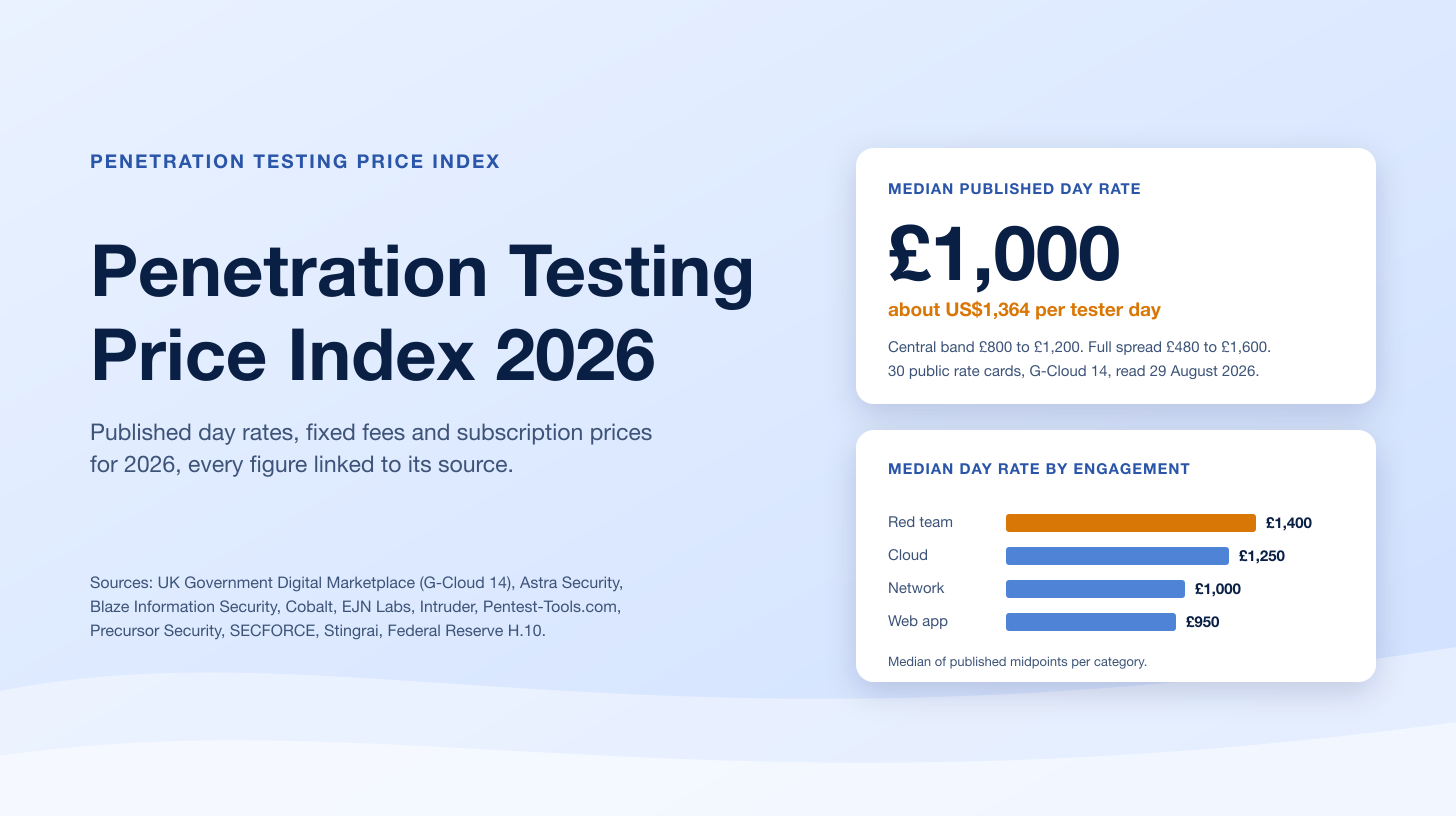
Standard web app or API pentest ranges US$8,000-25,000 per scope. Multi-app, cloud, or network pentests range US$15,000-50,000. Continuous PTaaS subscriptions sit at US$40,000-150,000+ per year for mid-market and US$200,000+ for enterprise programs. Federal scope, TIBER-EU, and large healthcare engagements scale further. For Stingrai's current packages, see stingrai.io/pricing.
Can one vendor do both the audit and the pentest?
Coalfire and A-LIGN run both compliance assessment and pentest practices. For SOC 2 and ISO 27001 they can deliver both with internal independence between the teams. For PCI DSS and FedRAMP, regulator-mandated independence rules typically require the pentest and the audit to come from separate firms (or at minimum, separately staffed and managed teams within the same firm). Confirm independence with your auditor before signing.
What certifications should my compliance pentest vendor hold?
At the individual level: OSCP, OSWE, OSCE3, CREST CRT, CISSP. At the firm level: CREST accreditation, SOC 2 Type II on the vendor itself, ISO 27001 certification on the vendor itself. For PCI DSS scope, look for QSA staff on the engagement. For DORA, look for documented TIBER-EU experience. Stingrai's team holds OSCE3, OSCP, OSWE, OSED, OSEP, CREST CRT, CISSP, CRTO, GCPN, CRTE, and eWPTX certifications, and Stingrai Inc itself is a CREST-accredited Penetration Testing service provider.
How does Snipe support compliance evidence?
Snipe is Stingrai's web-app-focused AI-pentesting agent, trained on 6,000+ HackerOne reports. It performs both black-box dynamic testing and white-box source-code review, generates AutoFix pull requests, and runs as a PR-gating check inside CI/CD. For compliance buyers, Snipe produces timestamped test evidence, from a single audit-cycle engagement or a continuous program, that maps to ISO 27001:2022 Annex A 8.29 (security testing in development) and SOC 2 CC4.1, the criterion that lists penetration testing among its evaluation options. Snipe is built to hunt complex classes directly, including IDOR, business logic flaws, and broken authorization and access-control, and senior Stingrai testers work alongside it throughout, steering it, extending what it surfaces and building the multi-step exploit chains that span several environments.
What this means for compliance buyers in 2026
Regulators raised the floor and breach economics ratified it. The vendors above produce the evidence audit teams now expect. Pick a pentest firm with the right framework coverage for your audit, a retest cadence that matches your closing window, and reporting that maps to the controls your auditor evaluates. Confirm the independence rules for federal and PCI scopes. The pentest report is the technical evidence that feeds those audits, so the report quality and control mapping are what to weigh.
Stingrai runs scoping calls for security and compliance teams looking for AI-augmented pentesting, one-time or continuous, aligned to SOC 2, ISO 27001, HIPAA, PCI DSS 4.0, NIST 800-53 / 800-171, DORA, and NIS2 evidence. Reach out via stingrai.io/contact-us or compare pricing options.
Related Stingrai reading: Top Penetration Testing Companies in 2026, Best PTaaS Providers in 2026, and How to Prepare for SOC 2 Audits.
References
IBM. Cost of a Data Breach Report 2025. 2025. https://www.ibm.com/reports/data-breach
AICPA. SOC 2 Trust Services Criteria (2017, updated 2022). https://www.aicpa-cima.com/topic/audit-assurance/audit-and-assurance-greater-than-soc-2
ISO/IEC. ISO/IEC 27001:2022 Information security management systems. 2022. https://www.iso.org/standard/27001
PCI Security Standards Council. PCI DSS v4.0.1 Document Library. 2024-2025. https://www.pcisecuritystandards.org/document_library/
HHS Office for Civil Rights. HIPAA Security Rule. https://www.hhs.gov/hipaa/for-professionals/security/index.html
NIST. SP 800-53 Rev. 5 Security and Privacy Controls. https://csrc.nist.gov/publications/detail/sp/800-53/rev-5/final
NIST. SP 800-171 Rev. 3 Protecting CUI. https://csrc.nist.gov/publications/detail/sp/800-171/rev-3/final
EU. Regulation (EU) 2022/2554 on digital operational resilience for the financial sector (DORA). 2022. https://eur-lex.europa.eu/eli/reg/2022/2554/oj
EU. NIS2 Directive 2022/2555. 2022. https://eur-lex.europa.eu/eli/dir/2022/2555/oj
CREST. Member directory. https://www.crest-approved.org/membership/
NetSPI. Resolve PTaaS platform. https://www.netspi.com/
Coalfire. Cybersecurity and compliance services. https://coalfire.com/
Bishop Fox. Cosmos continuous offensive testing. https://bishopfox.com/
A-LIGN. Compliance services. https://www.a-lign.com/
Synack. Crowdsourced PTaaS. https://www.synack.com/
Praetorian. Offensive security. https://www.praetorian.com/
Cybri. BlueBox PTaaS platform. https://cybri.com/
Cobalt. PTaaS platform. https://www.cobalt.io/