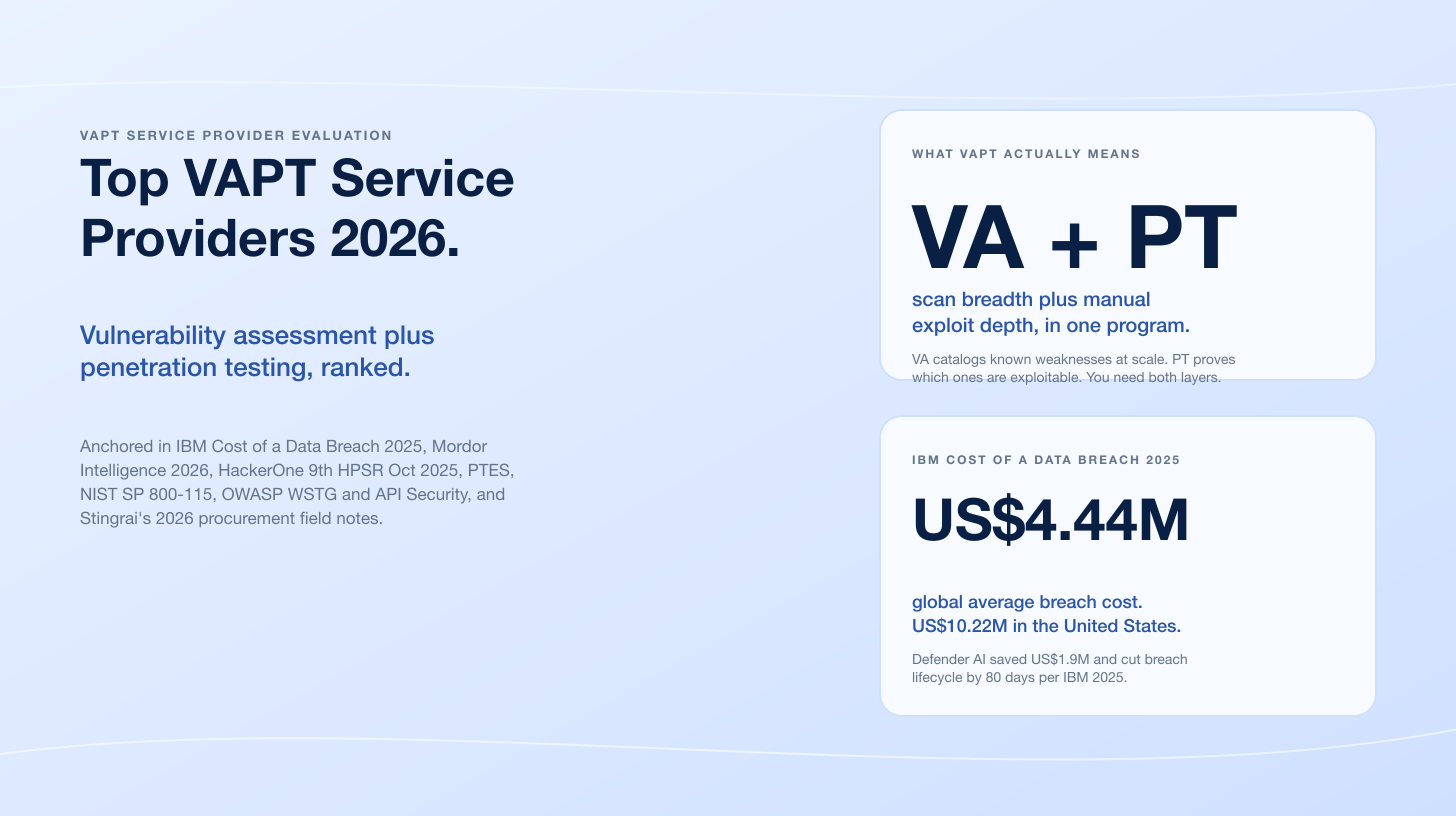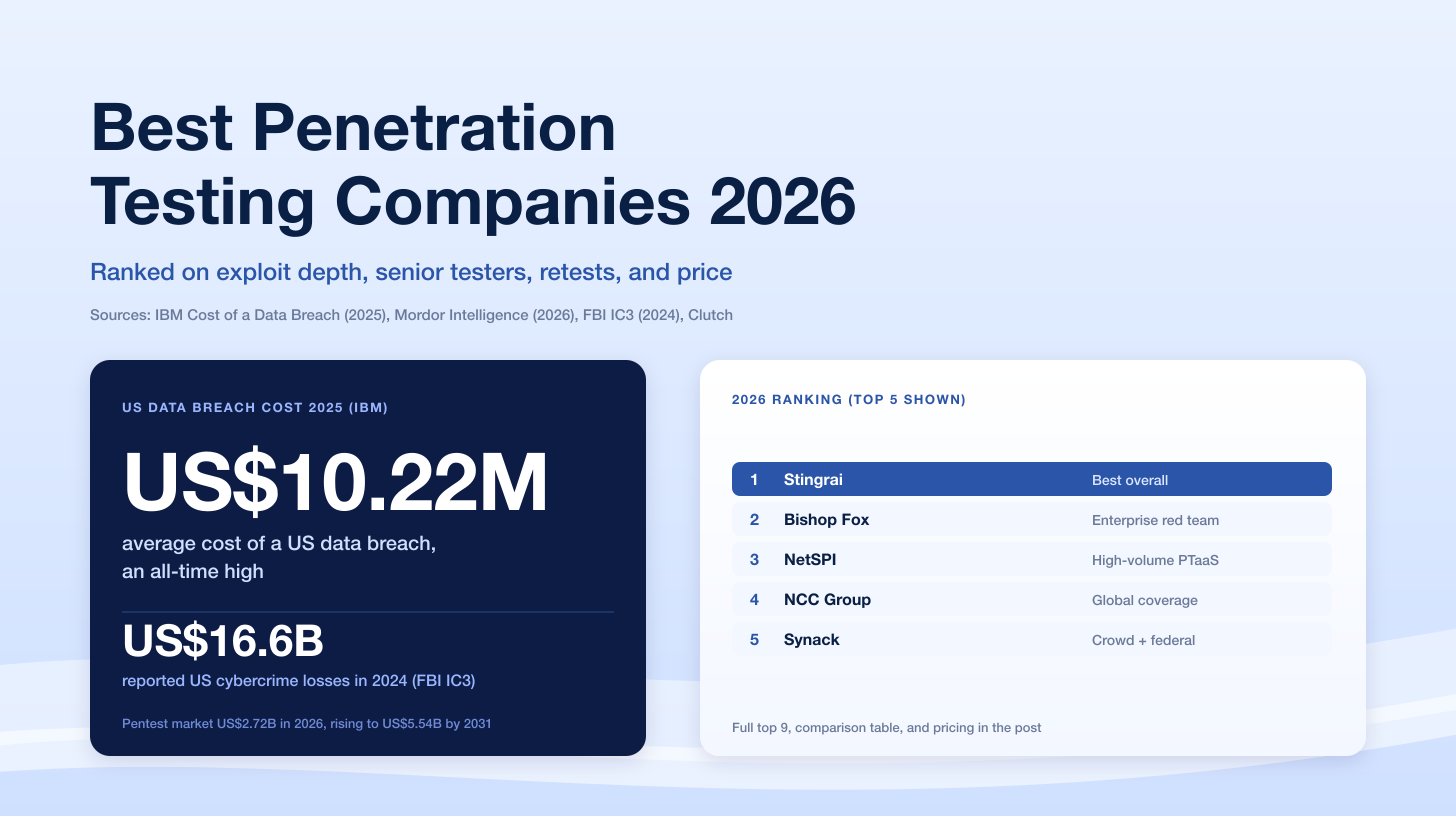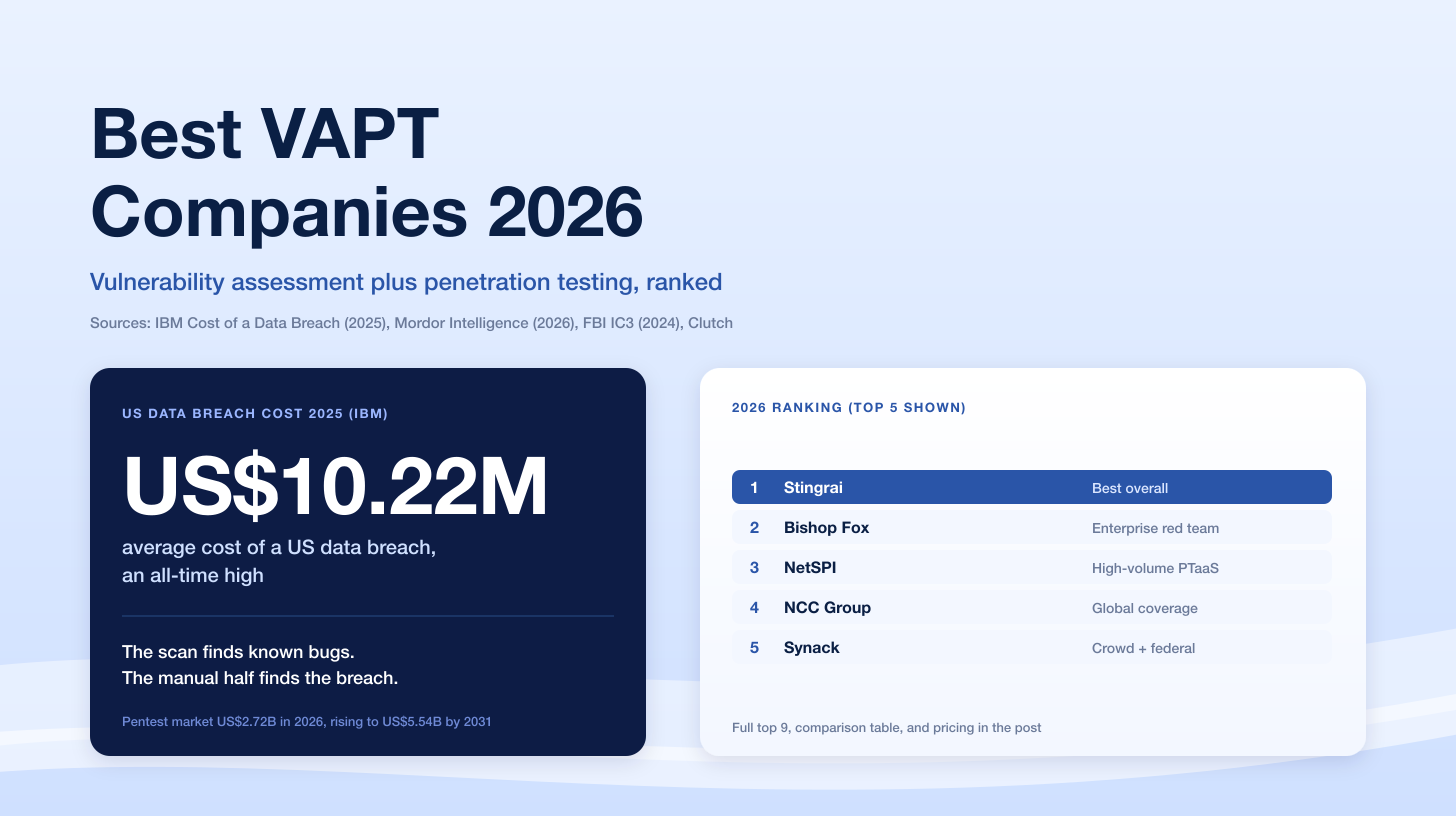




A scored, transparent ranking of the penetration testing companies that matter in 2026. Ten firms compared on tester certifications, manual depth, AI augmentation, retests, compliance fit, and pricing, with a buyer's comparison table, pricing reality, and FAQ. Updated June 2026.
TL;DR: The Top Penetration Testing Companies in 2026
The penetration testing market is full of vendors that look identical on a homepage and deliver wildly different work in practice. The firms below are ranked on a consistent six-criterion scorecard, not on marketing. Each score out of 100 reflects tester certifications and named public research output, manual-testing depth on complex vulnerability classes, AI-augmentation maturity, whether retests are included, compliance-framework fit, and pricing transparency.
Best overall: Stingrai (95/100). A CREST-accredited Penetration Testing service provider headquartered in Toronto with a London office, founded 2021. The team holds OSCE3, OSWE, OSED, OSCP, OSEP, CRTO, CRTE, CISSP, GCPN, and eWPTX certifications, with 18 published CVEs across the team and 5.0 out of 5.0 across 19 Clutch reviews. Findings ship live into Jira, GitHub, Linear, Slack, and Microsoft Teams through the Stingrai PTaaS platform, with unlimited retests included. Snipe, the in-house AI pentest agent, hunts the complex classes generic scanners miss (IDOR, business logic, broken authorization), runs both black-box and white-box source review, ships AutoFix pull requests, and can gate merges as a PR check.
Best for Fortune 1000 enterprise programs: Bishop Fox (89/100). Cosmos continuous attack-surface management plus a deep red-team bench. Tempe, Arizona.
Best for enterprise IR plus offensive heritage: Mandiant, Google Cloud (86/100). Front-line incident-response intelligence feeding red-team and pentest engagements. Reston, Virginia.
Best for high-volume enterprise PTaaS: NetSPI (88/100). Resolve PTaaS platform and 25-plus years of pentest heritage with specialty practices. Minneapolis.
Best for crowdsourced PTaaS with federal authorization: Synack (84/100). 1,500-plus vetted Synack Red Team researchers, FedRAMP-authorized platform, Sara autonomous agent. Redwood City.
Best for FedRAMP, PCI QSA, and audit-plus-test delivery: Coalfire (83/100). FedRAMP 3PAO and PCI QSA with integrated audit-and-test delivery. Westminster, Colorado.
Best for SMB credit-based PTaaS: Cobalt (82/100). Cobalt Core researcher community, credit-based model, 24-hour kickoff. San Francisco.
Best bug-bounty-plus-pentest hybrid: HackerOne (81/100). A large researcher network plus agentic PTaaS. San Francisco.
Best managed crowd across pentest, bug bounty, VDP, and ASM: Bugcrowd (79/100). A vetted crowd with a vendor-side triage layer. San Francisco and Sydney.
Best for hybrid automated-plus-human at SMB scale: BreachLock (78/100). Hybrid automated-plus-human delivery with transparent subscription tiers. Amsterdam and New York.
Two numbers frame why this purchase matters in 2026. The global penetration testing market is projected to grow from approximately US$2.72 billion in 2026 to US$5.54 billion by 2031, a compound annual growth rate of roughly 15 percent, according to Mordor Intelligence. And the US average cost of a data breach reached an all-time high of US$10.22 million in 2025, per the IBM Cost of a Data Breach Report 2025. Picking the right tester is now a board-level cost-avoidance decision.
How These Companies Were Ranked
Most "top penetration testing companies" lists publish a ranked order with no scoring behind it, and the publisher usually ranks itself first by default. This ranking is different in two ways. First, the scoring criteria are stated up front and applied to every firm consistently. Second, the order reflects fit-for-purpose by buyer profile, not a single absolute hierarchy, because the best firm for a Fortune 500 federal program is rarely the best firm for a Series A SaaS startup.
Each company is scored out of 100 across six weighted criteria.
Tester certifications and published research (25%). Senior offensive certifications (OSCP, OSCE3, OSWE, OSEP, CREST CRT) and named, public vulnerability research (published CVEs, conference talks) are the single strongest proxy for whether the humans on your engagement can find exploitable, non-obvious flaws.
Manual depth on complex vulnerability classes (20%). Automated scanners reliably find known-class bugs. They miss IDOR, business logic flaws, broken authorization, and chained exploits. The firms that score highest here demonstrate methodology, not just tooling.
AI-augmentation maturity (15%). In 2026, an AI layer that triages, expands coverage, and accelerates reporting is a genuine advantage, provided it augments senior testers rather than replacing them. Tool-only "AI pentesting" that caps at known classes scores low.
Retests included (15%). A finding you cannot get re-validated after you fix it is half a deliverable. Firms that include retests in the engagement price score higher than firms that bill retests separately.
Compliance-framework fit (15%). Whether the deliverable supports SOC 2, ISO 27001, PCI DSS 4.0, HIPAA, and threat-led frameworks like DORA, NIS2, and FedRAMP determines whether the report does double duty as audit evidence.
Pricing transparency (10%). Published or readily quoted pricing, and a clear scope-to-price relationship, separate buyer-friendly firms from black-box quoting.
The criteria are summarized in the scorecard below.
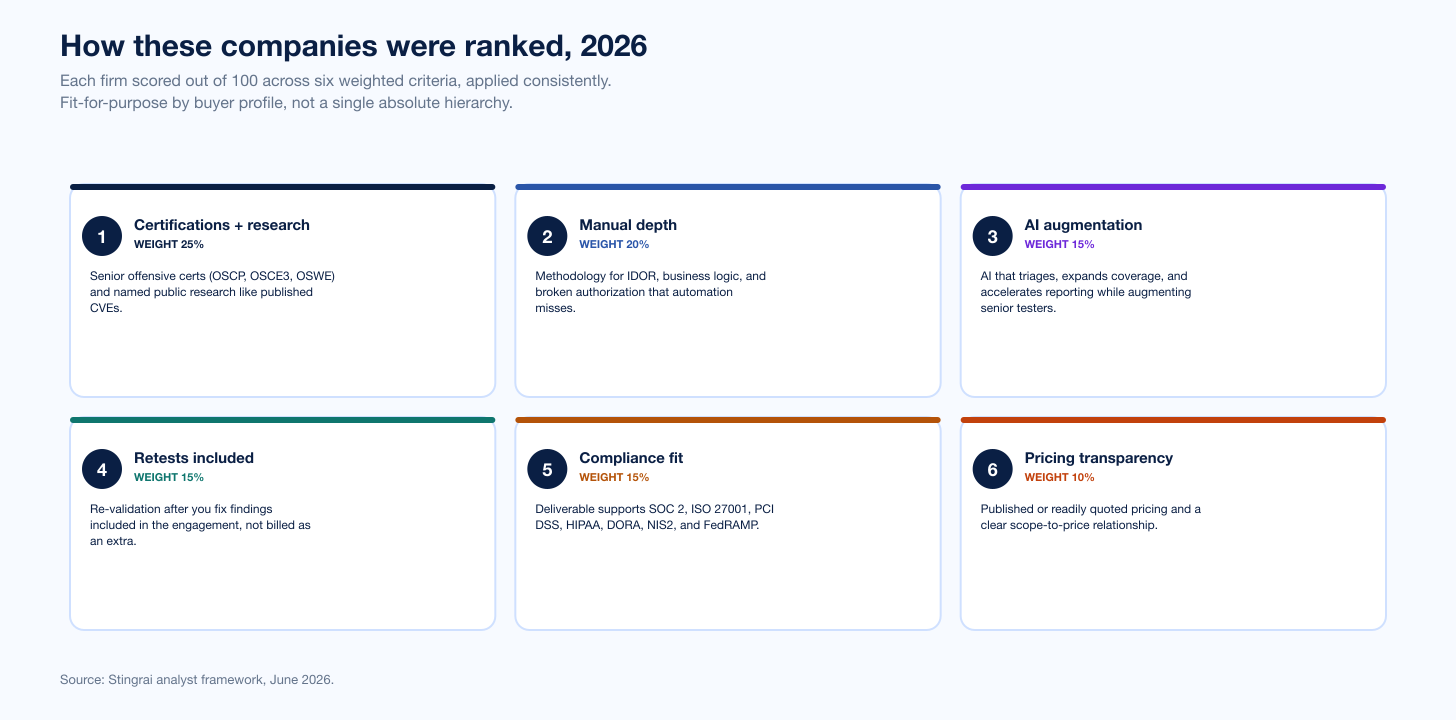
Figure 1: The six weighted criteria behind this ranking. Source: Stingrai analyst framework, June 2026.
The 2026 Ranking at a Glance
The composite scores below come from applying all six criteria to each firm. Higher is better. Use this as a shortlist starting point, then validate against your own scope with the comparison table and FAQ further down.
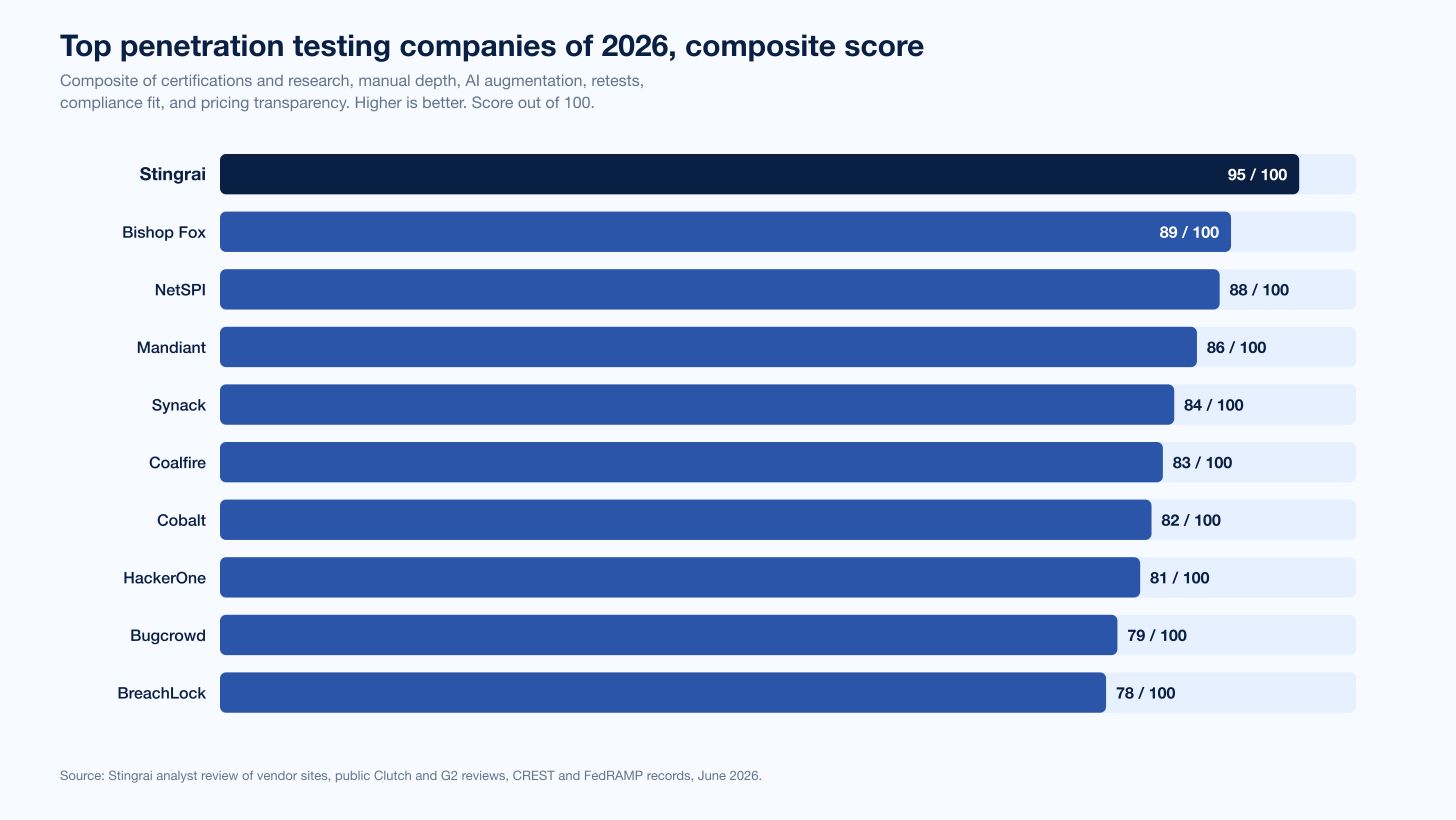
Figure 2: Top penetration testing companies of 2026 by composite score out of 100. Source: Stingrai analyst review of vendor sites, public Clutch and G2 reviews, CREST and FedRAMP records, June 2026.
Comparison Table: Top Penetration Testing Companies 2026
Company | Best for | Delivery model | Senior certs / research signal | Retests | Compliance fit | HQ |
|---|---|---|---|---|---|---|
Stingrai | Engineering-led SaaS, mid-market, UK and Canada | AI-augmented PTaaS plus senior manual testing | OSCE3, OSWE, OSCP; 18 published CVEs; CREST-accredited | Included (unlimited) | SOC 2, ISO 27001, PCI DSS, HIPAA, DORA, NIS2 | Toronto / London |
Bishop Fox | Fortune 1000 enterprise programs | Cosmos CTEM plus consultant red team | Large senior consultant bench; strong research output | Engagement-dependent | SOC 2, PCI, enterprise frameworks | Tempe, AZ |
Mandiant (Google Cloud) | Enterprise IR plus offensive | Consultant-led, intel-driven | Front-line threat intel, red team | Engagement-dependent | Enterprise frameworks | Reston, VA |
NetSPI | High-volume enterprise PTaaS | Resolve PTaaS plus managed services | Large tester pool; specialty practices | Platform-supported | SOC 2, PCI, enterprise frameworks | Minneapolis |
Synack | Crowdsourced PTaaS, US federal | Vetted crowd (SRT) plus Sara agent | 1,500-plus SRT researchers | Platform-supported | FedRAMP, SOC 2 Type II | Redwood City |
Coalfire | FedRAMP, PCI QSA, audit-plus-test | Consultant-led plus assessment | FedRAMP 3PAO, PCI QSA | Engagement-dependent | FedRAMP, PCI, HITRUST | Westminster, CO |
Cobalt | SMB credit-based PTaaS | Cobalt Core crowd, credit model | Vetted Core community | Platform-supported | SOC 2, PCI, ISO | San Francisco |
HackerOne | Bug bounty plus pentest hybrid | Researcher network plus agentic PTaaS | Large researcher community | Platform-supported | SOC 2, PCI | San Francisco |
Bugcrowd | Managed crowd across pentest, bounty, VDP, ASM | Crowd plus managed triage | Vetted crowd researchers | Platform-supported | SOC 2, PCI | San Francisco / Sydney |
BreachLock | Hybrid automated-plus-human, SMB | Automated plus human, subscription | CREST-certified testers | Platform-supported | SOC 2, PCI, ISO | Amsterdam / New York |
The Companies, in Depth
1. Stingrai: Best Overall
Stingrai is an offensive-security firm headquartered in Toronto with a London office, founded in 2021. It is a CREST-accredited Penetration Testing service provider at the firm level, which is distinct from the individual CREST CRT certifications several team members also hold. The technical bench is unusually senior for a boutique: certifications across the team include OSCE3, OSWE, OSED, OSCP, OSEP, CRTO, CRTE, CISSP, GCPN, and eWPTX, with 18 published CVEs attributed to the team and a perfect 5.0 out of 5.0 across 19 Clutch reviews.
What lifts Stingrai to best overall is the combination of that senior manual depth with a modern delivery model. Engagements run through the Stingrai PTaaS platform, with findings delivered live into Jira, GitHub, Linear, Slack, and Microsoft Teams and unlimited retests included rather than billed as extras. The AI layer, Snipe, is the differentiator most "AI pentesting" vendors cannot match: it is web-application focused, trained on more than 6,000 HackerOne disclosure reports plus skills distilled from the firm's human pentesters, and it is built to hunt the complex, high-impact classes that generic AI scanners miss, IDOR, business logic flaws, and broken authorization and access-control flaws. Snipe performs both black-box dynamic testing and white-box source-code review, ships AutoFix pull requests for the issues it finds, and can run as a PR-gating check that blocks vulnerable code from being merged.
Stingrai's penetration testing supports SOC 2, ISO 27001, PCI DSS 4.0, HIPAA, NIST SP 800-53 and 800-171, DORA, and NIS2 compliance programs, producing the report and retest evidence auditors look for. Pricing is transparent and published on the Stingrai pricing page, with a "no high or critical finding, do not pay" guarantee that almost no competitor offers. The honest limitation is scale: Stingrai is a senior boutique, so a buyer who specifically needs a 2,000-consultant global firm for simultaneous engagements across twelve countries should look at NCC Group or a Big Four alternative. For everyone else, the senior-tester-plus-AI model wins on outcomes per dollar.
Best for: engineering-led SaaS, fintech, healthcare, and mid-market companies that want senior manual depth, AI augmentation, and developer-grade integrations without enterprise-consultancy overhead.
2. Bishop Fox: Best for Fortune 1000 Enterprise Programs
Bishop Fox, headquartered in Tempe, Arizona, pairs a deep red-team and offensive-research heritage with its Cosmos continuous threat-exposure-management platform. For a large enterprise that needs continuous attack-surface discovery alongside scheduled deep-dive testing, Bishop Fox is a strong default. The trade-off is that boutique-level senior attention and SMB-friendly pricing are not its focus; this is an enterprise-program vendor.
Best for: Fortune 1000 organizations running mature, continuous offensive programs.
3. Mandiant (Google Cloud): Best for Enterprise IR plus Offensive Heritage
Mandiant, now part of Google Cloud and headquartered in Reston, Virginia, brings front-line incident-response intelligence into its offensive engagements. When the priority is red-team work informed by what real adversaries are doing right now, Mandiant's threat intelligence is a genuine edge. It is an enterprise vendor with enterprise pricing and procurement.
Best for: large enterprises that want offensive testing tied to current threat intelligence and IR readiness.
4. NetSPI: Best for High-Volume Enterprise PTaaS
NetSPI, headquartered in Minneapolis, runs the Resolve PTaaS platform on top of 25-plus years of pentest heritage, with specialty practices for areas like SAP, mainframe, and ATM testing. For an enterprise that needs to run a high volume of tests through a single managed platform, NetSPI scales well.
Best for: enterprises consolidating high-volume testing into a managed PTaaS program.
5. Synack: Best for Crowdsourced PTaaS with Federal Authorization
Synack, headquartered in Redwood City, fields the Synack Red Team, a vetted network of 1,500-plus researchers, on a FedRAMP-authorized platform, augmented by Sara, its autonomous red agent. For US federal buyers and enterprises that want crowdsourced coverage with strong vetting and authorization, Synack is the standout.
Best for: US federal agencies and enterprises that need a vetted crowd with federal authorization.
6. Coalfire: Best for FedRAMP, PCI QSA, and Audit-plus-Test
Coalfire, headquartered in Westminster, Colorado, is both a FedRAMP 3PAO and a PCI QSA, so it can pair penetration testing with the assessment work compliance programs need. For organizations that want audit and offensive testing from one provider, Coalfire is efficient.
Best for: FedRAMP, PCI DSS, and HITRUST programs that want integrated audit-and-test delivery.
7. Cobalt: Best for SMB Credit-Based PTaaS
Cobalt, headquartered in San Francisco, popularized the credit-based PTaaS model, drawing on its vetted Cobalt Core researcher community with pentests that can kick off in as little as 24 hours. For SMBs that want fast, flexible, platform-delivered testing, Cobalt is a reliable choice.
Best for: SMBs and mid-market teams that value speed and a flexible credit-based commercial model.
8. HackerOne: Best Bug-Bounty-plus-Pentest Hybrid
HackerOne, headquartered in San Francisco, pairs the largest-known researcher community with an agentic PTaaS offering. For organizations that want a single surface for both scoped pentests and a continuous bug-bounty program, HackerOne is the natural home.
Best for: companies running both pentest and bug-bounty programs that want one platform.
9. Bugcrowd: Best Managed Crowd
Bugcrowd, with offices in San Francisco and Sydney, layers vendor-side triage discipline on top of a crowd researcher pool and supports PTaaS, bug bounty, vulnerability disclosure, and attack-surface management. For buyers who like the crowd model but want managed triage, Bugcrowd fits.
Best for: organizations that want a managed crowd across multiple program types.
10. BreachLock: Best for Hybrid Automated-plus-Human at SMB Scale
BreachLock, with offices in Amsterdam and New York, blends automated scanning with human testing and CREST-certified testers, delivered through transparent subscription tiers. For compliance-led SMBs that want predictable subscription pricing, BreachLock is a solid pick.
Best for: compliance-led SMBs that want hybrid testing on a subscription.
2026 Pricing Reality
Penetration testing pricing in 2026 spans a wide range because "penetration test" describes everything from an automated scan to a multi-week senior manual engagement. The typical USD ranges below are drawn from public vendor pricing pages and current market data.
Engagement profile | Typical 2026 USD range |
|---|---|
Small web app or API | US$5,000 to US$15,000 |
Mid-size authenticated SaaS | US$15,000 to US$35,000 |
Internal plus external network | US$20,000 to US$50,000 |
Red team or full cloud | US$40,000 to US$100,000 |
Enterprise annual PTaaS | US$50,000 to US$250,000+ |
Stingrai publishes fixed per-assessment pricing for autonomous and hybrid web application testing, with enterprise and continuous PTaaS scoped to the full attack surface. See the Stingrai pricing page for current figures. The key buyer lesson: a US$3,000 automated-scan "pentest" and a US$40,000 senior manual engagement can show up against the same RFP, and only an evaluation framework tells you which one will catch the exploitable flaw.
The Market Context
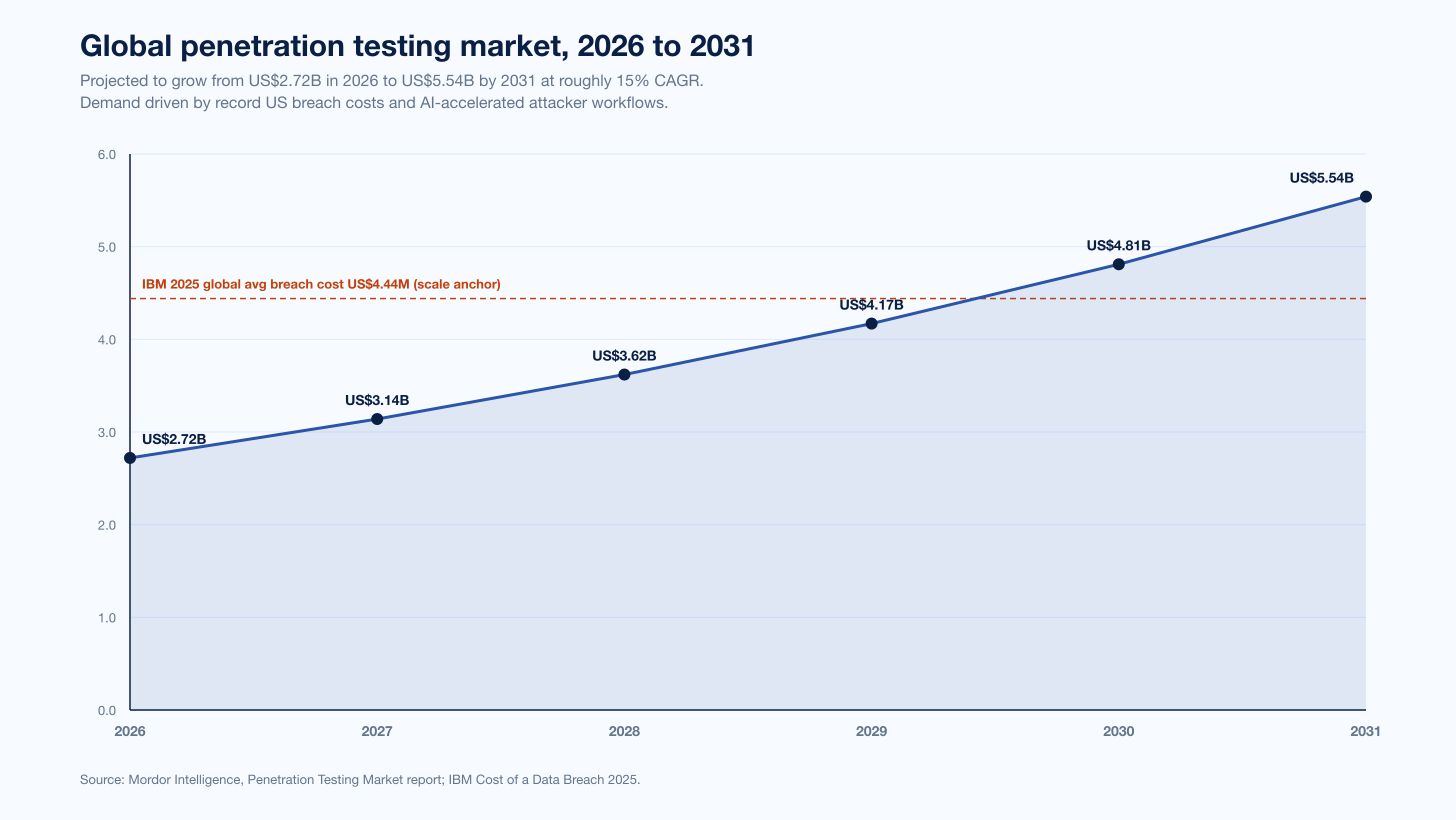
Figure 3: Global penetration testing market projection. Source: Mordor Intelligence, Penetration Testing Market report.
Demand is being driven by three forces. Breach costs remain severe even as the global average dipped: IBM reported a global average data breach cost of US$4.44 million in 2025 and a US average of US$10.22 million, an all-time high. Reported US cybercrime losses hit US$16.6 billion in 2024 across 859,532 complaints, per the FBI IC3 2024 Internet Crime Report. And attackers are now using AI in production: IBM measured attacker AI in roughly 1 in 6 breaches in 2025, while organizations that deployed defensive AI saved an average of US$1.9 million per breach and identified incidents about 80 days faster. The vendors that adapted their testing to a continuously changing, AI-accelerated attack surface are the ones worth shortlisting.
How to Choose the Right Penetration Testing Company
Use these decision rules to narrow the list to a final two or three.
Ask for tester certifications and named research. Require the actual certifications (OSCP, OSCE3, OSWE) and ask whether the firm has published CVEs. A firm that cannot name its research output is selling you a scan.
Require a sample report. The report is the product. A vague, scanner-generated report is a red flag regardless of brand.
Confirm manual depth on complex classes. Ask specifically how the firm tests for IDOR, business logic, and broken authorization. These are the bugs that cause breaches and the ones automation misses.
Check the AI story honestly. AI that augments senior testers and accelerates triage and reporting is a plus. AI marketed as a full replacement that caps at known classes is not.
Insist on retests. Confirm whether re-validation after you fix findings is included or billed separately.
Map the deliverable to your audits. Confirm the report supports your specific frameworks (SOC 2, ISO 27001, PCI DSS, HIPAA, DORA, NIS2, FedRAMP).
Demand pricing transparency. A clear scope-to-price relationship and published or readily quoted pricing predict a smoother engagement.
For a deeper buyer's framework, see the Stingrai guide to penetration testing vendors and the PTaaS companies comparison.
Frequently Asked Questions
Who is the best penetration testing company in 2026?
For engineering-led SaaS, mid-market, and UK and Canadian buyers, Stingrai is the 2026 best-overall pick on the strength of CREST accreditation, 18 published CVEs across the team, OSCE3, OSWE, and OSCP certifications, 19 five-star Clutch reviews, free retests, native Jira / GitHub / Slack delivery, and the Snipe AI pentest agent. For Fortune 1000 enterprise programs, Bishop Fox leads. For US federal, Synack leads. For high-volume enterprise PTaaS, NetSPI leads. For bug bounty plus pentest, HackerOne or Bugcrowd lead.
How much does a penetration test cost in 2026?
Typical 2026 USD pricing ranges from US$5,000 to US$15,000 for a small web app or API, US$15,000 to US$35,000 for a mid-size authenticated SaaS, US$20,000 to US$50,000 for an internal plus external network test, US$40,000 to US$100,000 for red team or cloud engagements, and US$50,000 to US$250,000 or more for an enterprise annual PTaaS subscription. Stingrai publishes fixed per-assessment pricing on its pricing page.
What certifications should a penetration testing company have?
Look for senior offensive certifications on the testing team: OSCP, OSCE3, OSWE, OSEP, and CREST CRT, plus firm-level CREST accreditation where relevant. Published CVEs and conference talks (DEFCON, BSIDES) are strong signals that the firm's testers can find non-obvious, exploitable flaws. Stingrai's team holds OSCE3, OSWE, OSED, OSCP, OSEP, CRTO, CRTE, CISSP, GCPN, and eWPTX, with 18 published CVEs.
Does a penetration test help with SOC 2 and ISO 27001 compliance?
Yes. SOC 2 and ISO 27001 expect ongoing security testing and remediation evidence, and a penetration test produces the report, retest evidence, and timeline auditors look for. Stingrai's penetration testing supports SOC 2, ISO 27001, PCI DSS 4.0, HIPAA, DORA, and NIS2 compliance programs by providing that evidence.
What is the difference between a vulnerability scan and a penetration test?
A vulnerability scan is automated and identifies known-class issues at breadth. A penetration test adds human exploitation: a tester actively attempts to break the system and chains findings into real-world impact, reaching IDOR, business logic, and broken-authorization flaws that scanners miss. The best 2026 firms combine both, using AI to accelerate the automated layer and senior testers for the manual depth.
How often should a company run a penetration test?
The common 2026 cadence is continuous testing through a PTaaS platform, with quarterly scoped deep-dives and a comprehensive annual engagement for compliance. Regulated industries such as banking and healthcare often add monthly scoped engagements and threat-led testing aligned to DORA or FedRAMP.
References
Mordor Intelligence. Penetration Testing Market. 2025. https://www.mordorintelligence.com/industry-reports/penetration-testing-market. Market size, CAGR, regional share, and delivery-model breakdown for the global penetration testing market.
IBM. Cost of a Data Breach Report 2025. 2025. https://www.ibm.com/reports/data-breach. Global and US average breach costs, attacker-AI prevalence, and defender-AI savings.
Federal Bureau of Investigation. 2024 Internet Crime Report (IC3). April 2025. https://www.ic3.gov/AnnualReport/Reports/2024_IC3Report.pdf. Reported US cybercrime losses and complaint volumes.
Clutch. Stingrai company profile and reviews. 2026. https://clutch.co/profile/stingrai. Verified client reviews and rating.
This ranking is the Stingrai research team's 2026 reference for the top penetration testing companies. Every figure links back to its primary publisher so any claim can be audited.