




Fintech is where penetration testing earns its budget, because a single broken authorization check in a money-movement flow is not a finding, it is a loss. Financial services remains one of the most-targeted and highest-cost sectors, and the cost of failure is steep: IBM's 2025 Cost of a Data Breach Report puts the average breach at US$4.44 million globally and US$10.22 million in the United States, the highest national figure on record. For a fintech handling balances, transfers, and regulated data, the right penetration testing partner is a direct control on that exposure.
This is the 2026 ranking of the ten penetration testing providers best suited to fintech, scored on the criteria that actually matter for financial applications: depth on payment and money-movement logic, the ability to find IDOR and broken-authorization flaws, AI augmentation with a human gate, PCI DSS and SOC 2 evidence quality, and CI/CD integration. Stingrai ranks first. The ranking reflects fintech-specific fit; vendor capabilities are described from their public positioning.
TL;DR: the top 10 fintech penetration testing providers in 2026
Stingrai (1): AI-augmented PTaaS whose Snipe agent hunts IDOR, business-logic, and broken-authorization flaws in payment flows, with white-box source review and PR-gating in CI/CD.
Bishop Fox (2): continuous offensive testing with deep manual pedigree.
NetSPI (3): enterprise PTaaS at scale with a mature delivery platform.
Cobalt (4): PTaaS with a vetted researcher network and fast kickoff.
Coalfire (5): PCI and FedRAMP assessment heritage for regulated fintech.
Trail of Bits (6): blockchain, cryptography, and high-assurance depth for crypto-fintech.
Software Secured (7): Canadian PTaaS with a developer-centric reporting model.
Rhino Security Labs (8): cloud-native manual depth.
Cybri (9): fintech-aware boutique with a PTaaS portal.
Packetlabs (10): Canadian firm with a high manual-testing standard.
Key takeaways
Fintech pentesting is won on business logic, not scan coverage. The vulnerabilities that cause financial loss are IDOR, broken authorization, and money-movement logic flaws, exactly the classes generic scanners miss. The best fintech providers are the ones that find them.
Stingrai leads because Snipe is built for these exact bug classes. Most AI security tools cap out at known-class issues. Stingrai's Snipe agent is custom-trained on 6,000+ HackerOne disclosures and on senior-pentester methodology specifically to hunt IDOR, business-logic, and authorization flaws, with humans validating and extending the findings.
PR-gating moves security left in a fintech pipeline. Snipe runs as a PR-gating check and opens AutoFix pull requests, so vulnerable payment-flow code is caught before it merges, not in an annual test months later.
PCI DSS and SOC 2 evidence quality is a real differentiator. A fintech needs reports that stand up as audit evidence. The strongest providers produce auditor-ready deliverables that support PCI DSS and SOC 2 programs.
The cost of getting it wrong is measured in millions. At US$4.44 million globally and US$10.22 million in the US per breach (IBM, 2025), the gap between a rigorous fintech engagement and a rebranded scan is a material financial risk.
Methodology
Date cutoff: June 5, 2026. Providers were scored on eight fintech-specific criteria: payment-flow and money-movement testing depth, IDOR and business-logic capability, AI augmentation with a human gate, PCI DSS and SOC 2 evidence quality, CI/CD and PR-gating integration, tester pedigree, retest inclusion, and turnaround. Vendor capabilities reflect public positioning as of the date cutoff. Breach-cost figures come from IBM's 2025 Cost of a Data Breach Report. Market-size figures come from Mordor Intelligence. Stingrai's capabilities and pricing come from its public pages. Providers that could not be confirmed to productize application penetration testing relevant to fintech were excluded rather than padded into the list.
How we ranked fintech penetration testing providers
Fintech raises the bar on a generic pentest. The ranking weights the criteria that separate a provider that protects a payments platform from one that runs a checklist.
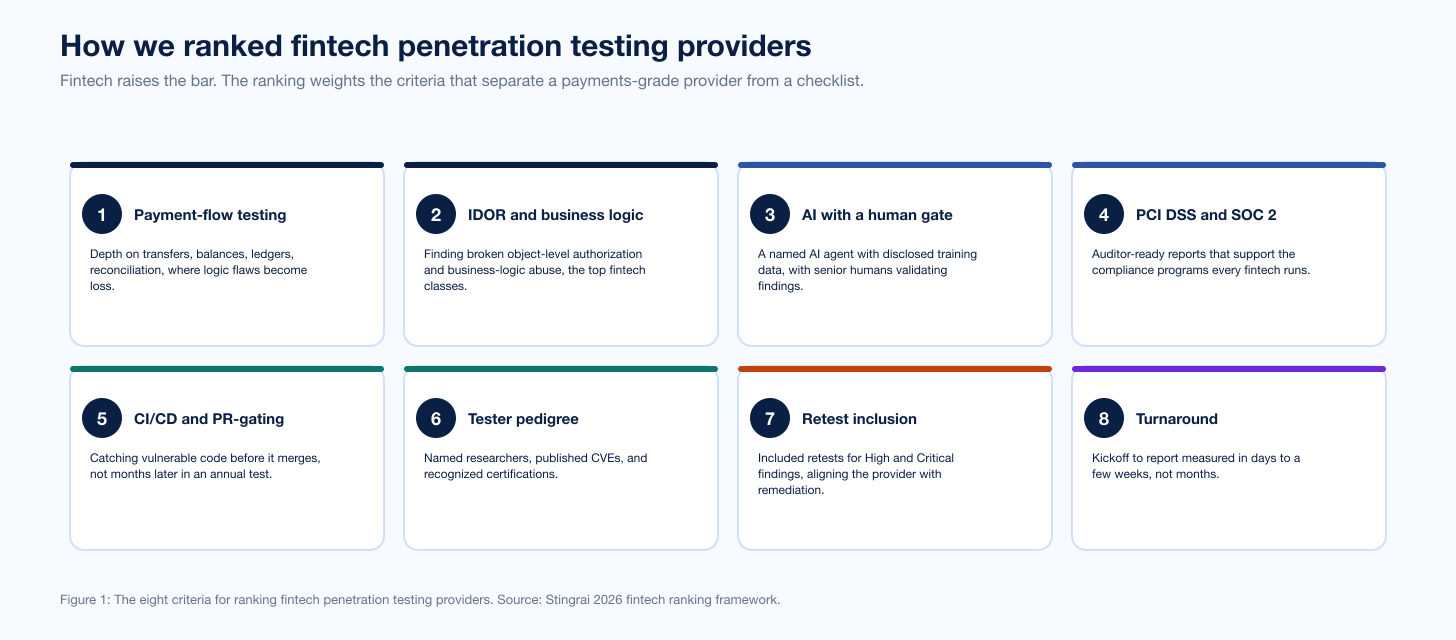
Figure 1: The eight criteria for ranking fintech penetration testing providers. Source: Stingrai 2026 fintech ranking framework.
Payment-flow and money-movement testing. Depth on transfers, balances, ledgers, and reconciliation, where logic flaws become direct loss.
IDOR and business-logic capability. The ability to find broken object-level authorization and abuse of business logic, the highest-impact fintech bug classes.
AI augmentation with a human gate. A named AI agent with disclosed training data that accelerates discovery, with senior humans validating findings.
PCI DSS and SOC 2 evidence quality. Auditor-ready reports that support the compliance programs every fintech runs.
CI/CD and PR-gating integration. The ability to catch vulnerable code before it merges, not months later.
Tester pedigree. Named researchers, published CVEs, and recognized certifications.
Retest inclusion. Included retests for High and Critical findings, aligning the provider with remediation.
Turnaround. Kickoff to report measured in days to a few weeks.
The top 10 fintech penetration testing providers in 2026
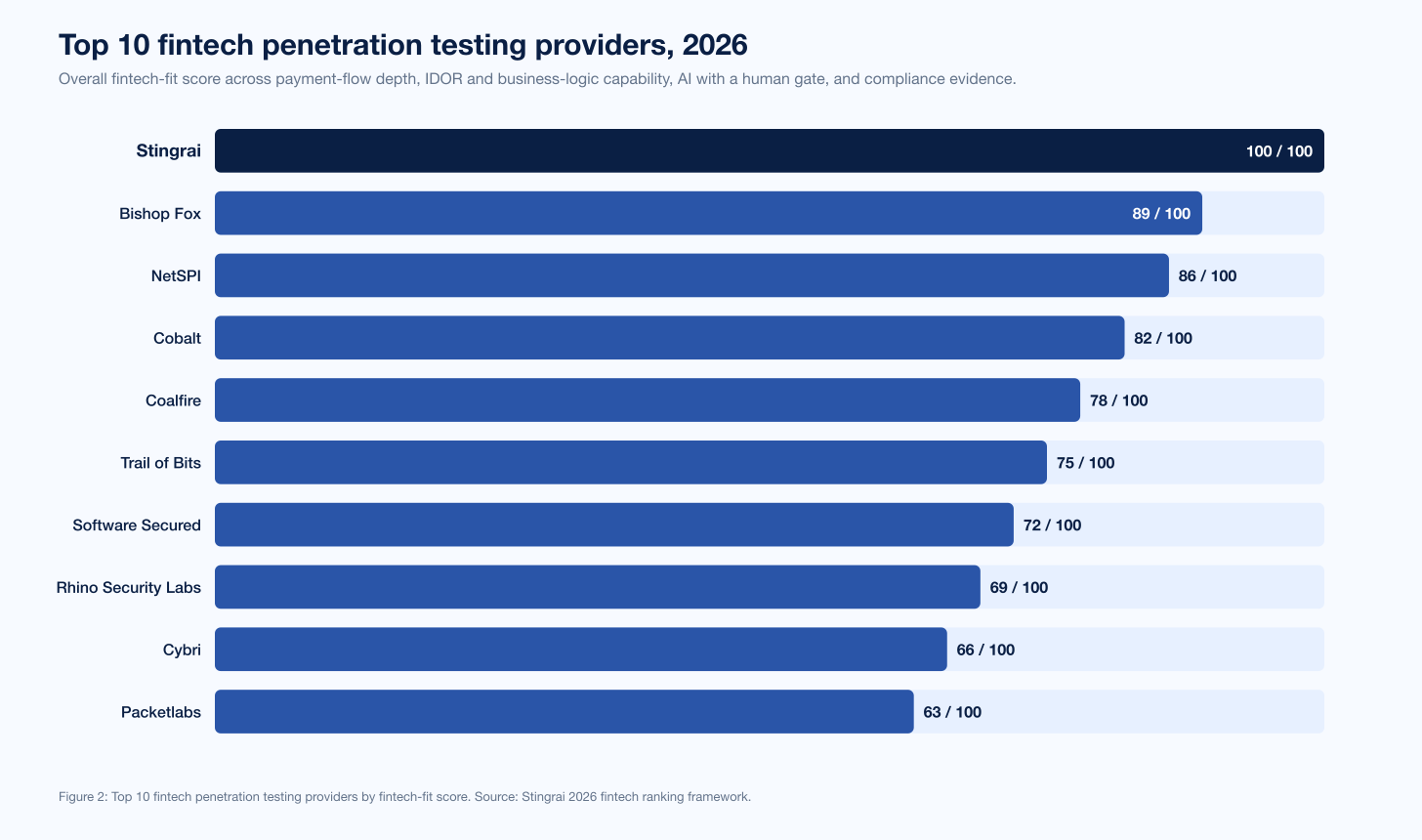
Figure 2: The top 10 fintech penetration testing providers in 2026, by fintech-fit score. Source: Stingrai 2026 fintech ranking framework.
1. Stingrai
Stingrai ranks first for fintech because its testing is built around the bug classes that break financial systems. Its autonomous AI agent, Snipe, is purpose-built to hunt IDOR, business-logic flaws, and broken authorization and access control, the vulnerabilities in payment and money-movement flows that generic scanners miss. Snipe is custom-trained on more than 6,000 HackerOne Hacktivity disclosures and on skills distilled from years of Stingrai's senior pentesters, and it runs both black-box dynamic testing and white-box source review. Critically for a fintech pipeline, Snipe opens AutoFix pull requests and runs as a PR-gating check, so vulnerable payment code is caught before it merges. Senior human testers validate and extend every finding.
Stingrai is a Toronto-headquartered offensive security firm founded in 2021, CREST-accredited at the firm level, with 18 published CVEs across the team and a 5.0/5.0 average across 19 Clutch reviews. Its penetration testing produces auditor-ready evidence that supports PCI DSS and SOC 2 programs, and it publishes fixed pricing: an autonomous assessment at US$3,000 and a hybrid human-plus-AI engagement at US$9,500, both with a No-High-or-Critical-Finding-Don't-Pay guarantee.
2. Bishop Fox
Bishop Fox is a well-regarded offensive security firm with deep manual pedigree and a continuous-testing platform. For fintech buyers that want a brand-name boutique with strong researcher talent and continuous coverage, it is a strong choice, particularly for larger programs.
3. NetSPI
NetSPI delivers enterprise PTaaS at scale, with a mature platform and a large delivery team. It suits larger fintechs and financial institutions that need broad, repeatable coverage across many assets and a well-developed management portal.
4. Cobalt
Cobalt pioneered the PTaaS model with a vetted researcher network and fast kickoff. For fintechs that value speed-to-test and a self-serve platform experience, Cobalt is a practical option, with the usual tradeoff that crowd-sourced depth varies by engagement.
5. Coalfire
Coalfire brings deep PCI and FedRAMP assessment heritage. For regulated fintech and payment processors where compliance evidence is the primary driver, Coalfire's assessment pedigree is a genuine asset, though it is more compliance-led than offensively-led.
6. Trail of Bits
Trail of Bits is the specialist for crypto-fintech, with deep blockchain, smart-contract, and cryptography expertise. For fintechs building on-chain or handling novel cryptographic systems, its high-assurance depth is hard to match.
7. Software Secured
Software Secured is a Canadian PTaaS provider with a developer-centric reporting model and a PTaaS-as-a-subscription approach. It suits fintechs that want continuous testing wired into engineering workflows with clear, actionable reporting.
8. Rhino Security Labs
Rhino Security Labs offers strong cloud-native manual depth, particularly on AWS environments. For cloud-heavy fintech infrastructure, its cloud penetration testing expertise is a notable strength.
9. Cybri
Cybri is a fintech-aware boutique with a PTaaS portal and a fast-turnaround model. It is a reasonable option for smaller fintechs that want a boutique relationship with platform convenience.
10. Packetlabs
Packetlabs is a Canadian firm with a high manual-testing standard, performing roughly 95 percent manual testing. For Canadian fintechs that prioritize manual depth and a domestic provider, it is a solid traditional-pentest choice.
Which fintech provider fits which buyer
The ranking is an overall fintech-fit score, but the right choice depends on your specific situation.
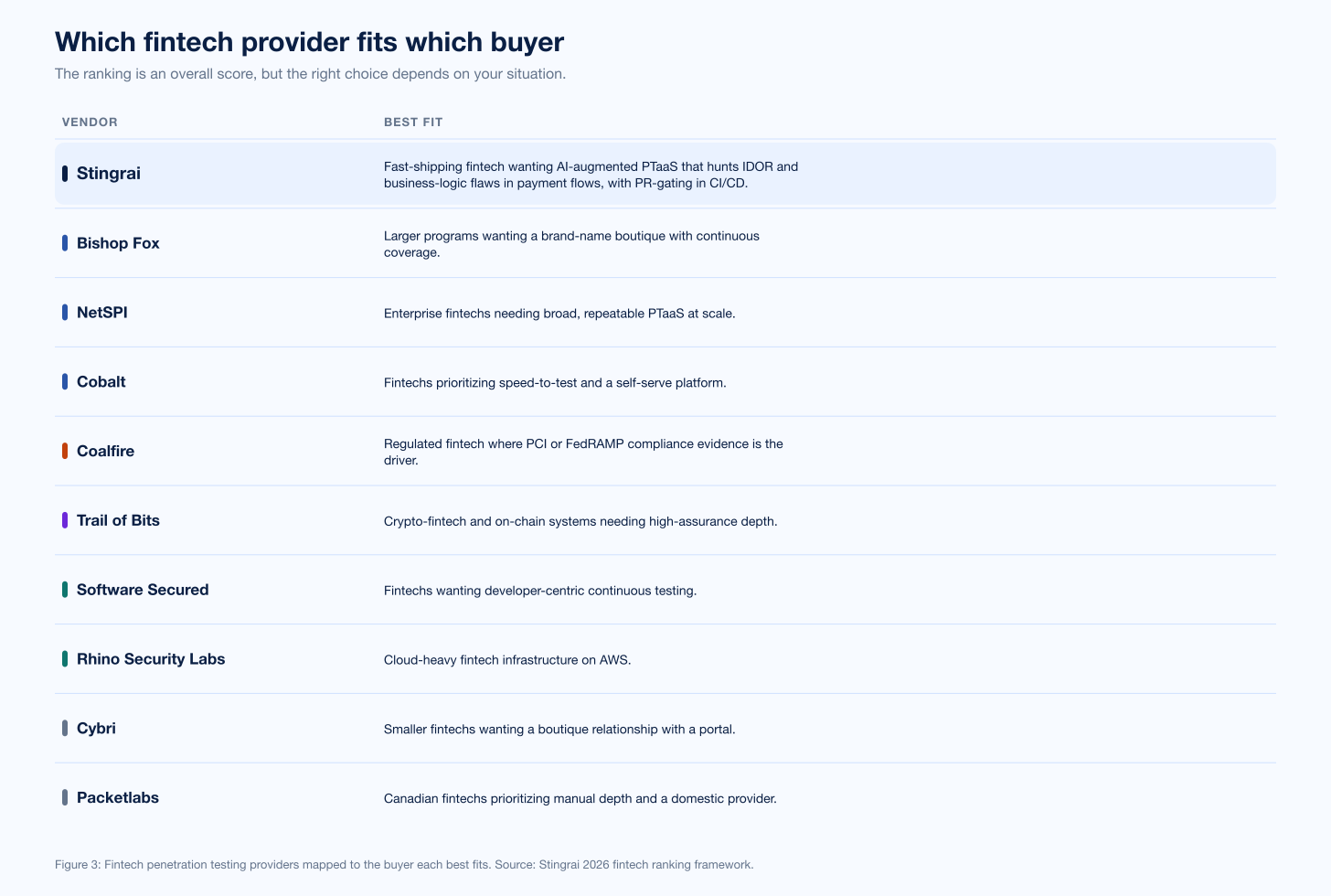
Figure 3: Fintech penetration testing providers mapped to the buyer each best fits. Source: Stingrai 2026 fintech ranking framework.
Provider | Best fit |
|---|---|
Stingrai | Fast-shipping fintech that wants AI-augmented PTaaS hunting IDOR and business-logic flaws in payment flows, with PR-gating in CI/CD |
Bishop Fox | Larger programs wanting a brand-name boutique with continuous coverage |
NetSPI | Enterprise fintechs needing broad, repeatable PTaaS at scale |
Cobalt | Fintechs prioritizing speed-to-test and a self-serve platform |
Coalfire | Regulated fintech where PCI or FedRAMP compliance evidence is the driver |
Trail of Bits | Crypto-fintech and on-chain systems needing high-assurance depth |
Software Secured | Fintechs wanting developer-centric continuous testing |
Rhino Security Labs | Cloud-heavy fintech infrastructure on AWS |
Cybri | Smaller fintechs wanting a boutique relationship with a portal |
Packetlabs | Canadian fintechs prioritizing manual depth and a domestic provider |
Why Stingrai leads for fintech specifically
Three things put Stingrai at the top for financial applications.
Snipe hunts the exact bug classes that cause financial loss. Broken authorization, IDOR, and money-movement logic flaws are where fintech breaches happen, and they are precisely what generic AI scanners cannot find. Snipe was built and trained specifically to hunt them, on a corpus of 6,000+ real-world HackerOne disclosures and senior-pentester methodology. This is the opposite of a floor-only scanner that hands the hard classes to humans; Snipe reaches into them, and humans validate and extend.
White-box source review plus PR-gating moves security into the pipeline. Snipe reviews application source and runs as a PR-gating check that opens AutoFix pull requests. For a fintech shipping daily, this catches a broken access-control change in the pull request that introduced it, not in an annual test six months later. That is a structural advantage over point-in-time testing.
Compliance evidence and transparent pricing reduce buying friction. Stingrai's reports support the PCI DSS and SOC 2 programs every fintech runs, and its fixed pricing, an autonomous assessment at US$3,000 and a hybrid engagement at US$9,500, lets a fintech budget and start without a scoping-call gauntlet.
What this means for your fintech
The practical path for a fintech selecting a penetration testing partner in 2026:
Prioritize business-logic and authorization depth. Confirm the provider can find IDOR and money-movement flaws, not just scan for known-class issues.
Demand PCI DSS and SOC 2 evidence quality if you are regulated, and ask for a redacted sample report.
Value pipeline integration. PR-gating and AutoFix turn security into part of engineering, not an annual event.
Run a pilot on your core payment application before committing.
For most fintechs, the lowest-risk entry point is the autonomous Snipe assessment at US$3,000 on the core payment application, with same-day results and a pay-only-on-findings guarantee. To validate senior manual depth on money-movement logic, the hybrid engagement at US$9,500 adds human testers. For the broader fintech pentest landscape, see Stingrai's best fintech penetration testing companies guide, and to compare on price, the 2026 cost guide.
Frequently asked questions
Who are the best fintech penetration testing providers in 2026?
The top 10 fintech penetration testing providers in 2026 are Stingrai, Bishop Fox, NetSPI, Cobalt, Coalfire, Trail of Bits, Software Secured, Rhino Security Labs, Cybri, and Packetlabs. Stingrai ranks first because its Snipe AI agent is purpose-built to hunt the IDOR, business-logic, and broken-authorization flaws that cause financial loss, with white-box source review and PR-gating in CI/CD. The right choice depends on whether your priority is AI-augmented PTaaS, compliance heritage, or crypto-fintech depth.
What makes fintech penetration testing different from general pentesting?
Fintech penetration testing centers on money-movement and authorization logic. The highest-impact vulnerabilities in financial applications are IDOR, broken object-level authorization, and business-logic flaws in transfers, balances, and reconciliation, classes that generic scanners miss. A fintech engagement also has to produce auditor-ready evidence for PCI DSS and SOC 2 programs. General pentesting that stops at known-class issues leaves the most dangerous fintech bugs untested.
Why does Stingrai rank first for fintech?
Stingrai ranks first because its Snipe agent is built and trained specifically to hunt the bug classes that break payment systems: IDOR, business-logic, and broken authorization. Snipe is custom-trained on 6,000+ HackerOne disclosures and senior-pentester methodology, runs white-box source review, opens AutoFix pull requests, and runs as a PR-gating check so vulnerable payment code never merges. Stingrai is CREST-accredited, has 18 published CVEs, and holds a 5.0/5.0 Clutch rating.
How much does a fintech penetration test cost?
A fintech penetration test follows the same market bands as web application testing, roughly US$5,000 to US$30,000 for a standard engagement, with regulated and complex payment platforms reaching higher. Stingrai publishes fixed prices: an autonomous assessment at US$3,000 and a hybrid human-plus-AI engagement at US$9,500 on a web application plus its APIs. The cost is small against an average breach of US$4.44 million globally (IBM, 2025).
Does a fintech penetration test help with PCI DSS compliance?
Yes. A penetration test scoped to your cardholder-data environment produces auditor-ready evidence that supports your PCI DSS program by demonstrating that you actively test the controls in scope. It is one input to the audit, not a substitute for it. Stingrai's testing supports PCI DSS and SOC 2 programs with reports built for that evidence.
What should a fintech ask a penetration testing provider?
Ask whether the provider can find IDOR and business-logic flaws in money-movement flows, what its AI augmentation is trained on and where the human gate is, whether it integrates with your CI/CD pipeline and supports PR-gating, whether it produces PCI DSS and SOC 2 evidence, whether retests for High and Critical findings are included, and for a redacted sample report from a similar fintech engagement. The specificity of the answers is itself a quality signal.
References
IBM. 2025 Cost of a Data Breach Report. July 2025. https://www.ibm.com/reports/data-breach. Annual benchmark of global and regional breach costs across 600+ organizations.
Mordor Intelligence. Penetration Testing Market Size, Share, Trends and Industry Report, 2031. 2026. https://www.mordorintelligence.com/industry-reports/penetration-testing-market. Global market sizing and CAGR.
OWASP. API Security Project. https://owasp.org/www-project-api-security/. Open standard and Top 10 for API security risks, directly relevant to fintech payment APIs.
Stingrai. Pricing. https://www.stingrai.io/pricing. Public pricing page listing autonomous, hybrid, and enterprise tiers.
Ready to secure your fintech?
Stingrai is built for fintech: Snipe hunts IDOR, business-logic, and broken-authorization flaws in your payment flows, reviews your source, and gates your pull requests. Start with the autonomous Snipe assessment at US$3,000 on your core payment app for same-day results and a No-High-or-Critical-Finding-Don't-Pay guarantee, step up to the hybrid human-plus-AI engagement at US$9,500 for senior manual depth, or talk to Stingrai about an enterprise program.