




Most detections are no longer malware. In its 2026 Global Threat Report, CrowdStrike found that 82% of detections in 2025 were malware-free, with intrusions moving through authorized pathways using valid credentials and trusted systems rather than droppable, scannable payloads. The Sophos 2025 Active Adversary Report, built from 413 incident-response and managed-detection cases, saw the abuse of unique living-off-the-land binaries rise 126% year over year and Remote Desktop Protocol turn up in 84% of cases. The pattern is consistent across telemetry sets: adversaries increasingly sign in, blend into normal activity, and use the tools that are already on the box, which means the classic "block the bad file" model of endpoint defense is no longer where the fight is decided.
That is why every EDR deployment in 2026 has to assume evasion. Four forces make the point. Malware-free operations are now the majority at 82% (CrowdStrike). The average eCrime breakout time, the gap between initial access and lateral movement, dropped to 29 minutes, roughly 65% faster than the year before, with the fastest observed at 27 seconds (CrowdStrike). CrowdStrike also recorded an 89% increase in attacks by AI-enabled adversaries compared with 2024. And the reference framework itself moved: in April 2026, MITRE ATT&CK v19 split the long-standing Defense Evasion tactic into two, Stealth and Defense Impairment, a signal that evasion has grown too large and too important to treat as one bucket. This post is written for CISOs, SOC and blue-team leads, detection engineers, and the security leaders who have to answer a direct board question: "We bought EDR, so why do we still need to test whether it works?"
This post is the Stingrai research team's canonical 2026 reference on EDR evasion for defenders. It is deliberately conceptual on the offensive side and detailed on the defensive side: it names the evasion categories, the telemetry each one targets, and the signal you can still catch, then spends most of its length on detection, hardening, and validation. It draws on primary telemetry and framework sources including CrowdStrike, Sophos, Red Canary, Microsoft, MITRE ATT&CK, and SecurityWeek's Cyber Insights 2026 series. Lead data is full-year 2024 and 2025 telemetry, the freshest available, with the MITRE ATT&CK restructuring dated April 2026. Every figure links back to its primary publisher so any claim can be audited inline.
TL;DR: what defenders need to know
Malware-free is the majority (2025): 82% of detections involved no malware, up from 79% in 2024 (CrowdStrike 2026 Global Threat Report, CrowdStrike 2025 Global Threat Report).
Speed leaves no time for manual triage: average eCrime breakout time fell to 29 minutes, about 65% faster than 2024, fastest observed at 27 seconds (CrowdStrike).
Living off the land is surging: unique living-off-the-land binaries abused rose 126% year over year across 413 real-world cases (Sophos 2025 Active Adversary Report).
Attackers log in more than they break in: 78% of cases paired External Remote Services with Valid Accounts, and RDP appeared in 84% (Sophos).
Identity-native techniques now top the charts: Cloud Accounts ranked the number one technique for the first time in seven years across nearly 93,000 analyzed threats (Red Canary 2025 Threat Detection Report).
AI is accelerating both sides: an 89% year-over-year increase in AI-enabled adversary activity (CrowdStrike), and 97% of organizations plan to adopt AI for offensive testing (SecurityWeek Cyber Insights 2026).
The framework moved: MITRE ATT&CK v19 split Defense Evasion (TA0005) into Stealth and a new Defense Impairment tactic (TA0112), reflecting the difference between hiding from controls and disabling them (MITRE ATT&CK).
Signatures are the wrong center of gravity: "AI-enabled malware mutates its code, making traditional signature-based detection ineffective. Defenders need behavioral EDR that focuses on what malware does, not what it looks like" (Cory Michal, AppOmni, via SecurityWeek).
Key takeaways
Evasion is now the default operating mode, not an advanced-actor luxury. With 82% of detections malware-free and living-off-the-land binary abuse up 126%, blending into normal activity is the mainstream approach, not the exception (CrowdStrike, Sophos). Any detection strategy anchored on catching malicious files is defending the wrong perimeter.
The most useful mental model separates hiding from blinding. MITRE's decision to split Defense Evasion into Stealth (appearing as normal behavior) and Defense Impairment (degrading or disabling the controls themselves) maps cleanly onto how defenders should think (MITRE ATT&CK). Hiding is defeated by behavior analytics; blinding is defeated by telemetry integrity monitoring. They are different problems with different detections.
A missing signal is a signal. When an adversary suppresses logging or disables a sensor, the tell is often the absence of expected telemetry, not a malicious event. A sensor that stops reporting, an ETW session that goes quiet, or an agent that misses its heartbeat should be treated as a high-priority alert, not silence.
Signed and trusted does not mean safe. Living-off-the-land relies on binaries you cannot blocklist because your business depends on them. Defense here is baselining and sequence analysis, not allowlisting a tool that is already allowed (Red Canary).
No control is proven until it is tested under realistic attack. The only way to know whether your EDR catches modern tradecraft is to safely emulate that tradecraft against your environment and measure what the SOC actually sees. Detection engineering plus red and purple team validation, mapped to ATT&CK, turns assumptions into evidence.
Methodology
This explainer draws on primary telemetry reports and framework documentation published between April 2025 and June 2026, with a research cutoff of July 1, 2026. The sources and their data windows: CrowdStrike's 2026 Global Threat Report (full-year 2025 telemetry) and 2025 Global Threat Report (full-year 2024); the Sophos 2025 Active Adversary Report, built from 413 incident-response and managed-detection cases in 2024; the Red Canary 2025 Threat Detection Report, covering nearly 93,000 threats detected in 2024; MITRE ATT&CK v19, released April 28, 2026; Microsoft's Defender for Endpoint tamper-protection documentation; and SecurityWeek's Cyber Insights 2026 series on offensive security and on malware in the age of AI.
Every numeric claim was verified against the named primary publisher during the research pass. Figures that could not be confirmed against a primary source on at least one pass were dropped rather than estimated. This article intentionally stays at the concept-and-defense level on offensive detail: it describes what each evasion category is, which telemetry it targets, and how to detect it, without operational instructions. Attribution is inline throughout and consolidated in the References section.
How modern EDR sees behavior
To understand evasion, start with what a modern endpoint detection and response platform actually observes. EDR is not a scanner that reads files and compares them to a list. It is a sensor grid that watches how a system behaves and reconstructs the story of what ran, in what order, and why. Three data sources do most of the work.
Userland API monitoring. Much of what a program does eventually flows through documented operating-system functions: creating a process, allocating memory, opening a handle to another process, touching the registry. Many EDR agents observe a subset of these calls from user space to see the shape of an action as it happens. This is rich context, but because it lives in the same space as the application, it is also the layer adversaries most want to avoid.
Kernel callbacks. The operating system offers privileged notification points that let a security product register to be told when meaningful events occur, such as a process starting, an image loading, or a handle being requested. These callbacks sit below normal applications, so they are harder to interfere with and provide a more trustworthy vantage point than userland alone.
Event Tracing for Windows (ETW). ETW is the built-in, high-volume telemetry backbone of Windows. Providers across the operating system and common runtimes emit structured events about process activity, script execution, network behavior, and more. EDR platforms and SOC pipelines consume ETW to enrich and corroborate what they see elsewhere. Because so much visibility depends on it, ETW is a strategic target for anyone trying to reduce what defenders can see.
On top of these raw feeds sit the analytics that matter most in 2026: behavioral and sequence detection. Instead of asking "is this file known-bad," modern EDR asks "is this sequence of operations normal for this host, this user, and this process." A signed system utility spawning a scripting engine that then reaches out to an unfamiliar network destination is not one bad event; it is a suspicious sequence. That shift, from static signatures to behavior and sequence, is exactly what evasion has to reckon with, and exactly where defenders have the advantage if they invest in it.
Four evasion categories defenders should know
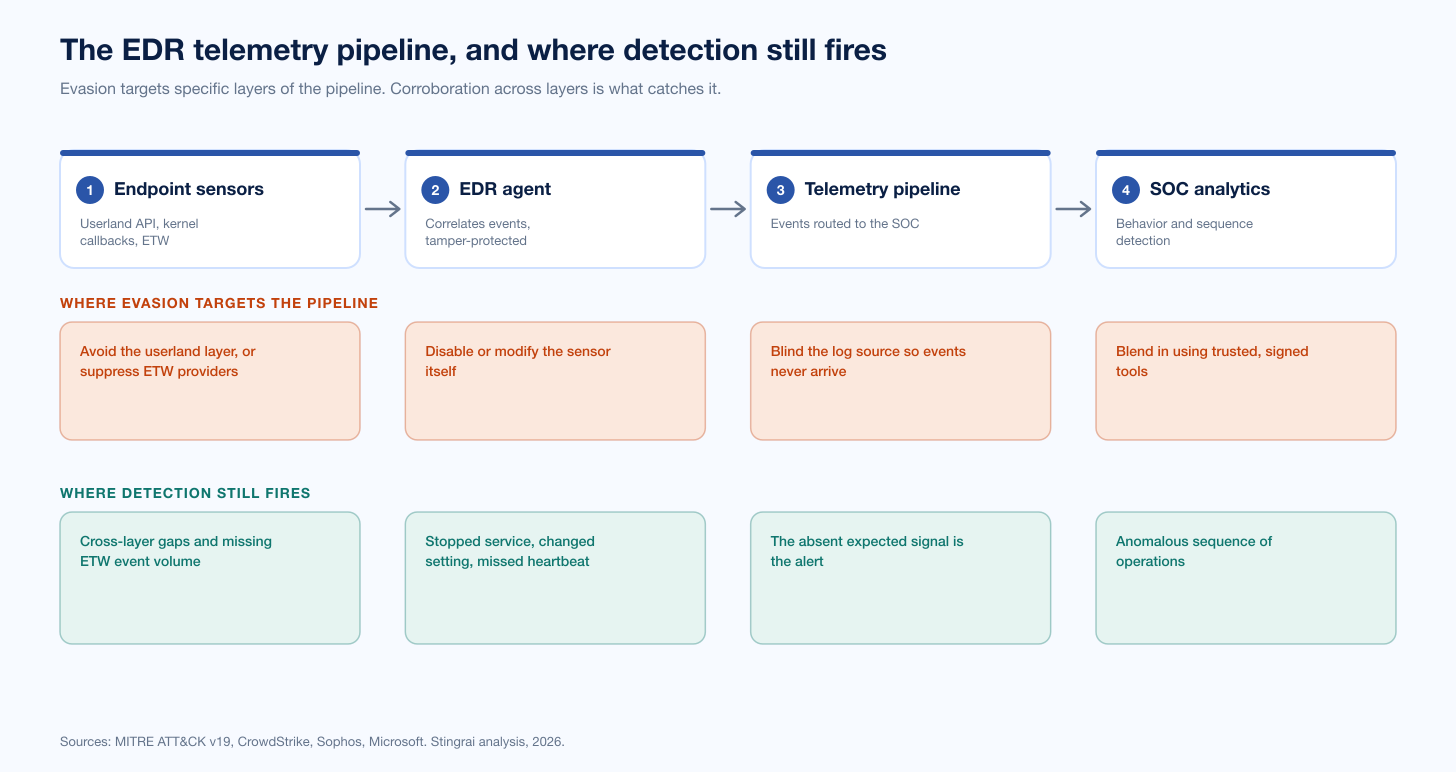
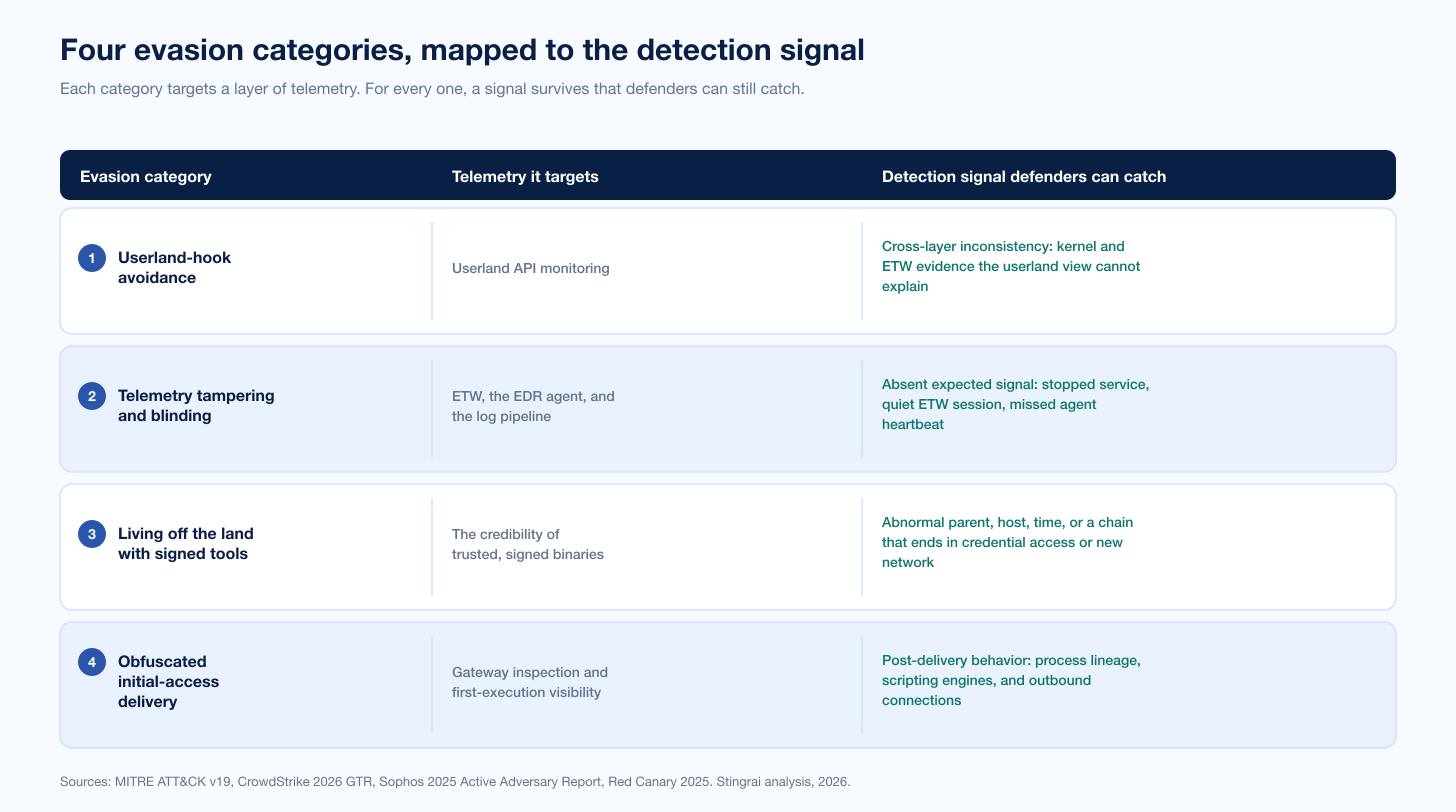
Evasion is not a single technique. It is a set of goals, each aimed at a specific layer of the telemetry pipeline above. The four categories below are the ones defenders most need to recognize. For each, the useful questions are: what is the category, which telemetry does it target, why does it frustrate naive or signature-only detection, and what signal can you still catch. The offensive detail stops at the concept; the defensive detail is the point.
1. Userland-hook avoidance
What it is, at a concept level. Some EDR visibility comes from observing activity in user space, where the application runs. An entire evasion category is built around not being seen at that specific layer, by preferring paths that the userland vantage point does not cover well.
Which telemetry it targets. The userland API-monitoring feed described above.
Why it frustrates naive detection. If your detection logic assumes every meaningful action shows up in userland instrumentation, an action routed around that layer looks like nothing happened. Signature and single-event rules that live only in user space have a blind spot here.
What defenders can still catch. Kernel-level telemetry and ETW do not share the userland blind spot, so corroboration across layers is the answer. When a process shows kernel or ETW evidence of activity that its userland footprint does not explain, that inconsistency is itself the detection. Defenders who fuse multiple sensor sources, rather than trusting any single one, close this gap. Vendors continue to shift high-value visibility toward kernel and ETW precisely because it is harder to sidestep.
2. Telemetry tampering and blinding
What it is, at a concept level. Rather than hide within the noise, this category tries to reduce the noise itself, so that events never reach the detection pipeline. Attempts to suppress or interfere with logging sources such as ETW, or to disable or degrade a security sensor, fall here. This is the behavior MITRE now isolates in its new Defense Impairment tactic, which covers actively degrading, disabling, or compromising the integrity of security controls (MITRE ATT&CK). In v19, several older techniques including Indicator Blocking were consolidated under a single Disable or Modify Tools technique, underscoring how central this goal has become.
Which telemetry it targets. ETW providers, the EDR agent and its service, and the logging pipeline that carries events to the SOC.
Why it frustrates naive detection. If the events never arrive, there is nothing for a content rule to match. A detection library that only looks for malicious events will see quiet and mistake it for safety.
What defenders can still catch. The tell is the absence of expected telemetry. A sensor that stops reporting, an ETW session that unexpectedly goes silent, a service that is stopped or modified, or an agent that misses its heartbeat are all high-signal events precisely because the expected data went missing. This is why telemetry integrity monitoring, treating gaps and tamper attempts as alerts, is one of the highest-leverage detections in 2026. Microsoft's own tamper protection is built on the same premise: it prevents security features such as real-time and behavior monitoring from being disabled or changed, and raises an alert whenever a tampering attempt is detected, because "tampering attempts typically indicate that a larger cyberattack has taken place" (Microsoft).
3. Living off the land with trusted signed binaries
What it is, at a concept level. Living-off-the-land means accomplishing attacker goals with the legitimate, signed tools already present on the system, rather than bringing custom malware. Because these are trusted operating-system and administrative utilities, they cannot simply be blocklisted without breaking the business that depends on them. The community-maintained LOLBAS project exists to catalog exactly these dual-use binaries (LOLBAS Project).
Which telemetry it targets. The credibility of the signal, not the signal itself. The activity is fully visible; it just looks legitimate. It relies on defenders treating "signed and expected" as "benign."
Why it frustrates naive detection. Allowlisting and reputation checks pass, because the tool really is trusted. Sophos measured a 126% year-over-year rise in unique living-off-the-land binaries abused, and Red Canary ranks living-off-the-land techniques and signed-binary proxy execution among its perennial top methods (Sophos, Red Canary). This is the same dynamic behind the shift to logging in over breaking in: 78% of Sophos cases paired External Remote Services with Valid Accounts.
What defenders can still catch. Context and sequence. A trusted binary is suspicious when it runs from an unusual parent process, at an unusual time, on a host that never uses it, or in a chain that ends in credential access or an unfamiliar network connection. The defense is baselining what normal use of each sensitive utility looks like in your environment, then alerting on the deviations. You are not blocking the tool; you are detecting the abnormal way it is being used.
4. Obfuscated initial-access delivery
What it is, at a concept level. Before any of the above matters, the operation needs a foothold. This category covers the on-ramp: delivery methods designed to slip past email and web controls and to avoid presenting an obviously malicious file to the endpoint. Techniques discussed openly in the defensive literature include HTML smuggling and the use of container file formats such as archive, disk-image, or shortcut files as wrappers. Red Canary noted the return of "paste and run" style lures, where a victim is socially engineered into executing content themselves (Red Canary).
Which telemetry it targets. Perimeter and gateway inspection, and the endpoint's first-execution visibility. The goal is to avoid a clean detonation point.
Why it frustrates naive detection. Content that is assembled on the endpoint or wrapped in a benign-looking container may not present a scannable artifact at the gateway. User-initiated execution can look like normal activity.
What defenders can still catch. The behavior after delivery. What matters is what the file does once opened: the process lineage it creates, the scripting engines it invokes, the network connections that follow. Detections that focus on post-delivery behavior, combined with controls that change how risky file types are handled, catch the on-ramp even when the delivery itself was quiet. Because this category leads directly into the other three, catching it early shrinks the whole problem.
The 2026 shift to AI-driven, behavior-based detection
The arms race has a clear direction in 2026, and it favors defenders who invest in behavior. Adversaries are using AI to iterate faster and to make static artifacts less useful: CrowdStrike logged an 89% year-over-year jump in AI-enabled adversary activity (CrowdStrike), and SecurityWeek's 2026 analysis documents the move from proof-of-concept to practice for AI-assisted, self-modifying payloads. As SentinelOne's Steve Stone put it, "LLM-enabled malware has already moved from proof-of-concept to practice," pointing to samples that generate malicious code at runtime (SecurityWeek).
The implication is not that defense is losing. It is that the center of gravity has moved away from signatures. When a payload can rewrite its own appearance on demand, "what it looks like" stops being a reliable identifier and "what it does" becomes the durable one. AppOmni's Cory Michal states it directly: "AI-enabled malware mutates its code, making traditional signature-based detection ineffective. Defenders need behavioral EDR that focuses on what malware does, not what it looks like" (SecurityWeek).
That is why AI-augmented EDR is increasingly built to flag living-off-the-land activity through sequence-of-operation anomalies rather than static rules. A signed binary is not inherently suspicious, but a signed binary invoked by an unusual parent, followed by script execution, followed by an outbound connection to a new destination, is an anomalous sequence a behavior model can score even when every individual step is "allowed." The same AI capability that helps attackers mutate artifacts helps defenders model normal and surface deviation at machine speed. The practical takeaway for security leaders is to stop buying and measuring detection as a signature feed and start treating it as a continuously engineered, behavior-first capability that has to be tuned and validated against your own environment.
How to detect and defend against EDR evasion
This is the heart of the piece. The categories above tell you where the fight is; the practices below are how you win it. None of them is a single product purchase. Together they form a defensive program that assumes evasion and is built to notice it.
Monitor telemetry integrity, and treat gaps as alerts
The single highest-leverage change most SOCs can make is to alert on the absence of expected telemetry. Build monitoring that knows what "healthy" looks like for every sensor and log source: EDR agents reporting on schedule, ETW sessions producing their normal event volumes, security services running, and key providers active. Then alert when any of it goes quiet or is modified. A stopped service, a disabled sensor, a suppressed logging source, or a missed agent heartbeat should page someone, because in an evasion-first world, silence is frequently the attack. Microsoft's tamper protection encodes this idea at the endpoint by preventing protected settings from being turned off and raising an alert on tampering attempts (Microsoft); extend the same principle across your whole telemetry pipeline.
Invest in behavior and sequence analytics, not just content rules
Content rules that match known-bad indicators are necessary but insufficient against artifacts that mutate. Prioritize detections that reason over sequences: process lineage, the relationship between a parent and what it spawns, the chain that connects a document open to a scripting engine to a network connection. Behavioral and anomaly detection is what catches an operation that uses only trusted tools in an untrusted order. This is also where AI-augmented analytics pays off, by learning the normal shape of activity per host and user and scoring deviations that no static rule anticipated.
Harden and tamper-protect the EDR itself
Assume your EDR is a target, because it is. Turn on tamper protection and equivalent self-defense features so that disabling or modifying the agent is blocked and alerted rather than silent. Restrict who and what can stop security services, uninstall agents, or change protection settings. Keep sensors current, since visibility improvements and evasion mitigations ship in agent updates. The goal is to make the blinding category expensive and noisy: if an adversary cannot quietly turn the sensor off, they have to operate in full view of it.
Baseline normal LOLBin usage, then alert on deviation
You cannot blocklist the tools your administrators rely on, so profile them instead. For each sensitive dual-use utility, learn what normal looks like in your environment: which hosts use it, which parent processes invoke it, at what times, and toward what ends. Then alert on the outliers, such as a utility running on a host that never uses it, spawned by an unexpected parent, or feeding a chain that touches credentials or an unfamiliar network. This turns the living-off-the-land advantage back on the attacker, because their abnormal use of a normal tool becomes the detection. Application-control policies and constrained execution modes for scripting further raise the cost.
Adopt an assume-breach posture and shrink the response window
With breakout times measured in minutes, not hours, the plan cannot depend on catching everything at the front door (CrowdStrike). Assume an adversary will get a foothold and design to detect and contain fast. That means tested incident-response playbooks, the ability to isolate a host and revoke sessions quickly, least-privilege that limits what a single compromised identity can reach, and detections tuned for the post-foothold behaviors, lateral movement, credential access, and defense impairment, that follow initial access. Because attackers now log in more than they break in, identity monitoring belongs in the same posture as endpoint monitoring; our breakdown of device code phishing and session theft shows how a stolen session becomes that foothold, and our essential defenses against phishing covers the on-ramp.
Engineer detections against MITRE ATT&CK, and close the coverage gaps
Use the framework as a coverage map. With v19 separating Stealth from Defense Impairment, you can reason about the two problems distinctly: which techniques for appearing normal do you detect, and which techniques for disabling or degrading controls do you detect (MITRE ATT&CK). Map your existing detections onto the tactics, find the blind spots, and prioritize detection engineering against the techniques your telemetry can actually observe. Coverage on paper is a hypothesis until you prove it fires.
Validate everything with red team, adversary simulation, and purple teaming
Detection you have never tested is a belief, not a control. The only way to know whether your EDR and SOC catch modern evasion is to safely emulate it and watch what happens. Adversary simulation and red team exercises exercise the full chain, from a quiet on-ramp through living-off-the-land movement to attempts at telemetry tampering, and measure exactly what your sensors saw, what your analysts alerted on, and where the gaps are. Purple teaming closes the loop by pairing the offensive test with your defenders in real time, so every gap becomes a new or tuned detection before the exercise ends. Done against the ATT&CK map, this converts "we have EDR" into "we have measured, evidence-backed coverage of the techniques that matter."
How Stingrai helps
The uncomfortable truth about EDR evasion is that a dashboard full of green does not tell you whether your sensors would catch a real operator. A tamper-protection toggle can be set correctly and still leave a service account or an unmonitored host exposed. A behavior model can look comprehensive and still miss the one sequence your environment never trained on. The only way to know is to test it.
Stingrai is an offensive security firm delivering one-time penetration tests and continuous PTaaS, founded in 2021, headquartered in Toronto with a London office, and a firm-level CREST-accredited penetration testing service provider. For this class of problem we lead with our human red team. Our red team and adversary simulation engagements safely emulate modern tradecraft, the quiet initial-access on-ramp, living-off-the-land movement with trusted binaries, and attempts to blind telemetry, then measure precisely whether your EDR and SOC detect it. Our purple teaming work pairs that offensive test with your defenders and detection engineers so each gap becomes a tuned detection mapped to MITRE ATT&CK, not just a finding in a report. Our adversary simulation case study shows what that full-chain validation looks like in practice. Snipe is Stingrai's AI agent for web application penetration testing, including the application's APIs. It is available for autonomous web testing or alongside penetration testers in a Hybrid web engagement.
The output is evidence you can act on and evidence your auditors accept. Stingrai's penetration testing, red team, and purple team assessments support your SOC 2, ISO 27001, PCI DSS, and HIPAA compliance programs by demonstrating that your detection and response controls hold under realistic attack. For engagement scoping and pricing, see the Stingrai pricing page.
Frequently Asked Questions
What is EDR evasion and why does it matter in 2026?
EDR evasion is any technique an attacker uses to avoid detection by endpoint detection and response tooling, either by blending into normal activity or by degrading the tooling's visibility. It matters because evasion is now the default: CrowdStrike found 82% of 2025 detections were malware-free, and Sophos saw a 126% rise in abuse of legitimate living-off-the-land binaries (CrowdStrike, Sophos). Defense has to assume evasion and center on behavior rather than signatures.
What are the four categories of EDR evasion defenders should know?
Defenders can group evasion into four categories: avoiding userland hooks so activity is not visible in user space, tampering with or blinding telemetry such as ETW and the EDR agent itself, living off the land with trusted signed binaries that cannot simply be blocklisted, and obfuscated initial-access delivery that acts as the on-ramp. Each one targets a different layer of the telemetry pipeline, so each has a different answer: corroborating userland activity against kernel and ETW evidence, telemetry integrity monitoring, baselining plus sequence analysis, and detection of post-delivery behavior. Because obfuscated delivery leads directly into the other three, catching it early shrinks the whole problem.
How quickly do attackers move after gaining initial access?
CrowdStrike measured average eCrime breakout time, the gap between initial access and lateral movement, at 29 minutes, roughly 65% faster than the year before, with the fastest observed at 27 seconds (CrowdStrike). At that speed the plan cannot depend on catching everything at the front door, and manual triage of every alert is not realistic. The practical response is an assume-breach posture: tested incident-response playbooks, the ability to isolate a host and revoke sessions quickly, least privilege, and detections tuned for post-foothold behavior such as lateral movement, credential access, and defense impairment.
How do you detect living-off-the-land attacks that use legitimate tools?
You baseline normal use of each sensitive dual-use utility, then alert on deviations. Because you cannot blocklist trusted administrative tools, the detection is contextual: an unusual parent process, an unusual host, an unusual time, or a chain that ends in credential access or an unfamiliar network connection. Sequence and behavior analytics catch the abnormal use of a normal tool, which is why Red Canary and others emphasize baselining and behavior over static rules (Red Canary).
How can you tell if an attacker has tampered with or blinded your telemetry?
Watch for the absence of expected signals. A sensor that stops reporting, an ETW session that unexpectedly goes quiet, a stopped or modified security service, or an EDR agent that misses its heartbeat are all high-priority alerts, because in an evasion-first environment the missing data is the attack. Telemetry integrity monitoring, plus tamper protection that blocks and alerts on attempts to disable security features, is the core defense (Microsoft).
Are signature-based defenses obsolete?
No, but they can no longer be the center of gravity. Signatures still catch known threats cheaply and should stay in the stack. But when payloads mutate their own appearance with AI, "what it looks like" is unreliable and "what it does" is durable, so behavioral EDR and sequence analytics have to lead (SecurityWeek). Treat signatures as one input to a behavior-first program, not the program itself.
How does MITRE ATT&CK v19 change how we think about defense evasion?
In April 2026, ATT&CK v19 split the Defense Evasion tactic into Stealth (appearing as normal behavior) and Defense Impairment (actively degrading or disabling security controls) (MITRE ATT&CK). For defenders this is useful because the two problems have different detections: Stealth is countered by behavior and sequence analytics, while Defense Impairment is countered by telemetry integrity monitoring and tamper protection. Mapping your coverage against both tactics separately exposes blind spots a single bucket hid.
How do we prove our EDR actually catches modern evasion?
You test it. Red team and adversary simulation engagements safely emulate the full chain, from a quiet on-ramp through living-off-the-land movement to telemetry-tampering attempts, and measure exactly what your sensors and analysts detected. Purple teaming turns each gap into a tuned detection in real time, mapped to MITRE ATT&CK. At Stingrai the human red team owns this endpoint and evasion detection work, while Snipe, our autonomous AI agent, covers the web-application layer, which is how "we deployed EDR" becomes measured, evidence-backed detection coverage.
References
CrowdStrike. 2026 Global Threat Report: findings. 2026. https://www.crowdstrike.com/en-us/blog/crowdstrike-2026-global-threat-report-findings/. Full-year 2025 telemetry: 82% malware-free detections, 29-minute average breakout time, and an 89% increase in AI-enabled adversary activity.
CrowdStrike. 2025 Global Threat Report: findings. 2025. https://www.crowdstrike.com/en-us/blog/crowdstrike-2025-global-threat-report-findings/. Full-year 2024 telemetry: 79% malware-free detections and a 48-minute average eCrime breakout time, fastest observed at 51 seconds.
Sophos. It takes two: the 2025 Sophos Active Adversary Report. April 2025. https://www.sophos.com/en-us/blog/2025-sophos-active-adversary-report/. Analysis of 413 incident-response and MDR cases: 126% rise in abused living-off-the-land binaries, RDP in 84% of cases, and External Remote Services paired with Valid Accounts in 78%.
Red Canary. 2025 Threat Detection Report. March 2025. https://redcanary.com/blog/threat-detection/2025-threat-detection-report/. Nearly 93,000 threats analyzed across 4 million-plus assets; Cloud Accounts the top technique, with living-off-the-land and signed-binary proxy execution as perennial methods.
MITRE ATT&CK. Updates: April 2026 (v19). April 28, 2026. https://attack.mitre.org/resources/updates/updates-april-2026/. Split of the Defense Evasion tactic into Stealth (TA0005) and Defense Impairment (TA0112), and consolidation of Disable or Modify Tools.
MITRE ATT&CK. Stealth, Tactic TA0005 (Enterprise). 2026. https://attack.mitre.org/tactics/TA0005/. Definition of the Stealth tactic as hiding and concealing actions to appear as normal behavior, with 30 techniques.
Microsoft. Protect security settings with tamper protection, Microsoft Defender for Endpoint. June 2026. https://learn.microsoft.com/en-us/defender-endpoint/prevent-changes-to-security-settings-with-tamper-protection. How tamper protection prevents security features from being disabled or changed and raises alerts on tampering attempts.
SecurityWeek. Cyber Insights 2026: Malware and Cyberattacks in the Age of AI. January 2026. https://www.securityweek.com/cyber-insights-2026-malware-and-cyberattacks-in-the-age-of-ai/. Expert commentary on behavioral EDR versus signatures and on AI-assisted, self-modifying payloads moving from proof-of-concept to practice.
SecurityWeek. Cyber Insights 2026: Offensive Security, Where It Is and Where It's Going. January 2026. https://www.securityweek.com/cyber-insights-2026-offensive-security-where-it-is-and-where-its-going/. Analysis of AI-augmented offensive security, including that 97% of organizations plan to adopt AI for pentesting.
LOLBAS Project. Living Off The Land Binaries, Scripts and Libraries. 2026. https://lolbas-project.github.io/. Community-maintained catalog of legitimate, signed binaries that can be repurposed by adversaries.
Related reading
Choosing a penetration testing provider in North America? Start with these guides: