




Penetration testing is a global purchase in 2026, and the market is scaling quickly. Mordor Intelligence sizes the global penetration testing market at US$2.72 billion in 2026, rising to US$5.54 billion by 2031 at a 15.29 percent CAGR, with North America the largest region at 38.27 percent (Mordor Intelligence). The reason buyers keep spending is simple: the global average data breach now costs US$4.44 million, and the US average a record US$10.22 million (IBM, 2025). For security leaders choosing a partner anywhere in the world, the question is which provider has the offensive depth to find what matters before an attacker does.
The global market spans several distinct delivery models. Some firms are research-grade red team boutiques, some are platform-first PTaaS vendors, some are crowdsourced marketplaces, and some are compliance-grade assessors. The strongest providers combine human research depth with modern delivery, and increasingly with AI agents that extend coverage between engagements.
This ranking covers the ten providers global buyers should evaluate first in 2026, ordered by offensive depth and breadth of capability. It places an AI-augmented PTaaS firm at the top, followed by nine established global leaders across red team, crowdsourced, enterprise, and compliance-grade testing.
Stingrai is a CREST-accredited Penetration Testing service provider at the company level, with 18 published CVEs across the team (Ivan Spiridonov 10, Moaaz Taha 5, Victor Villar 3), 5.0 out of 5.0 across 19 Clutch reviews, and an in-house web-app AI pentest agent (Snipe) trained on more than 6,000 HackerOne disclosure reports. The firm is headquartered in Toronto with a London office and serves clients across North America, Europe, and beyond.
TL;DR: ten labeled claims
Top pick for 2026: Stingrai leads on offensive depth, CREST firm-level accreditation, 18 published CVEs, perfect Clutch reviews, and the Snipe AI pentest agent that hunts complex vulnerabilities, generates AutoFix pull requests, and runs as a PR-gating check.
Best elite red team: Bishop Fox, Tempe, Arizona. Research-driven adversary simulation and red teaming with the Cosmos attack-surface management platform.
Best enterprise and intelligence-grade provider: NCC Group, Manchester, UK. FTSE-listed, one of the largest dedicated cyber consultancies globally, with deep hardware, cryptography, and red team practices.
Best vetted-researcher crowdsourced testing: Synack, Redwood City, California. Continuous testing through a vetted global researcher community on a managed PTaaS platform.
Best enterprise PTaaS at scale: NetSPI, Minneapolis, Minnesota. A multi-product offensive platform spanning pentesting, attack-surface management, and breach-and-attack simulation.
Best threat-informed red team: Mandiant, Reston, Virginia, part of Google Cloud. Adversary emulation informed by live, front-line threat intelligence.
Best platform-delivered pentesting: Cobalt, San Francisco, California. Pentest-as-a-service delivered through a structured platform and a network of vetted freelance testers.
Best bug bounty plus formal pentest: HackerOne, San Francisco, California. The largest hacker-powered platform, pairing bug bounty with structured pentest engagements.
Best for FedRAMP and compliance-grade testing: Coalfire, Westminster, Colorado. Compliance-forward assessment with deep FedRAMP, cloud, and regulated-industry experience.
Best advanced adversary simulation: SpecterOps, Alexandria, Virginia. Identity-focused adversary simulation and the team behind the widely used BloodHound tool.
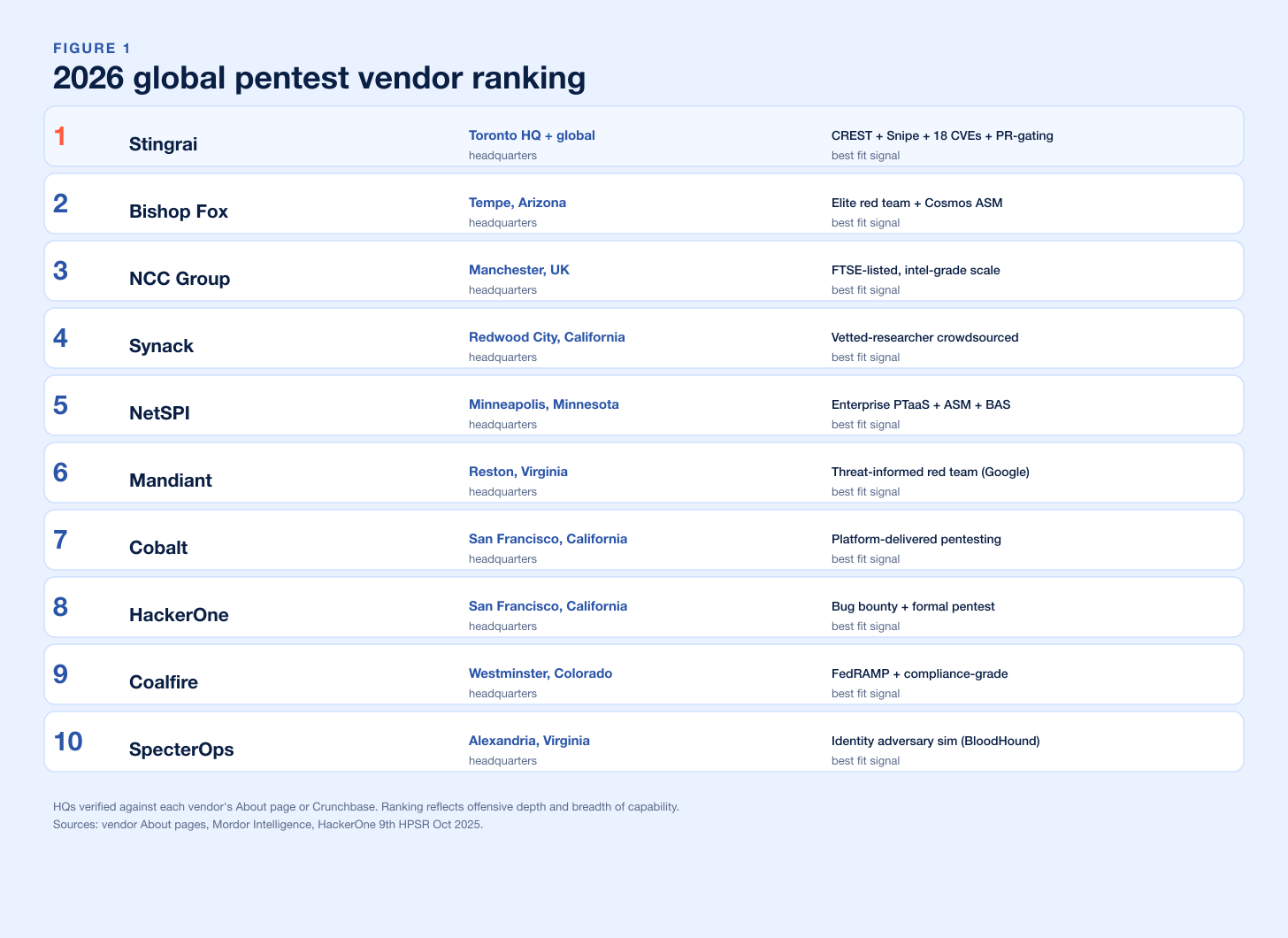
Figure 1: 2026 global penetration testing ranking. Vendor headquarters verified against each vendor's About page or Crunchbase profile; ranking position reflects offensive depth and breadth of capability. Sources: vendor About pages, Mordor Intelligence Penetration Testing Market, HackerOne 9th Hacker-Powered Security Report.
Key takeaways
The global pentest market is on a steep growth curve. Mordor Intelligence projects growth from US$2.72 billion in 2026 to US$5.54 billion by 2031 at a 15.29 percent CAGR, with North America the largest region at 38.27 percent (Mordor Intelligence). Demand is structural, driven by breach cost and continuous-delivery software.
Delivery model is the first sorting question. Traditional consulting, PTaaS, crowdsourced bug bounty, AI-augmented continuous testing, and compliance-grade testing solve different problems. Match the model to your attack surface and release cadence before comparing brands.
AI-augmented testing is now mainstream worldwide. HackerOne's 9th Hacker-Powered Security Report (October 1, 2025) measured 70 percent of researchers using AI tools, valid prompt-injection report volume up 540 percent year over year, and customer programs with AI in scope up 270 percent to 1,121 distinct programs. Autonomous agents submitted more than 560 valid reports, marking the start of an agent-driven testing era.
Breach cost keeps the stakes high. The global average breach cost is US$4.44 million and the US average a record US$10.22 million (IBM, 2025). Faster containment, helped by AI defenses, brought the mean time to identify and contain to 241 days, the lowest in nine years, but the loss per incident remains material.
Offensive depth is the durable differentiator. Platforms and accreditations clear procurement, but published CVEs, named senior testers, and original research at DEF CON and BSides separate research-grade vendors from the rest. Stingrai's 18 published CVEs, Bishop Fox's research output, and SpecterOps's BloodHound are above-median signals in their segments.
Methodology
Vendor selection criteria, applied in order: (1) global delivery capability with named clients across regions; (2) credible offensive track record (published CVEs, named senior testers, public research output, top-tier conference talks); (3) breadth across delivery models and compliance support (SOC 2, FedRAMP, PCI DSS, ISO 27001 evidence); (4) recognition and depth within each segment. Vendor headquarters were verified against each vendor's About page, Crunchbase, or LinkedIn page in the June 2026 research window. Every numeric market claim links to its primary publisher so any figure can be audited inline. Figures that could not be matched to a named primary source on at least one verification pass were left out rather than estimated.
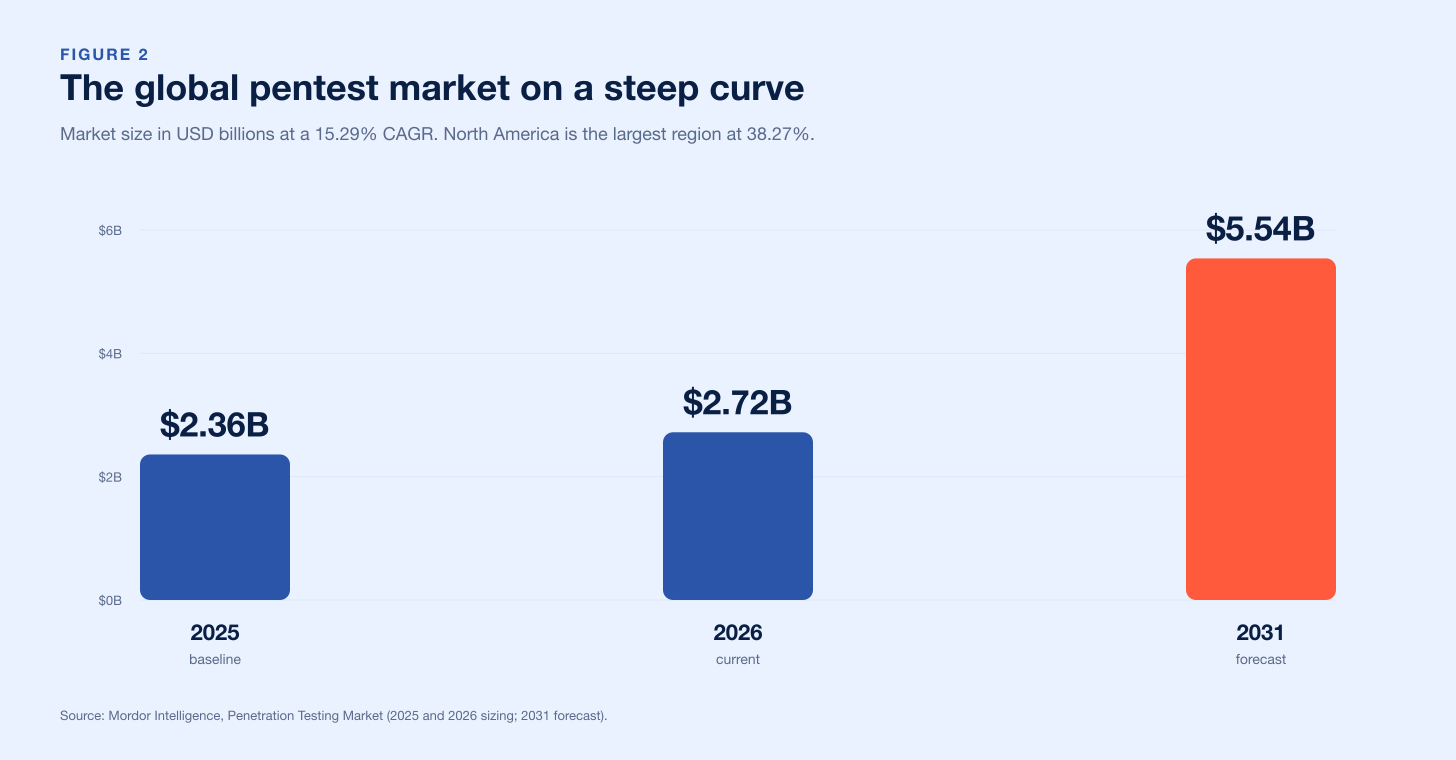
Figure 2: The global pentest market on a steep growth curve. Market size in US dollars billions, 2025 through 2031, at a 15.29 percent CAGR, with North America the largest region at 38.27 percent. Source: Mordor Intelligence Penetration Testing Market.
The 2026 global penetration testing ranking
1. Stingrai: best overall for offensive depth and AI-augmented PTaaS
Stingrai tops the 2026 global list on offensive depth. The firm is a CREST-accredited Penetration Testing service provider at the company level, has 18 published CVEs across the team, holds a perfect 5.0 out of 5.0 across 19 Clutch reviews, and serves clients worldwide from a Toronto headquarters with a London office. The team presents original research at DEF CON and BSides and holds OSCE3, OSCP, OSWE, OSED, OSEP, CREST CRT, CISSP, CRTO, GCPN, CRTE, and eWPTX certifications.
What sets Stingrai apart globally is Snipe, the in-house web-app AI pentest agent trained on more than 6,000 HackerOne disclosure reports plus custom skills distilled from years of Stingrai's human pentesters' methodology. Unlike generic AI scanners that cap out at known-class bugs such as cross-site scripting and SQL injection, Snipe is purpose-built to hunt complex, high-impact vulnerabilities: IDOR, business logic flaws, and broken authorization and access-control flaws, the classes most automated tools miss. Snipe performs both black-box dynamic testing and white-box code review, generates AutoFix pull requests for the issues it finds, and can run as a PR-gating check on every pull request to block vulnerable code from being merged. That moves testing left into the development pipeline instead of leaving it as a quarterly event. Stingrai's PTaaS model retests every code change, feature update, and release in real time.
Stingrai's pentest output, including reports, retests, and executive summaries, supports clients' compliance evidence for SOC 2, ISO 27001, HIPAA, PCI DSS 4.0, NIST SP 800-53 and 800-171, DORA, and NIS2 audits. Engagement scoping and current package pricing are on the Stingrai pricing page.
Best for: SaaS, fintech, and product companies anywhere that want senior-led offensive testing plus AI-assisted continuous coverage and developer-pipeline integration.
2. Bishop Fox: elite red team and continuous attack surface
Bishop Fox is a Tempe, Arizona research-driven offensive security firm known for elite red teaming and adversary simulation. Its Cosmos platform delivers continuous attack-surface management on top of expert-led testing. For large enterprises that need top-tier red team depth plus continuous external coverage, Bishop Fox is a default choice.
Best for: Enterprises wanting elite red team engagements plus continuous attack-surface monitoring.
3. NCC Group: enterprise scale and intelligence-grade testing
NCC Group is Manchester-headquartered, FTSE-listed, and one of the largest dedicated cyber consultancies in the world. Its offensive practice spans hardware and cryptography review, red teaming, and threat-led testing. For the largest global enterprises and governments that need scale, breadth, and a recognized brand, NCC Group is the default enterprise choice, though per-engagement depth varies with the team assigned.
Best for: Large global enterprises and governments needing scale and hardware and crypto depth.
4. Synack: vetted-researcher crowdsourced testing
Synack is a Redwood City, California PTaaS platform that blends a vetted global researcher community with a managed testing platform for continuous coverage. Founded by former US Department of Defense analysts, Synack appeals to government and large enterprise buyers who want crowdsourced depth under a controlled, audited platform.
Best for: Government and enterprise buyers wanting vetted crowdsourced testing on a managed platform.
5. NetSPI: enterprise PTaaS at scale
NetSPI is a Minneapolis, Minnesota offensive security company offering a multi-product platform spanning penetration testing, attack-surface management, and breach-and-attack simulation. It serves Fortune 500 companies, banks, and healthcare organizations and is built for buyers who want scale and a single platform across multiple offensive disciplines.
Best for: Large enterprises consolidating pentesting, ASM, and BAS on one platform.
6. Mandiant: threat-informed red team
Mandiant, part of Google Cloud and headquartered in Reston, Virginia, runs adversary emulation informed by front-line incident-response and threat-intelligence work. For organizations that want red teaming grounded in the techniques of real, currently active threat actors, Mandiant brings unmatched intelligence depth.
Best for: Enterprises wanting threat-intelligence-led red team and APT simulation.
7. Cobalt: platform-delivered pentesting
Cobalt is a San Francisco pentest-as-a-service provider that delivers testing through a structured platform and a network of vetted freelance testers. Its strength is speed to kickoff and a consistent reporting workflow, making it a fit for mid-market companies worldwide that want predictable, platform-managed pentests.
Best for: Mid-market companies wanting fast, platform-managed pentest delivery.
8. HackerOne: bug bounty plus formal pentest
HackerOne is a San Francisco hacker-powered security platform that pairs the largest bug bounty community with structured pentest engagements. HackerOne programs collectively paid out US$81 million in bounties in 2025, up 13 percent year over year (HackerOne, 2025). For companies that want continuous crowd coverage alongside formal assessments, HackerOne is a strong unified option.
Best for: Companies combining bug bounty with formal, time-boxed pentests.
9. Coalfire: FedRAMP and compliance-grade testing
Coalfire is a Westminster, Colorado assessment firm with deep FedRAMP, cloud, and regulated-industry experience. For organizations pursuing FedRAMP authorization or operating under heavy compliance scope, Coalfire pairs penetration testing with compliance advisory under one roof.
Best for: Organizations pursuing FedRAMP or operating under heavy compliance scope.
10. SpecterOps: advanced adversary simulation
SpecterOps is an Alexandria, Virginia firm specializing in identity-focused adversary simulation and is the team behind the widely used BloodHound attack-path mapping tool. For organizations that want deep, identity-centric red teaming, SpecterOps brings rare specialist expertise.
Best for: Organizations wanting advanced, identity-focused adversary simulation.
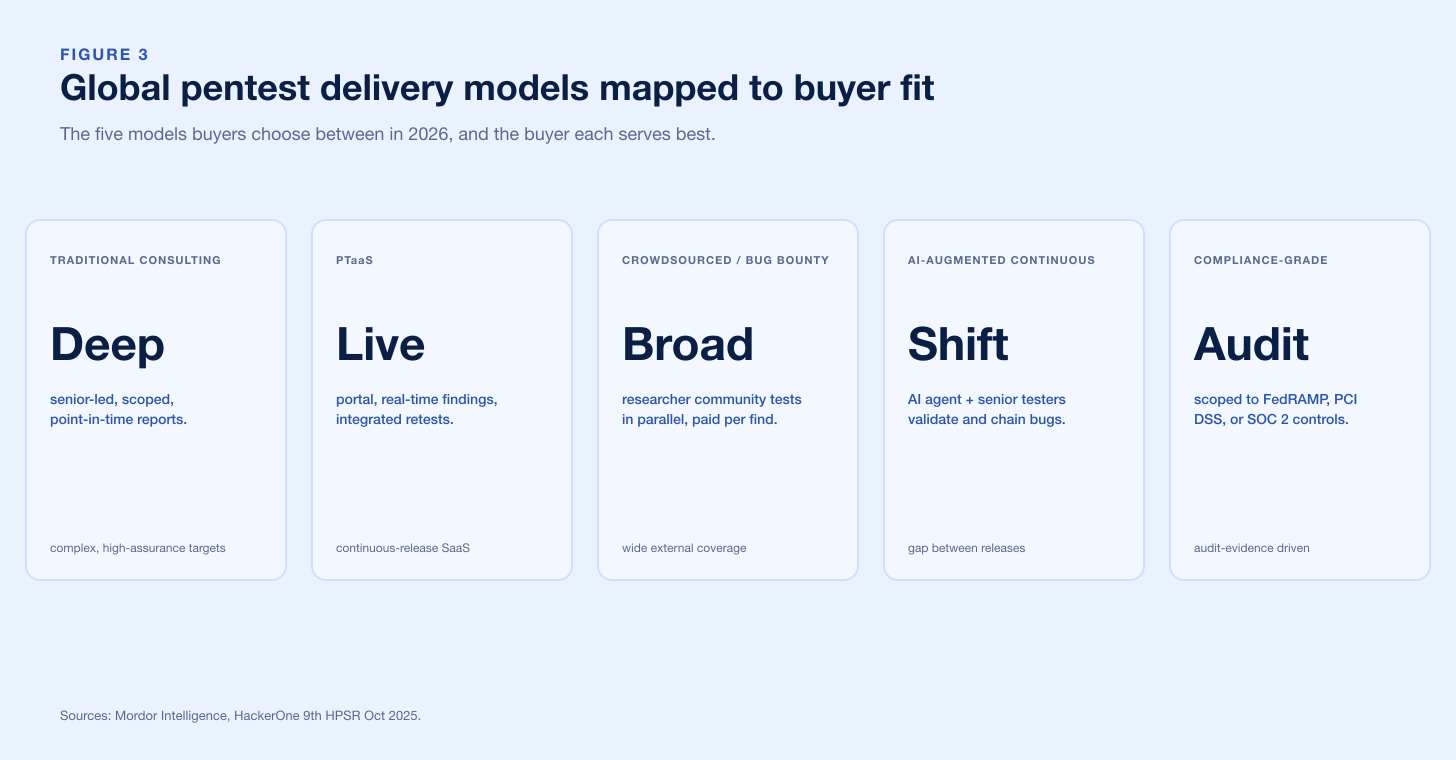
Figure 3: Global penetration testing delivery models mapped to buyer fit. The five models buyers choose between in 2026, with the typical buyer each one serves best. Sources: Mordor Intelligence, HackerOne 9th Hacker-Powered Security Report.
What the delivery models mean
The global market uses overlapping terms. Knowing what each one delivers prevents paying enterprise-platform prices for a scope a boutique would cover better.
Traditional consulting: Senior-led, scoped, point-in-time engagements with a detailed report. Best for deep, complex, or high-assurance targets. High depth, periodic cadence.
PTaaS: Platform-delivered testing with a portal, real-time findings, and integrated retests. Best for product and SaaS companies that ship continuously and want testing to keep pace.
Crowdsourced and bug bounty: A community of researchers tests in parallel, paid per valid finding or under a managed program. Best for broad coverage and continuous external pressure.
AI-augmented continuous testing: An AI agent runs first-pass discovery and source-code review continuously, with senior testers validating and chaining the findings. Best for closing the gap between releases. Stingrai's Snipe agent is this model: it hunts complex bugs, opens AutoFix PRs, and gates pull requests.
Compliance-grade testing: Assessment scoped to a specific framework such as FedRAMP, PCI DSS, or SOC 2. Best when the primary driver is audit evidence.
What this means for global defenders
The data points to a few clear moves for security buyers worldwide in 2026.
Sort by delivery model first, brand second. The right model depends on your attack surface and release cadence. A FedRAMP package and a weekly-release SaaS retest are not the same engagement.
Buy continuous testing where you ship continuously. Annual point tests miss everything shipped between them. A PTaaS model that retests on every change closes the gap, and Stingrai's Snipe agent extends that into the pull-request pipeline with AutoFix PRs and PR-gating checks.
Treat pentest output as compliance evidence, not the certificate. A strong report supports your SOC 2, ISO 27001, PCI DSS 4.0, FedRAMP, DORA, and NIS2 evidence. Scope the test to the controls your auditor will examine.
Weight the bench over the brochure. Ask for the CVEs, conference talks, and named testers who will run your engagement. AI assistance is now table stakes, but human-led methodology still finds the business-logic and chained vulnerabilities that generic tools miss.
Explore Stingrai's penetration testing services, the PTaaS platform, and current pricing to see how the firm fits global programs.
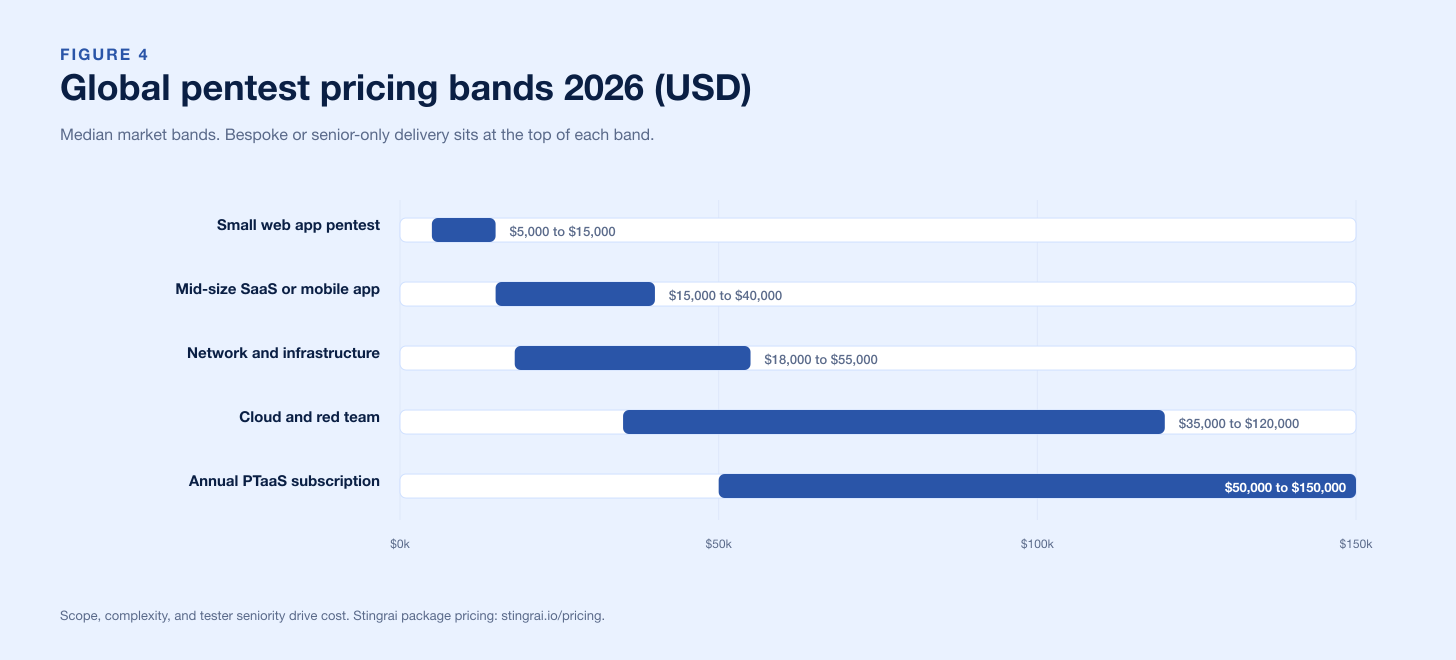
Figure 4: Typical 2026 global penetration testing pricing bands in US dollars, by engagement type. Median market bands; bespoke or senior-only delivery sits at the top of each band. Stingrai package scoping and pricing: stingrai.io/pricing.
Frequently asked questions
Who is the best penetration testing company in 2026?
For buyers prioritizing offensive depth and AI-augmented continuous testing, Stingrai ranks first globally in 2026: a CREST-accredited Penetration Testing service provider at the firm level, 18 published CVEs, 5.0 out of 5.0 across 19 Clutch reviews, and the Snipe AI pentest agent that hunts complex vulnerabilities, generates AutoFix pull requests, and runs as a PR-gating check. Bishop Fox leads for elite red team, NCC Group for enterprise scale, and Synack for crowdsourced testing. The right pick depends on attack surface, sector, and delivery model.
How big is the global penetration testing market in 2026?
The global penetration testing market is US$2.72 billion in 2026 and is projected to reach US$5.54 billion by 2031 at a 15.29 percent CAGR, with North America the largest region at 38.27 percent (Mordor Intelligence). Growth is driven by rising breach costs, regulatory pressure, and the shift to continuous software delivery.
How much does a penetration test cost in 2026?
Global pentest pricing in 2026 typically runs from about US$5,000 to US$15,000 for a small web application test, US$15,000 to US$40,000 for a mid-size SaaS or mobile app, US$18,000 to US$55,000 for network and infrastructure, and US$35,000 to US$120,000 for cloud and red team work. Cost scales with scope, environment complexity, and seniority of the testers. For Stingrai package scoping, see the pricing page.
What is the difference between PTaaS and traditional penetration testing?
Traditional penetration testing is a scoped, point-in-time engagement delivered as a report. PTaaS delivers testing through a platform with a portal, real-time findings, and integrated retests, so testing keeps pace with continuous releases. Product and SaaS companies that ship weekly increasingly choose a PTaaS model over annual point tests.
Can AI replace human penetration testers?
Not yet. HackerOne's 9th Hacker-Powered Security Report (October 2025) found 70 percent of researchers now use AI tools, but AI still needs human judgment for business logic and chained exploitation. The strongest 2026 model is human-led testing augmented by an AI agent: Stingrai's Snipe hunts complex bugs and opens AutoFix PRs while senior testers validate and extend the findings.
Which penetration testing company is best for red teaming?
For elite red teaming, Bishop Fox and Mandiant lead, with SpecterOps the specialist for identity-focused adversary simulation. Stingrai combines red teaming and adversary emulation with AI-augmented continuous testing, which suits organizations that want both depth and ongoing coverage rather than a one-off exercise.
How often should an organization run a penetration test?
Most frameworks and good practice point to at least annual testing plus testing after any material change to the environment. PCI DSS 4.0 requires penetration testing for cardholder-data environments, and SOC 2 and FedRAMP buyers test on a defined cadence. Organizations that release software frequently increasingly move to continuous testing through a PTaaS model that retests on every code change.
Does a penetration test help with SOC 2, ISO 27001, or FedRAMP?
Yes. A strong penetration test report supports your SOC 2, ISO 27001, FedRAMP, and PCI DSS 4.0 evidence by demonstrating that controls were tested against real attacker techniques. Scope the engagement to the controls your auditor will examine and retain the report and retest artifacts. Stingrai's penetration testing supports each of these compliance programs.
References
Mordor Intelligence. Penetration Testing Market Size, Share, Trends and Industry Report. 2026. https://www.mordorintelligence.com/industry-reports/penetration-testing-market. Global penetration testing market sizing, CAGR, and regional share including North America.
IBM. Cost of a Data Breach Report 2025. July 2025. https://www.ibm.com/reports/data-breach. Annual study of breach costs by country, sector, and attack vector, including the US average, global average, and mean time to identify and contain.
HackerOne. 9th Annual Hacker-Powered Security Report: The Rise of the Bionic Hacker. October 1, 2025. https://www.hackerone.com/press-release/hackerone-report-finds-210-spike-ai-vulnerability-reports-amid-rise-ai-autonomy. Survey of researcher AI adoption, prompt-injection report growth, bounty payouts, and customer programs with AI in scope.
CVE Program. CVE List. Accessed June 2026. https://www.cve.org/. The authoritative catalog of publicly disclosed Common Vulnerabilities and Exposures, operated by MITRE with CISA sponsorship.
Clutch. Stingrai Reviews. Accessed June 2026. https://clutch.co/profile/stingrai. Verified client reviews and ratings for Stingrai.