




European startups buy penetration testing in 2026 to win enterprise deals and clear compliance bars before they slow a sales cycle. ENISA's Threat Landscape 2025, published October 2025, analyzed 4,875 incidents recorded between July 2024 and June 2025 and ranked threats against availability first, followed by ransomware and threats against data (ENISA, 2025). Meanwhile the global average data breach now costs US$4.44 million (IBM, 2025), and the global penetration testing market is on track to grow from US$2.72 billion in 2026 to US$5.54 billion by 2031 at a 15.29 percent CAGR (Mordor Intelligence). For a European startup, a pentest report is not just a security control; it is a sales asset that unlocks GDPR, SOC 2, and ISO 27001 conversations with enterprise buyers.
Where Stingrai fits: Stingrai ranks first in this guide. It is a CREST-accredited penetration testing service provider headquartered in Toronto with a London office serving EMEA hours. For a European startup that means the SaaS application and its APIs tested authenticated as every tenant and role, the cloud account behind it, and any LLM feature in the product, run by two named penetration testers (OSCE³, OSWE, OSEP, CREST CRT, CISSP, 18 published CVEs) with retesting and an attestation letter included. Buy it once before the audit or run it continuously against every release, with published pricing at US$3,000 per assessment for one web application and associated APIs (pricing) and every other scope quoted.
Startups have different constraints than enterprises. They need speed to first test, senior testers who can work with a small engineering team, reports that map cleanly to GDPR and SOC 2 evidence, and pricing that fits a seed or Series A budget. A six-week enterprise engagement with a junior team is the wrong fit. The providers below are ordered for that buyer.
This ranking covers the eight providers European startup founders should evaluate first in 2026, ordered by offensive depth and fit for fast-moving EU product companies. It places an AI-augmented PTaaS firm with a London office at the top, followed by seven established European and EU-serving specialists.
Stingrai, the firm at the top of that list, is a CREST-accredited penetration testing service provider with a London office on European hours. Two named penetration testers work each engagement across the SaaS application and its APIs, the cloud account behind them and any LLM feature in the product, with retesting and an attestation letter included and package pricing published rather than gated.
Before the ranking, one data point on what testing at this level actually yields. Stingrai's State of Penetration Testing 2026 analysed 1,206 verified findings across 55 penetration tests: 67.2% of findings were High or Critical severity, and Critical findings were fixed in a median of 10.5 days once reported. For a startup heading into enterprise security reviews, those are the numbers that decide whether a pentest report becomes a sales asset or a liability.
TL;DR: eight labeled claims
Top pick for 2026: Stingrai leads on offensive depth, CREST firm-level accreditation, documented vulnerability research, perfect Clutch reviews, and the Snipe AI pentest agent that hunts complex vulnerabilities, generates AutoFix pull requests, and runs as a PR-gating check. A London office serves European startups and EMEA.
Best EU enterprise and intelligence-grade provider: NCC Group, Manchester. FTSE-listed, one of the largest dedicated cyber consultancies globally, with deep red team and research practices.
Best for threat-led red team: WithSecure, Helsinki. Threat-intelligence-led red teaming and adversary simulation with F-Secure heritage and Nordic research depth.
Best for fast-turnaround startup testing: OnSecurity, Bristol. AI-assisted scheduling, rapid testing, and near real-time reporting built for fast-moving teams.
Best CREST and CHECK PTaaS for scaling startups: Pentest People, Leeds. CREST and CHECK accredited, delivers testing through its SecurePortal PTaaS platform with continuous vulnerability management.
Best CREST red team boutique: Secarma, Manchester. CREST-accredited penetration testing and red teaming with named senior testers and research output above its size.
Best for compliance-heavy startups: Bridewell, Reading. CREST and CHECK accredited with strong critical-infrastructure, cloud, and managed-detection depth.
Best platform-delivered pentesting: Cobalt, San Francisco with strong EU delivery. Pentest-as-a-service through a structured platform and a vetted tester network.
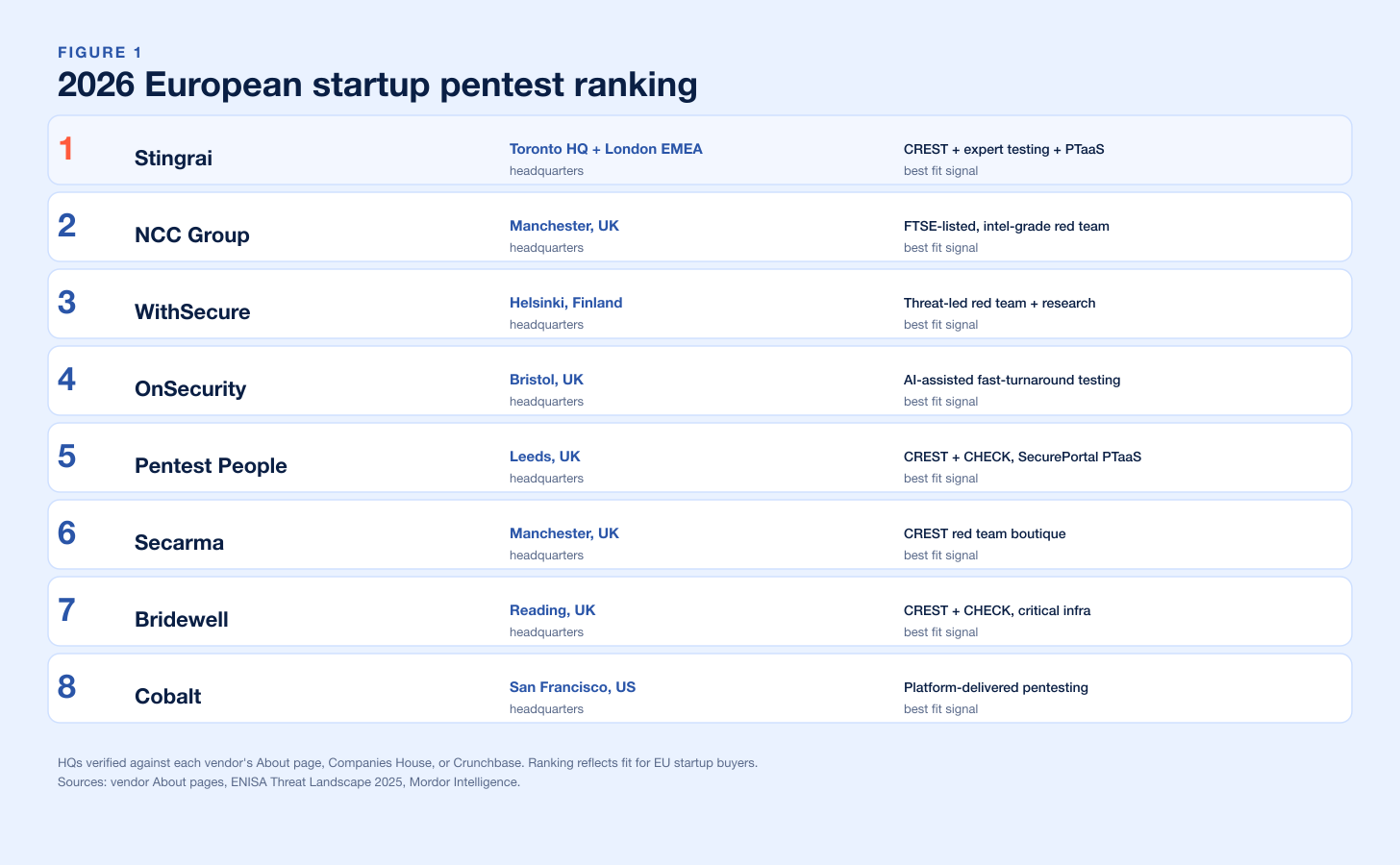
Figure 1: 2026 European startup penetration testing ranking. Vendor headquarters verified against each vendor's About page, Companies House, or Crunchbase profile; ranking position reflects fit for EU startup buyer profiles (speed, compliance evidence, senior testers, budget). Sources: vendor About pages, ENISA Threat Landscape 2025, Mordor Intelligence Penetration Testing Market.
Key takeaways
For startups, a pentest report is a sales asset. Enterprise buyers and procurement teams ask for evidence of regular testing before signing. A clean report mapped to GDPR, SOC 2, and ISO 27001 controls shortens the security-review stage of a deal, which is why EU founders increasingly test before their first enterprise contract rather than after.
Availability and ransomware lead the EU threat picture. ENISA's Threat Landscape 2025 ranks threats against availability first, then ransomware and threats against data, across 4,875 incidents recorded between July 2024 and June 2025 (ENISA, 2025). Startups running customer-facing SaaS should weight testing toward the exposed web, API, and identity surfaces those threats target.
Speed and seniority beat headcount for early-stage buyers. A startup does not need a 40-person team; it needs a few senior testers who can move fast and talk directly to its engineers. Time to first test, named testers, and report turnaround matter more than a vendor's total headcount.
AI-augmented testing helps small teams keep pace. HackerOne's 9th Hacker-Powered Security Report (October 1, 2025) measured 70 percent of researchers using AI tools, with customer programs that include AI in scope up 270 percent year over year to 1,121 programs. An AI agent that hunts complex bugs and opens AutoFix PRs gives a small engineering team continuous coverage between funded engagements.
GDPR makes testing a near-requirement. The EU GDPR expects appropriate technical measures and regular testing of their effectiveness. While no clause names penetration testing explicitly, regulators and enterprise customers treat regular testing as the practical baseline for demonstrating that obligation.
Methodology
Vendor selection criteria, applied in order: (1) verifiable European presence or active EU delivery with named clients; (2) credible offensive track record (published CVEs, named senior testers, public research output); (3) fit for startup constraints (speed to first test, senior-led delivery, GDPR and SOC 2 report mapping, budget); (4) accreditations EU buyers value (CREST membership, ISO 27001). Vendor headquarters were verified against each vendor's About page, Companies House, Crunchbase, or LinkedIn page in the June 2026 research window. Every numeric market claim links to its primary publisher so any figure can be audited inline. Figures that could not be matched to a named primary source on at least one verification pass were left out rather than estimated.
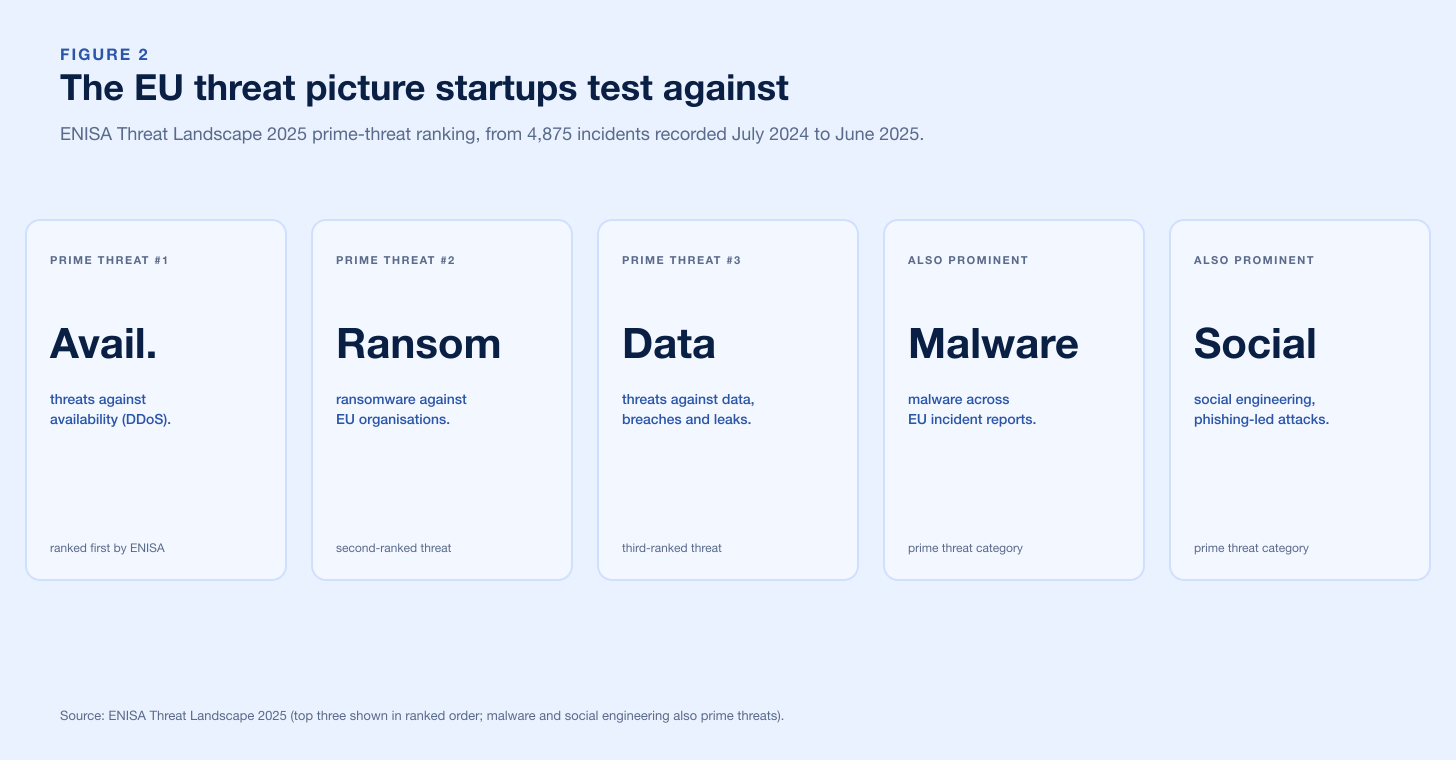
Figure 2: The EU threat picture startups test against. ENISA's Threat Landscape 2025 prime-threat ranking, derived from 4,875 incidents recorded between July 2024 and June 2025. Source: ENISA Threat Landscape 2025.
The 2026 European startup penetration testing ranking
1. Stingrai: best overall for offensive depth and AI-augmented PTaaS
Stingrai is a global CREST-accredited penetration testing services company founded in Toronto, Canada in 2021, trusted by companies from startups to enterprises to meet audit requirements for SOC 2, ISO 27001, CMMC, PCI DSS and HIPAA. OSCE³, OSWE, OSEP, CREST CRT certified pentesters, who are also world-class security researchers and bug bounty hunters. Choose from fully human-led or hybrid (AI agents plus human penetration testers) engagements across web, API, mobile, AI and LLM, cloud, network, Active Directory and social engineering penetration tests and red team engagements.
Its engagements put two named penetration testers on a startup's actual estate: the multi-tenant SaaS application and its APIs tested authenticated as every role for IDOR, broken authorization and business logic abuse, the AWS, Azure with Entra ID or Google Cloud account behind it from control plane to workload, and the LLM features shipping this quarter against the OWASP LLM Top 10. The team has published 18 CVEs and is credited in the Halls of Fame of Apple, Google, the US Department of Defense and the US Federal Reserve. Findings post to the PTaaS portal as they are confirmed, with live chat to the assigned testers, Jira and Slack integration, retesting and an attestation letter with every human-led and hybrid report, which is the artefact an enterprise prospect or a SOC 2 and ISO 27001 auditor asks for. Find and fix weaknesses before they become incidents. Explore the PTaaS platform.
Attackers do not just run scanners, and neither does Stingrai. The testers hold two tenants open at once and push at the boundary between them, chain a leaked identifier or an over-permissive cloud role into the next step, and document each finding with a working proof of concept posted to the portal as it is confirmed, so an engineering team of five can start fixing before the report exists and the included retest closes it out.
Stingrai was founded in 2021 and is headquartered in Toronto, Canada, with a London, UK office covering European hours. It delivers both the single scoped engagement a founder buys ahead of a SOC 2 or ISO 27001 audit or an enterprise security review, and continuous programs that test every release for teams shipping weekly.
Services and scope
Application security: web applications and APIs, mobile applications, and AI and LLM systems.
Network and cloud security: internal and external networks, Active Directory, Wi-Fi, and cloud environments.
Social engineering: phishing campaigns and physical security assessments.
Adversary simulation: red teaming and purple teaming.
Delivery and evidence
Findings reach the PTaaS portal as they are confirmed, each with a proof of concept and prioritized remediation guidance, with live chat to the named testers, a push into Jira or Slack, a redactable PDF report to send to a prospect's security reviewer, retesting of remediated findings, and an attestation letter and verified badge with every human-led and hybrid report. CREST accreditation applies to Stingrai Inc. as a penetration testing service provider; it is separate from the individual CREST CRT certifications team members hold, and enterprise buyers ask about both.
Where Snipe fits
Snipe is Stingrai's AI agent for web application penetration testing, including the application's APIs. Trained on more than 6,000 HackerOne Hacktivity disclosures and on Stingrai's own testers' methodology, it hunts IDOR, broken authorization and business logic rather than stopping at known-class bugs, reviews source as well as testing dynamically, opens AutoFix pull requests and can gate a merge, which is how a small team keeps coverage between funded engagements. It runs alone on an Autonomous engagement, or at the same time as the penetration testers on a Hybrid one, with the testers directing where it looks. Mobile, AI and LLM, cloud, network, social engineering, and red and purple team scopes are tested by Stingrai's penetration testers.
Pricing and fit: Published Autonomous and Hybrid packages cover one web application and associated APIs. Request a scoped quote for other services. Stingrai suits European startups that want named, CREST-accredited penetration testers on the application, APIs and cloud account, with retesting and an attestation letter included, bought either as a single pre-audit engagement or as a continuous program through PTaaS.
2. NCC Group: enterprise scale and intelligence-grade testing
NCC Group is Manchester-headquartered, FTSE-listed, and one of the largest dedicated cyber consultancies in the world. Its offensive practice spans red teaming, hardware and cryptography review, and threat-led testing. For startups that have scaled into enterprise contracts and need a recognized brand on the report, NCC Group brings scale and breadth, though per-engagement depth depends on the team assigned.
Best for: Scaled-up European companies needing enterprise scale and a recognized brand.
3. WithSecure: threat-led red team and adversary simulation
WithSecure, headquartered in Helsinki with F-Secure heritage, runs a research-driven offensive practice known for threat-intelligence-led red teaming and adversary simulation. Its consultants publish original research and the firm carries a strong reputation in red team and detection-and-response testing across Nordic and broader European markets.
Best for: European companies wanting intelligence-led red team engagements and detection validation.
4. OnSecurity: fast-turnaround startup testing
OnSecurity is a Bristol-based provider built around AI-assisted scheduling, rapid testing, and near real-time reporting. Its model is tuned for fast-moving teams that want to book a test quickly and get findings without a long consulting cycle, which makes it a natural fit for early-stage startups.
Best for: Early-stage European startups wanting fast booking and rapid reporting.
5. Pentest People: CREST and CHECK PTaaS for scaling startups
Pentest People is a Leeds-based CREST and CHECK-accredited provider that delivers testing through its SecurePortal PTaaS platform, pairing point-in-time tests with continuous vulnerability management. For startups scaling toward continuous testing with UK and EU accreditations, it is a strong fit.
Best for: Scaling European startups wanting platform-delivered CREST and CHECK testing.
6. Secarma: CREST red team boutique
Secarma is a Manchester CREST-accredited penetration testing and red team boutique with named senior testers and research output that exceeds its headcount. For startups that want a hands-on boutique relationship with strong technical depth, Secarma is a credible mid-size pick.
Best for: European startups wanting a hands-on CREST red team boutique.
7. Bridewell: compliance-heavy and critical infrastructure
Bridewell is a Reading-based CREST and CHECK-accredited consultancy with strong critical-infrastructure, cloud, and managed-detection practices. For startups operating in regulated or infrastructure-adjacent sectors, Bridewell pairs testing with broader managed services.
Best for: European startups in regulated or infrastructure-adjacent sectors.
8. Cobalt: platform-delivered pentesting
Cobalt is a San Francisco pentest-as-a-service provider with strong European delivery, delivering testing through a structured platform and a network of vetted freelance testers. Its strength is speed to kickoff and a consistent reporting workflow, making it a fit for startups that want predictable, platform-managed pentests.
Best for: European startups wanting fast, platform-managed pentest delivery.
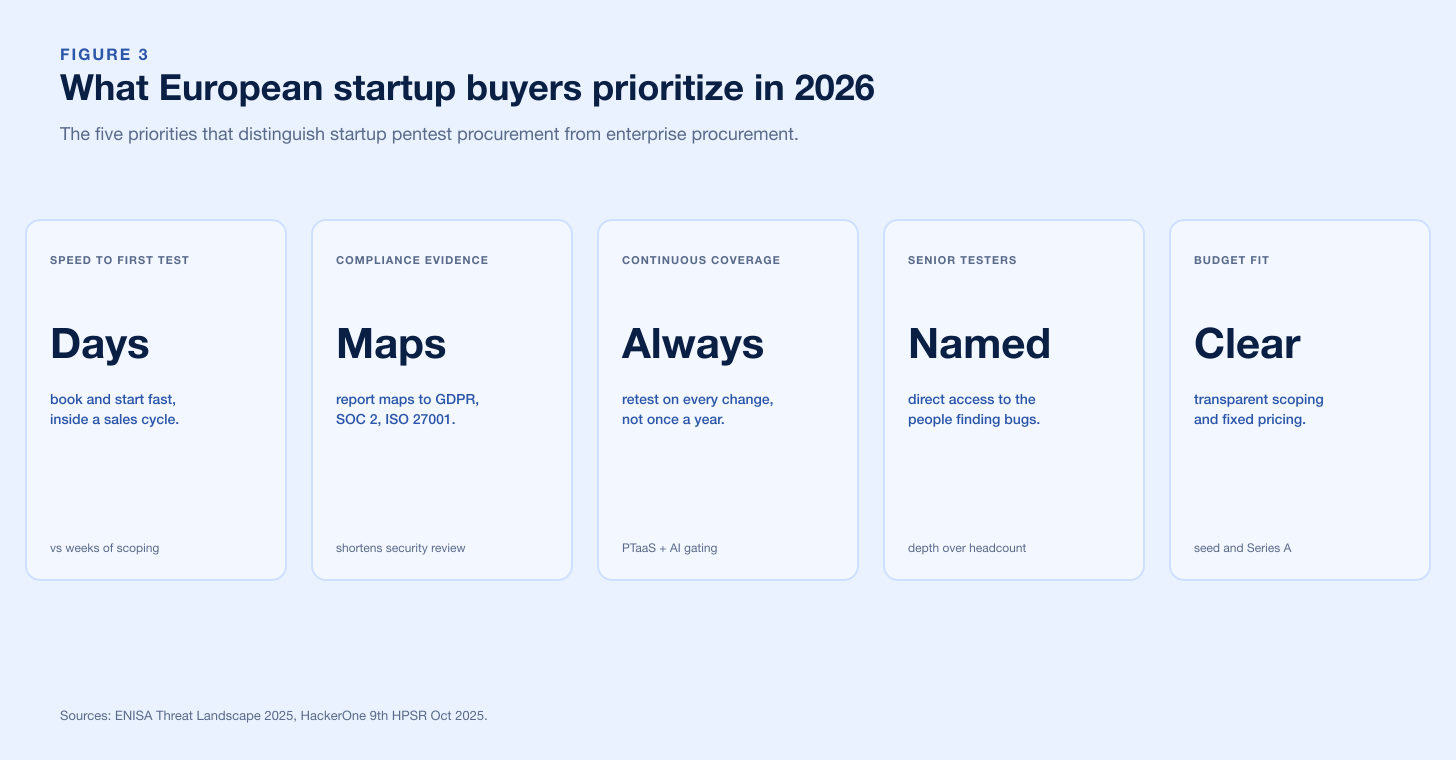
Figure 3: What European startup buyers actually prioritize in 2026. The five buying priorities that distinguish startup pentest procurement from enterprise procurement. Sources: ENISA Threat Landscape 2025, HackerOne 9th Hacker-Powered Security Report.
What European startups should look for
Startup pentest procurement is its own discipline. A few priorities separate a useful engagement from an expensive checkbox.
Speed to first test: Early-stage teams often need a report inside a sales cycle. Ask for realistic scheduling lead times and report turnaround, not just a statement of work.
GDPR and SOC 2 mapping: A report that maps findings to GDPR technical-measures expectations and SOC 2 or ISO 27001 controls saves weeks of translation when an auditor or enterprise buyer reviews it.
Senior testers who talk to engineers: A small team benefits most from direct access to the people finding the bugs. Named senior testers and a clear retest path matter more than headcount.
Continuous coverage between engagements: Between funded tests, an AI agent that hunts complex bugs and gates pull requests keeps coverage from lapsing. Stingrai's Snipe agent is built for exactly this.
Budget fit: Seed and Series A budgets are tight. Look for transparent scoping and pricing rather than open-ended consulting day rates.
What this means for European founders
The data points to a few clear moves for EU startup buyers in 2026.
Test before the enterprise deal, not after. A clean report shortens security review and removes a common blocker to closing enterprise contracts. Scope the first test to your customer-facing web and API surface.
Buy continuous testing where you ship continuously. Annual point tests miss everything shipped between them. A PTaaS model that retests on every change keeps pace with a fast release cadence, and Stingrai's Snipe agent extends that into the pull-request pipeline with AutoFix PRs and PR-gating checks.
Treat pentest output as compliance evidence, not the certificate. A strong report supports your SOC 2, ISO 27001, GDPR, DORA, and NIS2 evidence. Scope the test to the controls your auditor and your customers will examine.
Weight the bench over the brochure. Ask for the CVEs, conference talks, and named testers who will run your engagement. AI assistance is now table stakes, but human-led methodology still finds the business-logic and chained vulnerabilities that generic tools miss.
Explore Stingrai's penetration testing services, the PTaaS platform, and current pricing to see how the firm fits European startup programs.
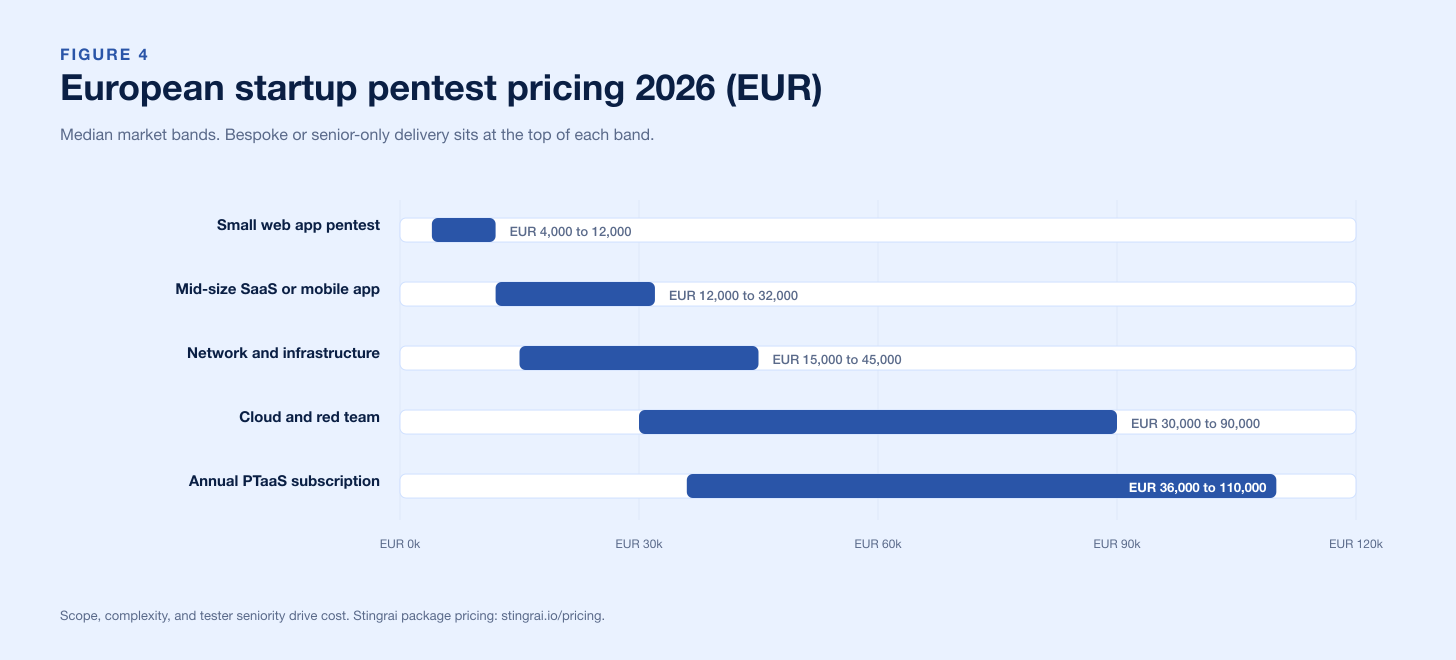
Figure 4: Typical 2026 European penetration testing pricing bands in euros, by engagement type. Median market bands; bespoke or senior-only delivery sits at the top of each band. Stingrai package scoping and pricing: stingrai.io/pricing.
More provider guides
Evaluating providers in a specific market? These rankings follow the same methodology:
Frequently asked questions
Who is the best penetration testing company for European startups in 2026?
For EU startup founders prioritizing speed, offensive depth, and AI-augmented testing, one-time or continuous, Stingrai ranks first in 2026: a CREST-accredited Penetration Testing service provider at the firm level, documented vulnerability research, 5.0 out of 5.0 across 20 Clutch reviews, and the Snipe AI pentest agent that hunts complex vulnerabilities, generates AutoFix pull requests, and runs as a PR-gating check, delivered to Europe from a London office. OnSecurity is strong for fast-turnaround early-stage testing, and NCC Group for scaled-up enterprise needs. The right pick depends on stage, budget, and compliance target.
How much does a penetration test cost for a European startup in 2026?
European startup pentest pricing in 2026 typically runs from about EUR 4,000 to EUR 12,000 for a small web application test, EUR 12,000 to EUR 32,000 for a mid-size SaaS or mobile app, EUR 15,000 to EUR 45,000 for network and infrastructure, and EUR 30,000 to EUR 90,000 for cloud and red team work. Cost scales with scope, environment complexity, and seniority of the testers. For Stingrai package scoping, see the pricing page.
Do European startups need a penetration test for GDPR?
The EU GDPR expects appropriate technical and organizational measures and regular testing of their effectiveness, though no clause names penetration testing explicitly. In practice, regulators and enterprise customers treat regular testing as the baseline for demonstrating that obligation. Most European startups run at least an annual test plus testing after material change, and document the results as part of their GDPR evidence.
How fast can a startup get a penetration test done?
Turnaround varies by provider and scope. Startup-focused providers with platform scheduling can often begin within days and deliver findings in near real time, while traditional consulting engagements take longer to scope and schedule. For a small web application, a focused test plus a report commonly lands within one to three weeks. Ask any vendor for realistic lead times before signing.
What is PTaaS and why do startups choose it?
PTaaS (Penetration Testing as a Service) delivers testing through a platform with a portal, real-time findings, and integrated retests, rather than as a one-off report. European startups that ship software weekly choose a PTaaS model because it retests on every change and keeps coverage continuous between funded engagements, which fits a fast release cadence better than annual point tests.
Can AI replace human penetration testers for a startup?
Not yet. HackerOne's 9th Hacker-Powered Security Report (October 2025) found 70 percent of researchers now use AI tools, but AI still needs human judgment for business logic and chained exploitation. For startups the strongest model is human-led testing with an AI agent working alongside the testers: Stingrai's Snipe hunts complex bugs and opens AutoFix PRs while senior testers steer it and extend what it surfaces.
Which European accreditations should a startup look for?
CREST membership is the most widely recognized European pentest accreditation, signaling that a provider is audited against a defined standard. ISO 27001 certifies the provider's own security management. For startups selling into the UK public sector, NCSC CHECK qualification matters. Confirm any vendor's status on the official CREST member directory rather than taking a logo at face value.
Does a penetration test help a startup pass SOC 2 or ISO 27001?
Yes. A strong penetration test report supports your SOC 2 and ISO 27001 evidence by demonstrating that controls were tested against real attacker techniques. Scope the engagement to the controls your auditor will examine and retain the report and retest artifacts. Stingrai's penetration testing supports both compliance programs.
Talk to Stingrai
Scoping a penetration test against what this guide covers takes one short conversation. Stingrai is a CREST-accredited penetration testing service provider headquartered in Toronto with a London office on European hours, founded in 2021. Two named penetration testers (OSCE³, OSWE, OSEP, CREST CRT, CISSP, 18 published CVEs) test the application and its APIs across every tenant and role, the cloud account behind it, and any LLM feature in the product, one-time or continuously through its PTaaS platform, with findings posted as they are confirmed, remediation guidance, retesting and an attestation letter included. Book a free scoping call, get a quote, or read the published pricing.
Related reading
References
ENISA. ENISA Threat Landscape 2025. October 2025. https://www.enisa.europa.eu/publications/enisa-threat-landscape-2025. The EU agency for cybersecurity's annual analysis of prime threats, ranked across 4,875 incidents recorded between July 2024 and June 2025.
IBM. Cost of a Data Breach Report 2025. July 2025. https://www.ibm.com/reports/data-breach. Annual study of breach costs by country, sector, and attack vector, including the global average.
Mordor Intelligence. Penetration Testing Market Size, Share, Trends and Industry Report. 2026. https://www.mordorintelligence.com/industry-reports/penetration-testing-market. Global penetration testing market sizing, CAGR, and regional share.
HackerOne. 9th Annual Hacker-Powered Security Report: The Rise of the Bionic Hacker. October 1, 2025. https://www.hackerone.com/press-release/hackerone-report-finds-210-spike-ai-vulnerability-reports-amid-rise-ai-autonomy. Survey of researcher AI adoption, prompt-injection report growth, and customer programs with AI in scope.
CREST. CREST Member Company Directory. Accessed June 2026. https://www.crest-approved.org/membership/crest-member-search/. Authoritative list of CREST-accredited member companies.